Author Archives: Sarah Maddox

Koel cuckoo wearing the midnight
The Koel cuckoos are back! They migrate to our region of eastern Australia in spring, and go back up north in autumn. You know they’re there because of their loud call: coo-eee, coo-ee. It’s less often that you manage to see one, as they tend to stay high up in the trees and make use of the foliage to hide from other birds.
This male Koel spent a few minutes in a relatively exposed position on the street where I live:
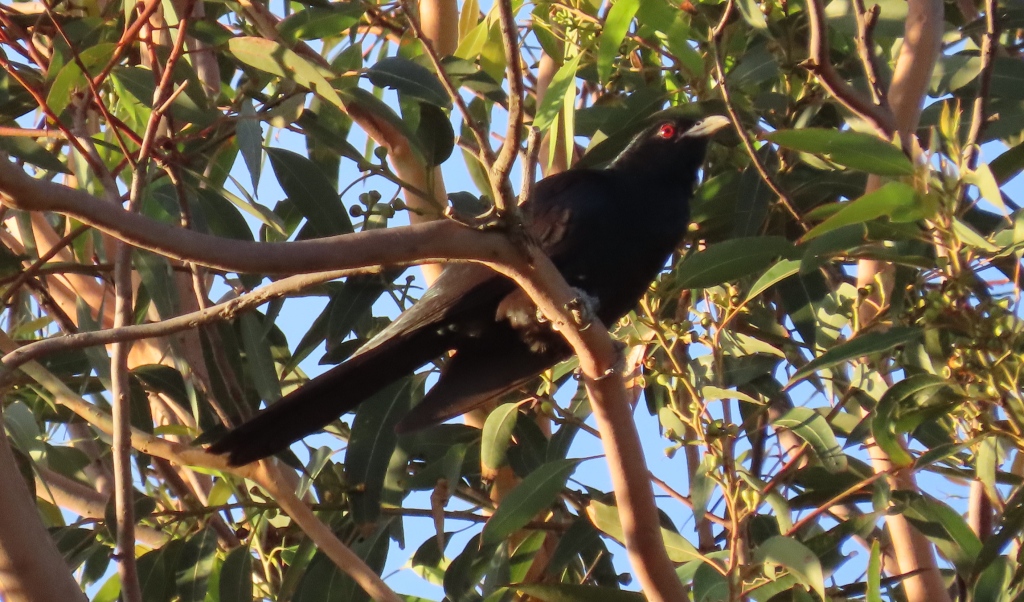
The males are entirely black, with bright red eyes and a pale beak. Like other cuckoos, the females lay their eggs in the nests of other birds (mostly wattle birds and friar birds). The cuckoo then abandons the egg and leaves it up to the foster parents to bring up the chick.
My earlier posts name this bird as a Common Koel (Eudynamys scolopacea). I’ve discovered recently that Koel cuckoos were recently reclassified as Pacific Koels (Eudynamys orientalis).
Common name: Pacific Koel or Eastern Koel
Scientific name: Eudynamys orientalis (was scolopacea)
Approximate length: 45 cm
Date spotted: 19 January 2024 (summer)
Location: Allambie Heights (north of Sydney) New South Wales, Australia

Water Dragon lurking under water (mostly)
Australian Water Dragons (Intellagama lesueurii) are large dragon lizards, reaching a length of more than two metres. You’ll often spot them close to creeks and other bodies of water (hence the name, Water Dragon). Sometimes, you’ll see them actually in the water:
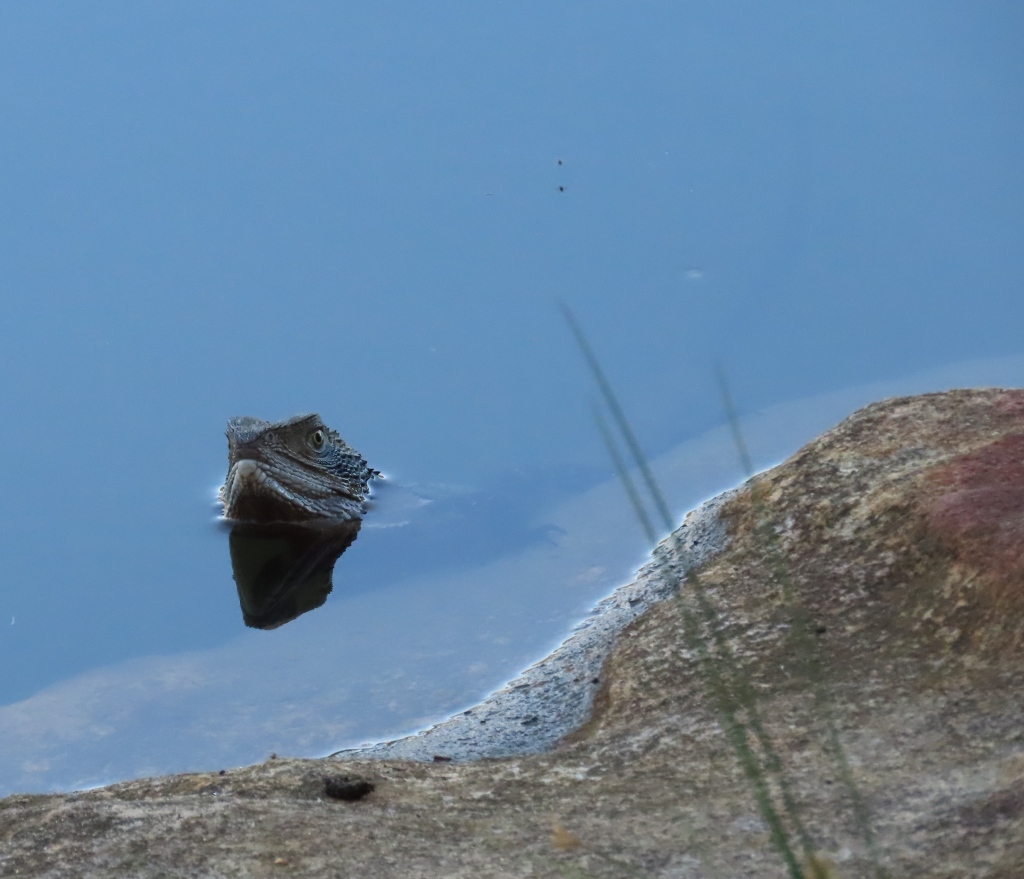
They can stay under water for an hour before coming up to breathe! From a distance, their heads are easy to mistake for a piece of log sticking up. As you draw closer, the rest of the body becomes clearer. This is a different dragon in a nearby spot:

They’re completely at home on the land too. When you approach them, they tend to stay still, pretending to be a tree stump, until you get too close.

Water Dragons eat insects, fruit, and flowers.
A few days ago, I came across a Water Dragon that had spotted a piece of litter (a wet tissue or picnic wipe) and was nosing it when I came along. The video shows the dragon’s characteristic side-to-side gait as it moves away from the litter. (I picked up the litter and took it away.)

Magpie-lark nest with chicks
A couple of days ago, I spotted a Magpie-lark having a quick cicada snack. Today, back in the same area of Manly Dam, there was more activity in the Magpie-lark community. It turns out that the birds have a nest nearby, and the adults are busily feeding the chicks.
In this video, the chicks’ heads pop up when the adult arrives to feed them. When the adult leaves, the babies stretch the necks, begging for more.
As you can tell, the nest was quite far away from my vantage point, and my camera’s zooming powers are stretched to the utmost. Still, you can see what’s happening.
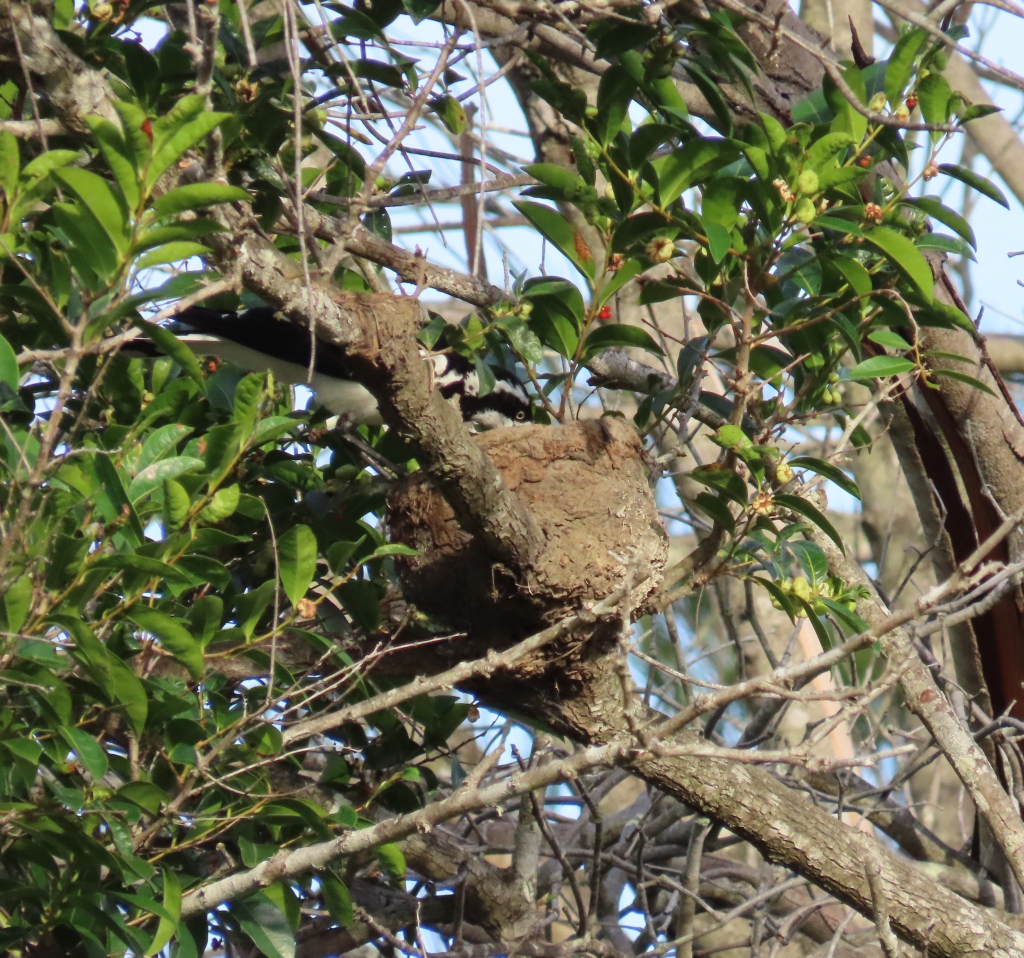
Here’s a still shot of the nest with an adult Magpie-lark peering down into it. The adult is a female, as it has a white throat. You can see the white underbelly of the bird towards the left, the black wings above, and then, on the right of the branch, the black-and-white head with the bird’s eye just above the rim of the nest:
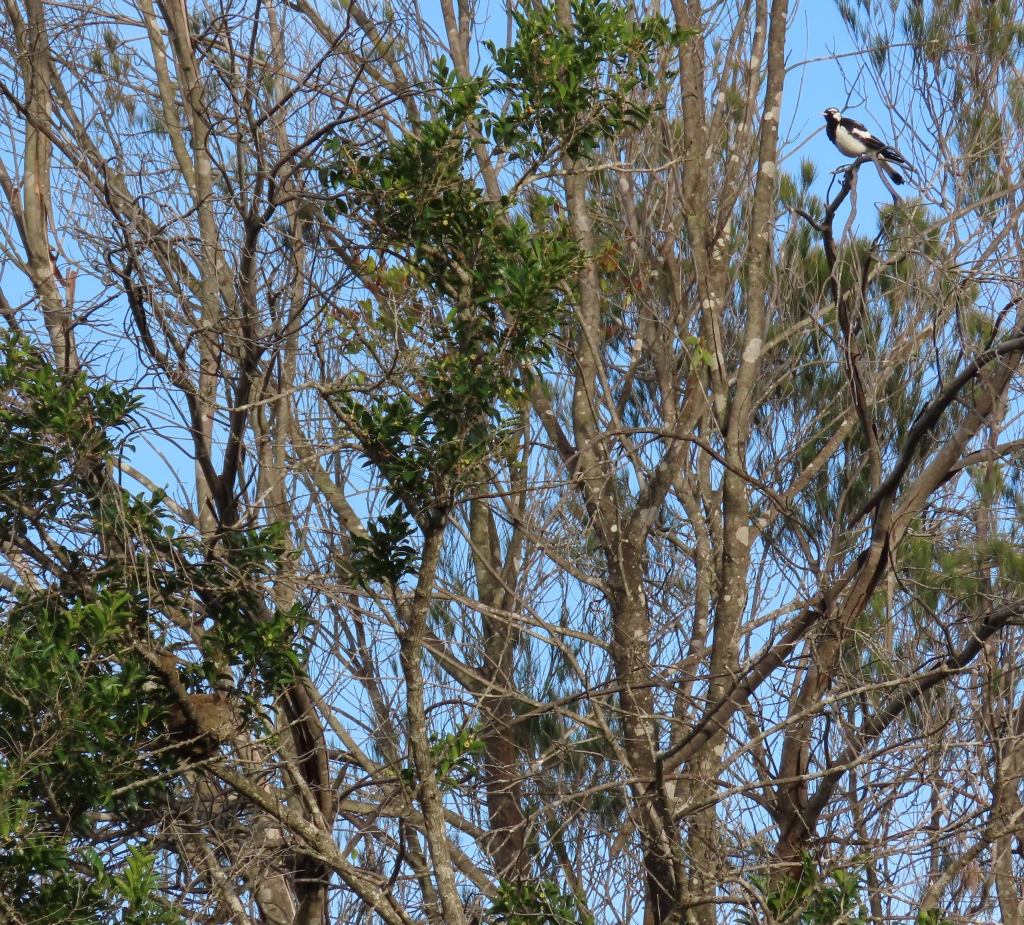
Gathering food and feeding babies is hard work. The adults often take a breather within sight of the nest, but out of sight of the babies, so that the babies don’t squawk for food. Here’s a male adult (black throat) at top right of the photo, with the nest near the bottom left:
Here’s a closeup of the adult taking a breather:
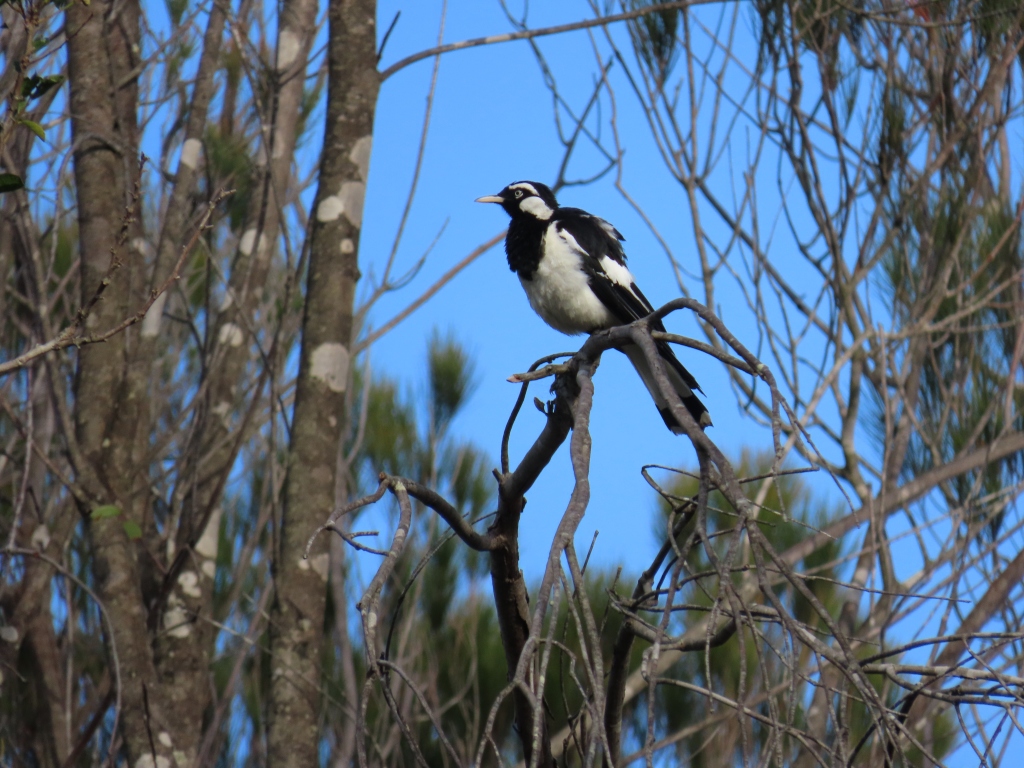
Common name: Magpie-lark, also called a Peewee or a Mudlark
Scientific name: Grallina cyanoleuca
Approximate length: 30 cm
Date spotted: 7 January 2024 (summer)
Location: Manly Dam National Park, New South Wales, Australia: 33°46’35.5″S 151°14’50.3″E
Magpie-lark eating a cicada
Magpie-larks are quite striking to look at, with their clear black-and-white markings and their strangely light-coloured eyes. This one caught my attention because it had captured a large insect and was making a good meal of it. The insect is an interesting yellowish pink colour. I think it’s a cicada, most likely the yellow variation of a Green Grocer cicada:
The name Magpie-lark is rather confusing. This bird isn’t a magpie or a lark. I guess the “magpie” part of the name comes from the black and white colouring. I don’t know where the “lark” part comes from.
Evidently Magpie-larks, like their namesake magpies, do swoop at humans to protect their territory. Luckily that hasn’t happened to me yet.
This bird is a male. It has a black throat, whereas the female has a white throat.
Common name: Magpie-lark, also called a Peewee or a Mudlark
Scientific name: Grallina cyanoleuca
Approximate length: 30 cm
Date spotted: 5 January 2024 (summer)
Location: Manly Dam National Park, New South Wales, Australia: 33°46’35.5″S 151°14’50.3″E

Oriental Dollarbird surveying the world
It’s been a while since I last managed to photograph a Dollarbird. They tend to spend their time very high up on tall trees or poles, silhouetted against the harsh Australian sky. It was a delight to see one a little lower down in a bushy wetland.

Oriental Dollarbirds are migratory. We see them near Sydney, on the east coast of Australia, in the summer months. They spend the winter up north, in New Guinea and surrounding islands.
They’re quite pretty when you see them up close, dark with a blue-green sheen on their feathers. Their large heads tend to make them look cute and cuddly. They also have a gently curved beak, with the tip outlined in black , which adds a touch of nobility.

The bird changed position, and we can now see the blue-green colouring on its back too:
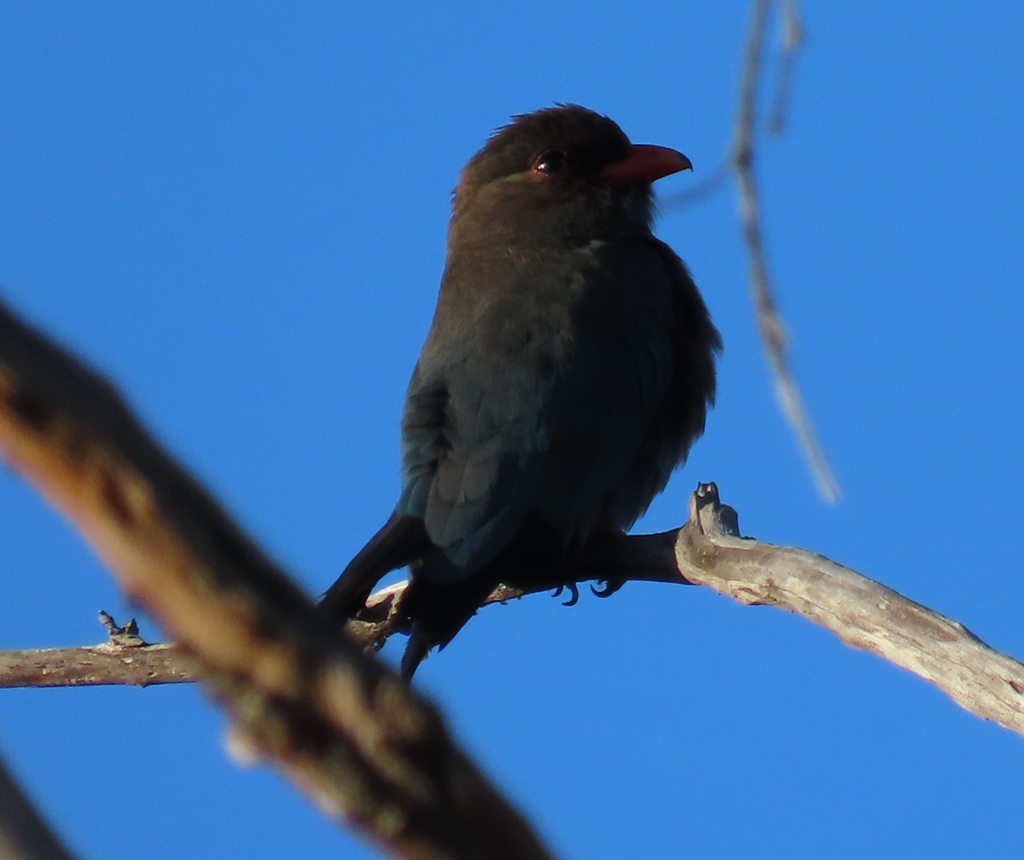
Common name: Dollarbird
Scientific name: Eurystomus orientalis
Approximate length: 27 cm
Date spotted: 30 December 2023 (summer)
Location: Manly Dam Park, NSW, Australia: 33°46’21.4″S 151°14’32.7″E

Rainbow Lorikeet
A brightly coloured Rainbow Lorikeet posed in the early morning light:

Common name: Rainbow Lorikeet
Scientific name: Trichoglossus haematodus
Approximate length: 30 cm
Date spotted: 1 January 2024 (summer)
Location: Dobroyd Head, Sydney Harbour, Australia: 33°48’38.6″S 151°16’05.4″E

Red-whiskered Bulbul with view of Sydney Harbour
Red-whiskered Bulbuls are native to southern Asia (India, Myanmar, Laos, Cambodia, Vietnam, and Malaysia), and were introduced into Sydney in the late 1800s. They’re found mostly around the inhabited areas, rather than in the more remote countryside.
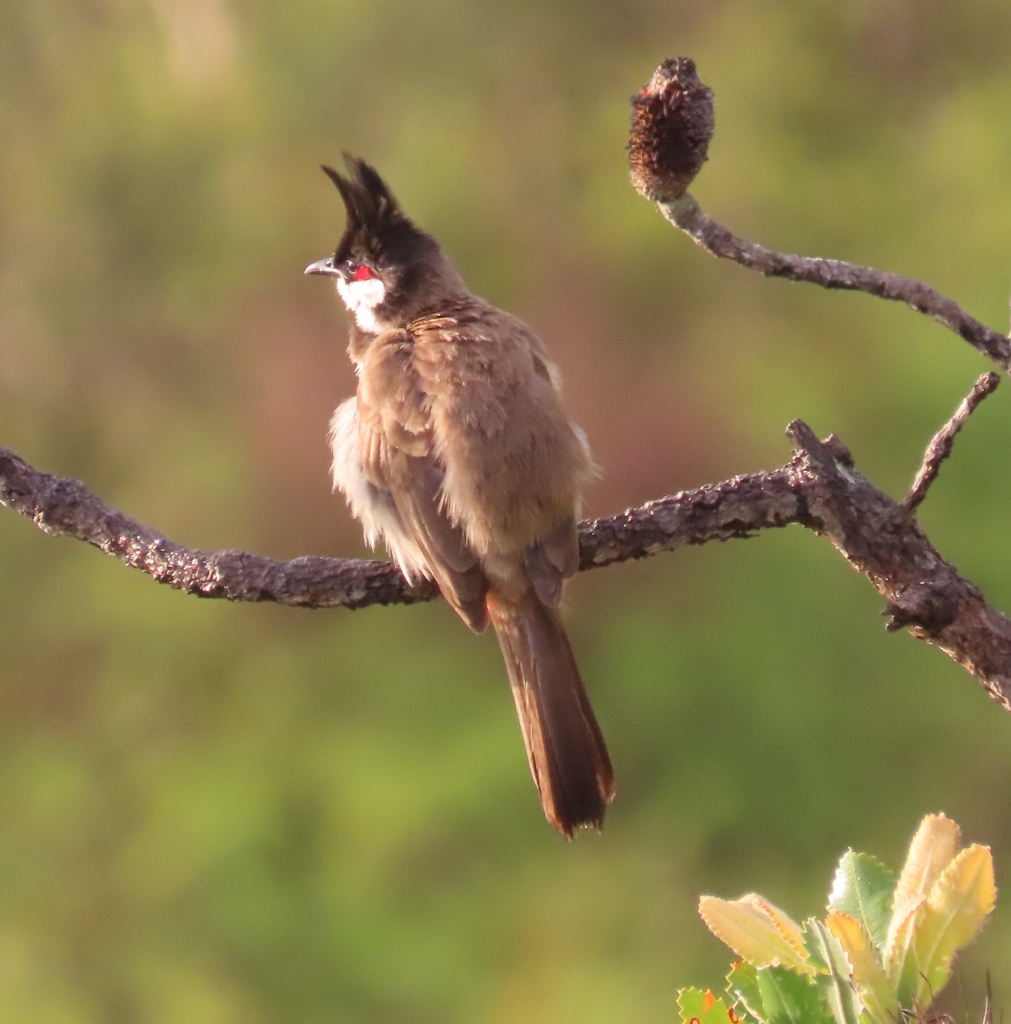
It’s a pretty little bird, with striking black, red, and white markings. In this picture, the tall crest on its head seems to be divided into two parts, a little like horns.
The next photo includes the Banksia bush that the bird is sitting on and the dense vegetation around the bird:
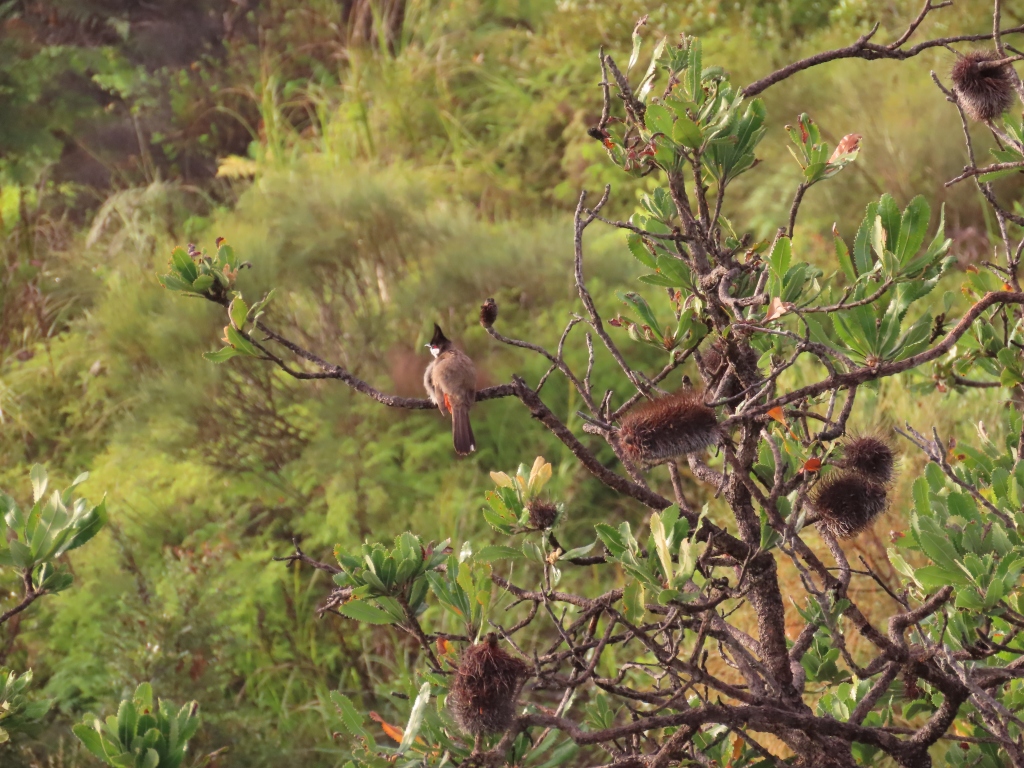
This is the second time I’ve spotted a Red-whiskered Bulbul in this area of Sydney Harbour, on a promontory called Dobroyd Head. The bird has certainly picked a spot with a view! The next video focuses on the bird, then zooms out to show the steep hill descending to Sydney Harbour. In the distance is the opening that leads from the harbour to the ocean.
Common name: Red-whiskered Bulbul
Scientific name: Pycnonotus jocosus
Approximate length: 20 cm
Date spotted: 1 January 2024 (summer)
Location: Dobroyd Head, Sydney Harbour, Australia: 33°48’38.6″S 151°16’05.4″E

Brown Thornbill in the rain
This is my first recording of a Brown Thornbill. They’re tiny little birds (about 10 cm long from tip of beak to end of tail) that spend their time in the middle-to-low area of a forest. This one was dodging raindrops in search of insects:
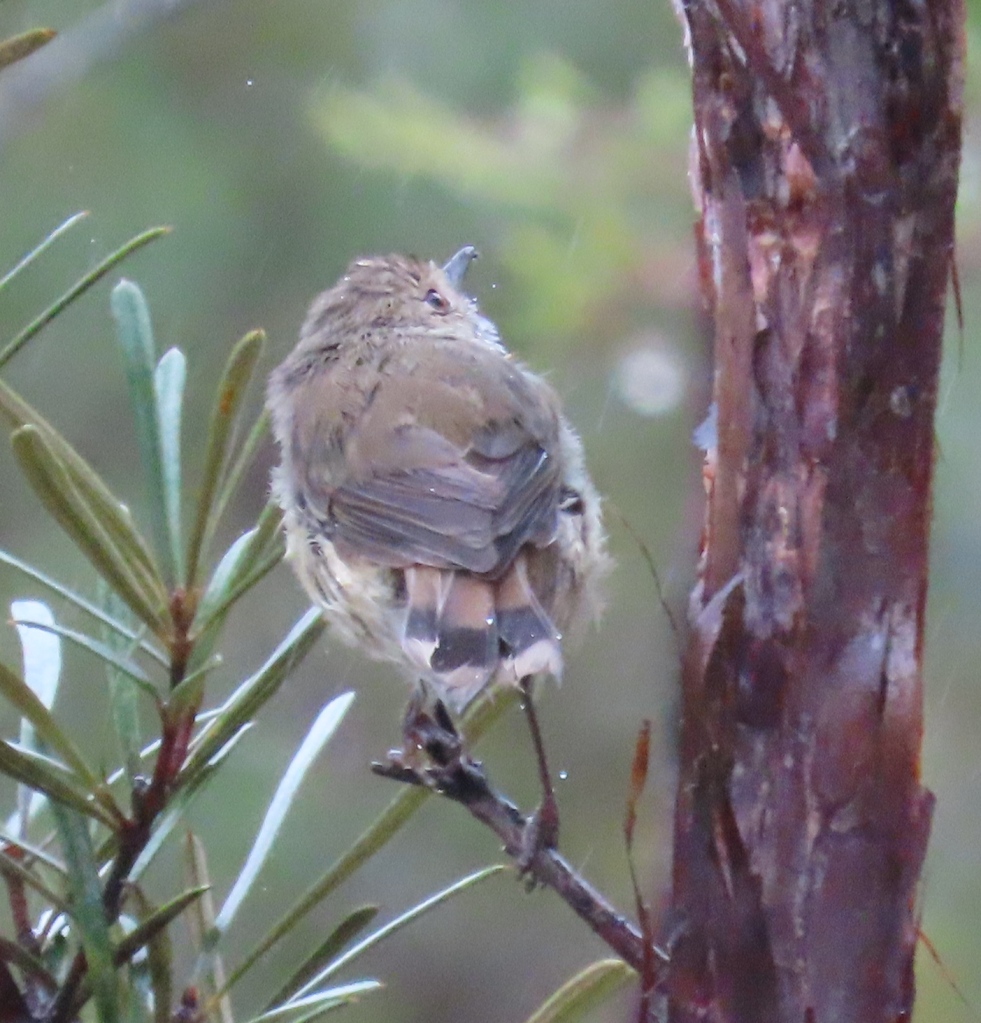
Brown Thornbills have a soft colouring of light brown to fawn, with darker edges to the tail and wings. The chin, throat and breast have light grey speckles:
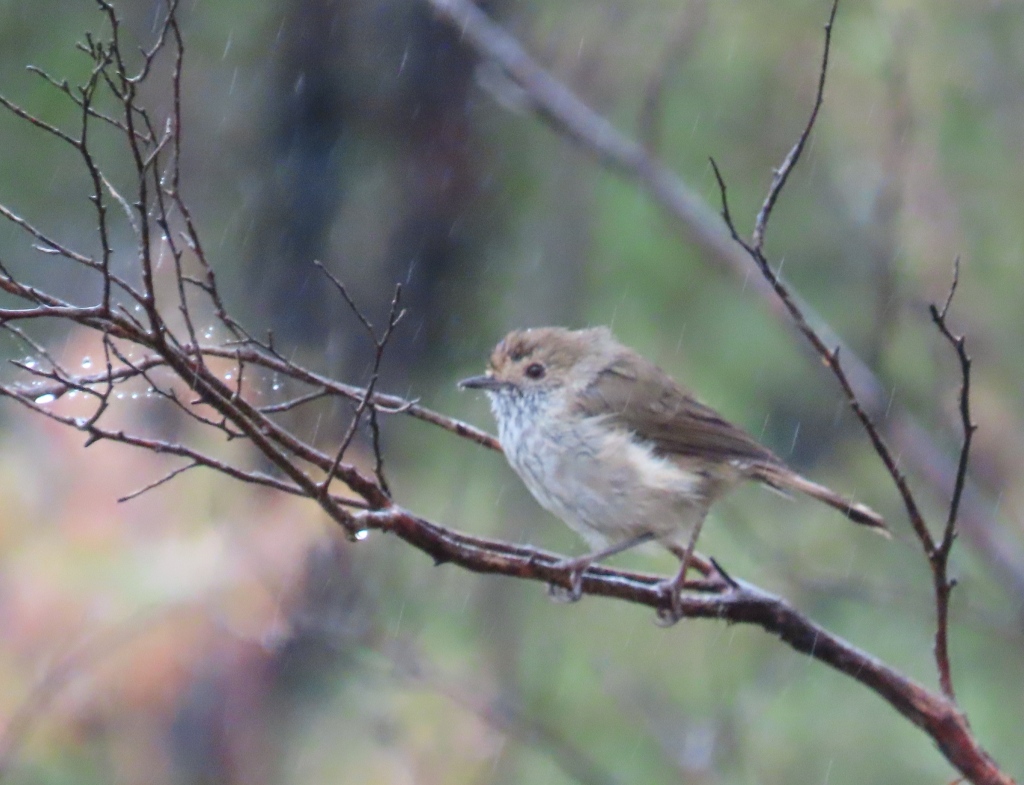
The little bird puffed itself up to ward off the cold and wet, much as I was doing by huddling in my cosy warm jacket.

Common name: Brown Thornbill
Scientific name: Acanthiza pusilla
Length: 9.5-10.5 cm
Date spotted: Sunday 31 December 2023 (summer)
Location: Blue Mountains National Park, New South Wales, Australia: 33°33’58.9″S 150°20’40.8″E

Sacred Kingfisher dives on a robin
This morning, I was trying to get a good photo of this Eastern Yellow Robin:

The robin took flight and I followed it with my camera. Suddenly, a splash of bright colours dived at the robin, there was a flurry of dust and a soft thunk, and the robin took cover in the low bushes. A kingfisher had taken umbrage with the robin! Or perhaps the two birds had simply made a beeline for the same tasty-looking insect.
The kingfisher perched nearby to check for other interlopers, or perhaps to recover from the mid-air collision:
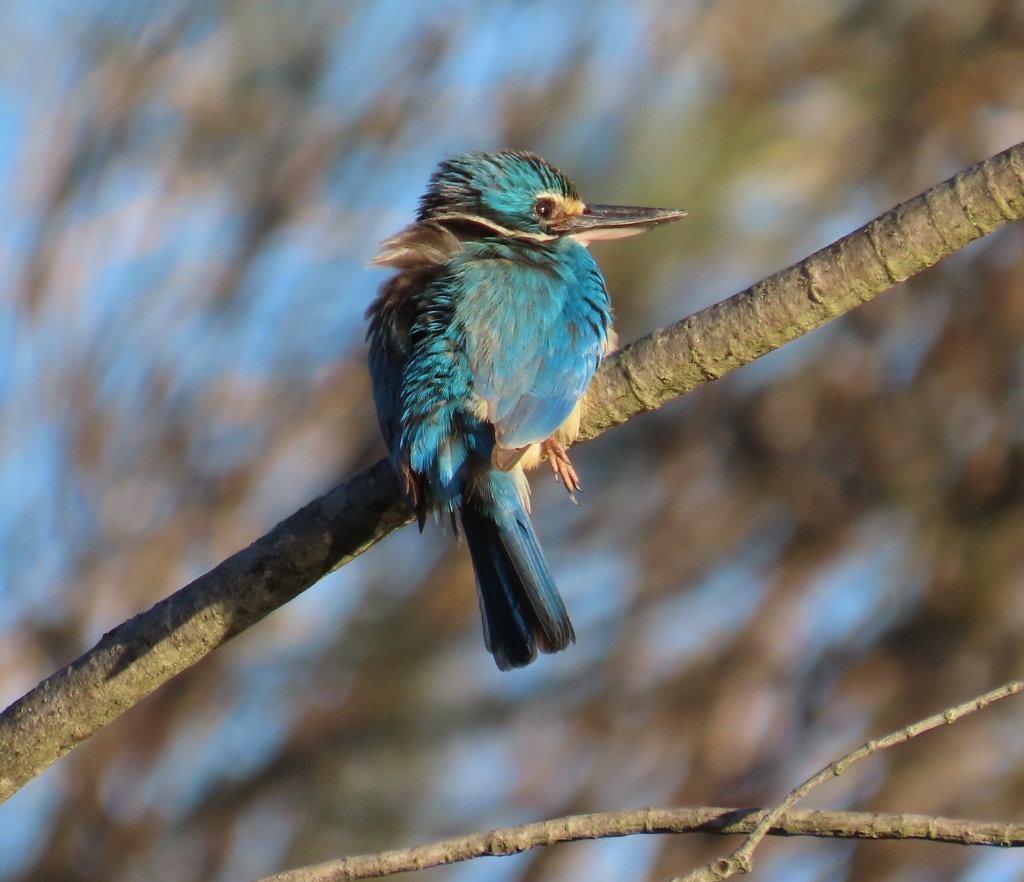
I think it’s a Forest Kingfisher, but it could be a Sacred Kingfisher. They’re very similar, but the Sacred Kingfisher is usually more green in colour.
Update on 31 December: Thank you to Andrew for the comment below, identifying the bird as a Sacred Kingfisher.
Here’s another view of the bird:
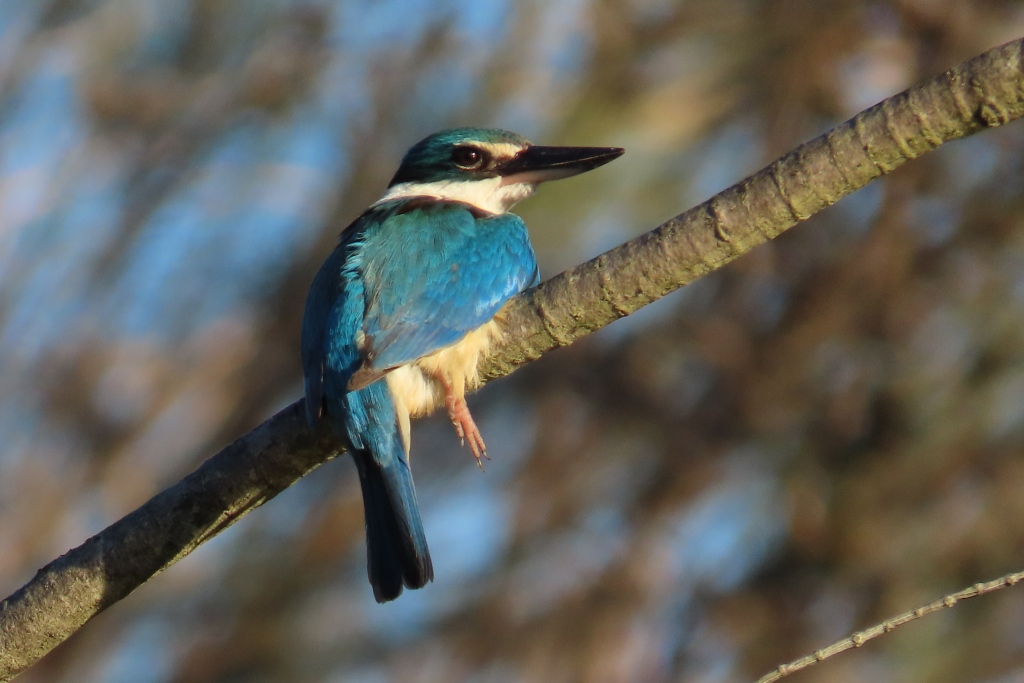
It’s interesting to see how the kingfisher seems to rest on its stomach, with its foot hanging down alongside the branch. Perhaps it’s perching on the other leg.
The next photo shows the strong blue colouring of the bird in the bright sunlight:

Common name: Sacred Kingfisher
Scientific name: Todiramphus sanctus
Length: 20-23 cm
Date spotted: Saturday 30 December 2023 (summer)
Location: Manly Dam Park, New South Wales, Australia: 3°46’31.2″S 151°14’46.6″E

Little Black Cormorant swimming underwater
Today I managed to catch some footage of a Little Black Cormorant swimming in a quiet offshoot of the Hawkesbury River.
We were at Akuna Bay in the Ku-ring-gai Chase National Park. The bay is home to a marina, with boats and jetties and restaurants, yet it was quiet and peaceful when we were there.
This is a still shot of the cormorant under the water:

Little Black Cormorants are one of five types of cormorants found in Eastern Australia. I don’t have many photos of them yet. As well as being entirely black, Little Black Cormorants are distinguishable by their bright green eyes. The next photo gives some idea of the eye colour, though it’s rather blurry:

Common name: Little Black Cormorant (see other cormorants)
Scientific name: Phalacrocorax sulcirostris
Approximate length: 65 cm
Date spotted: 29 December 2023 (summer)
Location: Ku-ring-gai Chase National Park, New South Wales, Australia: 33°38’46.1″S 151°14’04.9″E
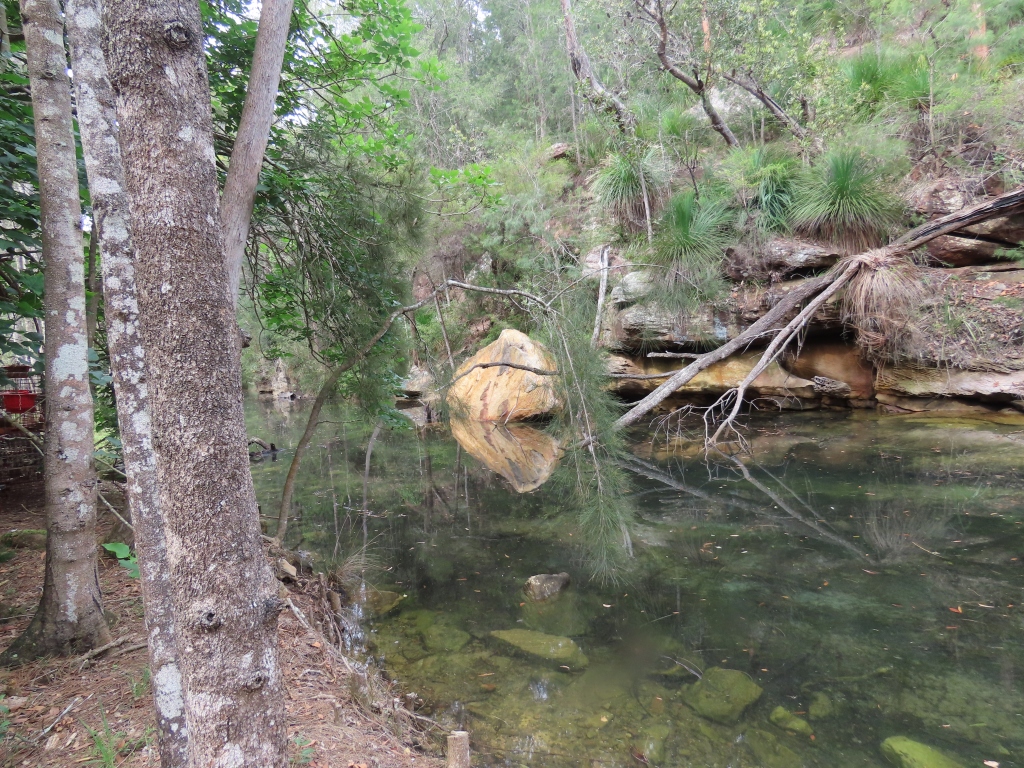
The creek was still and smooth. A haven for mosquitoes, alas, but pretty too:
Here’s a rare picture of me examining another part of the creek:


 Sydney Birder