Author Archives: Sarah Maddox

Fun facts about Grebes
Yesterday, this beautiful little Australasian Grebe was pottering about in an inlet of Manly Dam:
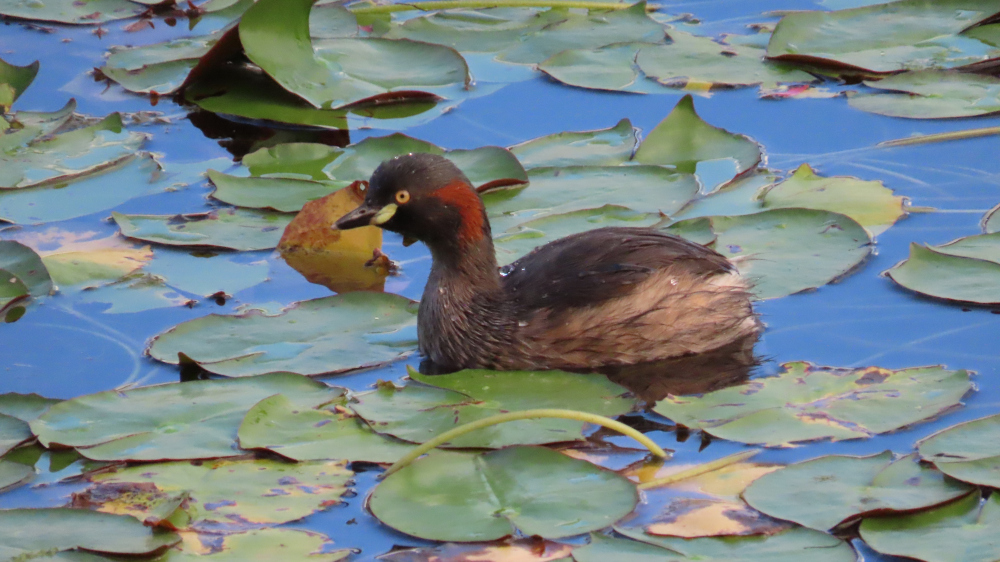
This grebe is wearing its breeding plumage, with a large chestnut patch stretching from its eye down its neck, and that odd yellow patch at the base of its beak. Outside the breeding season, the yellow patch turns white and the bird’s neck is a dark grey-brown to match its back.
Fun fact: Grebes eat their own feathers and also feed their feathers to their young. People think the goal is to make it easier to swallow fish bones, by wrapping around the bones and preventing injury to the bird.
Another fun fact: Grebes have big feet with lobed toes, more like those of coots than ducks. I’ve never seen a grebe out of the water, but I do have a picture of a coot’s feet, which are rather adorable: The foot of the Coot.
Common name: Australasian Grebe
Scientific name: Tachybaptus novaehollandiae
Approximate length: 23-25 cm
Date spotted: 25 March 2026 (autumn)
Location: Manly Dam Park, near Sydney, Australia: 33°46’34.8″S 151°14’49.6″E
Local group of Glossy Black-Cockatoos now six strong!
Every now and then over the last few years, I’ve seen a group of Glossy Black-Cockatoos on the banks of Manly Dam. They have a few favourite spots, always where the Casuarina trees are in seed.
For the first couple of years, there were always three birds in the group. I don’t know if they were the same birds each time. Then suddenly there were five. And yesterday, for the first time, there were six. Glossies are rare compared to the other types of cockatoos in our area (Sulphur-crested, Yellow-tailed Black, and Corellas), so it’s wonderful to see this group growing in size.
Yesterday was a muggy, grey day. My camera kept misting up due to the high humidity. Every now and then the mist turned to light, drifting rain that settled into blotches on the lens. Still, the video gives you and idea of the gentle, calm presence of these large birds.
Glossies are a type of parrot. In Australia we have 56 species of parrots, including cockatoos, lorikeets, rosellas, ringnecks and budgerigars. Check out my previous sightings of Glossy Black-Cockatoos.
Common name: Glossy Black-Cockatoo
Scientific name: Calyptorhynchus lathami
Approximate length: 50cm
Date spotted: 19 March 2026 (autumn)
Location: Manly Dam Park, near Sydney: 33°46’23.8″S 151°14’39.5″E
Olive-backed Oriole calling and mimicking other birds
I listened to this Olive-backed Oriole for a while, trilling its characteristic call interspersed with imitations of other birds. I managed to get part of its performance on video. As well as being pretty and having a lovely song, this Oriole is an excellent mimic.
At the start of the video, the Oriole reacts to the shriek of Masked Lapwings (also known as Spur-winged Plovers). After a couple of seconds, the Oriole starts its own performance again.
Common name: Olive-backed Oriole
Scientific name: Oriolus sagittatus
Approximate length: 25-28 cm
Date spotted: 17 March 2026 (autumn)
Location: Manly Dam Park, New South Wales, Australia: 33°46’31.7″S 151°14’47.8″E
Tongue of the White-cheeked Honeyeater
A White-cheeked Honeyeater feeds off the flower of a Banksia bush. At 19 to 24 seconds into the video, you can see the bird’s long, thin, white tongue flicking quickly in and out of its beak. The bird chirps every now and then, no doubt commenting about me to the other birds in the area.
Like most honeyeaters, these birds feed on nectar from flowers and also will snap up a handy insect every now and then. Their tongues are long enough to stick out beyond the end of their beaks, making it easier to lap up nectar from a flower.
Common name: White-cheeked Honeyeater
Scientific name: Phylidonyris nigra
Approximate length: 16-19 cm
Date spotted: 25 February 2025 (summer)
Location: Manly Dam Reserve, New South Wales, Australia: 33°46’28.7″S 151°14’46.3″E

Shining Bronze-Cuckoo, first sighting
This morning I spotted a bird I hadn’t seen before. What’s more, it was at one of my favourite stomping grounds: Manly Dam. A few minutes after seeing the bird, I showed my photos to another bush walker. He identified the bird as a Shining Bronze-Cuckoo. I think he’s right.
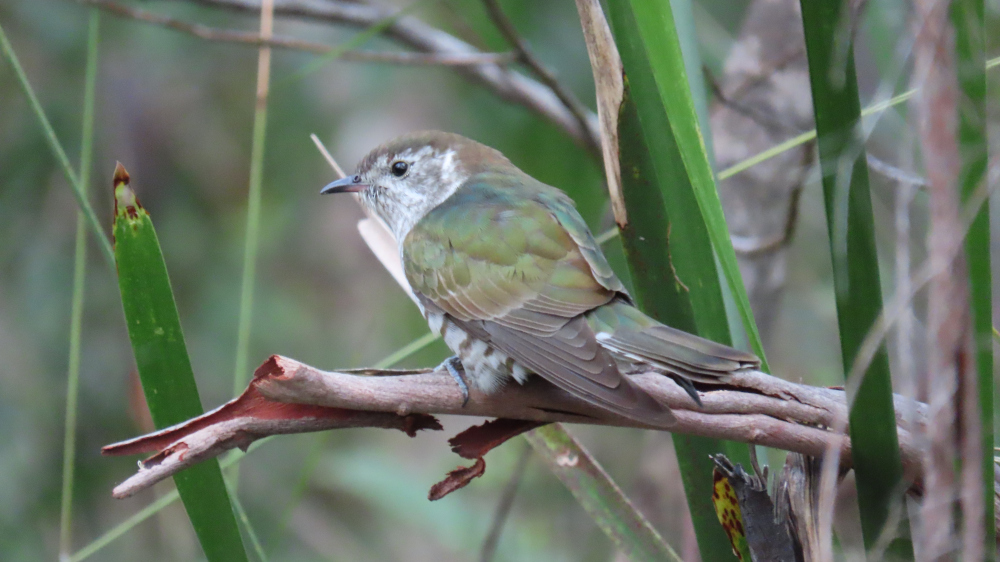
The bird was quite small, with glowing green-blue wings and tail. Its face was light grey and white, and its front had horizontal brown barring on white:
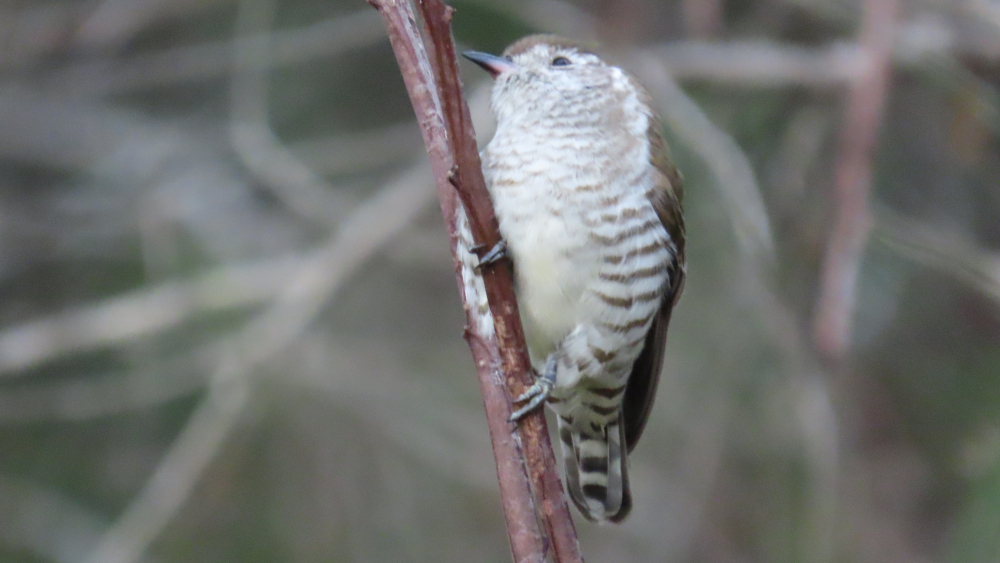
This looks like a juvenile bird, as the barring is not yet as well-defined as in the adults.
Due to the less well-defined barring, I did wonder if this was a Horsefield’s Bronze-Cuckoo. But this bird doesn’t have the dark line through the eye that’s characteristic of Horsefield’s Bronze-Cuckoos, and the white tips of the tail feathers are hidden at rest, while in the Horsefield’s Bronze-Cuckoo the white tips are visible.
Like most other cuckoos, Shining Bronze-Cuckoos don’t build nests. Instead, they lay their eggs in the nest of another bird species and leave the other species to raise their young. Shining Bronze-Cuckoos usually choose the nests of thornbills, gerygones, scrubwrens, or fairy-wrens. There were several Variegated Fairy-wrens in the same area as this cuckoo. I wonder if some of them were the adoptive parents!
Common name: Shining Bronze-Cuckoo
Scientific name: Chrysococcyx lucidis
Length: 16-18 cm
Date spotted: 25 February 2026 (summer)
Location: Manly Dam Park, New South Wales, Australia: 33°46’38.8″S 151°14’49.0″E

My first Bassian Thrush
I was having a picnic next to Sugarloaf Range Dam (a very small body of water) in the Sugarloaf State Conservation Area, when I spotted a bird moving around on the other side of the water:
This is my first sighting of a Bassian Thrush. The video isn’t great, but it does show the characteristic movement pattern of this shy bird: darting forward in a short burst, then freezing to blend in with the vegetation.
Here’s a photo, which also isn’t great. The bird was very far away and the lighting was harsh: bright and dark with nothing in between:
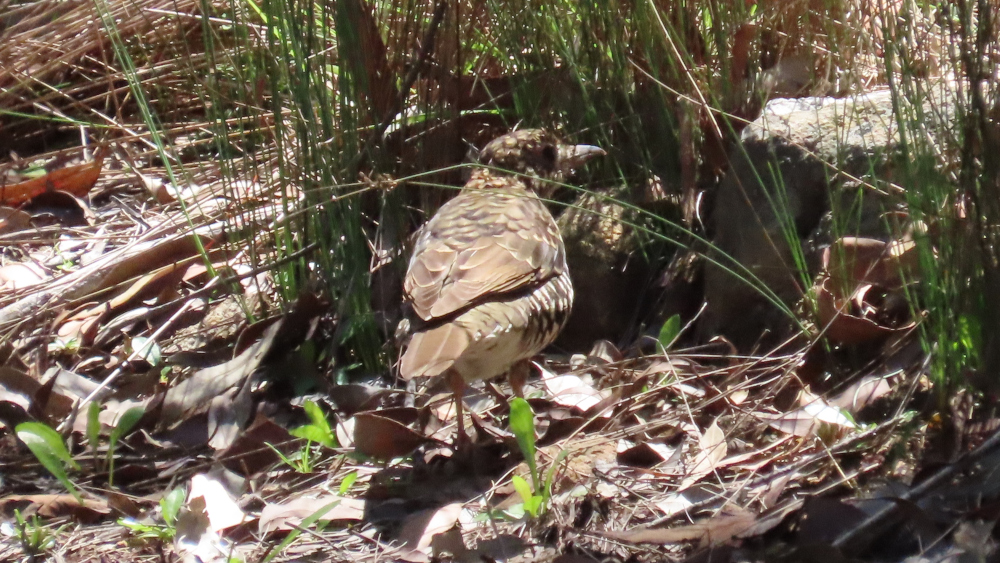
I’m excited about this first sighting! It’s also the first thrush of any type that I’ve posted to this blog (aside from Grey Shrike-thrushes, which aren’t actually thrushes).
Common name: Bassian Thrush
Scientific name: Zoothera lunulata
Length: 27-29 cm
Date spotted: 18 February 2026 (summer)
Location: Sugarloaf Dam Access Road, New South Wales, Australia: 32°56’36.6″S 151°30’39.5″E

Black Swan baby is no longer an ugly duckling!
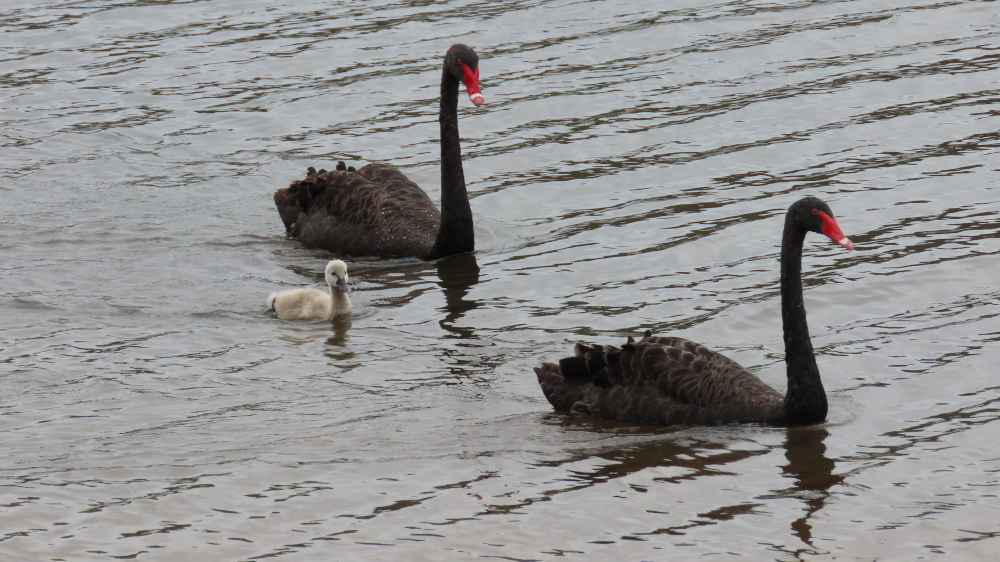
Back in November, I posted some pictures of a lone Black Swan cygnet with its parents. The baby was actually very cute, not an ugly duckling at all, unless you’re a duck, I guess. Since then, I’ve been keeping an eye on the young family and hoping that the little one makes it through its first difficult months. So far, so good.
Here’s the little one in December, just a few weeks after I first saw it:
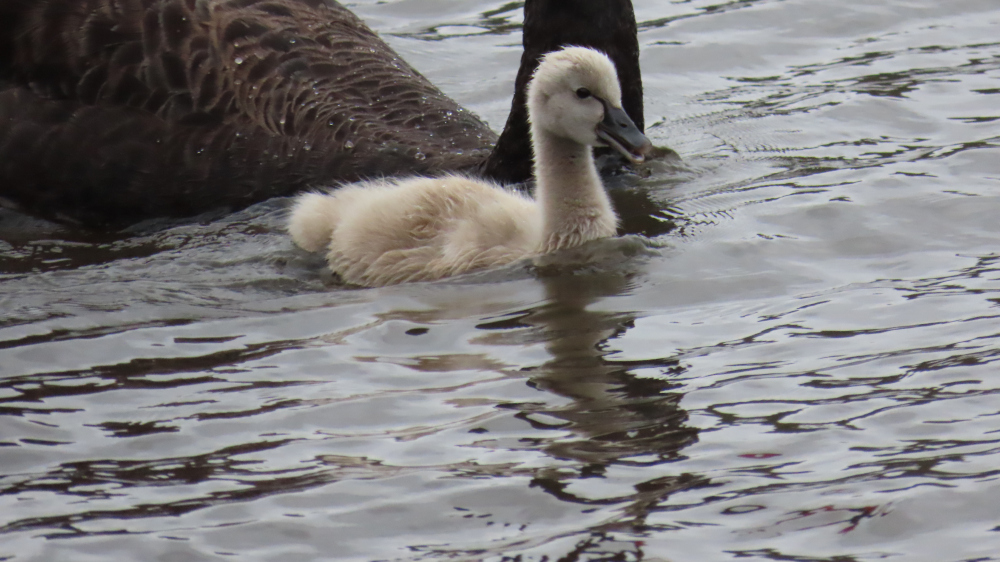
It’s very small next to its parents, and doesn’t look much like a swan:
Now we’re in early February, three months after I first saw the baby, and what a difference! The little one is nearly the size of its parents and already looks more like a swan than a bundle of fluff:
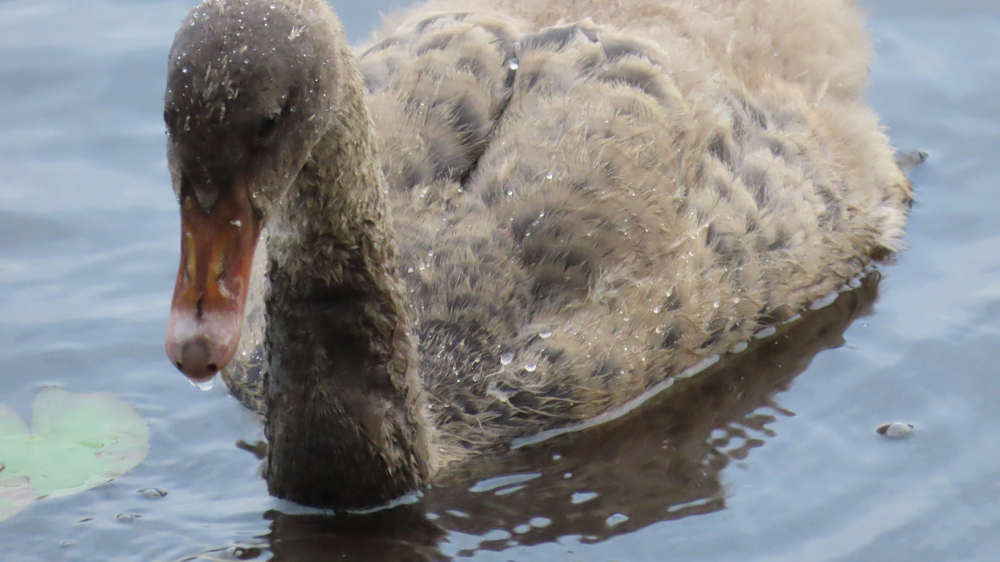
Black Swans face several dangers: foxes, dogs, getting snagged and injured by fishing line, boats, and pollution. I don’t know how many there were in the brood, but it’s great to see one youngster doing well.
This video from December shows the little one bravely battling the choppy waters of the dam where they live. If you listen carefully, you’ll hear the cygnet cheeping continually. The rushing sound is the wind:
Now, in February, the youngster sails majestically around the adult birds. The noisy birds off-camera are Rainbow Lorikeets:
Common name: Black Swan
Scientific name: Cygnus atratus
Approximate length of adult bird: 120 cm
Date spotted: 3 February 2026 (summer)
Approximate location: Sydney’s Northern Beaches, New South Wales, Australia

Cockatoo chases off a falcon
I was walking along a bush path at Manly Dam when I heard a cockatoo making a big fuss on the other side of the creek that feeds into the dam. I looked across the water in time to see the cockatoo leaping off its perch and launching itself towards a branch not far away. As the cockatoo landed on its new perch, a dark shape took off from that same branch and floated away to another tree.
I grabbed my camera and zoomed in on the bird that the cockatoo had chased off. It was a Nankeen Kestrel:
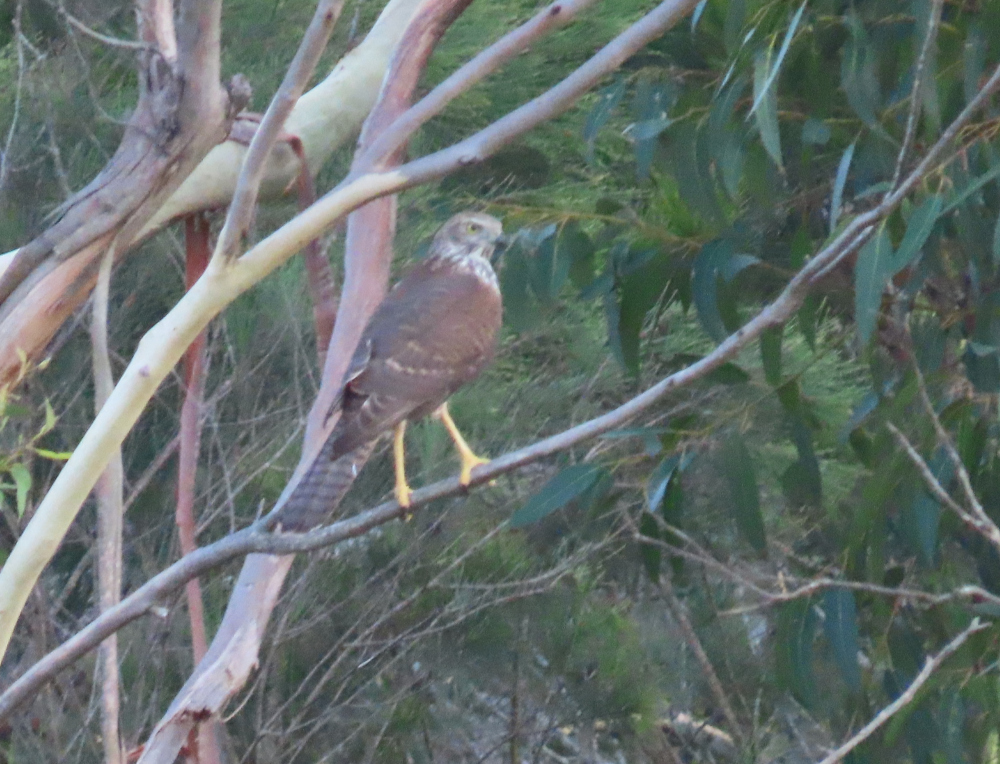
It looks like a female bird, with its light-coloured head and the dark-grey “tear mark” going down vertically from its eye.
Common name: Nankeen Kestrel
Scientific name: Falco cenchroides
Length: 30-35 cm; wing span: 60-80 cm
Date spotted: 29 January 2026 (summer)
Location: Manly Dam Park, New South Wales, Australia: 33°46’19.8″S 151°14’35.5″E
The Sulphur-crested Cockatoo looked very pleased with itself, now owning the area where the hawk had been resting:
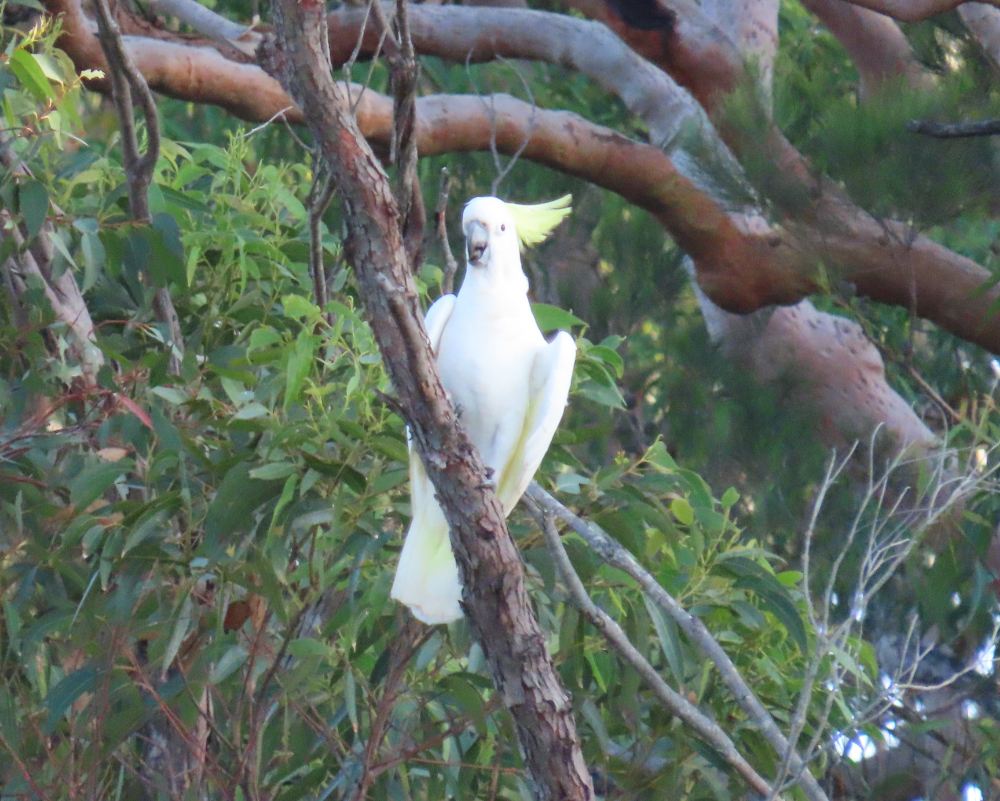
Common name: Sulphur-crested Cockatoo
Scientific name: Cacatua galerita
Approximate length: 50 cm; wing span: up to 103 cm
It takes a brave bird to attack a falcon. On the other hand, it takes a brave bird to stand up to a cockatoo, especially when the cockatoo is bigger than you. I think the falcon was vulnerable as it was perched on a branch. If it had been in the air, the cockatoo might have come off worse.
The photos aren’t very clear, since the birds were far away on the opposite side of the dam. Still, they’re good enough to identify the birds.
After a couple of minutes of enduring the cockatoo’s screeching and prancing, the kestrel decided enough was enough. It floated away in search of a quieter location:
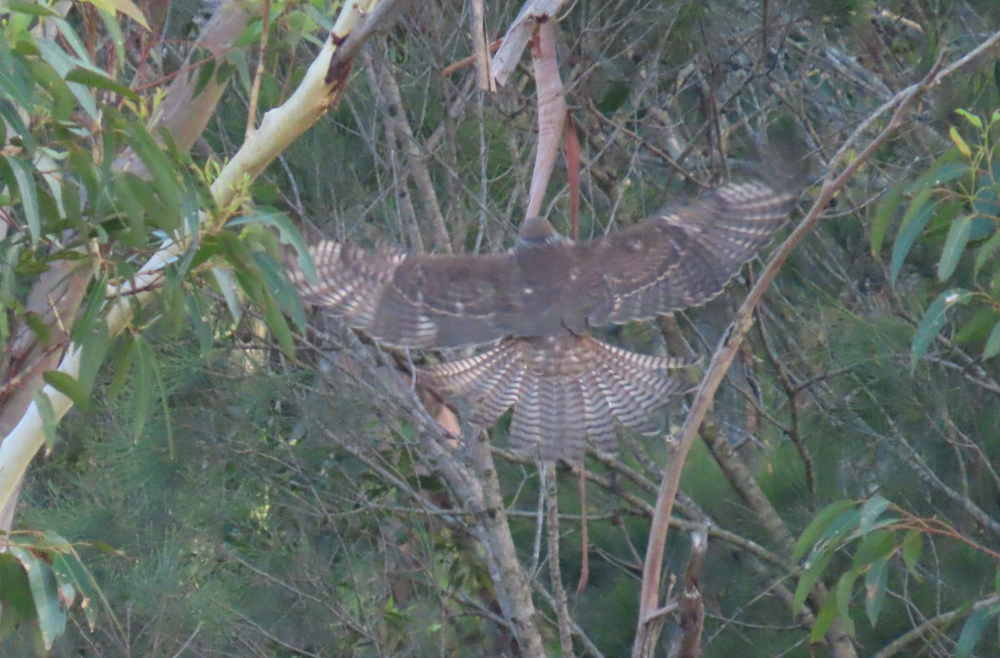
Nankeen Kestrels are small falcons, quite common in Australia. They feed on small mammals and birds, reptiles, and insects.
This is only the second time that I’ve spotted a Nankeen Kestrel. My first sighting was of a male bird in Victoria.
Happy bush-walking all!

My first Nankeen Kestrel
According to my bird book, Nankeen Kestrels are common in mainland Australia. Still, this is the first time I’ve spotted one. The bird has a distinctive light-coloured tail with dark tips to the tail feathers:

The bird was very far away, flying and diving above a valley in the Victorian Alps. For that reason, the photos aren’t great. But I do want to record the sighting!
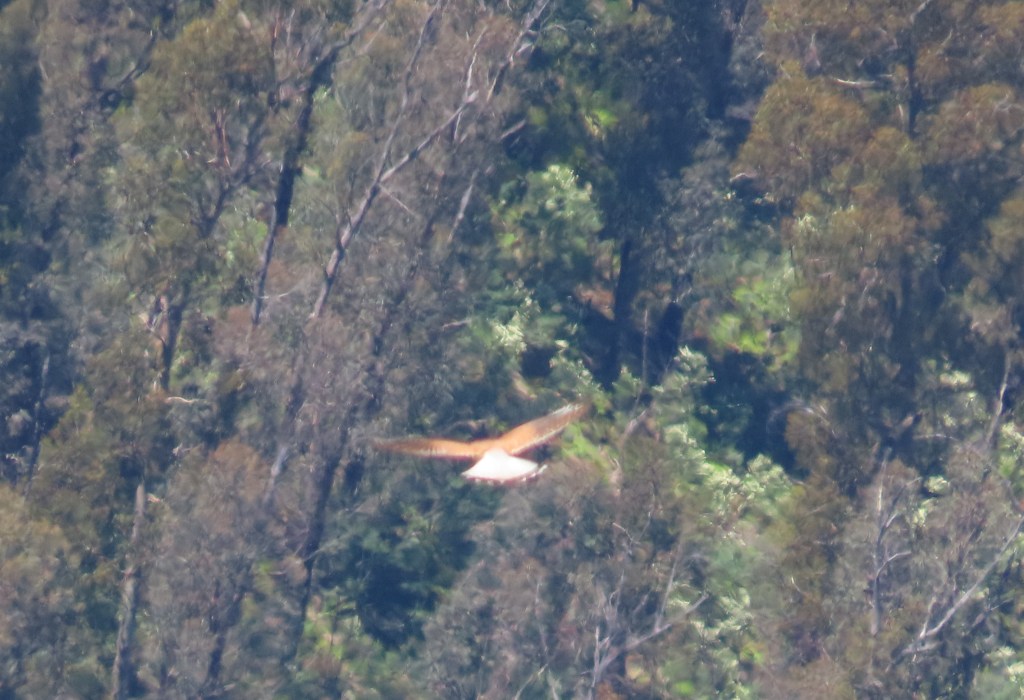
Common name: Nankeen Kestrel
Scientific name: Falco cenchroides
Length: 30-35 cm; wing span: 60-80 cm
Date spotted: 27 December 2025 (summer)
Location: Blue Rag Range Track, Victoria, Australia: 37°06’13.4″S 147°04’00.4″E

Big baby! Koel cuckoo fed by Red Wattlebird
It’s cuckoo season here on the east coast of Australia. We have several types of cuckoos that migrate to our shores for the summer months and get the local birds to feed their young. That’s right! Cuckoos lay their eggs in some other bird’s nest and fly away free as a … well, as a bird. The adoptive parent is often much smaller than the baby cuckoo, but it’s hornswoggled into feeding the youngster until the cuckoo is old enough to take care of itself.
One of the cuckoos that come to our shores is the Common Koel, also called the Eastern Koel. A couple of days ago, I saw a young Koel being fed by a Red Wattlebird:
In the video, you can hear the juvenile Koel chirping repeatedly, begging for food.
Here’s a photo of the big baby:

Adult Koels make quite a variety of sounds, including loud squawks and more melodic whistles. You can hear them in the video in this post. And you can see some shots of male and female adult Koels in other posts.
Common name: Common Koel, Pacific Koel, or Eastern Koel
Scientific name: Eudynamys orientalis (was scolopacea)
Approximate length: 45 cm
Date spotted: 3 December 2025 (summer)
Location: Manly Dam Park, New South Wales, Australia: 33°46’57.5″S 151°15’20.8″E


 Sydney Birder