Blog Archives

Noisy Friarbirds at Manly Dam!
I was excited to hear Noisy Friarbirds at Manly Dam park in Sydney’s Northern Beaches. I haven’t seen these birds in the area before — they’re more common further north and west.
Over the past couple of weeks, I’ve heard the unforgettable sounds that these birds make. Today I managed to take some photos. In the video, you can hear the odd sounds made by the Noisy Friarbirds amongst other bird calls, but you don’t actually see the friarbirds. They’re very hard to spot.
The first bird sound in the video is the chirping of Rainbow Lorikeets. The laugh-like cackle and chatter of the Noisy Friarbirds begins soon after the start, at about 0:02. The lorikeets continue chirping throughout. In the background is the cackle of some Little Wattlebirds, which is similar to the friarbirds’ call but less varied in tone and style.
I did manage to snap a few photos of two friarbirds, though they’re quite blurry. This photo shows one of the friarbirds perched briefly out in the open:

Another friarbird was having an altercation with a Rainbow Lorikeet. The friarbird was the one to cede ground:

You can see some better pictures of friarbirds in my other posts, taken in other areas of Australia.
Common name: Noisy Friarbird
Scientific name: Philemon corniculatus
Approximate length: 30-35 cm
Date spotted: 26 March 2025 (summer)
Location: Manly Dam Reserve, New South Wales, Australia: 33°46’42.5″S 151°14’54.3″E
Call of the Whipbird
An Eastern Whipbird does his morning grooming, stopping occasionally to call to his friends. The noise that whipbirds make is strange: “eeeuuw-phwit”. It reminds people of a whip whistling and cracking, and that’s what gives the bird its name.
In the background, you can hear other whipbirds replying. Each time, a bird off-camera echoes the long drawn-out call of the on-camera bird( “eeeuuw-phwit”) then another bird also off-camera replies immediately (“phit-phit-pheeuw”). These two off-camera calls sound like a single call, but they’re actually from two birds.
Common name: Eastern Whipbird
Scientific name: Psophodes olivaceus
Approximate length: 30 cm
Date spotted: 9 March 2025 (summer)
Location: Manly North Head, Sydney Harbour, NSW, Australia: 33°48’55.1″S 151°17’58.9″E

If you were a baby Brush-turkey
If you were a baby Brush-turkey strolling down The Corso in Manly …

… and you could choose between a summer hat, a list of summer reads, or something that might be a worm, which would you choose?

The baby Brush-turkey is quite cute and pretty. The adults are much larger and not very pretty, though they do have a certain dinosaur dignity. Here’s an adult male from one of my other posts about Australian Brush-turkeys.

Common name: Australian Brush-turkey
Scientific name: Alectura lathami
Approximate length of adult bird: 60-70 cm
Date spotted: 11 February 2025 (summer)
Location: The Corso, Manly, New South Wales, Australia: 33°47’51.8″S 151°17’12.9″E

Peregrine Falcon in the suburbs
It was good to see this Peregrine Falcon perched high in a tree above the rooftops in Sydney’s Northern Beaches.
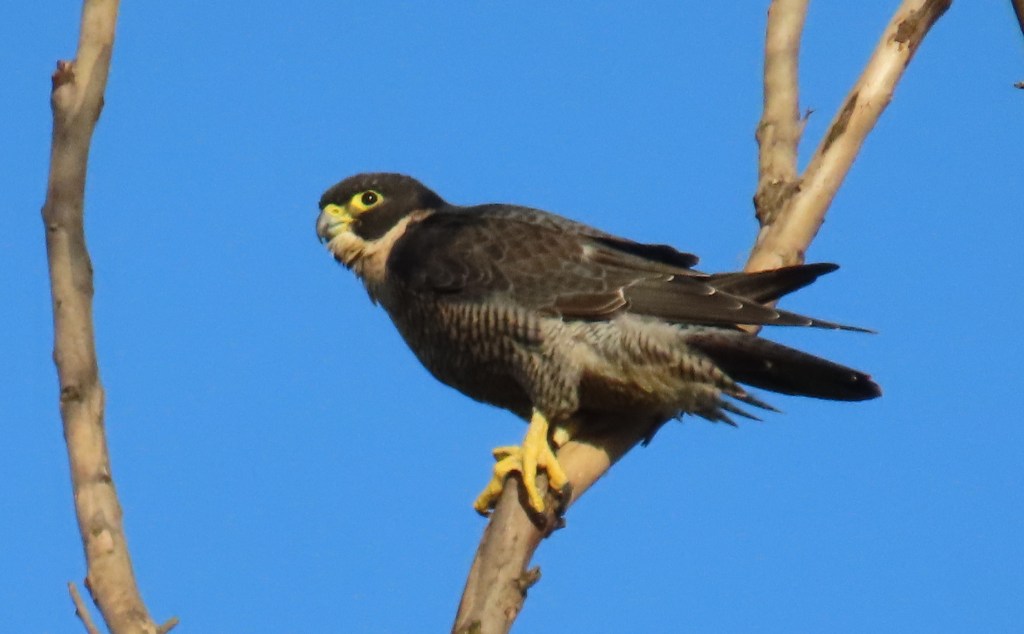
They’re beautiful birds, with that fierce eye and the contrast between yellow and black colouring. I’ve seen just a few Peregrine Falcons before, usually in a wilder setting. Check out the posts about my other sightings of Peregrine Falcons.
Common name: Peregrine Falcon
Scientific name: Falco Peregrinus
Approximate length: 42 cm
Date spotted: 15 February 2025 (summer)
Location: Allambie Heights, New South Wales, Australia. Approximate map reference: 33°46’18.2″S 151°15’39.4″E

Lost! Baby Purple Swamphen
A baby Purple Swamphen hops around the lily pads, sticking close to the safety of her mother. But where is her little brother?
I love the baby birds’ tiny little wings. They look like little arms flapping about. At first, I thought that the baby had caught a frog. No, it’s just those little wing stubs.
But where is her brother? Another tiny little Purple Swamphen is lost amongst the reeds! It’s hard to see how such a tiny thing can find his way back to his mother and sister, so far away among the giant lily pads:
I don’t know whether these birds are male or female, so I’ve just picked pronouns at random. Both sexes of Purple Swamphens look after their young, and they’re hard to tell apart.
Mother might not have the most beautiful face, but she offers safety and comfort:
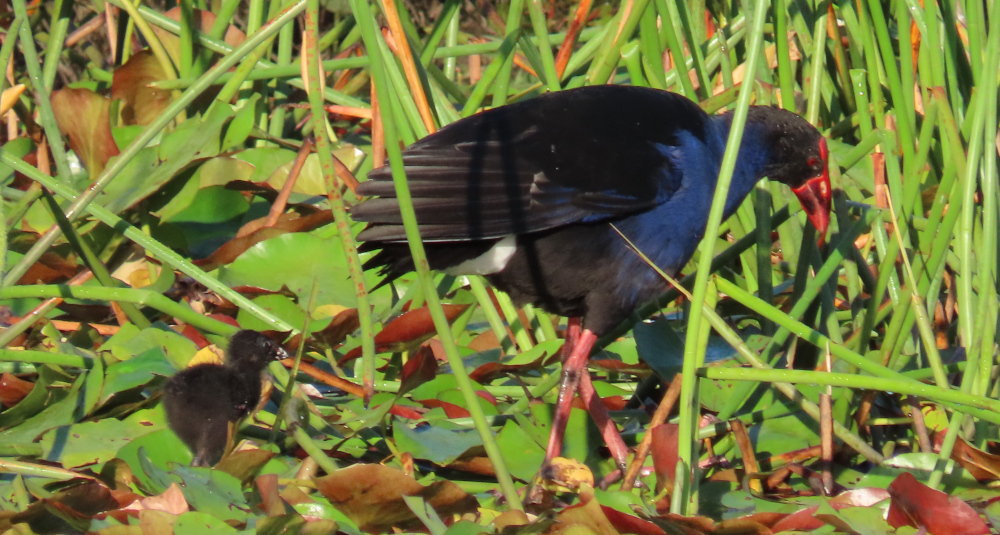
Will the little one find his way back? His sister gazes across the lily pads, as if searching for him:
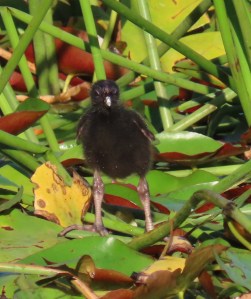
At last, the wanderer spots his family and hurries across the lily pads. His sister greets him warmly, while mother looks on fondly:
Common name: Purple Swamphen
Scientific name: Porphyrio porphyrio
Approximate length of adult: 50 cm
Date spotted: 5 February 2025 (summer)
Location: Manly Dam Reserve, New South Wales, Australia: 33°46’35.4″S 151°14’49.1″E

A rather shaggy Whipbird
This little whipbird looks as if it hasn’t combed its feathers in a while. Still, it’s a nice-looking bird. It might be a juvenile, still coming into full feather:
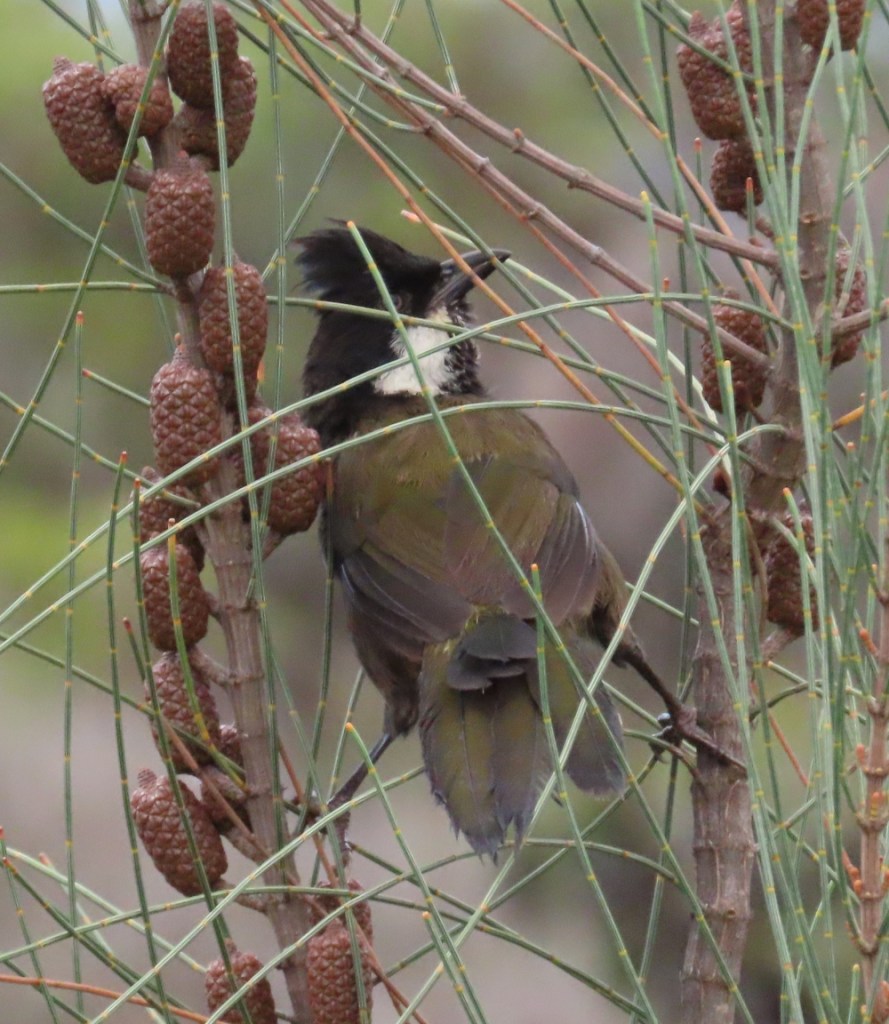
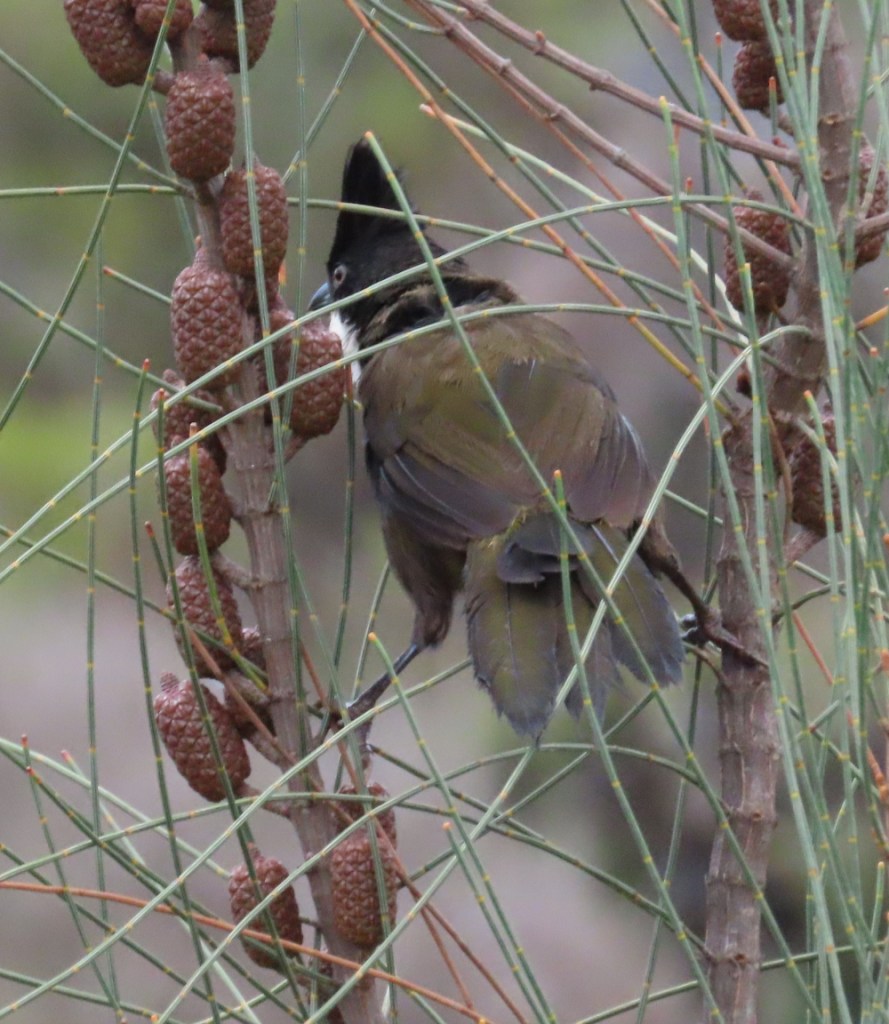
Whipbirds spend their time mostly in the low shrubbery, often rustling around in the leaves on the ground. As a result, they’re hard to spot and they usually look dark brown and black in colour. It’s nice to see one with a bit of sunlight on its feathers, bringing out the soft olive green glow on the wings and tail.
The noise that whipbirds make is strange: “eeeuuw-phwit”. It reminds people of a whip whistling and cracking, and that’s what gives the bird its name. I managed to get a good video of them calling, which I published in an earlier post.
Common name: Eastern Whipbird
Scientific name: Psophodes olivaceus
Approximate length: 30 cm
Date spotted: 16 January 2025 (summer)
Location: Dobroyd Head in Sydney Harbour, NSW, Australia: 33°48’34.0″S 151°16’25.3″E

A beautiful orange cormorant
Usually, Little Pied Cormorants have bright white and shiny black feathers. This one, though, has a lovely burnished orange head and chest. This is probably due to staining from natural iron deposits in the water.


Here’s a short video, showing the back of the bird’s head with a neat black stripe between the orange feathers of the bird’s face:
Common name: Little Pied Cormorant
Scientific name: Phalacrocorax melanoleucos
Approximate length: 60 cm
Date spotted: 20 January 2025 (summer)
Location: Manly Dam, Allambie Heights, New South Wales, Australia: 33°46’35.1″S 151°14’48.5″E

Termites and kookaburras
Termites are very active in our area of the world at the moment: the east coast of Australia just north of Sydney. When walking along a road that passes through a park area, it’s common to see low mud tunnels crossing the road. Termites build these tunnels to shelter in when they’re on their travels. Recently, I’ve also seen long trains of termites venturing out without any cover at all.
Here’s a stream of termites crossing the road. They’ve even built themselves a junction so that they can head off in different directions:
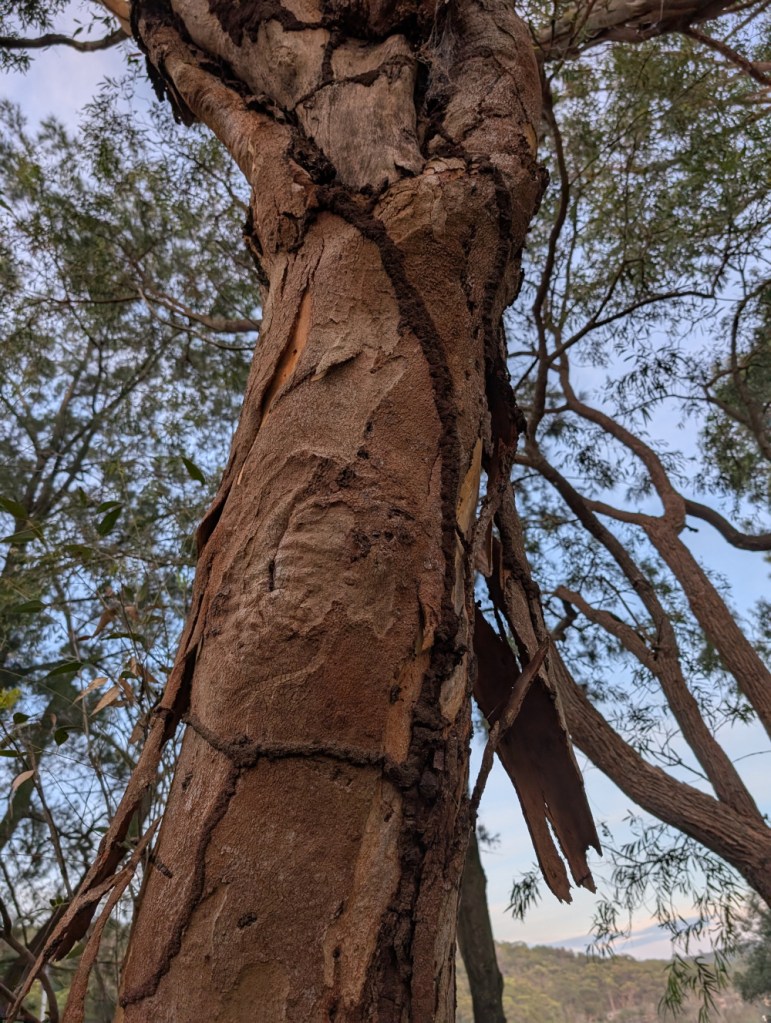
Termites’ mud tunnels often go up the outside of a tree:
The termites in this part of Australia build their nests as large mud mounds, stuck high up in a tree:

Termite nests make a handy home for monitor lizards, kookaburras, kingfishers, and other creatures. In an earlier post, I showed pictures of a termite nest that had been adopted by kookaburras as a home for their young family: Baby kookaburras out of their nest.
In the next video, two young kookaburras attack the side of a termite nest, slowly digging a hole in the nest. They’re probably thinking ahead to the next breeding season, when such a home will come in useful:
In the video, you can hear the two kookaburras chattering, and other kookaburras giving the full laughing cackle in the background. There are also cicadas singing, and a butcherbird calls at one time too.
Common name: Laughing Kookaburra
Scientific name: Dacelo novaeguineae
Approximate length: 47 cm
Date spotted: 13 January 2025 (summer)
Location: Manly Dam near Sydney, New South Wales, Australia

Baby kookaburras out of nest
For the past month, I’ve been watching a termite nest that housed two Laughing Kookaburra chicks. The kookaburra parents had set up house in an old termite nest in a dead tree. The sound of the chicks crooning drew me to the tree on November 21st. The chicks were still very young, and it wasn’t possible to see them. But after waiting around a while, I did see the parents bringing food to the nest:
A month later, on December 20th, the chicks were right at the opening of the nest, peering out at the world. This photo shows one of the babies — you can see one eye clearly on the right, then the beak and white bib and the other eye on the left:

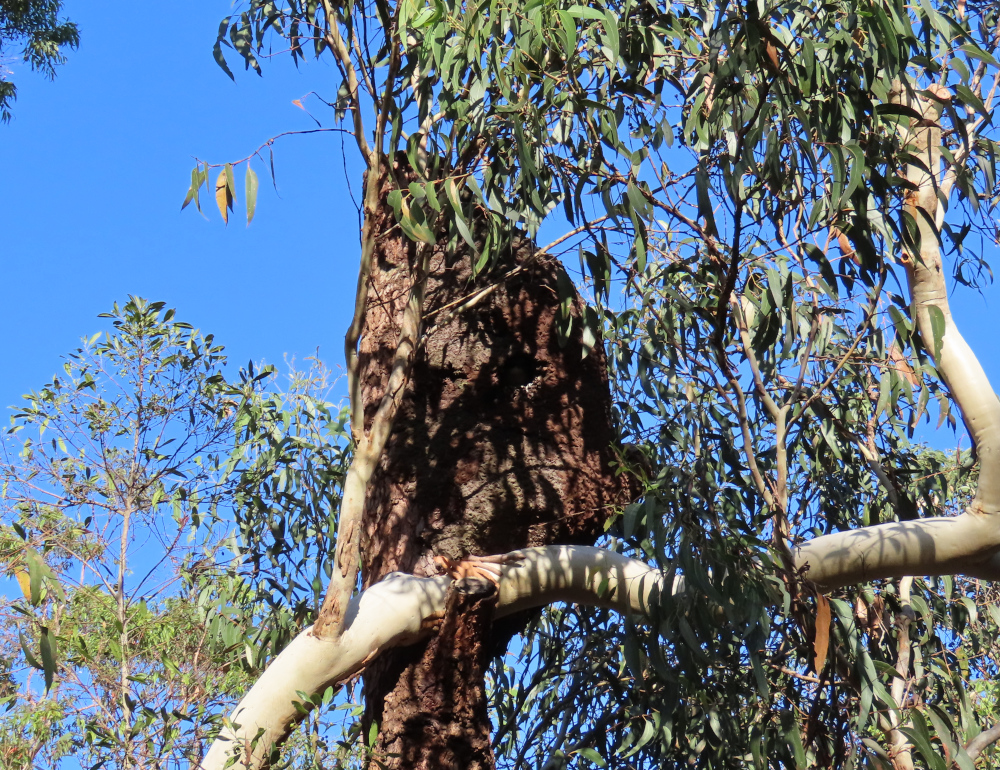
Here’s a view of the termite nest at the top of a dead tree. The nest projects from the top the right of the dead trunk, nicely protected by the branches of a living tree:
Here’s one of the parents with a morsel of food — a winged insect of some kind:

By my next visit, on December 23rd, the nest was empty. Both babies were out and about, calling and being fed by the adult birds.
One of the babies was on the ground when I got there, but soon managed to fly up onto a tree branch. The parents were nearby and attentive:
The youngsters are a bit smaller than the adults, and more fluffy. Their feathers aren’t yet fully developed, especially on the head and wings, and the tails are noticeably shorter.
The other youngster was on a nearby branch, also crooning:
This photo shows the youngster’s short tail:
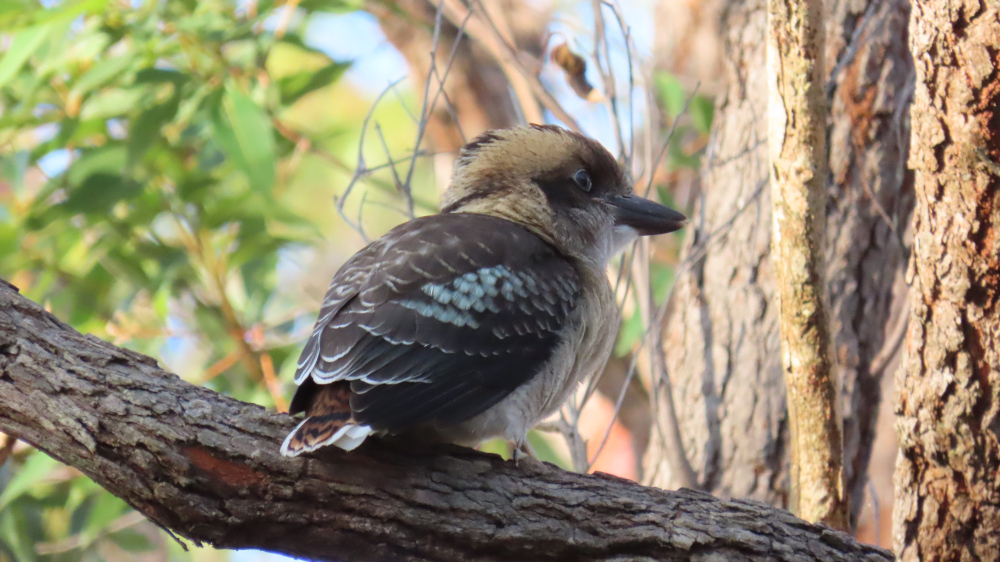
To close off, here’s the same youngster from another angle:
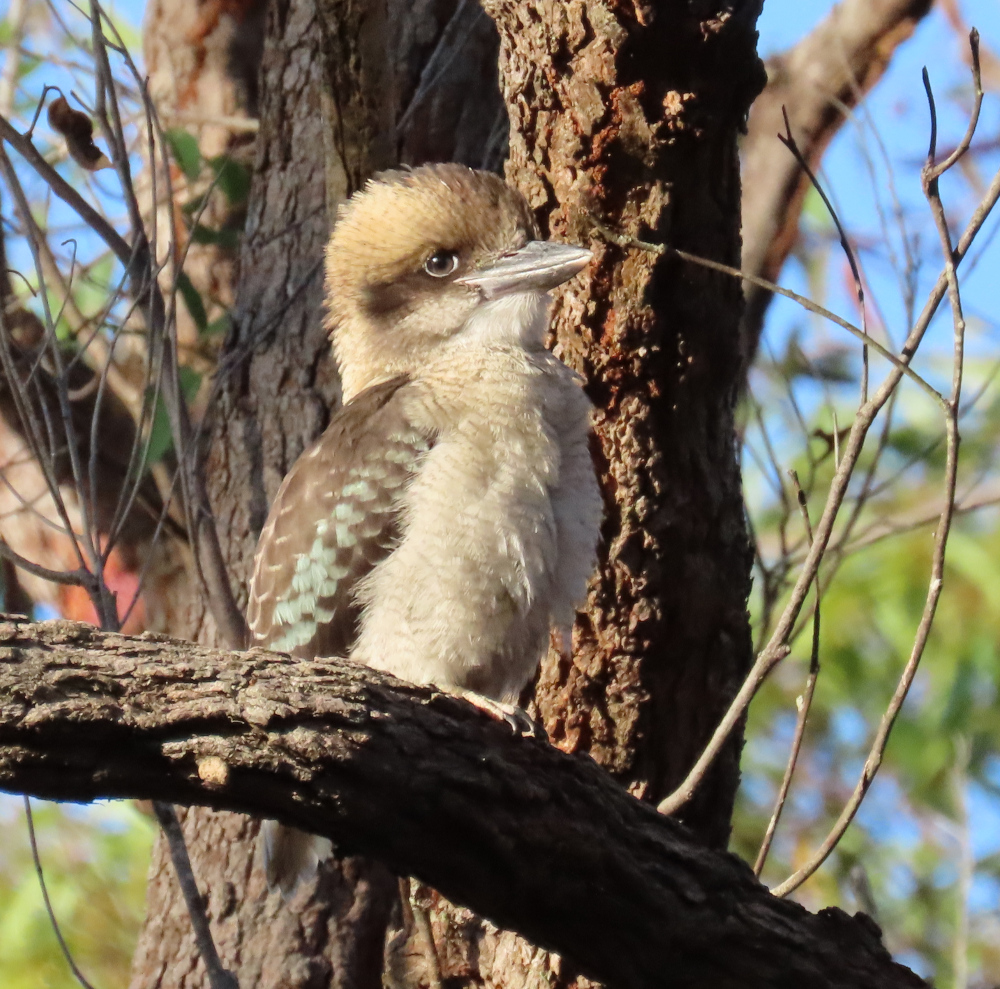
Common name: Laughing Kookaburra
Scientific name: Dacelo novaeguineae
Approximate length (adult): 47 cm
Date spotted: 21 November to 23 December 2024 (summer)
Location: Manly Dam near Sydney, New South Wales, Australia

Pretty Dollarbird near Sydney
Dollarbirds are migratory, which makes it a treat to see the first one of the spring!

They’re pretty birds, with the shades of green-blue in their feathers and the striking orange of their beaks and feet. Their habit is to sit on very high tree branches or power lines, making it tricky to take a photo. This one was in an area of coastal scrub and low trees on the edge of Sydney harbour, which meant that the highest perch the bird could find wasn’t too high, and I could take a near-decent photo.
When Dollarbirds fly, you see the round white circles on the underside of their wings. Those circles reminded people of the old silver Australian dollar coin, hence the bird’s name.
I’ve posted about earlier sightings of Dollarbirds, including a video of a pair courting. It’s worth a watch.
Common name: Dollarbird
Scientific name: Eurystomus orientalis
Approximate length: 27 cm
Date spotted: 10 December 2024 (summer)
Location: Dobroyd Head, Sydney Harbour, NSW, Australia: 33°48’33.8″S 151°16’25.1″E


 Sydney Birder