Blog Archives
Young Kookaburra learning call from adult
The bush is alive with the sound of young Kookaburras practising their call. They sound like rusty saws, or motor engines that can’t quite start. After crooning away to itself for a while, this little one approached an adult for a lesson!
Common name: Laughing Kookaburra
Scientific name: Dacelo novaeguineae
Approximate length: 47 cm
Date spotted: 3 March 2022 (summer)
Location: Manly Dam Park, New South Wales, Australia: 33°46’56.3″S 151°15’10.4″E

Large net-casting spider
While doing some gardening a couple of weeks ago, I came across this large, unique-looking spider. It was on my green bin, where I was about to deposit a load of garden trimmings. I didn’t want to hurt the spider, so I carefully moved it onto the nearby vegetation, after taking a couple of photos.
Here’s the spider, with my finger for scale:

It has its legs neatly clumped together in four groups of two. The body is long and thin, with two little humps on the sides about half way down the length. It’s head, seen from above, forms a neat triangle with two bulbs at the front.
Today I spent some time figuring out what type of spider it is. It turns out to be a net-casting spider. I wish I’d know that at the time! Evidently the spider has two huge eyes (under those bulbs seen here from above) and its face looks a little scary. As well as earning the name net-casting spiders, they’re also called ogre-faced spiders! I wish I’d got down onto the ground and looked at the spider from below, so that I could see its eyes and ogre face.
Here’s another picture, without the finger this time:

Why the name net-casting spider? These creatures spin a small square of web each night, which they hold in their front legs and cast over their prey. That’s why they have big eyes: to be able to see their prey in the dark.
Fascinating. It’s a jungle out there.

Baby Channel-billed Cuckoos fed by Currawongs
Walking along a shady path this morning, I heard a loud caterwauling from above. Two baby Channel-billed Cuckoos sat in the trees, yowling and shaking their wings. A Currawong arrived and fed a piece of meat to one of the cuckoos. Then another Currawong brought food to the second screeching youngster.
Like most cuckoos, Channel-billed Cuckoos lay their eggs in the nests of other birds and leave it to those other birds to hatch the egg and look after the growing chick. These particular cuckoos are very large (around 65 cm from head to tail) and so they need to pick the adoptive parents carefully. Currawongs are the usual choice.
This video shows one of the babies yowling and begging for food from its Currawong adoptive parent:
See how large the baby is in relation to the Currawong who’s looking after it! In the next video, one of the babies attempts to eat a largish morsel of meat that a Currawong has just fed to it:
I’ve never seen two babies together before. I wonder if they both came from the same nest, or if they found each other after leaving their nests?
Here’s a still picture of one of the baby cuckoos:
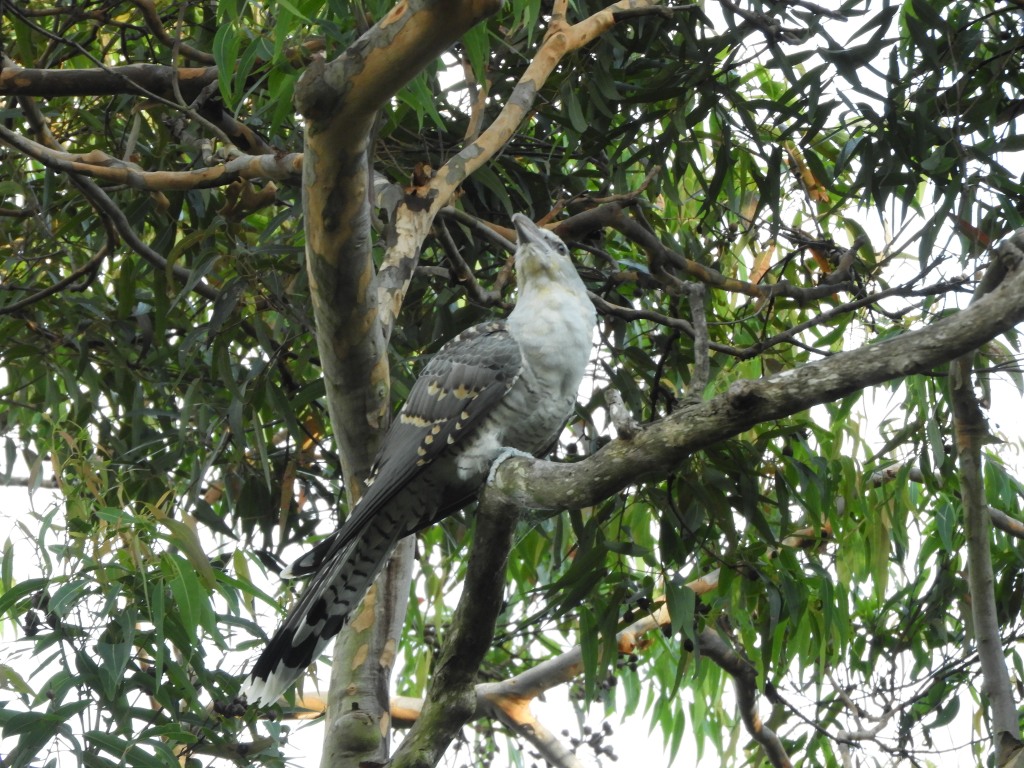
Being a youngster, its eyes are still light brown. The adult birds have fierce red eyes. They’re magnificently ugly birds.
In the next picture, one of the babies is pointing its beak at the sky, perhaps wondering where its next feed is coming from:
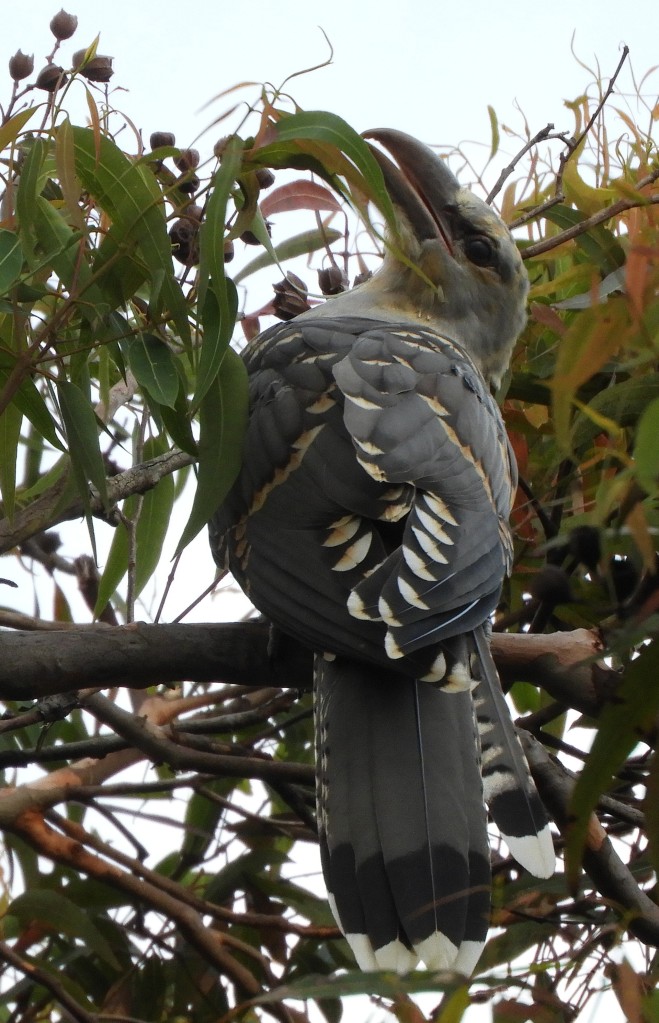
That picture gives a good view of the bird’s large beak and the markings on its back and tail.
One of the things you notice about Channel-billed Cuckoos is the supple way they move their neck and head. Here’s one of the babies leaning forward, in a pose that’s typical of these birds:
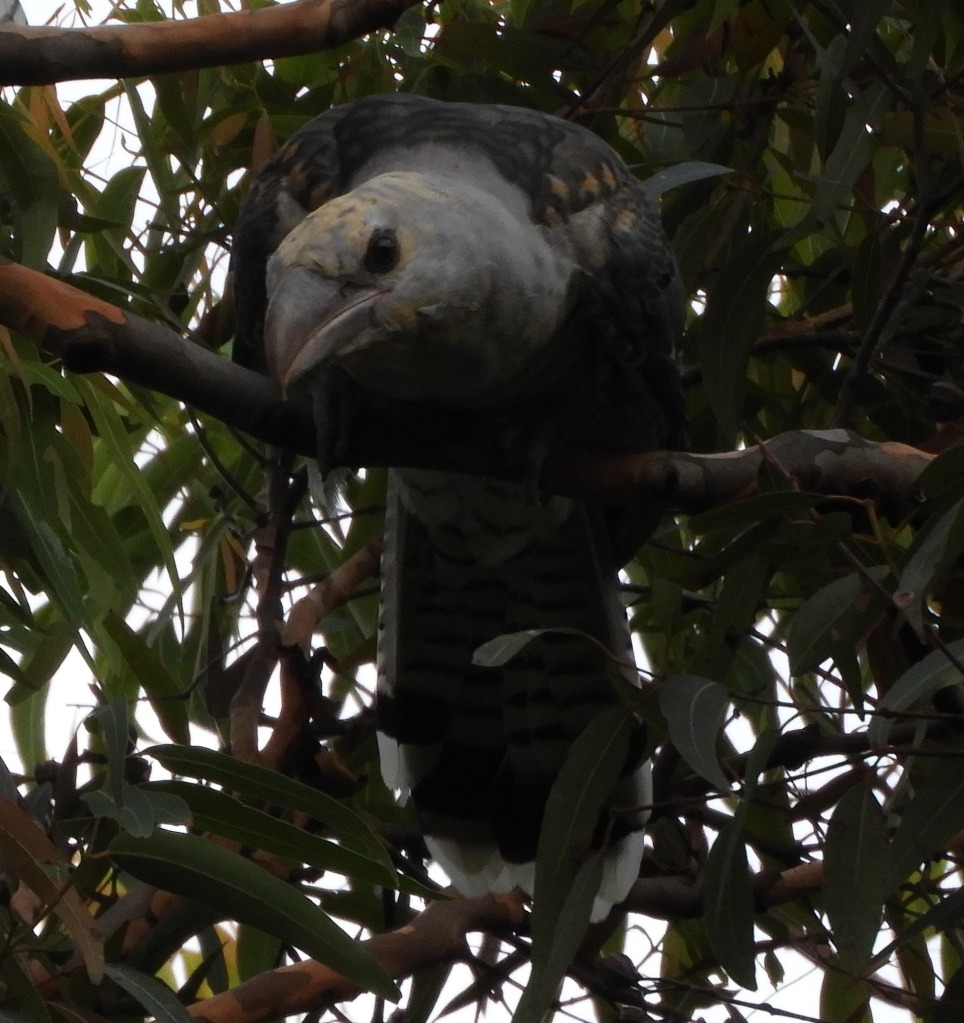
Oo-er, you probably wouldn’t want to bump into that bird one dark night. Here’s a picture of both baby cuckoos, looking at each other:

To finish off with, here’s a close up of one of the babies, head and neck only:

You can find out more about these birds in my other posts about cuckoos.
Common name: Channel-billed Cuckoo
Scientific name: Scythrops novaehollandiae
Approximate length: 58-65 cm
Date spotted: 18 December 2021 (summer)
Location: Manly-to-Spit Walk, Balgowlah, New South Wales, Australia: 33°48’00.9″S 151°15’54.9″E

Dollarbirds courting
It’s that time of year for birds on the south east coast of Australia: breeding season! I heard a cosy chattering sound high in the treetops. My superzoom camera revealed two Dollarbirds getting friendly:
Dollarbirds are migratory. They travel down to the south east coast of Australia for the summer months (roughly September to March) then fly up north to warmer climes for the winter.
They get their name from the white circular markings on the undersides of their wings. The white circles reminded people of the old silver Australian one-dollar coins. You can see the flash of white nicely when the male flies off at the end of the video.
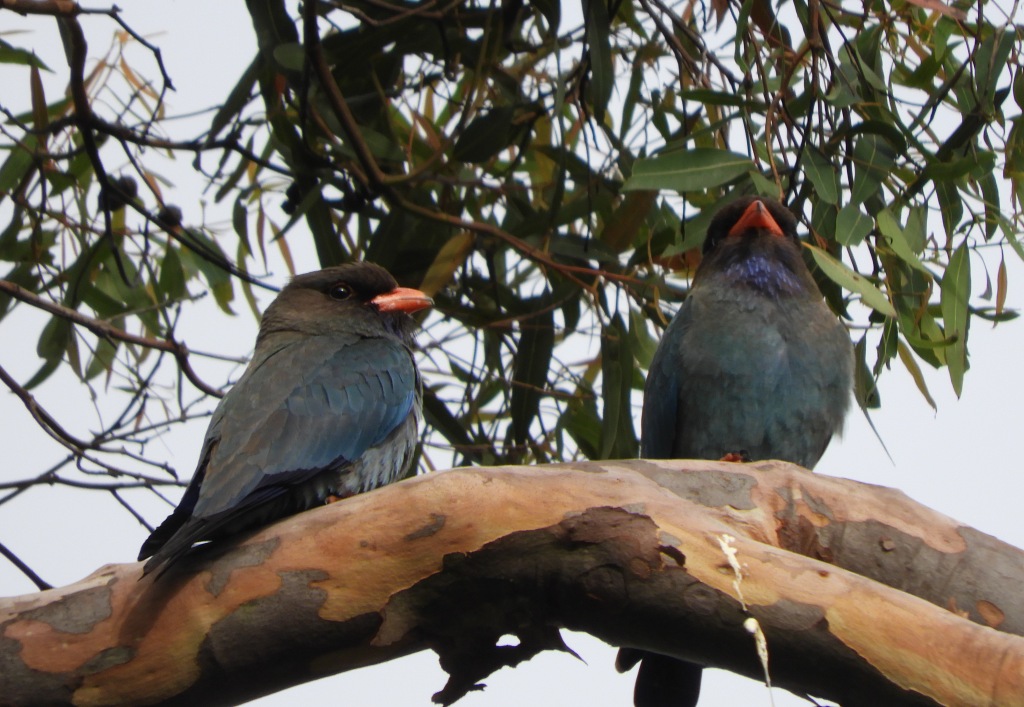
This still photo shows the blue-green colouring of the birds. They have soft brown heads and pretty purple shading under the beak:
Common name: Dollarbird
Scientific name: Eurystomus orientalis
Approximate length: 30 cm
Date spotted: 29 November 2021 (late spring)
Location: North Harbour Reserve, Balgowlah, NSW: 33°47’59.4″S 151°15’57.8″E

Rainbow Lorikeets enjoying our Banksia flowers
One of our Banksia trees has covered itself in blooms. The local Rainbow Lorikeets are delighted. A delighted lorikeet is a noisy lorikeet! In fact, anyone who lives near these birds will tell you that a lorikeet in any type of mood is a noisy creature.
One day was quite breezy. I like this video because of the way the bird hangs on to the Banksia flower as it sways in the wind, and because you get a chance to see the bird’s colourful underside as well as its topside.
Here are a couple of the birds lurking on a nearby tree before making the hop down to the Banksia:
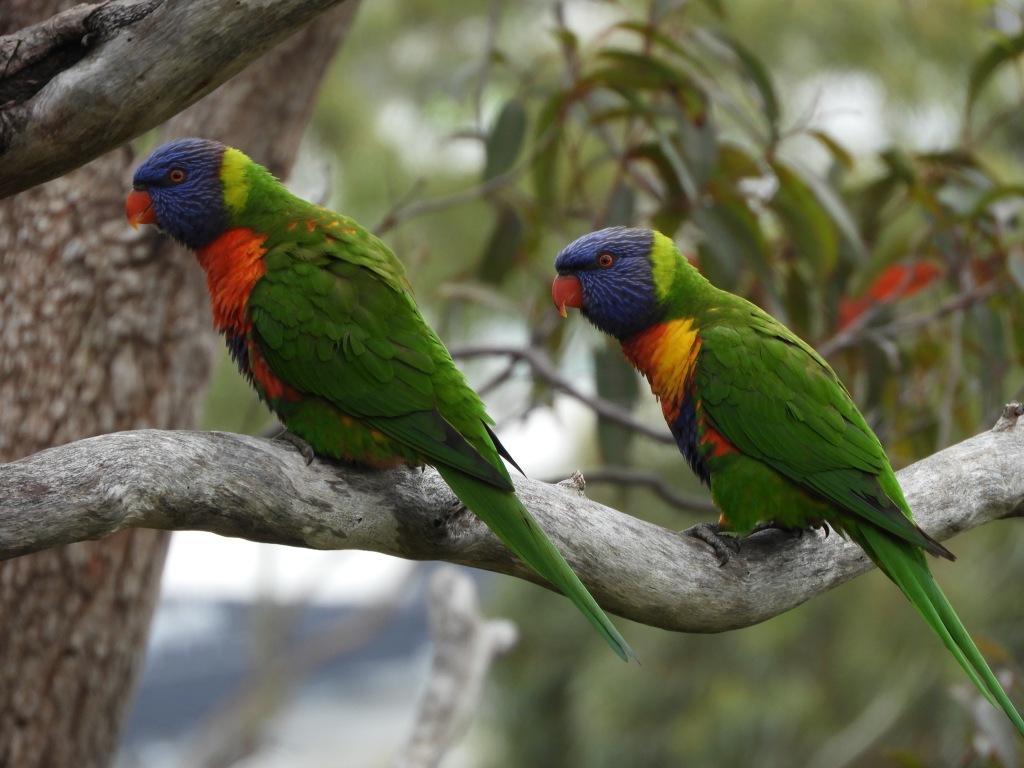
I’m so lucky to have these pretty, chatty little birds dropping in regularly to see what’s what.
Common name: Rainbow Lorikeet
Scientific name: Trichoglossus haematodus
Approximate length: 30 cm
Date spotted: November 2021 (spring)
Location: Australian east coast, about 20km north of Sydney
Whipbird takes a dip in a puddle
This is why they put puddles on paths, right? An Eastern Whipbird enjoys a quick dip in a puddle, on the path right in front of me:
The whipbird is so called because of the rather strange noise it makes: a long drawn-out whistle ending in a small explosion, which reminds people of the crack of a whip. Some of my other posts about this bird manage to capture the sound of the call too.
Common name: Eastern Whipbird
Scientific name: Psophodes olivaceus
Approximate length: 30 cm
Date spotted: 6 November 2021 (spring)
Location: Dobroyd Head Track, Balgowlah Heights, NSW, Australia: 33°48’37.6″S 151°16’23.9″E

Majestic Glossy Black-Cockatoo pair
Two Glossy Black-Cockatoos have taken to hanging out at Manly Dam. The Casuarina trees are currently full of seed pods, which are this bird’s favourite food. In fact, Glossies feed almost exclusively on Casuarina seeds.
This video shows the male bird first, its feathers gleaming a soft blue in the early morning light, and the red tail flares standing out nicely. Then the view moves to the female feeding on a nearby tree.
Glossy Black-Cockatoos are large parrots at around 15 cm in length. We’re lucky to see four different types of cockatoos in this area. Glossies are heavier than the white Sulphur-crested Cockatoos and Corellas, and shorter in length than the Yellow-tailed Black Cockatoos. Of the four types, Glossies are by far the least common.
This is the male bird, with that blueish gleam lent by the early morning light, and those red tail flares:
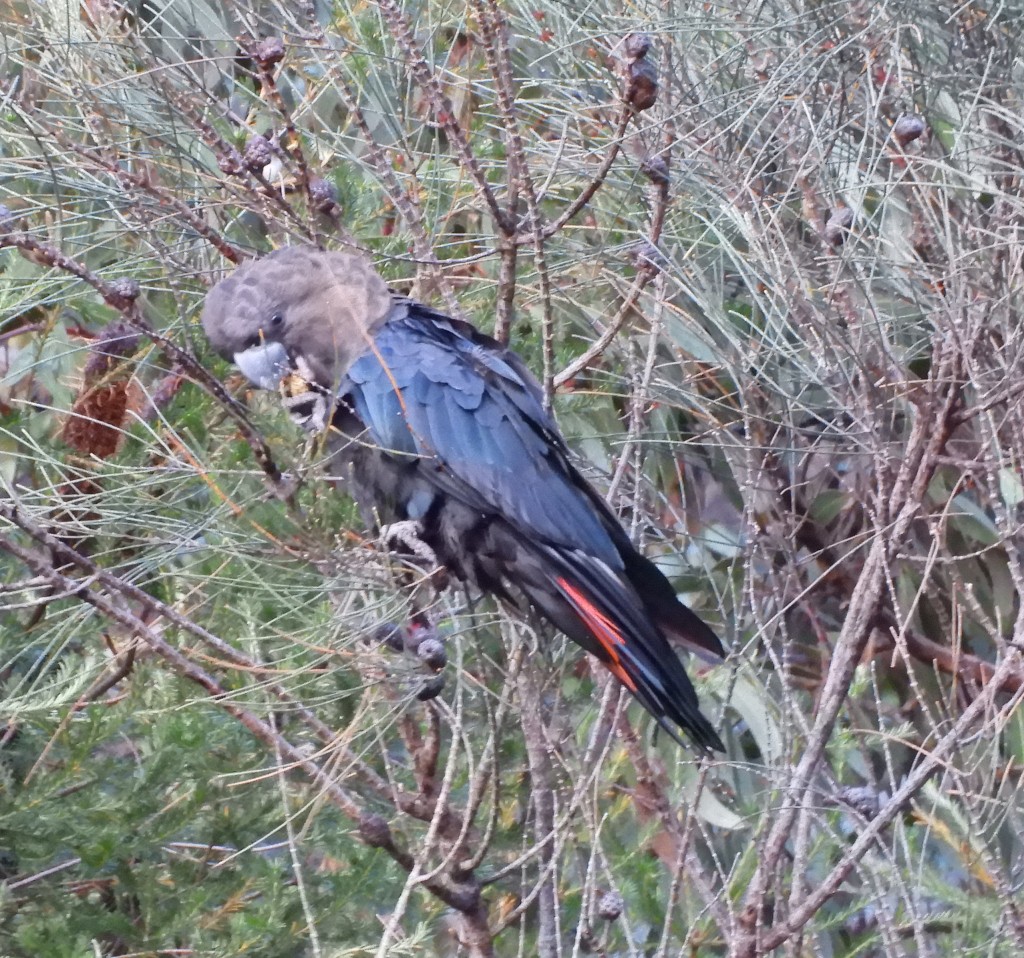
The female has yellow markings around her neck, and her tail flares are yellow and a softer shade of orange-red than the male’s:
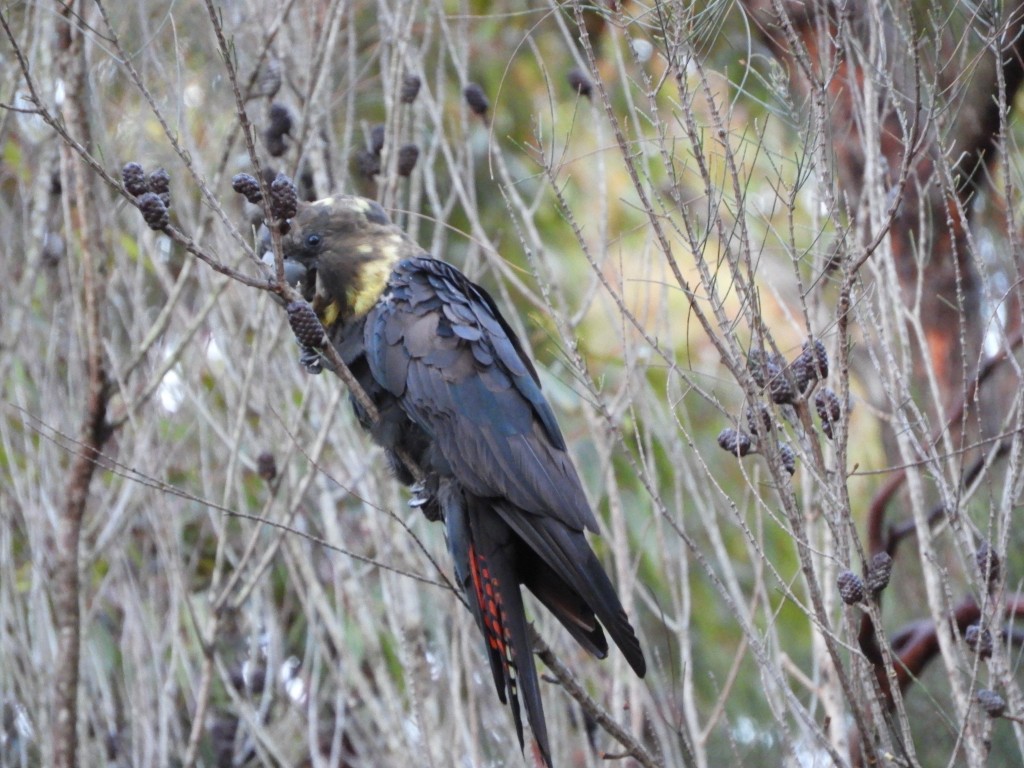
With their large heads and that mane of feathers, Glossies sometimes remind me of a bear. Here’s a close up of the male bird, taken a few days before the above shots:

Here are both birds, sharing a tree this time:
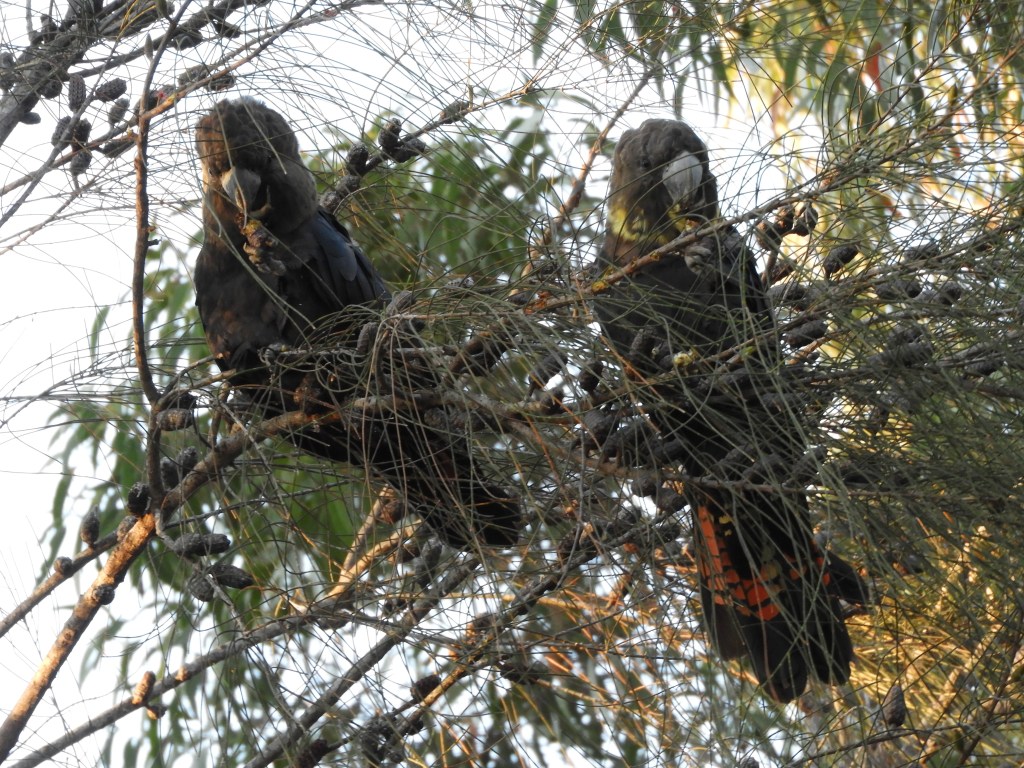
Common name: Glossy Black-Cockatoo
Scientific name: Calyptorhynchus lathami
Approximate length: 50cm
Date spotted: 5 October and 15 October 2021 (spring)
Location: Manly Dam Park, near Sydney: 33°46’56.5″S 151°15’10.3″E

Noisy Miner babies
For a couple of weeks, we had the pleasure of hosting a nest of Noisy Miners in our garden. The adults built the nest in a tree fern, right in the hollow where the new fern leaves sprout. This picture shows the tree fern, with the nest and one of the adult birds in attendance:
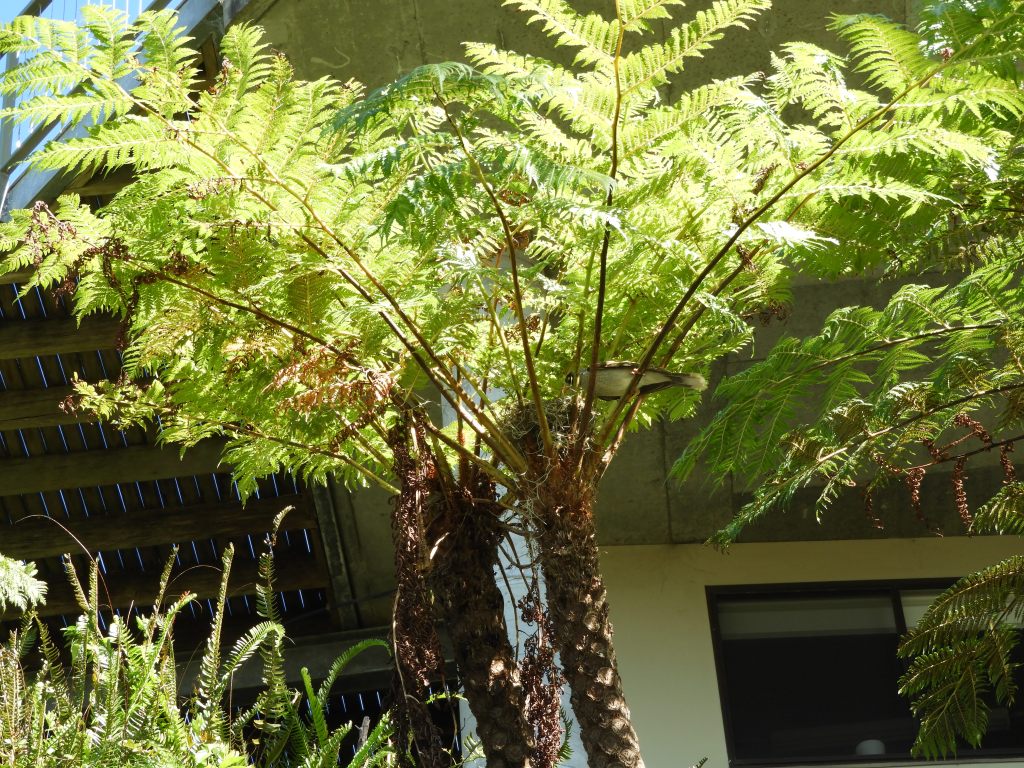
It’s a good thing that little Noisy Miners grow so fast. A few years ago, some Red Wattle Birds attempted the same thing, and were forced to abandon the nest when the fern leaves pushed it out of place!
This video shows an adult bird feeding the babies:
With Noisy Miners, feeding the little ones is a communal responsibility. You can’t tell which are the parents. We sometimes saw three birds waiting in line with a goody for the growing babies.
In the above video, the adult is regurgitating nectar or other food. Its long, thin tongue flicks out occasionally. In the next video, a bird brings a large green bug and passes it to the babies. I’m not sure if the bug is a mantid or something else. It’s too early in the season for cicadas:
Here’s a still picture of the little ones begging for food:

After a couple of weeks of feeding and fast growing babies, the nest became pretty full. Then one day, the little ones left the nest. I wasn’t there to see this exciting event, alas. I took this video the day before the nest was suddenly empty:
The little ones are now all round the garden, peeping constantly to get the adults’ attention. For the most part, they’re tucked away safely in the foliage, hard to find from my vantage point on the ground. This picture is of one of the little ones, a few days after leaving the nest:

Here’s the empty nest, with a clothes peg for scale:

Common name: Noisy Miner, also called Australian Miner
Scientific name: Manorina melanocephala
Approximate length of adult bird: 26 cm
Date spotted: September 2021 (spring)
Location: Near Sydney, NSW, Australia
Magpies carolling with a view of Sydney Harbour
This morning I walked along a path overlooking Sydney Harbour and the headlands that act as a gateway to the ocean. A treeful of Australian Magpies provided musical accompaniment.
Common name: Australian Magpie
Scientific name: Gymnorhina tibicen
Approximate length: 40 cm
Date spotted: 3 October 2021 (spring)
Location: Dobroyd Head, Sydney Harbour: 33°48’36.7″S 151°16’03.4″E

First Channel-billed Cuckoo of the season
It’s spring down under, and the cuckoos are back on the east coast of Australia. Last week I heard the calls of Koel Cuckoos and Channel-billed Cuckoos. Now I’ve seen my first one of the season: A Channel-billed Cuckoo sheltering from the local birds in a gum tree.
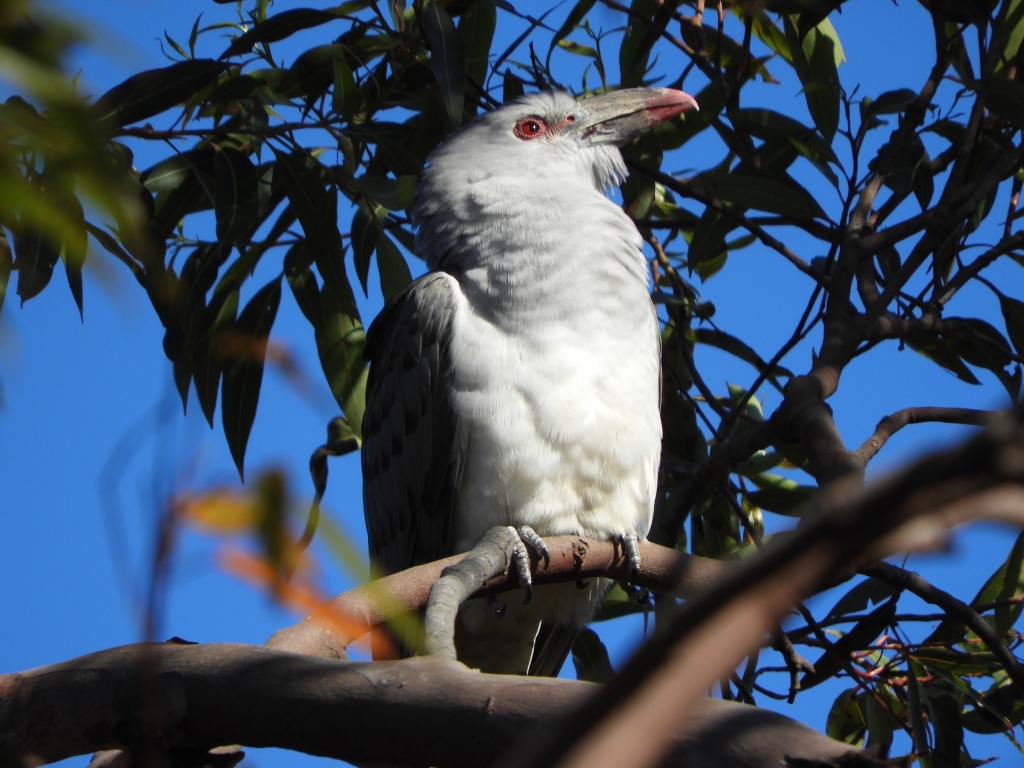
Channel-billed Cuckoos are large birds (approximately 60 cm long) with red eyes and a big beak. They often look a little scruffy, even ghoulish. The other birds seem to think so too, because they spend a lot of time dive-bombing the cuckoos and shouting at them. Usually the Noisy Miners (living up to their name) are the noisiest of the birds that strive to make the cuckoos feel unwelcome, but other birds play their part too.
This video shows the cuckoo enjoying the peace and quiet of a gum tree. At the start of the video, a Currawong swoops past in a threatening flyby. You don’t actually see the Currawong, but you can hear it and see the cuckoo flinch:
Here’s a photo showing the full length of the cuckoo, including its long, barred tail:
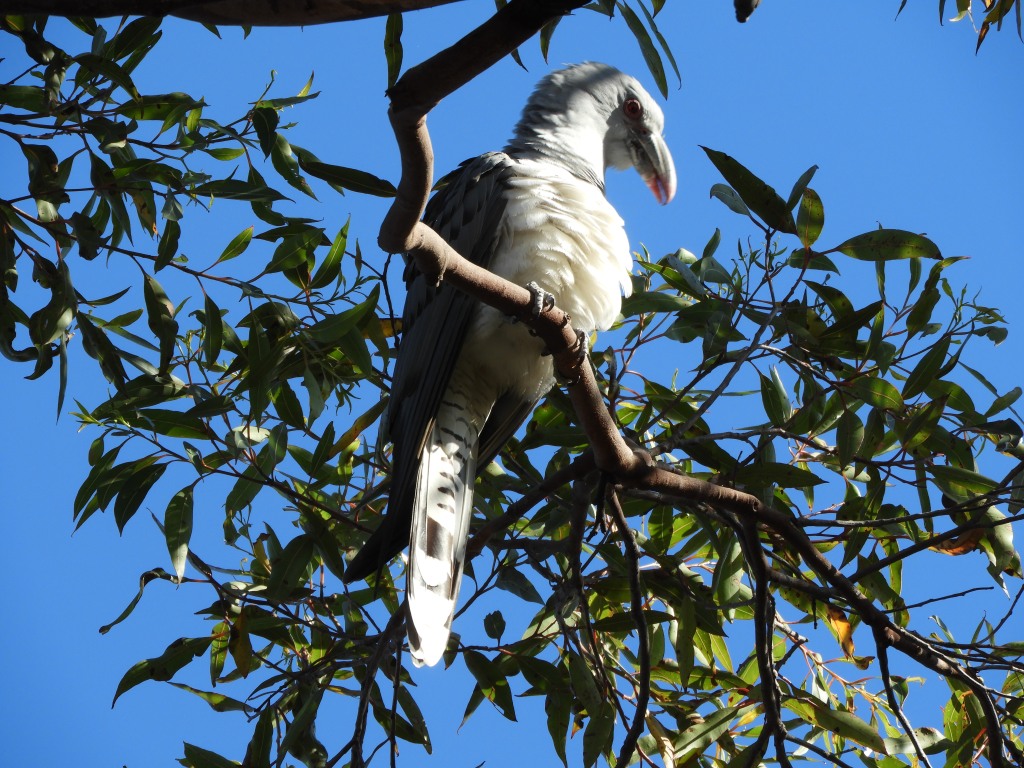
Here’s a view from the back:

Common name: Channel-billed Cuckoo
Scientific name: Scythrops novaehollandiae
Approximate length: 58-65 cm
Date spotted: 19 September 2021 (spring)
Location: Manly Dam Park, New South Wales, Australia: 33°46’33.8″S 151°15’17.8″E
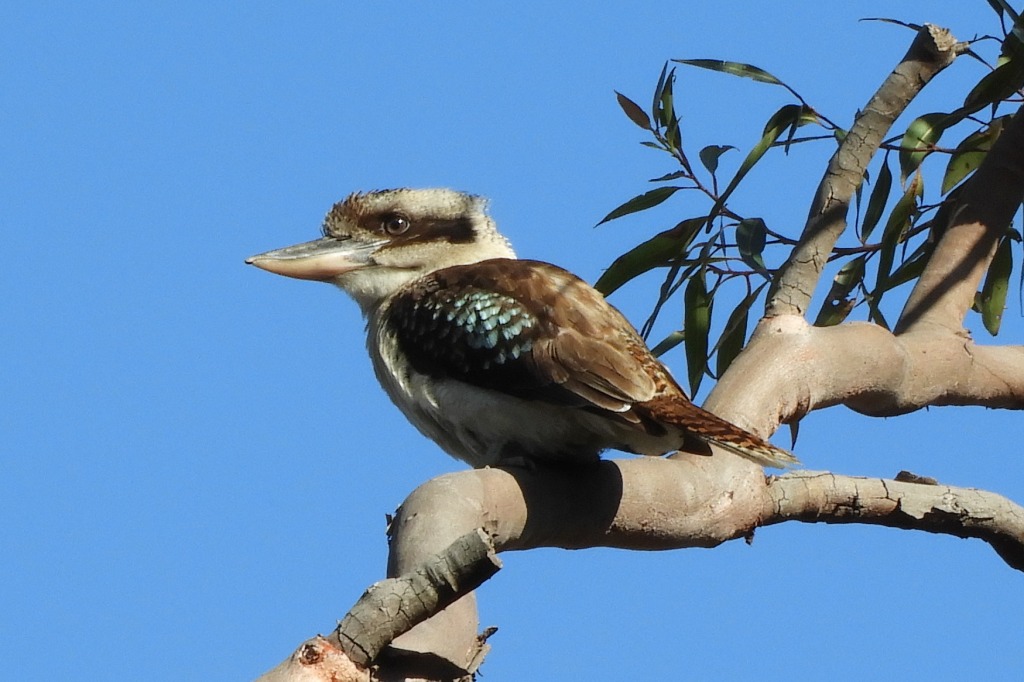
A bonus bird: Just after the Channel-billed Cuckoo flew off, a kookaburra landed on a nearby branch:


 Sydney Birder