Blog Archives

Red-browed Finch builds nest in lichen-covered tree
A little Red-browed Finch wrangles a long supple twig into its nest. The nest is in a lichen-covered tree, making a pretty scene with the red flashes on the bird against the green of the lichen.
The nest is barrel-shaped, bigger than I’d expect for such a small bird, with a small hole at one end:
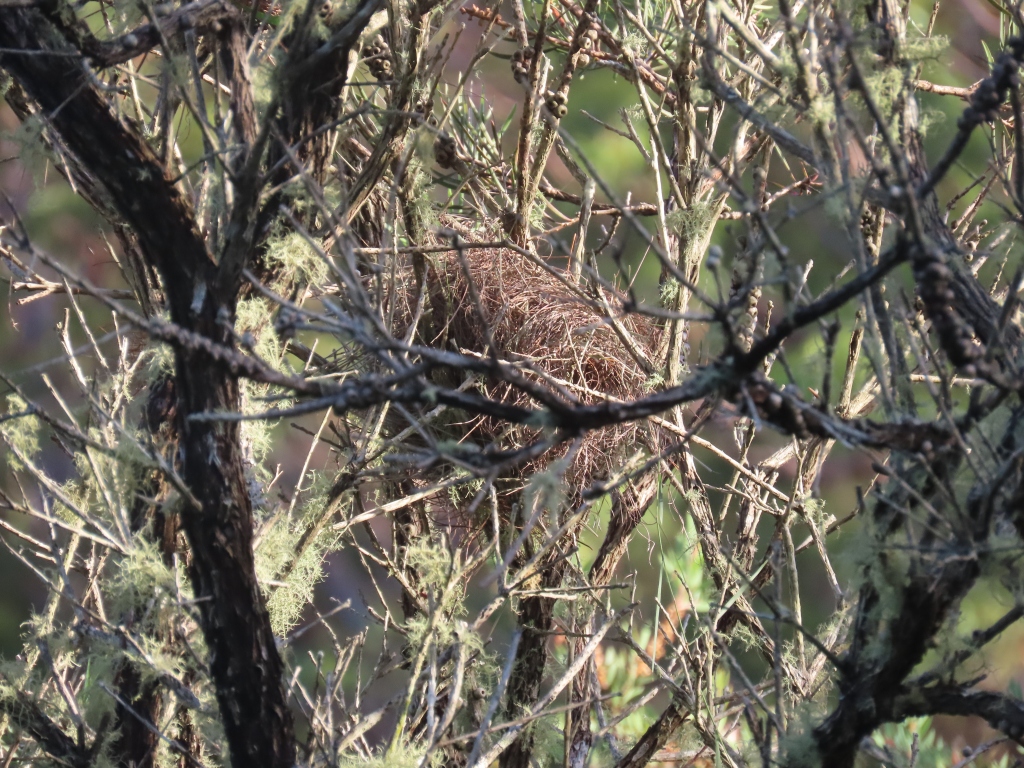
The tree is in a swampy area of Manly Dam. When the weather is wet and humid, the lichen flourishes, as now:
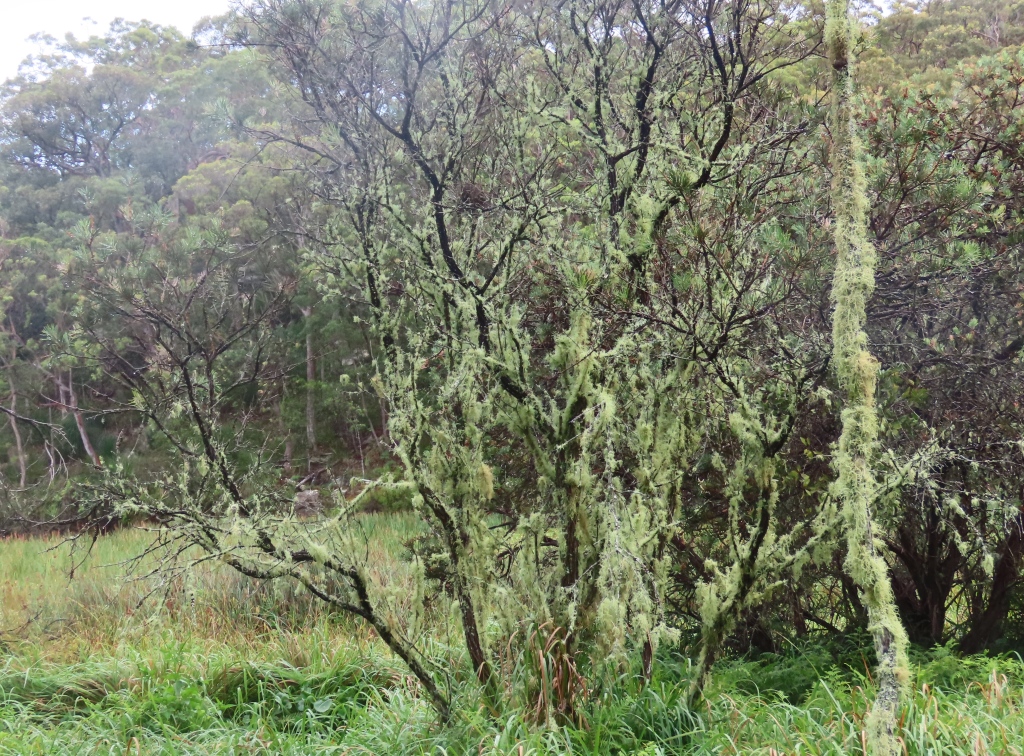
In the dry summer heat yet to come, the lichen will die away, but it always seems to come back.
Common name: Red-browed Finch
Scientific name: Neochmia temporalis
Approximate length: 12 cm
Date spotted: 22 December 2023 (summer)
Location: Manly Dam park, near Sydney: 33°46’23.1″S 151°14’35.9″E

Young Shufflewing being fed
Black-faced Cuckoo-shrikes are often called Shufflewings, because they flip their wings up and down a little each time they land. I hear the birds calling often while walking in the bush, and see them sometimes too. Usually, though, they’re high in the treetops and difficult to spot. It’s been a long-time ambition of mine to catch a video of one doing the wing-shuffle.
Today was my lucky day. Not only did I film the wing-shuffle of an adult Black-faced Cuckoo-shrike, but I also saw a juvenile being fed by adults. The birds were quite low down in a Casuarina tree, probably because that’s where the youngster landed after emerging from its nest.
In the first video, an adult bird lands next to the youngster and feeds it a parcel of food before flying off to a higher branch. The adult sits up high for a while, holding another tasty morsel in its beak. Adult and child trill softly to each other. The adult then drops down and feeds the little one again. When it lands on another branch, it does one of its characteristic wing-shuffles.
The second video starts with an adult bird carrying some food in its beak. The bird visits the youngster, passes over the food and hangs around for a short time, then flies off. The youngster takes some time to swallow the food, while gazing around and calling for the next morsel.
Here’s a still picture of the young bird:

The youngster again, from a different angle:

Here’s the adult, posed neatly against a blue sky:
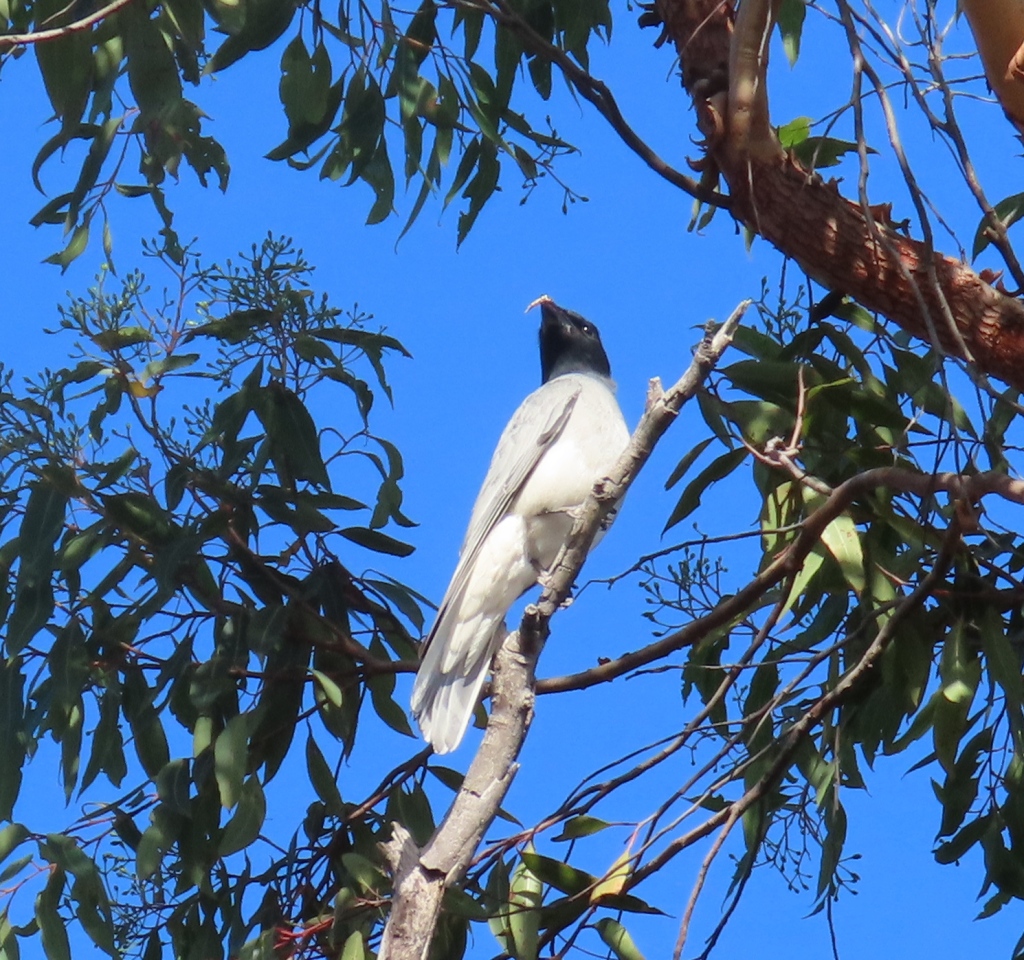
Despite their name, Black-faced Cuckoo-shrikes aren’t shrikes, nor even cuckoos. Evidently they acquired the name because their beaks have the same hooked end as a shrike’s and their feathers have similar patterns to some cuckoos.
These are beautiful, graceful birds to see and hear. I’ve posted descriptions of other Black-faced Cuckoo-shrikes that I’ve spotted over time.
Common name: Black-faced Cuckoo-shrike, also called a Shufflewing
Scientific name: Coracina novaehollandiae
Approximate length: 35 cm
Date spotted: 22 December 2023 (summer)
Location: Manly Dam Park, New South Wales, Australia: 33°46’53.2″S 151°15’08.0″E

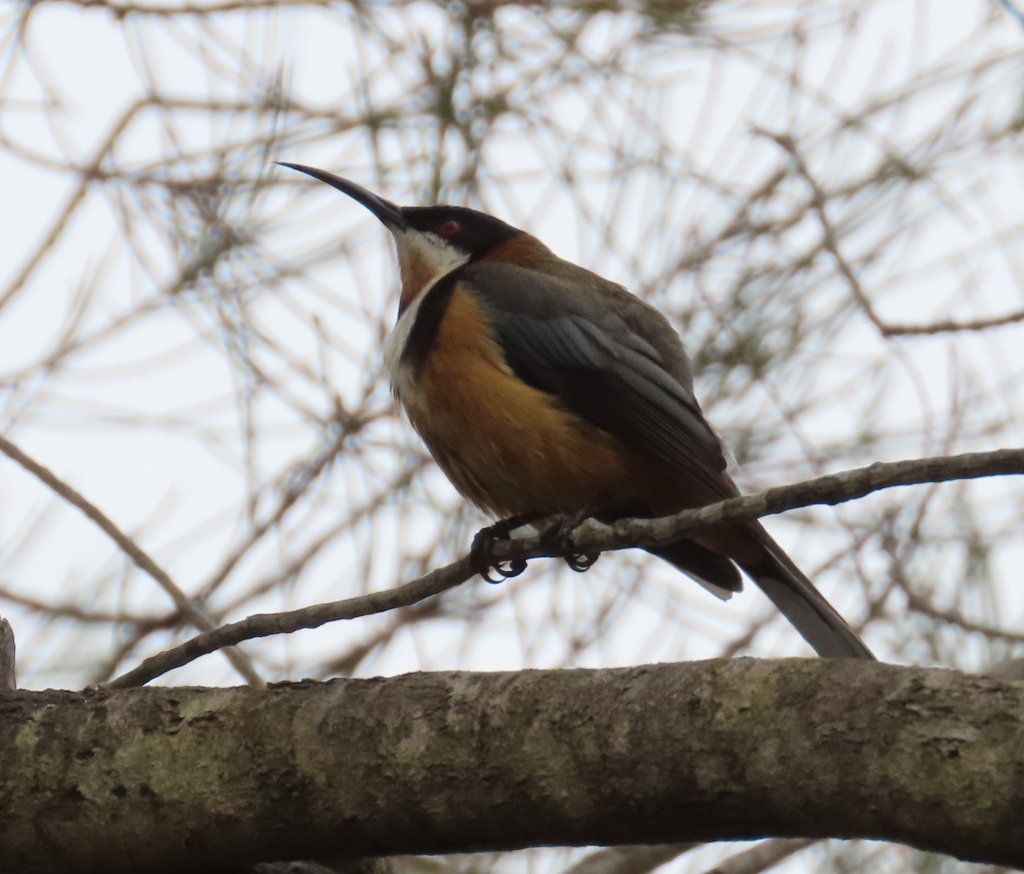
Eastern Spinebill all fluffed up
Usually, Eastern Spinebills look sleek and well groomed. This one seems to be having a bit of an off day.
Common name: Eastern Spinebill
Scientific name: Acanthorhynchus tenuirostris
Approximate length: 16cm
Date spotted: 19 November 2023 (spring)
Location: Manly Dam Park, New South Wales, Australia: 33°46’23.8″S 151°14’38.2″E

White-cheeked Honeyeater enjoying the spring blossoms
A White-cheeked Honeyeater peeks out from a flower-covered bush. The bird is mostly black and white, but you can just make out some of the yellow markings on its wings and tail:
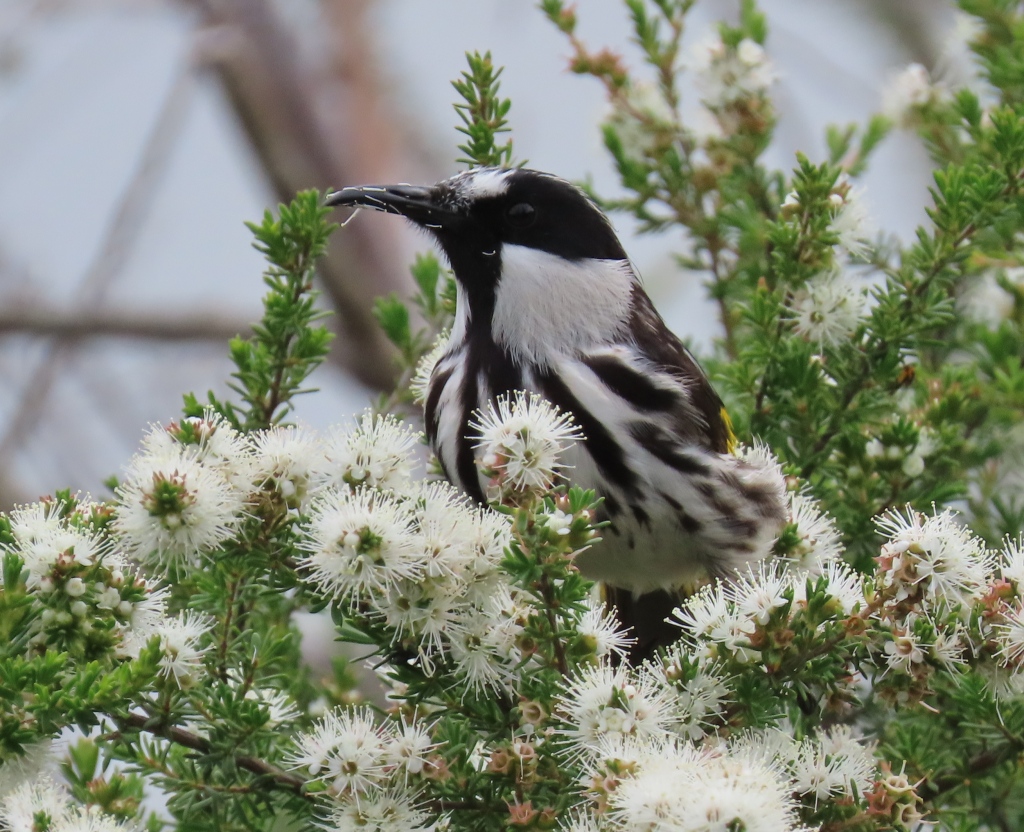
If you have trouble distinguishing these little birds from New Holland Honeyeaters, you’re not alone! This one has the black eye and large white cheek patch that identify it as a White-cheeked Honeyeater. A while ago, I took some photos of both birds to compare them.
Common name: White-cheeked Honeyeater
Scientific name: Phylidonyris nigra
Approximate length: 16-19 cm
Date spotted: 20 November 2023 (spring)
Location: Manly Dam Reserve, New South Wales, Australia: 33°46’30.3″S 151°14’46.6″E

Two Sacred Kingfishers at Manly Dam
A rare treat! This morning I saw two Sacred Kingfishers resting on a clump of dry bush at the edge of Manly Dam. I’ve seen a kingfisher at Manly Dam twice before, both near the dam wall. These two were in a different area, at an inlet on the north west side of the dam.

Before I saw the birds, I’d heard their call, though I didn’t know what it was at the time. It was a fairly high-pitched, insistent sound, uttered in groups of two to four squawks: “kik-kik-kik-kik”.
I think the one on the left might be male, and the one slightly higher up on the right might be female. Females have more green and less blue on their wings than the males do.
Kingfishers are related to kookaburras. (See my earlier posts for pictures of kookaburras.) But whereas Laughing Kookaburras are quite large (47 centimetres from head to tail), Sacred Kingfishers measure only 20 centimetres.
For comparison, here’s a kookaburra from another day:

Back to today’s Sacred Kingfishers: At one stage, both birds turned round to show me the backs of their heads. They look much more like colourful kookaburras now:
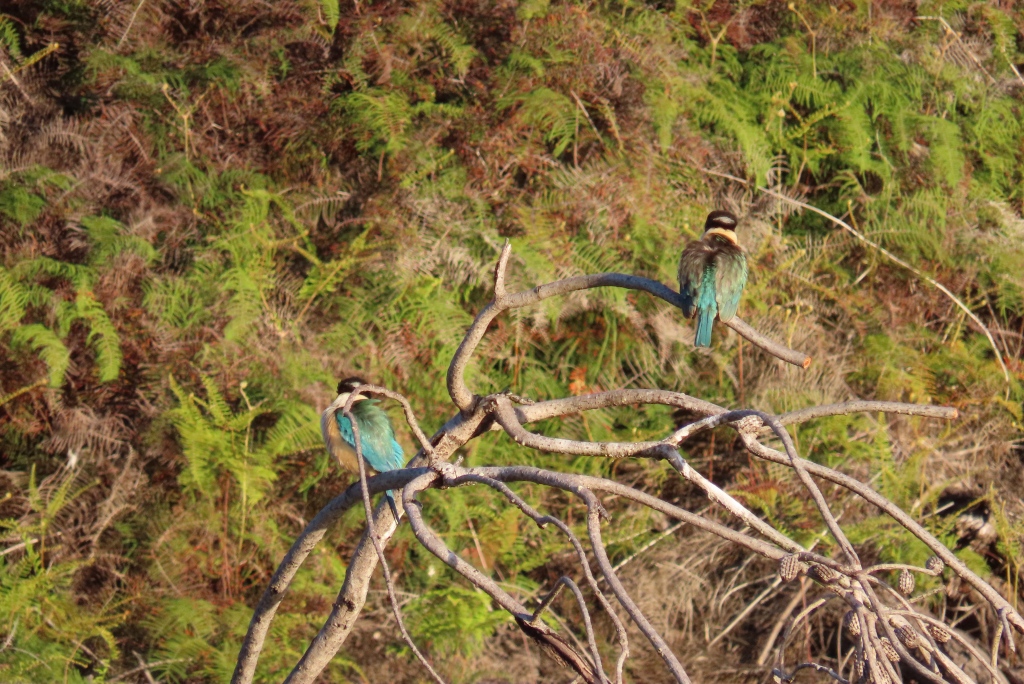
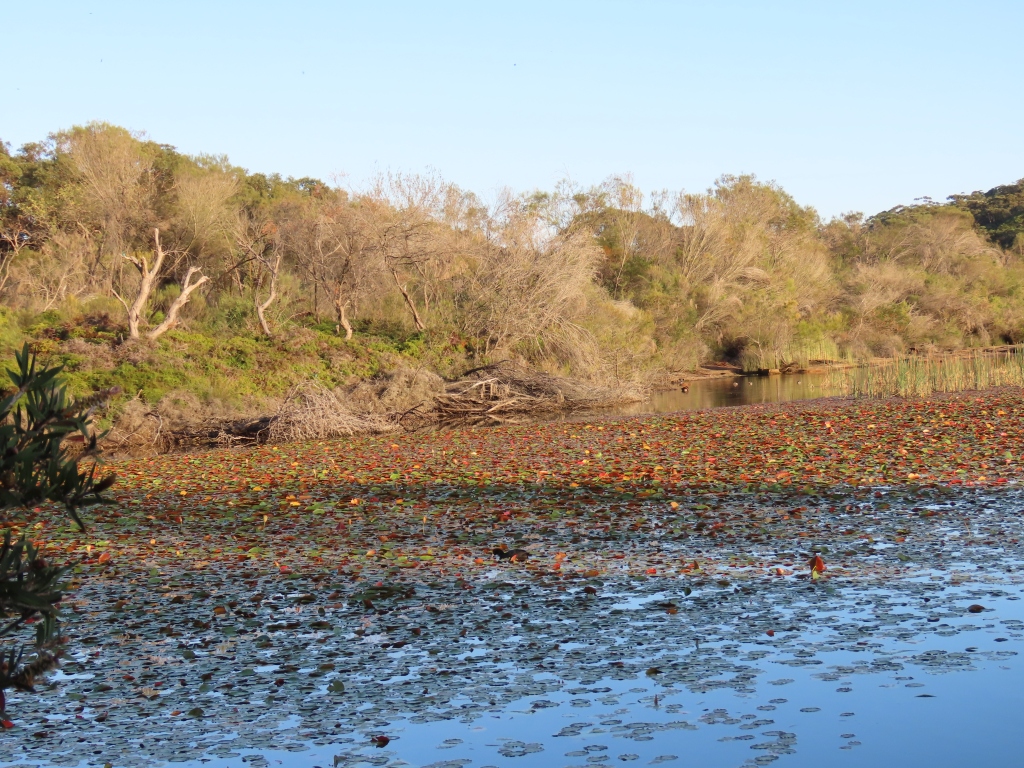
The next picture shows the bank of the dam where the birds were sitting. I was on the far side of the inlet. You might just be able to make out one of the kingfishers on the clump of dead bush towards the middle left of the picture. The other kingfisher had been chased away by a Willy Wagtail!
Common name: Sacred Kingfisher
Scientific name: Todiramphus sanctus
Approximate length: 20 cm
Date spotted: Saturday 14 October 2023 (spring)
Location: Manly Dam Park, New South Wales, Australia: 33°46’34.4″S 151°14’48.9″E

Gorgeous male Fairy-wren with glossy blue tail
I took a number of shots of this lovely little Variegated Fairy-wren. As usual, only one of the shots was anywhere near usable. Here it is:

Like many bird names in Australia, the name “fairy-wren” is misleading. These birds aren’t actually wrens. They’re related to honeyeaters and pardalotes.
This one is a male, and in full breeding colour. I haven’t seen such a glossy blue tail before!
Common name: Variegated Fairy-wren
Scientific name: Malurus lamberti
Approximate length: 13 cm
Date spotted: 5 October 2023 (spring)
Location: Manly Dam Park, New South Wales, Australia: 33°47’00.6″S 151°15’19.5″E
Pair of White-faced Herons in Sydney Harbour
A pretty pair of White-faced Herons were strutting their stuff at Forty Baskets Beach this morning. They were quite interested in each other, and the feathery plumes on their backs were quite noticeable. It looks as if breeding season has started.
In this video, the pair of herons are on a small boat moored just off the beach. All is peaceful until the seagulls start bullying the herons. After ducking a few incoming gulls, the herons take off and fly past me, landing on some rocks near by. Along comes a small dog (off scene). The dog owner tells the dog to wait. The dog doesn’t threaten the birds in any way, but they decide it’s politic to move to a different spot. They fly past me again, and come to rest in a quiet little bay.
Aside from the noise made by the seagulls and the sea, you can hear some raucous Sulphur-crested Cockatoos in the background. And, if you listen very carefully, you can hear the softer grunting croaks of the herons as they fly past me and then land on the rocks.
Scientific name: Ardea novaehollandiae
Approximate length: 66-69 cm
Date spotted: 5 August 2023 (winter)
Location: Forty Baskets Beach, Sydney Harbour, New South Wales, Australia: 33°48’15.8″S 151°16’13.9″E

Grey Goshawk in quiet contemplation
On a walk through the Australian forests near Sydney, I stopped on a rocky ledge to take in the view. Then I noticed a Grey Goshawk on a branch close by, also gazing out across the valley.
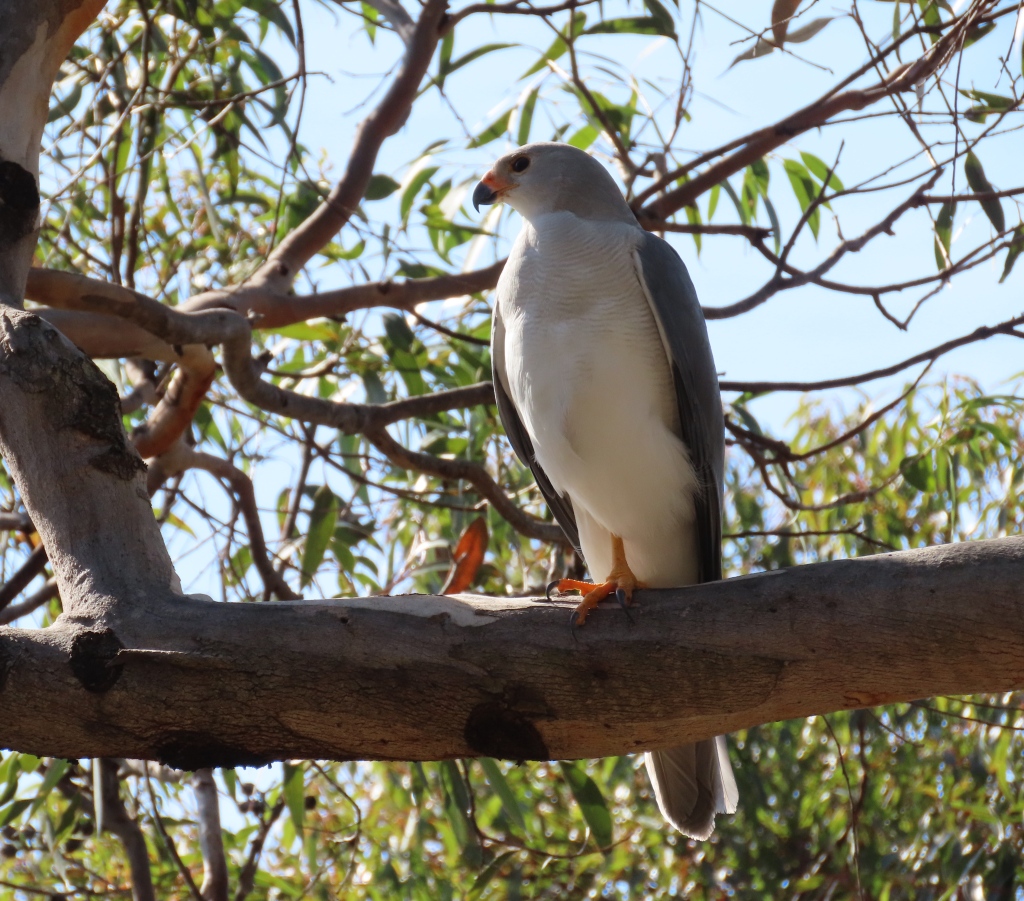
These beautiful birds of prey are quite sturdy, about 55 cm in length from head to tail, and have a wingspan of about one metre. Their chest and belly feathers are white with light grey horizontal bars. The head is grey, with large dark eyes outlined in yellow, and a yellow beak tipped in dark grey. Add the dark grey wings and tail feathers, and you have a very striking bird.
The goshawk was standing on one leg, with the other foot tucked under its belly feathers. The bird turned its head to see whether I posed it any danger, then went back to quiet contemplation of the view.

After five minutes or so, it hopped off the branch and glided away.
This is only the second time I’ve managed to snap some photos of a goshawk, though I’ve seen them a couple more times.
Common name: Grey Goshawk
Scientific name: Accipiter novaehollandiae
Approximate length: 40-55 cm. Wing span: 70-110 cm.
Date spotted: 4 August 2023 (winter)
Location: Manly Dam Reserve, New South Wales, Australia: 33°46’54.8″S 151°15’03.5″E

Pardalotes nesting on a Sydney beach
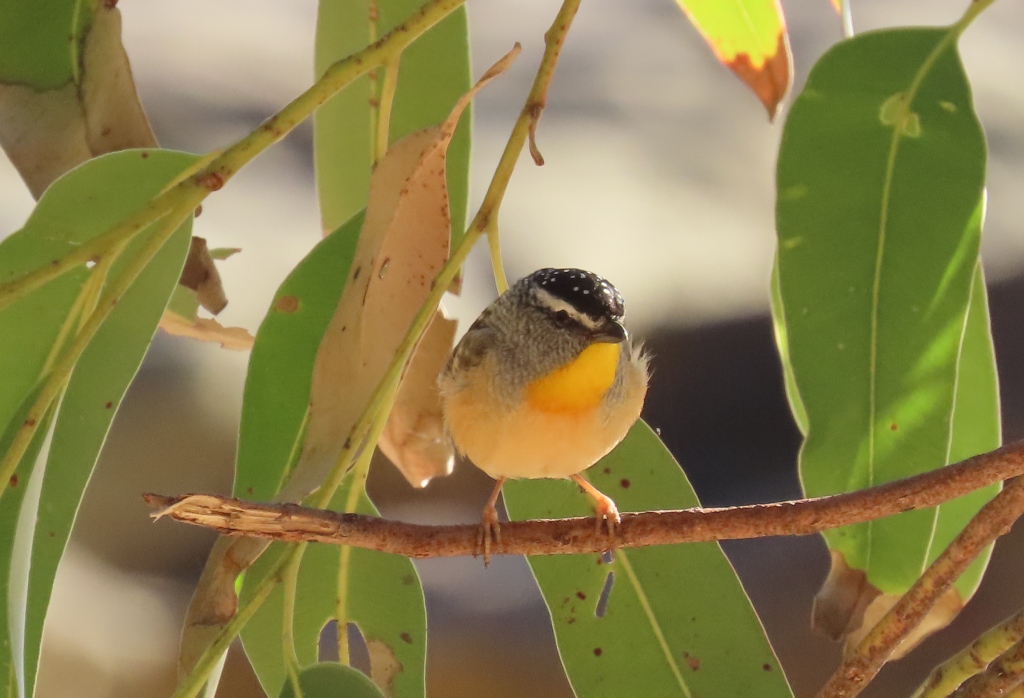
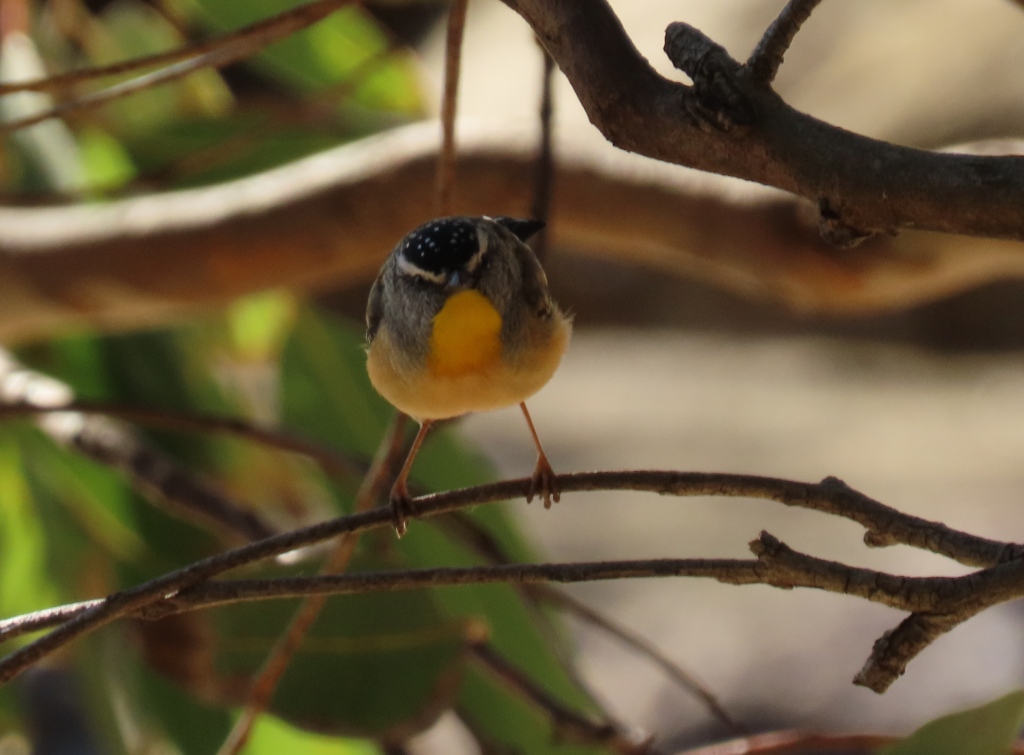
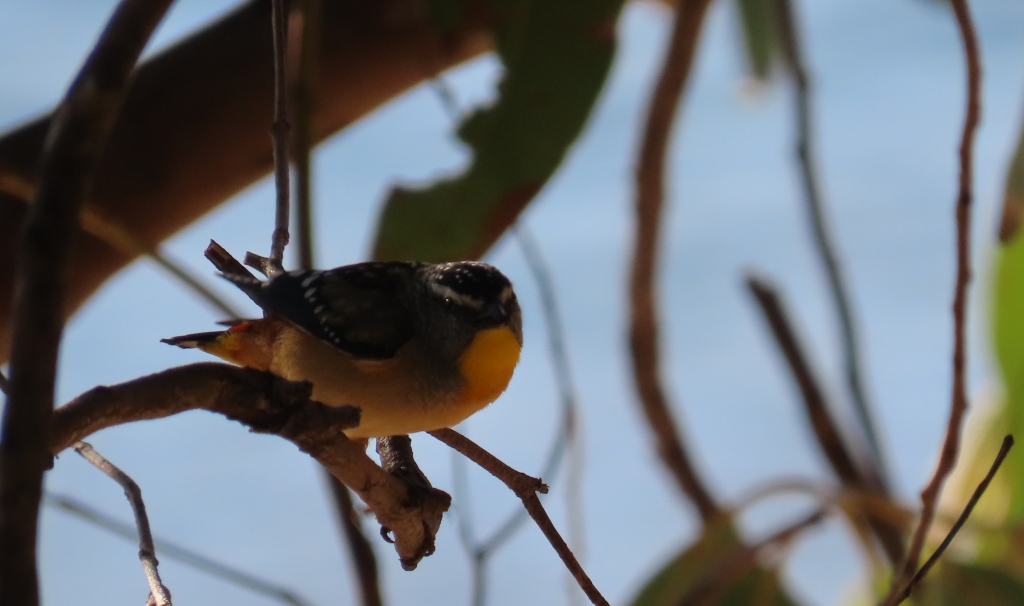
Pardalotes are unusual in that they build their nests underground, usually at around ankle height. This morning I spotted a couple of the birds flitting around a grassy bank on a beach in Sydney Harbour. With a bit of patience and the benefit of my camera’s super zoom, I was able to see the birds going in and out of their nesting tunnel.
The next video shows the male bird waiting on a tree branch until the coast is clear, then flitting off towards the nest:
Here’s the female, also checking for danger near the nest:
These are Spotted Pardalotes, also called Diamondbirds. They’re one of the smallest of Australian birds, at approximately 10 cm from head to tail. I’m often surprised at how unbothered they seem by my presence.
The female has a pale, faun-coloured chest. Her head and back are prettily dotted with spots, and her tail is aflame with red and yellow.

The male has an orange-yellow chest. The white stripes across its eyes are more pronounced than those of the femail, and there’s more black on the head and back, making the white spots stand out.
Common name: Spotted Pardalote or Diamondbird
Scientific name: Pardalotus punctatus
Approximate length: 10 cm
Date spotted: 29 July 2023 (winter)
Location: Reef Beach in Sydney Harbour

Spitfire grubs and Kookaburras
While wandering along a bush path, I came across a curious collection of grubs:
They’re spitfire grubs, which are the larvae of a type of wasp called a sawfly. The grubs look quite a lot like caterpillars with a don’t-mess-with-me attitude. They’re black and shiny, with white bristles, yellow feet, and a yellow tail. They’re quite long and fat: about the size of my little finger.
Despite the name “spitfire”, the grubs don’t actually spit anything, but if you touch them you can get a burning sting from the spikes. The grubs also spew out a thick yellow liquid from their mouths when threatened, but the liquid isn’t harmful to people. It’s made from eucalyptus oil, since the grubs feed on eucalyptus leaves.
In the video, you can see them tapping their tails on the rock. They do that to communicate their whereabouts with each other.
Here’s a close-up of some of their heads:
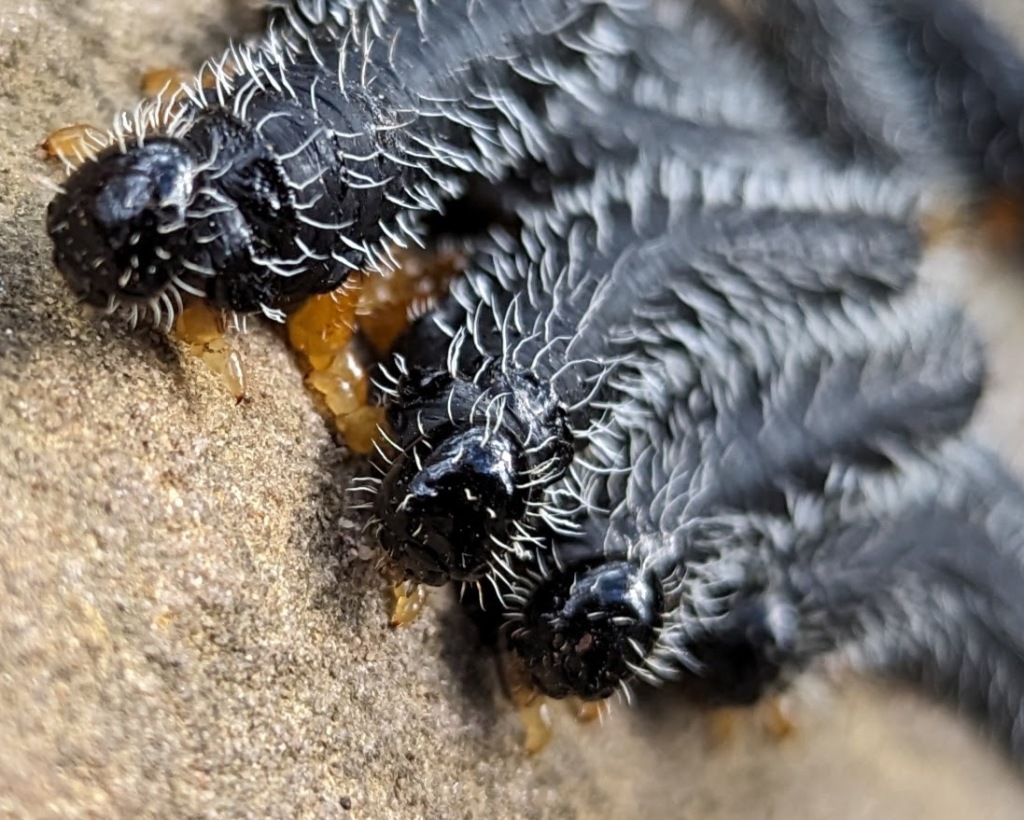
There were ten grubs in the clump:
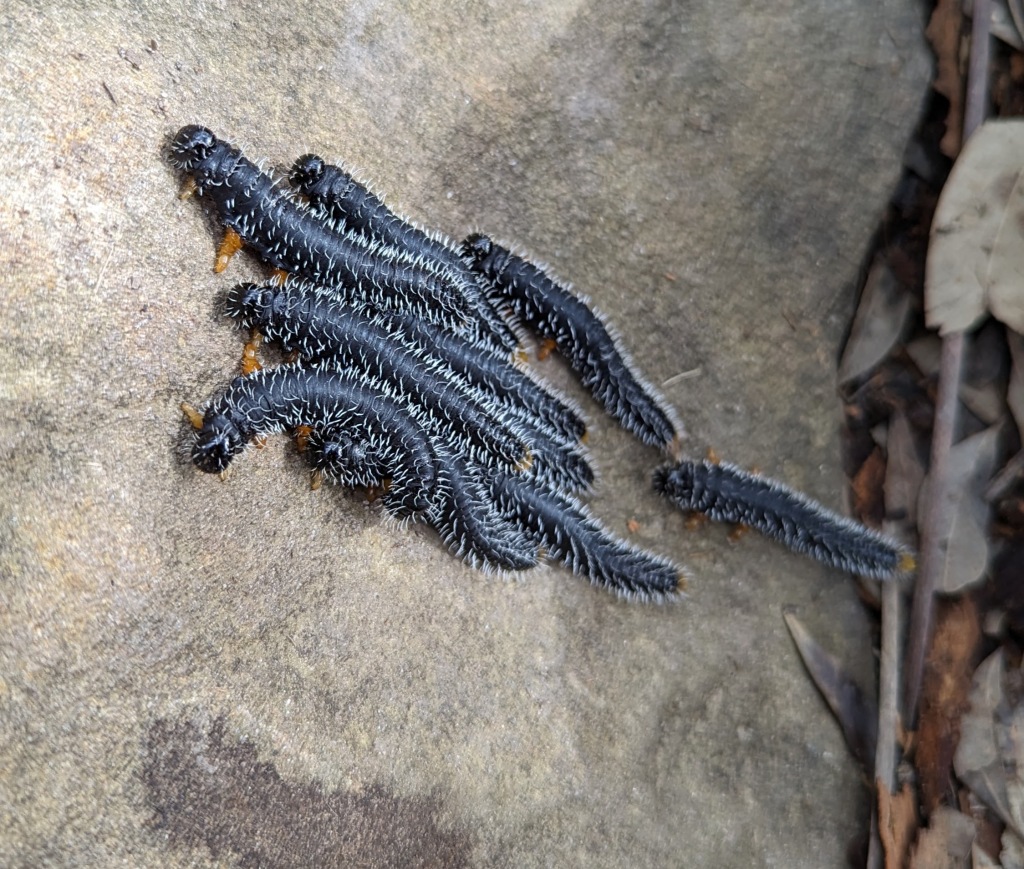
Next on the scene was a riot of Kookaburras! The birds gathered above me while I was bent over the clutch of spitfire grubs. I was worried that the Kookaburras might swoop down and grab a grub as a snack!
The Kookaburras left the grubs alone. I guess they don’t taste great!
Common name: Laughing Kookaburra
Scientific name: Dacelo novaeguineae
Approximate length: 47 cm
Date spotted: 18 July 2023 (winter)
Location: Manly Dam park, New South Wales, Australia: 33°46’56.0″S 151°15’05.4″E


 Sydney Birder