Blog Archives

Cockatoo chases off a falcon
I was walking along a bush path at Manly Dam when I heard a cockatoo making a big fuss on the other side of the creek that feeds into the dam. I looked across the water in time to see the cockatoo leaping off its perch and launching itself towards a branch not far away. As the cockatoo landed on its new perch, a dark shape took off from that same branch and floated away to another tree.
I grabbed my camera and zoomed in on the bird that the cockatoo had chased off. It was a Nankeen Kestrel:
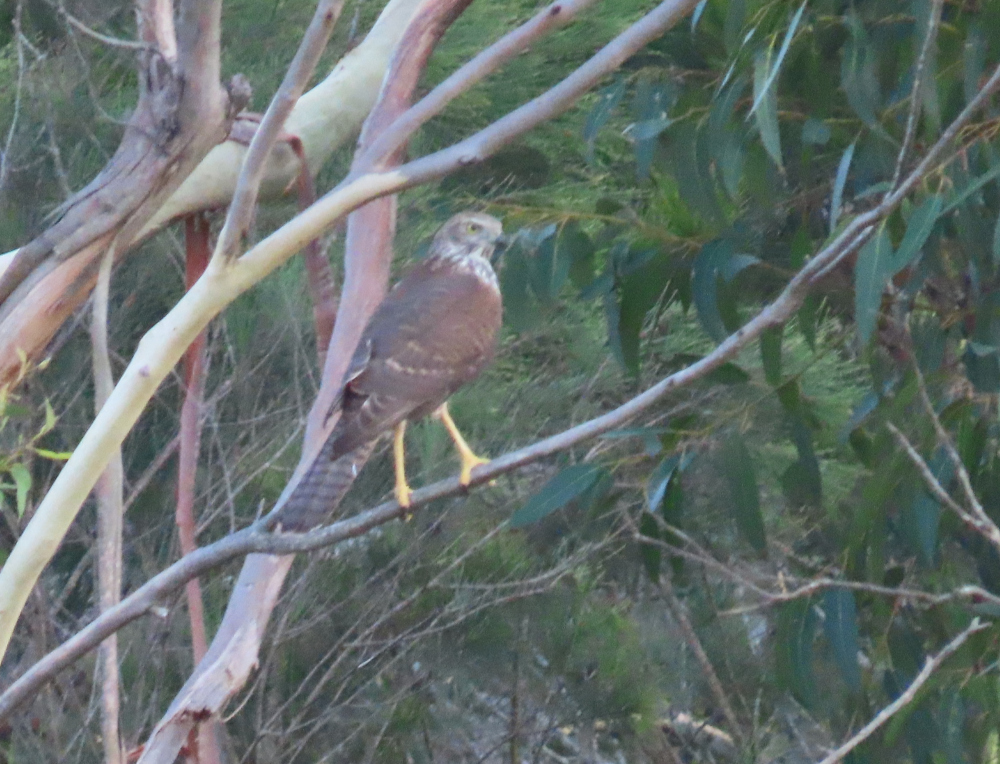
It looks like a female bird, with its light-coloured head and the dark-grey “tear mark” going down vertically from its eye.
Common name: Nankeen Kestrel
Scientific name: Falco cenchroides
Length: 30-35 cm; wing span: 60-80 cm
Date spotted: 29 January 2026 (summer)
Location: Manly Dam Park, New South Wales, Australia: 33°46’19.8″S 151°14’35.5″E
The Sulphur-crested Cockatoo looked very pleased with itself, now owning the area where the hawk had been resting:
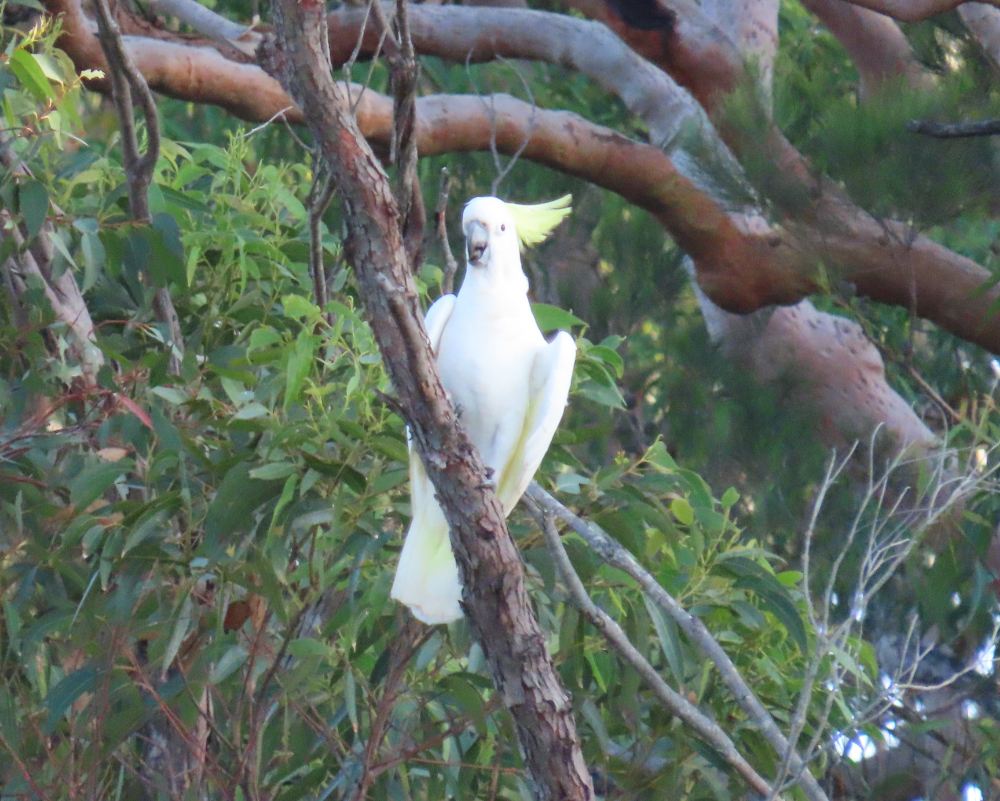
Common name: Sulphur-crested Cockatoo
Scientific name: Cacatua galerita
Approximate length: 50 cm; wing span: up to 103 cm
It takes a brave bird to attack a falcon. On the other hand, it takes a brave bird to stand up to a cockatoo, especially when the cockatoo is bigger than you. I think the falcon was vulnerable as it was perched on a branch. If it had been in the air, the cockatoo might have come off worse.
The photos aren’t very clear, since the birds were far away on the opposite side of the dam. Still, they’re good enough to identify the birds.
After a couple of minutes of enduring the cockatoo’s screeching and prancing, the kestrel decided enough was enough. It floated away in search of a quieter location:
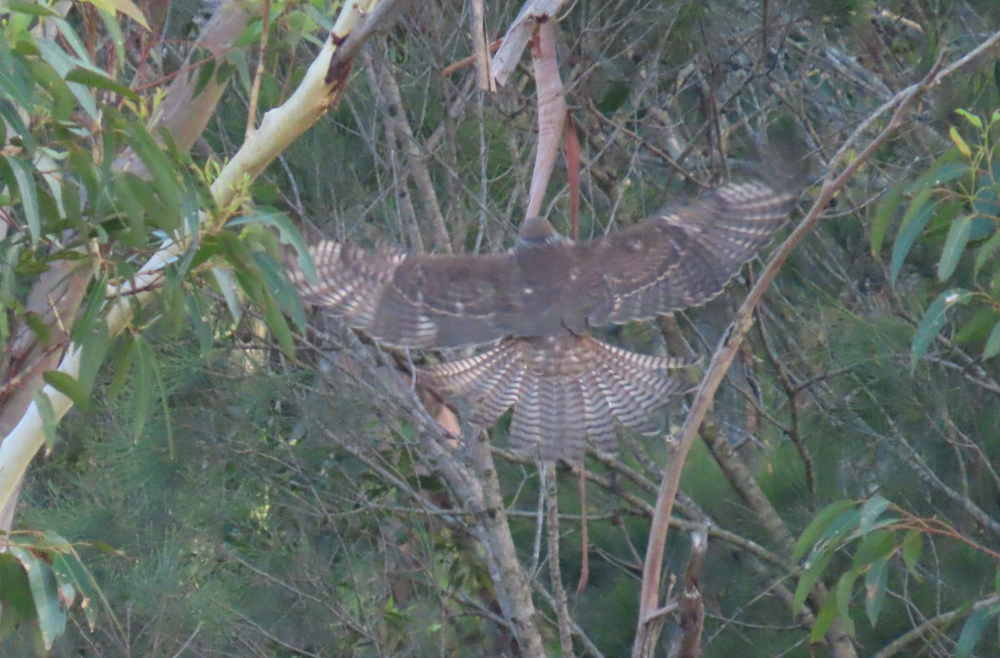
Nankeen Kestrels are small falcons, quite common in Australia. They feed on small mammals and birds, reptiles, and insects.
This is only the second time that I’ve spotted a Nankeen Kestrel. My first sighting was of a male bird in Victoria.
Happy bush-walking all!

Wild cockatoos come up close for a chat
This morning, I was out for a walk in the bush near Sydney, Australia, when I spotted two Sulphur-crested Cockatoos on a bush overhanging the path. As I came along the path, I spoke softly to the birds, as I often do. It’s partly because they’re so friendly-looking (anthropomorphism, I know!) and partly in the hope that I won’t scare them unduly. Many birds seem to respond well to being spoken to.
When I was close, the two cockatoos glided down to join their mates on the bank of a creek just below. I crouched down to take some photos. After a couple of minutes, the group of birds fluttered up and joined me on my rocky outcrop. They were on the ground next to me, just a foot or so away. It was a lovely, though slightly daunting, experience.
In the video, you can hear some Grey Fantails and a Golden Whistler, as well as the cockatoos.
Here’s one of the cockatoos on the bush overhanging the path, before the bird dropped down to join the gang on the bank of the creek. It’s enjoying an Acacia seed pod:

Common name: Sulphur-crested Cockatoo
Scientific name: Cacatua galerita
Approximate length: 50 cm
Date spotted: 29 August 2025 (winter)
Location: Manly Dam Reserve, New South Wales, Australia: 33°46’50.9″S 151°14’52.3″E

Pacific Baza chased by cockatoos
I was walking along Forty Baskets Track on Sydney Harbour when the Sulphur-crested Cockatoos started making an enormous ruckus. They took to the sky in a large flock and circled overhead screaming blue murder.
When I managed to find a gap in the tree canopy, I saw that the cockatoos were chasing a large bird of prey:
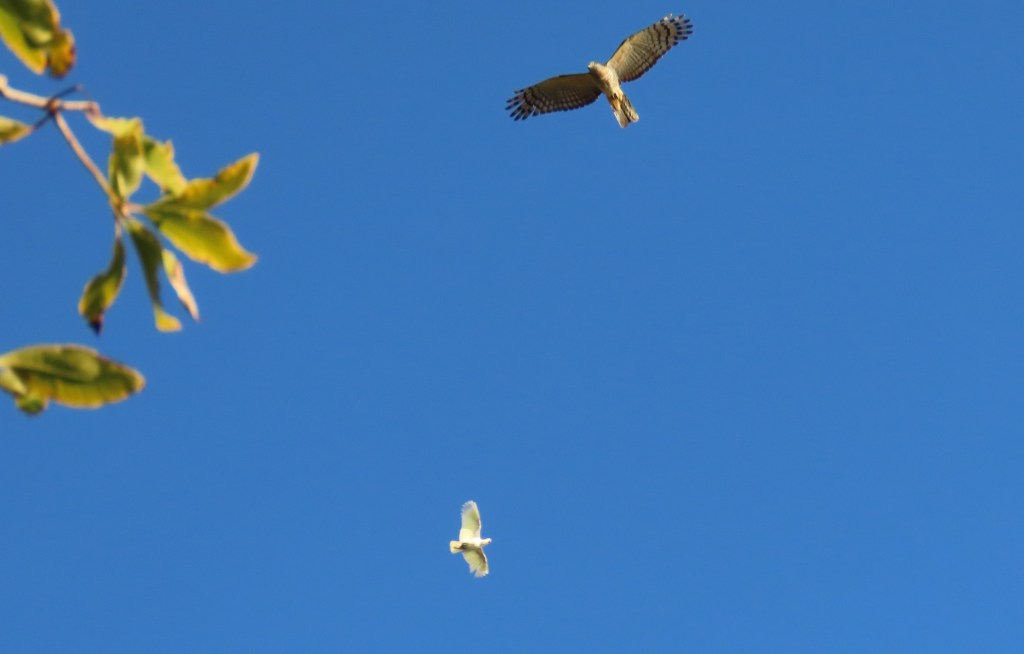
I followed the pack of birds for about 15 minutes, back and forth along the track. The bird of prey landed in the tree tops a few times, and I was able to identify it as a Pacific Baza. I managed to see the crest on its head, but didn’t get a good enough photo of the crest to post here. This is the best photo I got of the bird at rest:

Pacific Bazas are uncommon, mostly found in north and north-east Australia, and are rare in New South Wales (where I am). They eat small reptiles, and praying mantises and stick insects (both of which can be quite large in Australia).
Common name: Pacific Baza
Scientific name: Aviceda subcristata
Length: 35-45 cm
Wing span: 1 metre
Date spotted: 29 June 2025 (winter)
Location: Forty Baskets Track, Balgowlah, NSW, Australia: 33°48’18.2″S 151°16’18.2″E

A row of cockatoos and one raven

The arrival of the raven: It’s pouring with rain. Several Sulphur-crested Cockatoos line up on the wall of Manly Dam. Clumping together for company in the dismal weather. An Australian Raven joins the line-up. The cockatoos eye the interloper up and down, but don’t make too much of a fuss. Some of them get bored and head for a nearby tree:
Off camera: A runner arrives and the rest of the cockatoos depart for the tree. The raven doesn’t budge. Another raven arrives.
The return of the cockatoos: They need to reclaim their perch! The strategy seems to be simply to pile into the line-up until it becomes too uncomfortable for the ravens. One raven departs quickly, the other sticks it out for a while, then decides to retreat to a higher roost and gaze down at the silly, squawking cockatoos:
Common name: Sulphur-crested Cockatoo
Scientific name: Cacatua galerita
Approximate length: 50 cm
Common name: Australian Raven
Scientific name: Corvus coronoides
Approximate length: 50 cm
Date spotted: 28 March 2025 (autumn)
Location: Manly Dam, New South Wales, Australia: 33°46’55.3″S 151°15’20.1″E
Cockatoos on a shed roof
A gang of Sulphur-crested Cockatoos dropped by to examine our shed roof and munch some grass seeds. One of the birds rather liked the noise the roof made when he jumped on it. Another bird is rather mucky, with brownish feathers. Perhaps he’s been dumpster diving? It’s interesting watching the interaction between the birds as they share a spray of grass flowers.

3 parrots on one walk
A few days ago I went for a walk and saw three different types of parrots all within a few paces of each other. How amazing is that!
First up, a trio of King Parrots. Two were males, the other a female. This is one of the males:

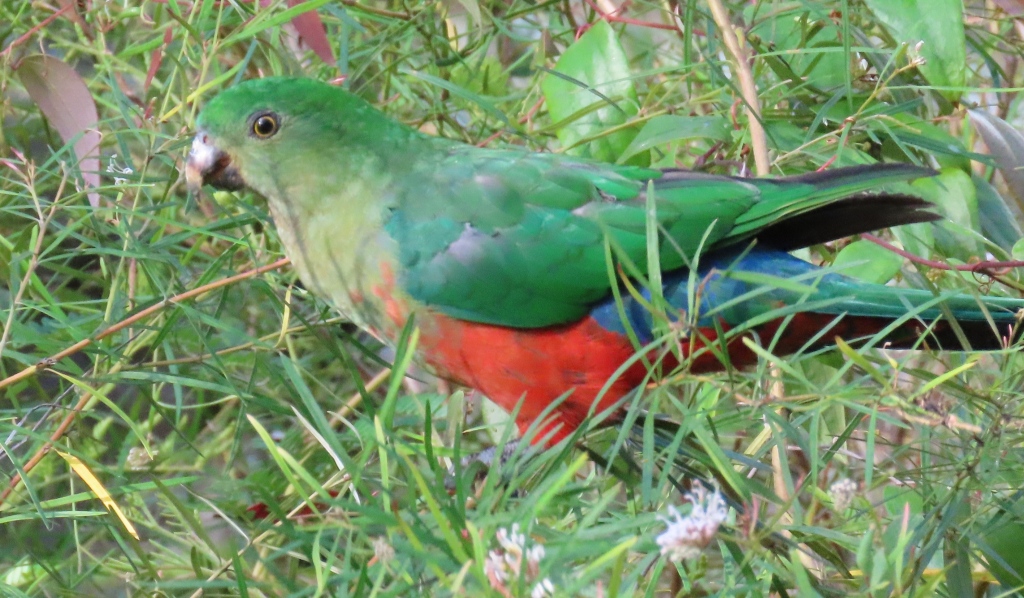
King Parrots are quite large, at 44 cm from head to tail. The females have a lot more green in their colouring. I think they’re prettier than the males, with their softer shading:
This video shows all three of the birds enjoying the flowers of a Grevillea bush. First you see the two males together. Then one of them flies over to join the female on the other side of the bush:
In the trees around the parrots, the smaller Rainbow Lorikeets chattered and scolded. Here’s one in a more contemplative mood than most:

One of them stood still for a while to examine me, before launching itself in my direction then swerving at the last moment as they are wont to do:
At the next tree, a group of Sulphur-crested Cockatoos examined a tree hollow. Perhaps a good place to raise a family? But competition is fierce!
Here’s one of the cockatoos making a point about ownership, or perhaps just being its usual excited self:

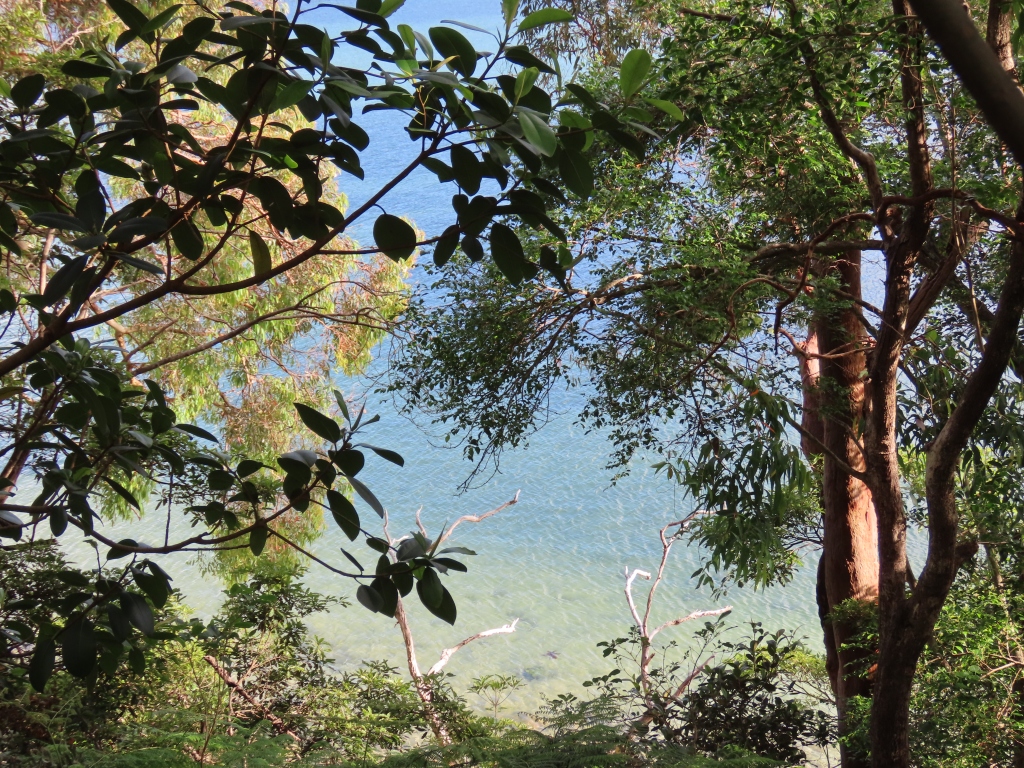
The walk itself is lovely, starting in Balgowlah and winding along the coast of Sydney Harbour, with bushland and forest on one side:

And pretty views of the waters of Sydney Harbour on the other side:
The birds:
Common name: Australian King Parrot
Scientific name: Alisterus scapularis
Approximate length: 44 cm
Common name: Rainbow Lorikeet
Scientific name: Trichoglossus haematodus
Approximate length: 30 cm
Common name: Sulphur-crested Cockatoo
Scientific name: Cacatua galerita
Approximate length: 50 cm
Date spotted: 26 November 2022 (spring)
Location: Near Forty Baskets beach, Sydney Harbour, New South Wales, Australia: 33°48’03.2″S 151°16’07.2″E

Cockatoo sculpted by sunlight
It can be difficult to get a good photo of a white cockatoo, because they’re so uniformly white. My camera tends to treat them as an uninteresting blob of uniform colour, unless I can get really close to the bird. I was quite pleased with this shot. Even though the bird was high in a tree, the early morning sun glows nicely through the cockatoo’s yellow crest and adds contour to the bird’s body:

The video of the same cockie is also rather nice. The bird is screeching and waving its head around, as they often do. It’s having fun with a small pool of water in a tree hollow, dipping its beak in and throwing water droplets around:
Common name: Sulphur-crested Cockatoo
Scientific name: Cacatua galerita
Approximate length: 50 cm
Date spotted: 3 April 2022 (autumn)
Location: Angophra Track, Balgowlah Heights, New South Wales, Australia: 33°48’20.9″S 151°16’17.8″E
Local cockatoos excited about new tree stumps
Over the last few weeks, our neighbours have been cutting down some tall trees on their property. The local cockatoos are excited about the new tree stumps that have appeared in their neighbourhood. (I call them “stumps”, but they’re several stories high.) The birds arrive on most evenings to sit on the stumps, and have started hollowing out the centre of one of them. I guess the cockies may be thinking the tree would make a good nest.
You can see the tree felling in my earlier post, Magpie scolds tree feller.

Cockatoo on a beach at sunrise
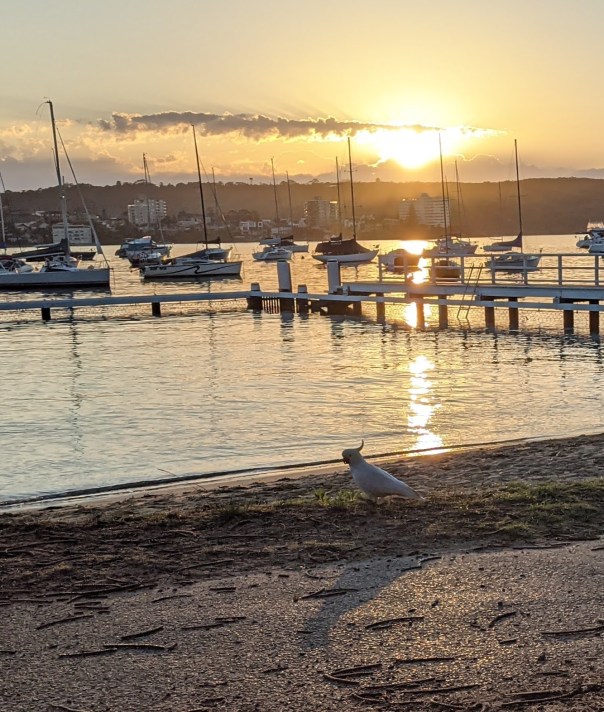
Common name: Sulphur-crested Cockatoo
Scientific name: Cacatua galerita
Approximate length: 50 cm
Date spotted: 27 December 2020 (summer)
Location: Forty Baskets Beach, New South Wales, Australia: 33°48’11.5″S 151°16’12.1″E
Sulphur-crested Cockatoo with orange chest feathers
The Sulphur-crested Cockatoos were out in full force early this morning. I enjoy hearing their conversations, whilethey chatter, scold, and screech at each other. I zoomed in to take this video of one of the birds from close up. It’s interesting to see that the cockatoo has pinkish orange feathers on its chest. I wonder if this is a seasonal variation of the more usual pure white? It’s late spring, and perhaps the colour is an attempt to appear more attractive to the opposite sex.
The next video shows a group of birds wheeling around the trees. You can hear the sounds of other birds when the cockatoos are quiet enough to allow it!
Common name: Sulphur-crested Cockatoo
Scientific name: Cacatua galerita
Approximate length: 50 cm
Date spotted: 1 December 2019 (summer)
Location: Manly Dam Reserve, New South Wales, Australia: 33°46’49.7″S 151°14’56.0″E


 Sydney Birder