Blog Archives
Cockatoos on a shed roof
A gang of Sulphur-crested Cockatoos dropped by to examine our shed roof and munch some grass seeds. One of the birds rather liked the noise the roof made when he jumped on it. Another bird is rather mucky, with brownish feathers. Perhaps he’s been dumpster diving? It’s interesting watching the interaction between the birds as they share a spray of grass flowers.

Bird on a wire – Eastern Rosella
Eastern Rosellas are medium-sized parrots, found on the east coast of Australia. We’re lucky enough to be visited regularly by a pair of them. I don’t know if it’s the same two birds each time, or if our phone line is somehow part of the flight lines for a family of birds.
In this video, the male Eastern Rosella struts along a phone line, spiffy in his breeding colours. Alas, the background sound is noisy, but you can just hear the bird chirping as he does his little hello dance:
The next picture is somewhat whimsical. It’s what my camera made up when the bird flew off. I love the colours and motion in this picture, even if the bird’s head is off camera:

The female glowed in the sunlight:

The male’s colours are brighter, with the divisions between the coloured sections more clearly defined. Deep blue and black scallops outline the wings, while the rest of the bird is yellow and black, and red and white:
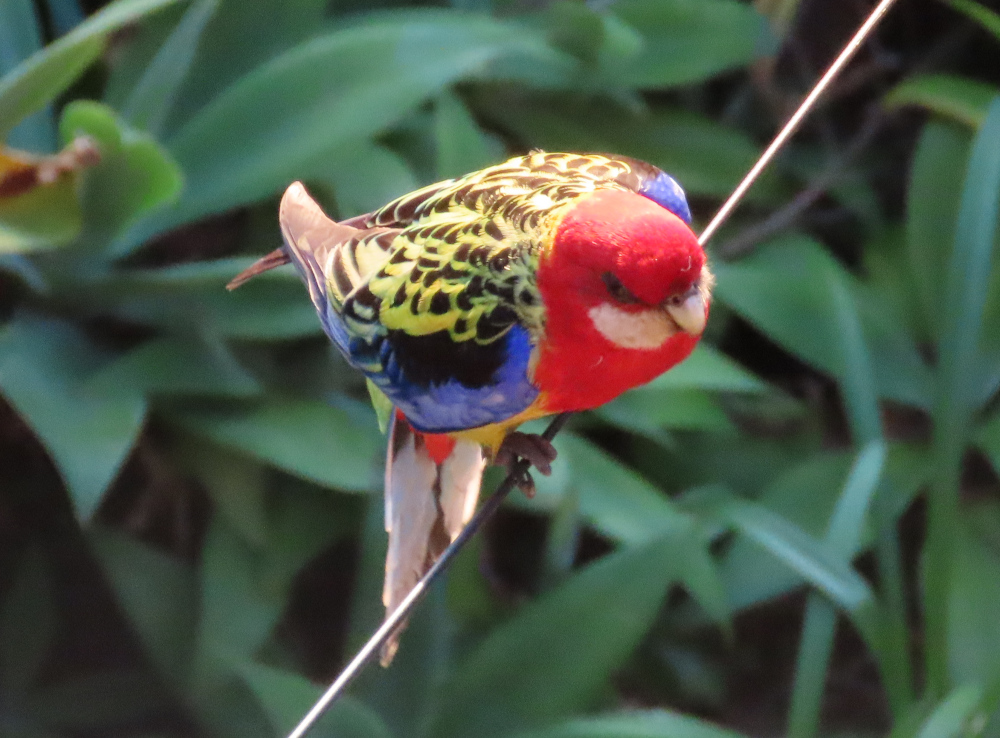
He knows he’s gorgeous!
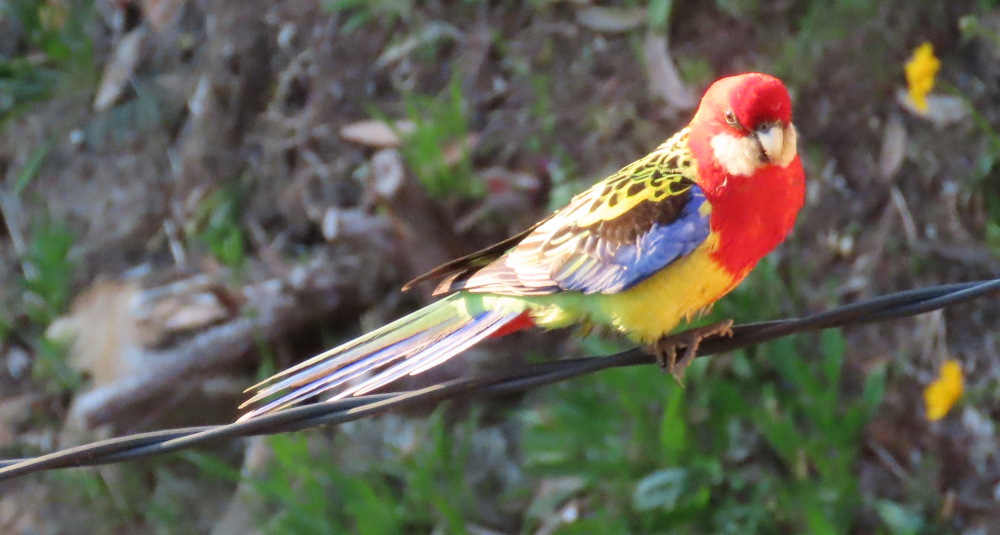
Common name: Eastern Rosella
Scientific name: Platycercus eximius
Approximate length: 30 cm
Date spotted: 28 October 2024 (spring)
Location: Allambie Heights, NSW, Australia

Glossy Black-Cockatoo
Five Glossy-Black Cockatoos are frequent visitors to the Casuarina trees on the edge of Manly dam at the moment. Here’s one of the birds:
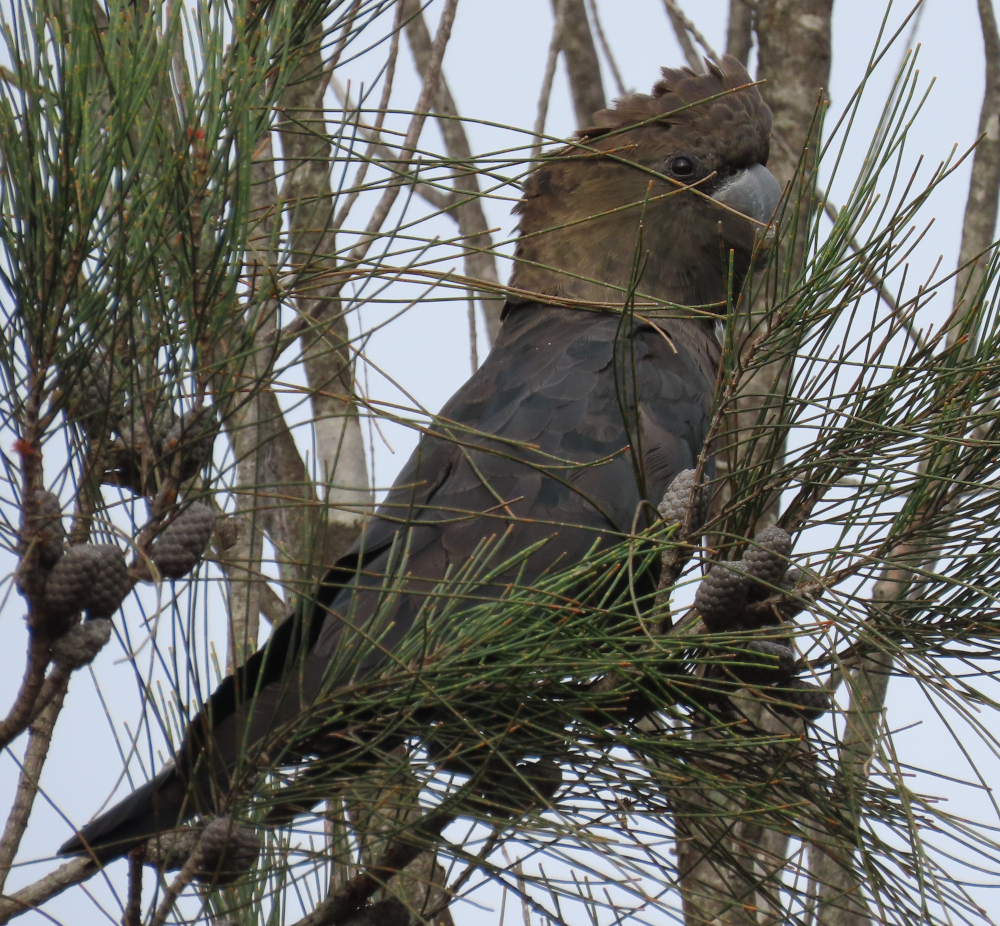
Common name: Glossy Black-Cockatoo
Scientific name: Calyptorhynchus lathami
Approximate length: 50cm
Date spotted: 27 October 2024 (spring)
Location: Manly Dam Park, near Sydney: 33°46’16.4″S 151°14’30.9″E

Mmm, Mountain Devil flowers make a nice change from those tough Banksia pods!
A Yellow-tailed Black-cockatoo contemplates life while demolishing the flower of a Mountain Devil bush.
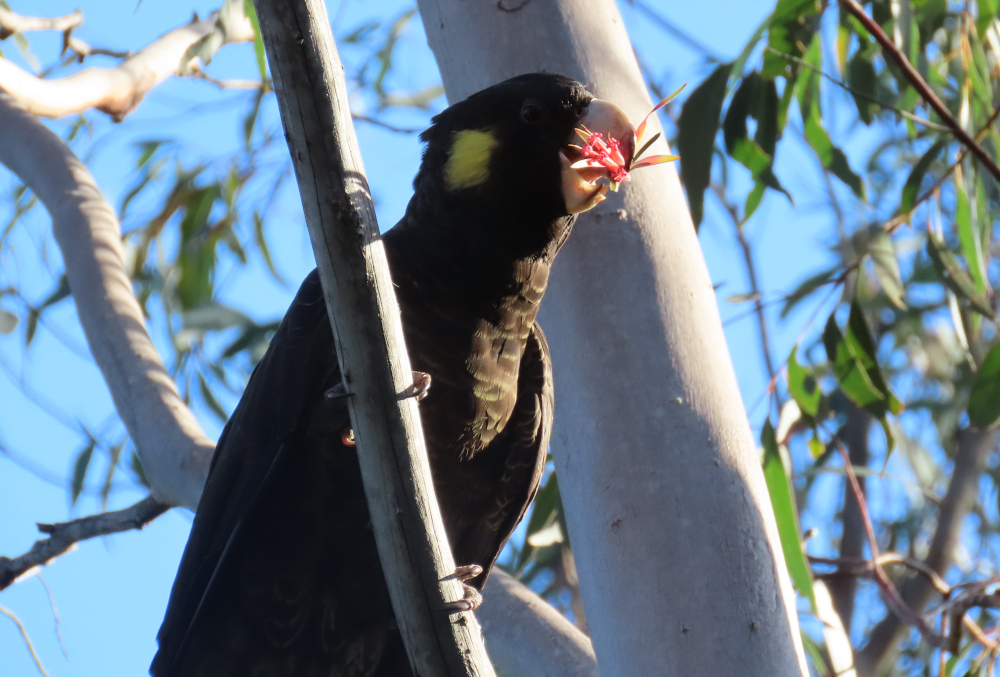
Common name: Yellow-tailed Black Cockatoo
Scientific name: Calyptorhynchus funereus or Zanda funereus
Length: 58-65 cm
Date spotted: 26 October 2024 (spring)
Location: Manly Dam Reserve, New South Wales, Australia: 33°46’40.0″S 151°14’50.2″E

The tranquil parrot: Glossy-black Cockatoos
Of all the various types of cockatoos that we get in our area of Australia, the Glossy-blacks are by far the most restful to be with. When they chatter to each other, their call is a restful croon. They seem to take life easy, with few sudden moves. Watch this one going with the flow while the wind tosses her perch back and forth:
Casuarina seeds are just about the only food that Glossy-black Cockatoos eat. I usually find the birds by the comfortable munching noises that they make, rather than the noisy fuss that other types of cockatoos are fond of making!

This family of three birds has been visiting the Casuarina trees beside one of my current favourite bush walks.

I took these pictures over the period of a week.
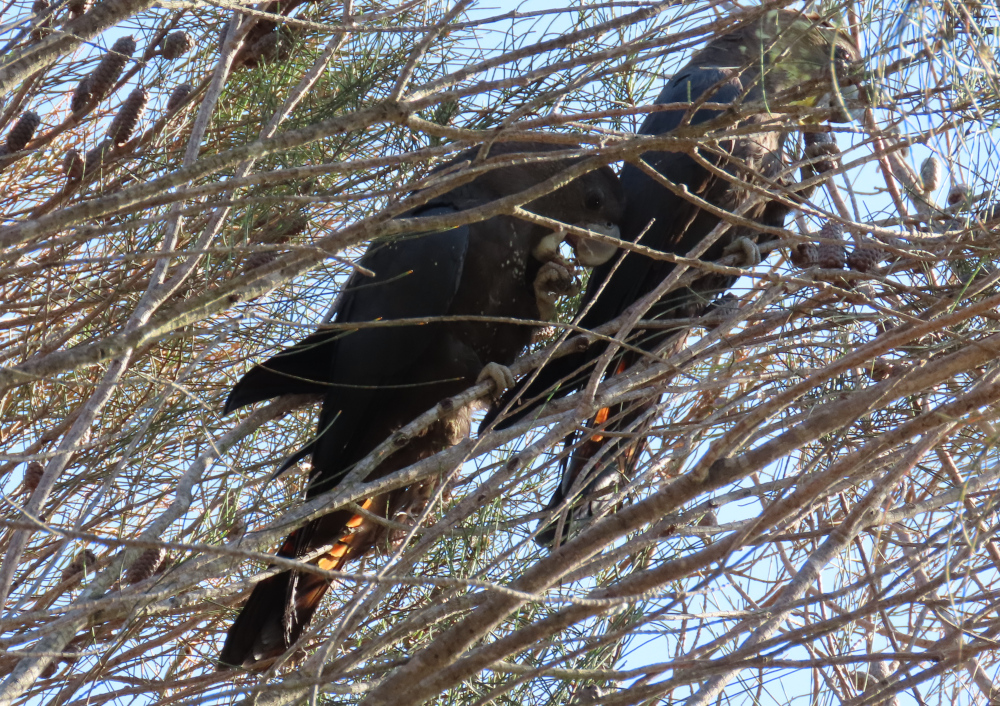
It’s interesting that I almost always see these birds in groups of three, most likely an adult male and female, and a juvenile. The bird with yellow around her head is the female of the group. I think this one is the adult male:
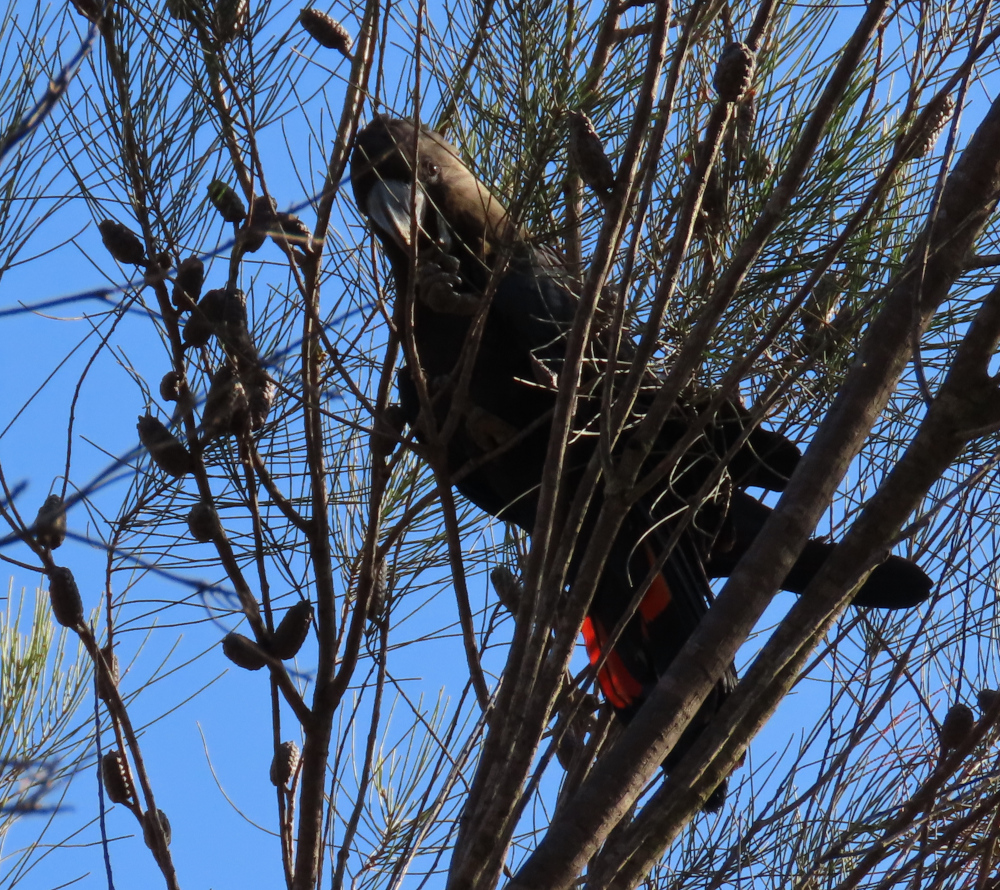
Check out some previous sightings of these gorgeous birds.
Common name: Glossy Black-Cockatoo
Scientific name: Calyptorhynchus lathami
Approximate length: 50cm
Date spotted: 23-27 September 2024 (spring)
Location: Manly Dam Park, near Sydney: 33°46’16.4″S 151°14’30.9″E

Corellas chewing yacht ropes
A group of Little Corellas has lately taken a shine to the Forty Baskets Beach area in Balgowlah, NSW. They spend their time in the nearby trees and on the rocks.

The corellas seem to enjoy the sea water trapped in crevices on the rocks. Or perhaps it’s rain water.
The corellas are beautiful, and fun to watch, but I’m rather glad that I don’t have a yacht moored there.

The birds really get into the ropes, watched by their friends:
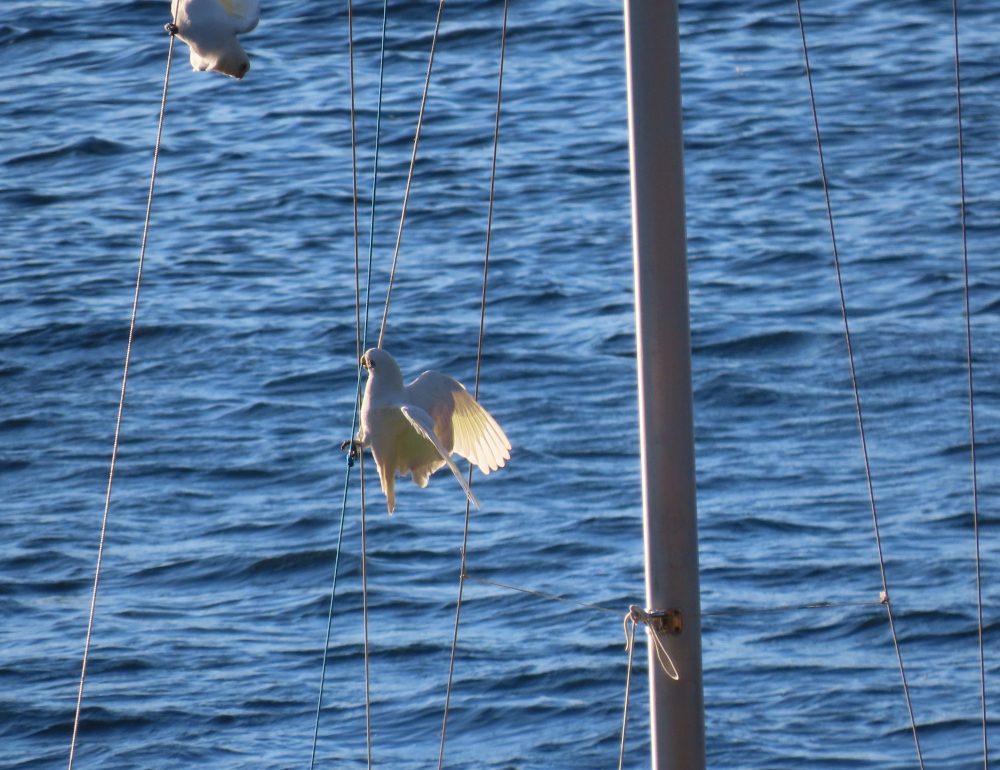

It’s a good time for all.

When fun at the beach palls, it’s time to find a nook for a bit of canoodling:

This grooming session ended in a squabble:
Common name: Little Corella
Scientific name: Cacatua sanguinea
Approximate length: 36-39 cm
Date spotted: 28 July 2024 (winter)
Location: Forty Baskets Beach, Sydney Harbour, New South Wales, Australia: 33°48’15.8″S 151°16’13.9″E
Pale-headed Rosella, my first
I recently paid a visit to Brisbane and stayed in an Airbnb with a gorgeous garden. Every morning, as the sun came up, birds visited the flowering Grevilleas outside our window. One morning, this beautiful bird was among them:
It’s my first sighting of a Pale-headed Rosella. They’re not found in the Sydney area, but are common further north in NSW and Queensland. I love the soft colours and gentle manner of this bird.
Common name: Pale-headed Rosella
Scientific name: Platycercus adscitus
Approximate length: 28-32 cm
Date spotted: 6 July 2024 (winter)
Location: The Gap, Brisbane, Queensland (approximate map reference)

Black Cockatoo feeding a youngster
Every six months or so, a group of Yellow-tailed Black Cockatoos come to our Banksia for a feed. They come for a few days in a row, then move on to find another feeding area.
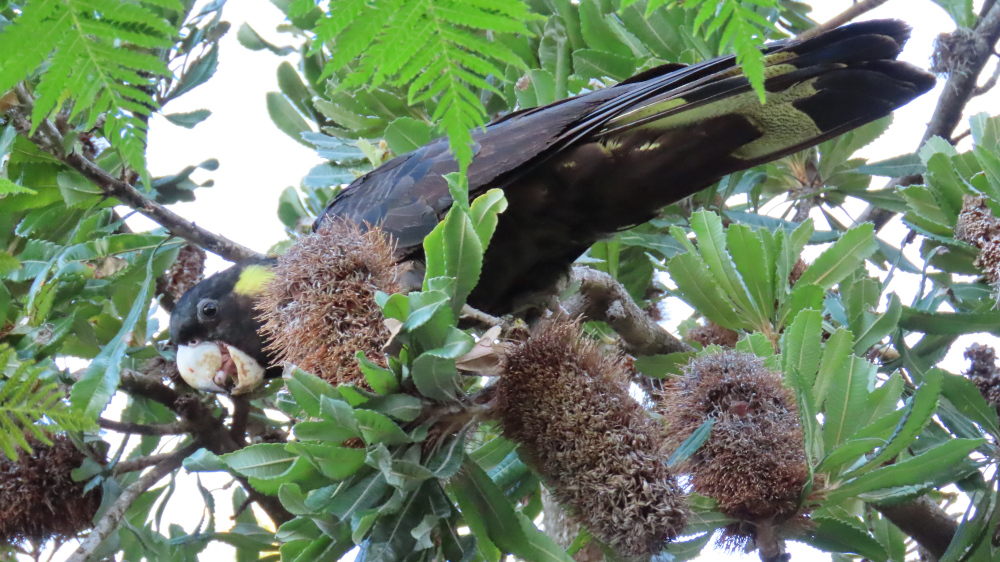
Sometimes they spend more time plucking and dropping than eating. Still, it always feels like such a privilege to have magnificent creatures like this just dropping by. I love the wild, screaming noise that they make. Some people call them the “squeaky door birds”:
The tree is a Banksia serrata, also known as Old Man Banksia.
On the birds’ second visit a day or so later, I filmed some interesting behaviour. One of the birds was making a continuous groaning noise. That’s not unusual, and I’ve wondered in the past if the bird is a youngster begging for food, or if it’s some kind of mating behaviour.
I think I have an answer! In this video, it looks like the male bird (he has a pink ring around his eye) is regurgitating food and then feeding it to the bird that’s making all the noise:
I added quite a lot of detail about these birds in a previous post: Those magnificent black cockatoos are back!
Common name: Yellow-tailed Black Cockatoo
Scientific name: Calyptorhynchus funereus or Zanda funereus
Length: 58-65 cm
Date spotted: 27th and 29th May 2024 (autumn)
Location: Allambie Heights, NSW, Australia

Silly Galahs but so pretty
When someone does something daft, Australians affectionately say, “Silly Galah!” That saying is a reference to these birds:

They’re Galahs, a type of cockatoo found across most of Australia. I saw these two on the outskirts of Lake Mungo in the Australian Outback. The one on the left is a male (brown eyes) and the one on the right is female (pink eyes).
The birds were looking particularly pretty, outlined by the early morning sun.
Galahs do sometimes behave in a way that people see as silly. And here is perhaps a case in point…
The day after seeing the birds at Lake Mungo, we were on the road again. Near Griffith in central New South Wales, a large flock of Galahs had for some reason taking a liking to the tarmac. Despite the oncoming vehicles, the birds kept wheeling around and landing on the road. We stopped, and drove slowly, careful not to collide with any of the birds.
Let’s finish off with another two Galahs, again looking pretty at Lake Mungo:
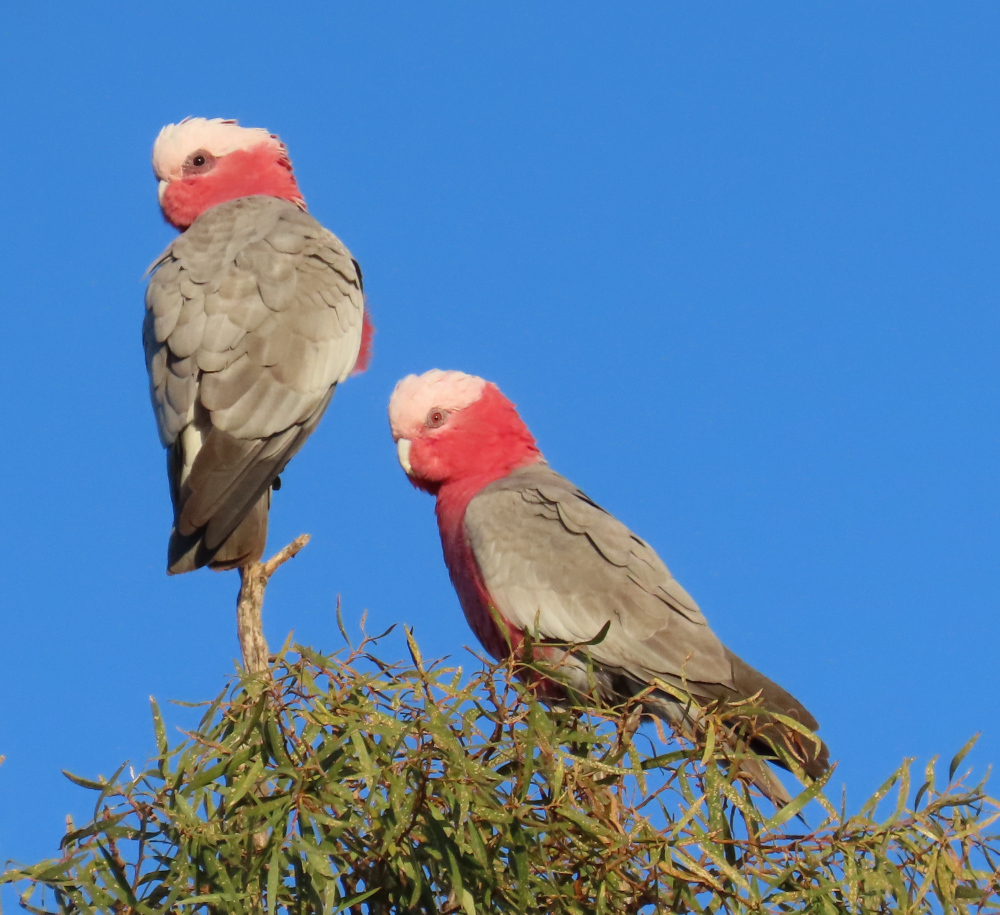
Common name: Galah
Scientific name: Cacatua roseicapilla
Approximate length: 35-38 cm
Date spotted: 20 May 2024 (autumn)
Location: Mungo Lodge, Mungo National Park, New South Wales, Australia: 33°44’31.4″S 143°00’06.1″E

A tree full of Pink Cockatoos at Lake Mungo
I came across a tree full of Pink Cockatoos at Mungo Lodge, on the outskirts of Lake Mungo in the Australian Outback. The alternative name for these birds is Major Mitchell’s Cockatoo and they were also previously known as Leadbeater’s Cockatoo.
Here’s a portrait of one of these spectacular birds:
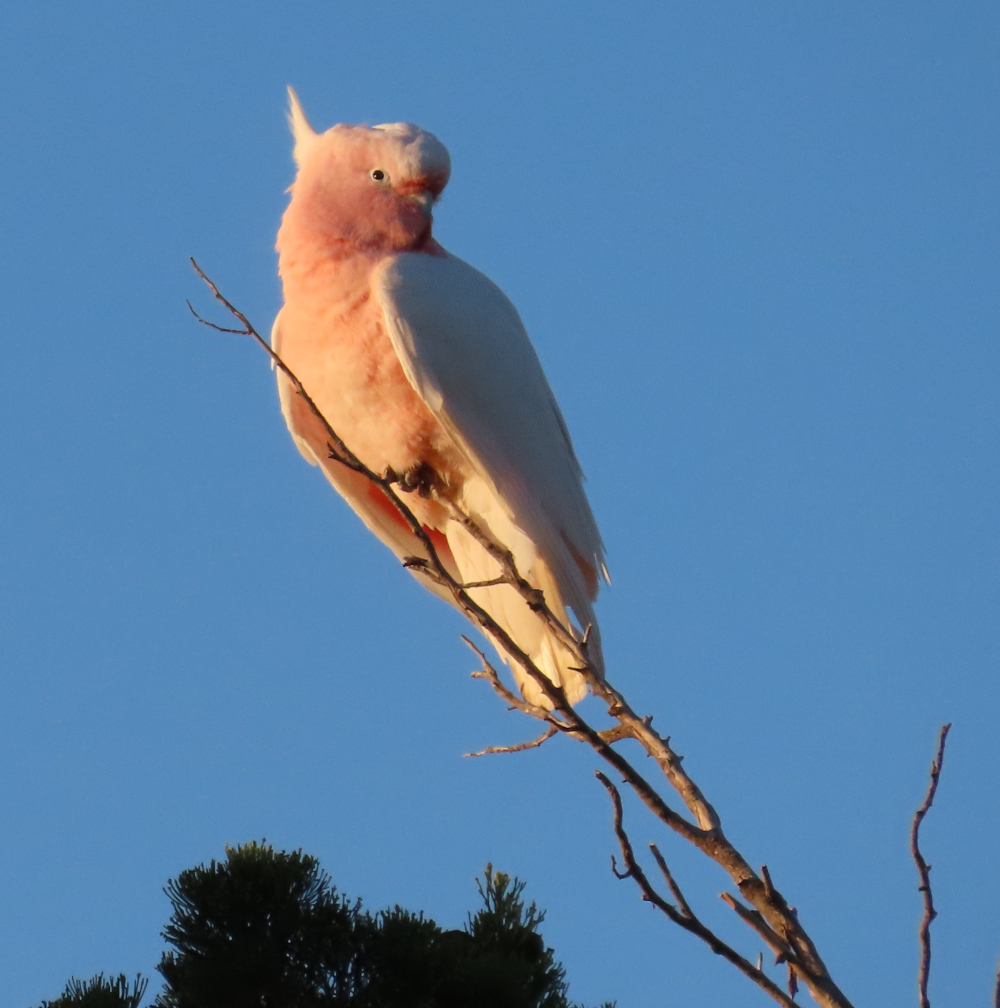
They’re gregarious and chatty birds. This video shows them in a quieter moment, enjoying the early sunlight at the top of a tree:
It was exciting to see these birds. Pink Cockatoos are uncommon, and are considered endangered. Here’s a still picture of part of the tree full of birds:
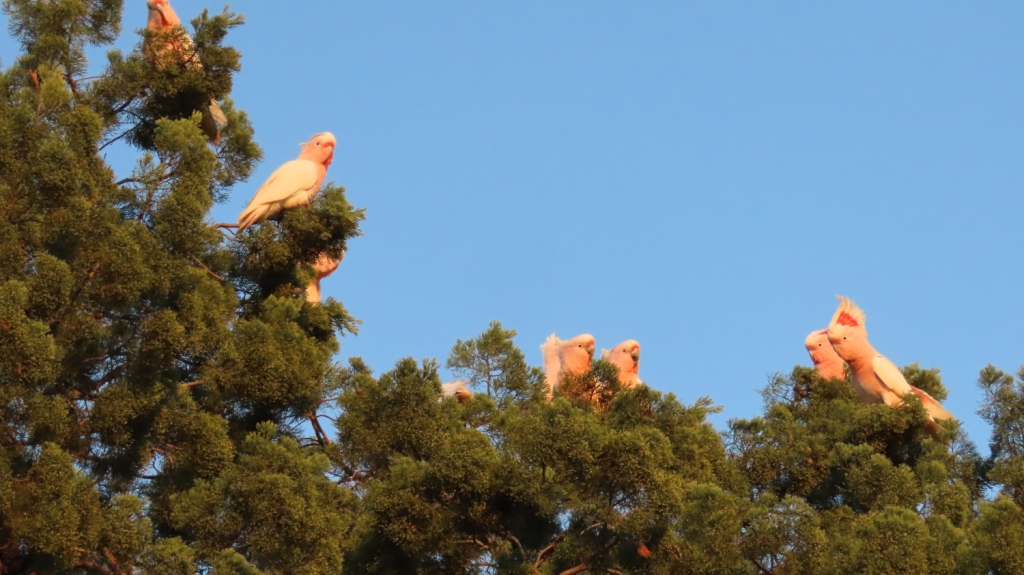
In September 2023, Birdlife Australia published an intention to change the common name of these birds from Major Mitchell’s to Pink Cockatoo, because Major Mitchell played a major part in the massacre of Aboriginal people in the 19th century.
It’d be a pity to taint the beauty of these birds with such a memory. The birds have a delicate beauty, the pink colour changing in the light from soft pink to quite dramatic colouring:
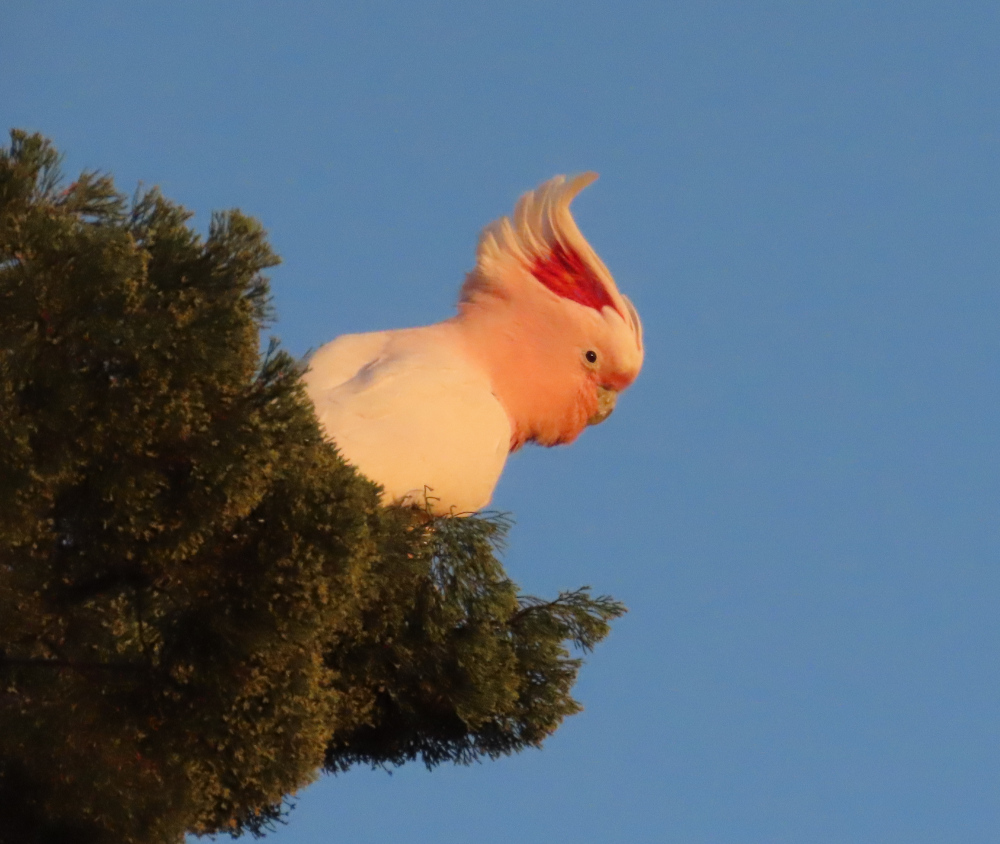
At 35-40 centimetres from head to tail, these birds are about the same size as a Galah. They’re smaller than the well-known Sulphur-crested Cockatoo (45-50 cm).
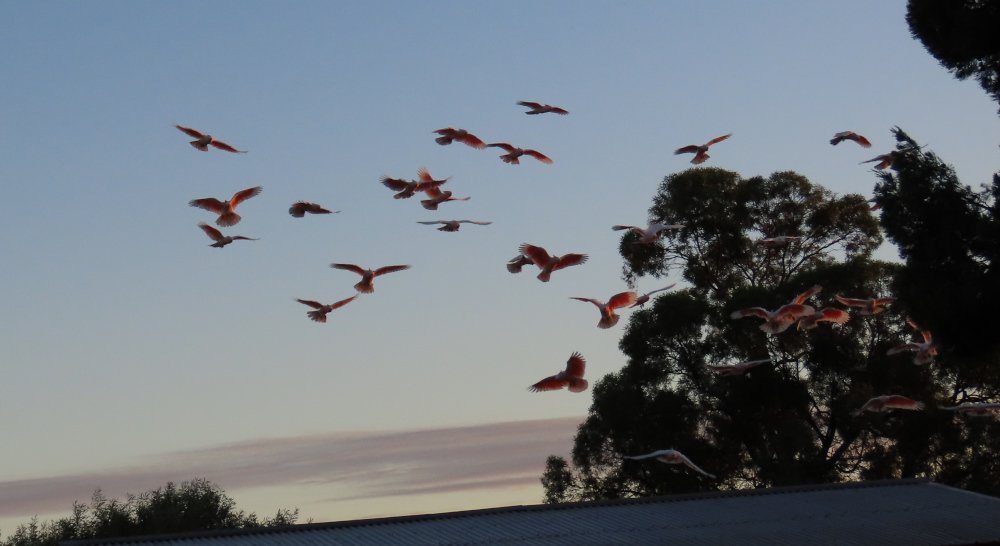
A final shot of a group of birds coming in to land:
Common name: Pink Cockatoo (alternative name: Major Mitchell’s Cockatoo)
Scientific name: Cacatua leadbeateri
Approximate length: 35-40 cm
Date spotted: 20-21 May 2024 (autumn)
Location: Mungo Lodge, Mungo National Park, New South Wales, Australia: 33°44’31.4″S 143°00’06.1″E


 Sydney Birder