Blog Archives
Blue Laughing Kookaburra at The Bluff above Bantry Bay
Today I hiked from Seaforth Oval to Natural Bridge. Phew! Almost 12,000 steps, 7.7 km, and three climbs down into the valley and back up again! It’s a good walk with lovely views of Bantry Bay, which is one of the inlets of Sydney Harbour.
Close to a lookout point called The Bluff was this fine-looking Laughing Kookaburra. It has a lot more blue in its feathers than most kookaburras that I’ve seen. Perhaps it’s clothed in its spring finery.

This is the view of Bantry Bay from The Bluff Lookout:

Common name: Laughing Kookaburra
Scientific name: Dacelo novaeguineae
Approximate length: 47 cm
Date spotted: 31 August 2020 (Late winter)
Location: Bluff Trail, Killarney Heights, New South Wales, Australia: 33°46’00.3″S 151°13’42.3″E
Kookaburras at dawn
In my previous post about birdsong at dawn, I mentioned that dawn is a calm but not quiet time around here. One bird that was remarkable for its absence in yesterday’s video was the kookaburra. This morning the laughing cacklers made up for that!
Kookaburra standoff with Magpie
In this video, a Laughing Kookaburra stands guard against an Australian Magpie. The kookaburra has a stash of some kind of food on the rock behind it. Before I started filming, the magpie tried a few times to approach the food. Now, as seen in the video, the magpie seems more or less resigned to just giving the kookaburra a piece of its mind. At the end of the video, an Australian Miner drops in too. I wish I knew what the Magpie was saying!
This is the kookaburra after it finished its meal and flew to a nearby branch:
Common name: Laughing Kookaburra
Scientific name: Dacelo novaeguineae
Approximate length: 47 cm
Date spotted: 28 March 2020 (late summer)
Location: Near Sydney, Australia
The magpie took refuge on our roof:

Common name: Australian Magpie
Scientific name: Gymnorhina tibicen
Approximate length: 40 cm
Date spotted: 28 March 2020 (late summer)
Location: Near Sydney, Australia
I didn’t get a shot of the Australian Miner. It’s probably one of the birds guarding the nest of baby miners which I’ve blogged about recently.
Birding at home
Like many people, I’m currently working from home to stave off the Coronavirus. There’s a great hashtag on Twitter at the moment: #BirdingAtHome. As a contribution to that hashtag, here are some of the birds I’ve seen at home over the last few days.
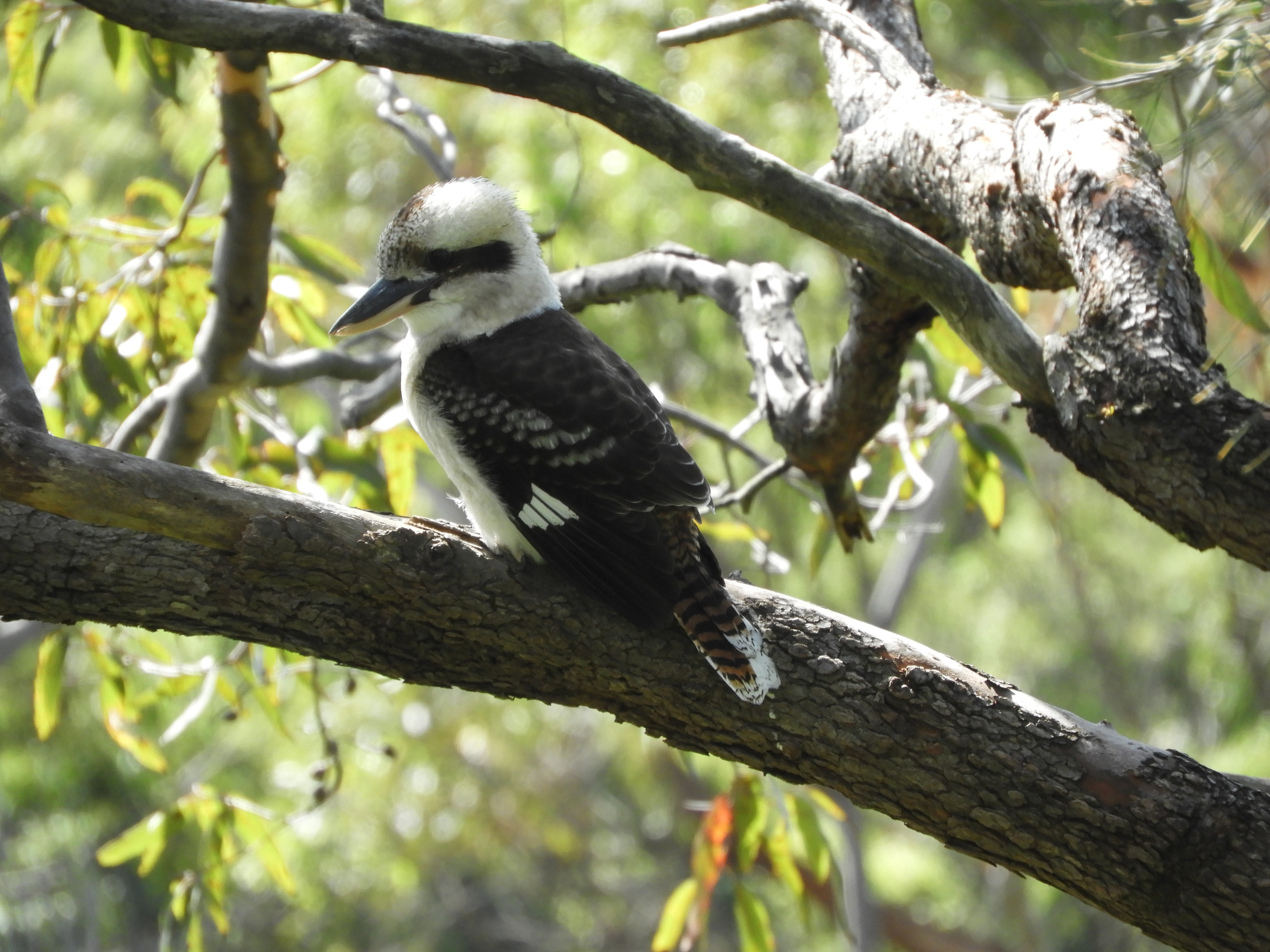
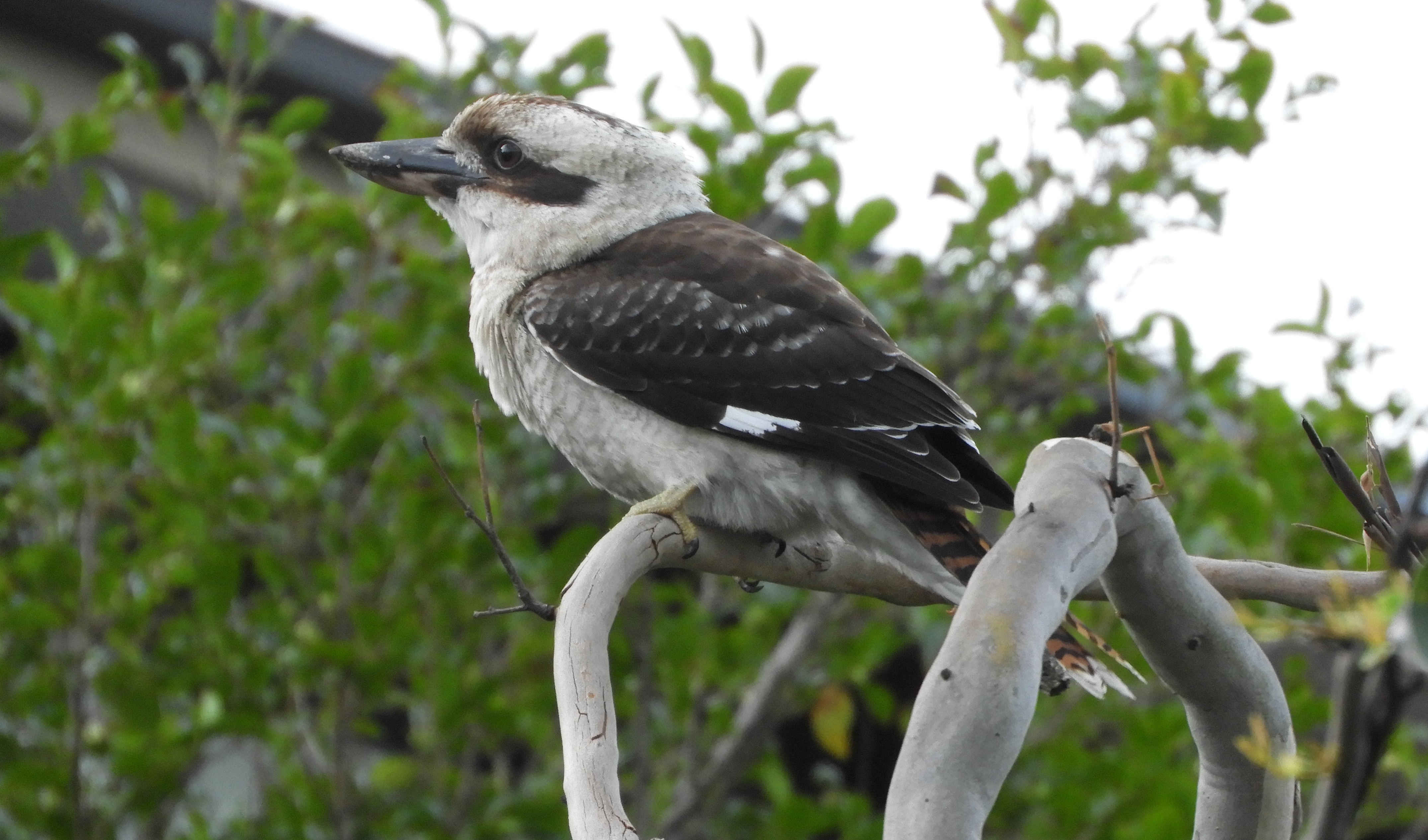
Laughing Kookaburra
Scientific name: Dacelo novaeguineae | Approximate length: 47 cm | Date: 17 March 2020
Grey Butcherbird
Scientific name: Cracticus torquatus | Approximate length: 30 cm | Date: 17 March 2020
I think this may be a juvenile, as the lines between the black and white sections of plumage are not well defined. The bird is on a Sydney Red Gum, one of my favourite trees, and currently the biggest tree in our garden:

Australian Magpie
Scientific name: Gymnorhina tibicen | Approximate length: 40 cm | Date: 17 March 2020
This inquisitive Australian Magpie landed on the roof of our porch and peered down at us. It was in a perfect spot to achieve a weird doubling effect with its reflection in the window. The real bird is on the left:
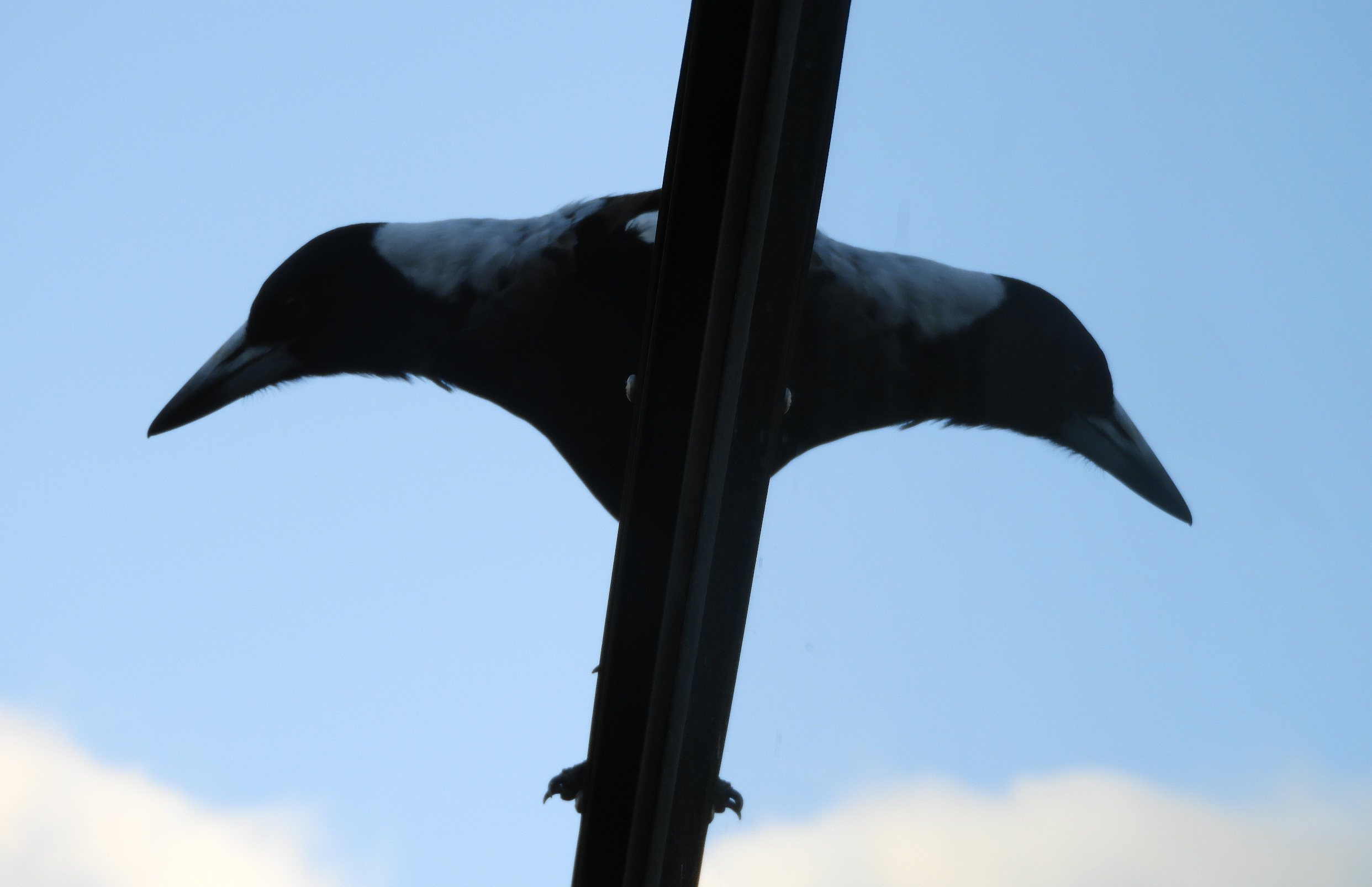
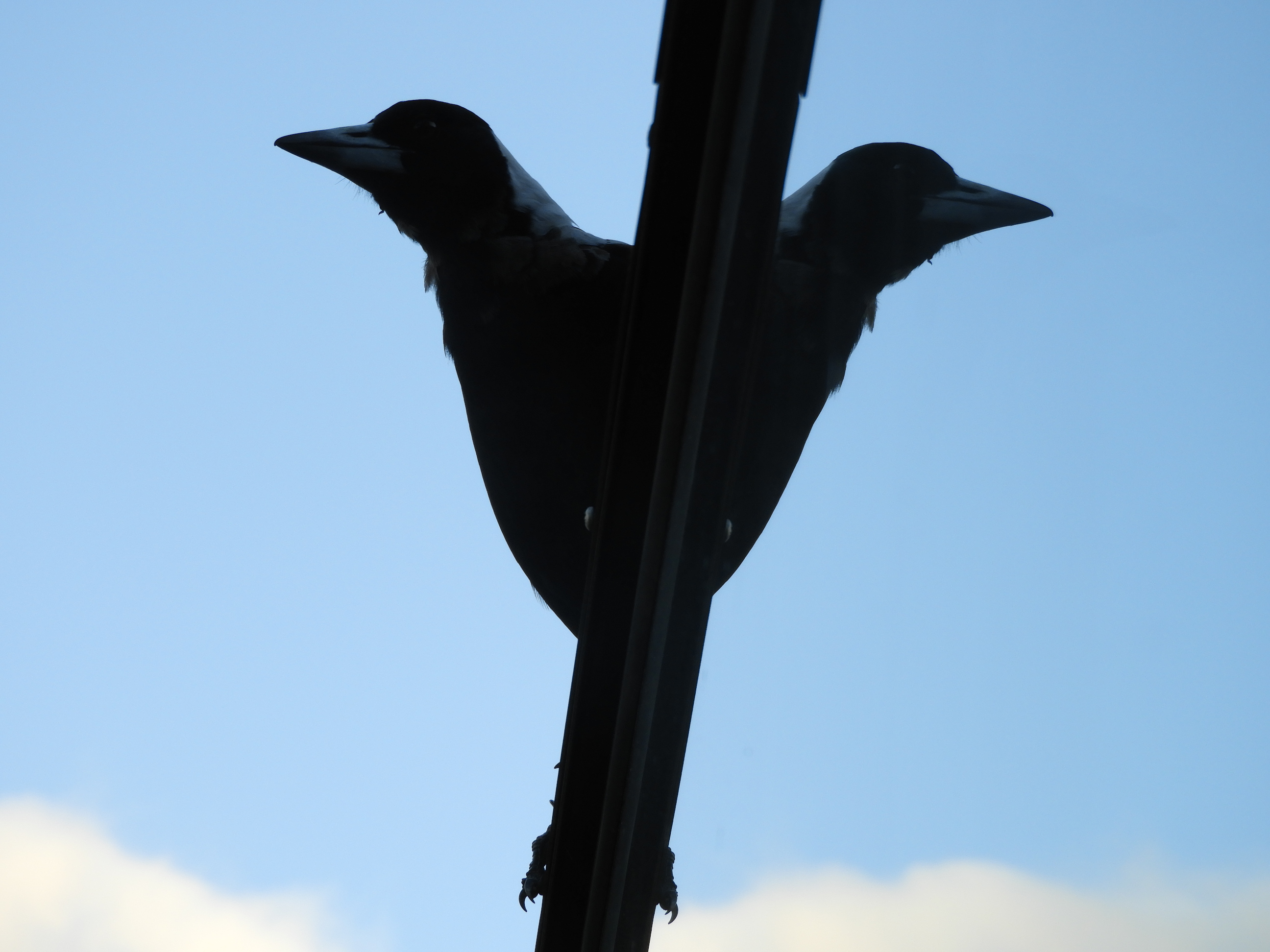
You can see the bird’s head and shoulders at the top and its feet at the bottom. Here’s another pose by the same bird in the same spot on the roof:
The magpie then hopped in through the window and examined the place:

A couple of days earlier, a juvenile magpie (note the soft grey colouring) posed like a statue on a pedestal. The pedestal is the trunk of a tree fern that died off a while ago:
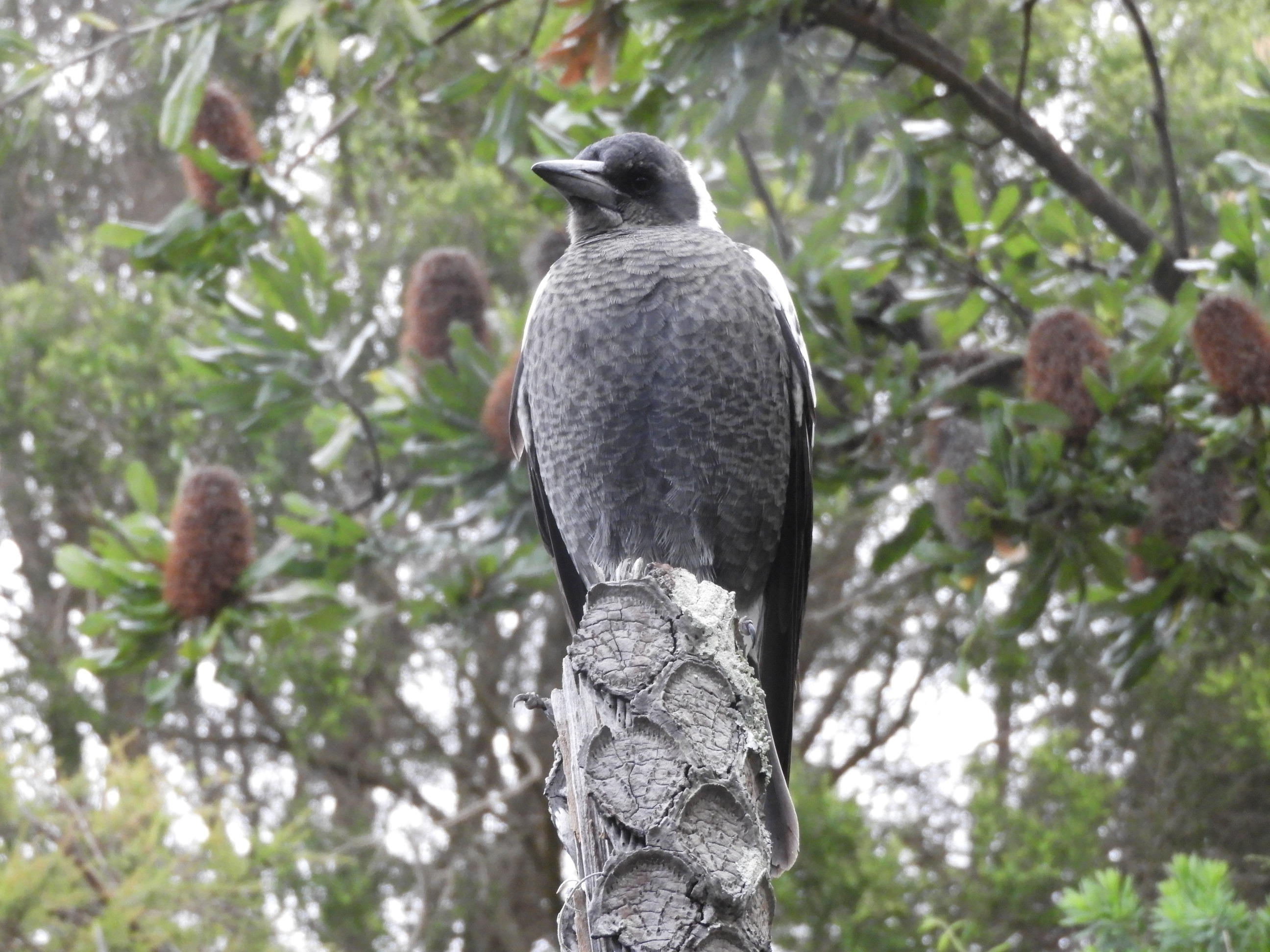
A side view of the same bird on the same perch:

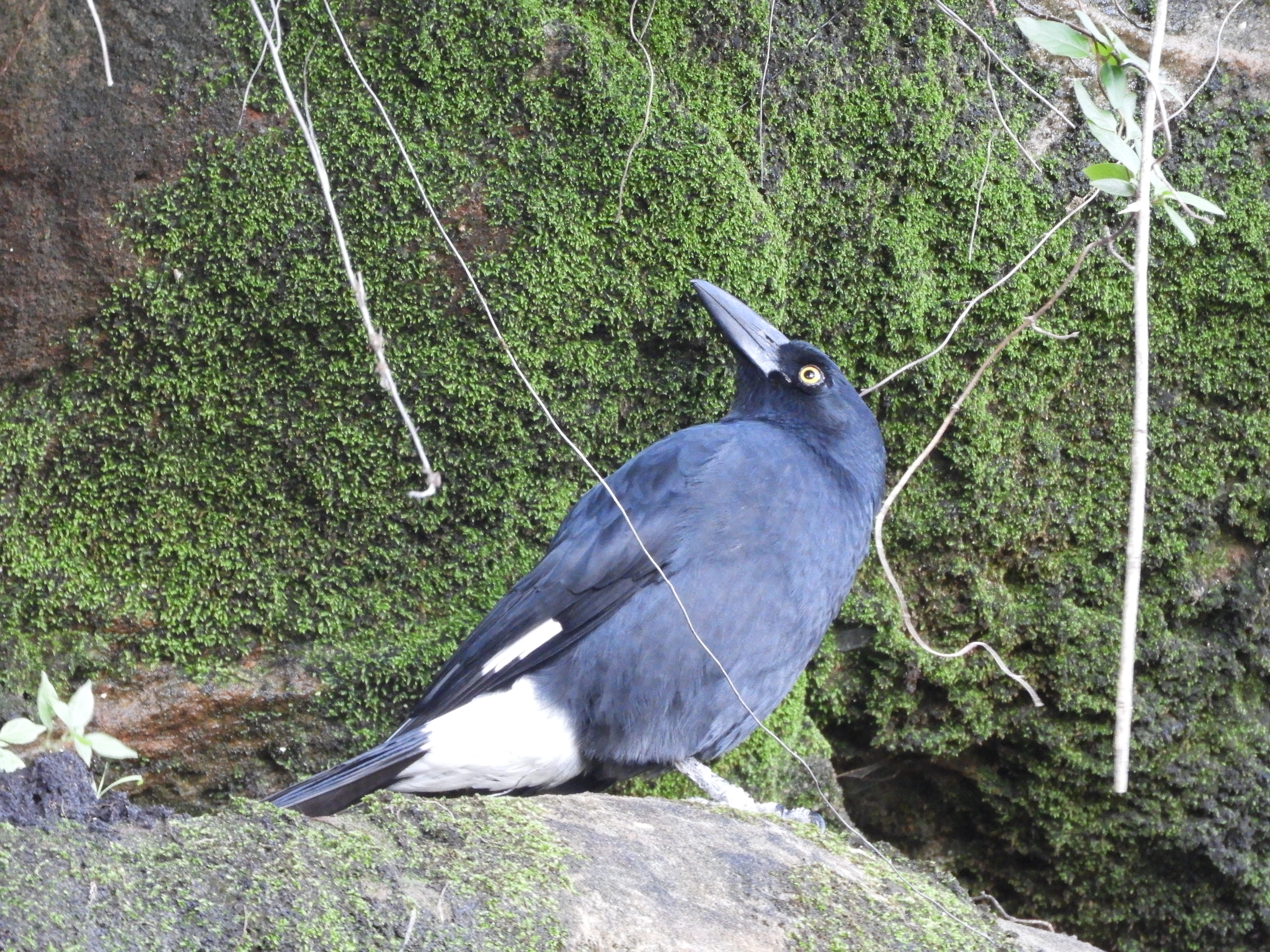
Pied Currawong
Scientific name: Strepera graculina | Approximate length: 45 cm | Date: 11 March 2020
Currawongs are not quite as bold as magpies. They tend to view human activity from afar and swoop past when something interesting is going on. This one chose a mossy perch that showed off its dark plumage and yellow eyes:
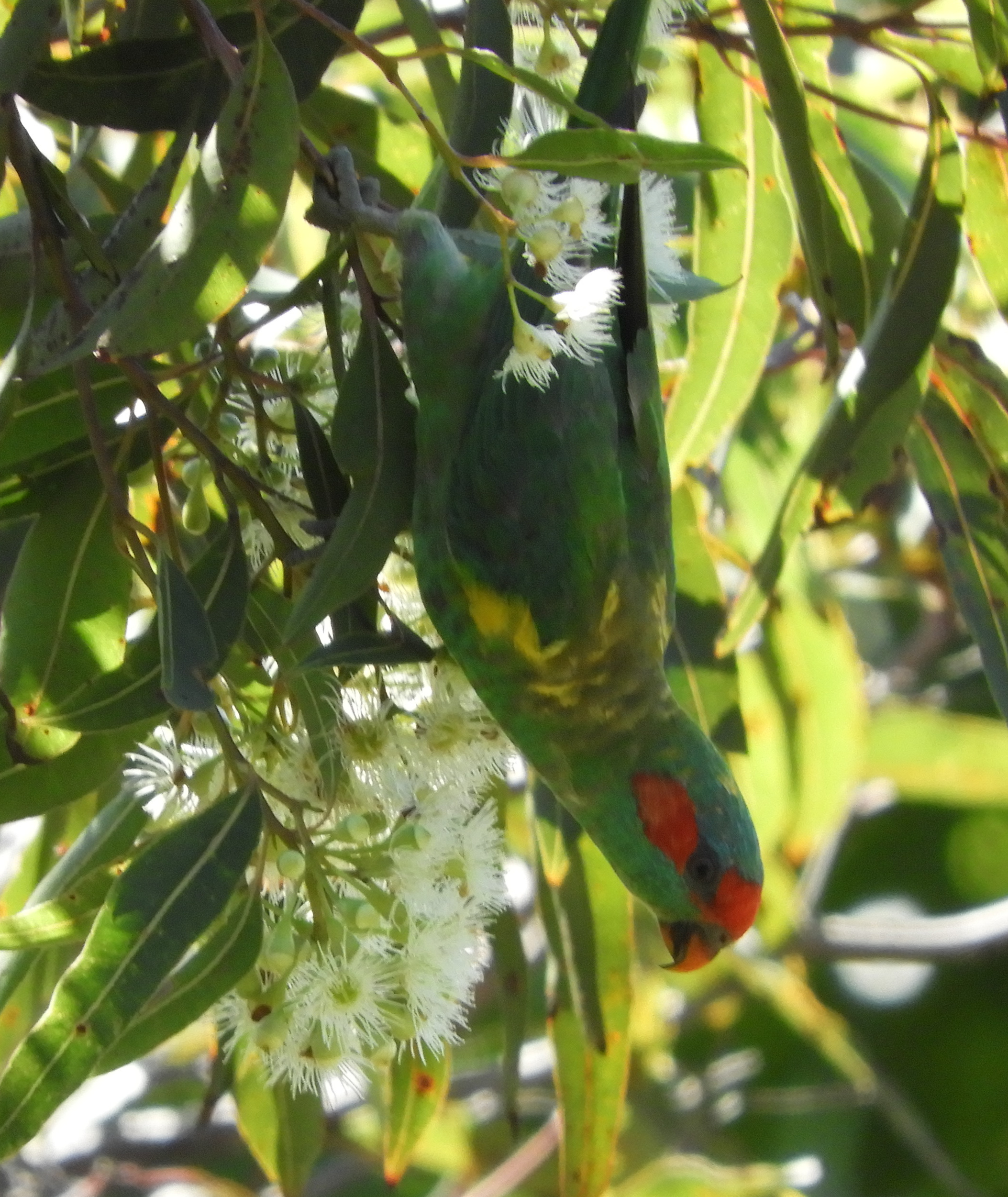
Musk Lorikeet
Scientific name: Glossopsitta concinna | Approximate length: 23 cm | Date: 18 March 2020
I don’t often see Musk Lorikeets. At the moment, a number of the gum trees are in flower and are attracting a variety of birds. It’s hard to get a good picture of a Musk Lorikeet. They seem to be more shy than other birds and take care to hide within the foliage as much as possible.
Rainbow Lorikeet
Scientific name: Trichoglossus haematodus | Approximate length: 30 cm | Date: 17 March 2020
We see many of these colourful, quarrelsome birds, and these last few days have been no exception. They were competing with the Musk Lorikeets for the same flowers:

Australian King Parrot
Scientific name: Alisterus scapularis | Approximate length: 44 cm | Date: 15 March 2020
A couple of days ago, I blogged about the two King Parrots that spent some time above our patio. Here’s the male again:

Grey-headed Flying Fox
Scientific name: Pteropus poliocephalus | Approximate length: 30 cm | Date: 18 March 2020
To finish off with, below is a very dark pic of a Flying Fox, which is a bat not a bird. In fact, it’s a megabat (yes, that’s a thing) and is one of the largest bats in the world. These bats eat fruit and flowers, and they visit the flowering trees at night. They make quite a noise, but it’s a privilege to have them around!

The bat is, as usual, upside down. You can see an ear near the bottom of the picture, slightly to left of centre. The nose is higher up on the left. The spiky bit to the right is a folded wing. The feet are attached to a branch at top centre. A Grey Headed Flying Fox is about 30 cm long and has a wing span of one metre.
Happy #BirdingAtHome everyone!
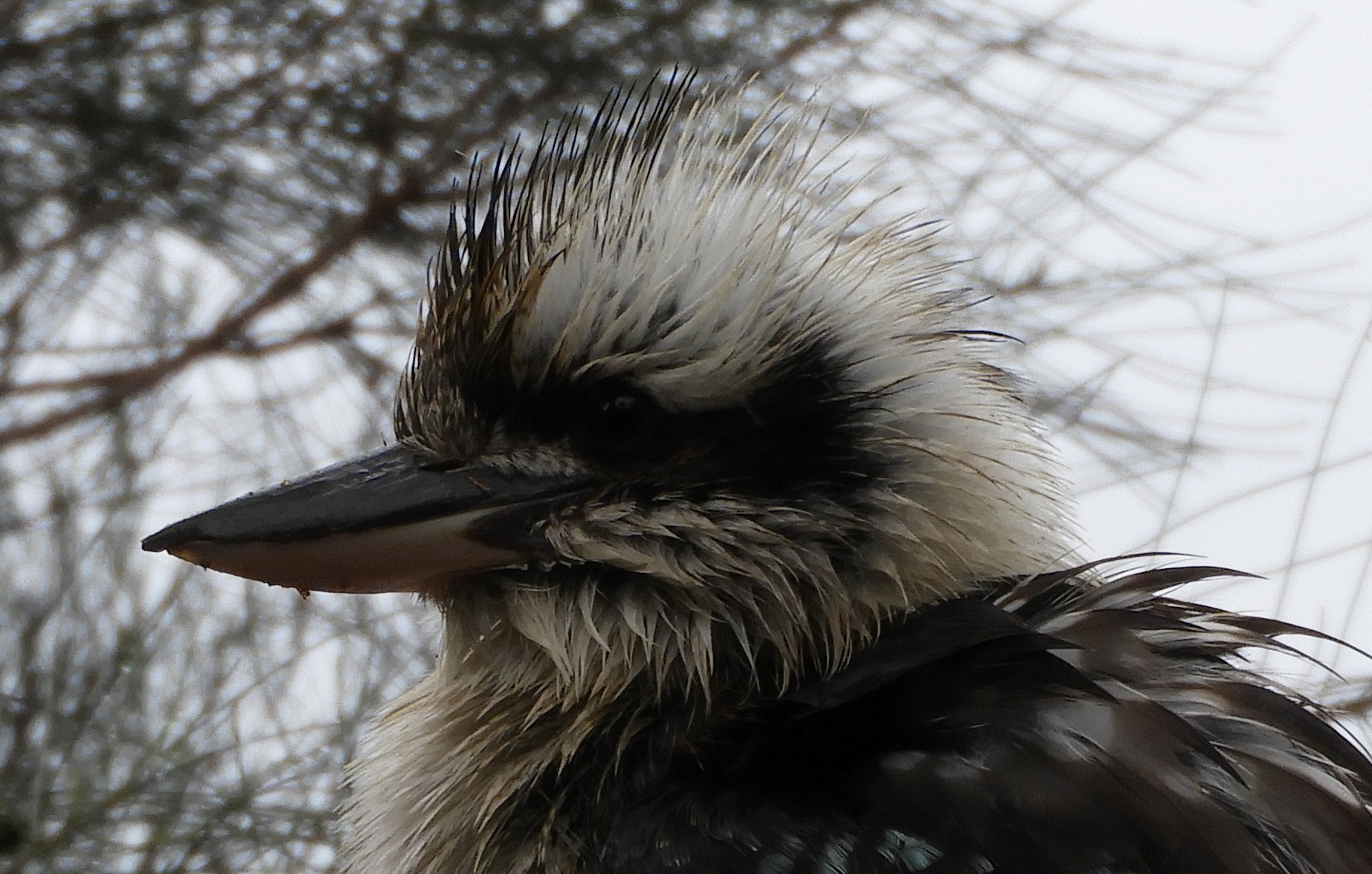
Wet Kookaburra
It’s been raining quite a bit recently, which is a good thing for the environment and our water supply. Sometimes, though, I do feel sorry for the wildlife caught out in the deluge.
Crikey, that was a downpour, mate!

A view of the bird’s head from behind isn’t any prettier:
Turn me upside down, and I’d do a good job of mopping your floor.
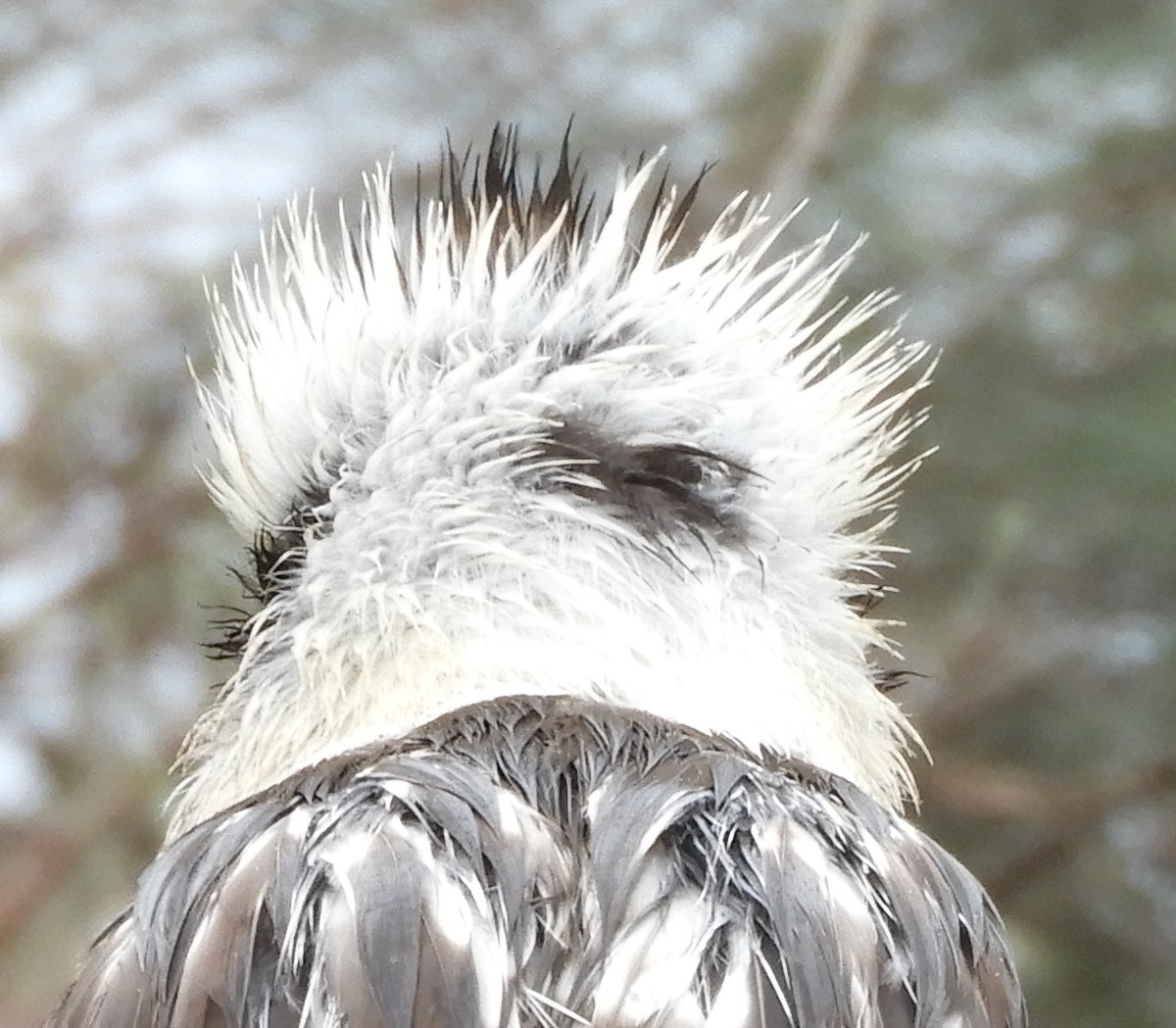
You know that feeling, when your feathers just feel like old, wet fur…
I feel like I’ve been hung out to dry:
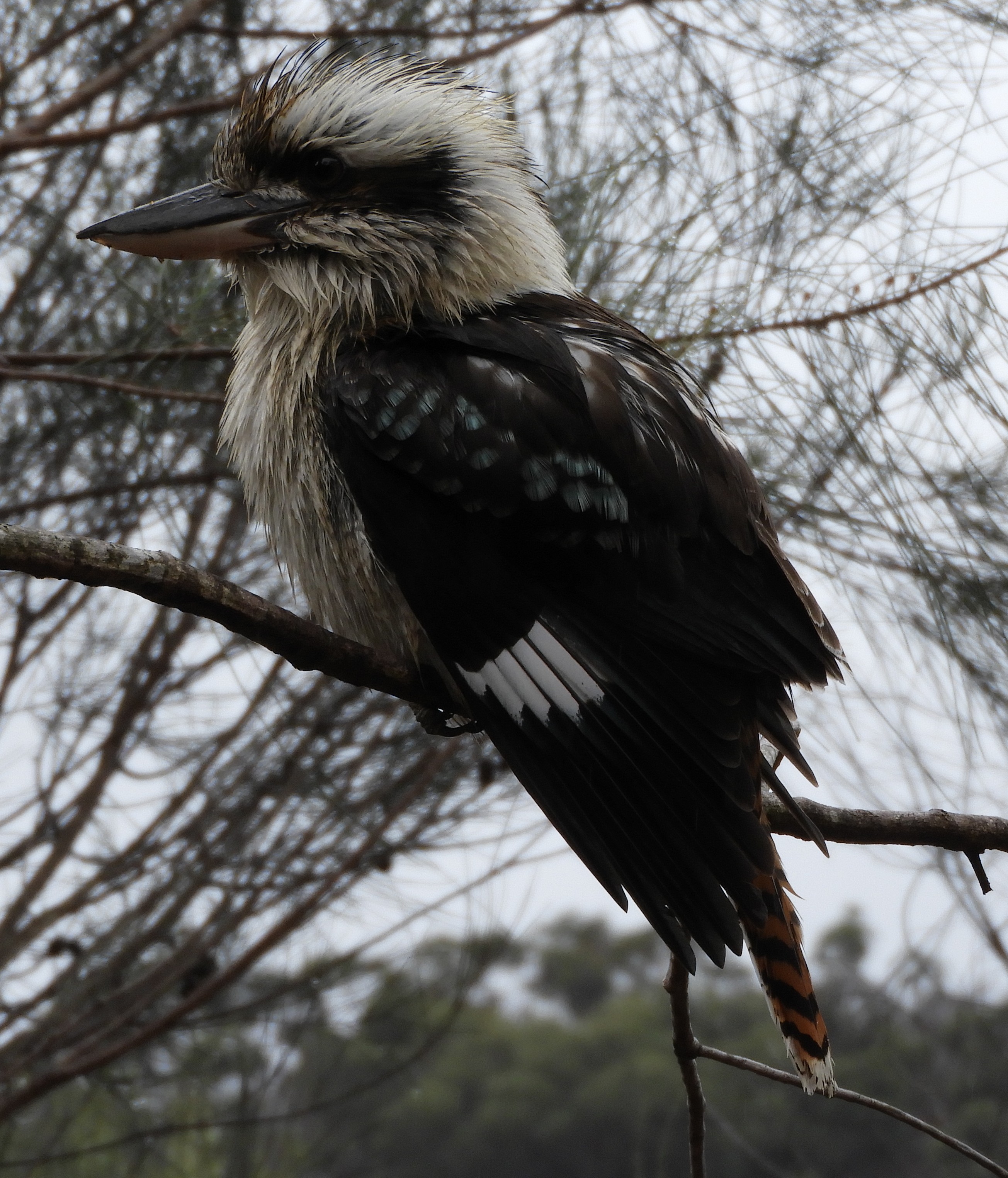
Common name: Laughing Kookaburra
Scientific name: Dacelo novaeguineae
Approximate length: 47 cm
Date spotted: 27 August 2019 (Late winter)
Location: Manly Dam National Park, New South Wales, Australia: 33°46’54.6″S 151°15’09.4″E
Kookaburra in a mess after hollowing out termite nest
“Don’t look at me! I’m a mess.
Been hard at work hollowing out a termite nest.”
That’s what this kookaburra seems to be saying:

“What, you don’t think termite gunge is the right look for me?”

“OK then. Here’s what I’ve been doing for the last half hour:”
“That’s a big termite nest, high up in a tall tree.
And soon it’ll be a home for my family and me:”

Common name: Laughing Kookaburra
Scientific name: Dacelo novaeguineae
Approximate length: 47 cm
Date spotted: 28 July 2019 (Winter)
Location: Manly Dam National Park, New South Wales, Australia: 33°46’48.1″S 151°14’52.5″E
Kookaburra baby cackling and feeding
The kookaburras around our neighbourhood are very noisy at the moment. A couple of juveniles drop by regularly to practise their cackling skills. They’re cute and funny.
In this video, you can see one youngster crooning to himself, and another behind the branches. In the background, other birds chime in to show him how it’s done. A parent comes by a couple of times too, to feed the ever-demanding little one.
Common name: Laughing Kookaburra
Scientific name: Dacelo novaeguineae
Approximate length: 47 cm
Date spotted: 31 December 2016
Season: Summer
Location: Allambie Heights, New South Wales, Australia
Kookaburras cranking up for a cackle
You’ve probably heard kookaburras in full voice, cackling and hooting raucously. I think the sound they make when they’re preparing for a full-voice yodel is funny and cute. It happens in particular when there’s a group of birds. They chunter at each other, perhaps in warning or perhaps companionably. They sound a bit like rusty saws in a dusty attic.
These two were in a tree high above my lounge window:
I encountered this disreputable, slightly dangerous looking character deep in the bush:
Common name: Laughing Kookaburra
Scientific name: Dacelo novaeguineae
Approximate length: 47 cm
Date spotted (second video): 26 December 2016
Season: Summer
Location (second video): Manly Dam Nature Reserve, New South Wales, Australia: 33°46’50.4″S 151°14’59.6″E
Kookaburra pair swaying in the wind
Kookaburras have an endearing habit of swaying back and forth when sitting on a branch. Today a pair sat cosily together on a branch, chewing the breeze. It’s soothing to watch their synchronised swaying.
For a giggle, here’s a short extract from the above video showing my favourite bit:
Common name: Laughing Kookaburra
Scientific name: Dacelo novaeguineae
Approximate length: 47 cm
Date spotted: 23 August 2016
Season: Winter
Location: Allambie Heights, New South Wales, Australia
Latitude/longitude: 33°46’13.9″S 151°15’39.2″E
Funny-faced kookaburra
Kookaburras are gorgeous, but sometimes they can look a little goofy.

Here’s the whole bird:

Common name: Laughing Kookaburra
Scientific name: Dacelo novaeguineae
Approximate length: 47 cm
Date spotted: 6 August 2016
Season: Winter
Location: Allambie Heights, New South Wales, Australia
Latitude/longitude: 33°46’55.4″S 151°15’10.3″E


 Sydney Birder