Blog Archives

Bird spotting with Aussie Bird Tours
Yesterday my family and I went on a bird-spotting trip with Aussie Bird Tours. Mike Barrow led us on a wonderful half-day tour around the Dee Why Lagoon, Warriewood Wetlands, and Irrawong Reserve. We spotted a large number of birds (40-50 types) and heard others too. Here are the ones that I managed to get a half-decent photo of.
Our tour started at Dee Why Lagoon, where we saw a number of water birds: a darter, cormorants, ducks, a black swan, coots, a Silver Gull, and more. Songbirds were there too. A Magpie-lark strutted over the mud. Welcome Swallows darted across the water. A Willie Wagtail chirped in the distance. An Eastern Whipbird spent many minutes exploring the dense reeds a couple of metres from our feet. We could hear its characteristic chattering, but only saw it when it made a break for the higher foliage.
This male Olive-backed Oriole (Oriolus sagittatus) posed for a profile shot against the blue sky:
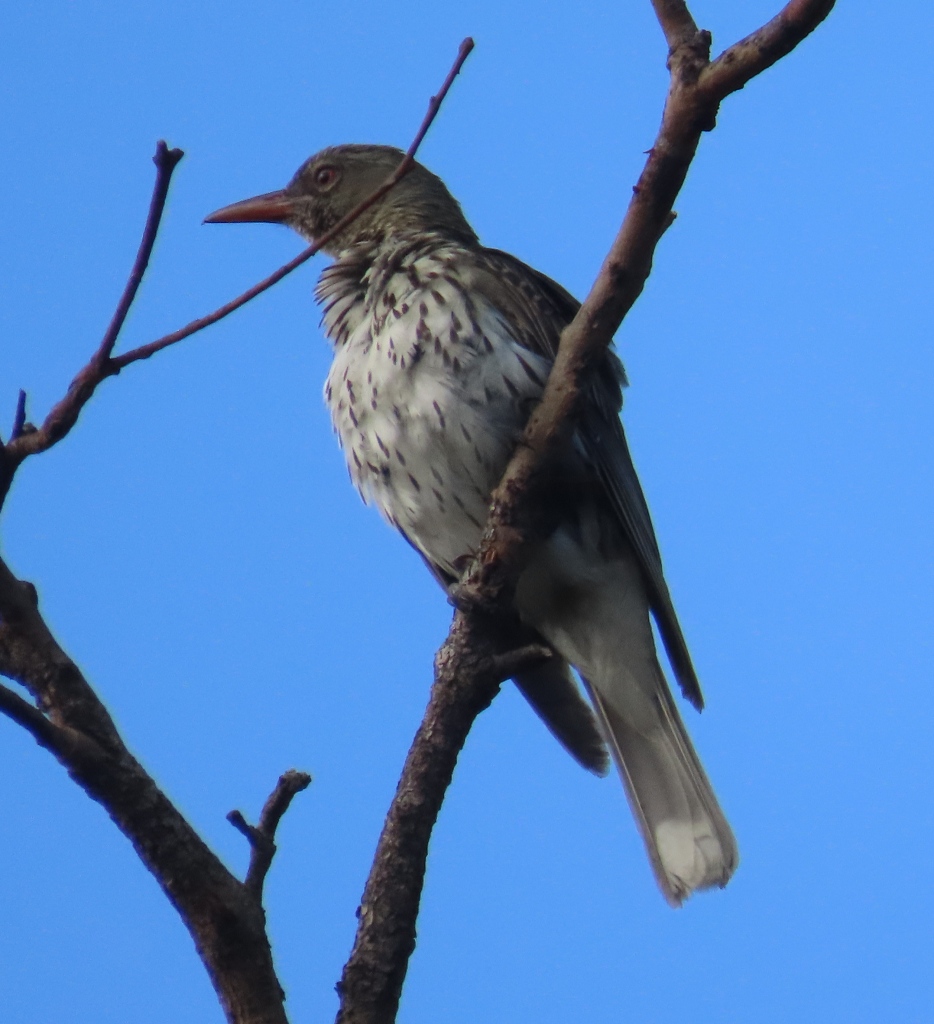
On this trip I learned what Olive-backed Orioles sound like (you can hear their call on eBird). I also learned the call of the Darter (hear it on xeno-canto). The latter sounds very like a Dollarbird, and I’ve probably mixed up those two calls in the past.
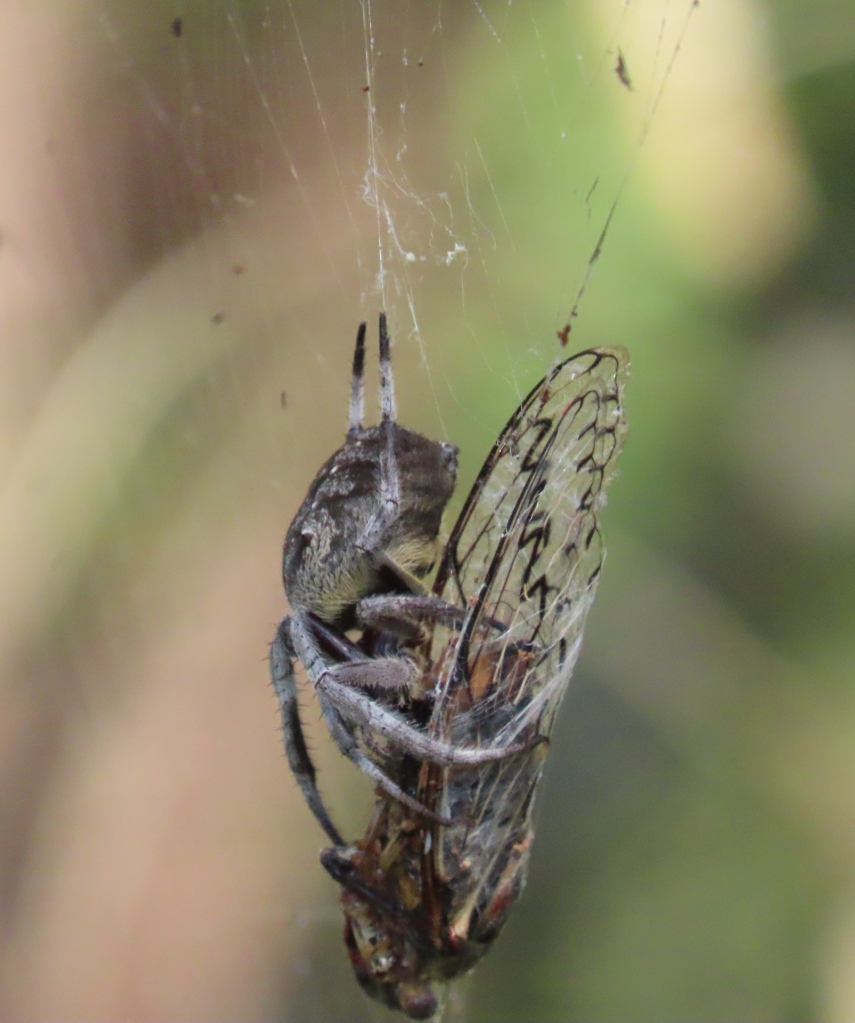
Our next stop was the Warriewood Wetlands, which is an interesting patch of swampy bushland. A raised path leads you across the reeds and water, with great views of wetlands all round you. The cicadas were out in full force, deafening us while providing food to other creatures. Here, a large spider has caught a cicada in its web and is having a feast:
Discarded cicada husks stuck to tree trunks, shed when the cicada larva emerges from the ground and morphs into the winged insect:

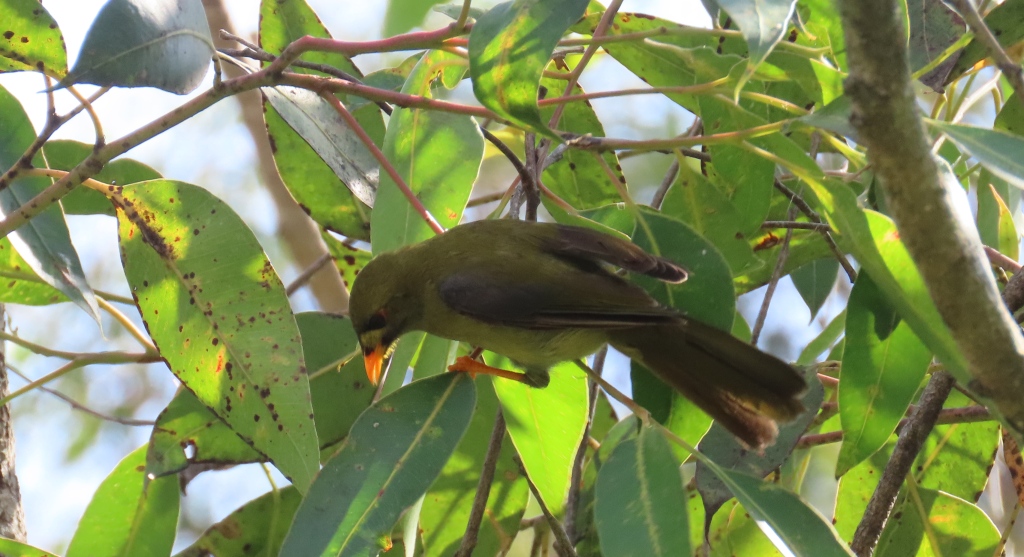
Bell Miners (Manorina melanophrys) have moved into the Warriewood Wetlands in large numbers. The call of these honeyeaters is a clear, single, oft-repeated clink, like the sound of a bell. They’re quite attractive birds, with olive wings and back, and a pale yellow chest:
What with the screeching of the cicadas and the pinging of the Bell Miners, this was a noisy patch of bush!
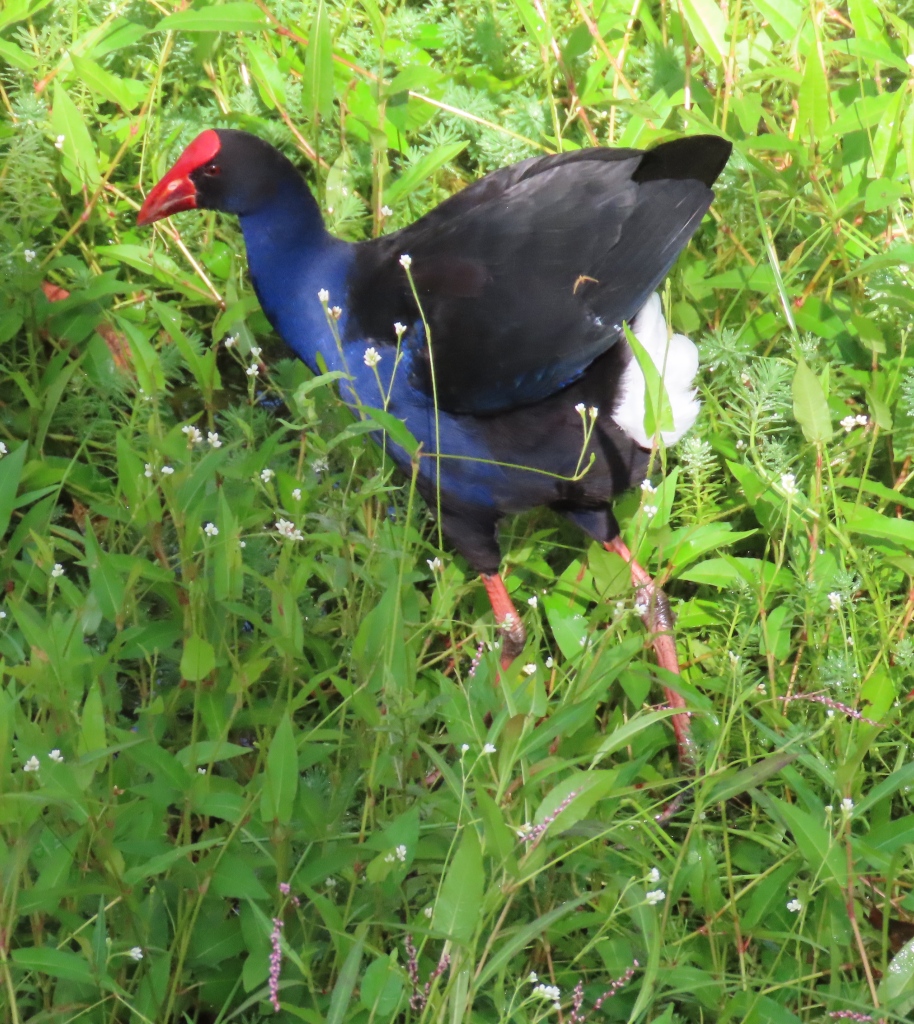
The noise didn’t seem to bother the Purple Swamphens (Porphyrio porphyrio), who carried out a lively courtship beneath the wooden walkway:
A small water dragon looked on:

A Dusky Moorhen (Gallinula tenebrosa) showed up in bold orange and yellow:

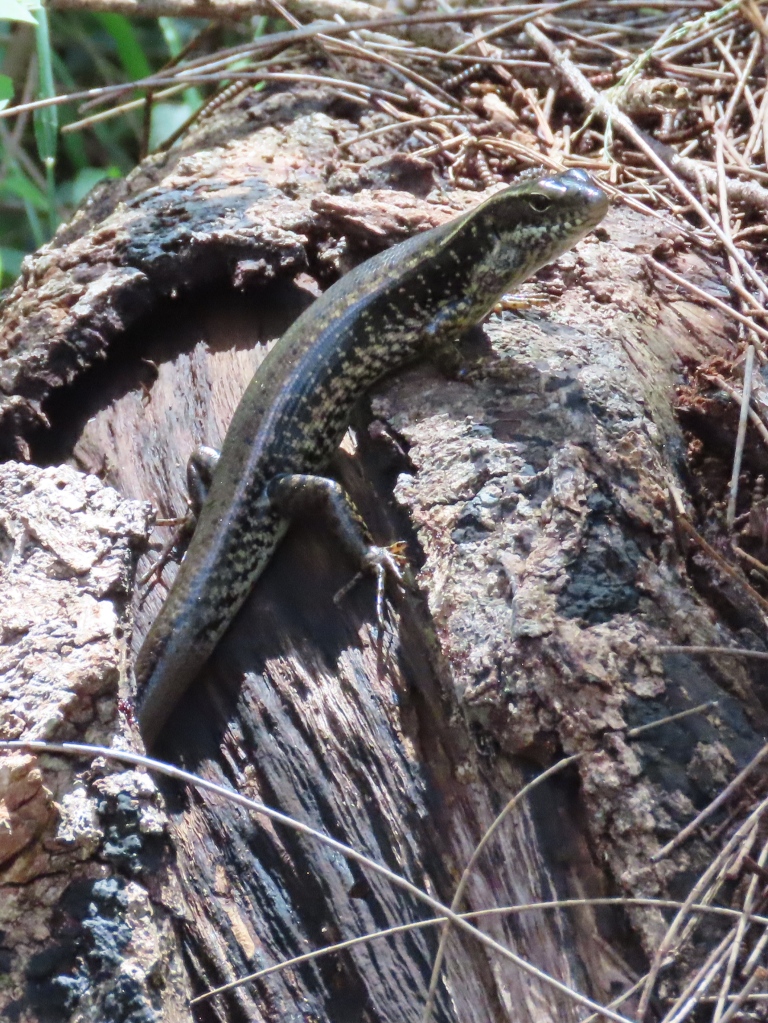
We didn’t see any snakes, though evidently they’re around. We did see a couple of largish skinks, like this one:
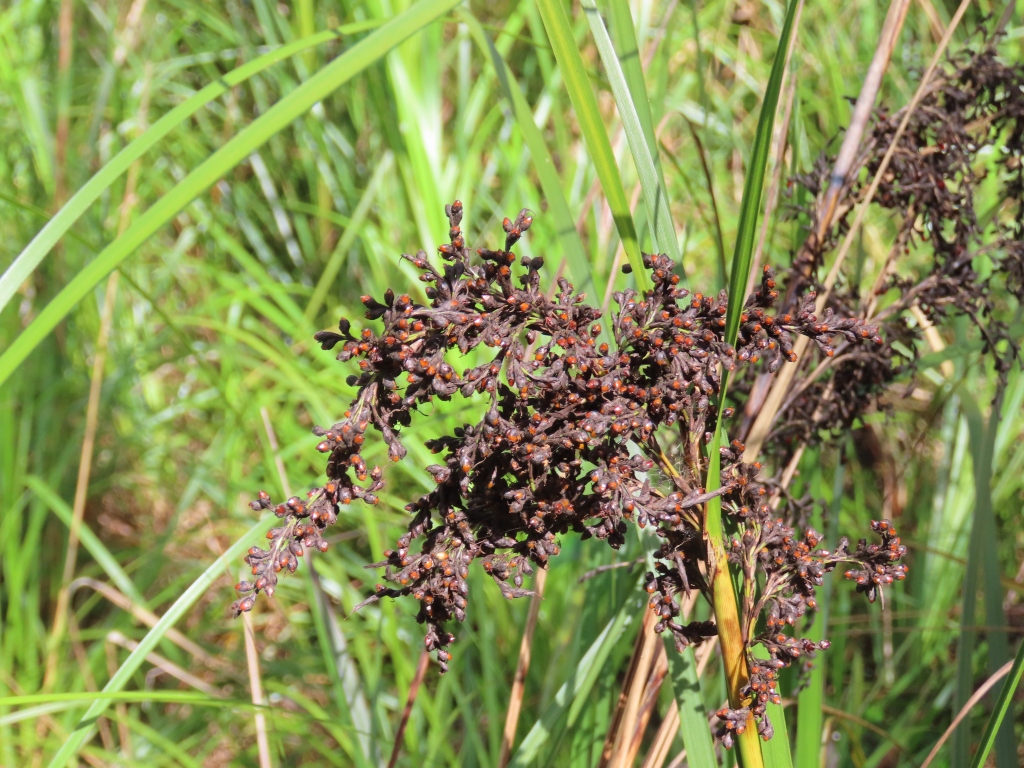
Striking dark grass flowers lined the way:
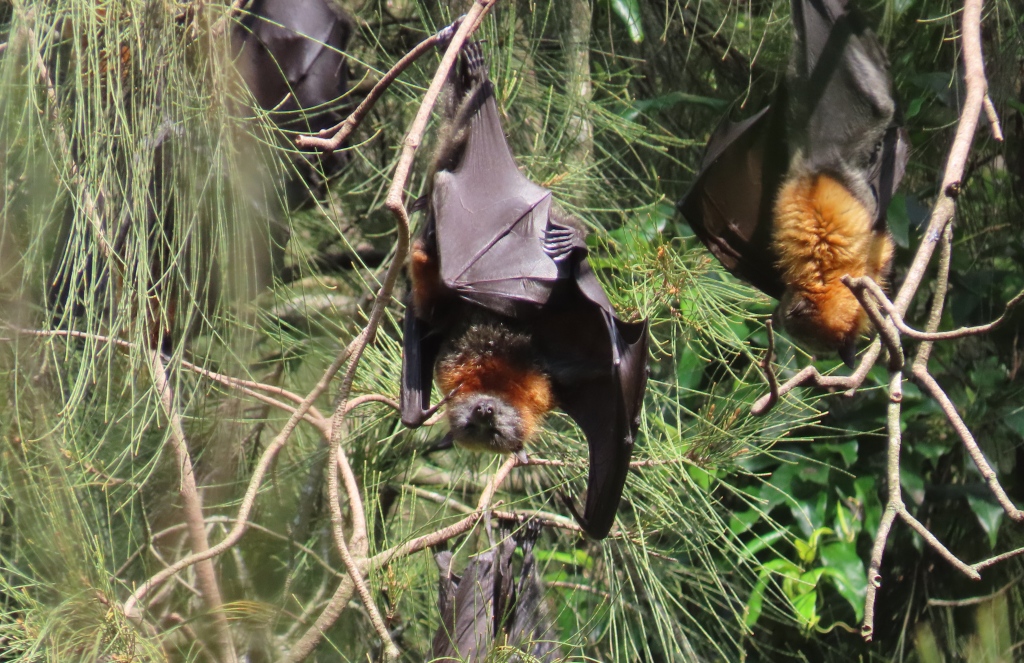
A colony of Flying Foxes (large fruit bats) occupies one corner of the wetlands:

Here’s a close-up of one of these attractive, intriguing mammals. They have a grey face, with a reddish fur collar and back. Their wings are black and leathery, strong enough to support these large bats in their long cross-country flights:
After the Warriewood Wetlands, we visited Irrawong Reserve. A Golden Whistler (Pachycephala pectoralis) carolled in the dense bush. This is the male bird:
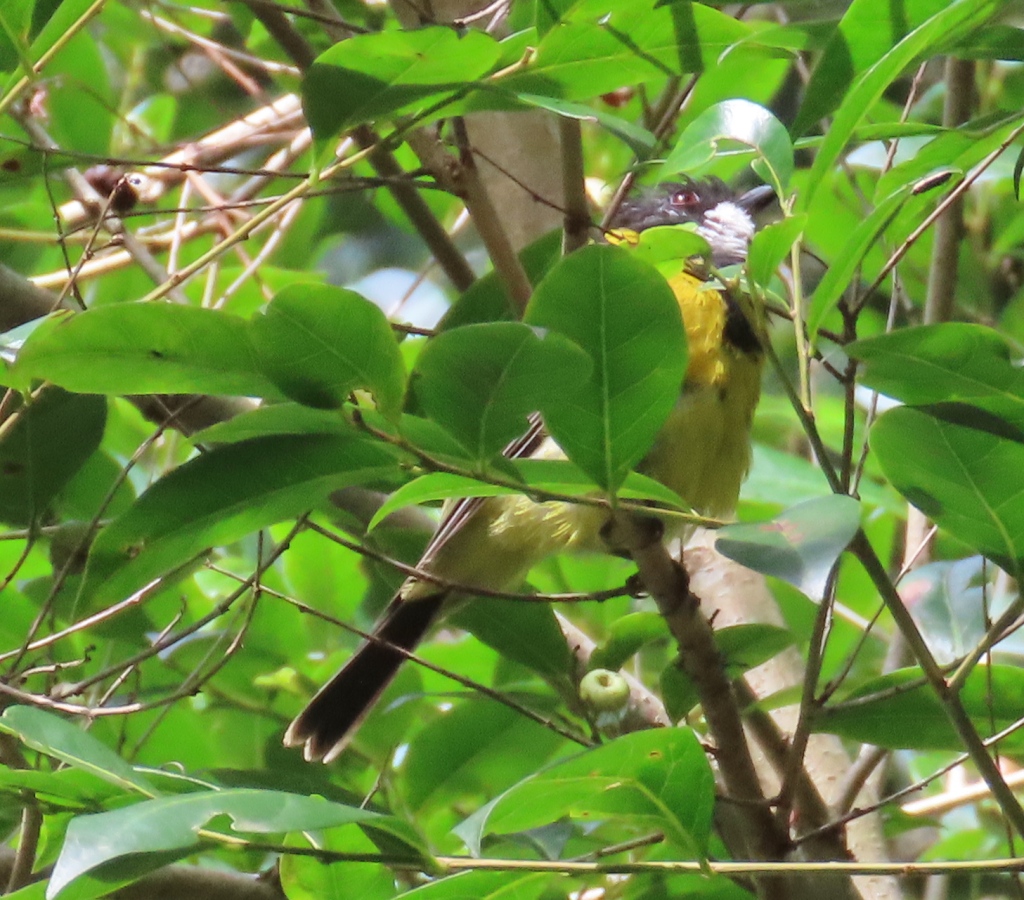
As you can see, it’s adept at hiding behind the foliage. Here’s another shot of the same bird, with its tail fanned:

I think the next bird is a female Golden Whistler. They’re harder to identify because of their soft colouring:
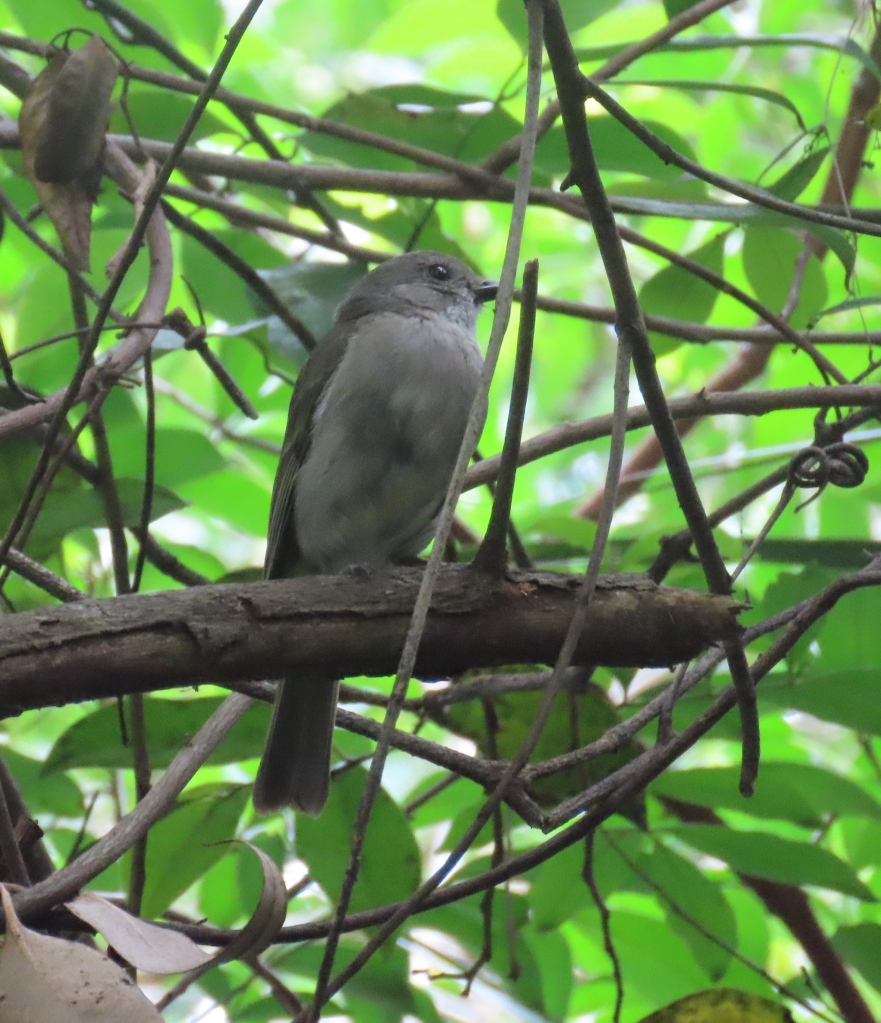
The next bird is a first sighting for me: a pretty Rufous Fantail (Rhipidura rufifrons):
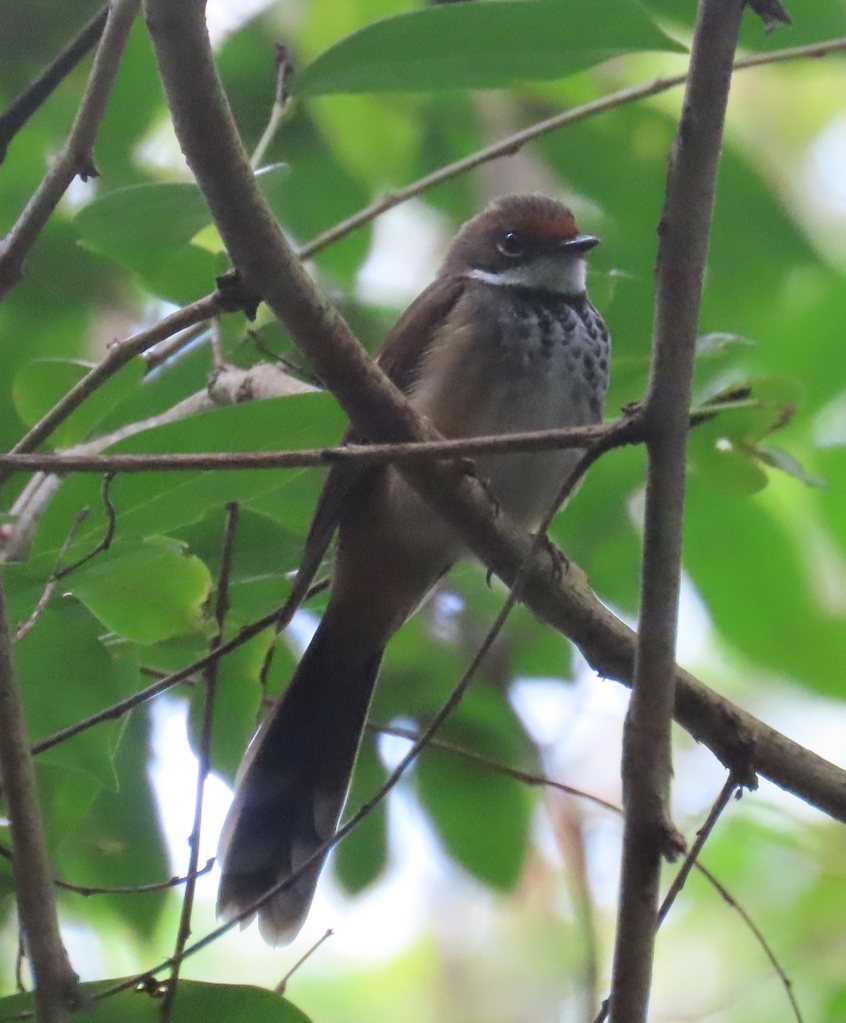
This video is rather blurry, but it’s useful because you can hear the characteristic song of the fantail, similar to that of the Grey Fantail and Willie Wagtail:
My last bird of the day is a Brown Gerygone (Gerygone mouki), another first sighting for me:

The photograph of this bird is very similar to the earlier one of the female Golden Whistler. However, the Gerygone has grey markings running from beak to eye. The Gerygone (9-11 cm) is also smaller than the Golden Whistler (16-18 cm), though that’s hard to tell from the photos.

White-cheeked Honeyeater enjoying the spring blossoms
A White-cheeked Honeyeater peeks out from a flower-covered bush. The bird is mostly black and white, but you can just make out some of the yellow markings on its wings and tail:
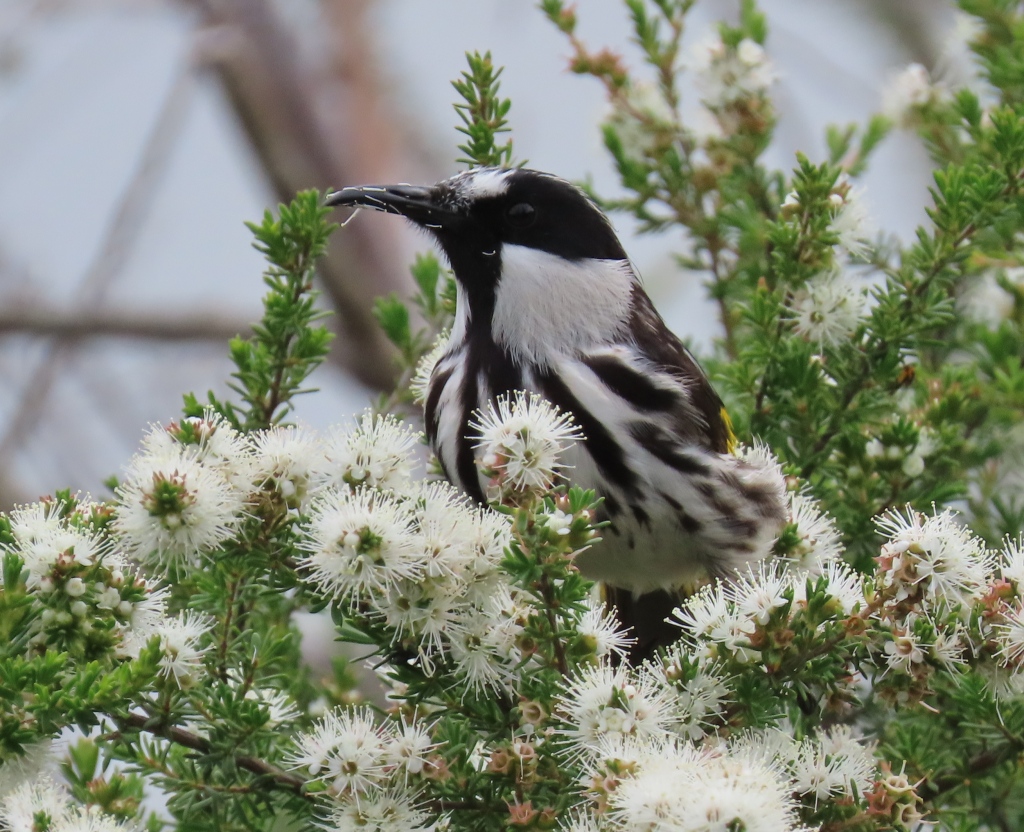
If you have trouble distinguishing these little birds from New Holland Honeyeaters, you’re not alone! This one has the black eye and large white cheek patch that identify it as a White-cheeked Honeyeater. A while ago, I took some photos of both birds to compare them.
Common name: White-cheeked Honeyeater
Scientific name: Phylidonyris nigra
Approximate length: 16-19 cm
Date spotted: 20 November 2023 (spring)
Location: Manly Dam Reserve, New South Wales, Australia: 33°46’30.3″S 151°14’46.6″E

My first Lewin’s Honeyeater
Australia hosts several types of honeyeater, and I’ve spotted a few of them over the lifetime of this blog. Recently I saw my very first Lewin’s Honeyeater:
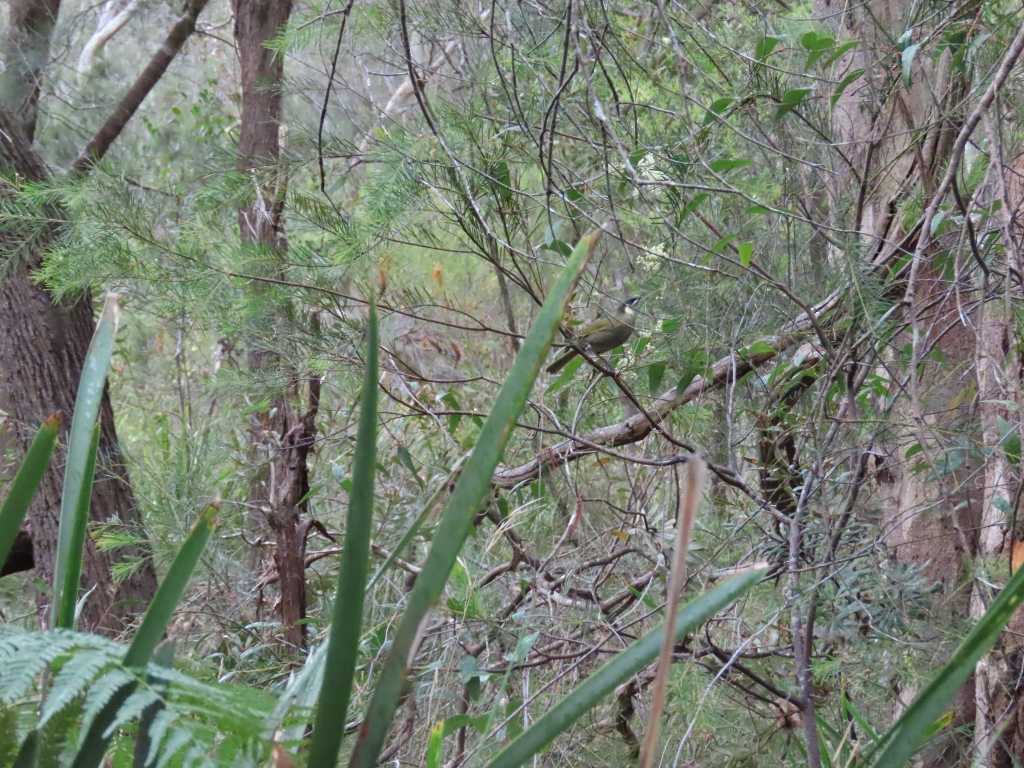
Lewin’s Honeyeater is a medium-sized bird. As is the case with other honeyeaters, nectar forms a major part of their diet. They also eat fruits and insects. They have a distinctive, crescent-shaped yellow ear patch as well as a light yellow stripe under each eye.
According to my bird book, they’re “abundant”, especially in the wetter areas of eucalypt forests. I’ll keep a look out now that I know they’re around.
Common name: Lewin’s Honeyeater
Scientific name: Meliphaga lewinii
Approximate length: 19-22 cm
Date spotted: 5 June, 2023 (winter)
Location: Manly Dam Reserve, New South Wales, Australia: 33°46’47.6″S 151°14’53.2″E

Yellow-faced Honeyeater near Capertee
Yet another first sighting for me: a Yellow-faced Honeyeater that I spotted during last week’s trip out west of Sydney. I was taking an early-morning walk in the countryside near the little town of Capertee. It’s gorgeous out there. Rolling hills, vistas of the Blue Mountains, Eucalypt forests, and green grassy clearings.
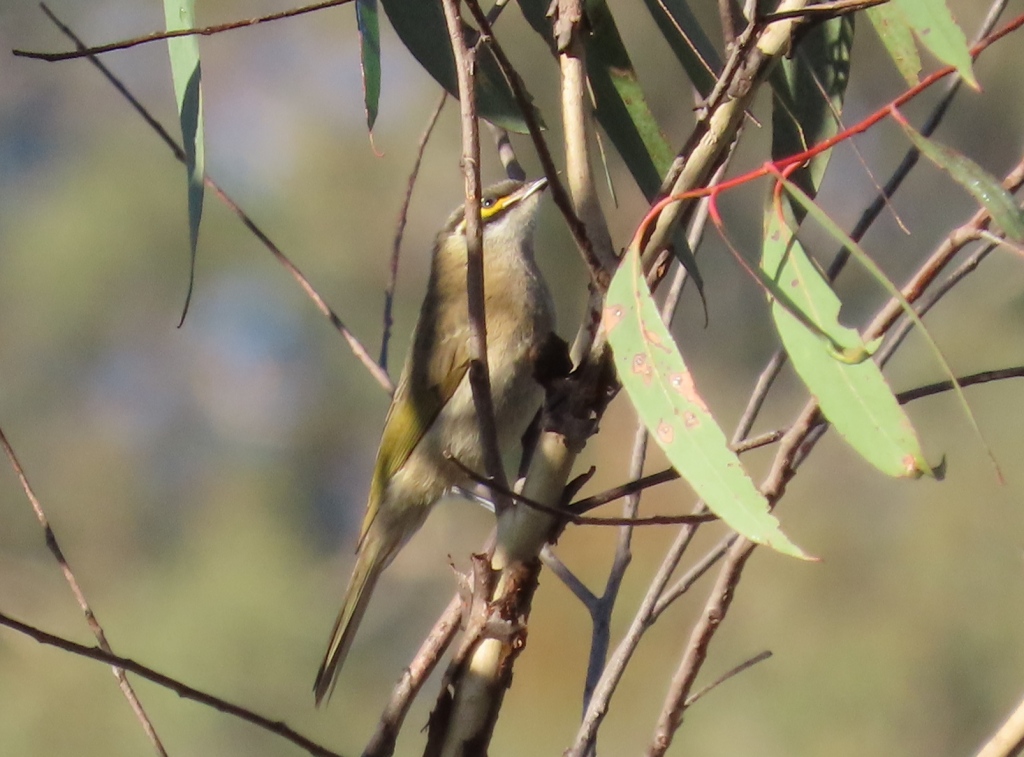
Yellow-faced Honeyeaters feed on manna, nectar, and small insects. They get their name from the yellow streak that runs across the face below the eye. The streak is bordered in black. Other colours on the bird range from off-white to grey-brown, with olive-yellow edges on the wings.
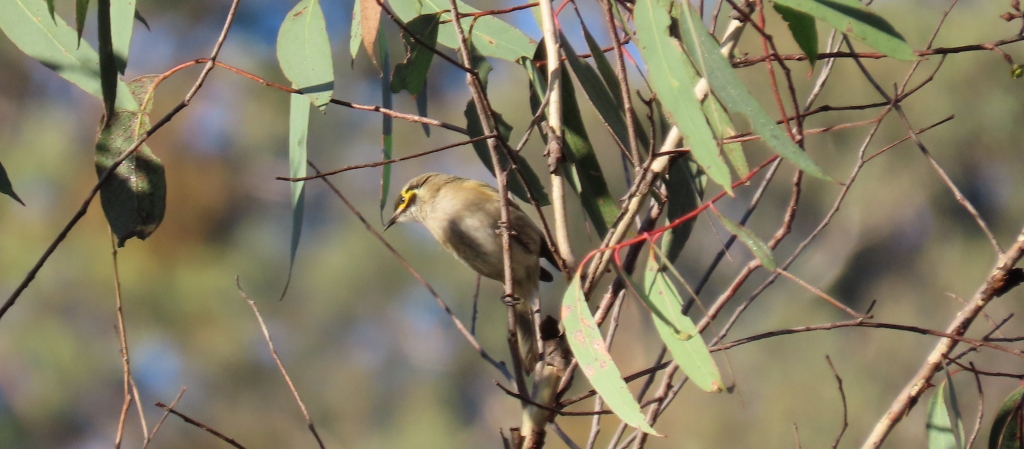
Common name: Yellow-faced Honeyeater
Scientific name: Lichenostomus chrisops
Approximate length: 16-18 cm
Date spotted: 23 April 2023 (autumn)
Location: Long Ridge, Capertee, New South Wales, Australia: 33°09’53.9″S 150°00’06.2″E

Soft colours of a young Little Wattlebird
This bird was busy gathering food on an Old Man Banksia tree (Banksia serrata). It has a small insect in its beak:

I think the bird is a Little Wattlebird, though others that I’ve seen have been darker and greyer in colour. Perhaps it’s a juvenile. I considered an oriole, but the stripes on this bird’s chest are more like those of a wattlebird than an oriole, and the shapes of the beak and head are closer to those of a wattlebird too.

Little Wattlebirds don’t have the red wattles that give this genus its name. These birds are classified as honeyeaters, but like most honeyeaters they’ll grab a passing insect too. This bird was at Dobroyd Head, one of the pieces of land that jut into Sydney Harbour.
Here’s a view that shows more of the wings and back:

Common name: Little Wattlebird
Scientific name: Anthochaera chrysoptera
Approximate length: 30 cm
Date spotted: 11 March 2023 (autumn)
Location: Dobroyd Head Track, Balgowlah, New South Wales, Australia: 33°48’33.2″S 151°16’14.1″E

Scarlet Honeyeater at Dobroyd Head
A little Scarlet Honeyeater adds a dash of colour to a wintry day:
It’s interesting that the bird was focusing on the Red Spider Flowers (Grevillea). Perhaps it’s not a crazy idea to be bright red in colour if you spend your time among red flowers! I’ve read that these birds also frequent Bottlebrush shrubs (Callistemon) which are also red.
This is only my second sighting of a Scarlet Honeyeater. They’re small and move fast, which makes it hard to get a good shot. Here’s still photo of the same bird, a male:
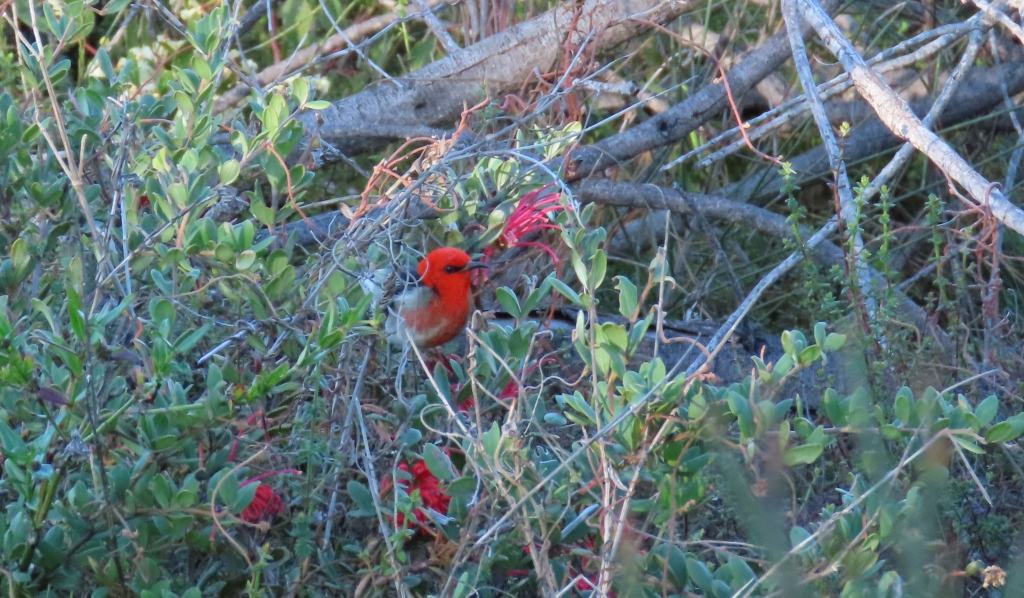
Scarlet Honeyeaters feed mainly on the nectar from flowers, hence their name. Sometimes they catch insects.
A female was close by. This photo shows the bird’s curved beak, a good tool for probing blossoms in search of nectar:
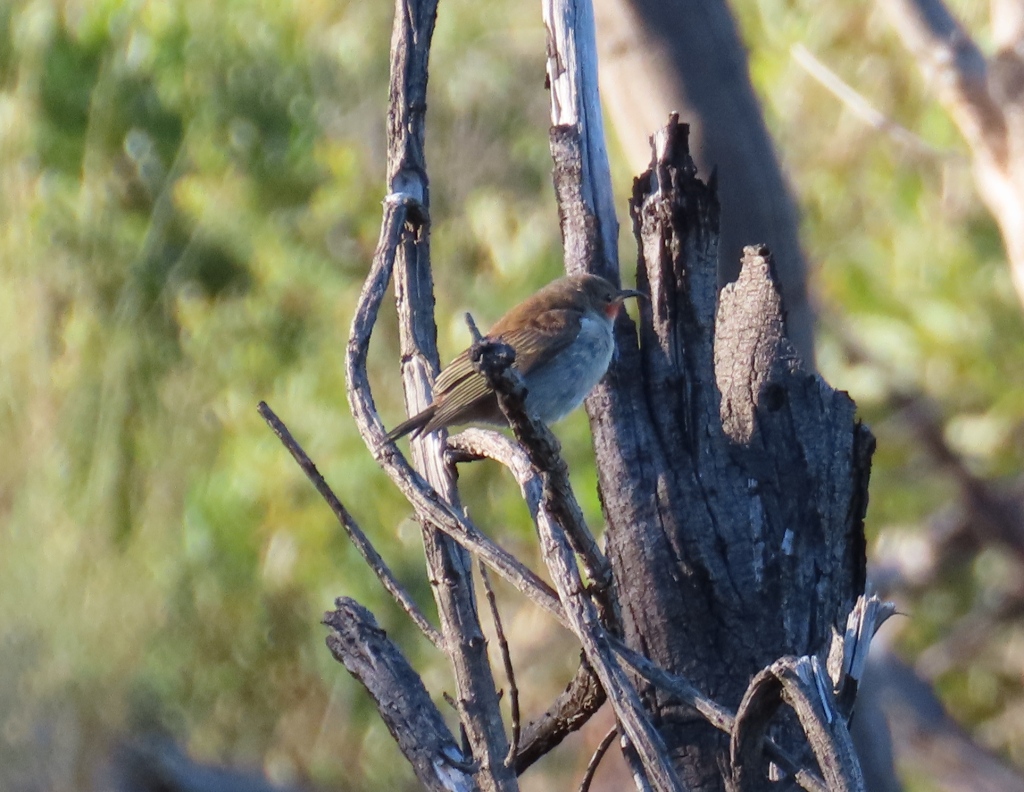
Common name: Scarlet Honeyeater
Scientific name: Myzomela sanguinolenta
Approximate length: 10 cm
Date spotted: 17 July 2022 (winter)
Location: Dobroyd Head, New South Wales, Australia: 33°48’36.4″S 151°16’19.0″E

My first Scarlet Honeyeater
Flashes of scarlet against the orange of a Banksia bloom first drew my attention to this tiny bird. It moved fast, never staying still for long. I managed to snap a couple of photos, though none very clear alas. I think it’s a Scarlet Honeyeater:

What a pretty little thing! I’ve been back to the same area a couple of times but not seen the bird again. Here’s another photo of the same bird after it moved to a different tree:

Common name: Scarlet Honeyeater
Scientific name: Myzomela sanguinolenta
Approximate length: 10 cm
Date spotted: 18 May 2021 (autumn)
Location: Manly Dam Park, New South Wales, Australia: 33°46’54.2″S 151°15’08.2″E
Red Wattlebird on Banksia
Red Wattlebirds are large, noisy honeyeaters. They get their name from the red flaps of skin below their eyes. This one was feeding on the nectar of a Heath Banksia flower:

The next picture shows both wattles on the bird’s neck:
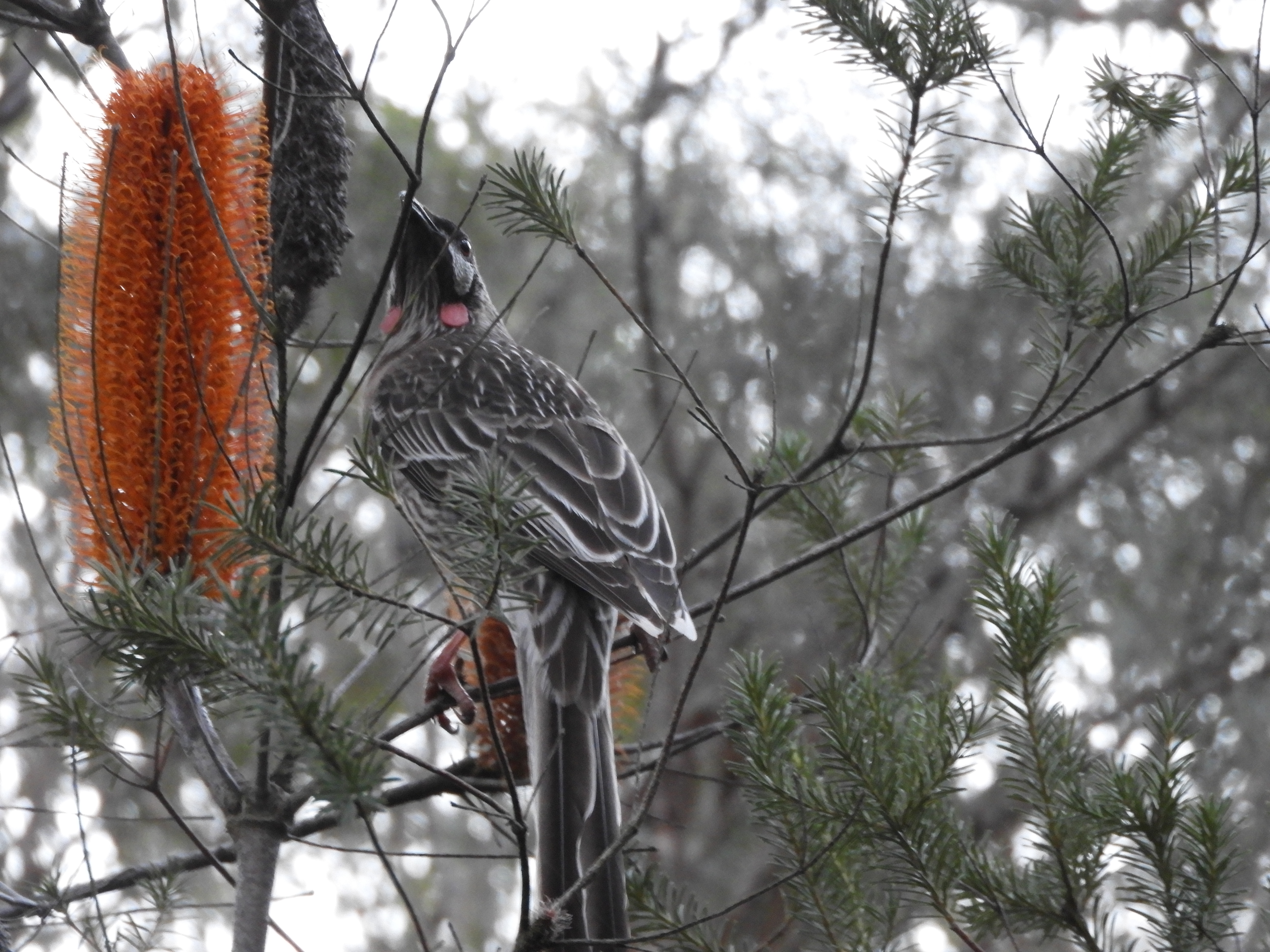
Common name: Red Wattlebird
Scientific name: Anthochaera carunculata
Approximate length: 35 cm
Date spotted: 18 July 2020 (winter)
Location: Manly Dam National Park, New South Wales, Australia. Approximate map reference: 33°46’27.0″S 151°14’57.6″E
Little Wattlebirds are common in the area too. The two birds can be hard to tell apart. Red Wattlebirds are larger (approx 35 cm from head to tail) whereas Little Wattlebirds measure approximately 30 cm. Little Wattlebirds don’t have the large red wattles. Here’s a Little Wattlebird that I photographed a while ago:

White-cheeked Honeyeaters and New Holland Honeyeaters hanging out together
Until today, I didn’t realise that we have two very similar types of honeyeaters in the area. I’ve seen and photographed New Holland Honeyeaters before. Yesterday, I took some photos of a number of birds, thinking they were all the same type.
Looking at the photos today, I noticed that some birds in the group have black eyes, some white, and the black-eyed birds seem shorter and more compact than the others. It turns out that the group included White-cheeked Honeyeaters, which I haven’t knowing seen before. They’ve probably been around all along, but I just didn’t notice.
This is a New Holland Honeyeater. Notice the white eye, and the smallish white patch near the beak:

Another New Holland Honeyeater:

Whereas the next one is a White-cheeked Honeyeater. Notice the black eye and the large white patch on the cheek:

This video shows a couple of White-cheeked Honeyeaters. You can hear the calls of the other birds around them:
While I was watching the group of birds, they would all hang out together in their chosen area of bushy cover, then emerge to go foraging in the nearby trees. Every now and then, something would alarm them, and they’d all dive for cover again. Standing near them was a little alarming, as they move extremely fast and I could hear them hitting the leaves all around. After a few moments, they’d emerge and repeat the pattern. The next video shows one such episode:
Common name: White-cheeked Honeyeaters and New Holland Honeyeaters
Scientific name: Phylidonyris nigra and Phylidonyris novaehollandiae
Approximate length: 16-19 cm and 17-19 cm
Date spotted: 9 November 2019 (spring)
Location: Manly Dam Reserve, New South Wales, Australia: 33°46’55.8″S 151°15’26.2″E
Yellow-tufted Honeyeater at Bobbin Head
A pair of Yellow-tufted Honeyeaters darted through the mangroves around the boardwalk at Bobbin Head. I managed to catch a snap of one of them before they both disappeared.
The photo shows the yellow tuft of feathers behind the black mask around the eye. The tuft is what gives the bird its name:

This bird is related to the Helmeted Honeyeater, a subspecies of Yellow-tufted Honeyeaters that is critically endangered and is found only in three small areas of Victoria.
Common name: Yellow-tufted Honeyeater
Scientific name: Lichenostomus cratitius
Approximate length: 16-19 cm
Date spotted: 28 August 2019 (late winter)
Location: Bobbin Head, Ku-ring-gai Chase National Park, New South Wales, Australia: 33°39’50.8″S 151°09’18.3″E


