Blog Archives

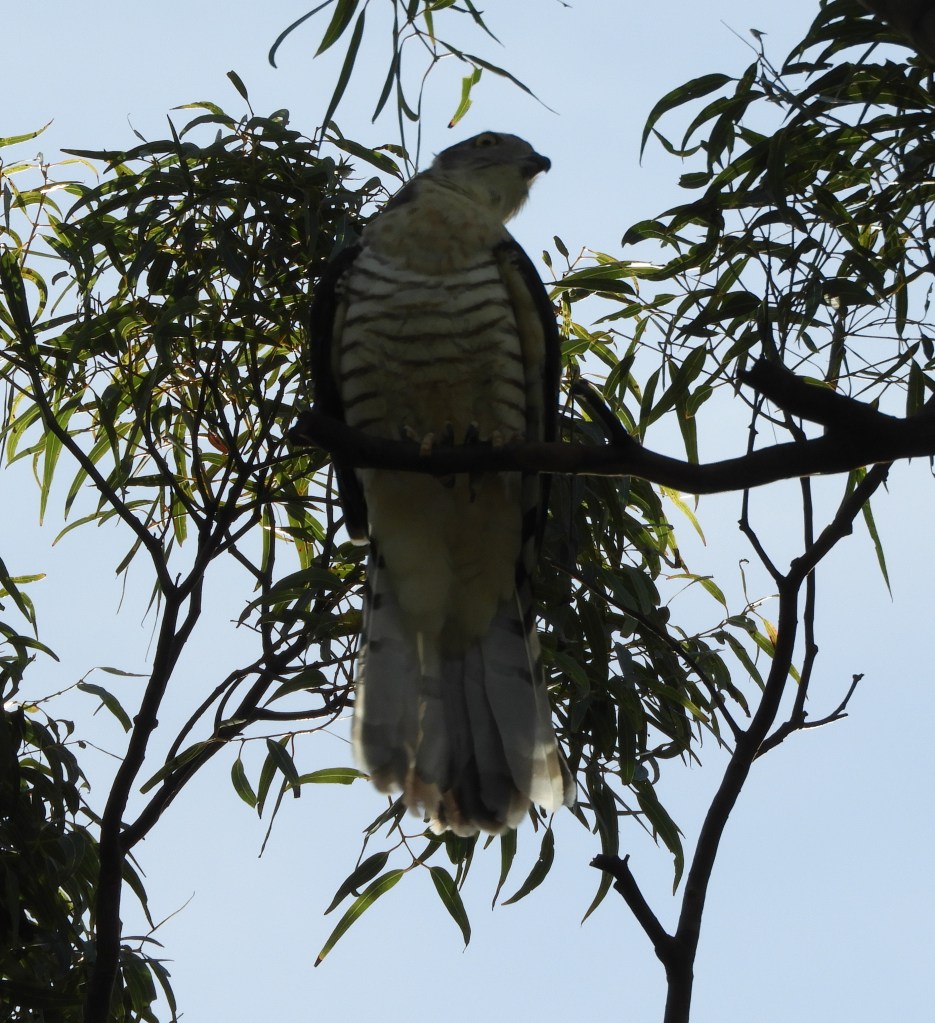
Very light-coloured Grey Goshawk
This is a Grey Goshawk, but it’s a lot lighter in colour than others I’ve seen, and it doesn’t seem to have the barring on its front (though I didn’t get to see it fully front on). It was at Manly Dam in Sydney’s Northern Beaches area.
There are two colour variations in the Grey Goshawk: the white morph and the grey morph. The white morph is found in north-western Australia, Tasmania, and the Victorian coast. It isn’t known to be found near Sydney. Besides which, this bird has light grey plumage as well as white, whereas the white morph is entirely white.

Whatever the answer to the question about its colour, this is a gorgeous bird.
Common name: Grey Goshawk
Scientific name: Accipiter novaehollandiae
Approximate length: 40-55 cm. Wing span: 70-110 cm.
Date spotted: 1 October 2024 (spring)
Location: Manly Dam Reserve, New South Wales, Australia: 33°46’22.5″S 151°14’35.7″E

Three raptors in one day
A few days ago, I was super lucky: I saw three birds of prey in one afternoon. The first was an Eastern Osprey, holding a fish in its claws. The second was a Black-shouldered Kite, hovering above the grasslands near the beach. For a short time, there were two of these birds quite close to each other. The third was a Peregrine Falcon, soaring in the sky above the suburbs.
Eastern Osprey
The Eastern Osprey was exciting to see. It was quite large, flying high in the sky above Long Reef Aquatic Reserve in Collaroy. At first I thought this large bird was one of the pelicans that were floating about. When I saw it through my camera lens, I spotted the fish in the bird’s grip.
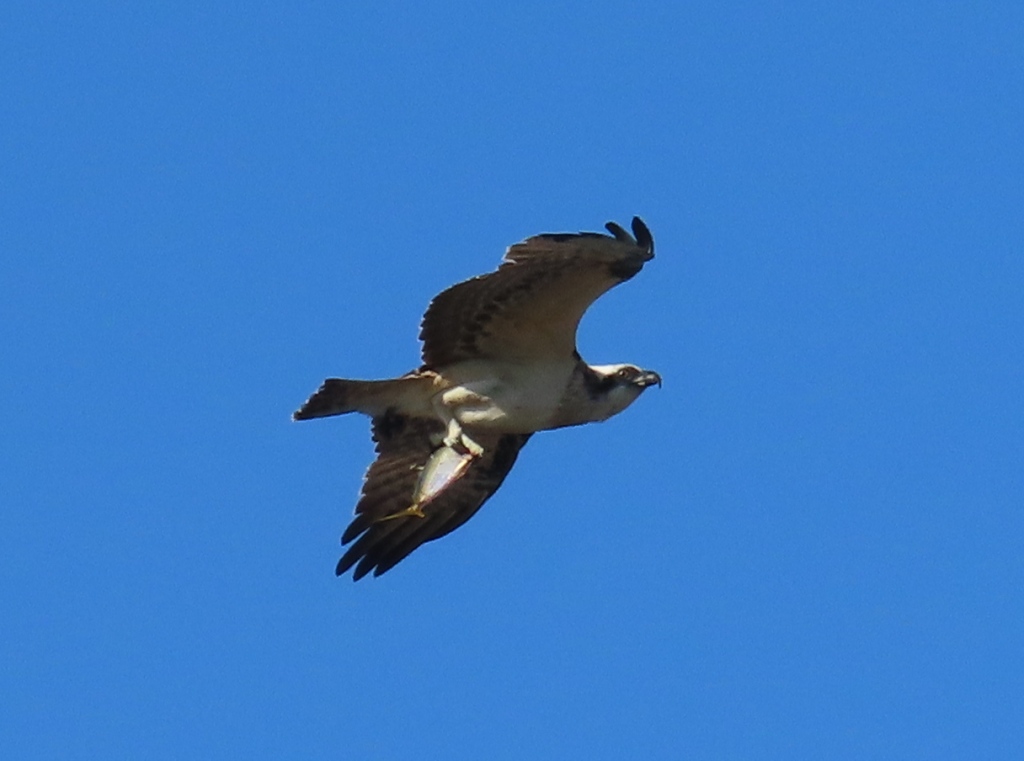
The next picture is fuzzy and only a partial shot of the bird, but it gives a good idea of the colouring of the underside:
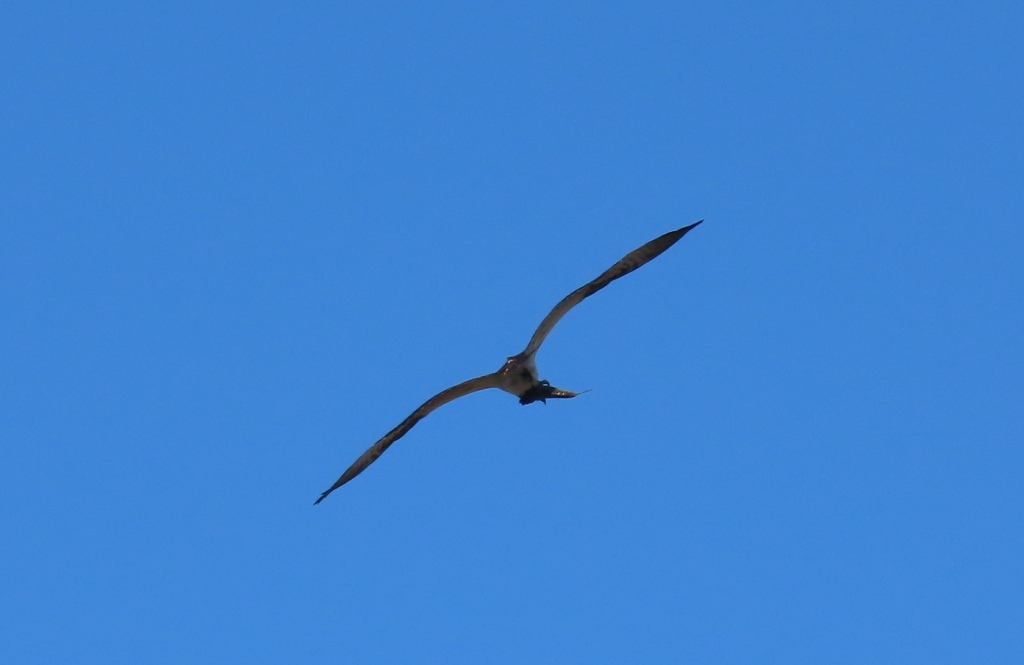
The next picture shows the Osprey’s long wingspan — about 1.5 metres. The bird is flying away from the camera:
Common name: Eastern Osprey
Scientific name: Pandion cristatus
Approximate length: 57 cm
Date spotted: 24 March 2024 (summer)
Location: Long Reef Aquatic Reserve, Collaroy, New South Wales, Australia: 33°44’19.7″S 151°18’42.0″E
Black-shouldered Kite
Nearby, a Black-shouldered Kite hovered above the grassy, bushy stretch that runs along the coast. It was amazing how the bird hung almost motionless in the air, held aloft by the air currents:
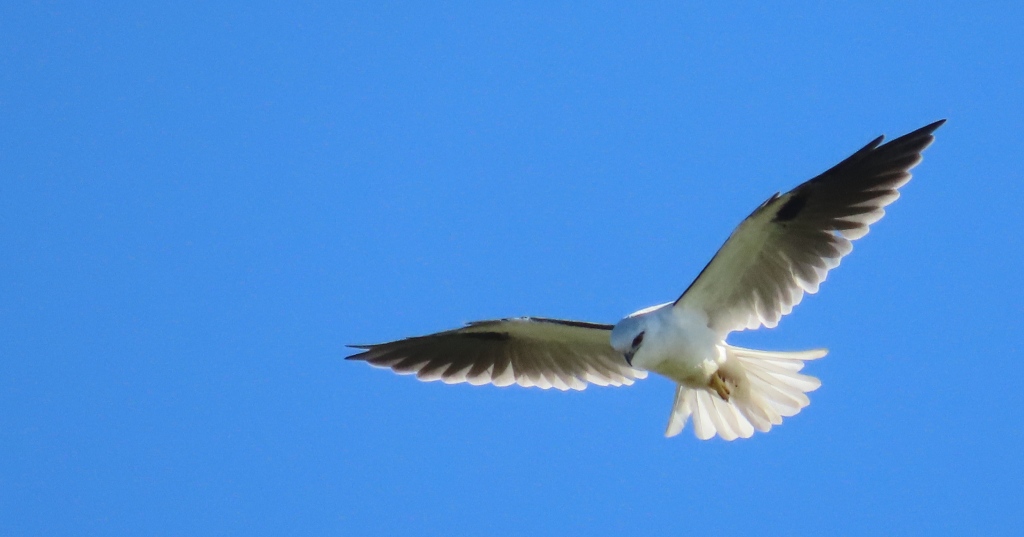
The next photo shows a slightly different angle. It might be the same bird or a different one, as there were two in the area:
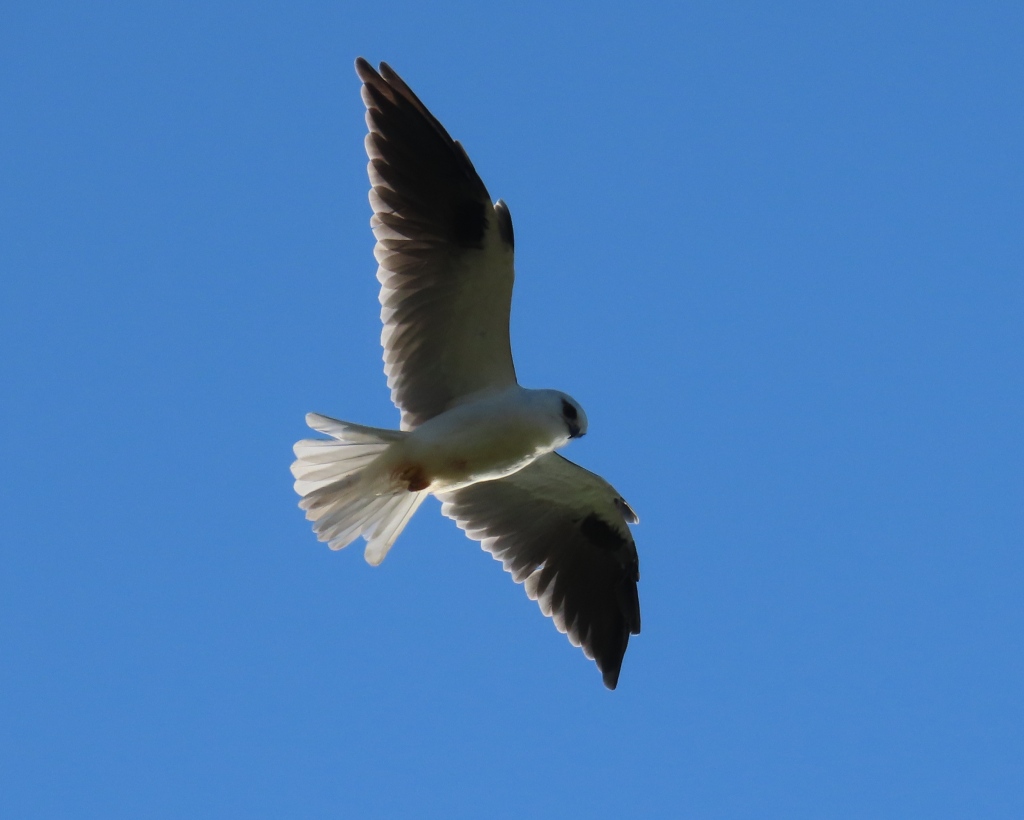
Also in the area were some paragliders, enjoying the same up currents as the birds. The gliders kept a respectful distance, and the birds didn’t seem worried at all, as you can see in the next video. The second Black-shouldered Kite makes a brief appearance part-way through:
Common name: Black-shouldered Kite
Scientific name: Elanus axillarus
Approximate length: 35 cm
Date spotted: 24 March 2024 (summer)
Location: Long Reef Aquatic Reserve, Collaroy, New South Wales, Australia: 33°44’19.7″S 151°18’42.0″E
Peregrine Falcon
On my way home, I saw a Peregrine Falcon soaring high in the sky. As I took the photo, the bird turned its head and looked down at me:

The images are fuzzy because my camera isn’t super powerful, but you can still make out the features of the Peregrine Falcon:
Common name: Peregrine Falcon
Scientific name: Falco Peregrinus
Approximate length: 42 cm
Date spotted: 24 March 2024 (summer)
Location: Allambie Heights, New South Wales, Australia: 33°46’18.2″S 151°15’39.4″E
It’s not often that I see one of Australia’s birds of prey. To see three different types in one day was a raretreat.

Grey Goshawk in quiet contemplation
On a walk through the Australian forests near Sydney, I stopped on a rocky ledge to take in the view. Then I noticed a Grey Goshawk on a branch close by, also gazing out across the valley.
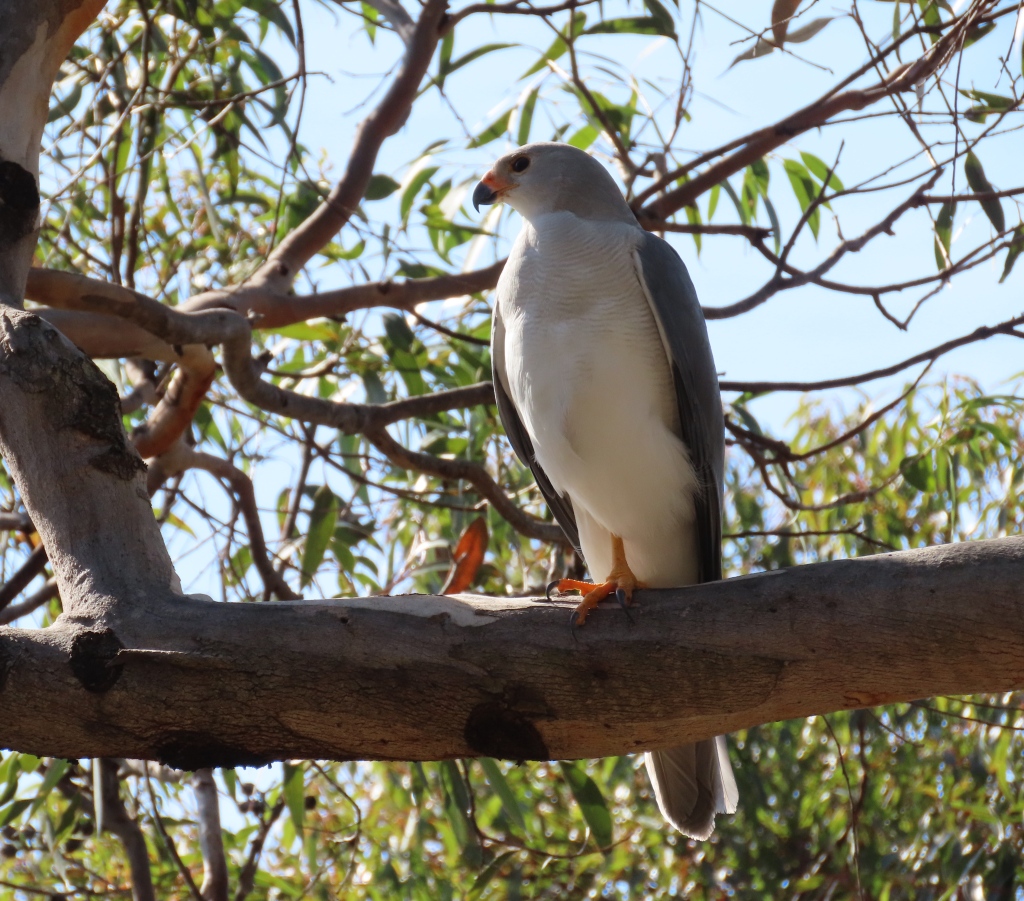
These beautiful birds of prey are quite sturdy, about 55 cm in length from head to tail, and have a wingspan of about one metre. Their chest and belly feathers are white with light grey horizontal bars. The head is grey, with large dark eyes outlined in yellow, and a yellow beak tipped in dark grey. Add the dark grey wings and tail feathers, and you have a very striking bird.
The goshawk was standing on one leg, with the other foot tucked under its belly feathers. The bird turned its head to see whether I posed it any danger, then went back to quiet contemplation of the view.

After five minutes or so, it hopped off the branch and glided away.
This is only the second time I’ve managed to snap some photos of a goshawk, though I’ve seen them a couple more times.
Common name: Grey Goshawk
Scientific name: Accipiter novaehollandiae
Approximate length: 40-55 cm. Wing span: 70-110 cm.
Date spotted: 4 August 2023 (winter)
Location: Manly Dam Reserve, New South Wales, Australia: 33°46’54.8″S 151°15’03.5″E

Pacific Baza pays a visit
Exciting! We had a visit from a rare bird this morning. A juvenile Pacific Baza took refuge in the trees in our garden for a short time.
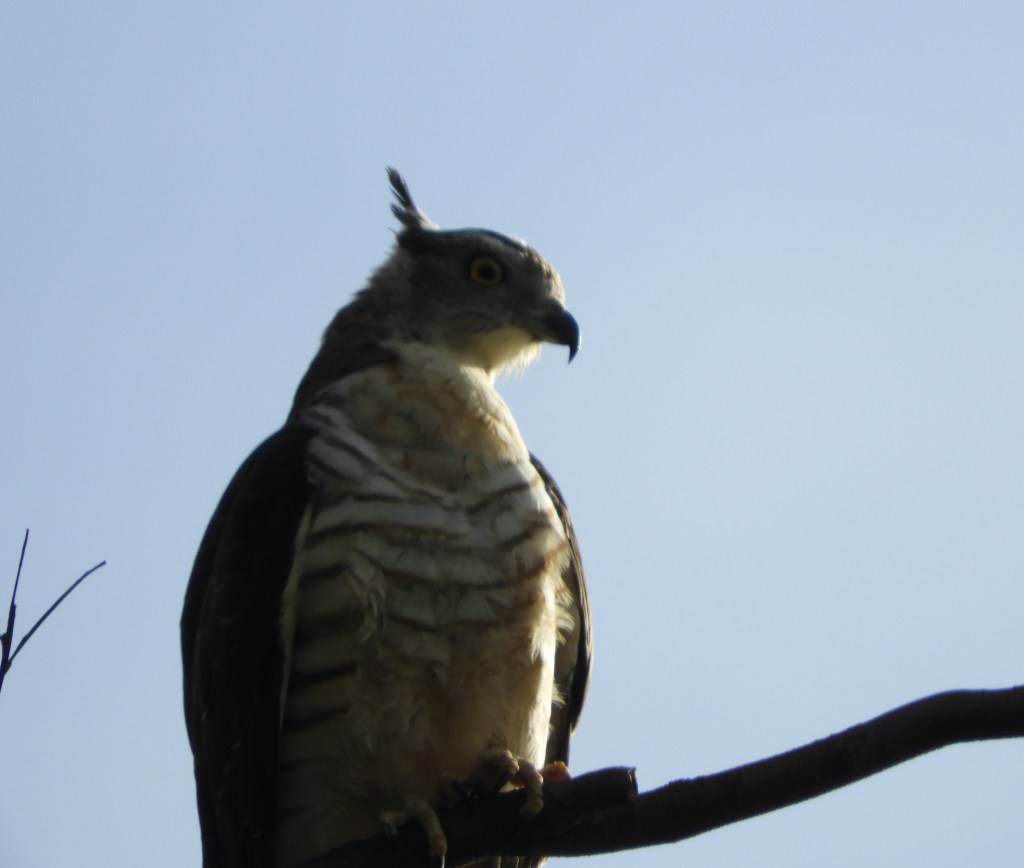
A Pacific Baza is a large bird of prey with a funny-looking crest on its head. The adults have a white head, neck, and shoulders, whereas this one still has the cinnamon colouring of a juvenile.
These birds are uncommon, mostly found in north and north-east Australia, and are rare in New South Wales (where I am). They eat small reptiles, and praying mantises and stick insects (both of which can be quite large in Australia).
Common name: Pacific Baza
Scientific name: Aviceda subcristata
Length: 35-45 cm
Wing span: 1 metre
Date spotted: 6 July 2021 (winter)
Location: Allambie Heights, NSW, Australia
Collared Sparrowhawk
This sparrowhawk was sitting quietly on a branch above a scrubby patch of bush, on the edge of Manly Dam.
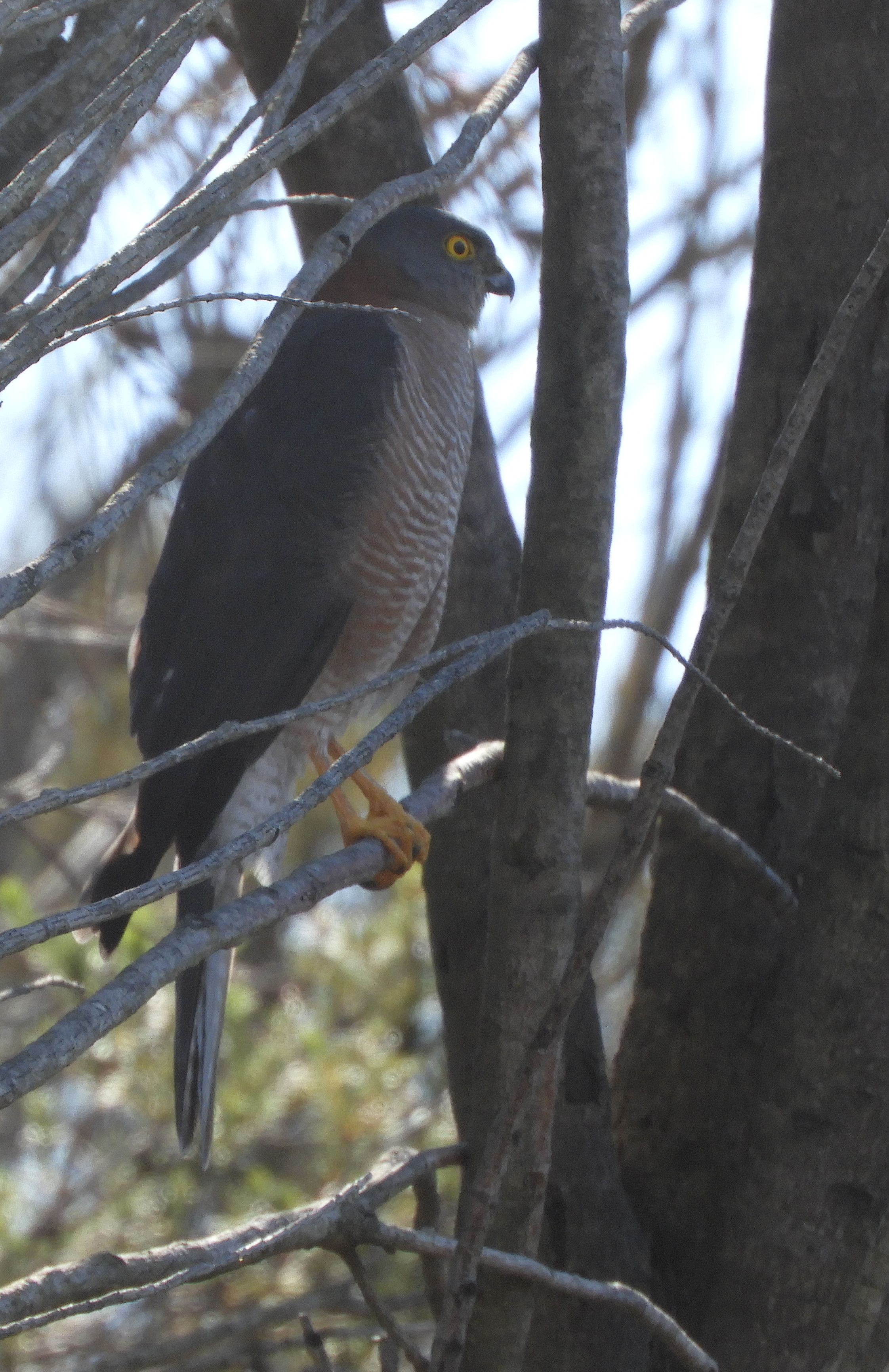
I think it’s a sparrowhawk, but it could be a Brown Goshawk. They’re very similar in appearance. Collared Sparrowhawks have a very long middle toe. This was the only photo I managed to take before the bird flew away, and the photo doesn’t show the toes too well. Brown Goshawks are larger than Collared Sparrowhawks, but it’s hard to judge the size of a bird.
Common name: Collared Sparrowhawk
Scientific name: Accipiter cirrhocephalus
Approximate length: 30-40 cm, wing span 55-80cm
Date spotted: 6 May 2020 (autumn)
Location: Manly Dam National Park, New South Wales, Australia: 33°46’31.8″S 151°14’46.8″E
Grey Goshawk has soft plumage, big eyes, and fierce beak
Although Noisy Miners are a nuisance, they do lead me to plenty of interesting sights. This time they were complaining about this Grey Goshawk that was invading their territory:

The Grey Goshawk looks soft and fluffy, with its light grey and white plumage and large eyes. But it has a fierce beak and strong feet, fit for catching and eating its prey. Evidently it can catch birds as large as a heron.
The Noisy Miners chased the hawk from perch to perch as I watched. The next picture shows the bird at the moment that it decides to take flight. The branch above the hawk seems to be in just the wrong place for optimal wing deployment:
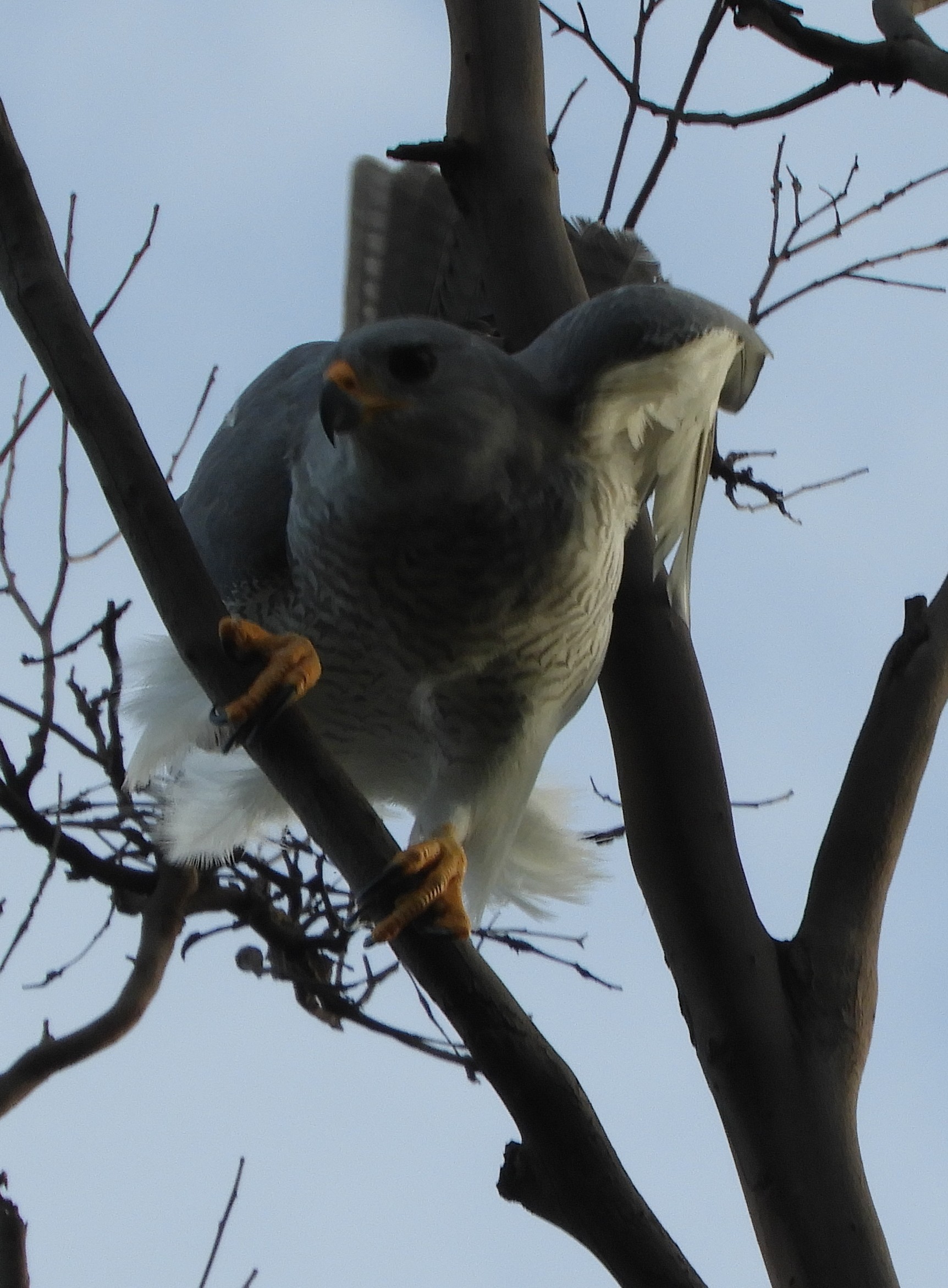
Each time it took flight, the Grey Goshawk uttered a series of short, high-pitched chirps that clashed with the shrieking of the Noisy Miners. Almost as if it was telling them off!
Wing deployment progressing despite unfortunate position of upper branch:

Wing deployment looking good, initiating detachment from lower branch:
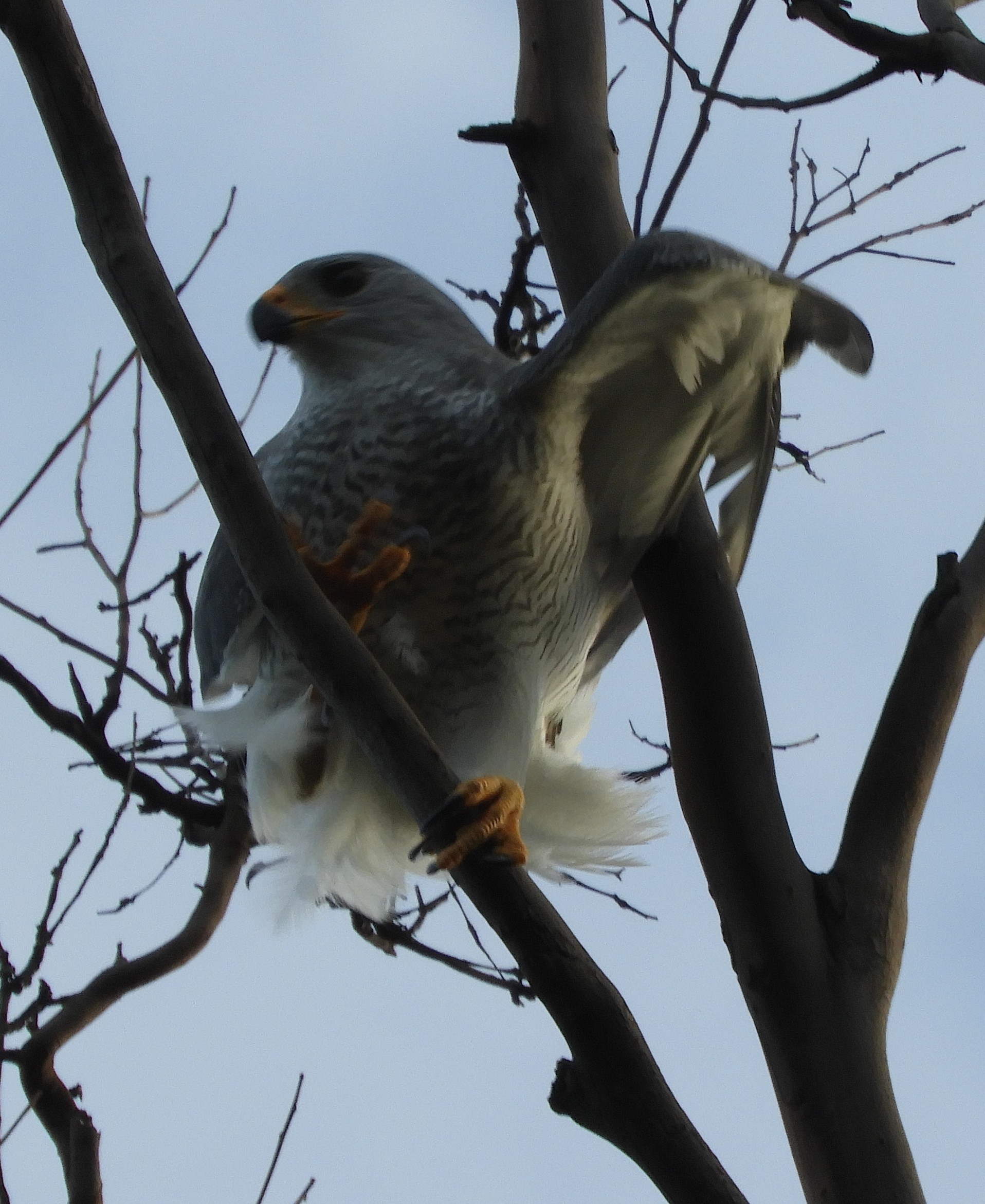
The hawk took off and coasted through the tops of the trees. Soon after it disappeared from view, a group of cockatoos burst from the tree tops and circled the area, shrieking and shouting in alarm.
This was my first sighting of a Grey Goshawk. What a beautiful bird.
Common name: Grey Goshawk
Scientific name: Accipiter novaehollandiae
Approximate length: 40-55 cm. Wing span: 70-110 cm.
Date spotted: 24 February 2020 (summer)
Location: Manly Dam Reserve, New South Wales, Australia: 33°46’36.9″S 151°14’47.7″E
Spotted a Sparrowhawk near Manly Dam
It took me a while to identify this bird. I’ve decided it’s a Collared Sparrowhawk. Other candidates were a Brown Goshawk and a Peregrine Falcon. I’ve spent a while poring over my bird book, and decided that this bird doesn’t have a light enough front collar to be a Peregrine Falcon. Deciding between the Goshawk and the Sparrowhawk was even more difficult. Close examination reveals that this bird has middle toes that are longer than the other toes, which qualifies it to be the Sparrowhawk.
Common name: Collared Sparrowhawk
Scientific name: Accipiter cirrhocephalus
Approximate length: 30-40 cm, wing span 55-80cm
Date spotted: 25 December 2013
Season: Summer
Location: Manly Dam Reserve, New South Wales, Australia
Latitude/longitude: -33° 46.608′, 151° 15.268′
Here’s a still of the same bird. What a fierce gaze!

This one shows the barred plumage on the bird’s chest, and the long middle toe:


 Sydney Birder