Blog Archives

Fun facts about Grebes
Yesterday, this beautiful little Australasian Grebe was pottering about in an inlet of Manly Dam:
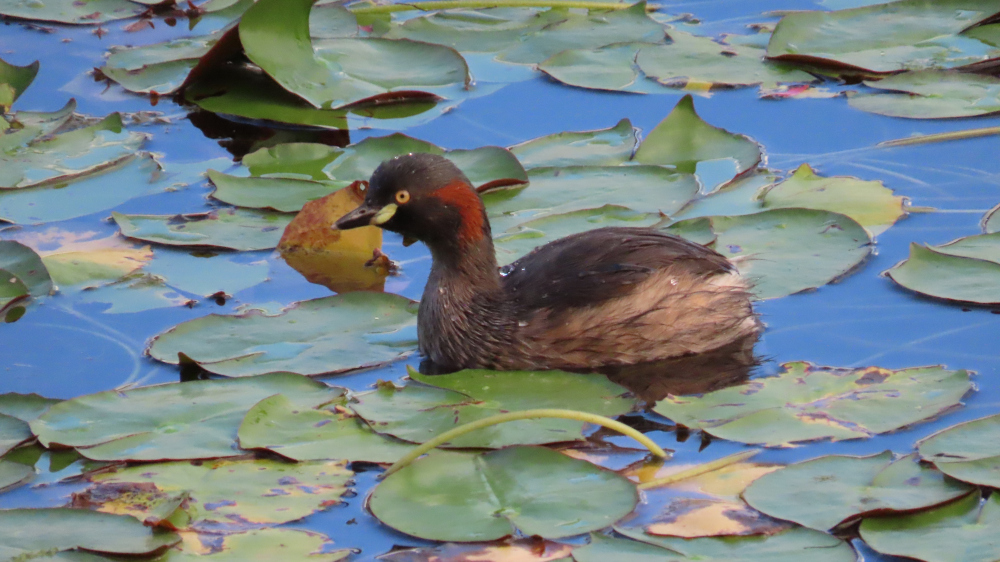
This grebe is wearing its breeding plumage, with a large chestnut patch stretching from its eye down its neck, and that odd yellow patch at the base of its beak. Outside the breeding season, the yellow patch turns white and the bird’s neck is a dark grey-brown to match its back.
Fun fact: Grebes eat their own feathers and also feed their feathers to their young. People think the goal is to make it easier to swallow fish bones, by wrapping around the bones and preventing injury to the bird.
Another fun fact: Grebes have big feet with lobed toes, more like those of coots than ducks. I’ve never seen a grebe out of the water, but I do have a picture of a coot’s feet, which are rather adorable: The foot of the Coot.
Common name: Australasian Grebe
Scientific name: Tachybaptus novaehollandiae
Approximate length: 23-25 cm
Date spotted: 25 March 2026 (autumn)
Location: Manly Dam Park, near Sydney, Australia: 33°46’34.8″S 151°14’49.6″E

Willie Wagtail enchanted by Grebe
This little Willie Wagtail seems intrigued by the way a Grebe keeps disappearing under the water and popping up again:
My camera battery died as I was taking the above video, which is a pity because the birds were quite close to me. Here’s another video, a bit noisy due to a plane flying overhead, and the birds are further away:
It’s funny how the Coot seems to be surprised by the Grebe’s disappearance too. I love Coots!
I watched the two birds for about fifteen minutes, as the Willie Wagtail tirelessly followed the Grebe around this reedy inlet of Manly Dam. I wonder if the Willie Wagtail was hoping for some insects to fly up each time the Grebe surfaced. Perhaps the Grebe’s activities would disturb a lily pad and cause an insect to jump?

Common names: Australasian Grebe and Willie Wagtail
Scientific names: Tachybaptus novaehollandiae and Rhipidura leucophrys
Approximate length: 23-25 cm and 20 cm
Date spotted: 5 June 2024 (autumn)
Location: Manly Dam Park, near Sydney, Australia: 33°46’34.8″S 151°14’49.6″E

Battlestar Grebe
This little Australasian Grebe looks quite fierce, but cute at the same time:
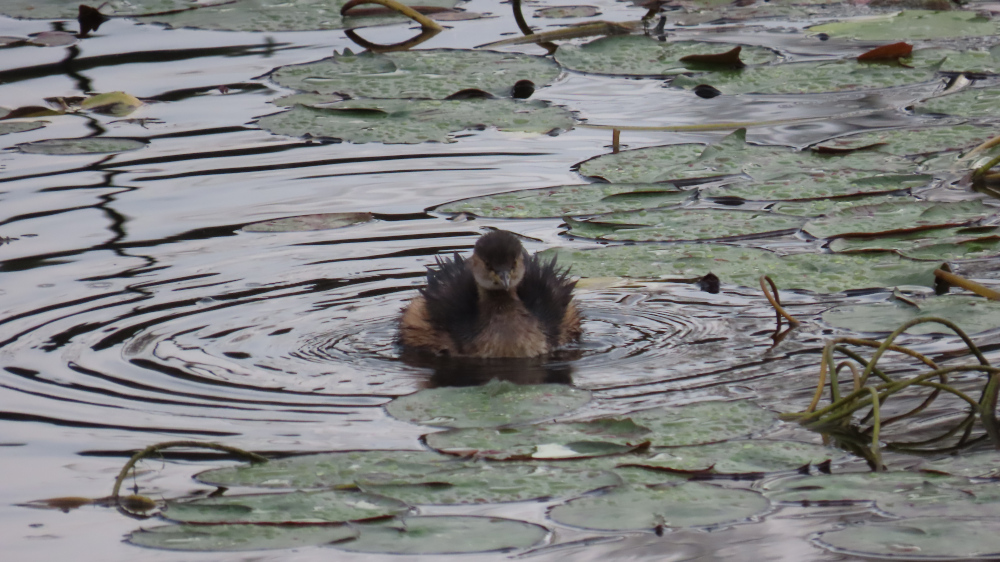
Here’s another pic of the same bird:
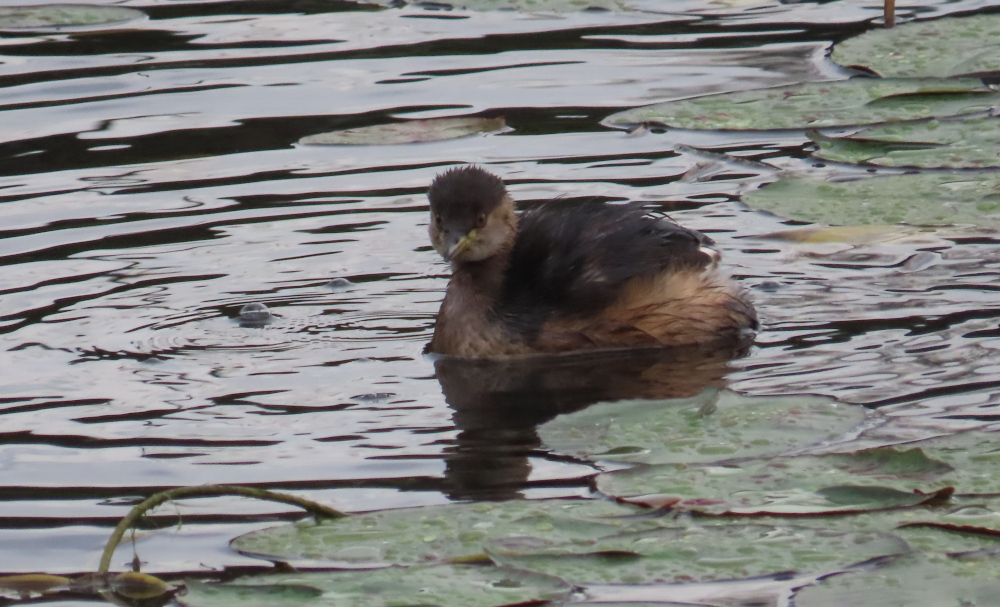
I’ve seen a Grebe once before, way back in April 2020. It was in the same location as this one. Despite my few sightings, these birds are evidently common. They have lobed feet, like the Coot, rather than webbed feet like a duck, and they’re adept divers despite their plump appearance.
Common name: Australasian Grebe
Scientific name: Tachybaptus novaehollandiae
Approximate length: 23-25 cm
Date spotted: 4 May 2024 (autumn)
Location: Manly Dam Park, near Sydney, Australia: 33°46’34.8″S 151°14’49.6″E
Fluffy Australasian Grebe, not a duckling
Update on 19 April: The bird is actually an Australasian Grebe, not a duckling as I originally thought. Thanks to Pamela and Carol for helping to identify the bird (see comments on this post).
This tiny ball of fluff was zooming around an inlet of Manly Dam. I thought it was a Mallard duckling, because it seemed to spend most time close to an adult Mallard. Despite its size, the little thing was independent of spirit and a fast paddler.

Common name: Australasian Grebe
Scientific name: Tachybaptus novaehollandiae
Approximate length: 23-25 cm
Date spotted: 6 April 2020 (autumn)
Location: Manly Dam National Reserve, near Sydney: 33°46’34.8″S 151°14’49.6″E
This is the Mallard that the little one seemed to home in on:

Mallards are an introduced species in Australia. Their original home is the northern hemisphere, but they’re quite common in south eastern Australia now too.
Common name: Mallard
Scientific name: Anas Platyrhynchos
Approximate length: 50-70 cm
Date spotted: 6 April 2020 (autumn)
Location: Manly Dam National Reserve, near Sydney: 33°46’34.8″S 151°14’49.6″E


 Sydney Birder