Blog Archives

Mmm, Mountain Devil flowers make a nice change from those tough Banksia pods!
A Yellow-tailed Black-cockatoo contemplates life while demolishing the flower of a Mountain Devil bush.
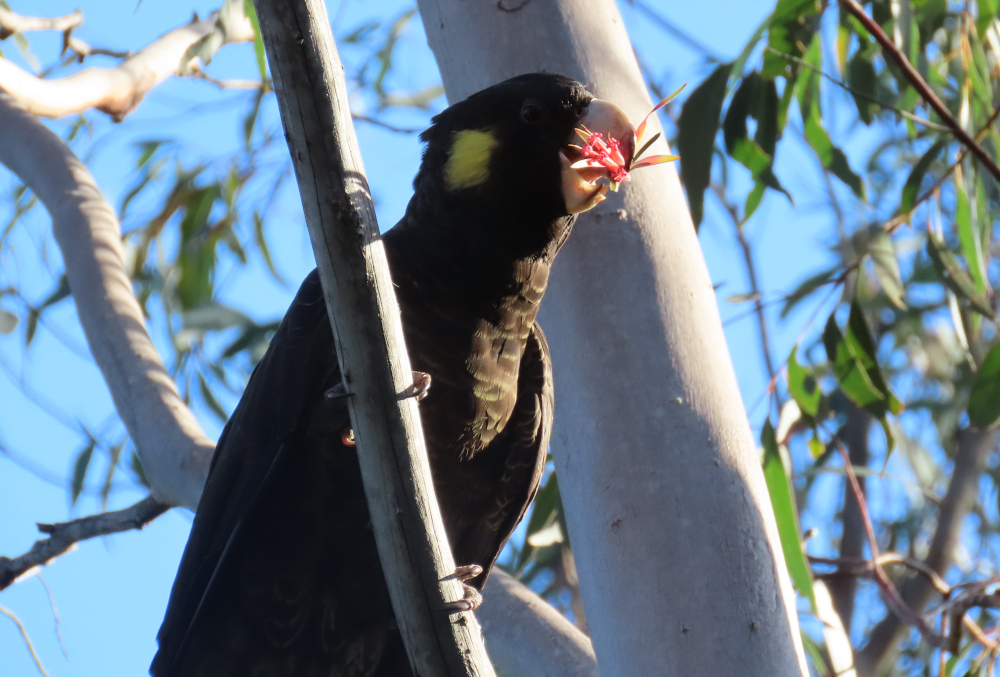
Common name: Yellow-tailed Black Cockatoo
Scientific name: Calyptorhynchus funereus or Zanda funereus
Length: 58-65 cm
Date spotted: 26 October 2024 (spring)
Location: Manly Dam Reserve, New South Wales, Australia: 33°46’40.0″S 151°14’50.2″E

The tranquil parrot: Glossy-black Cockatoos
Of all the various types of cockatoos that we get in our area of Australia, the Glossy-blacks are by far the most restful to be with. When they chatter to each other, their call is a restful croon. They seem to take life easy, with few sudden moves. Watch this one going with the flow while the wind tosses her perch back and forth:
Casuarina seeds are just about the only food that Glossy-black Cockatoos eat. I usually find the birds by the comfortable munching noises that they make, rather than the noisy fuss that other types of cockatoos are fond of making!

This family of three birds has been visiting the Casuarina trees beside one of my current favourite bush walks.

I took these pictures over the period of a week.
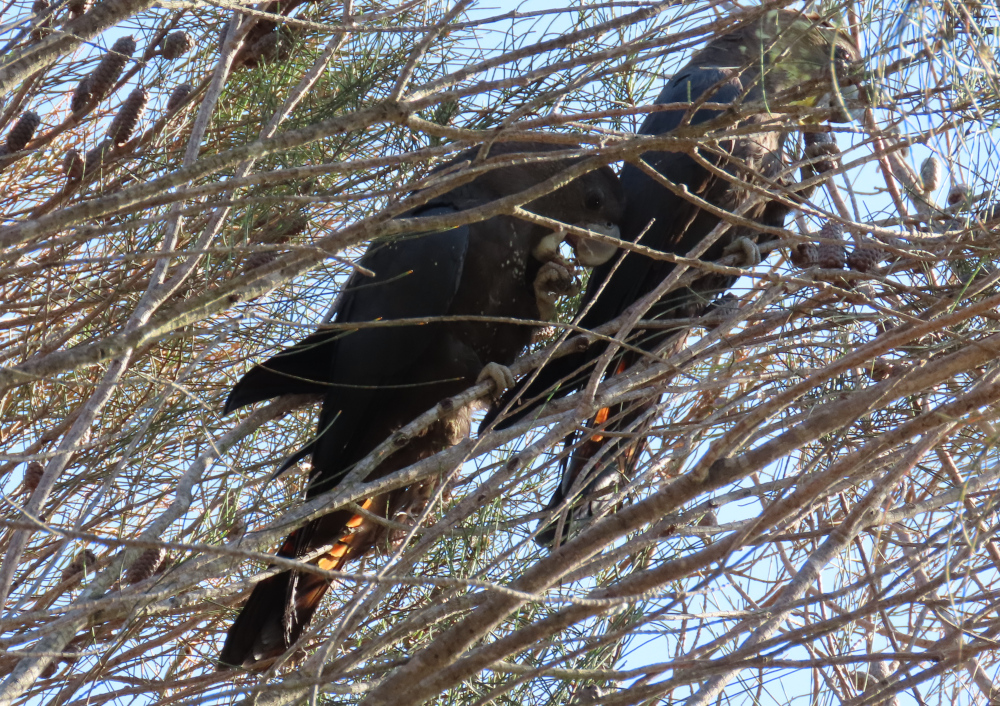
It’s interesting that I almost always see these birds in groups of three, most likely an adult male and female, and a juvenile. The bird with yellow around her head is the female of the group. I think this one is the adult male:
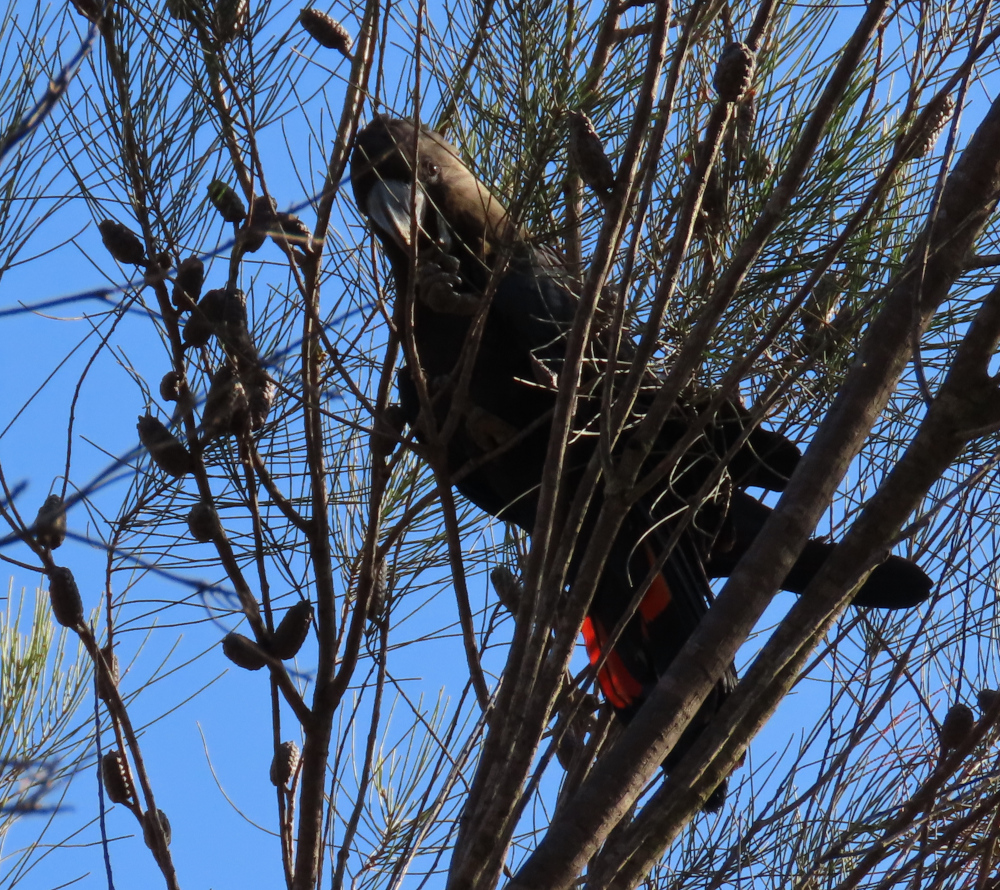
Check out some previous sightings of these gorgeous birds.
Common name: Glossy Black-Cockatoo
Scientific name: Calyptorhynchus lathami
Approximate length: 50cm
Date spotted: 23-27 September 2024 (spring)
Location: Manly Dam Park, near Sydney: 33°46’16.4″S 151°14’30.9″E

Corellas chewing yacht ropes
A group of Little Corellas has lately taken a shine to the Forty Baskets Beach area in Balgowlah, NSW. They spend their time in the nearby trees and on the rocks.

The corellas seem to enjoy the sea water trapped in crevices on the rocks. Or perhaps it’s rain water.
The corellas are beautiful, and fun to watch, but I’m rather glad that I don’t have a yacht moored there.

The birds really get into the ropes, watched by their friends:
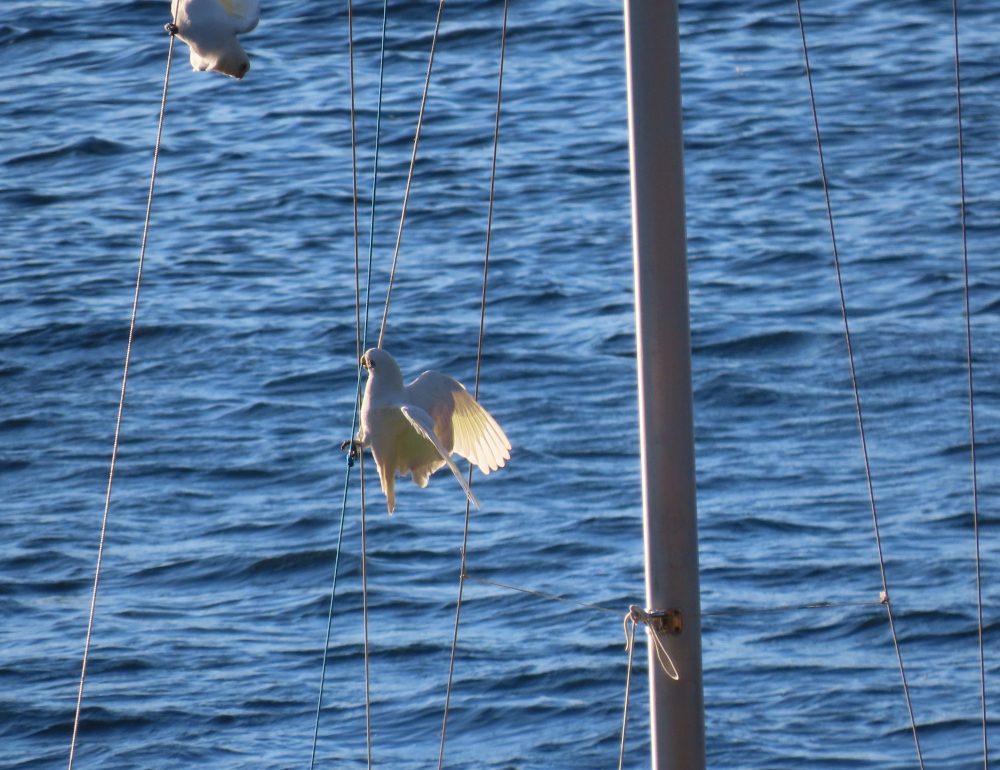

It’s a good time for all.

When fun at the beach palls, it’s time to find a nook for a bit of canoodling:

This grooming session ended in a squabble:
Common name: Little Corella
Scientific name: Cacatua sanguinea
Approximate length: 36-39 cm
Date spotted: 28 July 2024 (winter)
Location: Forty Baskets Beach, Sydney Harbour, New South Wales, Australia: 33°48’15.8″S 151°16’13.9″E

Black Cockatoo feeding a youngster
Every six months or so, a group of Yellow-tailed Black Cockatoos come to our Banksia for a feed. They come for a few days in a row, then move on to find another feeding area.
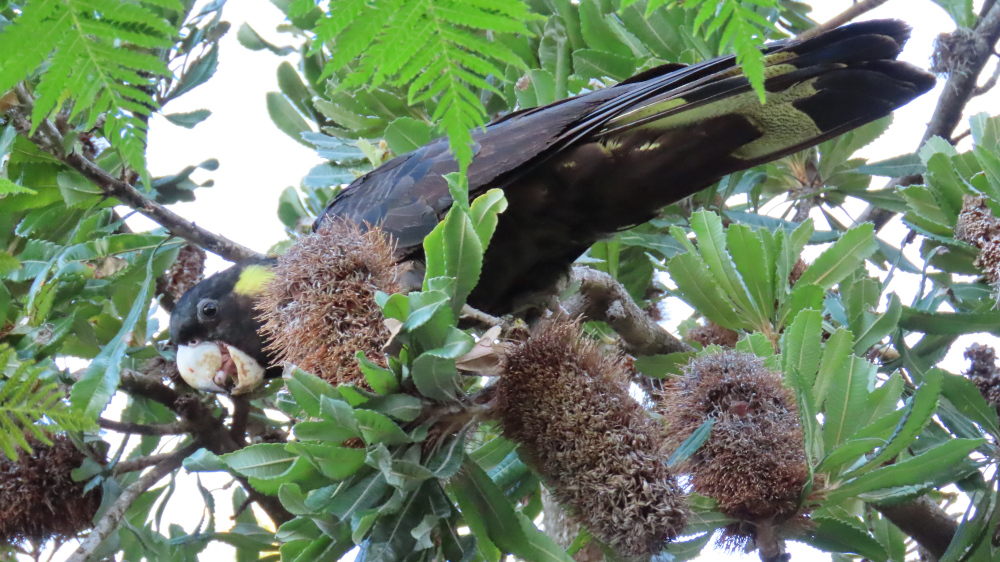
Sometimes they spend more time plucking and dropping than eating. Still, it always feels like such a privilege to have magnificent creatures like this just dropping by. I love the wild, screaming noise that they make. Some people call them the “squeaky door birds”:
The tree is a Banksia serrata, also known as Old Man Banksia.
On the birds’ second visit a day or so later, I filmed some interesting behaviour. One of the birds was making a continuous groaning noise. That’s not unusual, and I’ve wondered in the past if the bird is a youngster begging for food, or if it’s some kind of mating behaviour.
I think I have an answer! In this video, it looks like the male bird (he has a pink ring around his eye) is regurgitating food and then feeding it to the bird that’s making all the noise:
I added quite a lot of detail about these birds in a previous post: Those magnificent black cockatoos are back!
Common name: Yellow-tailed Black Cockatoo
Scientific name: Calyptorhynchus funereus or Zanda funereus
Length: 58-65 cm
Date spotted: 27th and 29th May 2024 (autumn)
Location: Allambie Heights, NSW, Australia

Silly Galahs but so pretty
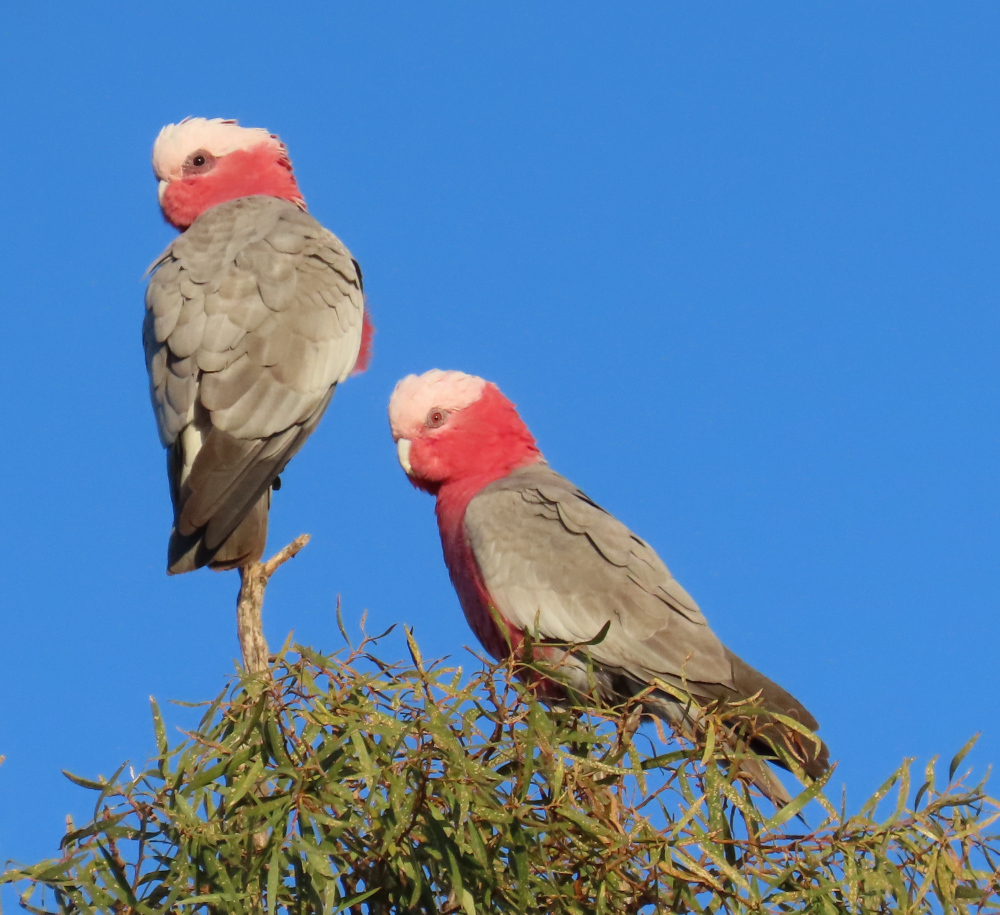
When someone does something daft, Australians affectionately say, “Silly Galah!” That saying is a reference to these birds:

They’re Galahs, a type of cockatoo found across most of Australia. I saw these two on the outskirts of Lake Mungo in the Australian Outback. The one on the left is a male (brown eyes) and the one on the right is female (pink eyes).
The birds were looking particularly pretty, outlined by the early morning sun.
Galahs do sometimes behave in a way that people see as silly. And here is perhaps a case in point…
The day after seeing the birds at Lake Mungo, we were on the road again. Near Griffith in central New South Wales, a large flock of Galahs had for some reason taking a liking to the tarmac. Despite the oncoming vehicles, the birds kept wheeling around and landing on the road. We stopped, and drove slowly, careful not to collide with any of the birds.
Let’s finish off with another two Galahs, again looking pretty at Lake Mungo:
Common name: Galah
Scientific name: Cacatua roseicapilla
Approximate length: 35-38 cm
Date spotted: 20 May 2024 (autumn)
Location: Mungo Lodge, Mungo National Park, New South Wales, Australia: 33°44’31.4″S 143°00’06.1″E

A tree full of Pink Cockatoos at Lake Mungo
I came across a tree full of Pink Cockatoos at Mungo Lodge, on the outskirts of Lake Mungo in the Australian Outback. The alternative name for these birds is Major Mitchell’s Cockatoo and they were also previously known as Leadbeater’s Cockatoo.
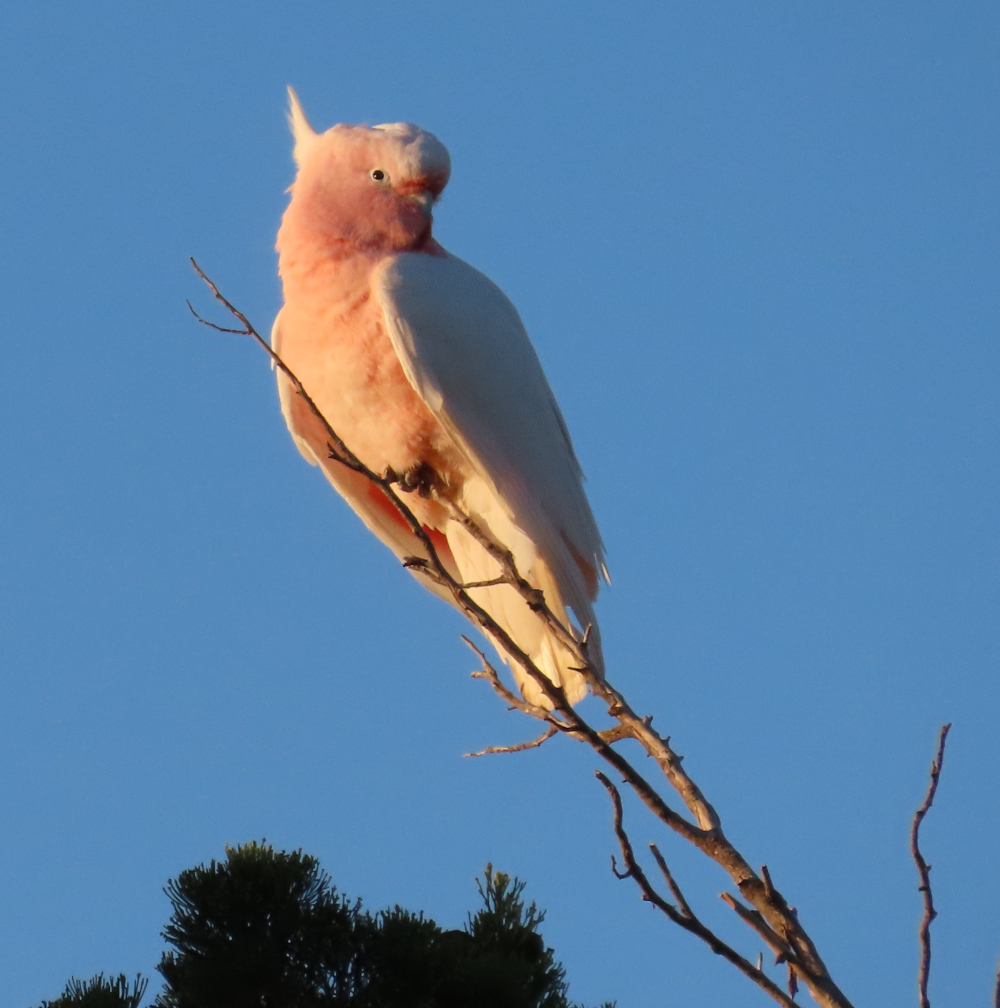
Here’s a portrait of one of these spectacular birds:
They’re gregarious and chatty birds. This video shows them in a quieter moment, enjoying the early sunlight at the top of a tree:
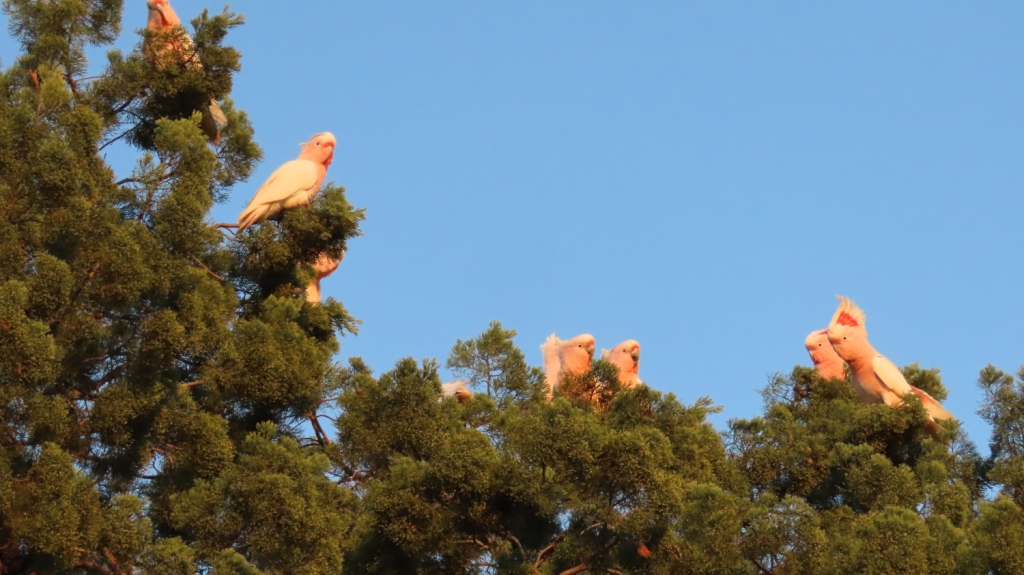
It was exciting to see these birds. Pink Cockatoos are uncommon, and are considered endangered. Here’s a still picture of part of the tree full of birds:
In September 2023, Birdlife Australia published an intention to change the common name of these birds from Major Mitchell’s to Pink Cockatoo, because Major Mitchell played a major part in the massacre of Aboriginal people in the 19th century.
It’d be a pity to taint the beauty of these birds with such a memory. The birds have a delicate beauty, the pink colour changing in the light from soft pink to quite dramatic colouring:
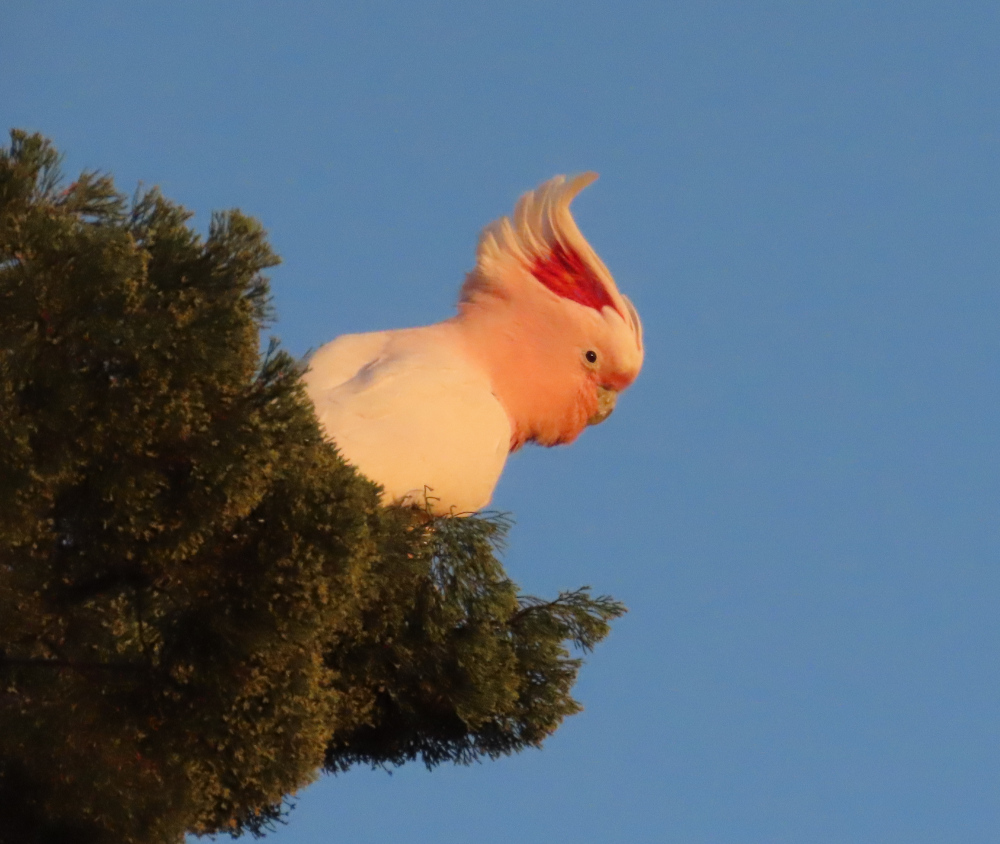
At 35-40 centimetres from head to tail, these birds are about the same size as a Galah. They’re smaller than the well-known Sulphur-crested Cockatoo (45-50 cm).
A final shot of a group of birds coming in to land:
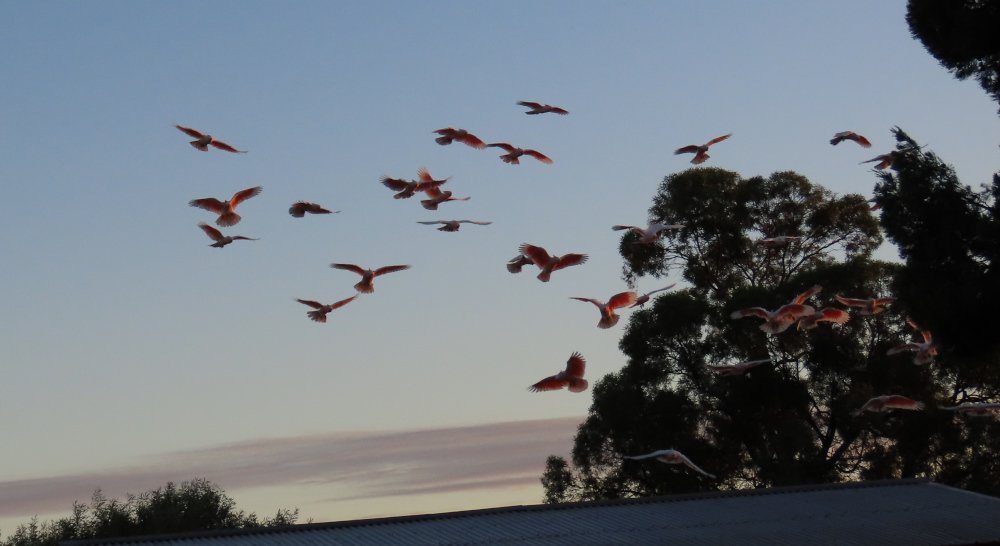
Common name: Pink Cockatoo (alternative name: Major Mitchell’s Cockatoo)
Scientific name: Cacatua leadbeateri
Approximate length: 35-40 cm
Date spotted: 20-21 May 2024 (autumn)
Location: Mungo Lodge, Mungo National Park, New South Wales, Australia: 33°44’31.4″S 143°00’06.1″E

3 parrots on one walk
A few days ago I went for a walk and saw three different types of parrots all within a few paces of each other. How amazing is that!
First up, a trio of King Parrots. Two were males, the other a female. This is one of the males:

King Parrots are quite large, at 44 cm from head to tail. The females have a lot more green in their colouring. I think they’re prettier than the males, with their softer shading:
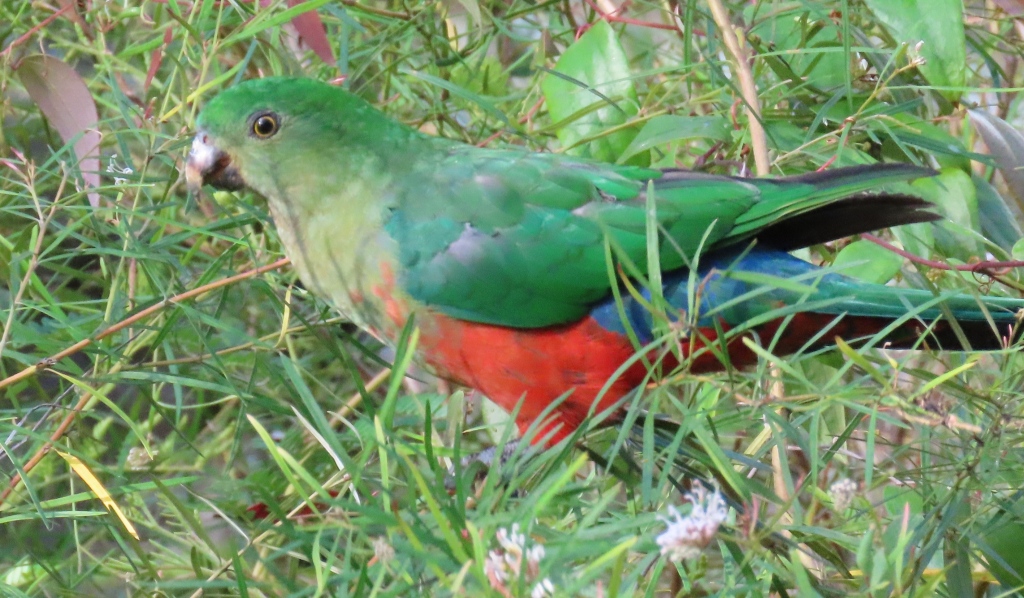
This video shows all three of the birds enjoying the flowers of a Grevillea bush. First you see the two males together. Then one of them flies over to join the female on the other side of the bush:
In the trees around the parrots, the smaller Rainbow Lorikeets chattered and scolded. Here’s one in a more contemplative mood than most:

One of them stood still for a while to examine me, before launching itself in my direction then swerving at the last moment as they are wont to do:
At the next tree, a group of Sulphur-crested Cockatoos examined a tree hollow. Perhaps a good place to raise a family? But competition is fierce!
Here’s one of the cockatoos making a point about ownership, or perhaps just being its usual excited self:

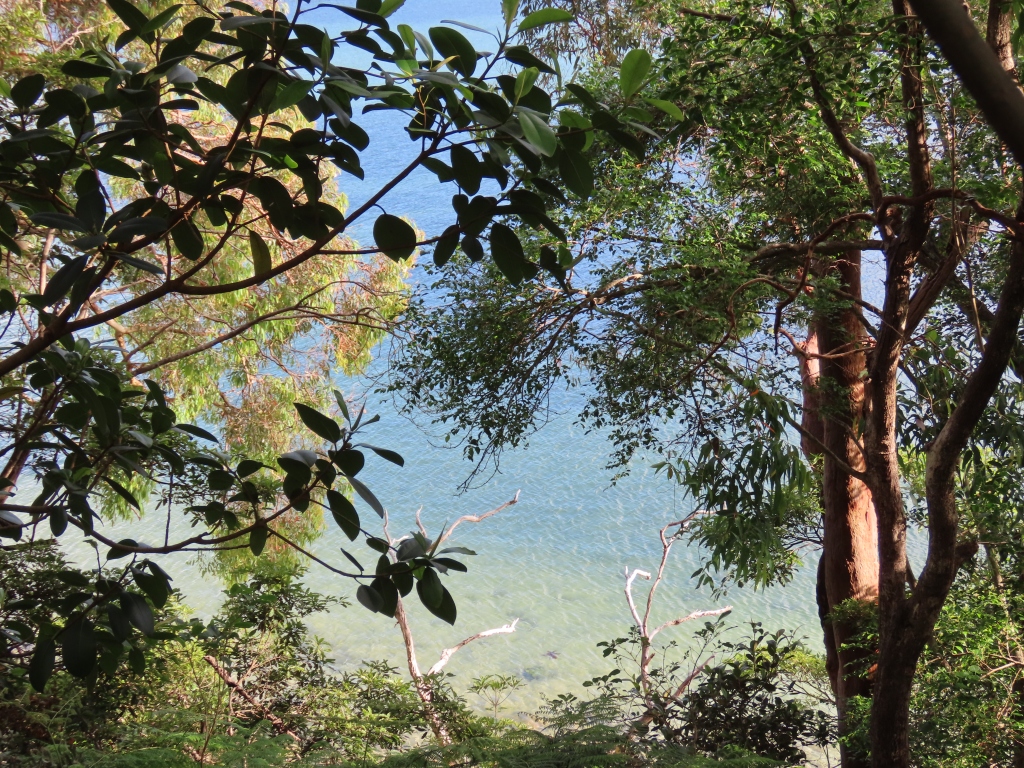
The walk itself is lovely, starting in Balgowlah and winding along the coast of Sydney Harbour, with bushland and forest on one side:

And pretty views of the waters of Sydney Harbour on the other side:
The birds:
Common name: Australian King Parrot
Scientific name: Alisterus scapularis
Approximate length: 44 cm
Common name: Rainbow Lorikeet
Scientific name: Trichoglossus haematodus
Approximate length: 30 cm
Common name: Sulphur-crested Cockatoo
Scientific name: Cacatua galerita
Approximate length: 50 cm
Date spotted: 26 November 2022 (spring)
Location: Near Forty Baskets beach, Sydney Harbour, New South Wales, Australia: 33°48’03.2″S 151°16’07.2″E

Those magnificent black cockatoos are back!
For the past couple of years, a group of Yellow-tailed Black Cockatoos has visited our garden to snack on our Banksia tree when the seeds are ripe. This happens around May-June and again in October. It’s a real privilege to have such magnificent birds in the garden. At approximately 65 cm (more than 2 feet) from head to tail, they’re much larger than the more common white Sulphur-crested Cockatoos (50 cm).
The bird on the left is a female. Toward the end of the video, you see the male higher up in the tree (he’ll be near the top right), keeping watch. You can tell the male by the pinkish colour of the ring surrounding his eye.
The bird on the right at the start of the video (in the middle when all three birds are in view) is making a constant low crooning sound. I think the noisy one must be a juvenile, because I’ve noticed that the juvenile birds of many species keep up a constant noise, perhaps to reassure their parents that they’re still around. Early on in the video, the female on the left calls out in that lovely, wild squeal that’s characteristic of these birds. They also chitter companionably to each other throughout.
Here’s a still picture of the male:
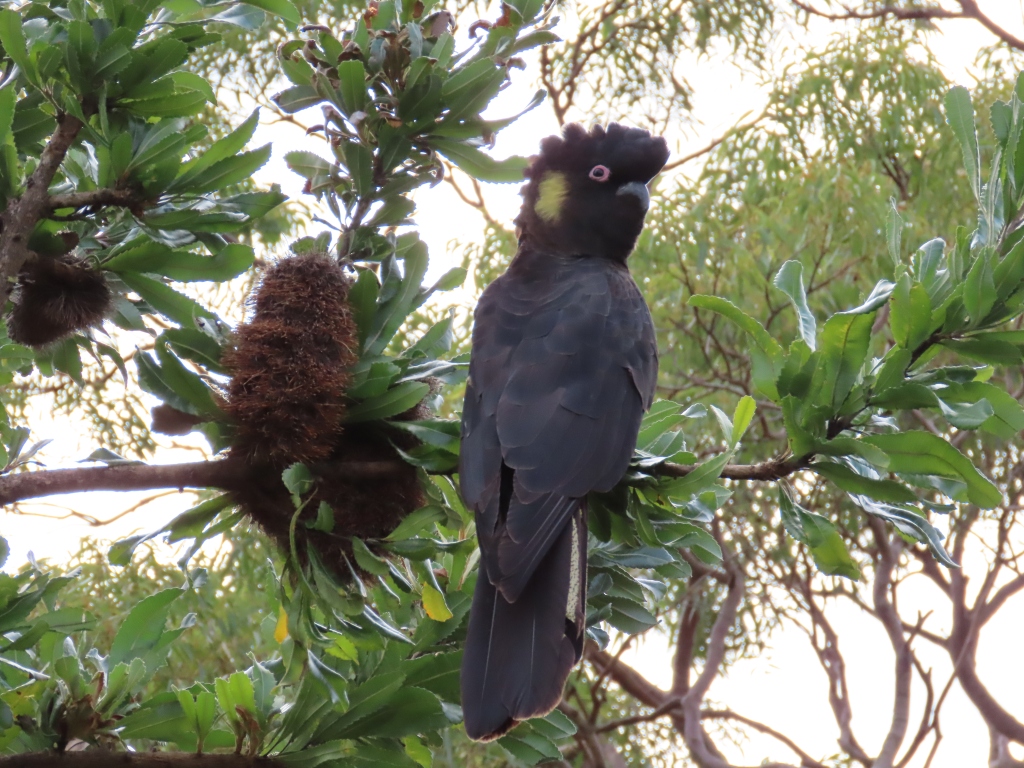
The next video shows one of the birds (probably the female, though it might be the juvenile) tucking into a Banksia seed pod:
It’s funny to see how ruthless the bird is. She basically tears the dead flower apart, chucking bits onto the floor seemingly at random, until she finds a tasty morsel. Our neighbour was giggling from his verandah, from where he had a birds’ eye view of the feasting! Our garden quickly became littered with half-eaten seeds:
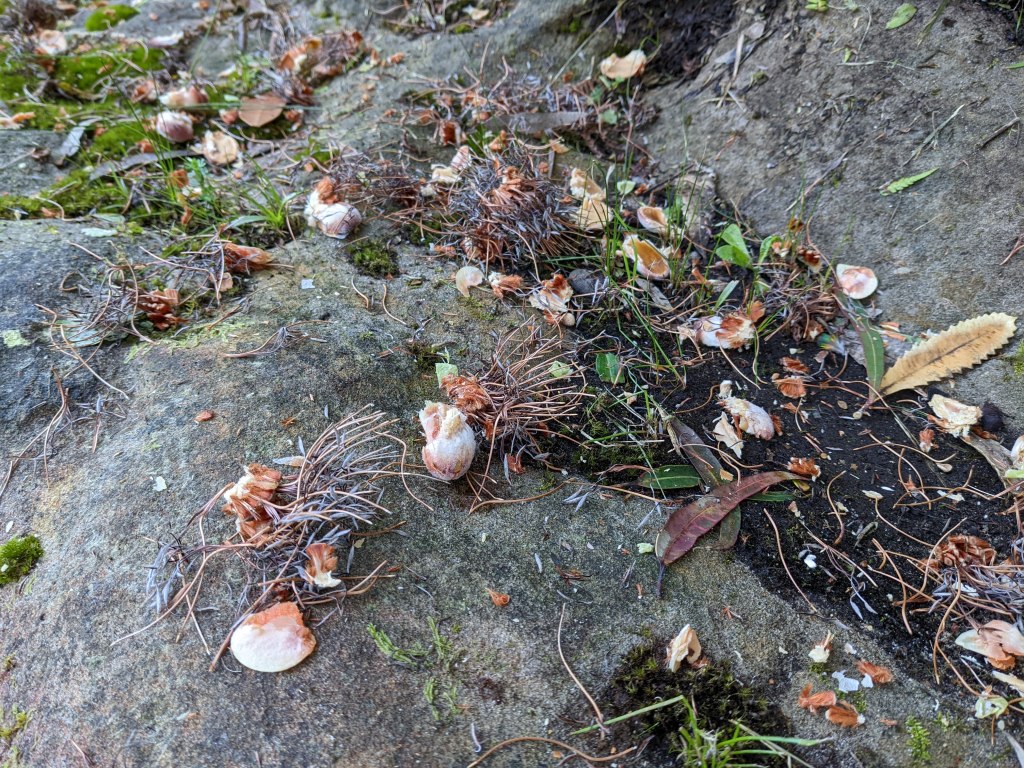
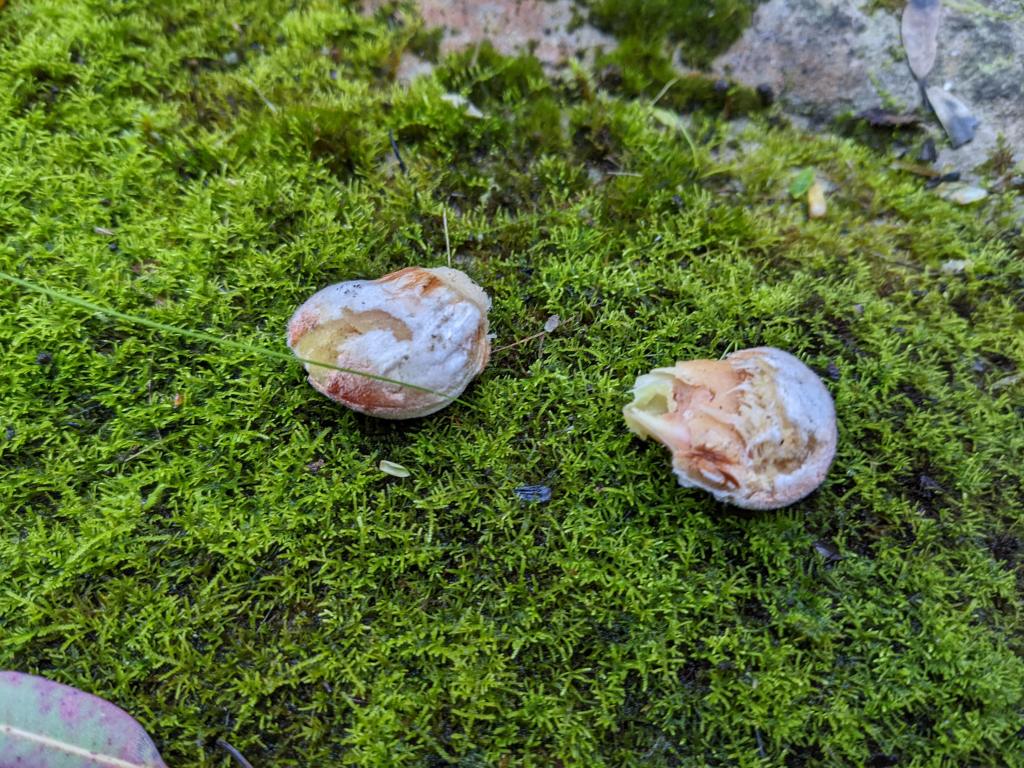
The tree is a Banksia serrata, also known as Old Man Banksia. See the marks of that huge beak on these seeds!
Here’s a closeup of a cockatoo on a seed pod:
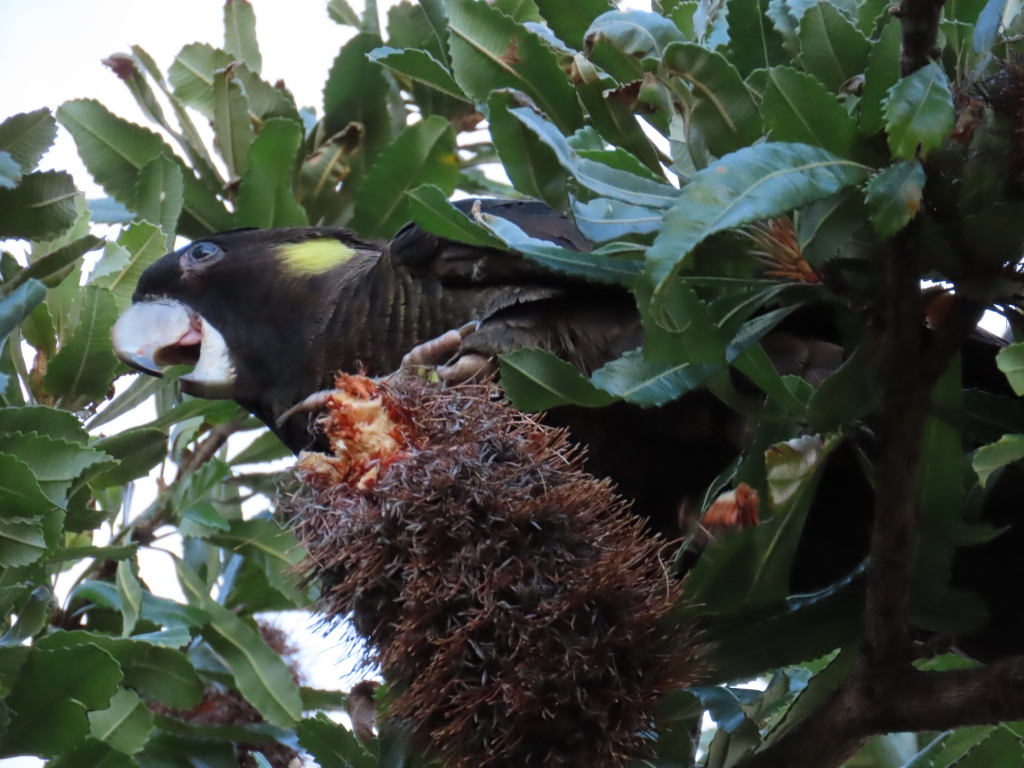
The scientific name of these birds is Calyptorhynchus funereus. Evidently the funereus part of the name stems from the dark, somewhat gloomy colouring of the birds. George Shaw, the naturalist who first named the birds, thought that the colouring was suited to a funeral! The bird was even called the “funereal cockatoo” for a while.
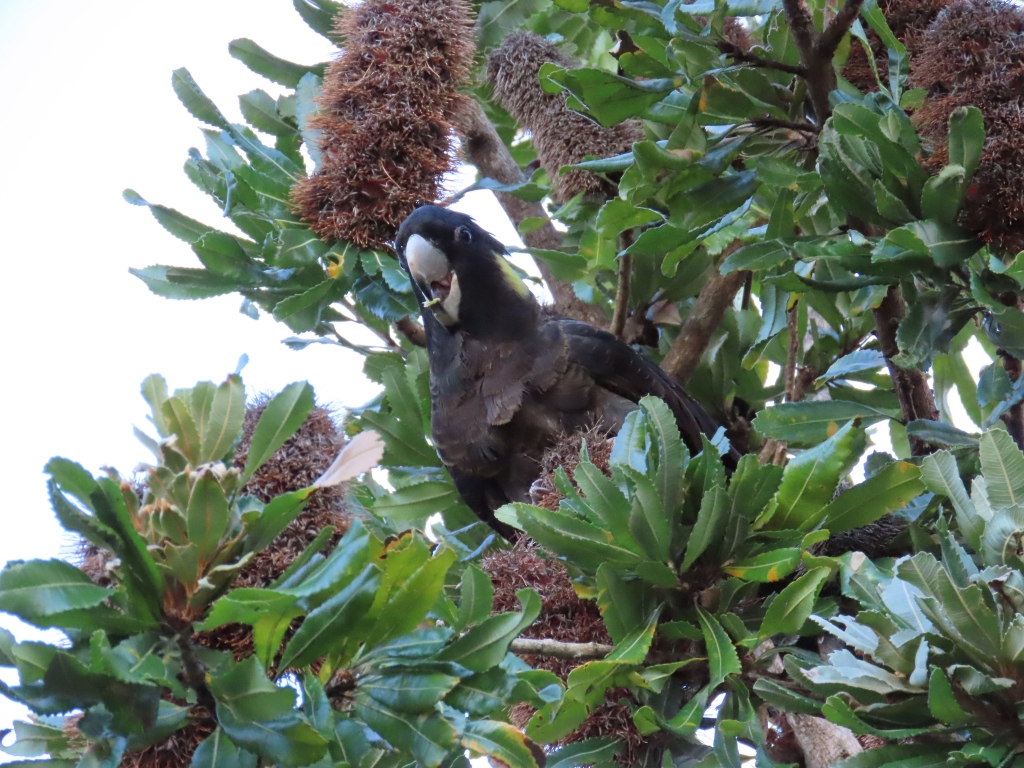
There’s also some dispute in the birding community about whether these birds are actually part of the genus Calyptorhynchus. Some people group them into a different genus, Zanda, based on genetic diversity.
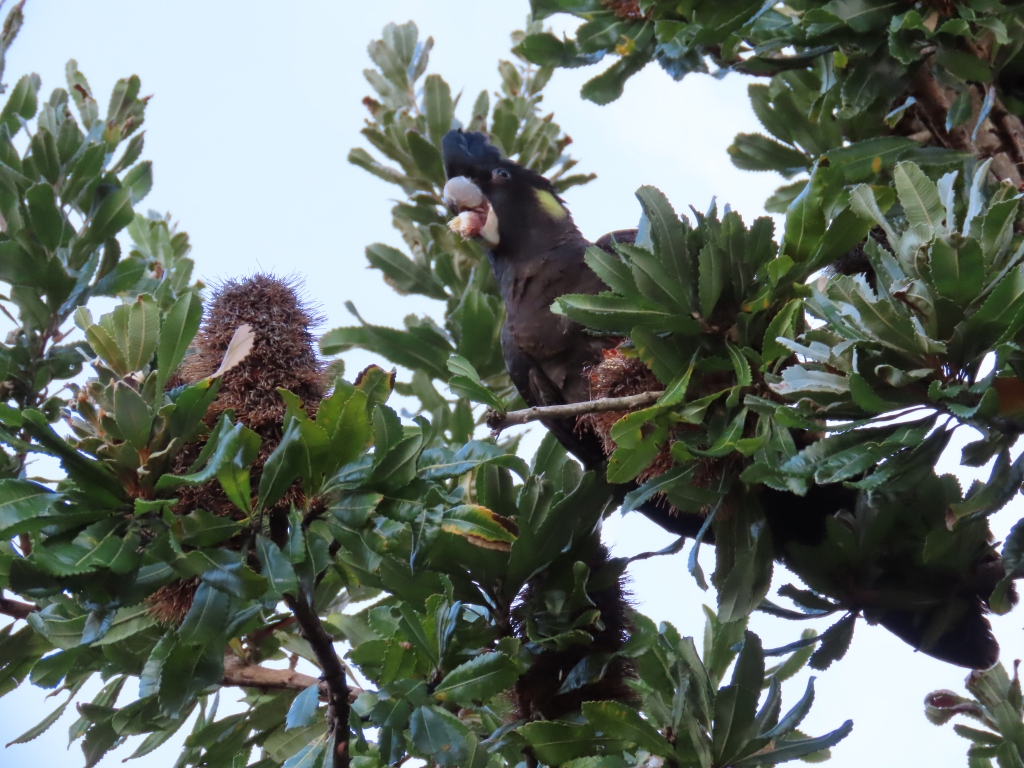
The next photo shows the bird that I think is a juvenile. With its beak feathers fluffed up, it seems to be sleepy or wanting attention!

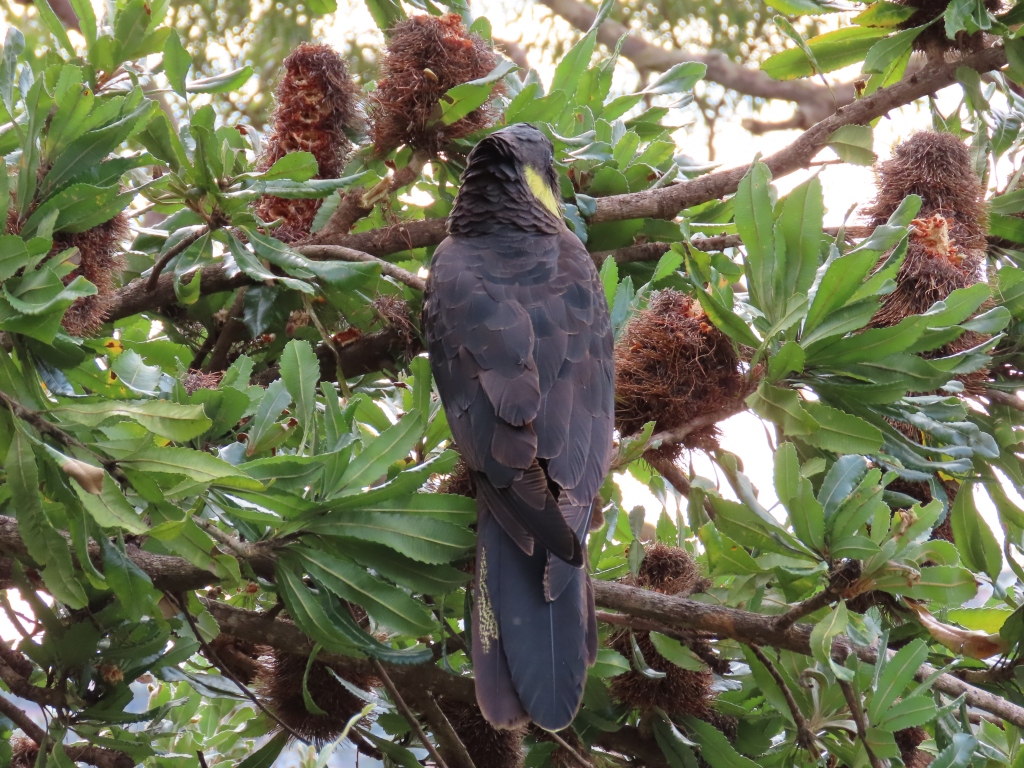
A shot from the back gives a nice view of the crest on the bird’s head:
Common name: Yellow-tailed Black Cockatoo
Scientific name: Calyptorhynchus funereus or Zanda funereus
Length: 58-65 cm
Date spotted: 2nd and 3rd June 2022 (winter)
Location: Allambie Heights, NSW, Australia

Sleepy Corellas in Newcastle
A few days ago, I was in the city of Newcastle on Australia’s east coast. The city lies about two hours’ drive north of Sydney. Like its namesake in the UK, this Newcastle too is known as a coal-shipping port. A river runs through the city. In a small green area on the river bank, in the middle of the city, a large number of Corellas roost.
When we saw them, most of the Corellas looked sleepy:

This one looks like a cuddly toy nestled in a Christmas tree:

Little Corellas are a type of cockatoo. To me, they look rather ghostly, with their pale beaks and that ring of pale blue around their eyes.
The next one looks more interested in what’s happening:

If you’d like to see more pictures of the city of Newcastle itself, take a look at my travelling bookmark’s blog.
Common name: Little Corella
Scientific name: Cacatua sanguinea
Approximate length: 36-39 cm
Date spotted: 11 March 2022 (late summer)
Location: Newcastle, New South Wales, Australia: 32°55’32.3″S 151°46’45.4″E

Majestic Glossy Black-Cockatoo pair
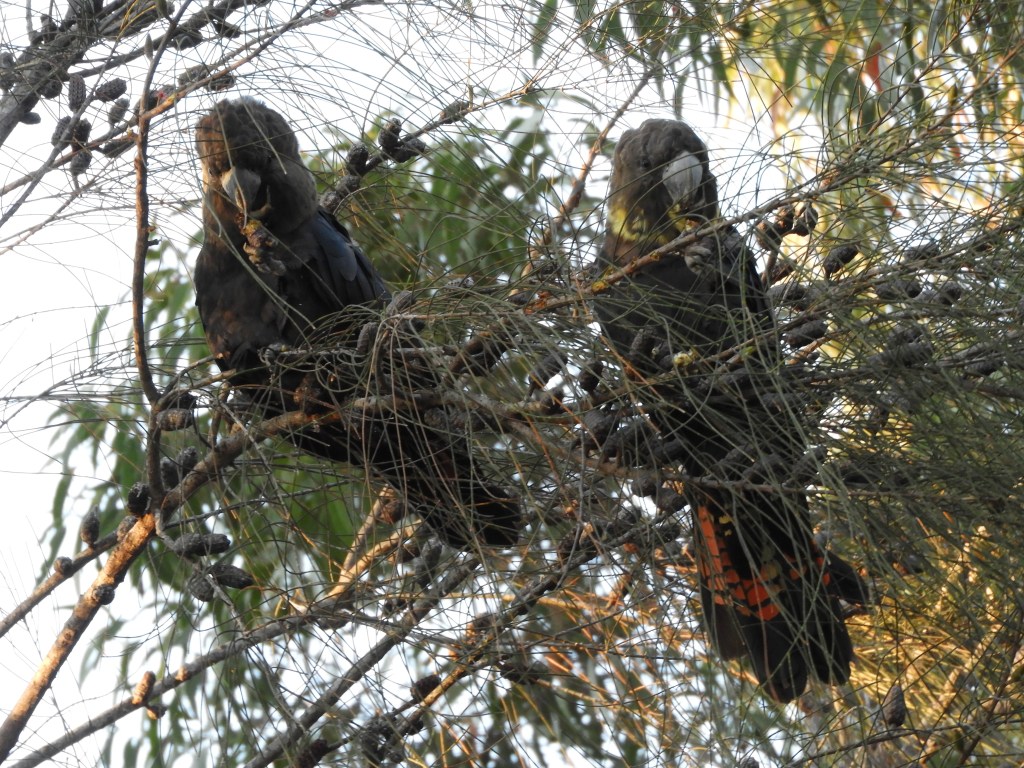
Two Glossy Black-Cockatoos have taken to hanging out at Manly Dam. The Casuarina trees are currently full of seed pods, which are this bird’s favourite food. In fact, Glossies feed almost exclusively on Casuarina seeds.
This video shows the male bird first, its feathers gleaming a soft blue in the early morning light, and the red tail flares standing out nicely. Then the view moves to the female feeding on a nearby tree.
Glossy Black-Cockatoos are large parrots at around 15 cm in length. We’re lucky to see four different types of cockatoos in this area. Glossies are heavier than the white Sulphur-crested Cockatoos and Corellas, and shorter in length than the Yellow-tailed Black Cockatoos. Of the four types, Glossies are by far the least common.
This is the male bird, with that blueish gleam lent by the early morning light, and those red tail flares:
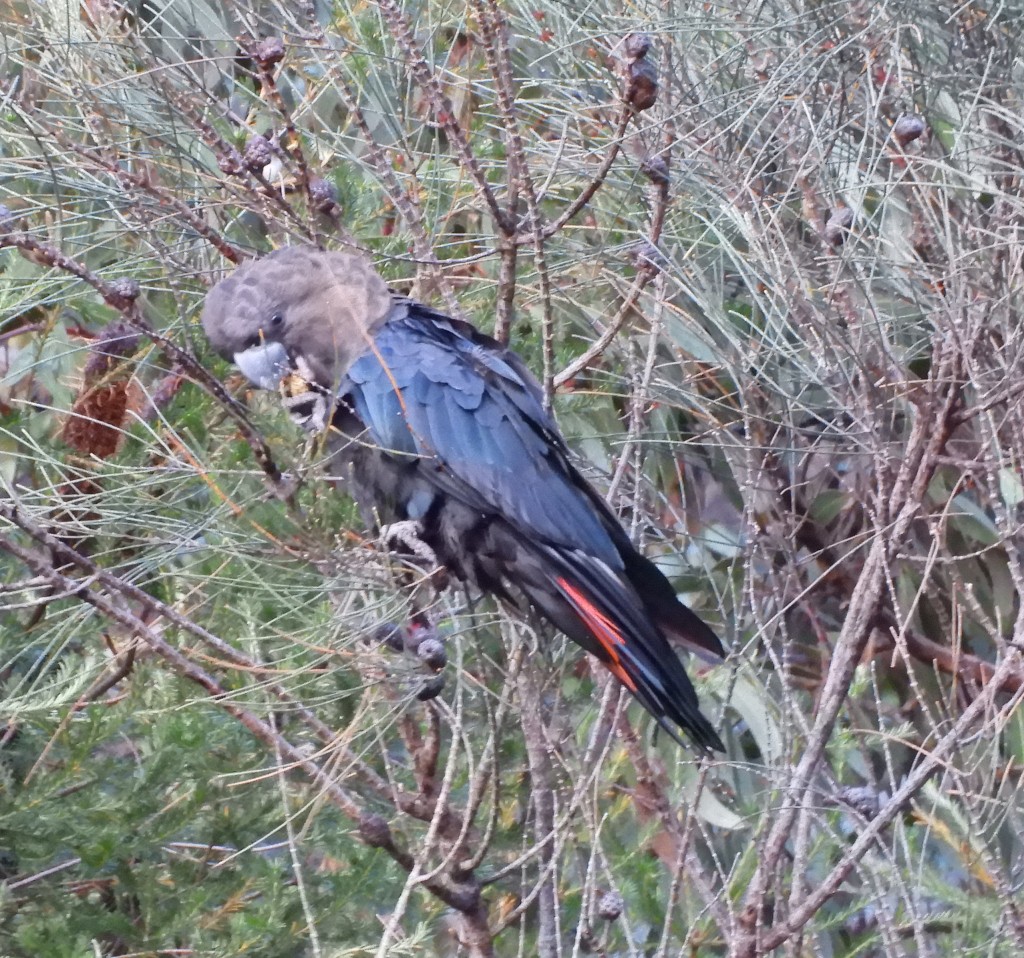
The female has yellow markings around her neck, and her tail flares are yellow and a softer shade of orange-red than the male’s:
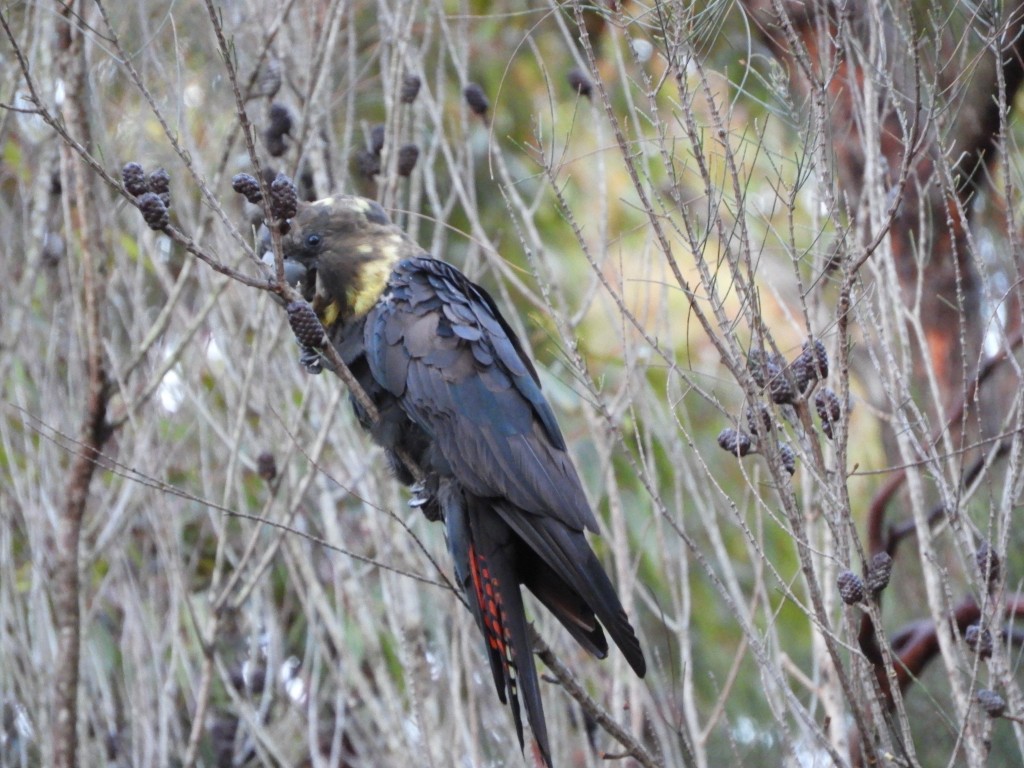
With their large heads and that mane of feathers, Glossies sometimes remind me of a bear. Here’s a close up of the male bird, taken a few days before the above shots:

Here are both birds, sharing a tree this time:
Common name: Glossy Black-Cockatoo
Scientific name: Calyptorhynchus lathami
Approximate length: 50cm
Date spotted: 5 October and 15 October 2021 (spring)
Location: Manly Dam Park, near Sydney: 33°46’56.5″S 151°15’10.3″E


 Sydney Birder