Blog Archives

Currawong youngsters with Avian Pox (plus a bonus cicada story)
A couple of young Pied Currawongs have been making quite a racket in our neighbourhood recently. I was puzzled and concerned when I noticed that one of them had red swellings around its eyes and an unhealthy-looking bump on top of its beak.

Aside from being unsightly, though, the swellings don’t seem to bother the youngster much. For wont of a better name, let’s call this one Youngster 1. The bird is quite lively and curious, and feeding well.
Here’s Youngster 1 hiding in the shade, awaiting its next feed:
The other young Currawong, Youngster 2, now also has similar swellings, though to a lesser extent:
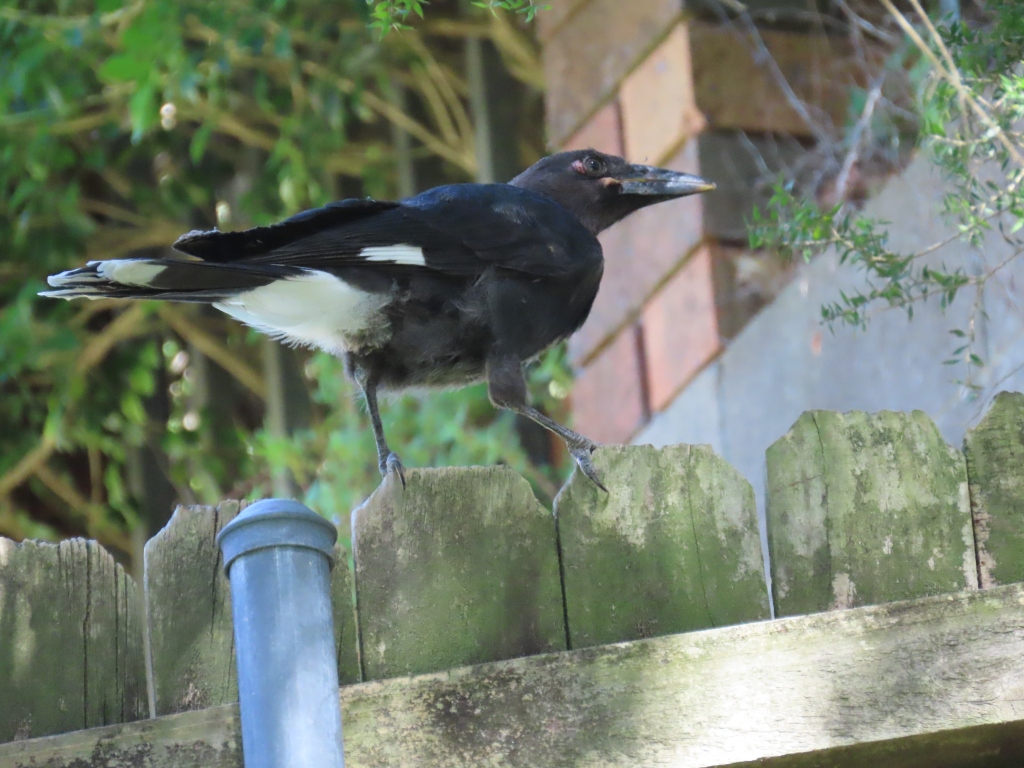
Here’s Youngster 2 sitting on the same fence as its sibling:
After some research and image comparison, I’ve discovered that these two little ones are most likely suffering from Avian Pox. This condition is caused by a virus that infects many bird species around the world, including currawongs and other Australian birds. It’s usually not too serious, and the birds recover within three to four weeks.
That’s good to know!
Here’s a glimpse of one of the hard-working adult currawongs, taking a breather between feeding runs:

Common name: Pied Currawong
Scientific name: Strepera graculina
Approximate length: 45 cm
Date spotted: 19 January 2024 (summer)
Location: Allambie Heights, north of Sydney, New South Wales, Australia
A bonus cicada story
A couple of weeks ago, I was filming one of the baby currawongs being fed:
As I was filming a bit of drama occurred. Alas, I didn’t capture any of it on film, as the action took up the whole sky and went down very fast.
Picture this:
A cicada flies past. Two little Noisy Miners give chase. One of them grabs the cicada and lands on our roof, the other Noisy Miner in close pursuit. A currawong parent thinks, “Ah, perfect for the little one.” It swoops on the Noisy Miners, who both fly away, abandoning the cicada to buzz around on the roof. The currawong grabs the cicada.
Not taking this lightly, the Noisy Miners swoop on the baby currawong, which is minding its own business deep in the foliage. There’s a sudden flurry of activity as the adult currawongs and Noisy Miners swoop noisily around the tree. The baby takes deeper cover under a thick leafy branch. The fuss dies down and everyone goes about their business.
I don’t know what happened to the cicada.

Bird spotting with Aussie Bird Tours
Yesterday my family and I went on a bird-spotting trip with Aussie Bird Tours. Mike Barrow led us on a wonderful half-day tour around the Dee Why Lagoon, Warriewood Wetlands, and Irrawong Reserve. We spotted a large number of birds (40-50 types) and heard others too. Here are the ones that I managed to get a half-decent photo of.
Our tour started at Dee Why Lagoon, where we saw a number of water birds: a darter, cormorants, ducks, a black swan, coots, a Silver Gull, and more. Songbirds were there too. A Magpie-lark strutted over the mud. Welcome Swallows darted across the water. A Willie Wagtail chirped in the distance. An Eastern Whipbird spent many minutes exploring the dense reeds a couple of metres from our feet. We could hear its characteristic chattering, but only saw it when it made a break for the higher foliage.
This male Olive-backed Oriole (Oriolus sagittatus) posed for a profile shot against the blue sky:
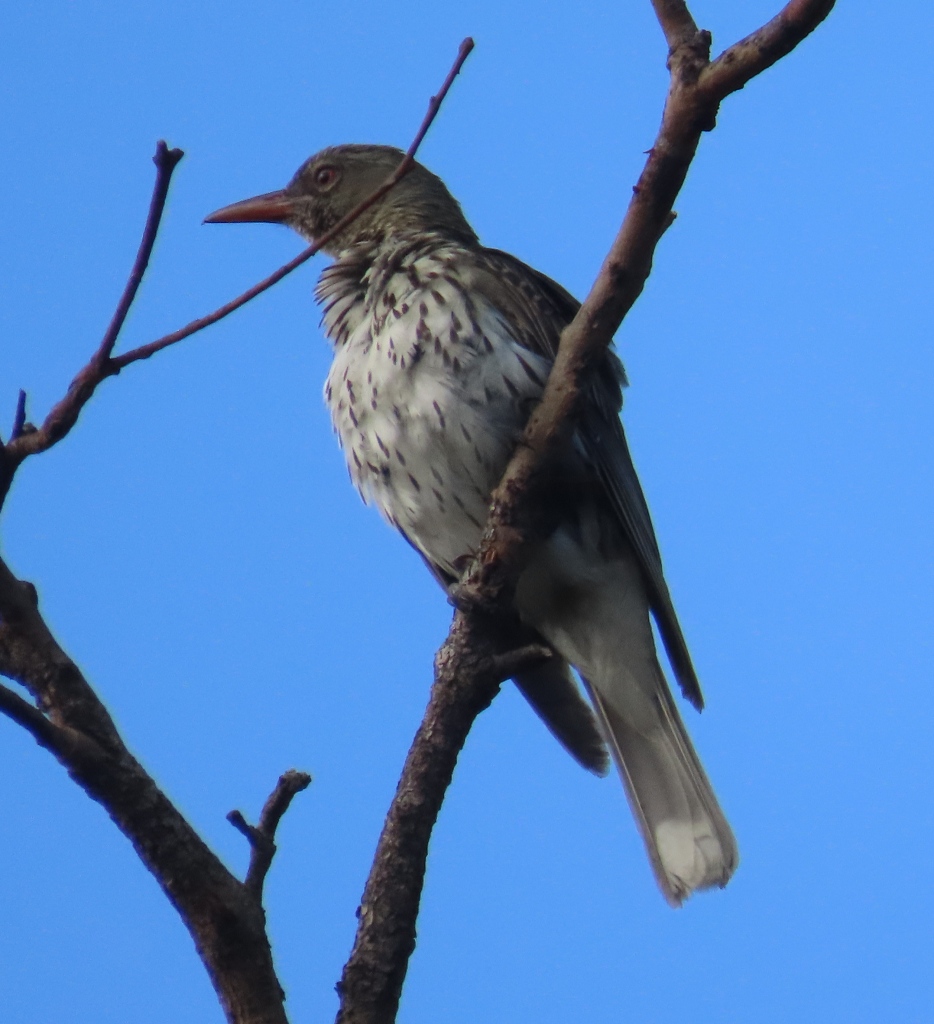
On this trip I learned what Olive-backed Orioles sound like (you can hear their call on eBird). I also learned the call of the Darter (hear it on xeno-canto). The latter sounds very like a Dollarbird, and I’ve probably mixed up those two calls in the past.
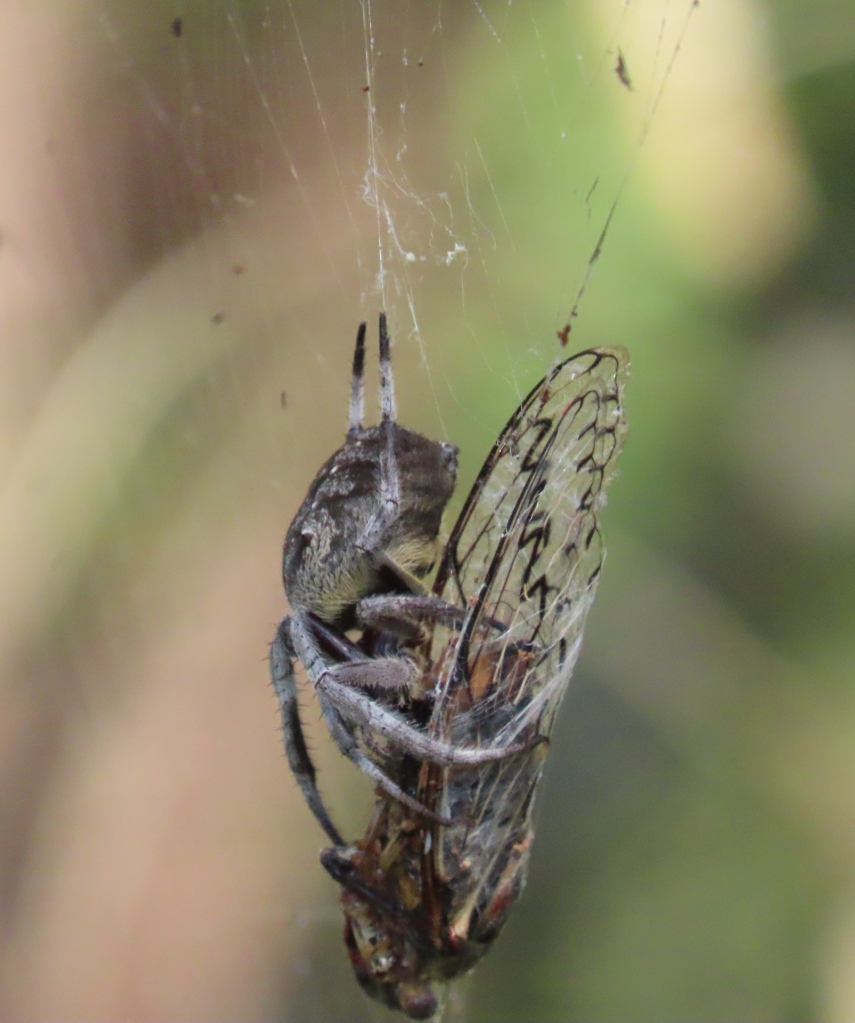
Our next stop was the Warriewood Wetlands, which is an interesting patch of swampy bushland. A raised path leads you across the reeds and water, with great views of wetlands all round you. The cicadas were out in full force, deafening us while providing food to other creatures. Here, a large spider has caught a cicada in its web and is having a feast:
Discarded cicada husks stuck to tree trunks, shed when the cicada larva emerges from the ground and morphs into the winged insect:

Bell Miners (Manorina melanophrys) have moved into the Warriewood Wetlands in large numbers. The call of these honeyeaters is a clear, single, oft-repeated clink, like the sound of a bell. They’re quite attractive birds, with olive wings and back, and a pale yellow chest:
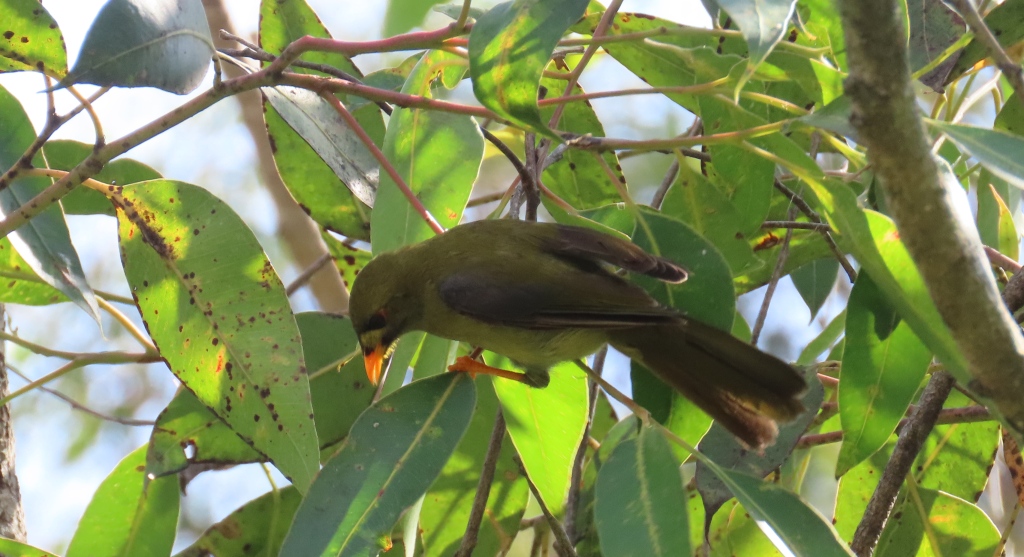
What with the screeching of the cicadas and the pinging of the Bell Miners, this was a noisy patch of bush!
The noise didn’t seem to bother the Purple Swamphens (Porphyrio porphyrio), who carried out a lively courtship beneath the wooden walkway:
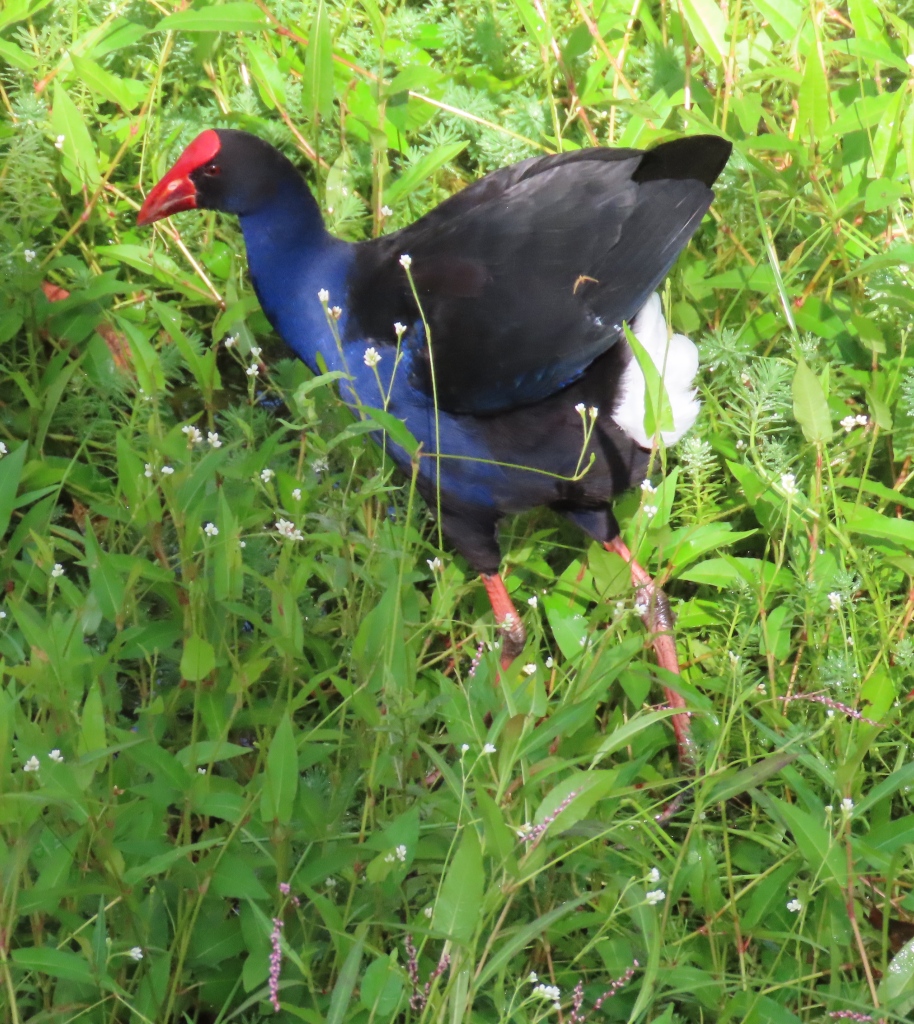
A small water dragon looked on:

A Dusky Moorhen (Gallinula tenebrosa) showed up in bold orange and yellow:

We didn’t see any snakes, though evidently they’re around. We did see a couple of largish skinks, like this one:
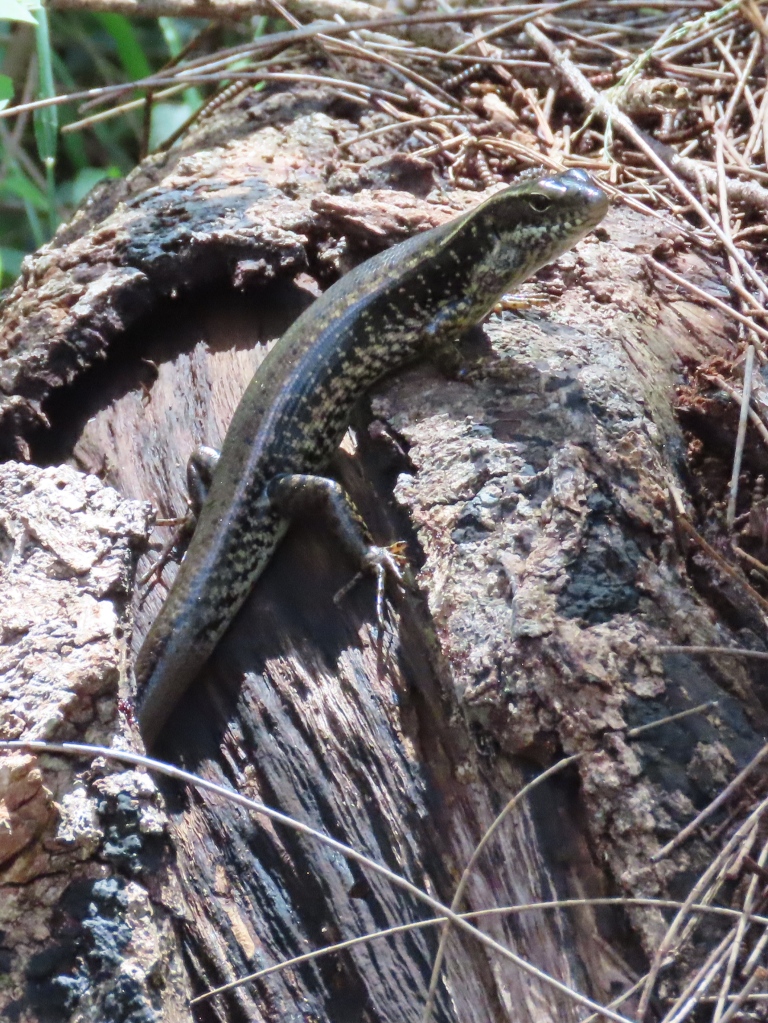
Striking dark grass flowers lined the way:
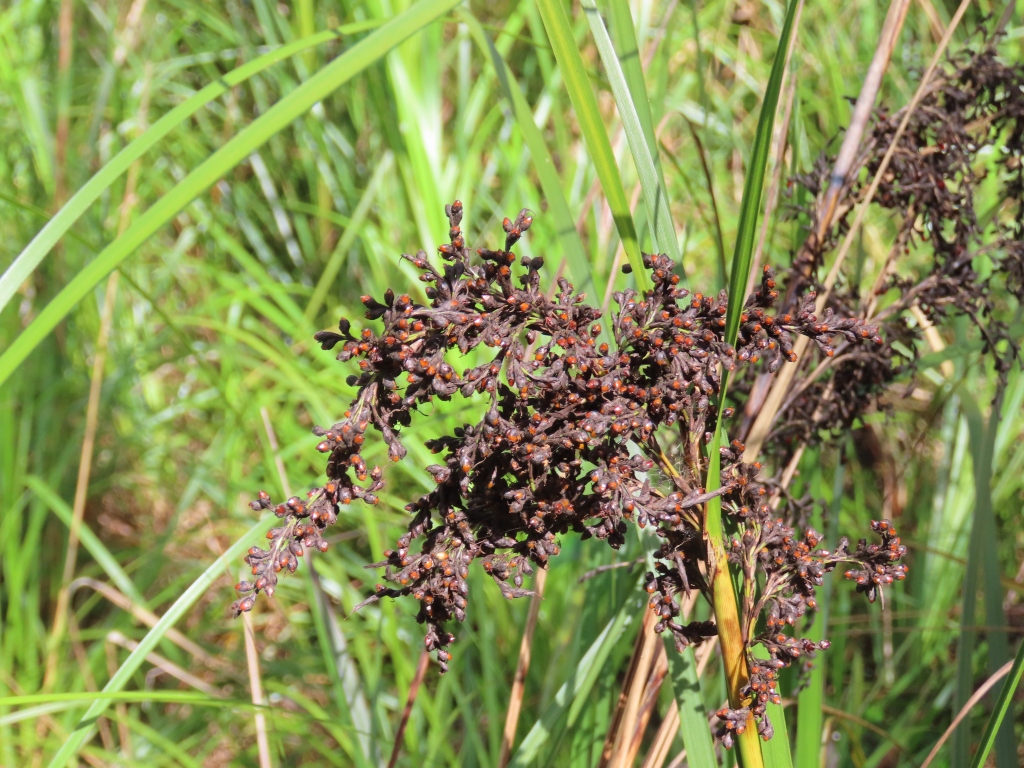
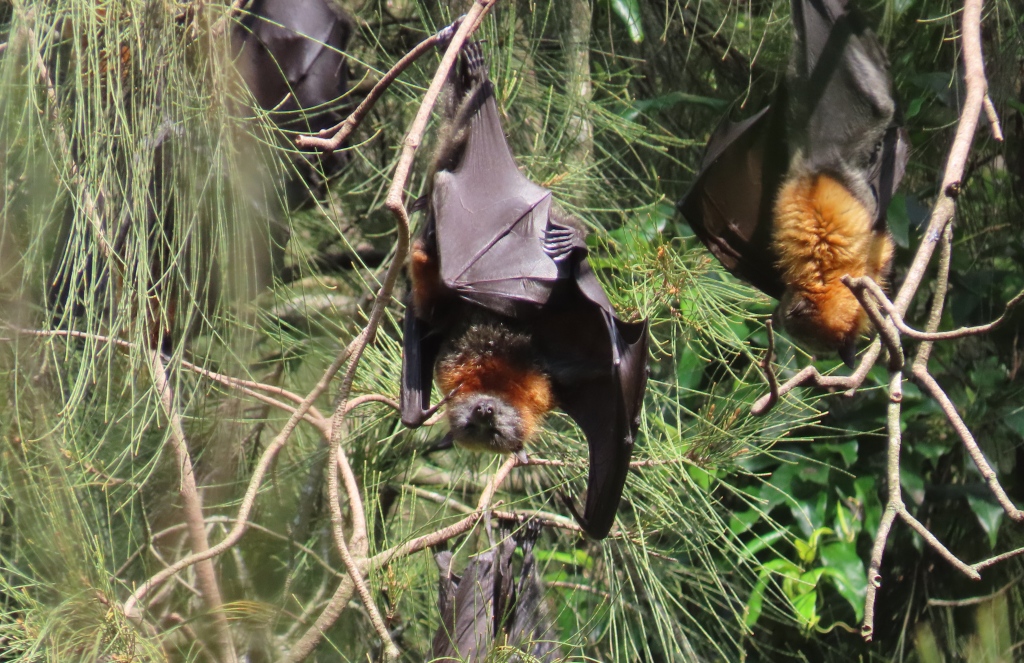
A colony of Flying Foxes (large fruit bats) occupies one corner of the wetlands:

Here’s a close-up of one of these attractive, intriguing mammals. They have a grey face, with a reddish fur collar and back. Their wings are black and leathery, strong enough to support these large bats in their long cross-country flights:
After the Warriewood Wetlands, we visited Irrawong Reserve. A Golden Whistler (Pachycephala pectoralis) carolled in the dense bush. This is the male bird:
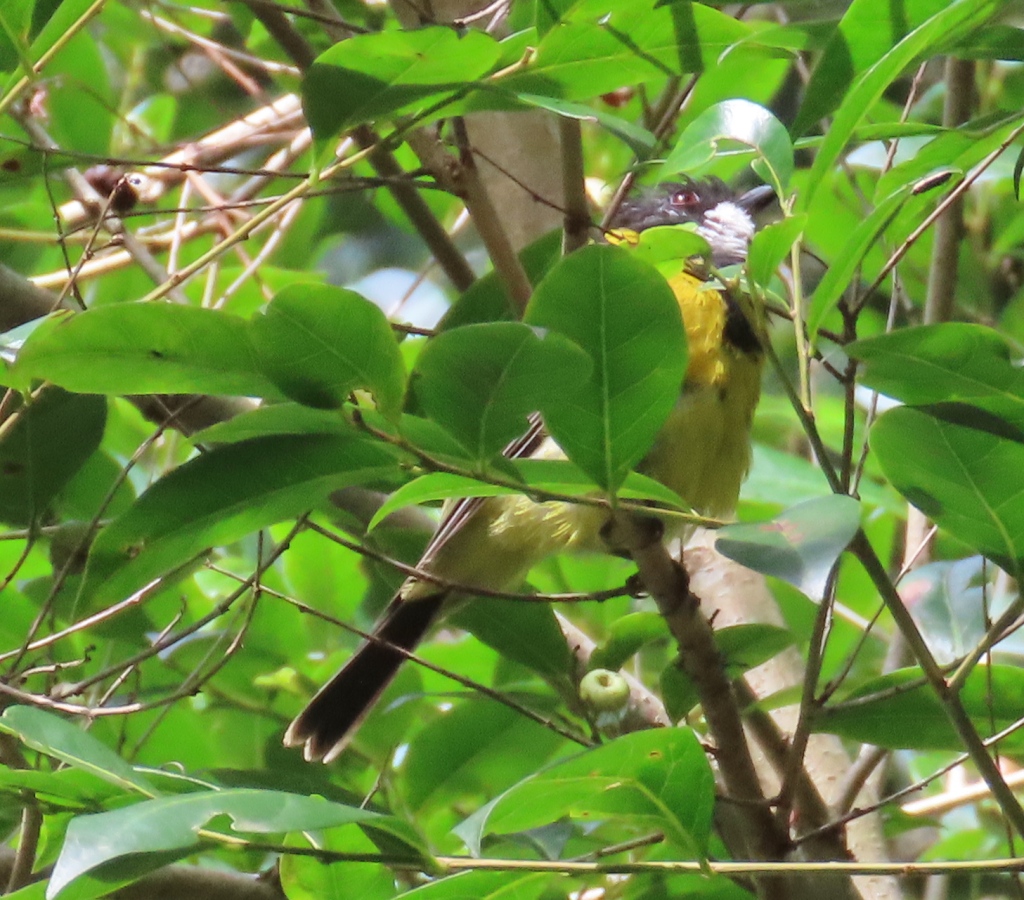
As you can see, it’s adept at hiding behind the foliage. Here’s another shot of the same bird, with its tail fanned:

I think the next bird is a female Golden Whistler. They’re harder to identify because of their soft colouring:
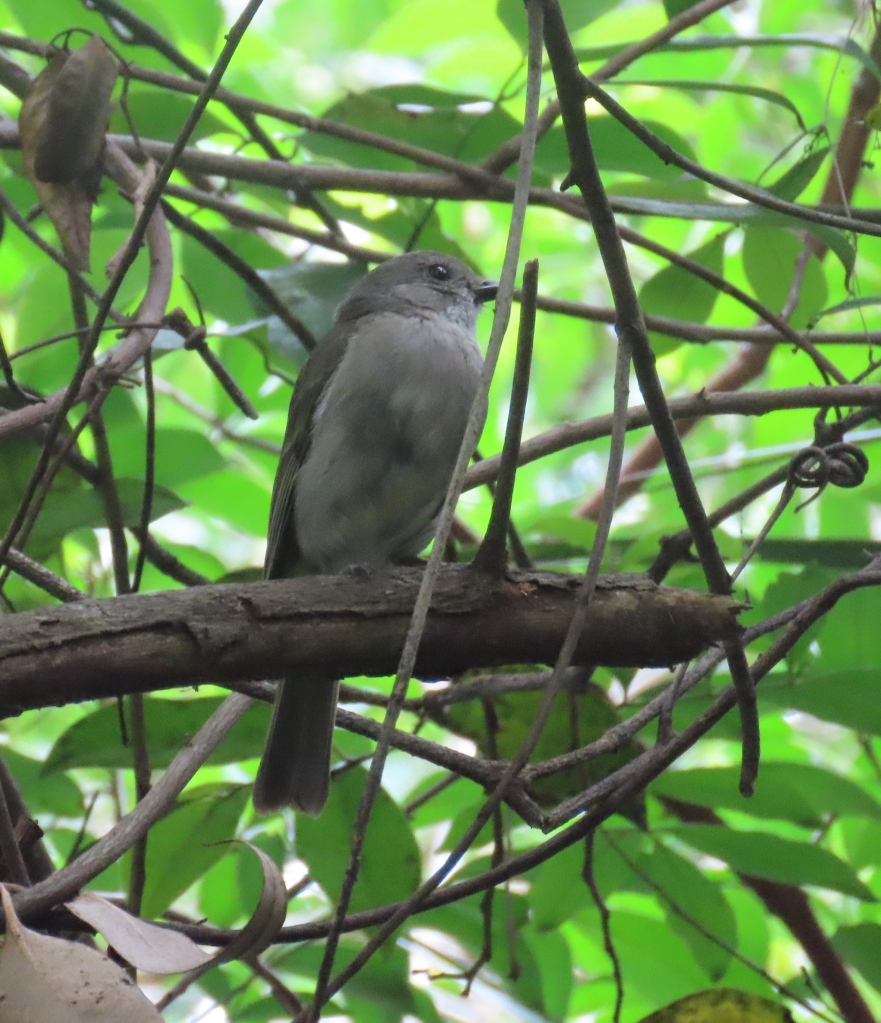
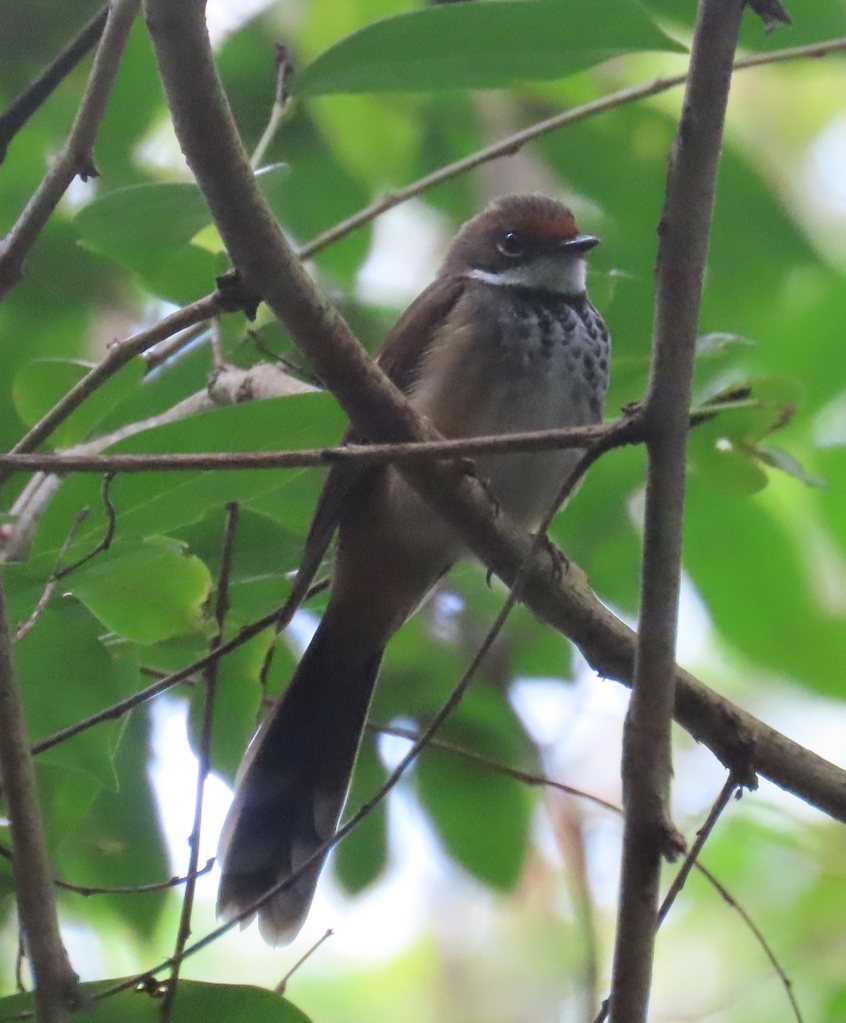
The next bird is a first sighting for me: a pretty Rufous Fantail (Rhipidura rufifrons):
This video is rather blurry, but it’s useful because you can hear the characteristic song of the fantail, similar to that of the Grey Fantail and Willie Wagtail:
My last bird of the day is a Brown Gerygone (Gerygone mouki), another first sighting for me:

The photograph of this bird is very similar to the earlier one of the female Golden Whistler. However, the Gerygone has grey markings running from beak to eye. The Gerygone (9-11 cm) is also smaller than the Golden Whistler (16-18 cm), though that’s hard to tell from the photos.

The loudest insect in the world: Australia’s green cicada
It’s summer in Australia, and the cicadas are already out in full force. This year is going to be a bumper year for cicadas, it seems. Cicadas are a good source of food for many birds. The food comes in particularly handy at this time of year, when chicks are hatching and demanding to be fed.
Today I spotted a green cicada for the first time ever. Well, that’s not exactly true. I did once see half a green cicada buzzing around, which was very distressing. The creature must have had an encounter with a bird. Today’s insect, though was in one piece, and lovely to see:

This cicada is known as the green grocer, or the great green cicada. It’s more scientific name is Cyclochila australasiae.
Cicadas make a very loud noise. The green grocer is one of the loudest insects in the world, spewing out a noise that can reach 120 decibels. (Prolonged exposure to a noise level of 90 decibels is harmful to the human ear, and 120 decibels can cause immediate harm.) Cicadas make their noise by pulsating their abdomens.
To see a cicada singing, or to see other types of cicadas, take a look at my earlier posts.

Magpie-lark eating a cicada
This Magpie-lark, also known as a Mudlark or a Peewee, has caught a cicada for breakfast.
Cicadas are large beetles that appear around Sydney in summer and drive us all crazy with their singing. You can hear the harsh, ringing sound of the cicadas in the video.
There are a few different types of cicadas, many of them quite lovely. Take a look at these posts to see some that I’ve photographed on other occasions.
Back to the bird! This Magpie-lark is a male. You can tell by the colour of its throat, which is black. Female birds have a white throat.

Common name: Magpie-lark, also called a Peewee or a Mudlark
Scientific name: Grallina cyanoleuca
Approximate length: 30 cm
Date spotted: 28 November 2020 (spring)
Location: Manly Dam National Park, New South Wales, Australia: 33°46’35.5″S 151°14’50.3″E
Floury Baker cicada so pretty
The cicadas are still making that dreadful noise all round. The noise is a nuisance, and by the end of summer I’ll be glad to welcome a relative silence back to the bush. And yet… I’ve grown a little fond of them too.
A couple of days ago I spotted this Floury Baker cicada in a Sydney suburb:

Its grey speckles caught my eye. At first I wondered if it was shedding its skin, but I did some research and found that cicadas don’t shed once they’ve emerged from the nymph stage of their life cycle. (I’ve written about the mysterious life of cicadas in other posts.) So I searched for “grey cicada” and found some information about Floury Bakers.
Here’s another view of the same bug, with a clearer view of its eyes (though the ends of the wings are a little blurry):

Did I mention they’re noisy? Yes! I’ve posted recordings of them in a couple of other posts.
Cicada, what a noise!
The cicadas are out in full force this summer. A week ago, while walking in the bush on a hot morning, I was suddenly doused in spray of cool drops from the trees above. It seems cicadas do pee. Copiously. A quick check of the internet assured me the spray is harmless. You can basically view it as sugar water that’s passed through a cicada.
However, the occasional dousing is not the most noticeable characteristic of cicadas. The thing most people notice about them is their singing. Song is not exactly the right word. What a noise! Only the male cicadas sing. This video shows how they pulsate their abdomens to make the noise:
They are large insects, about the thickness of an adult person’s thumb, and interesting to look at. I think they’re quite attractive, in an outdoorsy sort of way:
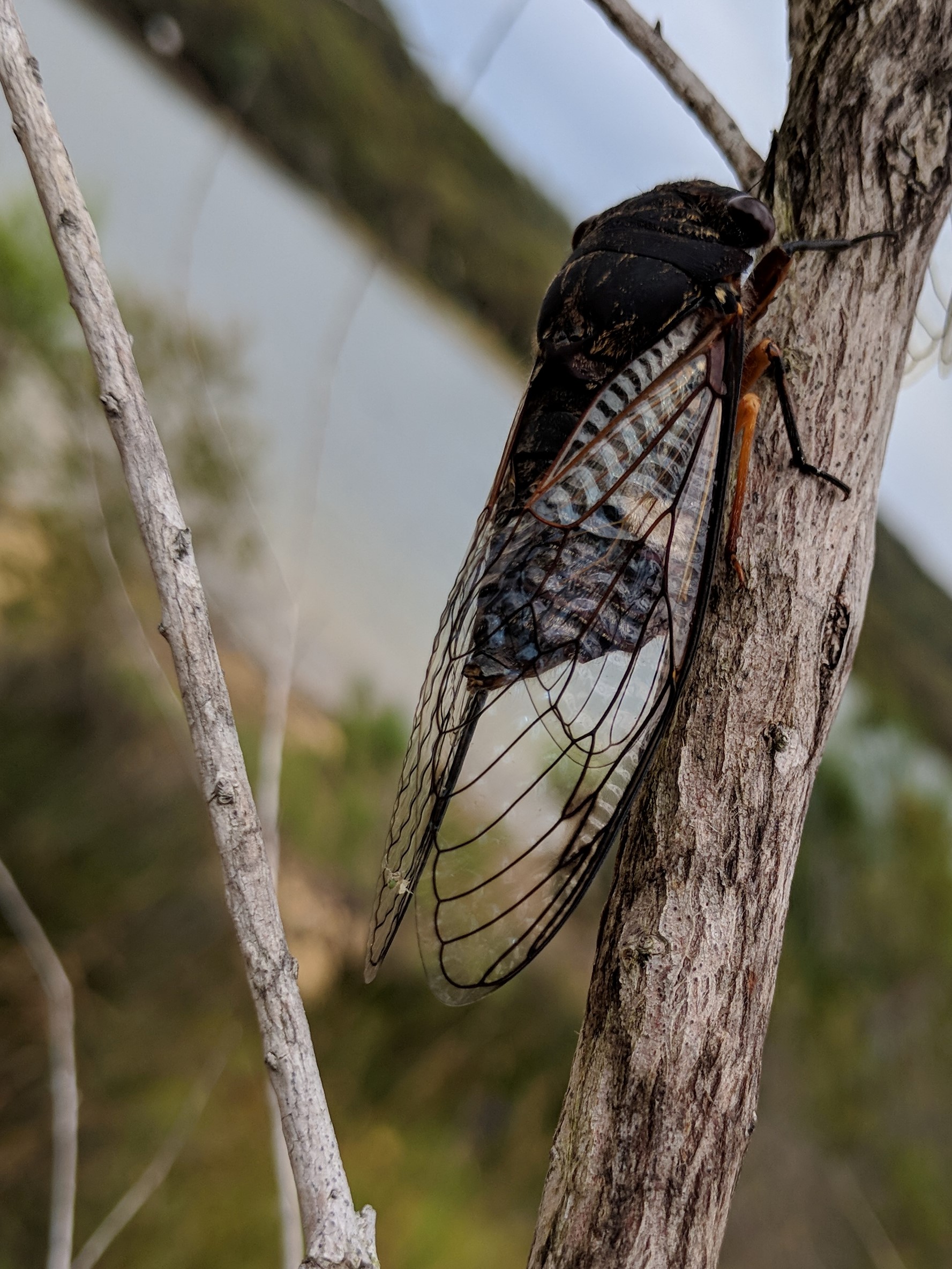
They have an impressive life cycle. The adult cicada is the winged insect we see, and it lives for only a few weeks. But the nymphs, which are the form of the creature that hatch from the eggs, live for around seven years, underground. A previous post of mine has pictures of the empty husks left behind when a nymph transforms into the winged adult.
This picture shows the underside of one cicada as well as the top of another:
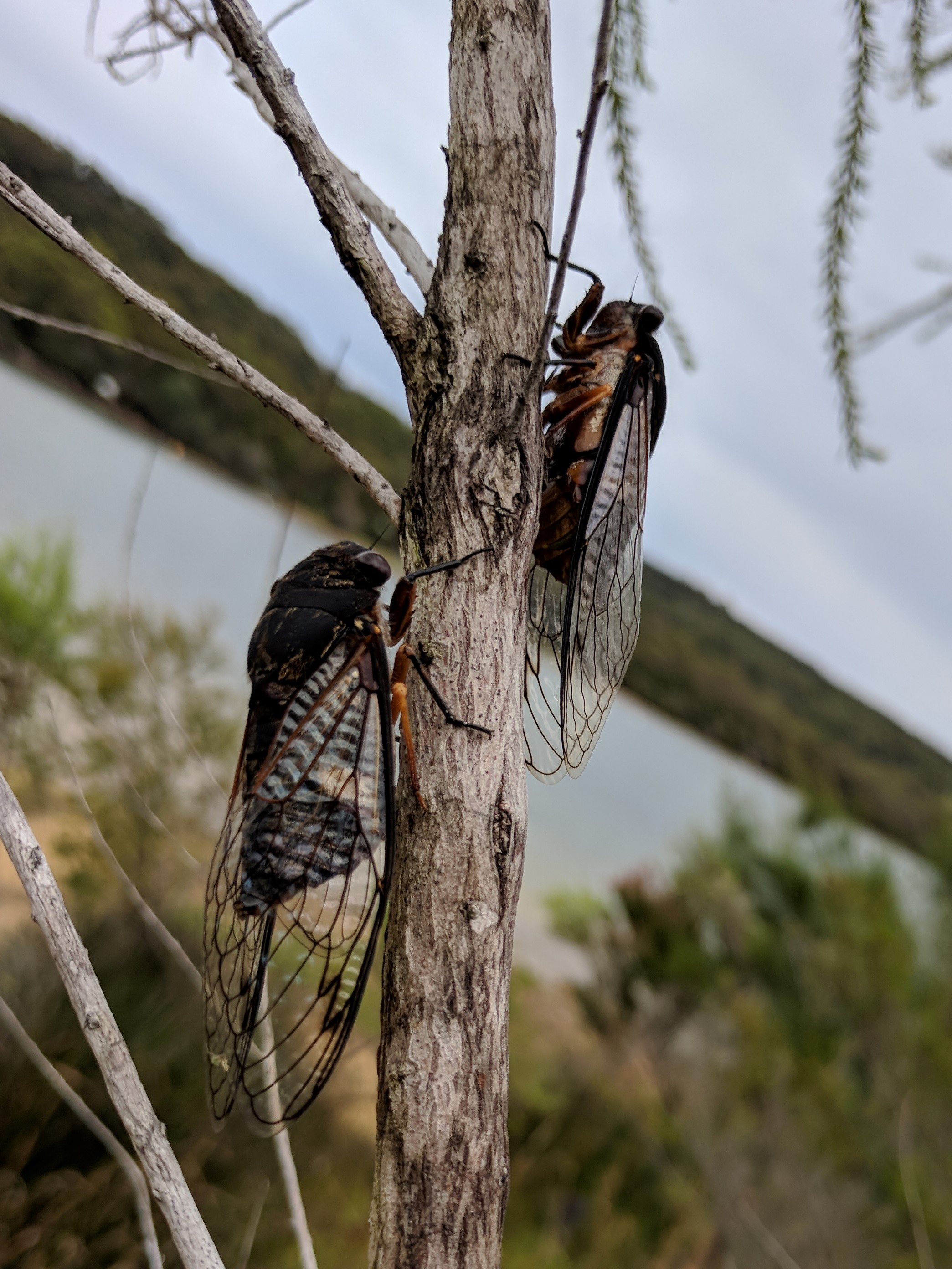
I think these are Black Prince cicadas (Psaltoda plaga). I found them at Manly Dam National Reserve, near Sydney: 33°46’37.6″S 151°15’09.4″E.
The cicadas in my previous post were Floury Bakers (Aleeta curvicosta), noted for singing upside down.
This blog is primarily about birds, and cicadas aren’t birds. But they’re nearly as big as some birds, and they’re part of our local birds’ ecosystem. In fact, the larger birds have a feast during cicada season. One of my first memories of Australia is of coming across half a cicada buzzing aimlessly on a path through a bushy area. The insect was bright green, the first green one I’d ever seen, and the sight filled me with sadness. So I’m happy to see them when they come, even though their call is a little intrusive!
Cicadas singing
Not a bird this time, but a beetle that makes bush walking painful to the ears in the summer months around Sydney. The piercing noise of cicadas is familiar to most Sydney-siders. In this video, you can hear them all round you, and see one close-up pulsating its abdomen to make the noise.
The insect is quite large – about the length of your thumb – and has transparent, lacy wings:
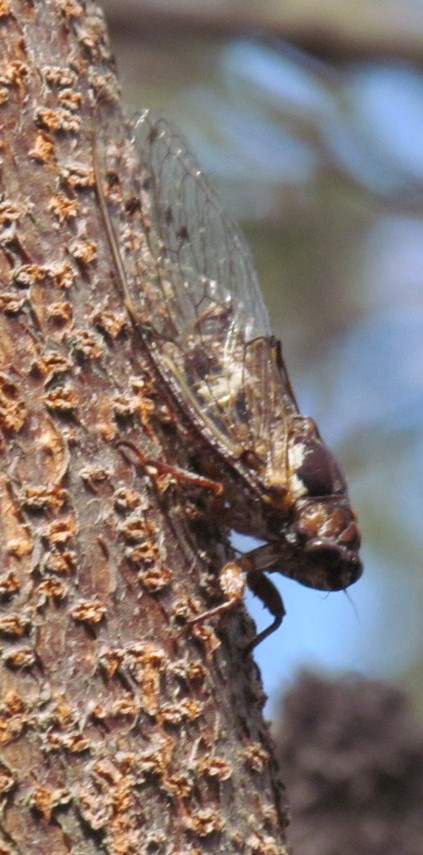
Their huge eyes make them look super cool, as if they’re wearing sun glasses:
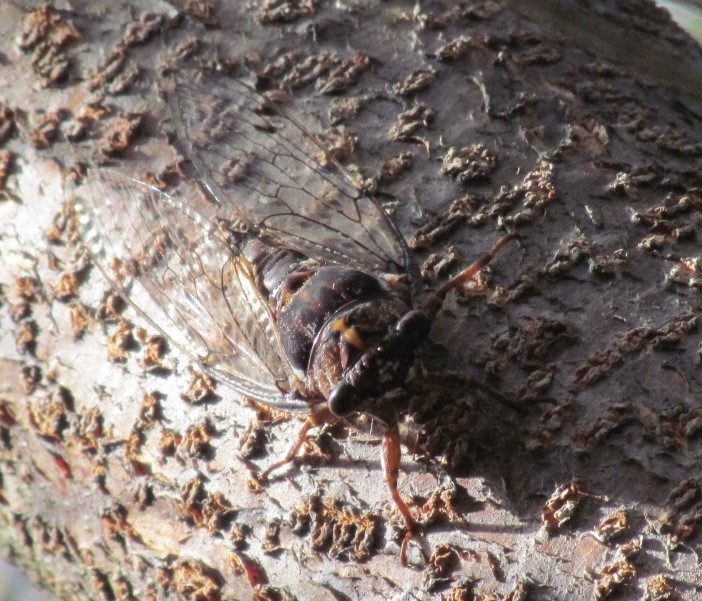
An interesting fact: The adult cicada is the winged insect we see, and it lives for only a few weeks. But the nymphs, which are the form of the creature that hatch from the eggs, live for around seven years, underground.
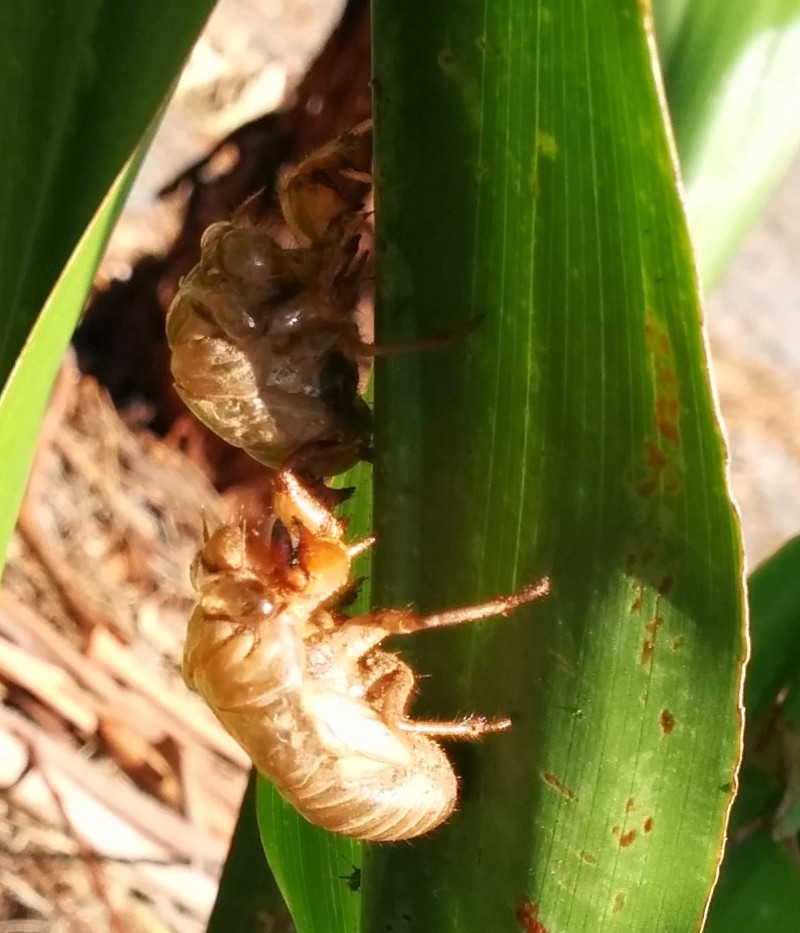
A while back, I came across these cicada husks. When the nymph is ready to transform into the winged insect, it climbs up from the underground onto a bush or tree trunk and sheds its skin. These are the resulting empty husks:


 Sydney Birder