Blog Archives

Post-fire scenes from the Australian bush
The National Parks and Wildlife Service recently conducted a hazard reduction burn in one of my favourite bush-walking areas. The NPWS lights these controlled fires to burn away excess vegetation, which reduces the chance of a more severe fire raging out of control during fire season.
Many of the plants in the Australian bush are adapted to cope with fires. For example, these Hakea seedpods popped open after the fire, allowing the seeds to escape:
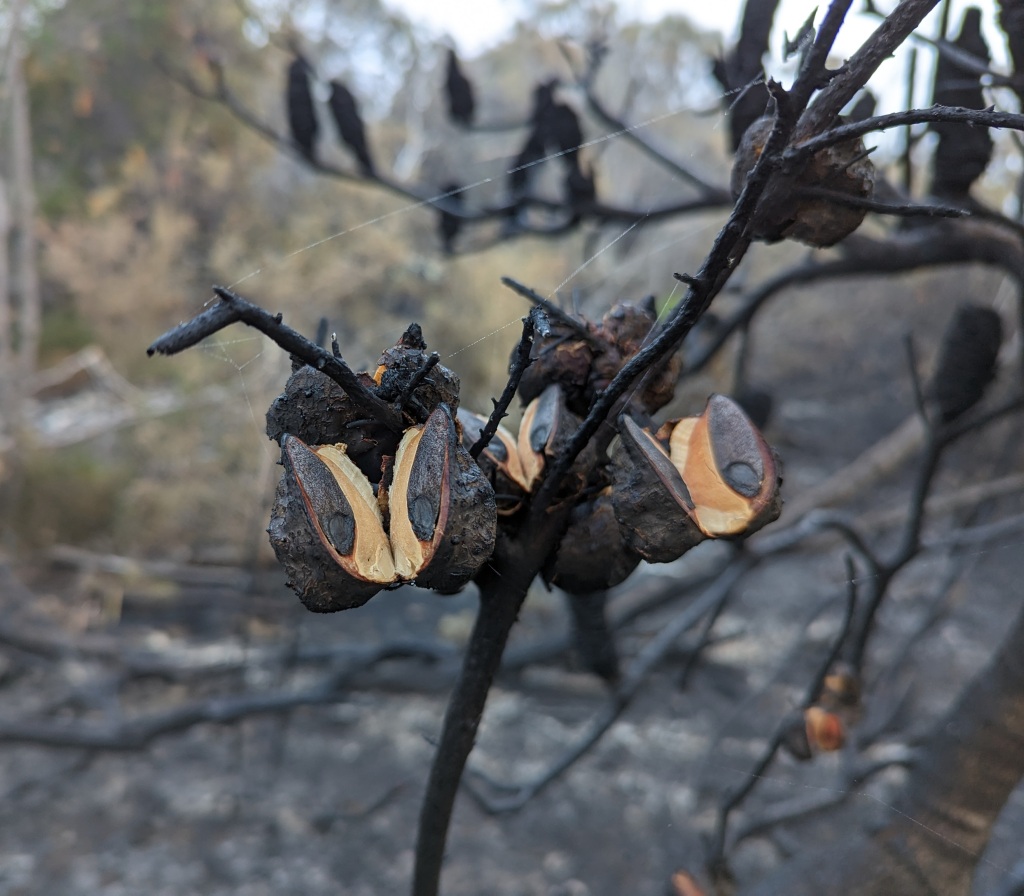
The above seed pods have both seeds still in place — the seeds are black and oval-shaped. Each seed is attached to a thin membrane, which acts as a wing: when the seed is released, it spirals gently to the ground. If there’s any wind around, the seed can travel a short distance from its parent bush.
In the next photo, only one of the seeds remains in the pod:

The next photo shows the seed head of a Banksia bush, also popped open to release the seeds. The open pods look like smiling mouths:

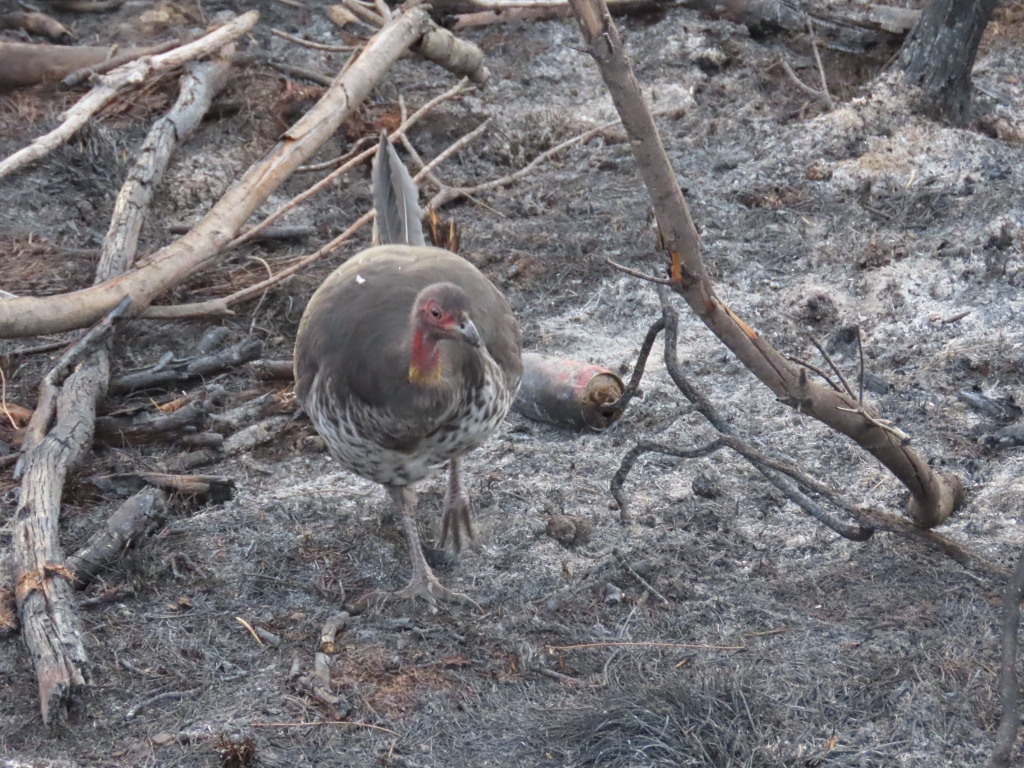
An Australian Brush-turkey wanders over the ashes, looking for pickings. A discarded can echoes the bird’s colouring:
Nearby, Australian Ravens look for insects and other goodies:

A Currawong keeps a watchful eye over the proceedings:

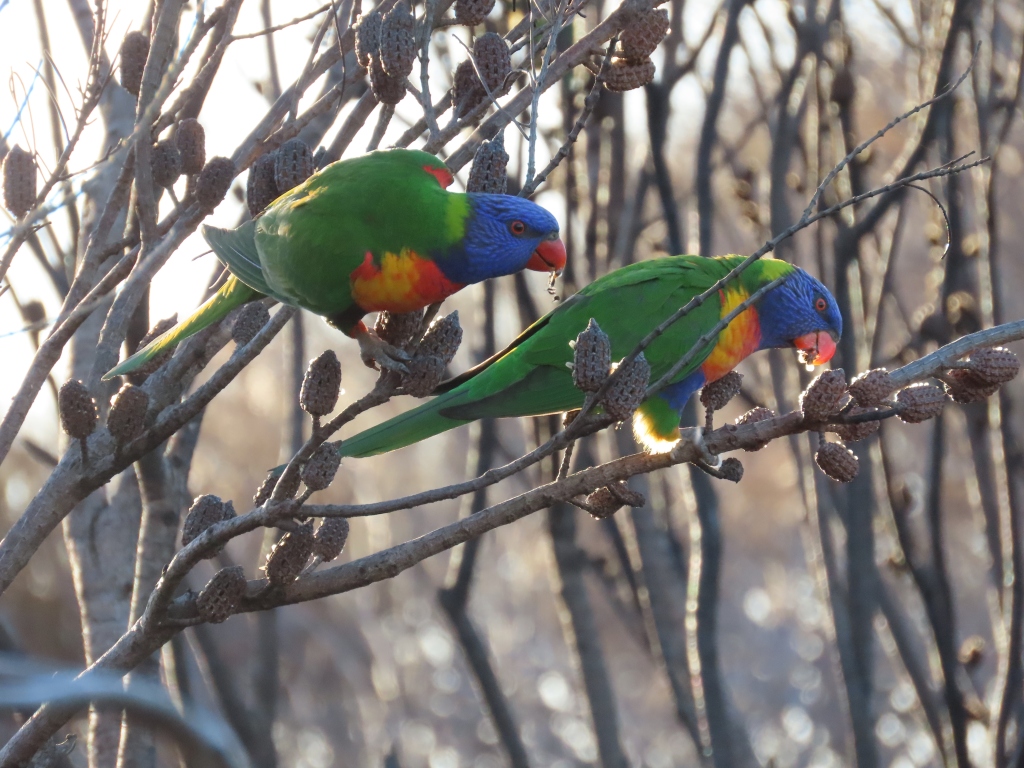
A Rainbow Lorikeet adds a splash of colour, hoping to snag a Casuarina seed or two:
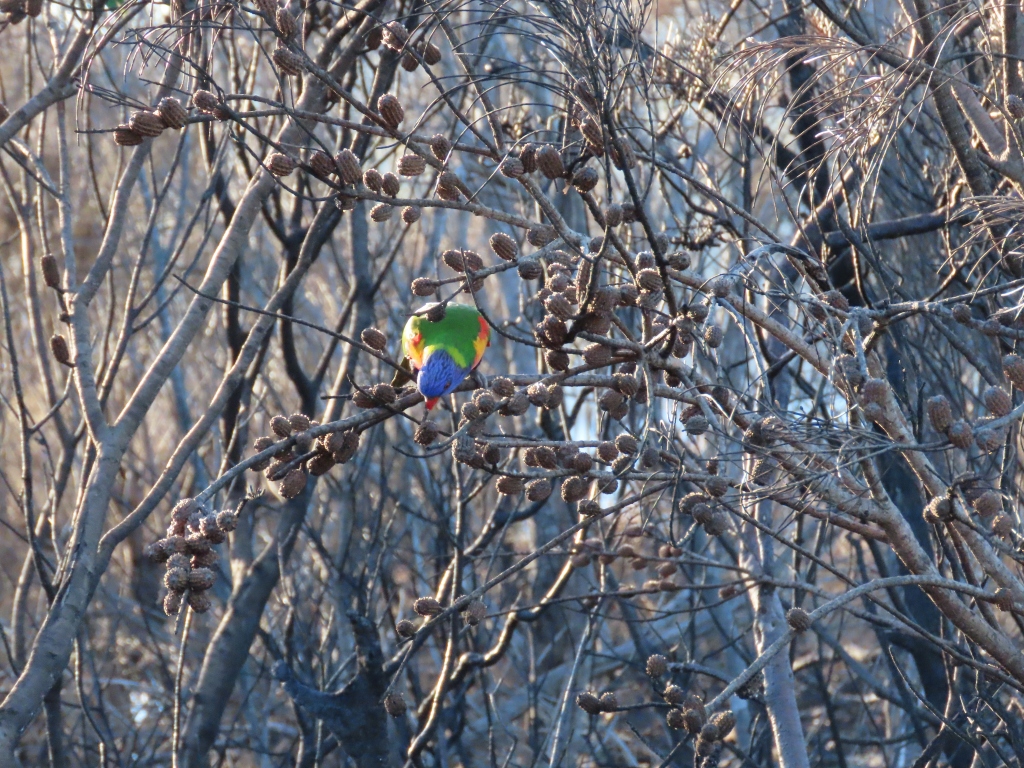
It’s much easier to grab a seed now that the fire has dried out the seedpods!
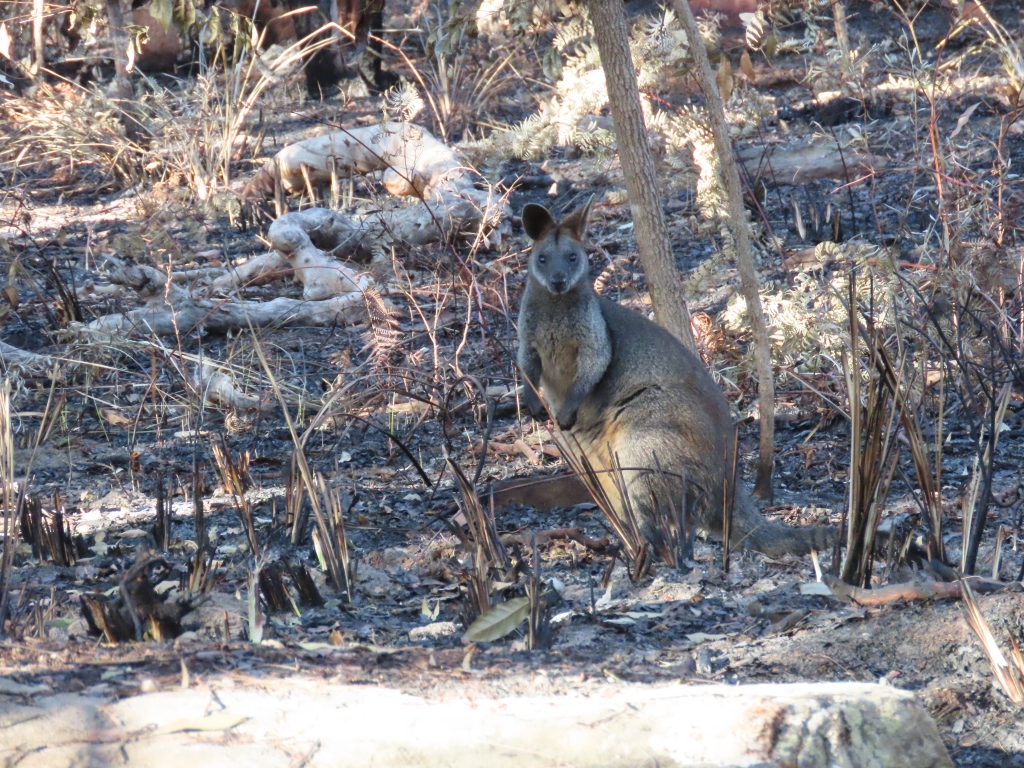
A week later, a Swamp Wallaby shared the browns and greys of the burned area too:
Here’s a video of the wallaby. At one stage, a plane flies overhead and a group of birds squawk loudly. The wallaby looks at me, checking whether I’m the cause of the disturbance, then goes calmly about its business:
To close, here’s a restful scene of the post-fire forest in the early morning light:

Date spotted: Early June, 2023
Location: Dobroyd Head, Sydney Harbour, NSW, Australia; between this point and this point on the map.

Kookaburra, grass trees, and the Australian bush after a fire
It’s early summer now in Australia, and the weather is still relatively cool. It’s a good time for the Parks and Wildlife services to do a hazard reduction burn, before the weather gets too extreme. They set fire to selected parts of the bush, after plenty of ground clearing and other preparatory work. On the day of the burn, the fire services are on hand to keep the fire within its boundaries. (This doesn’t always go according to plan, though!) The goal is to burn away undergrowth that could later result in a fierce, uncontrolled fire.
In the days since a recent burn in my area, I’ve noticed that a kookaburra often spends time in a particular area of the burned forest. Presumably there are small creatures around, even in the burned area, that offer a tempting snack.
This picture shows a kookaburra surveying the forest floor carefully. The blackened trunks and rocks are evidence of a burn that’s a few weeks old:

Here’s a closer view of the kookaburra:

The trees and many of the native plants survive fast-moving, relatively cool fires. Even the trees with blackened trunks are alive inside, and their leaves at the top of the canopy often remain green.
One plant that survives a fire amazingly well is the iconic grass tree (Xanthorrhoea). The trunk of a grass tree burns black, and sometimes all the spiky leaves are burned away. At other times, the leaves after a fire form a multi-coloured fan of green, orange, and brown.

The above grass tree is a few decades old. They grow very slowly, at the rate of 2 cm a year, and it can take about 20 years for them to form a trunk. Before that, they’re just a clump of spiky leaves sticking out of the ground.
Here’s a wider scene with a few small grass trees:

The next photo shows a bush area a couple of years after a burn. There’s plenty of regrowth happening:

And here’s a kookaburra under a bright blue sky, in a different area of Sydney:

I love walking in the post-fire forest in the early morning. Well, I love walking in any forest at any time, but after a fire there’s a surreal quality to the air. The Sydney Red Gums glow orange. Every sound is magnified, because there’s no muffling undergrowth. The rock formations show the structure of the land, usually hidden by plants. And bits of green start appearing almost immediately.


I hope you’ve enjoyed a stroll through some Ozzie bush, blackened but not daunted by hazard reduction burns.


 Sydney Birder