Blog Archives
Tawny Frogmouth eyeing me carefully
Tawny Frogmouths are irresistibly picturesque. They’re nocturnal birds, members of the nightjar family, so they’re a bit dozy by day. This one was very aware of me as I moved quietly around below it.
Click the image to open in a new tab, and zoom in to take look at its plumage. The bird’s eye is almost entirely closed in this image.

Here’s a close up view of the bird’s head. It’s eye is now half open, keep a watch on me:

There’s not much happening in the videos, but you can see the careful, slow movements that the bird makes, trying to preserve its disguise as a dry branch:
There’s even less happening in the next video, but it gives a nice view of the bird itself. The harsh chirring noise is the cicadas, which dominate the bush at this time of year.
Common name: Tawny Frogmouth
Scientific name: Podargus strigoides
Approximate length: 40 cm
Date spotted: 26 December 2014
Season: Summer
Location: Manly Dam Reserve, New South Wales, Australia
Latitude/longitude: 33°46’26.7″S 151°15’08.7″E
Dollarbird in Sydney
Update on 25 December 2014: It’s a Dollarbird, also called a Broad-billed Roller. Thanks to Hamish Robertson for identifying this bird! They’re migratory, arriving in Australia in September/October every year and leaving again in March. They spend the winter in New Guinea and other northern islands.
Does anyone know what bird this is? I heard it making an insistent chattering noise the other day. It was high up on an electric cable, so I couldn’t see it very well. It’s dark in colour, with a red beak. I’d guess its size to be roughly that of a magpie. Here’s the best shot I got of it:

Here’s a video, useful mainly for the sound. I had the camera on high zoom without a tripod, so it’s quite shaky, but you can hear the sound very well.
Common name: Dollarbird (Thanks to Hamish Robertson for identifying this bird!)
Scientific name: Eurystomus orientalis
Approximate length: 30 cm
Date spotted: 21 December 2014
Season: Summer
Location: Manly Dam Reserve, New South Wales, Australia
Latitude/longitude: 33°46’36.4″S 151°15’16.1″E
Sulphur-crested Cockatoo
Sulphur-crested Cockatoos are sociable creatures, often travelling in large groups. This one was with four others, but sat apart looking a bit grumpy.

It can be difficult to get a good photo of a cockatoo, because they’re so white that the sun gleams off them and the resulting glare removes all detail. So I was pretty please with these shots. Here’s a rear view:

Common name: Sulphur-crested Cockatoo
Scientific name: Cacatua galerita
Approximate length: 50 cm
Date spotted: 20 December 2014
Season: Summer
Location: Manly Dam Reserve, New South Wales, Australia
Latitude/longitude: 33°46’45.6″S 151°14’59.2″E
Jaded Kookaburra
I spent a fair bit of time today watching this kookaburra, hoping it would burst out laughing. (It’s my dream to video one of them laughing.) Instead, she just watched me back. I think this bird is a female, because she has only a small amount of blue marking on her wings, and none on her tail.

Her rear view makes me giggle, with that top knot of feathers:

And the other profile:

I think she’s wishing I’d fade into the sunset:

Common name: Laughing Kookaburra
Scientific name: Dacelo novaeguineae
Approximate length: 47 cm
Date spotted: 14 December 2014
Season: Summer
Location: Manly Dam National Park, Allambie Heights, New South Wales, Australia
Latitude/longitude: 33°46’37.4″S 151°14’50.1″E
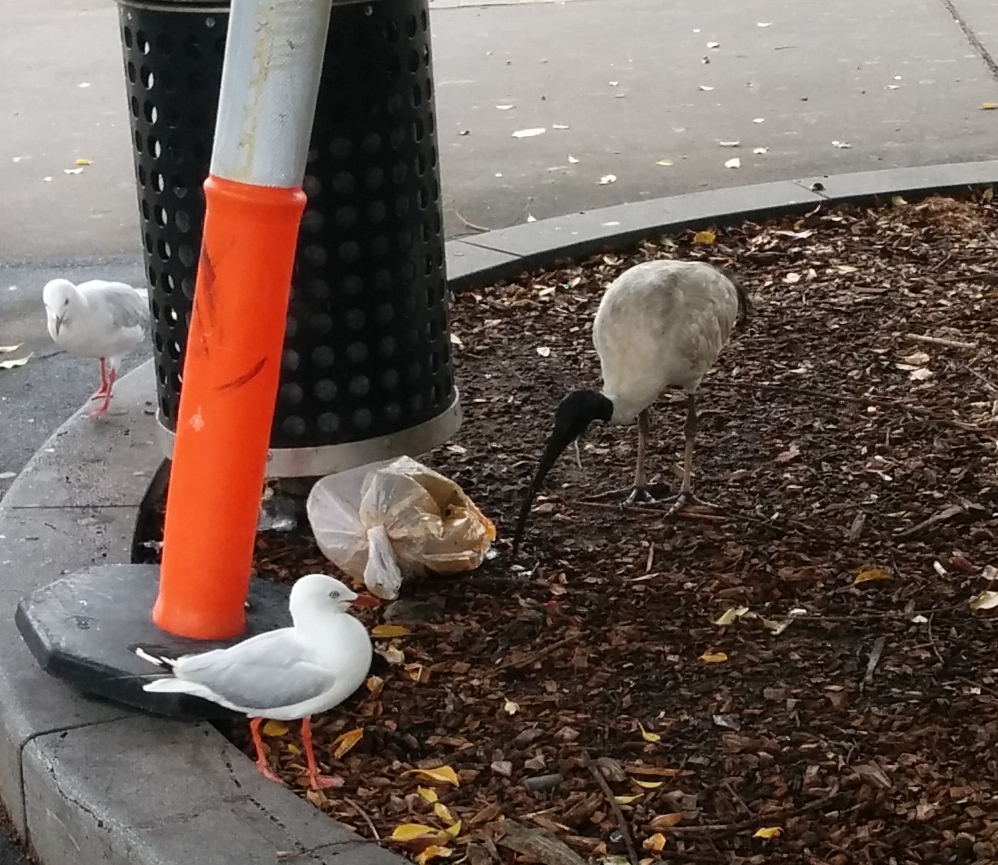
Ibis raiding the trash
Australian White Ibises are a common sight in the city, raiding the trash or swooping between the buildings. Their natural habitat is near water, nesting in colonies on trees and bushes on the water’s edge.
This video shows an ibis in Pyrmont, Sydney, guarding its booty from other raiders: screaming, strutting Silver Gulls and a curious but cautious Common Myna.
Here’s a close-up of the ibis.
Common name: Australian White Ibis
Scientific name: Threskiornis molucca
Approximate length: 70 cm
Date spotted: 4 December 2014
Season: Summer
Location: Pyrmont, in Sydney, Australia
Latitude/longitude: 33°51’56.4″S 151°11’46.6″E
Noisy Miner attacking a Brush-turkey
It’s a common sight in Australia, especially in spring: a small bird dive-bombing a larger one. The small bird is usually a Noisy Miner, although other types do it too. The larger bird can be a kookaburra, a raven, a cuckoo – you name it. In fact, Australian birds are likely to attack anything, including people.
On Thursday morning this week, I saw a Brush-turkey under attack from a Noisy Miner. The first couple of videos are in a fairly low resolution, because I was using my phone camera.
Late that afternoon I passed by the same spot, and the miner and turkey were still at it! Two very stubborn birds. This video shows why Australians who are fond of their gardens tend not to be so fond of the Brush-turkeys. You’ll see a cunning dive from the miner at one point too:
Eventually, the Brush-turkey decided discretion is the better part of valour and headed out into suburbia. I had my Canon camera with me this time, so you can see the turkey in full splendour:
Peace at last, although you can still hear the Noisy Miners heckling:
The Noisy Miner:
Common name: Noisy Miner
Scientific name: Manorina melanocephala
Approximate length: 26 cm
The Brush-turkey:
Common name: Australian Brush-turkey
Scientific name: Alectura lathami
Approximate length: 60 cm
Date spotted: 27 November 2014
Season: Late spring
Location: Allambie, New South Wales, Australia
Latitude/longitude: 33°46’18.0″S 151°15’42.6″E
Kingfisher at Manly Dam near Sydney
A bright kingfisher dashed in and out of a termite nest high in a tree. I caught a couple of photos of the bird perching on branches, and made a video of a lightning-fast dash at the termite nest. I think it’s a Forest Kingfisher, after careful scrutiny of the photos and my bird book. But it may be a Sacred Kingfisher instead. It was exciting to see this bird, as I didn’t know we had any kingfishers in the area apart from kookaburras.
Update on 25 June, 2022: I’m revising my opinion. I now think this is a Sacred Kingfisher.
Here’s the video, at actual speed (very short):
Here it is again, slowed down to quarter speed:
A still photo:
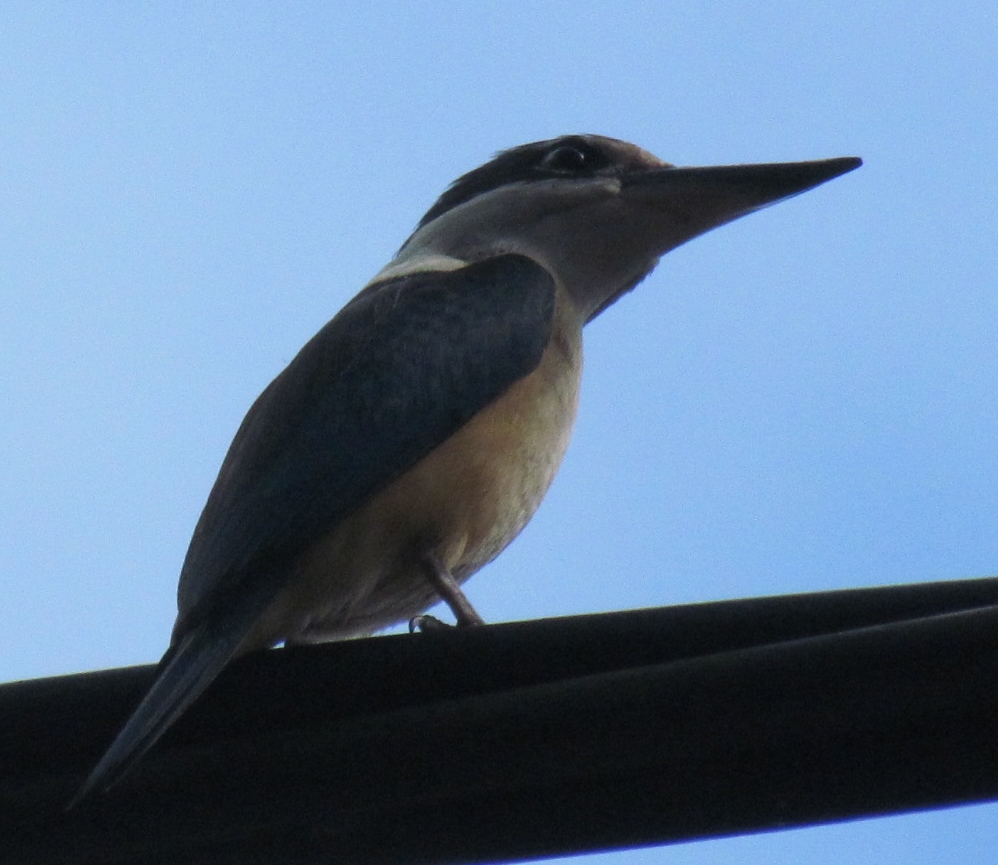
And another:

Common name: Sacred Kingfisher
Scientific name: Todiramphus sanctus
Approximate length: 20 cm
Date spotted: Saturday 22 November 2014
Season: Spring
Location: Manly Dam National Park, Sydney, Australia
Latitude/longitude: 33°46’57.5″S 151°15’20.2″E
Little Wattlebird croaking
This Little Wattlebird appears quite drab when seen from afar, but from close up has a sleek coat of streaks with chestnut touches on its wings. Wattlebirds are one of the many types of honeyeaters found in Australia. As well as nectar, they eat berries and insects. And they’re noisy and argumentative.
In the video, the bird is uttering its characteristic scratchy croak.
From behind:

In full song:

Common name: Little Wattlebird
Scientific name: Anthochaera chrysoptera
Approximate length: 30 cm
Date spotted: Saturday 22 November 2014
Season: Spring
Location: Manly Dam National Park, Sydney, Australia
Latitude/longitude: 33°46’40.3″S 151°14’58.5″E
New Holland Honeyeater at Wineglass Bay Lookout
Not in Sydney this time, I was at Wineglass Bay Lookout in Tasmania when I saw a bush full of New Holland Honeyeaters. This video focuses on one of them, then draws back to show the gorgeous location it’s chosen for its foraging.
Here’s a still picture. Click on it to open it in a new window where you can zoom into the detail.

Common name: New Holland Honeyeater
Scientific name: Phylidonyris novaehollandiae
Approximate length: 17-19 cm
Date spotted: Sunday 9 November 2014
Season: Spring
Location: Wineglass Bay Lookout, Tasmania
Approximate latitude/longitude: 42°08’60.0″S 148°17’20.2″E
Pardalote eating lerp
Pardalotes are very small, compact birds. They move fast, so it’s hard to catch one on film. This one is hanging upside down, snapping up lerp (I think) off a leaf.
Update on Tuesday 11 November: I originally wrote that the bird was snapping up insect eggs. But since then I’ve started reading Where song began by Tim Low. He describes how Pardalotes and other Australian birds scrape lerp off leaves. Lerp is a sweet carbohydrate excreted by tiny insects called psyllids.
I couldn’t get a good angle to see the whole bird all at once, but this short video gives a good idea of what it looks like.
Common name: Spotted Pardalote
Scientific name: Pardalotus punctatus
Approximate length: 10 cm
Date spotted: 2 November 2014
Season: Spring
Location: Manly Dam National Park, New South Wales, Australia
Latitude/longitude: 33°46’36.3″S 151°15’14.9″E


 Sydney Birder