Blog Archives

Shy Eastern Spinebill
Eastern Spinebills have long curved beaks, giving rise to the name “spinebill”. They’re one of many types of Australian birds that live on plant nectar and insects. Unlike many other honeyeaters, though, spinebills are shy and don’t stay in one place for long.

The bird’s dramatic colours of white, black, and chestnut, as well as its red eye make it a striking presence in the Australian bush.
Common name: Eastern Spinebill
Scientific name: Acanthorhynchus tenuirostris
Approximate length: 16cm
Date spotted: 29 May 2021 (late autumn)
Location: Manly Dam Park, New South Wales, Australia: 33°46’29.7″S 151°14’46.0″E

Pretty Pardalote on a Banksia bush
Pardalotes are tiny birds that manage to pack a lot of prettiness into sleek bundle. A couple of days ago I saw one foraging in a Banksia bush. It was probably picking tiny bugs (psyllids) from the leaves, or it could be drinking. I noticed in the photo that there are droplets of water on the twig near the bird’s feet:

A view from the top shows the spots on the bird’s head. It also demonstrates how nicely camouflaged the bird is in its natural environment:

Common name: Spotted Pardalote
Scientific name: Pardalotus punctatus
Approximate length: 10 cm
Date spotted: 25 May 2021 (late autumn)
Location: Manly Dam Park, New South Wales, Australia: 33°46’47.3″S 151°15’02.2″E

Spangled Drongo near Sydney
“Drongo”. What a weird name for a bird. Add “Spangled” and it sounds as if you’re about to encounter a clown. I’ve only spotted a Spangled Drongo once before, and that was up in Queensland. A few days ago, while walking in the bush near Sydney, I heard an unusual sound. A deep, slow chattering. The bird in question was perched high on a dead tree:
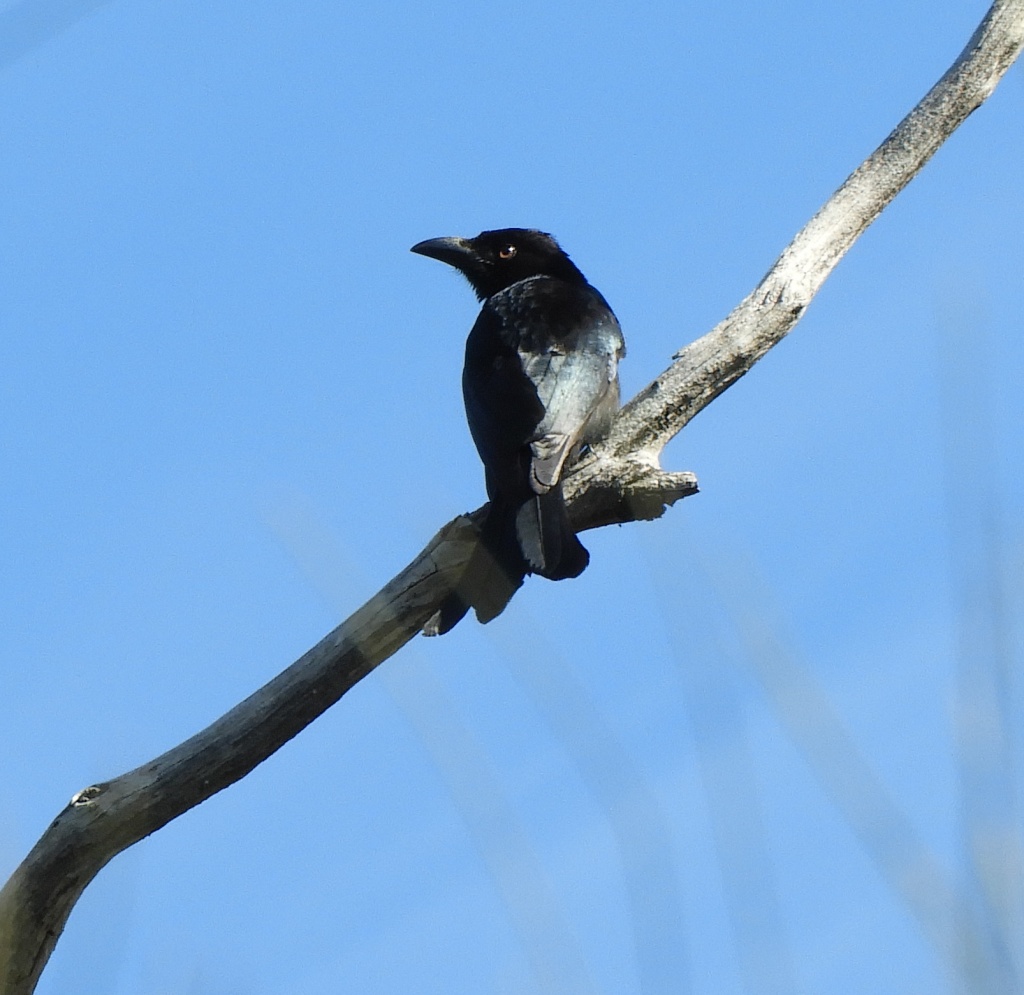
Just look at that forked tail, strong beak, and keen eye. An unusual bird indeed, and quite large at 30 centimetres or more from head to tail.
In Australia if someone calls you a “drongo”, it’s a bit of an insult. It means they think you’re not all that bright.
Common name: Spangled Drongo
Scientific name: Dicrurus bracteatus
Approximate length: 30 cm
Date spotted: 25 May 2021 (autumn)
Location: Manly Dam Park, New South Wales, Australia: 33°47’02.2″S 151°15’16.2″E
Eastern Whipbird chirrups to itself
While foraging and exploring the forest floor, this Eastern Whipbird chattered companionably to itself:
It’s likely that the bird’s partner was nearby. I’ve heard whipbirds chirruping and calling to each other on other occasions too. As well as this quiet chirruping, whipbirds make a long, drawn-out whistle ending in a short explosion. That’s the sound that gives the birds their name. You can hear that call in another post of mine.
Common name: Eastern Whipbird
Scientific name: Psophodes olivaceus
Approximate length: 30 cm
Date spotted: 19 May 2021 (autumn)
Location: Manly Dam Park, New South Wales, Australia: 33°46’48.0″S 151°14’53.6″E

My first Scarlet Honeyeater
Flashes of scarlet against the orange of a Banksia bloom first drew my attention to this tiny bird. It moved fast, never staying still for long. I managed to snap a couple of photos, though none very clear alas. I think it’s a Scarlet Honeyeater:

What a pretty little thing! I’ve been back to the same area a couple of times but not seen the bird again. Here’s another photo of the same bird after it moved to a different tree:

Common name: Scarlet Honeyeater
Scientific name: Myzomela sanguinolenta
Approximate length: 10 cm
Date spotted: 18 May 2021 (autumn)
Location: Manly Dam Park, New South Wales, Australia: 33°46’54.2″S 151°15’08.2″E
Eastern Whipbirds chatting and pecking at tree
An Eastern Whipbird was busily pecking at a tree, presumably to get at insects or grubs under the bark. Pretty soon, another bird joined the first one. They had an amiable chat. It looked as if they were consulting on how to tackle this troublesome hard bark on the tree. The first bird went back to the task while the other looked on. After a while, the first gave up and the second stepped in to give it a go.
I think the birds are quite young, because their feathers are a little untidy and the white cheek patches aren’t clearly defined. Perhaps they’re siblings!
It was interesting to see the birds interacting and to hear their chatting sounds. I often hear the long drawn-out call that gives these birds their name (this post has some examples) but I haven’t seen them chatting before.
Common name: Eastern Whipbird
Scientific name: Psophodes olivaceus
Approximate length: 30 cm
Date spotted: 15 February 2021 (summer)
Location: Manly Dam Park, New South Wales, Australia: 33°46’44.3″S 151°14’58.8″E

Eat your greens! Baby swans growing up
Early in October I spotted a family of swans at Manly Dam. These are Australian Black Swans. When I first saw them, there were five baby swans (cygnets), closely watched over by two adults. This was one of the little ones, just a few days old then, I think:

Since then, I’ve been watching the cygnets grow. Alas, two of them disappeared over the weeks. But there are still three of the cygnets, still with their parents in late December, and much bigger and stronger.
The video below shows a cygnet and a parent feeding on water weeds. This was towards the end of November, when the cygnets were around six weeks old. Near the beginning of the video, the adult swan grabs a clump of weed and dumps it near the baby.
Eat your greens!
Later the video zooms out to show the entire family of three babies and two adults:
Here’s one of the cygnets swimming with an adult, also at around six weeks old:

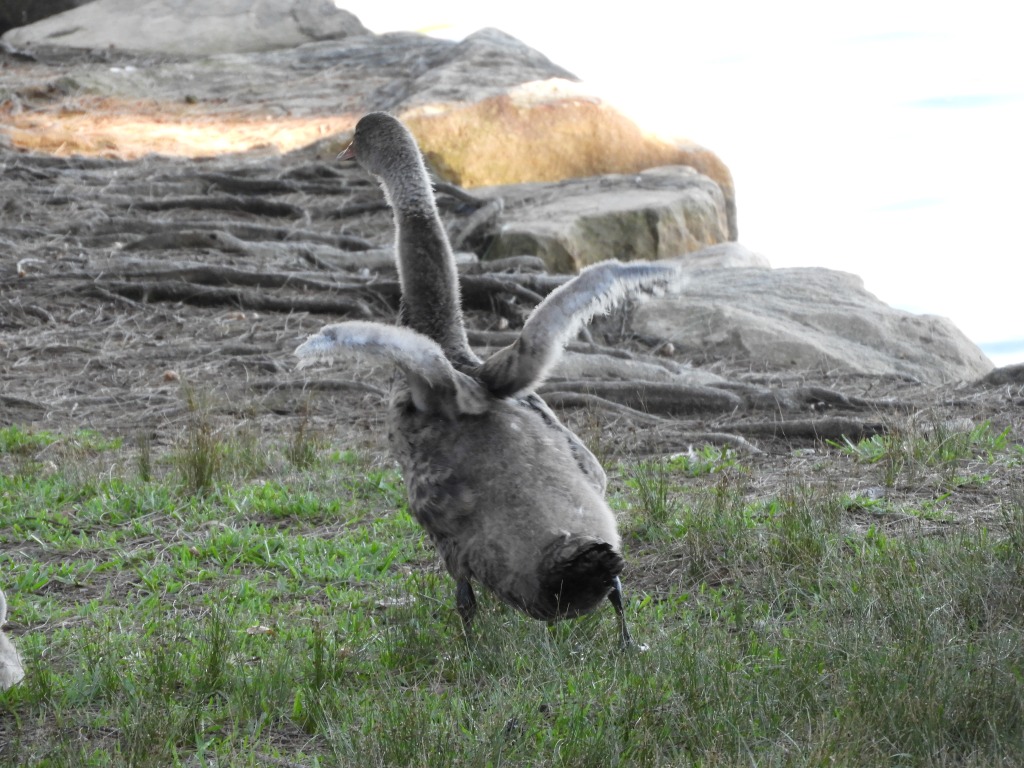
On 23 December, at ten to eleven weeks old, the cygnets are much bulkier and their faces look more swan-like:

Even at this age, their wings are still small and stumpy, nowhere near ready for flight:
Common name: Black Swan
Scientific name: Cygnus atratus
Approximate length of adult: 120 cm
Date spotted: 9 October 2020 (spring) through to 23 December 2020 (summer)
Location: Manly Dam Park, New South Wales, Australia: 33°46’58.5″S 151°15’18.6″E

So cute! Baby kookaburra in nest
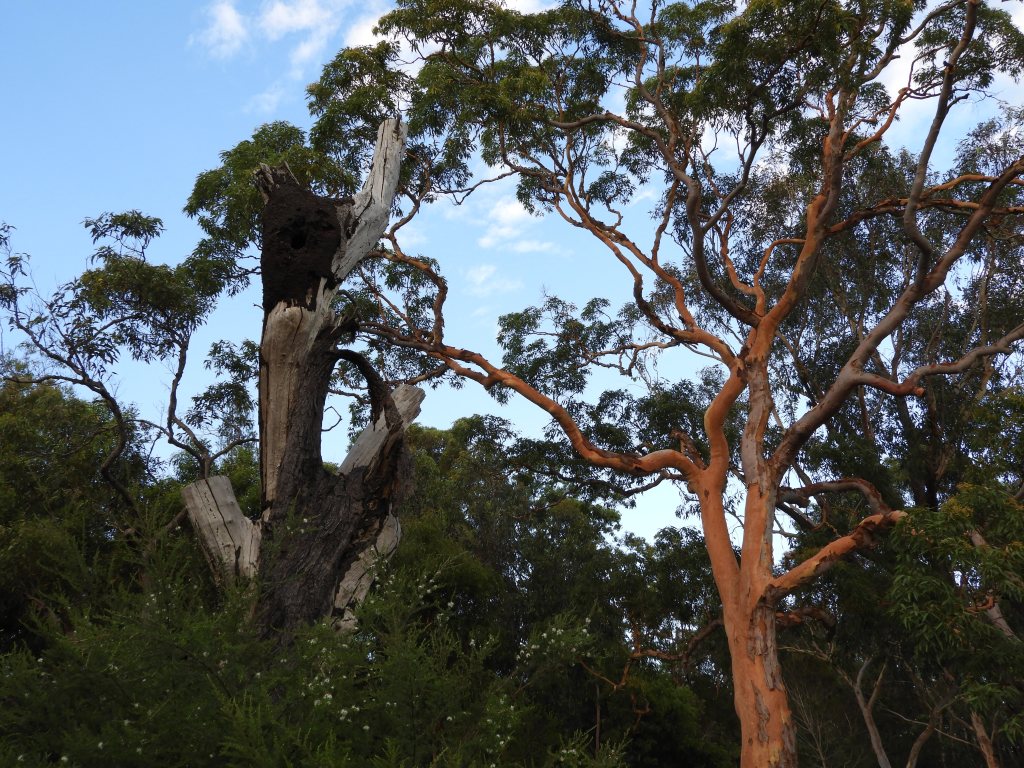
For the past few weeks, I’ve been following the progress of a baby kookaburra and its parents. The baby was housed in a termite nest on an old, dead tree. The first time that I noticed the nest was more than a month ago, on 17 November. At that time, the only sign of the baby was a faint crooning sound emerging from the termite nest. I’d heard baby kookaburras before, so I stuck around to see what would happen. Sure enough, an adult bird arrived with some food.
From that day on, I visited the nest regularly. And now, I’m delighted to report that the baby bird has safely left the nest and is being fed in the nearby trees.
The first video shows the baby kookaburra just a few days before it left the nest. The date was 14 December, almost a full month after I first noticed the nest. In the video, the baby peers curiously (and hungrily, no doubt) from the nest. You can hear an adult kookaburra off camera, calling to let the chick know that food is on its way. I moved the camera to take in the adult on a nearby branch. The bird checks the surroundings carefully, including me, to decide whether it’s safe to approach and feed the chick.
Meanwhile, the chick becomes more vociferous and sticks its head further out of the nest, impatient at the delay. The adult moved to a different branch to give itself a direct line of flight. I managed to catch a view of the adult there too, before moving back to the nest in time to see the adult arrive and feed the baby:
The parents were tireless and devoted in their care for the baby. On a couple of occasions, I spotted them foraging for food:

When the parents were not around, the chick eyed me from the safety of its home. The smallest scuffle was enough to bring an inquisitive eye to the hole in the nest:
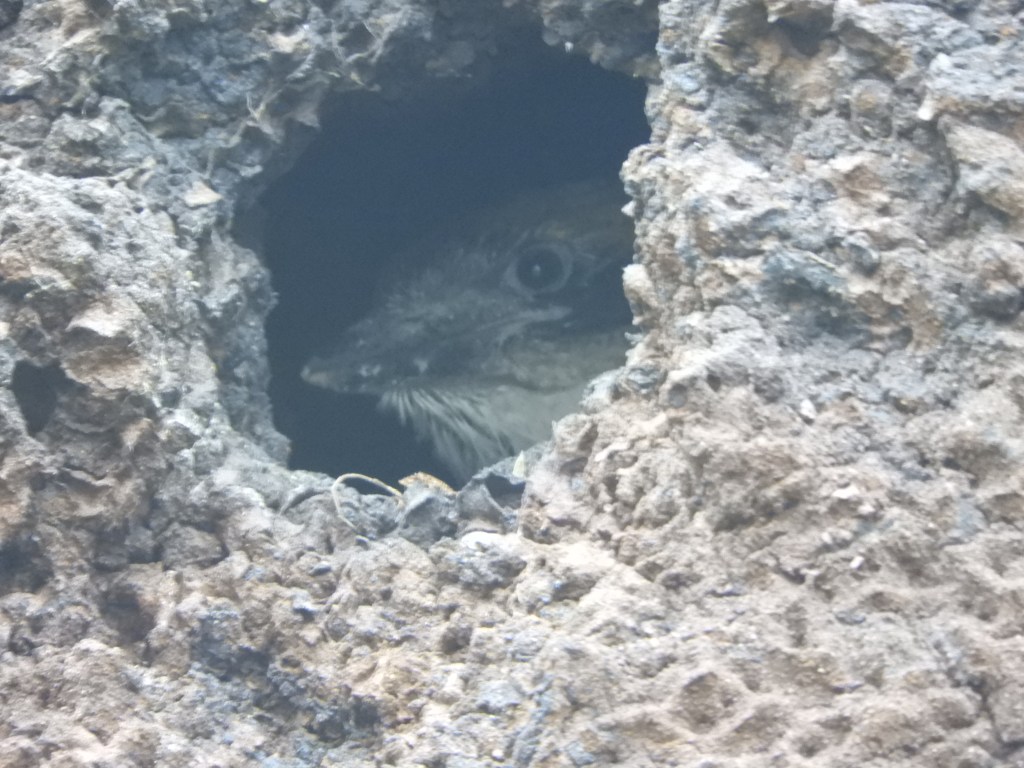
Partially hidden but oh so curious:
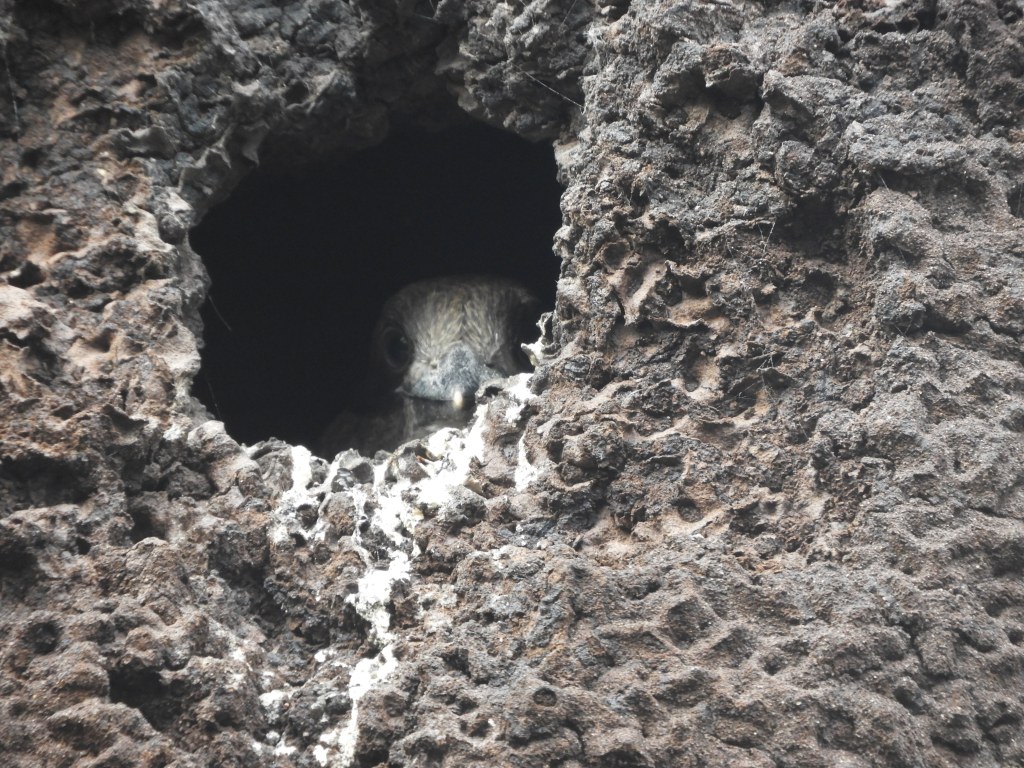
The nest was on the skeleton of a dead tree:
This is an earlier, short video (taken on 3 December) showing a parent arriving to feed the chick:
When I arrived on 17 December, the nest was quiet. Again the next day, there was no activity at the nest. I explored the area and soon heard the characteristic crooning of a kookaburra youngster. I found it in a quiet, tree-filled glen, being attended to two adults in turn. It was early in the morning, and the birds were high in the trees, so I didn’t manage to get a good photo. This is the glen:

This is the only photo I have of the youngster. Alas, I didn’t get the full head in the shot, but you can see the fluffiness of the feathers and the short tail:

Common name: Laughing Kookaburra
Scientific name: Dacelo novaeguineae
Approximate length: 47 cm
Date spotted: 18 December 2020 (summer)
Location: Manly Dam Park, New South Wales, Australia
This is the view the baby kookaburra had from its nest. It looks over Manly Dam towards the dam wall, with a bottlebrush bush glowing in the early morning light. A room with a view indeed:

Finally, here’s the view that the baby must have seen when it first emerged from its nest and could look in the other direction, up the length of Manly Dam:


Male and female Brush-turkeys getting affectionate plus bonus baby
Over the past few weeks I’ve been watching the action at a Brush-turkey mound. The male bird is very attentive, keeping the mound in good shape and calling to attract females.
Every so often, a female arrives and starts taking the mound apart! At first I thought the male was annoyed when he pecked at the female. But watch what happens at about one minute into the video. The male is the one with the long yellow flaps hanging below its beak:
Male Australian Brush-turkeys build huge mounds of leaves and other plant matter each year. They lovingly tend the mound, spending hours every day reorganizing the leaves. Every now and then, the male utters a strange booming call (I managed to make a video of this male calling a few weeks ago) to let females know he’s ready for business.
Females come and inspect the male’s work. If they approve, the birds mate and eventually the female lays eggs in the mound. The chicks hatch of their own accord, and are immediately independent of their parents.
Several females have visited this particular mound over the weeks. I’ve been waiting for chicks to appear, but haven’t seen any yet.
In the meantime, in another area of the park today, this cute little young Brush-turkey flew past me at knee height. It was about the size of a large fist. I didn’t know they could fly at this age!
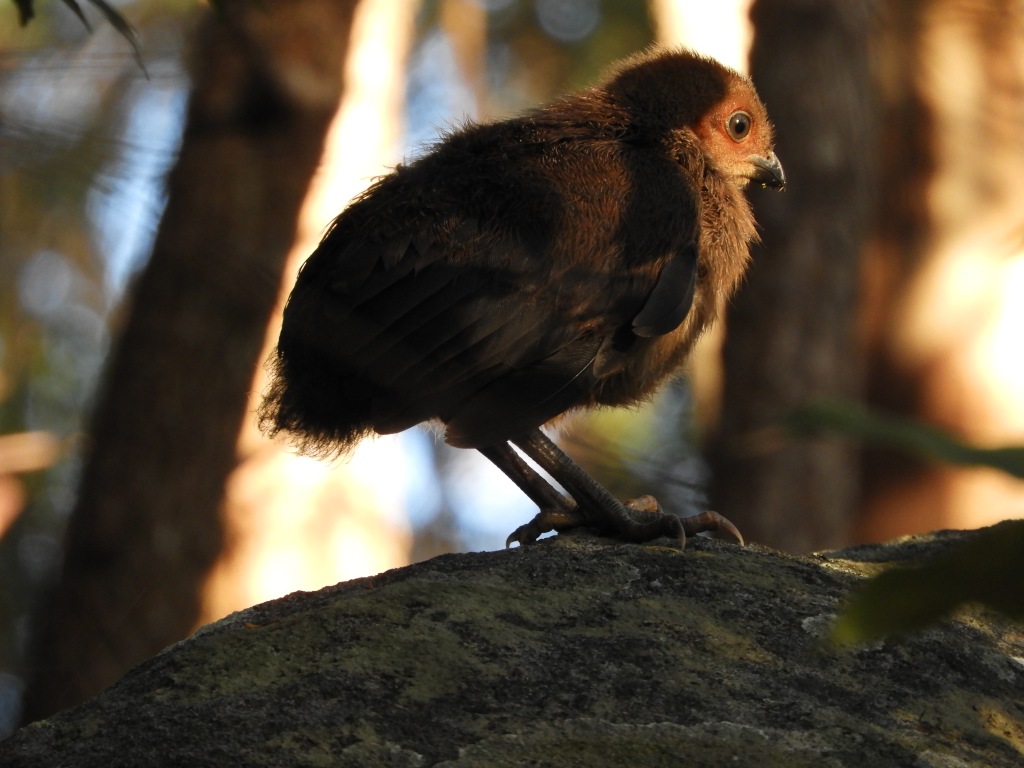
Common name: Australian Brush-turkey
Scientific name: Alectura lathami
Approximate length of adult: 60-70 cm
Date spotted: 13 December 2020 (summer)
Location of the chick: Manly Dam Park, New South Wales, Australia: 33°46’55.6″S 151°15’05.3″E
Song of the Golden Whistler
In competition with the raucous remarks of a nearby cockatoo, this little Golden Whistler sings his heart out.
Golden Whistlers are also known as thunder birds, because evidently they tend to sing in response to loud noises. Maybe the calls of the cockatoo were actually encouraging the little songster!
Common name: Golden Whistler
Scientific name: Pachycephala pectoralis
Approximate length: 16-18 cm
Date spotted: 9 December 2020 (early summer)
Location: Manly Dam Park, New South Wales, Australia: 33°47’02.4″S 151°15’14.9″E


 Sydney Birder