Blog Archives

Oriental Dollarbird surveying the world
It’s been a while since I last managed to photograph a Dollarbird. They tend to spend their time very high up on tall trees or poles, silhouetted against the harsh Australian sky. It was a delight to see one a little lower down in a bushy wetland.

Oriental Dollarbirds are migratory. We see them near Sydney, on the east coast of Australia, in the summer months. They spend the winter up north, in New Guinea and surrounding islands.
They’re quite pretty when you see them up close, dark with a blue-green sheen on their feathers. Their large heads tend to make them look cute and cuddly. They also have a gently curved beak, with the tip outlined in black , which adds a touch of nobility.

The bird changed position, and we can now see the blue-green colouring on its back too:
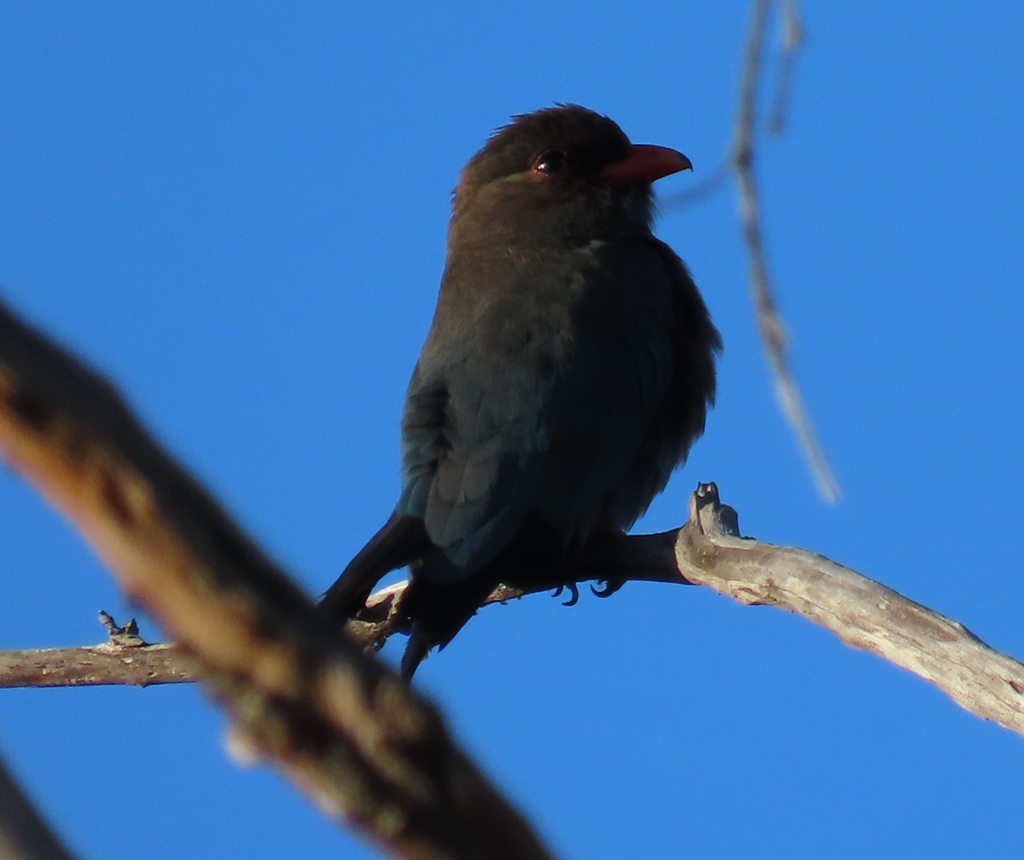
Common name: Dollarbird
Scientific name: Eurystomus orientalis
Approximate length: 27 cm
Date spotted: 30 December 2023 (summer)
Location: Manly Dam Park, NSW, Australia: 33°46’21.4″S 151°14’32.7″E

Rainbow Lorikeet
A brightly coloured Rainbow Lorikeet posed in the early morning light:

Common name: Rainbow Lorikeet
Scientific name: Trichoglossus haematodus
Approximate length: 30 cm
Date spotted: 1 January 2024 (summer)
Location: Dobroyd Head, Sydney Harbour, Australia: 33°48’38.6″S 151°16’05.4″E

Red-whiskered Bulbul with view of Sydney Harbour
Red-whiskered Bulbuls are native to southern Asia (India, Myanmar, Laos, Cambodia, Vietnam, and Malaysia), and were introduced into Sydney in the late 1800s. They’re found mostly around the inhabited areas, rather than in the more remote countryside.
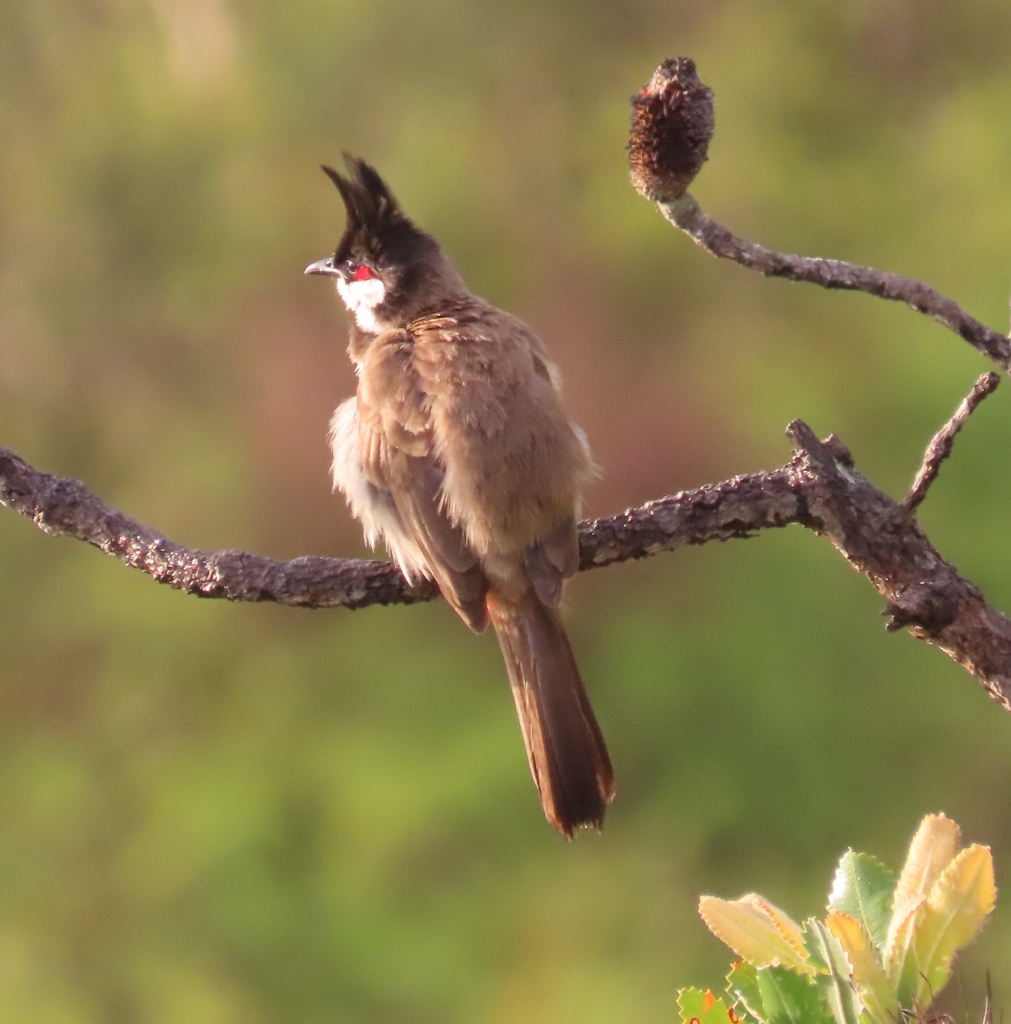
It’s a pretty little bird, with striking black, red, and white markings. In this picture, the tall crest on its head seems to be divided into two parts, a little like horns.
The next photo includes the Banksia bush that the bird is sitting on and the dense vegetation around the bird:
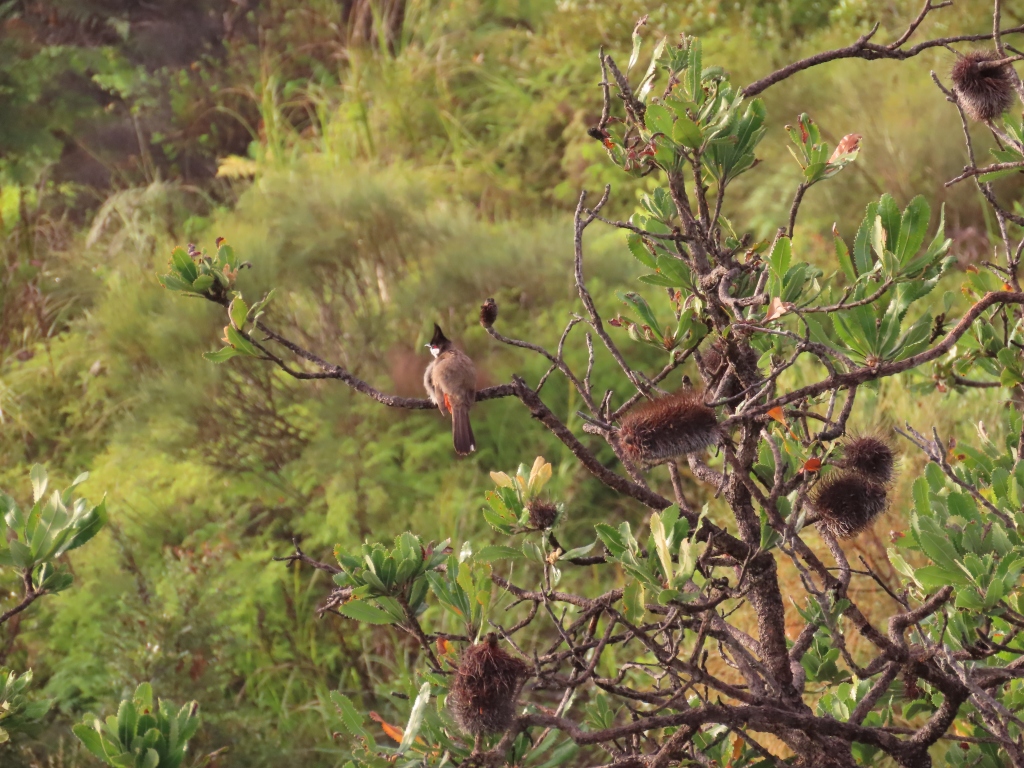
This is the second time I’ve spotted a Red-whiskered Bulbul in this area of Sydney Harbour, on a promontory called Dobroyd Head. The bird has certainly picked a spot with a view! The next video focuses on the bird, then zooms out to show the steep hill descending to Sydney Harbour. In the distance is the opening that leads from the harbour to the ocean.
Common name: Red-whiskered Bulbul
Scientific name: Pycnonotus jocosus
Approximate length: 20 cm
Date spotted: 1 January 2024 (summer)
Location: Dobroyd Head, Sydney Harbour, Australia: 33°48’38.6″S 151°16’05.4″E

Brown Thornbill in the rain
This is my first recording of a Brown Thornbill. They’re tiny little birds (about 10 cm long from tip of beak to end of tail) that spend their time in the middle-to-low area of a forest. This one was dodging raindrops in search of insects:
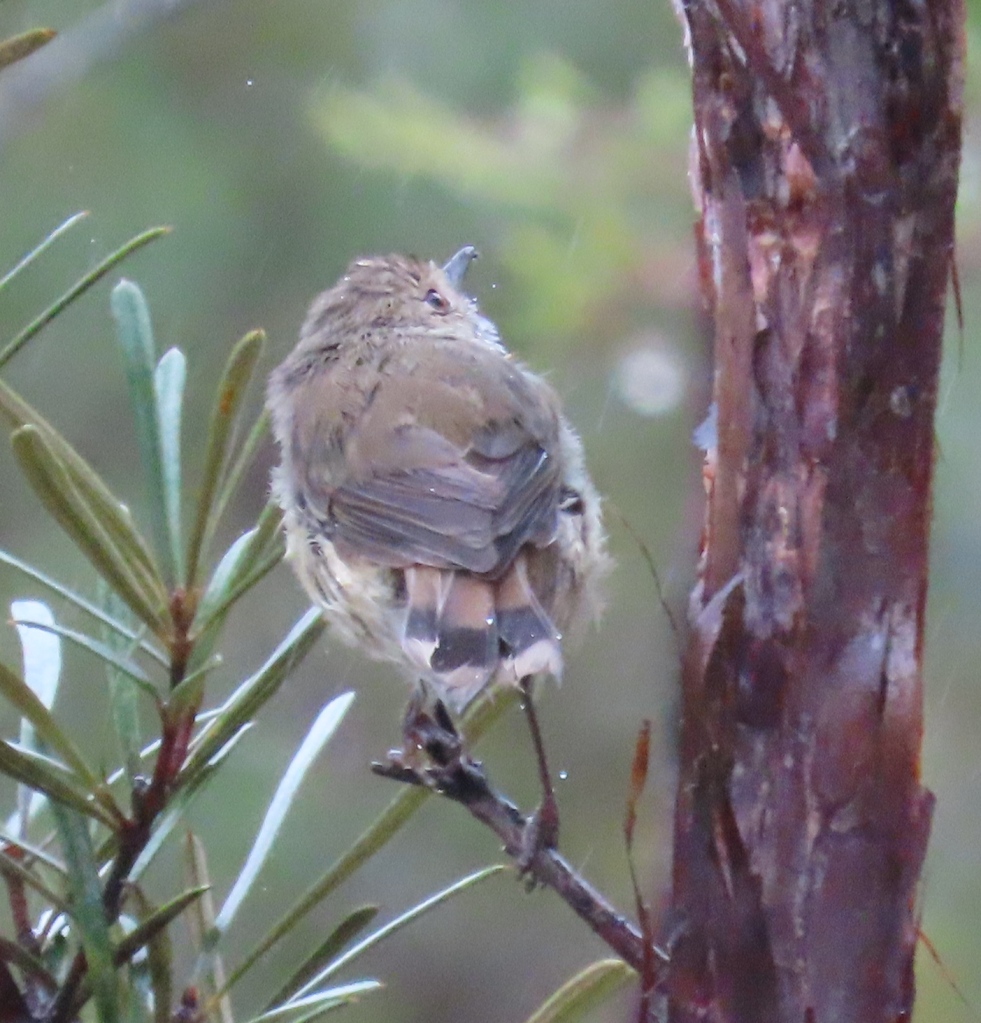
Brown Thornbills have a soft colouring of light brown to fawn, with darker edges to the tail and wings. The chin, throat and breast have light grey speckles:
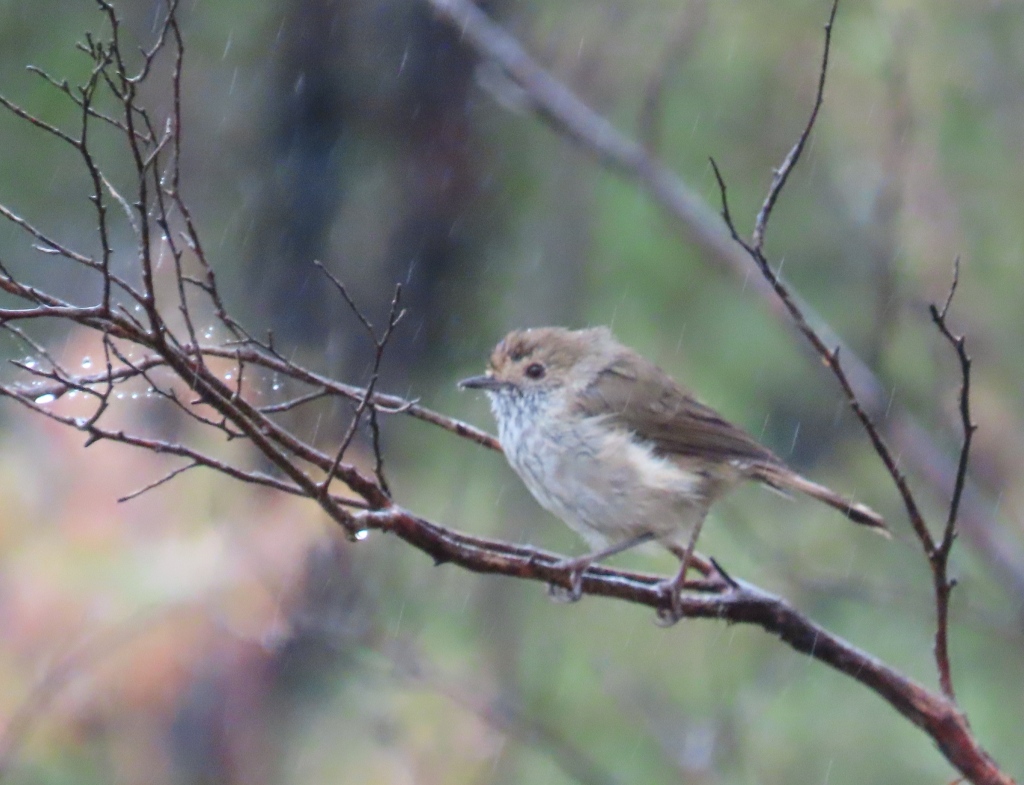
The little bird puffed itself up to ward off the cold and wet, much as I was doing by huddling in my cosy warm jacket.

Common name: Brown Thornbill
Scientific name: Acanthiza pusilla
Length: 9.5-10.5 cm
Date spotted: Sunday 31 December 2023 (summer)
Location: Blue Mountains National Park, New South Wales, Australia: 33°33’58.9″S 150°20’40.8″E

Sacred Kingfisher dives on a robin
This morning, I was trying to get a good photo of this Eastern Yellow Robin:

The robin took flight and I followed it with my camera. Suddenly, a splash of bright colours dived at the robin, there was a flurry of dust and a soft thunk, and the robin took cover in the low bushes. A kingfisher had taken umbrage with the robin! Or perhaps the two birds had simply made a beeline for the same tasty-looking insect.
The kingfisher perched nearby to check for other interlopers, or perhaps to recover from the mid-air collision:
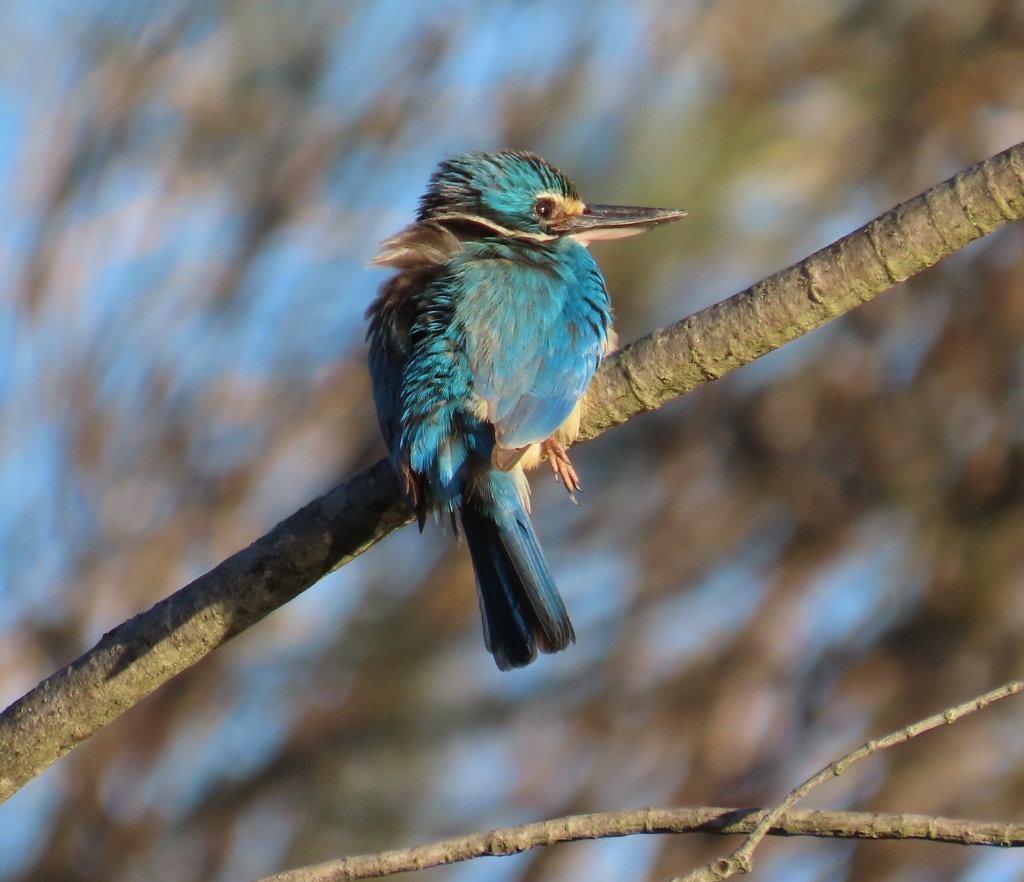
I think it’s a Forest Kingfisher, but it could be a Sacred Kingfisher. They’re very similar, but the Sacred Kingfisher is usually more green in colour.
Update on 31 December: Thank you to Andrew for the comment below, identifying the bird as a Sacred Kingfisher.
Here’s another view of the bird:
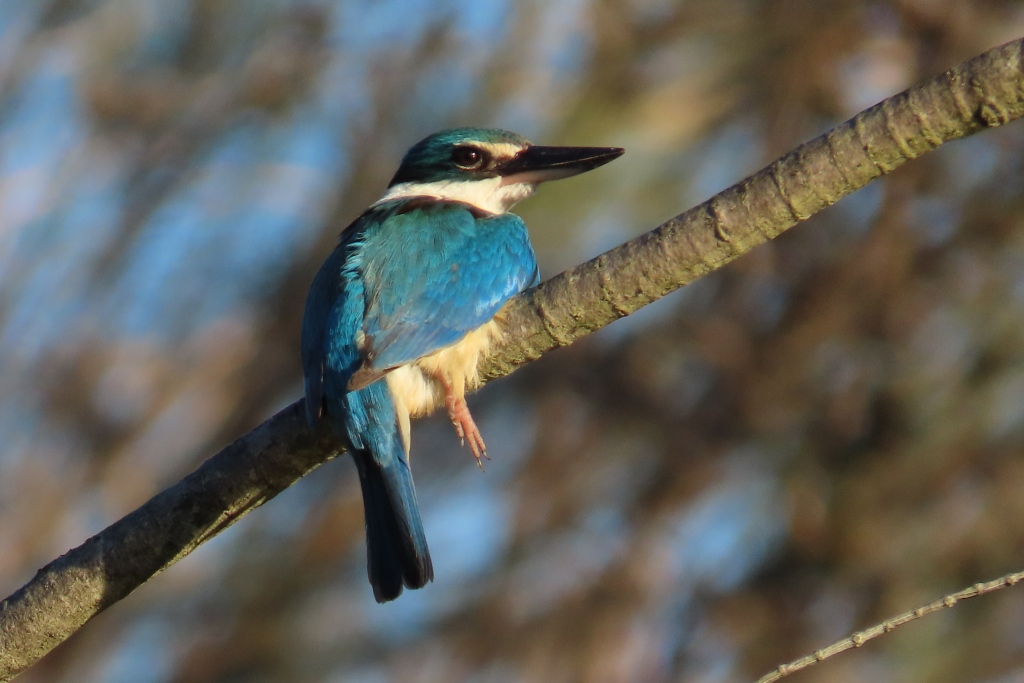
It’s interesting to see how the kingfisher seems to rest on its stomach, with its foot hanging down alongside the branch. Perhaps it’s perching on the other leg.
The next photo shows the strong blue colouring of the bird in the bright sunlight:

Common name: Sacred Kingfisher
Scientific name: Todiramphus sanctus
Length: 20-23 cm
Date spotted: Saturday 30 December 2023 (summer)
Location: Manly Dam Park, New South Wales, Australia: 3°46’31.2″S 151°14’46.6″E

Little Black Cormorant swimming underwater
Today I managed to catch some footage of a Little Black Cormorant swimming in a quiet offshoot of the Hawkesbury River.
We were at Akuna Bay in the Ku-ring-gai Chase National Park. The bay is home to a marina, with boats and jetties and restaurants, yet it was quiet and peaceful when we were there.
This is a still shot of the cormorant under the water:

Little Black Cormorants are one of five types of cormorants found in Eastern Australia. I don’t have many photos of them yet. As well as being entirely black, Little Black Cormorants are distinguishable by their bright green eyes. The next photo gives some idea of the eye colour, though it’s rather blurry:

Common name: Little Black Cormorant (see other cormorants)
Scientific name: Phalacrocorax sulcirostris
Approximate length: 65 cm
Date spotted: 29 December 2023 (summer)
Location: Ku-ring-gai Chase National Park, New South Wales, Australia: 33°38’46.1″S 151°14’04.9″E
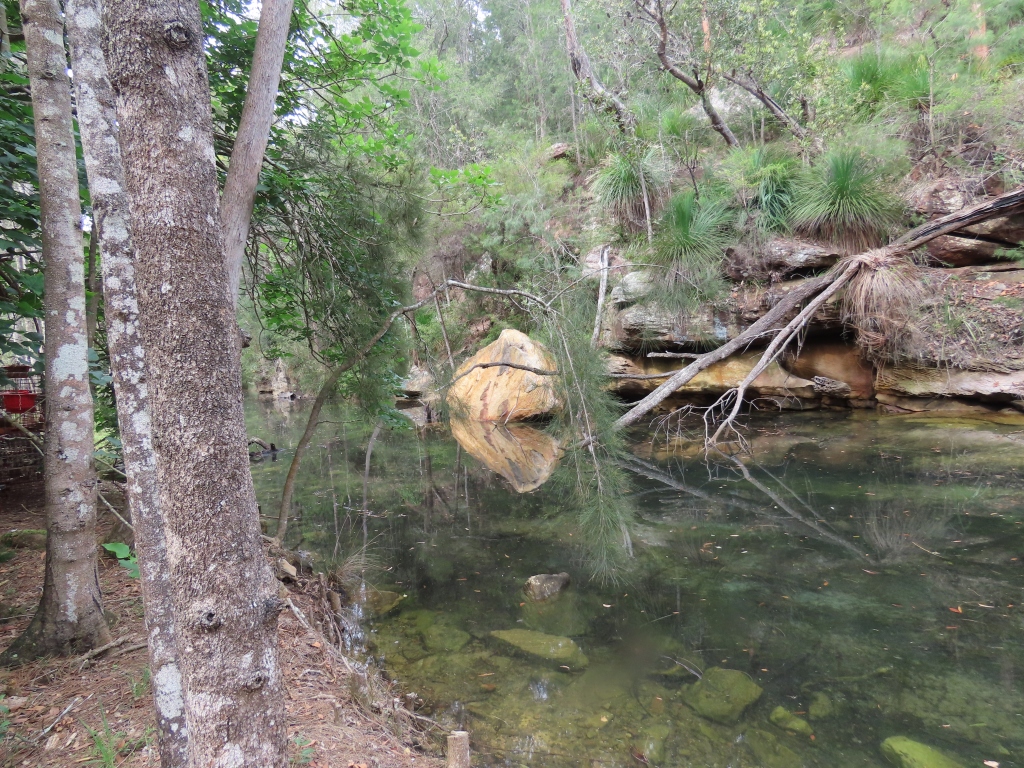
The creek was still and smooth. A haven for mosquitoes, alas, but pretty too:
Here’s a rare picture of me examining another part of the creek:


Bird spotting with Aussie Bird Tours
Yesterday my family and I went on a bird-spotting trip with Aussie Bird Tours. Mike Barrow led us on a wonderful half-day tour around the Dee Why Lagoon, Warriewood Wetlands, and Irrawong Reserve. We spotted a large number of birds (40-50 types) and heard others too. Here are the ones that I managed to get a half-decent photo of.
Our tour started at Dee Why Lagoon, where we saw a number of water birds: a darter, cormorants, ducks, a black swan, coots, a Silver Gull, and more. Songbirds were there too. A Magpie-lark strutted over the mud. Welcome Swallows darted across the water. A Willie Wagtail chirped in the distance. An Eastern Whipbird spent many minutes exploring the dense reeds a couple of metres from our feet. We could hear its characteristic chattering, but only saw it when it made a break for the higher foliage.
This male Olive-backed Oriole (Oriolus sagittatus) posed for a profile shot against the blue sky:
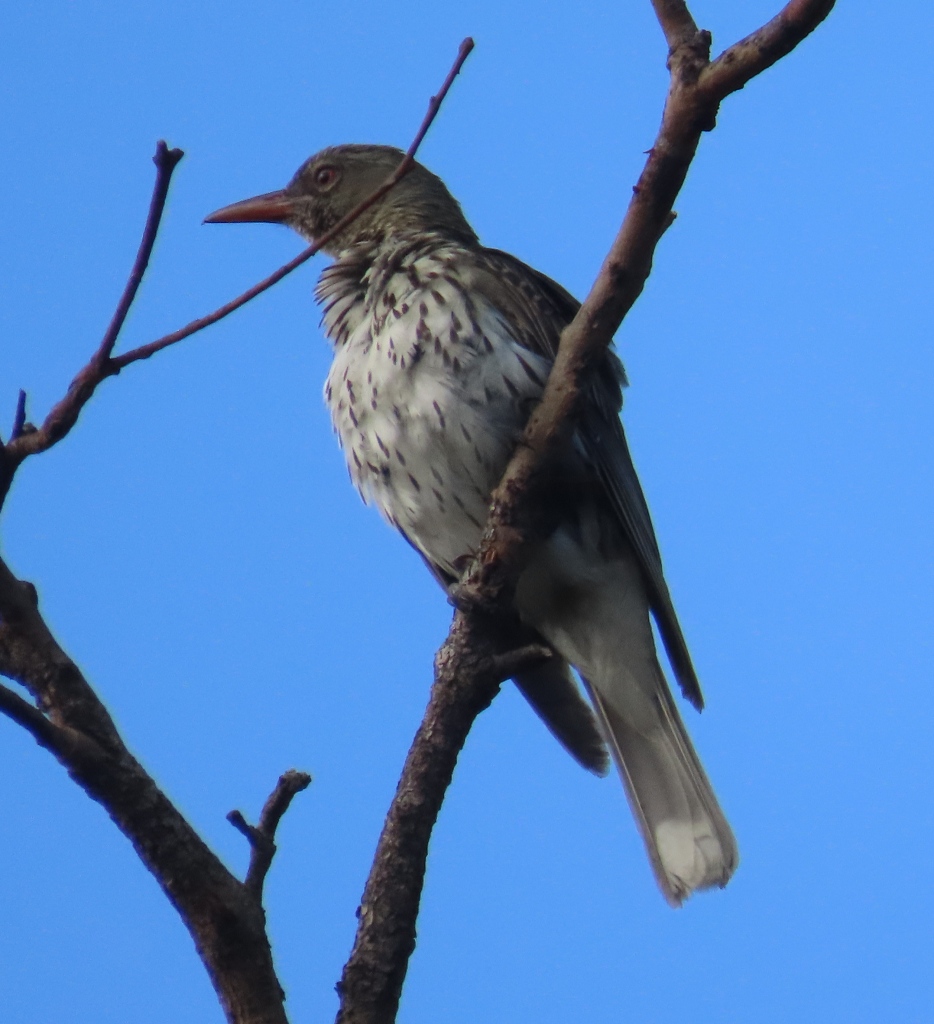
On this trip I learned what Olive-backed Orioles sound like (you can hear their call on eBird). I also learned the call of the Darter (hear it on xeno-canto). The latter sounds very like a Dollarbird, and I’ve probably mixed up those two calls in the past.
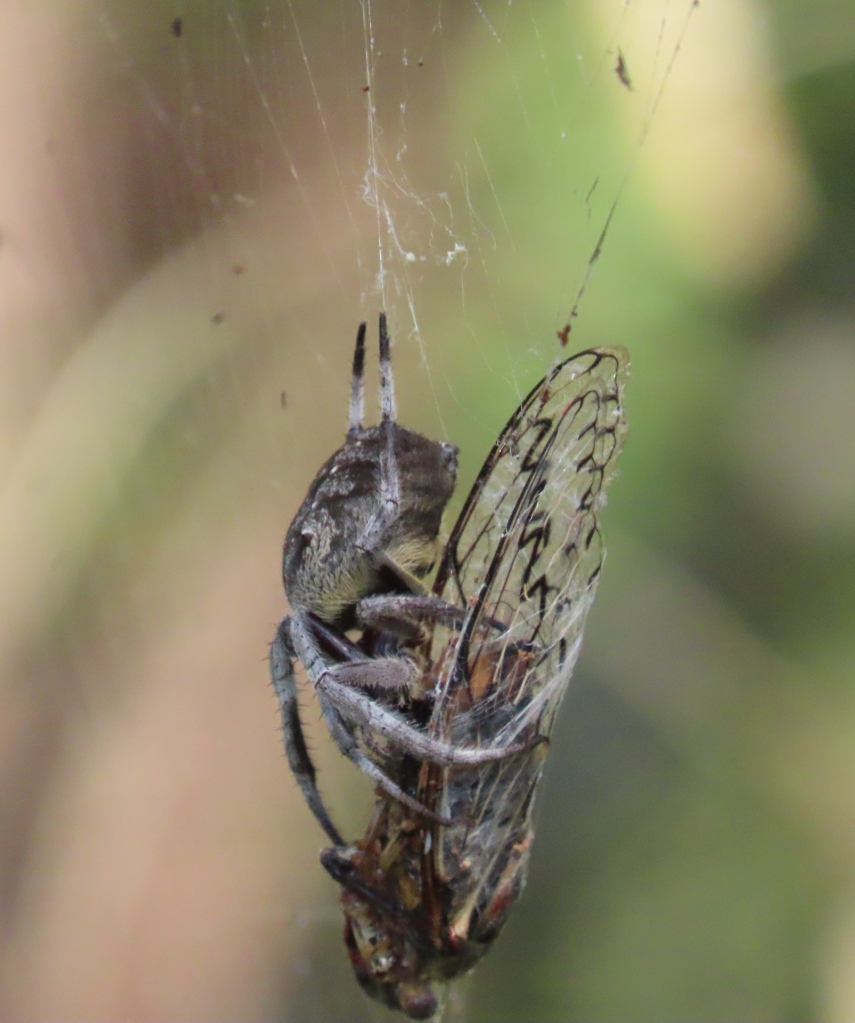
Our next stop was the Warriewood Wetlands, which is an interesting patch of swampy bushland. A raised path leads you across the reeds and water, with great views of wetlands all round you. The cicadas were out in full force, deafening us while providing food to other creatures. Here, a large spider has caught a cicada in its web and is having a feast:
Discarded cicada husks stuck to tree trunks, shed when the cicada larva emerges from the ground and morphs into the winged insect:

Bell Miners (Manorina melanophrys) have moved into the Warriewood Wetlands in large numbers. The call of these honeyeaters is a clear, single, oft-repeated clink, like the sound of a bell. They’re quite attractive birds, with olive wings and back, and a pale yellow chest:
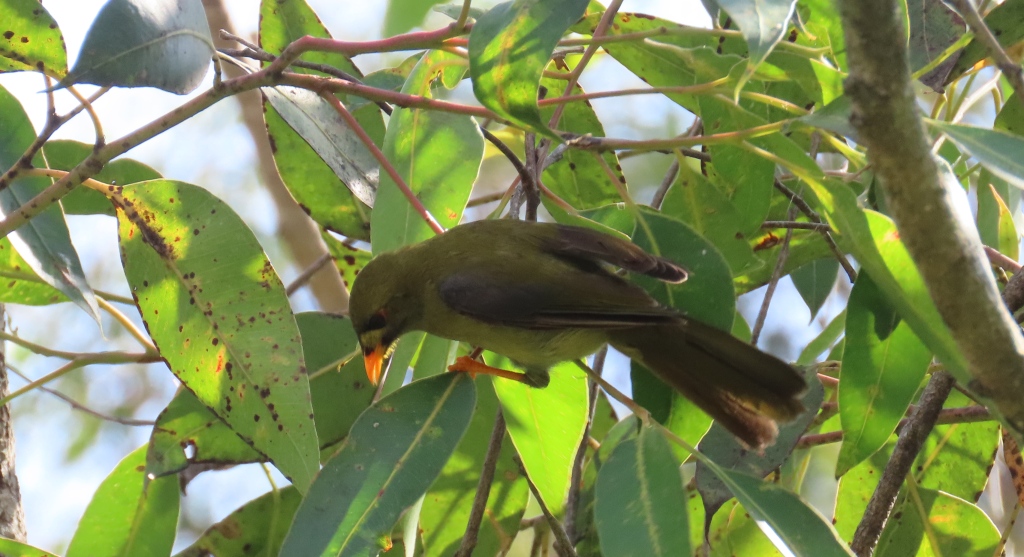
What with the screeching of the cicadas and the pinging of the Bell Miners, this was a noisy patch of bush!
The noise didn’t seem to bother the Purple Swamphens (Porphyrio porphyrio), who carried out a lively courtship beneath the wooden walkway:
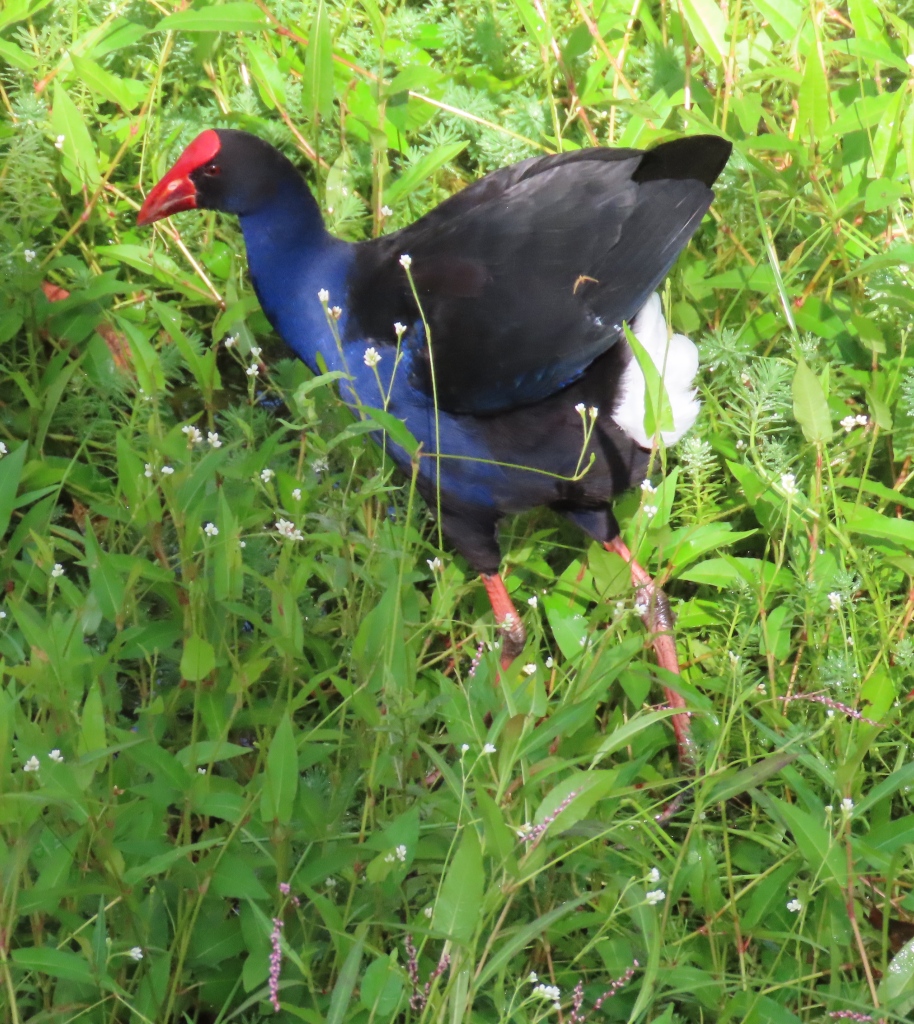
A small water dragon looked on:

A Dusky Moorhen (Gallinula tenebrosa) showed up in bold orange and yellow:

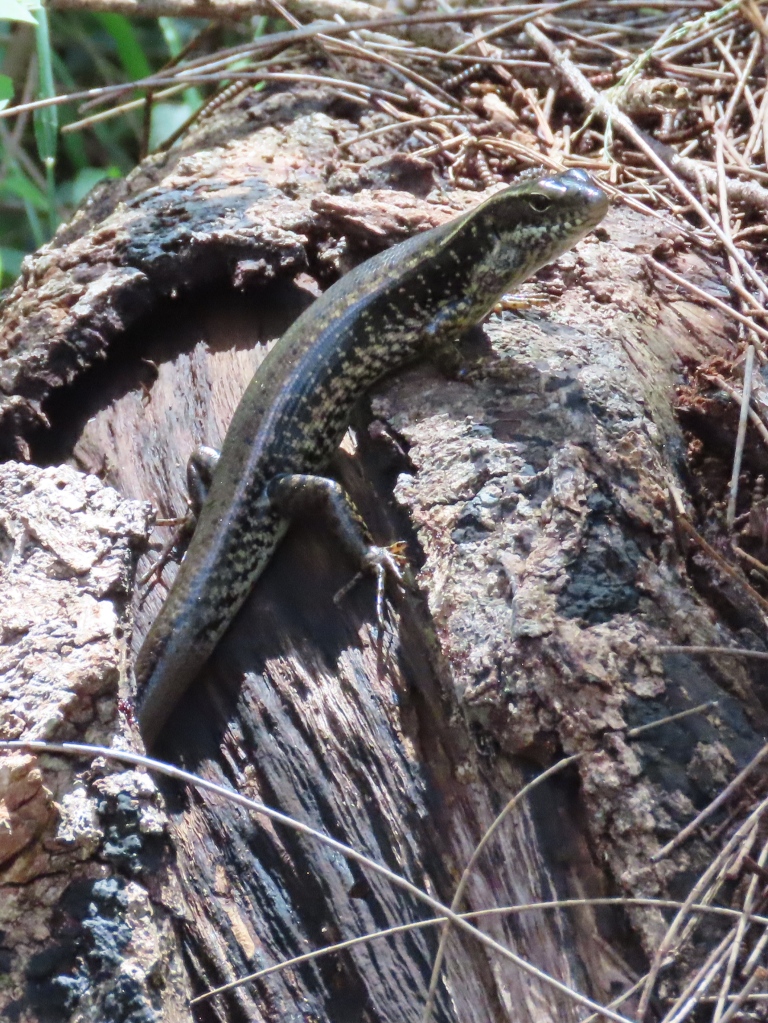
We didn’t see any snakes, though evidently they’re around. We did see a couple of largish skinks, like this one:
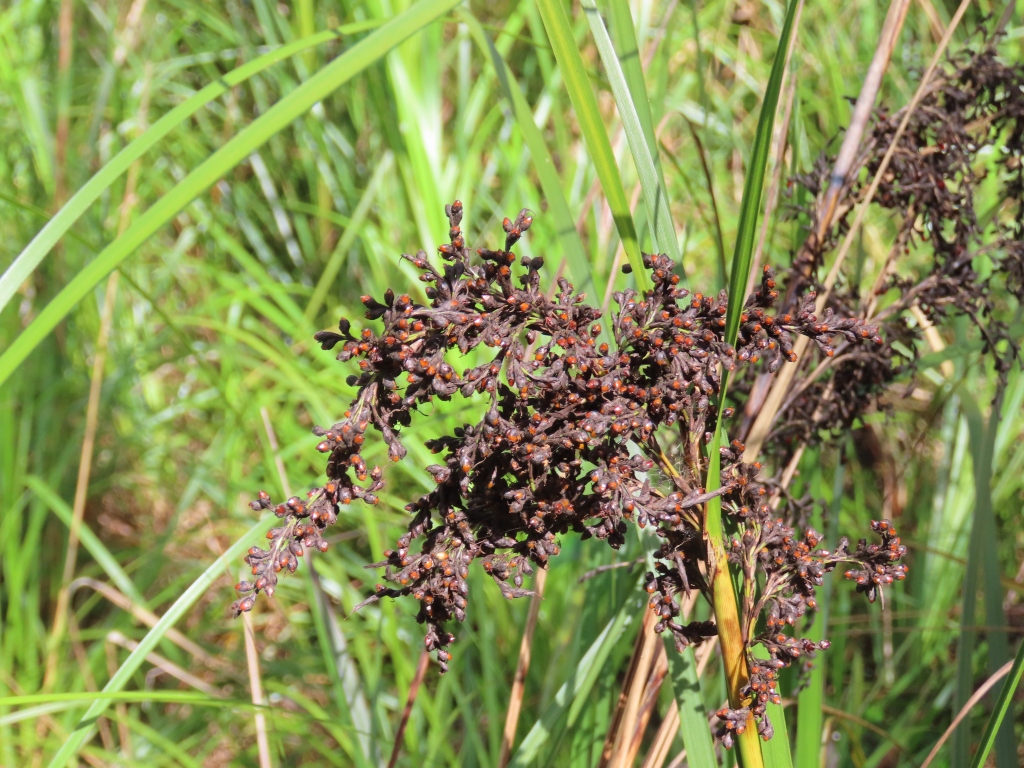
Striking dark grass flowers lined the way:
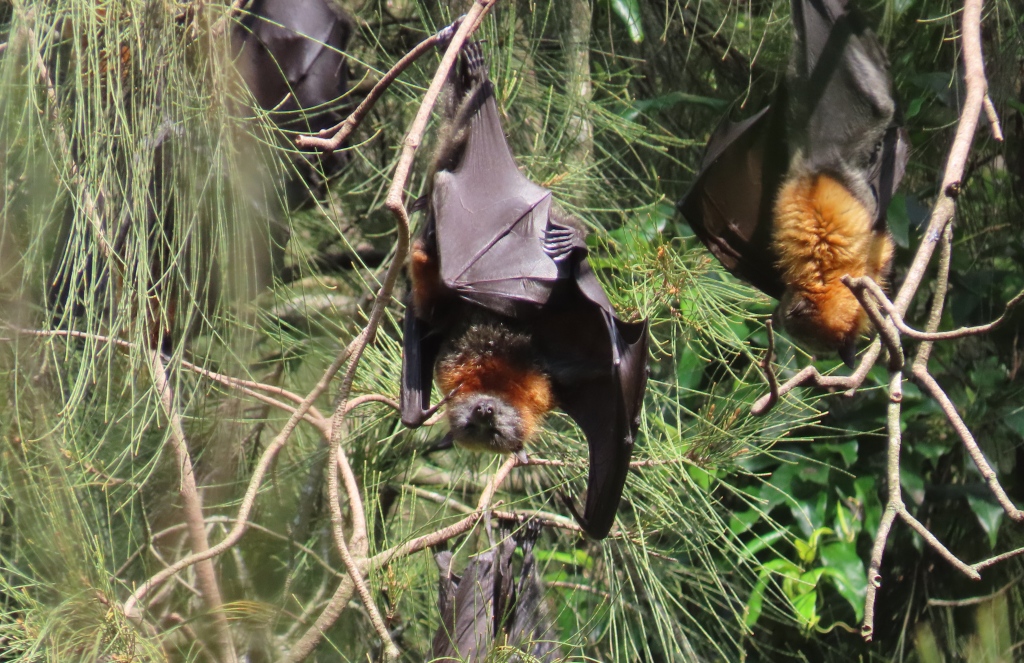
A colony of Flying Foxes (large fruit bats) occupies one corner of the wetlands:

Here’s a close-up of one of these attractive, intriguing mammals. They have a grey face, with a reddish fur collar and back. Their wings are black and leathery, strong enough to support these large bats in their long cross-country flights:
After the Warriewood Wetlands, we visited Irrawong Reserve. A Golden Whistler (Pachycephala pectoralis) carolled in the dense bush. This is the male bird:
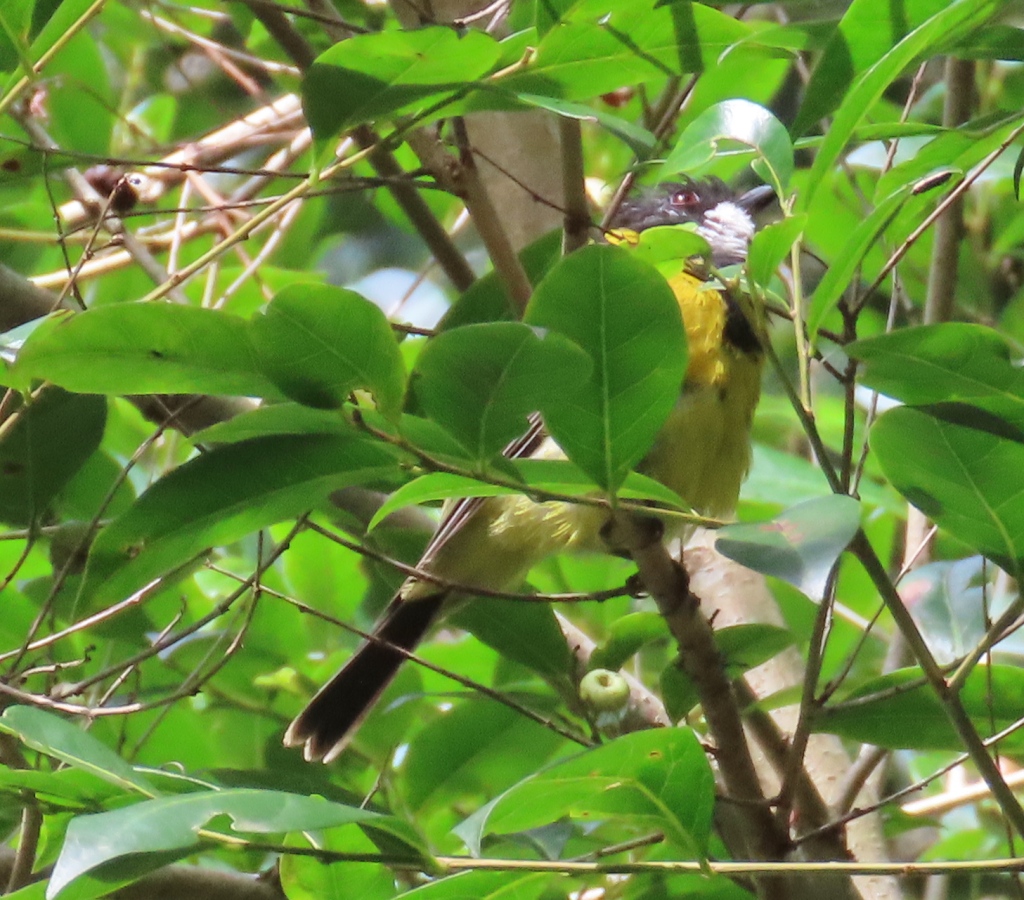
As you can see, it’s adept at hiding behind the foliage. Here’s another shot of the same bird, with its tail fanned:

I think the next bird is a female Golden Whistler. They’re harder to identify because of their soft colouring:
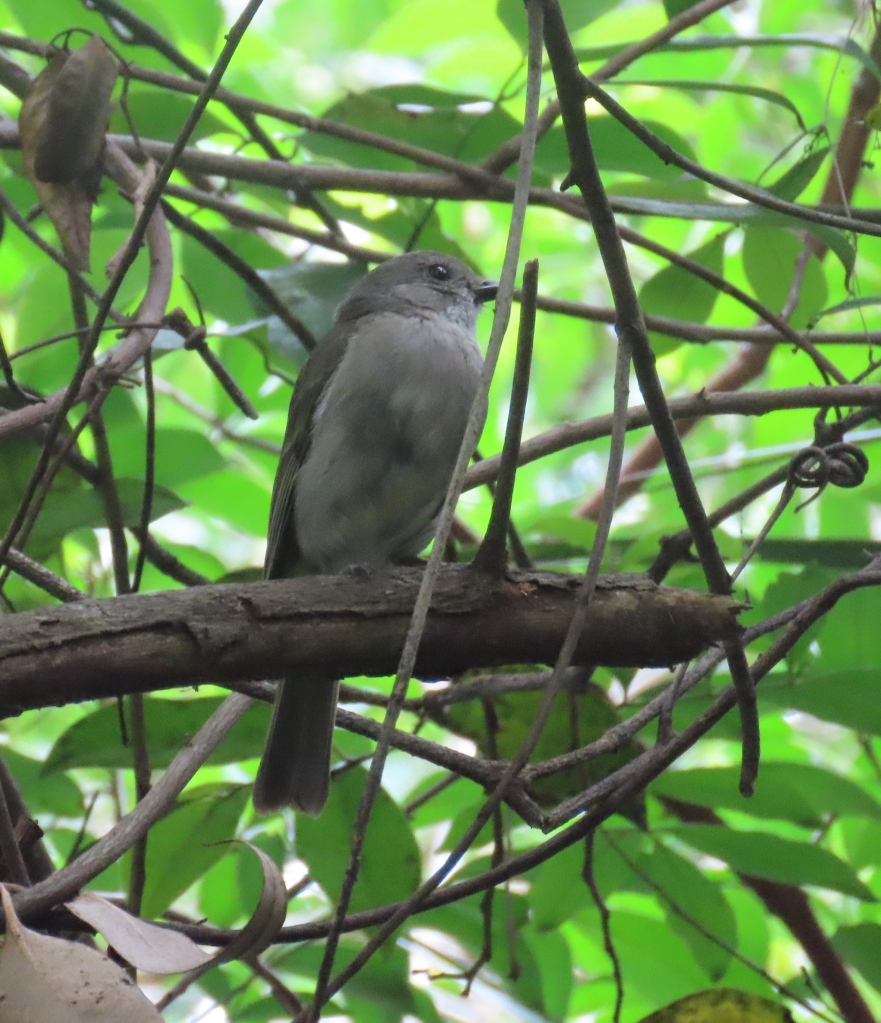
The next bird is a first sighting for me: a pretty Rufous Fantail (Rhipidura rufifrons):
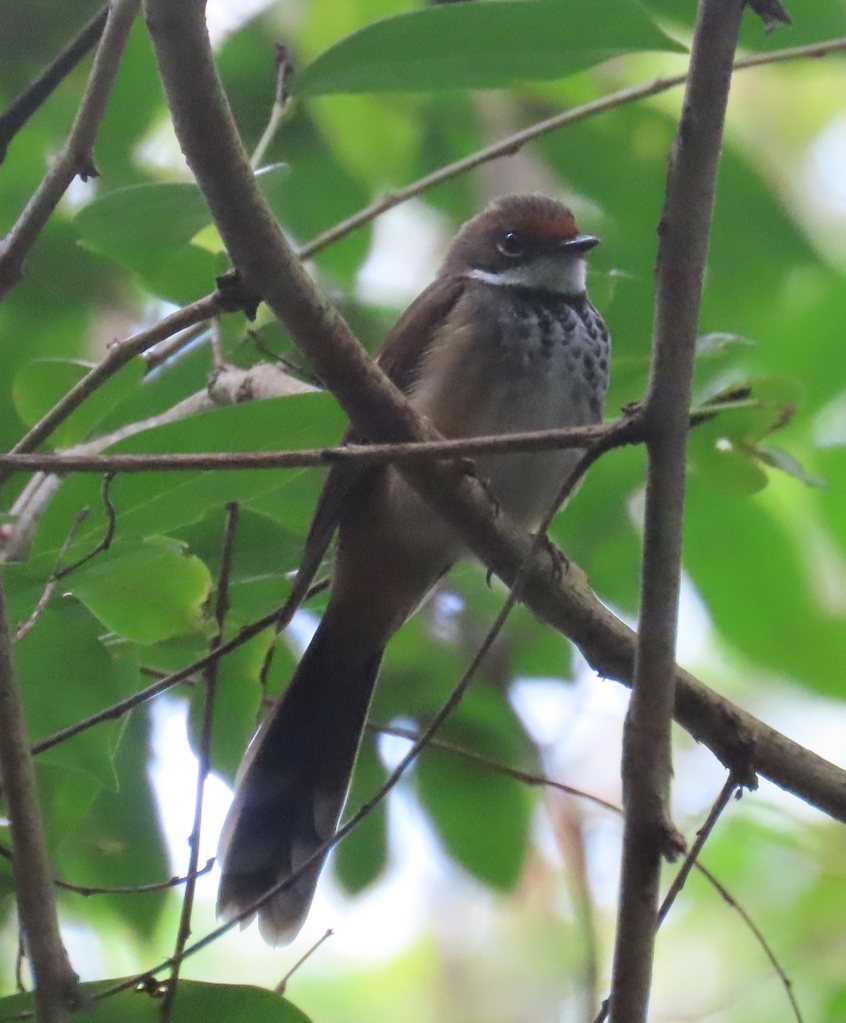
This video is rather blurry, but it’s useful because you can hear the characteristic song of the fantail, similar to that of the Grey Fantail and Willie Wagtail:
My last bird of the day is a Brown Gerygone (Gerygone mouki), another first sighting for me:

The photograph of this bird is very similar to the earlier one of the female Golden Whistler. However, the Gerygone has grey markings running from beak to eye. The Gerygone (9-11 cm) is also smaller than the Golden Whistler (16-18 cm), though that’s hard to tell from the photos.

Two Darters for the price of one
Yesterday and again today I saw a Darter in an inlet of Manly Dam. I think they’re two different birds, because yesterday’s bird looks darker in colour. That could be because it’s more mature than the one in the same spot today, or it might be that yesterday’s bird was male while today’s was female.
Today’s Darter was perched in full sunlight on a dead tree. At the start of the video, the bird has stretched its wings out to dry, in the pose that’s characteristic of Darters and Cormorants. The bird is doing a bit of preening. The camera zooms out to show the surrounds: an inlet of Manly Dam near Sydney, Australia. Then a couple of joggers approach. The camera zooms back in to see the Darter’s slight unease at the sound of approaching people. The bird turns and stretches its long neck to check for danger. The joggers pass by underneath the bird, and all goes back to normal after a bit of a shuffle to get the feathers back in order:
Darters are often called snakebirds, due to their long, snake-like necks. It’s good to see the neck in action! They eat fish, which they catch by spearing them with that long sharp beak.
Here’s a still photo of the bird, showing a leery eye:
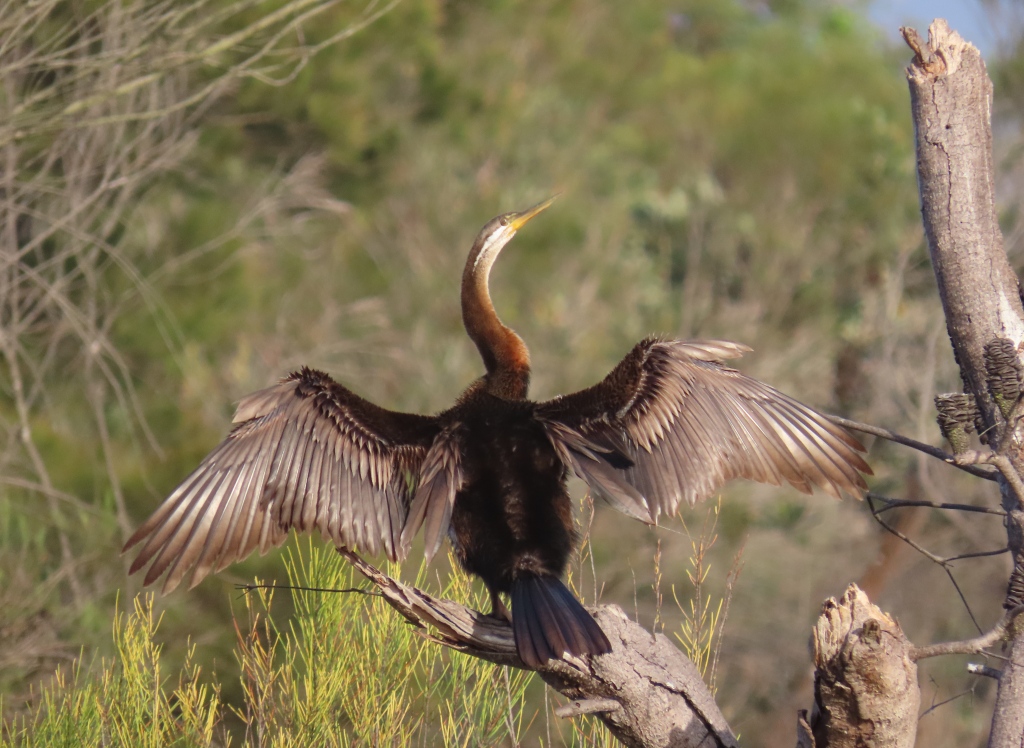
Yesterday’s bird was lower down, closer to the water and in shade. Its head, neck, and body look much darker in colour, and its wings more silvery:
Back in June this year, a cream-coloured Darter roosted in the same spot. The colouring of that bird surprised me, as I’d only seen dark brown or black ones up to that point.
Common name: Darter
Scientific name: Anhinga melanogaster
Approximate length: 90 cm; wing span: 1.2 m
Date spotted: 25 and 26 December 2023 (summer)
Location: Manly Dam Reserve, New South Wales, Australia: 33°46’34.7″S 151°14’48.9″E
Pacific Black Duck with blue and green wing patches
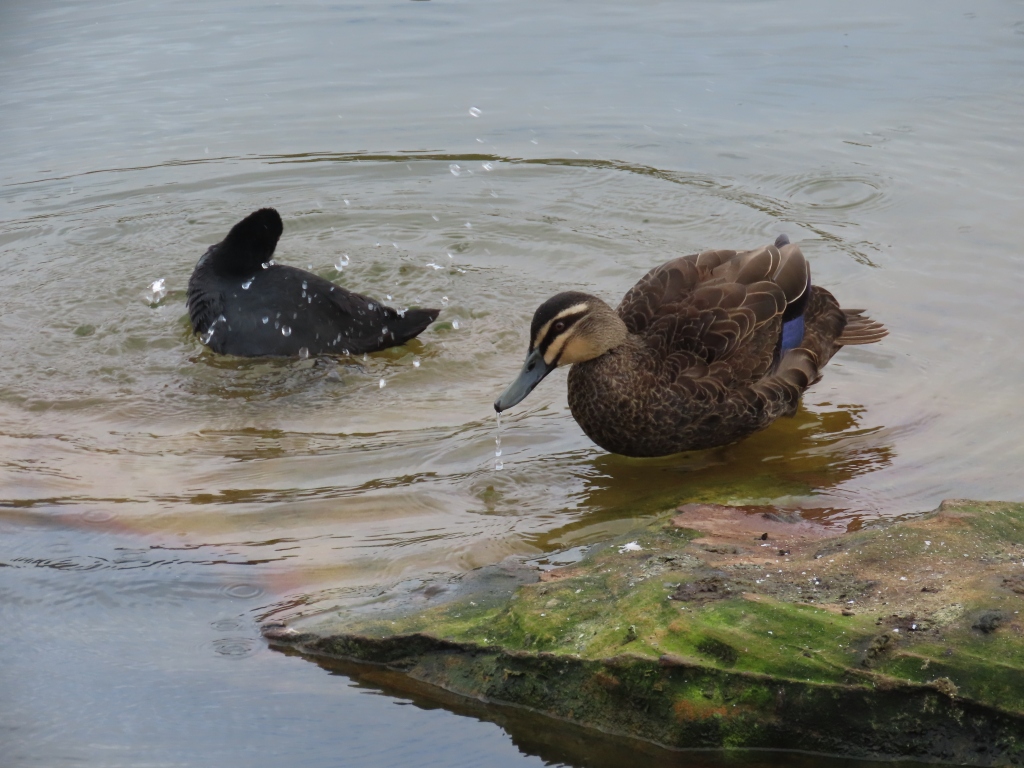
The lighting this morning was perfect for catching the beauty of this Pacific Black Duck making her morning ablutions. I think this bird is a female, because the crown of the head and the feathers on the back are brown rather than black.
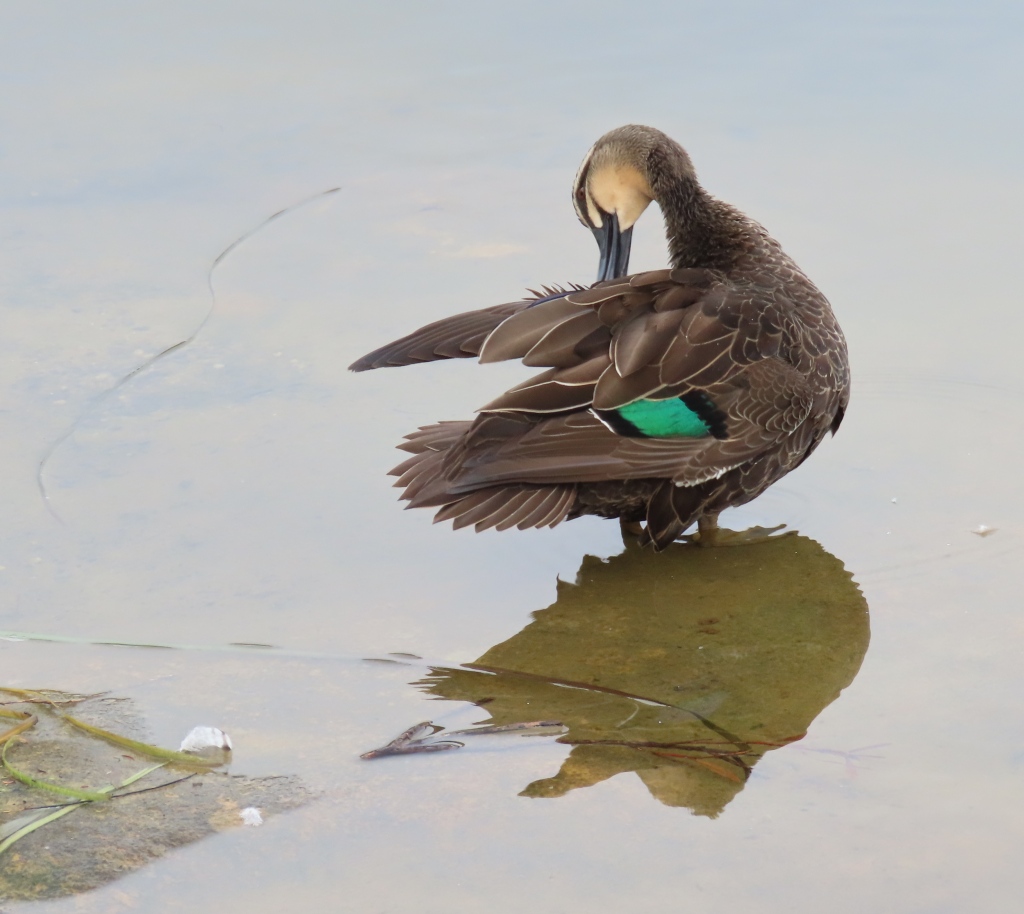
She spent many minutes preening, immersing herself in the water, then preening again.

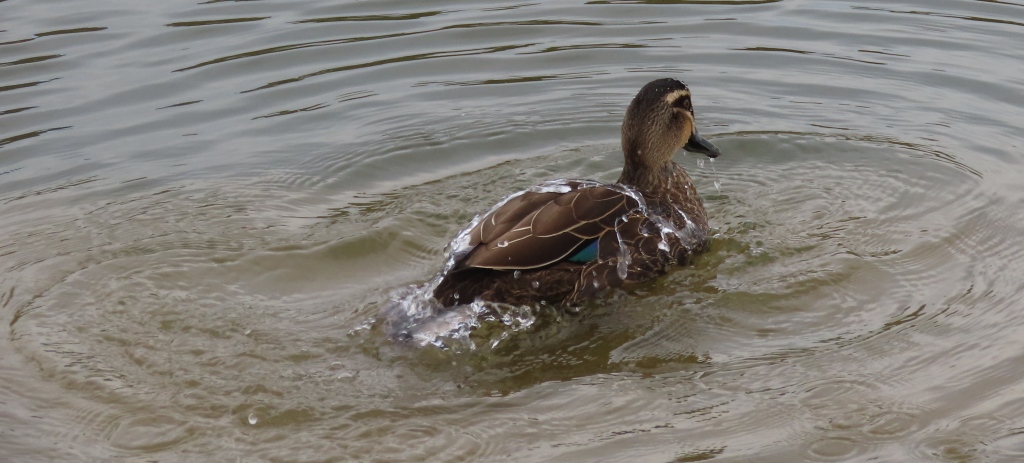
It was fascinating to see how the colour of her wing patches changed, depending on the lighting and the angle. In the first photo above, the patch is green. Here it’s purple:
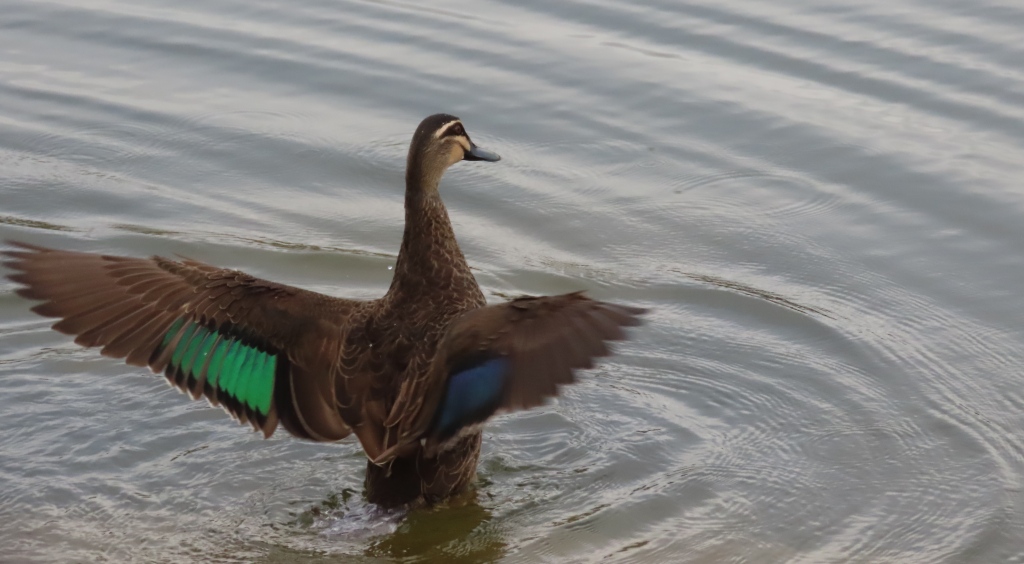
In this wing stretch, it’s as if she has different colours on each wing, one green and one blue:
Common name: Pacific Black Duck
Scientific name: Anas superciliosa
Approximate length: 45-60 cm
Date spotted: 25 December 2023 (summer)
Location: Manly Dam park, near Sydney: 33°46’35.0″S 151°14’50.2″E

Red-browed Finch builds nest in lichen-covered tree
A little Red-browed Finch wrangles a long supple twig into its nest. The nest is in a lichen-covered tree, making a pretty scene with the red flashes on the bird against the green of the lichen.
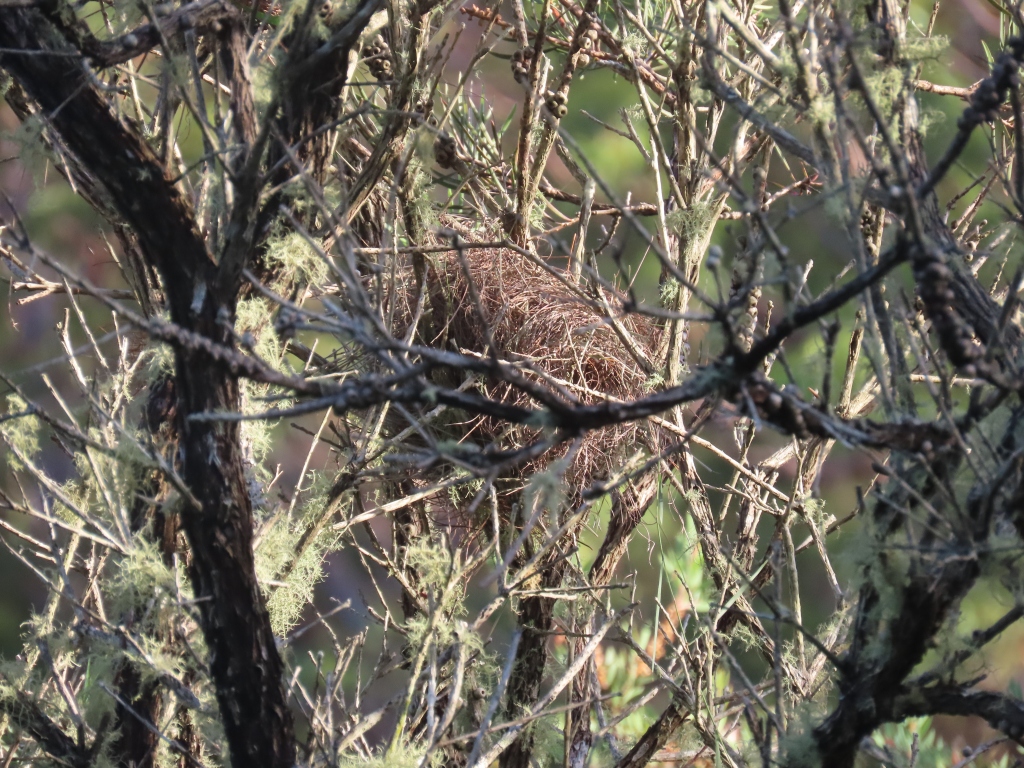
The nest is barrel-shaped, bigger than I’d expect for such a small bird, with a small hole at one end:
The tree is in a swampy area of Manly Dam. When the weather is wet and humid, the lichen flourishes, as now:
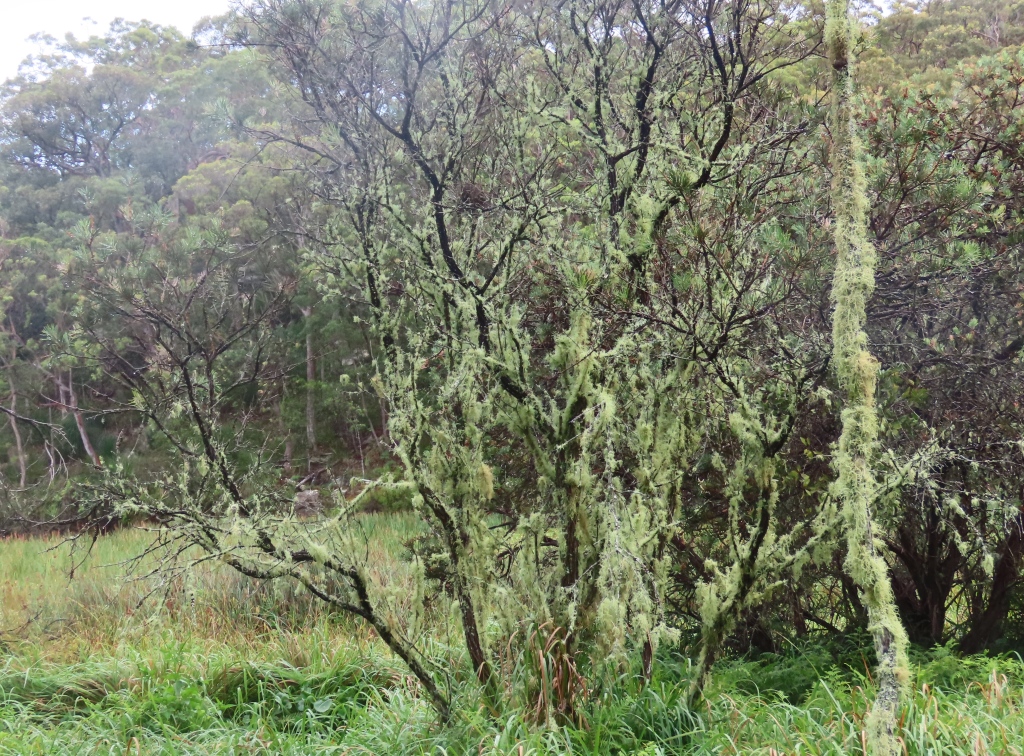
In the dry summer heat yet to come, the lichen will die away, but it always seems to come back.
Common name: Red-browed Finch
Scientific name: Neochmia temporalis
Approximate length: 12 cm
Date spotted: 22 December 2023 (summer)
Location: Manly Dam park, near Sydney: 33°46’23.1″S 151°14’35.9″E


 Sydney Birder