Blog Archives
Baby Noisy Miners doing well
Here’s an update on the nest of Australian Miners, also known as Noisy Miners, across the road from our house. The babies are getting bigger!
In this video, you see one of the chicks perched on the edge of the nest, making the incessant chirping that’s surely designed to drive a parent mad. One of the adults drops in with a quick morsel of food, and you can see both babies. I’m pretty sure there are only two chicks in the nest:
It’s quite a change since my previous post about the baby birds, just five days ago. This chick looks ready to take its first steps out of the nest:

Common name: Noisy Miner, also called Australian Miner
Scientific name: Manorina melanocephala
Approximate length: 26 cm
Date spotted: 30 March 2020 (late summer)
Location: Near Sydney, NSW, Australia
Kookaburra standoff with Magpie
In this video, a Laughing Kookaburra stands guard against an Australian Magpie. The kookaburra has a stash of some kind of food on the rock behind it. Before I started filming, the magpie tried a few times to approach the food. Now, as seen in the video, the magpie seems more or less resigned to just giving the kookaburra a piece of its mind. At the end of the video, an Australian Miner drops in too. I wish I knew what the Magpie was saying!
This is the kookaburra after it finished its meal and flew to a nearby branch:
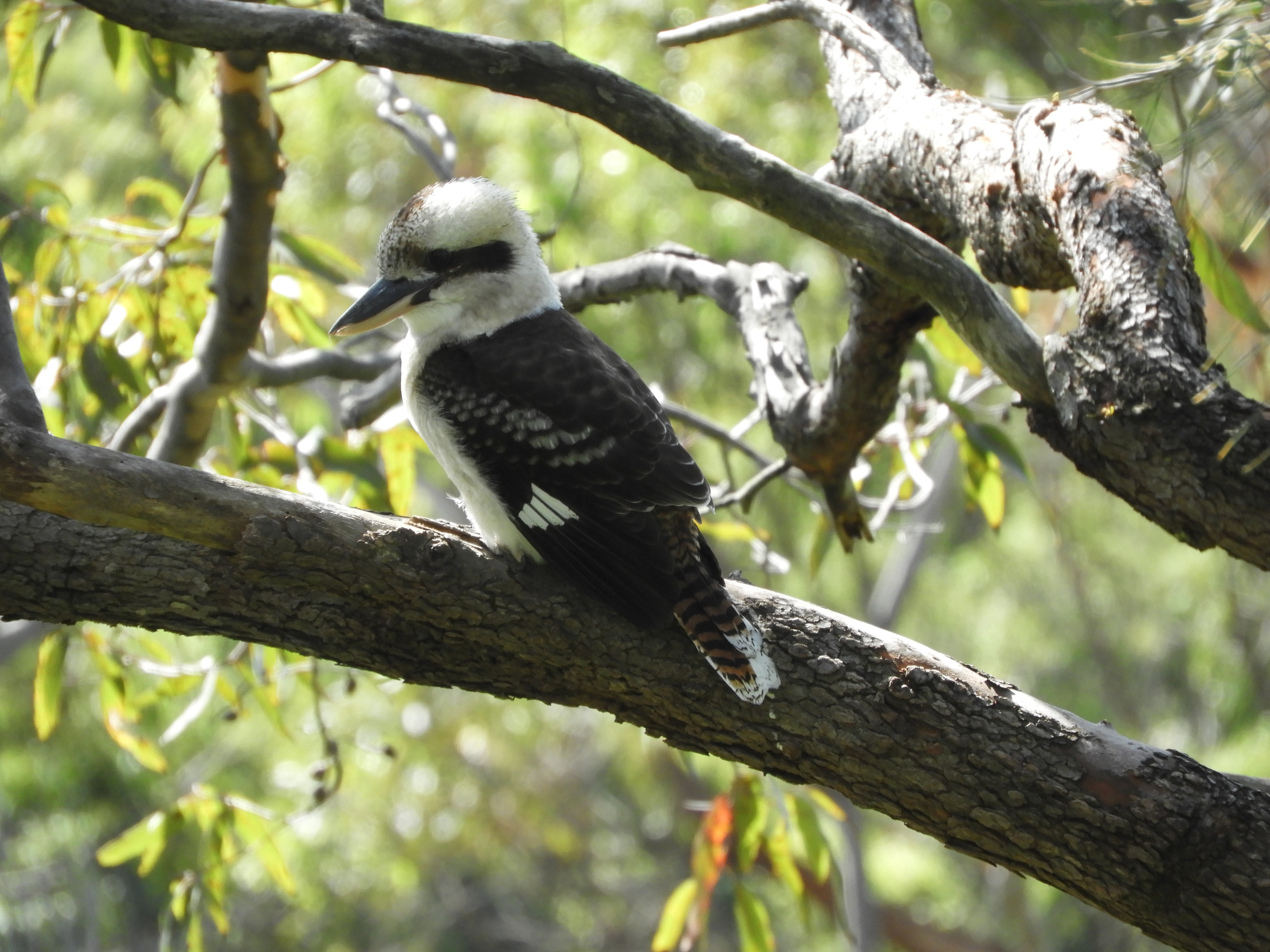
Common name: Laughing Kookaburra
Scientific name: Dacelo novaeguineae
Approximate length: 47 cm
Date spotted: 28 March 2020 (late summer)
Location: Near Sydney, Australia
The magpie took refuge on our roof:

Common name: Australian Magpie
Scientific name: Gymnorhina tibicen
Approximate length: 40 cm
Date spotted: 28 March 2020 (late summer)
Location: Near Sydney, Australia
I didn’t get a shot of the Australian Miner. It’s probably one of the birds guarding the nest of baby miners which I’ve blogged about recently.
Noisy Miners nesting off season
Just across the road from my front window, a family of Australian Miners is nesting. They certainly are noisy, living up to their alternative name of Noisy Miners. I was surprised to see the birds nesting at this time of year. It’s late summer, coming up to autumn in this part of the world.
This short video shows a parent feeding the chicks. You can make out the orange beaks of the little ones, particularly when the parent flies away.
Here’s a still picture of the nest. You can see the parent bird, and the underside of a chick’s beak just to the left of the parent, between the parent’s chest and the branch:

It’s busy work, looking after a new family. Both parents are very attentive. Here’s one of them gathering nectar from a Banksia bush in our garden:

Common name: Noisy Miner, also called Australian Miner
Scientific name: Manorina melanocephala
Approximate length: 26 cm
Date spotted: 25 March 2020 (late summer)
Location: Near Sydney, NSW, Australia
Australian Magpie singing
This young Australian Magpie dropped in to sing me a song! I think it’s a juvenile, as its eyes are brownish rather than red. It may be a female, as males tend to have a clearer demarcation between the black and the white sections of feathers, whereas females have more grey. But the colouring could be due to the bird being a juvenile.
The magpie spent at least ten minutes minutes singing, maybe more. I had time to grab my camera, make my way into the garden, film a few minutes from far away, then walk up and sit down near the bird and film again. This video is the result of the second set of filming.
Cool fact: Evidently magpies can hear the sounds of grubs and worms moving underground.
Common name: Australian Magpie
Scientific name: Gymnorhina tibicen
Approximate length: 40 cm
Date spotted: 6 January 2020 (summer)
Location: Near Sydney, Australia
Yellow-tailed Black Cockatoo calling while keeping a lookout
Yesterday I saw a group of four Yellow-tailed Black Cockatoos. I love coming across these large birds, as they impart a feeling of calm and grace. I took a video of the bird that seemed to be the designated lookout, sitting on a branch while the others foraged on the ground. You can hear the eerie call that the bird makes. It sounds rather like a door opening on rusty hinges!
Common name: Yellow-tailed Black Cockatoo
Scientific name: Calyptorhynchus funereus
Approximate length: 65 cm
Date spotted: 9 November 2019 (spring)
Location: Manly Dam Reserve, New South Wales, Australia: 33°46’40.0″S 151°14’50.2″E
White-cheeked Honeyeaters and New Holland Honeyeaters hanging out together
Until today, I didn’t realise that we have two very similar types of honeyeaters in the area. I’ve seen and photographed New Holland Honeyeaters before. Yesterday, I took some photos of a number of birds, thinking they were all the same type.
Looking at the photos today, I noticed that some birds in the group have black eyes, some white, and the black-eyed birds seem shorter and more compact than the others. It turns out that the group included White-cheeked Honeyeaters, which I haven’t knowing seen before. They’ve probably been around all along, but I just didn’t notice.
This is a New Holland Honeyeater. Notice the white eye, and the smallish white patch near the beak:

Another New Holland Honeyeater:

Whereas the next one is a White-cheeked Honeyeater. Notice the black eye and the large white patch on the cheek:

This video shows a couple of White-cheeked Honeyeaters. You can hear the calls of the other birds around them:
While I was watching the group of birds, they would all hang out together in their chosen area of bushy cover, then emerge to go foraging in the nearby trees. Every now and then, something would alarm them, and they’d all dive for cover again. Standing near them was a little alarming, as they move extremely fast and I could hear them hitting the leaves all around. After a few moments, they’d emerge and repeat the pattern. The next video shows one such episode:
Common name: White-cheeked Honeyeaters and New Holland Honeyeaters
Scientific name: Phylidonyris nigra and Phylidonyris novaehollandiae
Approximate length: 16-19 cm and 17-19 cm
Date spotted: 9 November 2019 (spring)
Location: Manly Dam Reserve, New South Wales, Australia: 33°46’55.8″S 151°15’26.2″E
Call of the Pale-yellow Robin is a bit dull
From high above the bush path came an insistent cheep-cheeping. After a bit of searching amongst the swaying branches (it was a windy day) I spotted the noise-maker: a Pale-yellow Robin:
Pale-yellow Robins are very similar in appearance to Eastern Yellow Robins. I’ve seen a few of the latter (see all my robin posts) but if my identification is right then this is the first time I’ve spotted a Pale-yellow Robin. Pale-yellows are smaller than Eastern Yellows (12 cm in length as opposed to 15) and have more white around the beak and throat. My bird book says they’re sedentary and common. They like rainforest and dense eucalypt forests.

Common name: Pale-yellow Robin
Scientific name: Tregellasia capito
Approximate length: 12 cm
Date spotted: 7 September 2019 (early spring)
Location: Manly Dam National Park, New South Wales, Australia: 33°46’27.0″S 151°15’01.5″E
Song of the Golden Whistler
It was exciting to see this pretty little bird and hear its call. This is the first time I’ve seen a Golden Whistler, though my bird book says they’re common. This one is a male, brightly coloured with clearly-delineated yellow, black, and white patches. Its song ripples through the forest.
In this video, the Golden Whistler makes a brief appearance and utters its call. Off stage, a Sulphur-crested Cockatoo squawks, and the Golden Whistler dives for cover:
Here’s a still shot of the bird. My apologies for the fuzziness – the bird was high up and far away, and my camera lens is on maximum zoom. The moon-shaped white patch is the white throat of the bird:
Here’s another brief video of the bird calling before he darts off again:
In the next video, the Golden Whistler enters from the right and has his say. The shot is taken with a lower zoom, so there’s more chance to stay with the bird:
The last video doesn’t show the bird, but you can hear its call and enjoy a general view of the forest, including some fungus growing on a dead tree trunk. The Golden Whistler’s call is slightly different from the earlier videos:
Common name: Golden Whistler
Scientific name: Pachycephala pectoralis
Approximate length: 16-18 cm
Date spotted: 24 August 2019 (late winter)
Location: Manly Dam Reserve, New South Wales, Australia: 33°46’48.6″S 151°14’52.3″E
Who said a Pardalote isn’t a dinosaur?
Well, I guess maybe nobody has ever said “a Pardalote isn’t a dinosaur”. I mean, why would you? Still, this little Pardalote’s plucky pose made me think of a dinosaur in a Spielberg movie. At the very least, it was considering auditioning for the role:

Although they’re only 10 centimetres tall, Spotted Pardalotes don’t seem to be daunted by huge creatures like me standing close by. This one was on a twig a few metres away, singing its heart out with a pause to grab a bite to eat:
It seemed to find me as interesting as I found it:
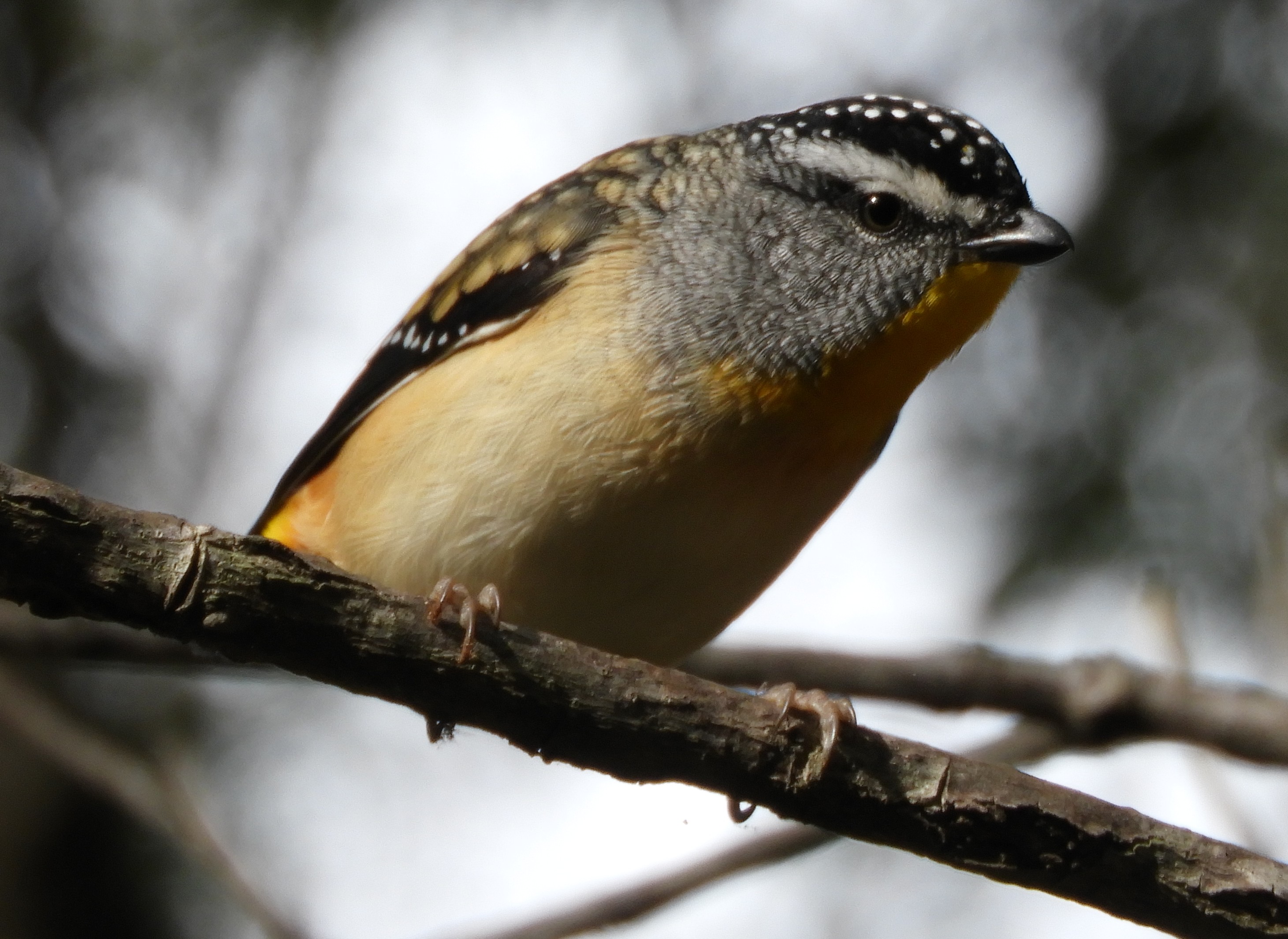
Did any dinosaur ever catch the sun as prettily as this?

Common name: Spotted Pardalote
Scientific name: Pardalotus punctatus
Approximate length: 10 cm
Date spotted: 22 July 2019 (Winter)
Location: Manly Dam National Park, New South Wales, Australia: 33°46’24.4″S 151°15’03.6″E
Common Myna picks a millionaire’s view
You’ll see Common Myna birds, also called Indian Mynas, throughout Sydney. They strut around restaurant tables, colonise balconies, peek into windows, and generally act like they own the place. They’re not original natives of Australia, but they’re so common a sight that most people assume they’re a native species nowadays.
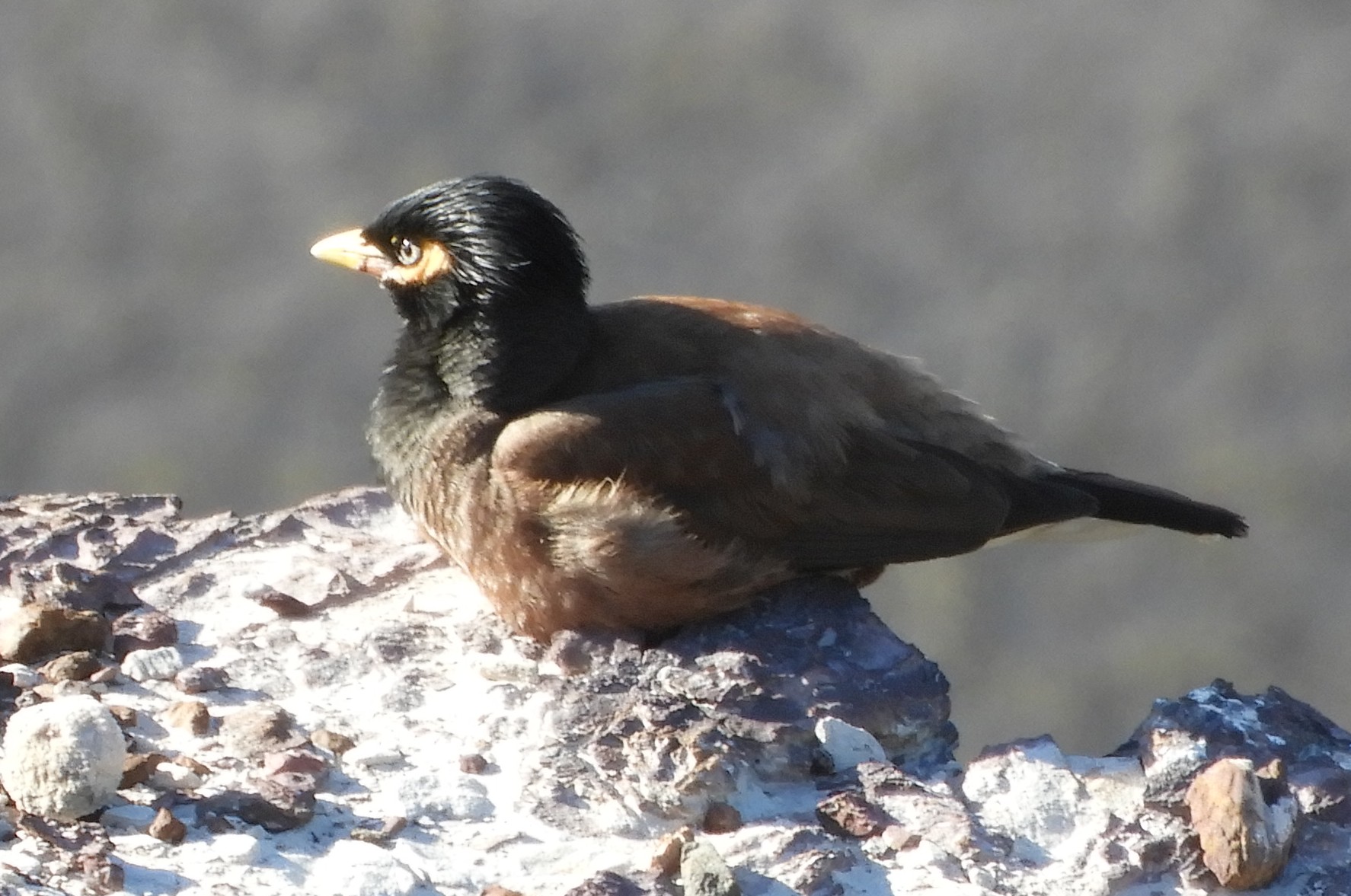
Often these birds look a little tatty, as if they’ve lived an interesting life. But a couple of days ago I saw this glossy bird roosting on the edge of a cliff at Dee Why Headland:
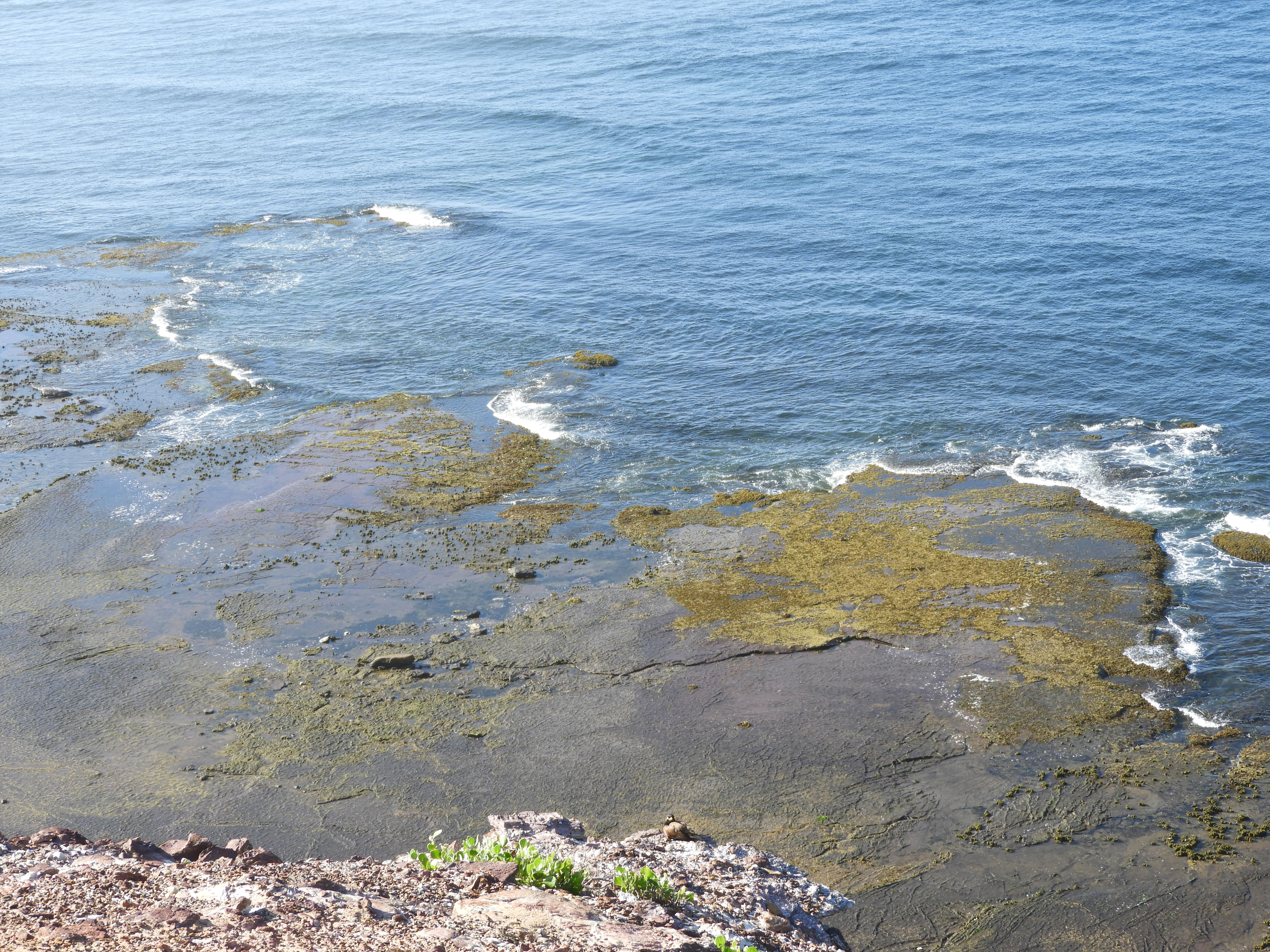
Zooming out, here’s the view that the bird is enjoying. If you look carefully, you’ll see the bird perched on the rocky outcrop at the bottom of the picture, to the middle right.
Not to be confused with the Australian Miner (“Noisy Miner”), the Common Mynas were introduced into Victoria in the late 1800s, to control the level of insects in market gardens. The birds have since made their way up the coast to New South Wales. Their original home is Asia (Kazakhstan, Turkmenistan, Iran, China, Indochina, Malay Peninsula, India).
Here’s another view of the same bird, still comfortably resting on the cliff edge:
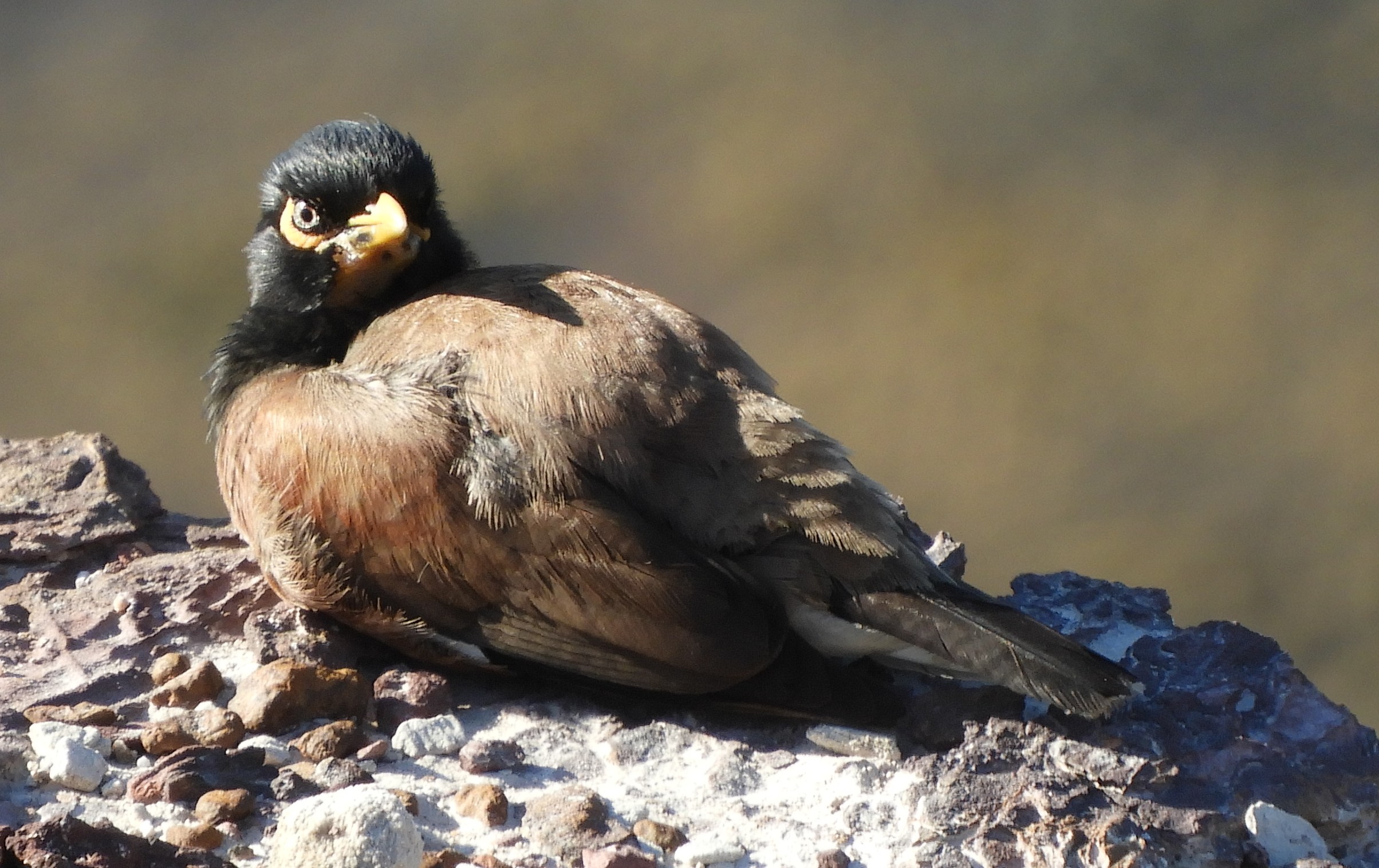
At first I wondered if the bird was sitting on a nest. But then it stood up when a friend arrived to share the view, and there’s no nest in sight:

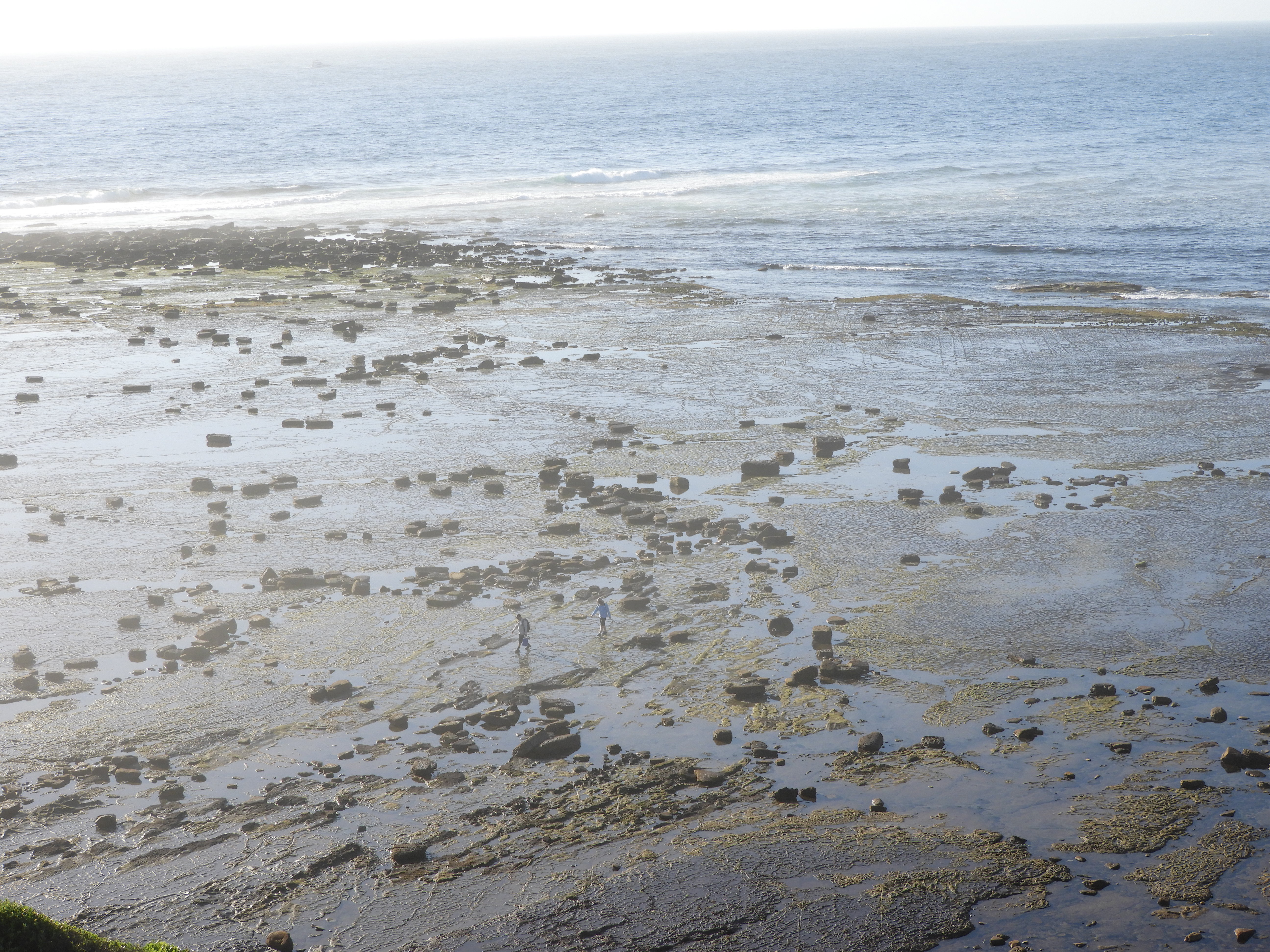
What can they see from their perch? Here’s their view of Long Reef, with two people walking on the rocks far below:
These little mynas are quite chatty and can make a wide variety of sounds. In this video of a group of birds on the same Dee Why Headland on the same day, you hear just some of the noises they make:
Common name: Common Myna, or Indian Myna
Scientific name: Acridotheres tristris
Approximate length: 25 cm
Date spotted: 29 December 2018 (Summer)
Location: Long Reef Headland, Dee Why, New South Wales, Australia: 33°44’30.6″S 151°19’04.2″E


 Sydney Birder