Blog Archives
Wild call of the black cockatoo
The banksias are in seed, and the black cockatoos are in town! Out strolling in the bush today, I came across a large group of these majestic birds. Their raucous squawks are typical cockatoo, but they add a wild, shrieking call that sounds more like a fish eagle, and a chitter chatter that’s all their own.
The first video shows a dead tree with plenty of interesting cavities and perches for a curious cockatoo. You can hear the wild calls as the birds take off and land.
In the next video, the birds chatter and call to each other as they clamber around the same dead tree. I hadn’t heard this type of chatter from black cockatoos before today.
What does a gum tree full of black cockatoos sound like? This is the same flock, high up in a gum tree.
Details of this sighting
Common name: Yellow-tailed Black Cockatoo
Scientific name: Calyptorhynchus funereus
Approximate length: 65 cm
Date spotted: 27 August 2016
Season: Late winter
Location: Manly Dam Reserve, New South Wales, Australia
Latitude/longitude: 33°46’50.7″S 151°14’53.7″E
A few days earlier
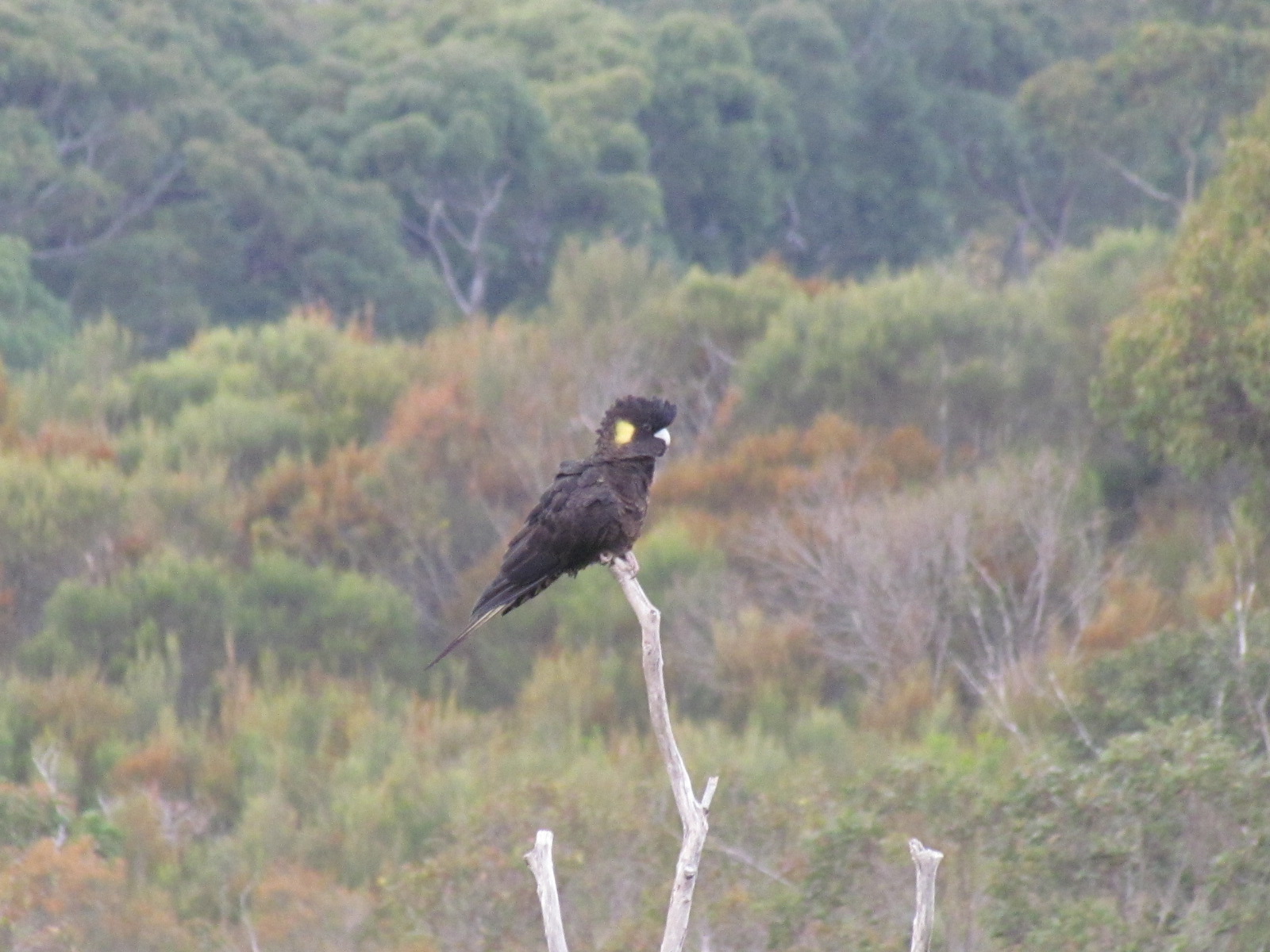
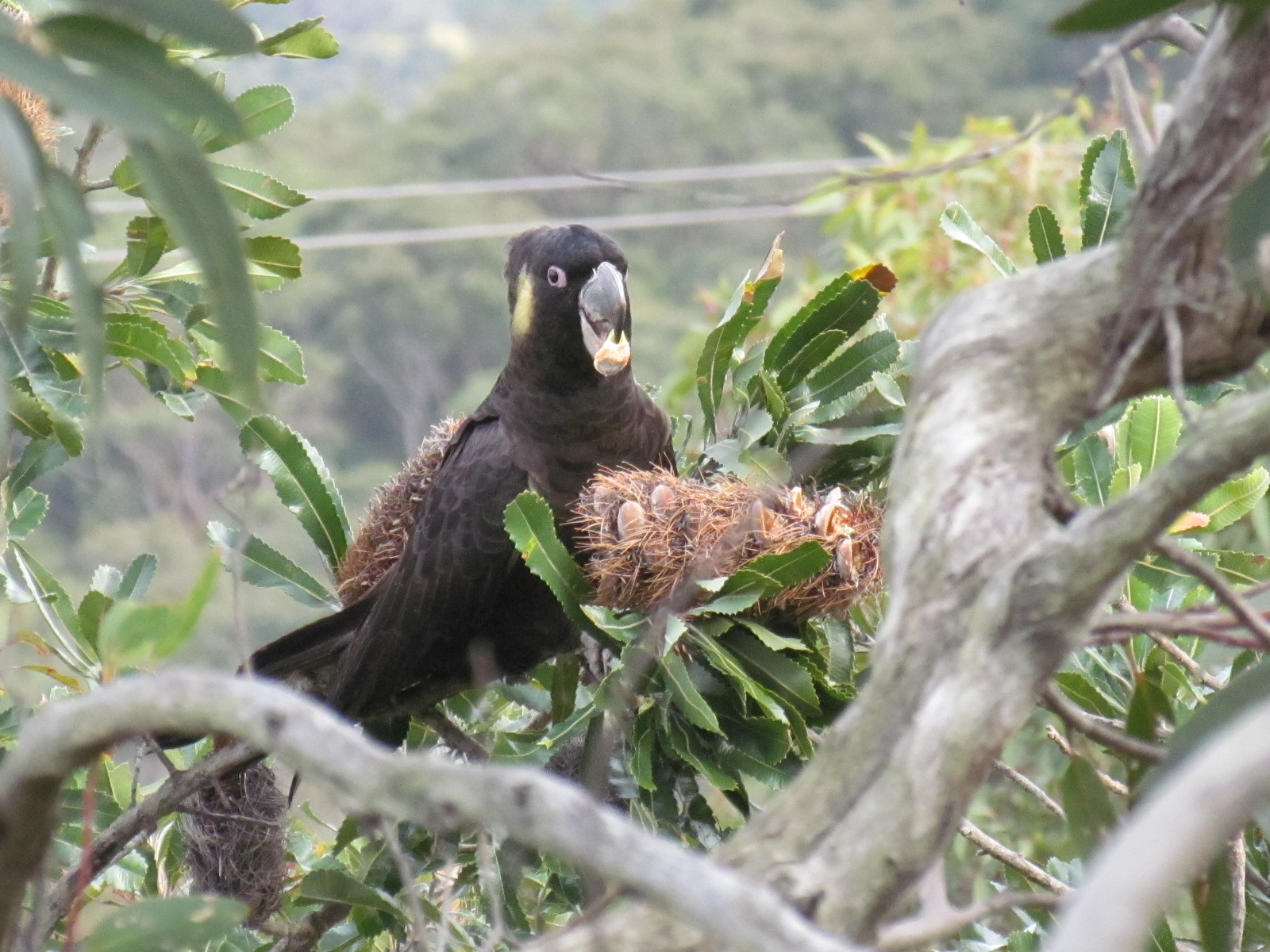
The following video and photos show an encounter with a group of the birds a few days earlier (22 August) in a different area of the reserve (33°46’35.1″S 151°15’16.7″E).
Perched high above the bush:
A final cheeky look:
New Holland Honeyeater enjoying a foretaste of spring
New Holland Honeyeaters are attractive in their neat black and white stripes, with yellow flares on their wings and tail feathers. This one darts from flower to flower, enjoying a foretaste of spring in the closing weeks of winter.
Common name: New Holland Honeyeater
Scientific name: Phylidonyris novaehollandiae
Approximate length: 17-19 cm
Date spotted: 22 August 2016
Season: Late winter
Location: Manly Dam Reserve, New South Wales, Australia
Approximate latitude/longitude: -33.772336, 151.249022
Kookaburra pair swaying in the wind
Kookaburras have an endearing habit of swaying back and forth when sitting on a branch. Today a pair sat cosily together on a branch, chewing the breeze. It’s soothing to watch their synchronised swaying.
For a giggle, here’s a short extract from the above video showing my favourite bit:
Common name: Laughing Kookaburra
Scientific name: Dacelo novaeguineae
Approximate length: 47 cm
Date spotted: 23 August 2016
Season: Winter
Location: Allambie Heights, New South Wales, Australia
Latitude/longitude: 33°46’13.9″S 151°15’39.2″E
Juvenile Australian Magpie calling and investigating his surrounds
It took me a while to identify this youngster. My choice was a magpie (but magpies’ eyes are red), a butcher bird (but this little fellow’s white cap is too big), or a currawong (but there’s too much white on this youngster). Then I read that a juvenile magpie has dark eyes. That clinched it.
So, here’s a juvenile Australia Magpie, playfully investigating a hole in a tree and a stray bit of fluff. Every now and then, the bird ducks and eyes the skies fearfully, as if expecting a sudden attack from above. As anyone knows who’s ever watched Australian birds in action, that fear is completely justified.
At one stage in the video, the warbling call of adult magpies makes the little one perk up and fluff his feathers in expectation of a feed.
Common name: Australian Magpie
Scientific name: Gymnorhina tibicen
Approximate length: 37 cm
Date spotted: 6 August 2016
Season: Winter
Location: Manly Dam Reserve, New South Wales, Australia
Latitude/longitude: 33°46’58.6″S 151°15’18.9″E
Black cockatoo eating banksia seedpod
Out for an early morning walk the other day, I suddenly found myself amongst a group of black cockatoos snacking on seedpods and chatting. These birds are large and wild, and fairly rare, so it’s a real treat when you bump into them.
The cockatoos were in a cluster of banksia trees. In the video, you’ll hear the black cockatoo’s weird squealing call just once, as well as the more raucous squawk of some sulphur-crested cockatoos (not visible in the video) and other bird calls.
Common name: Yellow-tailed Black Cockatoo
Scientific name: Calyptorhynchus funereus
Approximate length: 65 cm
Date spotted: 1 August 2016
Season: Winter
Location: Manly Dam Reserve, New South Wales, Australia
Latitude/longitude: 33°46’46.4″S 151°15’22.3″E
Funny-faced kookaburra
Kookaburras are gorgeous, but sometimes they can look a little goofy.

Here’s the whole bird:

Common name: Laughing Kookaburra
Scientific name: Dacelo novaeguineae
Approximate length: 47 cm
Date spotted: 6 August 2016
Season: Winter
Location: Allambie Heights, New South Wales, Australia
Latitude/longitude: 33°46’55.4″S 151°15’10.3″E
Wood duck quacking high in a gum tree
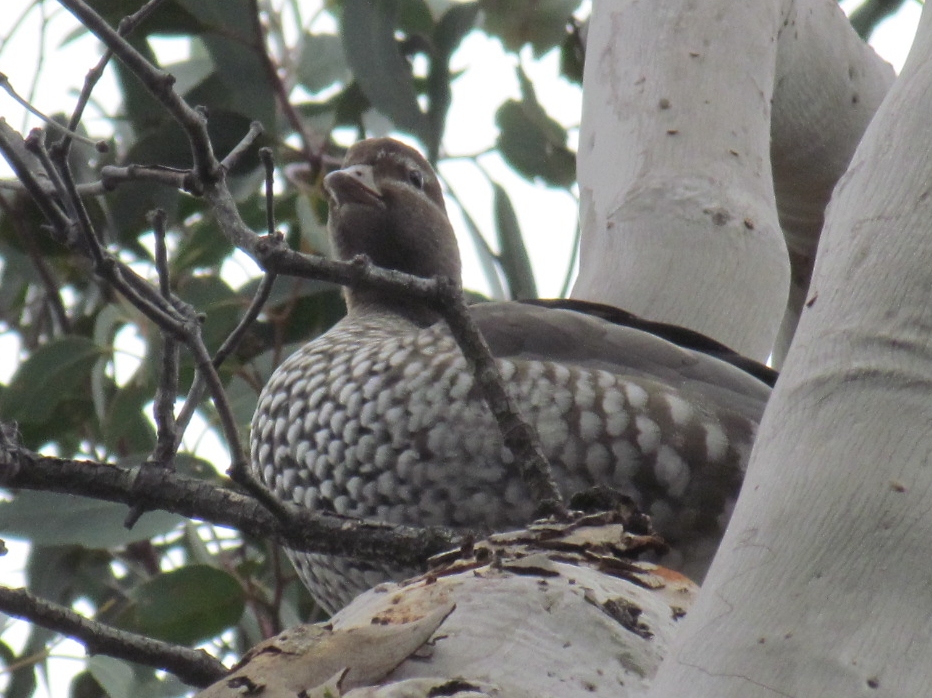
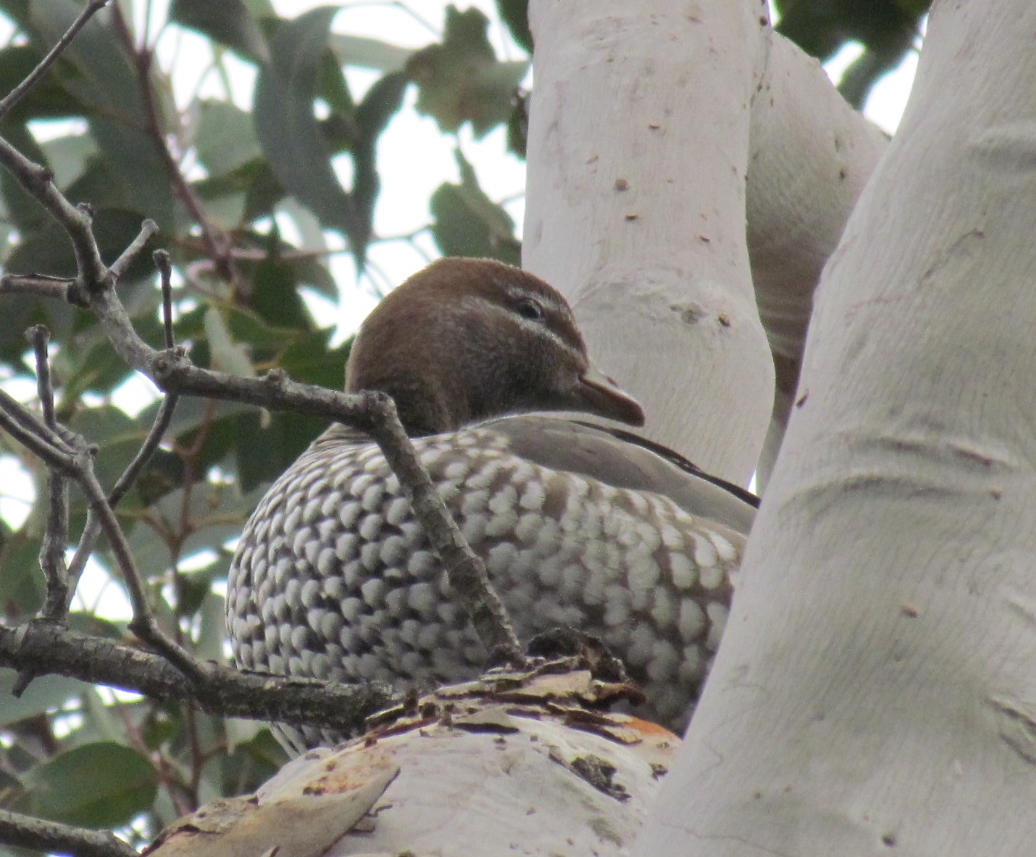
For some reason I’ve never expected to see a duck high up a gum tree. I know they fly, but somehow I think of them as spending their lives on the ground or on the water. Walking through the bush, I’ve occasionally heard a muttering, rolling sound coming from the tree tops. Imagine my surprise when I tracked it down to this Australian Wood Duck.
Here’s a still photo of the duck:
And in profile:
Common name: Australian Wood Duck
Scientific name: Chenonetta jubata
Approximate length: 50 cm
Date spotted: 31 July 2016
Season: Winter
Location: Manly Dam Reserve, New South Wales, Australia
Latitude/longitude: 33°46’41.1″S 151°14’54.9″E
Fairy-wren at last
I’ve been trying for ages to get a photo of a Fairy-wren. They’re tiny little puffballs of energy, never in one place long enough to focus the camera. I’ve managed plenty of blurs and smudges. Now at last here’s a recognisable picture.

Common name: Variegated Fairy-wren
Scientific name: Malurus lamberti
Approximate length: 13 cm
Date spotted: 31 July 2016
Season: Winter
Location: Manly Dam Reserve, New South Wales, Australia
Latitude/longitude: 33°46’55.7″S 151°15’26.9″E
Silvereyes at a mossy puddle
This photograph is more of a study in colour than a picture of a bird. I’d forgotten that I’d played with my camera settings on my previous outing. The result is rather Constable-esque.
Two tiny little Silvereyes at a mossy puddle:

A zoomed-in view, to make it easier to spot the birds:

Common name: Silvereye
Scientific name: Zosterops lateralis
Approximate length: 11 cm
Date spotted: 30 July 2016
Season: Winter
Location: Manly Dam Reserve, New South Wales, Australia
Latitude/longitude: 33°47’02.0″S 151°15’18.5″E
Psyduck in Sydney
This blog is usually about birds in the real world, but I couldn’t resist posting this encounter with Psyduck from Pokémon Go. The game is a cute demonstration of irtual reality and the real world merging in augmented reality.
According to the description in Pokémon Go, Psyduck has a mysterious power to generate brain waves that only sleeping creatures should be able to emit. Useful, I guess?

Common name: Psyduck
Scientific name: Duck Pokémon
Height: 80 cm
Date spotted: 23 July 2016
Season: Winter
Location: Manly Dam Reserve, New South Wales, Australia
Latitude/longitude: 33°46’37.2″S 151°14’49.3″E


 Sydney Birder