Blog Archives

Red-rumped Parrots in Sydney Olympic Park
Today I saw my first Red-rumped Parrots! These are very pretty little parrots that spend their time foraging on the ground among the flowers or sitting high in the trees. The male is a spectacular turquoise in colour, while the female is a more demure brown and fawn.
This video shows a male and a female walking through the grass and flowers, occasionally popping up their heads to check what’s going on around them:
At times in the video you get a glimpse of the browny-red patch at the base of the male’s back, which gives them the name “red-rumped”.
I saw the parrots in the area around Newington Armory – formerly the Royal Australian Navy Armaments Depot – at Sydney Olympic Park. I was doing the guided bird walk, offered by the BirdLife Discovery Centre. The walk happens on the last Sunday of every month. It’s fun and a good way to get out, meet some people, and see some birds.
Here’s the male Red-rumped parrot:

And this is the female:

The next picture shows the male high in a tree, showing his colourful front:

Common name: Red-rumped Parrot
Scientific name: Psephotus haematonotus
Approximate length: 26-28 cm
Date spotted: 28 August 2022 (winter)
Location: Sydney Olympic Park, Newington, New South Wales, Australia: 33°49’40.4″S 151°03’56.8″E
Pretty Silvereye
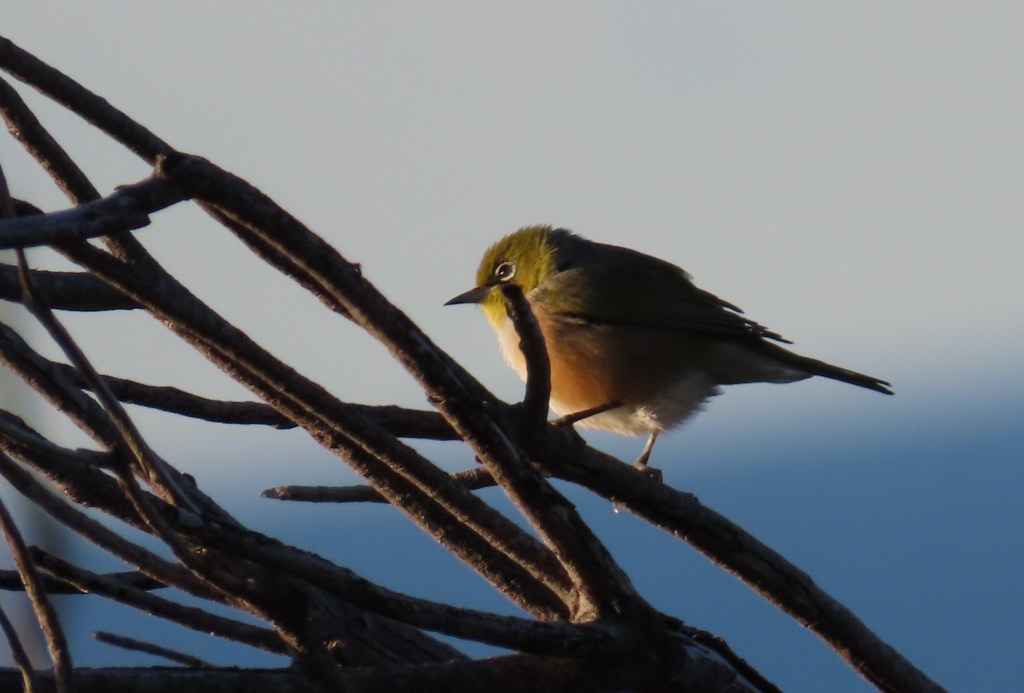
Silvereyes are tiny birds (about 11cm from beak to tail) that flit around the scrub, chirping and twittering merrily. Their colouring is muted but lovely, with a soft olive head and wings, a white front, and a chestnut blush on each side. And of course, the silver ring around the eyes that gives them their name.
Unfortunately, a twig got in the way of my photo. Still, you can get a good idea of this pretty little bird:
Common name: Silvereye
Scientific name: Zosterops cornwalli
Approximate length: 11 cm
Date spotted: 6 August 2022 (winter)
Location: Dobroyd Head, New South Wales, Australia: 33°48’35.4″S 151°16’19.3″E

Scarlet Honeyeater at Dobroyd Head
A little Scarlet Honeyeater adds a dash of colour to a wintry day:
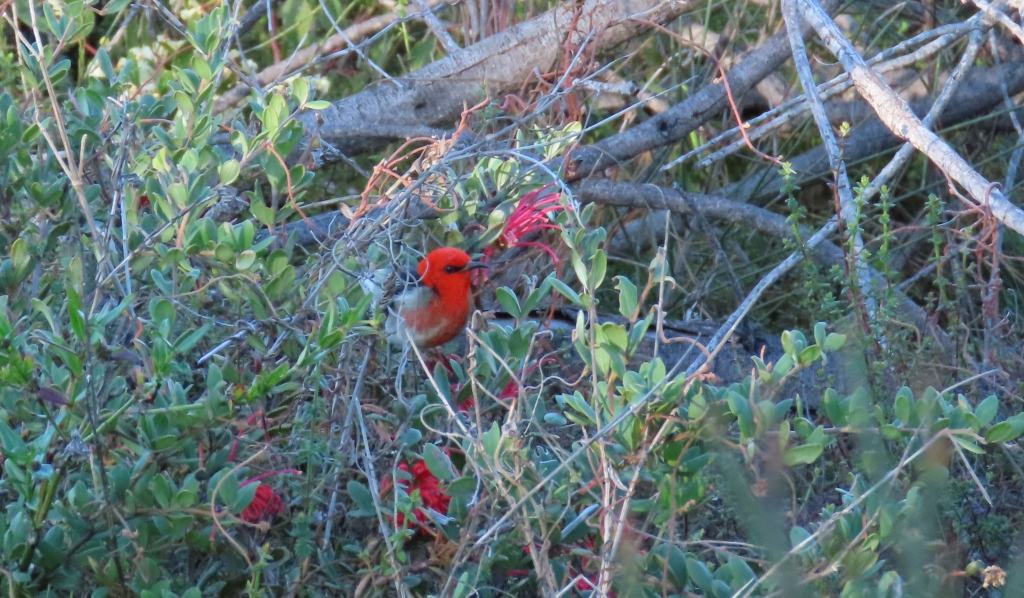
It’s interesting that the bird was focusing on the Red Spider Flowers (Grevillea). Perhaps it’s not a crazy idea to be bright red in colour if you spend your time among red flowers! I’ve read that these birds also frequent Bottlebrush shrubs (Callistemon) which are also red.
This is only my second sighting of a Scarlet Honeyeater. They’re small and move fast, which makes it hard to get a good shot. Here’s still photo of the same bird, a male:
Scarlet Honeyeaters feed mainly on the nectar from flowers, hence their name. Sometimes they catch insects.
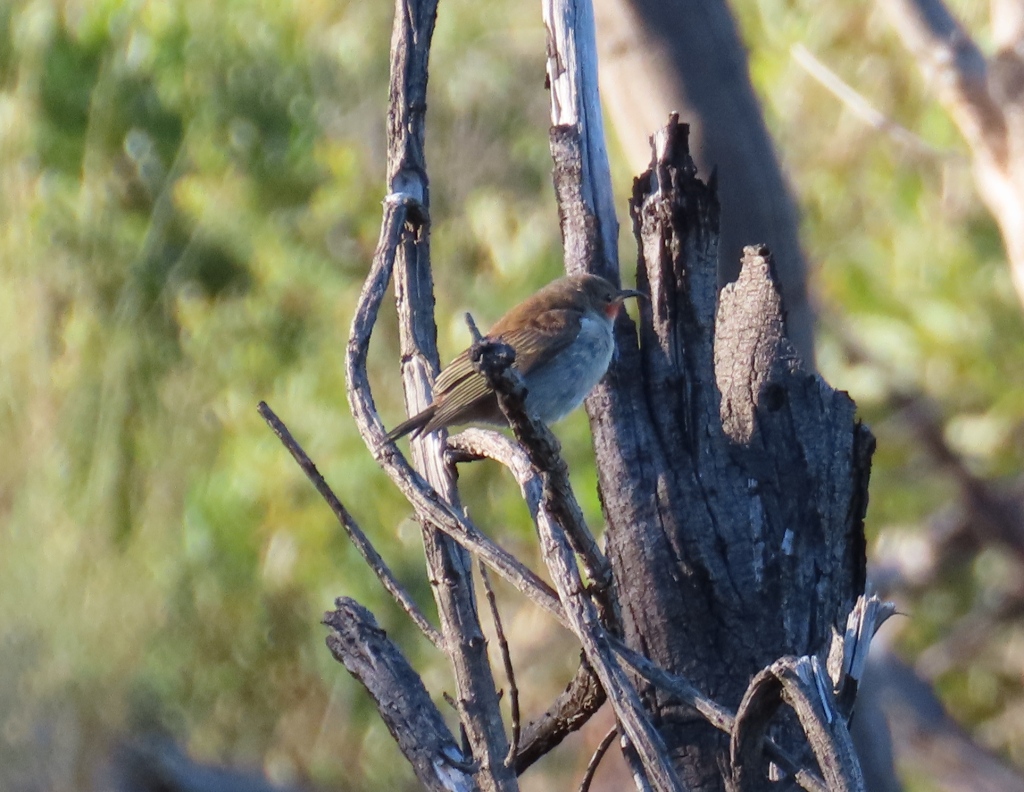
A female was close by. This photo shows the bird’s curved beak, a good tool for probing blossoms in search of nectar:
Common name: Scarlet Honeyeater
Scientific name: Myzomela sanguinolenta
Approximate length: 10 cm
Date spotted: 17 July 2022 (winter)
Location: Dobroyd Head, New South Wales, Australia: 33°48’36.4″S 151°16’19.0″E

A few birds from my recent trip to Cairns
This post rounds off my series of bird photos from a recent trip to Far North Queensland. The birds in this post were in Cairns, a lovely city on the east coast of Australia near the Great Barrier Reef.
A Great Egret stalked the mudflats of the bay. At low tide, this area is a vast muddy plain. The tide was in when I took this photo:

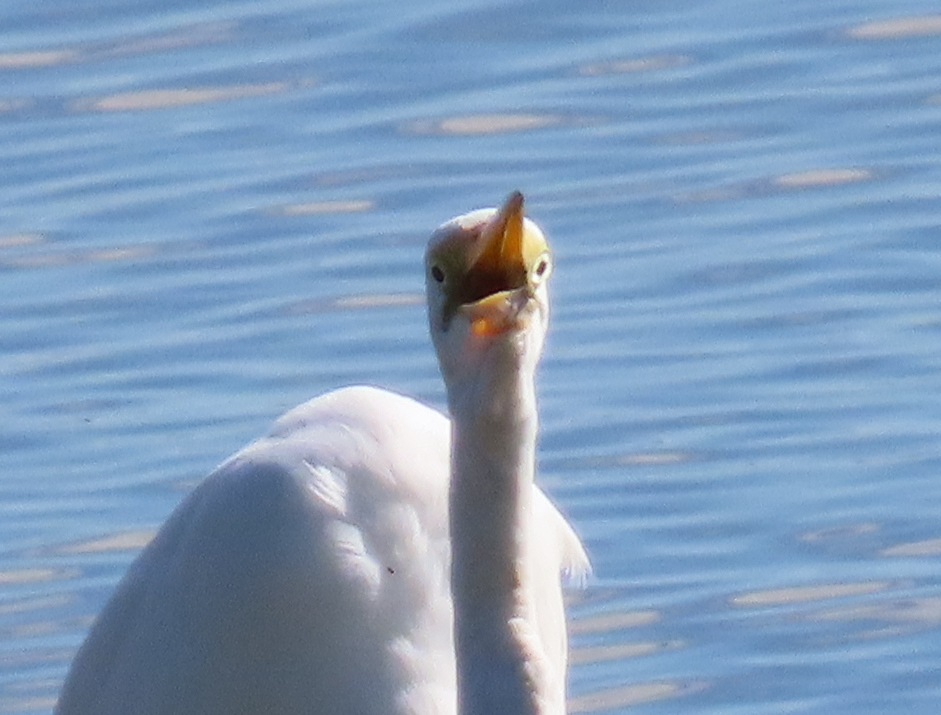
In this close up, the egret is looking rather alarmed. I think I just caught it at an inopportune moment. Perhaps a yawn, or a fish that went down the wrong way:
The next picture shows the bay when the tide is out. In the distance is a Black-necked Stork a first sighting for me:
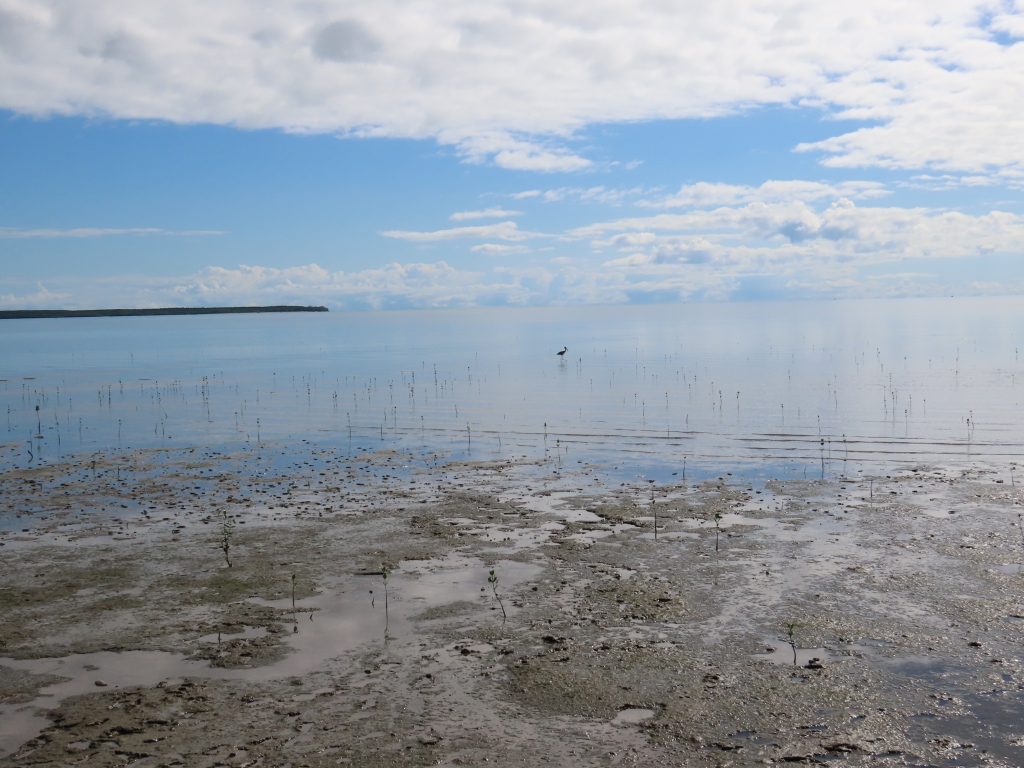
Here’s a close-up of the same Black-necked Stork. These are large birds, at 1.5 metres tall with a wingspan of over 2 metres. They’re the only species of stork found in Australia:

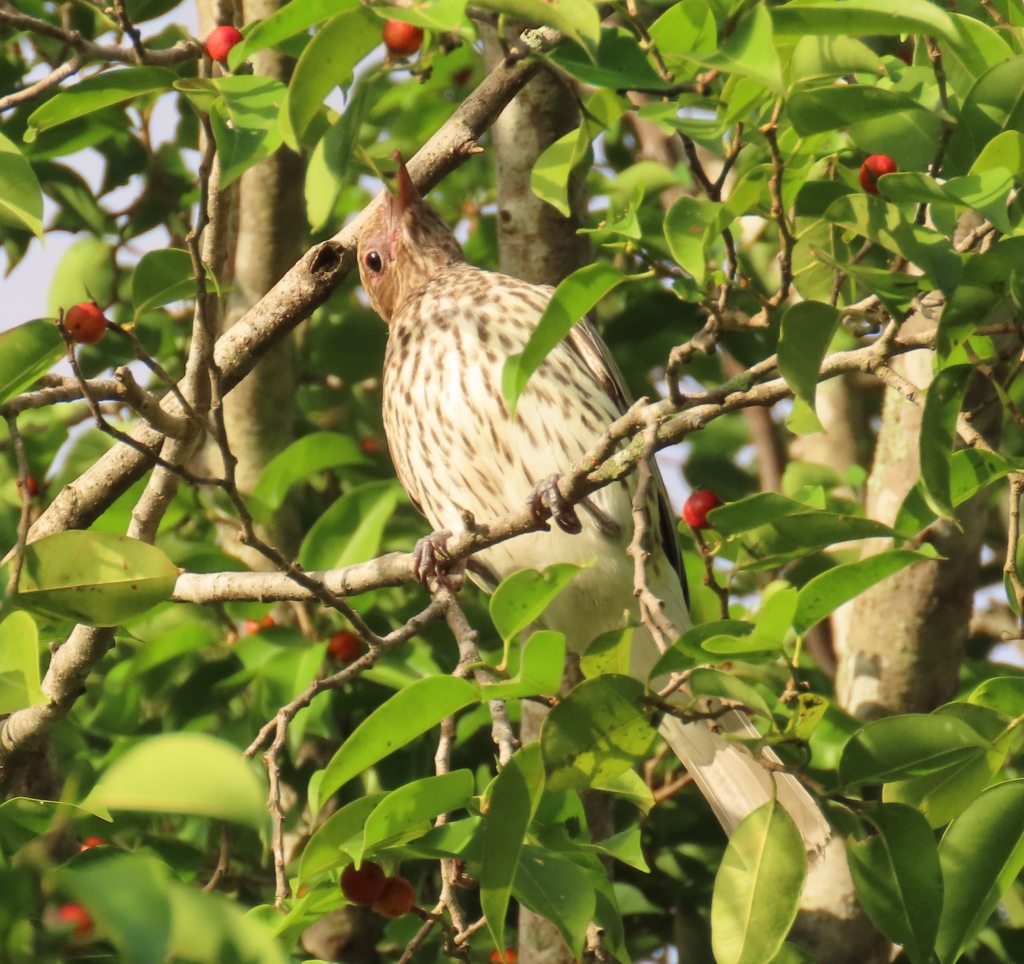
Figbirds called from the trees lining the Cairns promenade. The males in this area have a bright yellow front, which is different from the more subdued colouring of the figbirds down near Sydney. Here’s a male Figbird:

Here’s a female Figbird, with her gentle olive-brown colouring and streaked front:
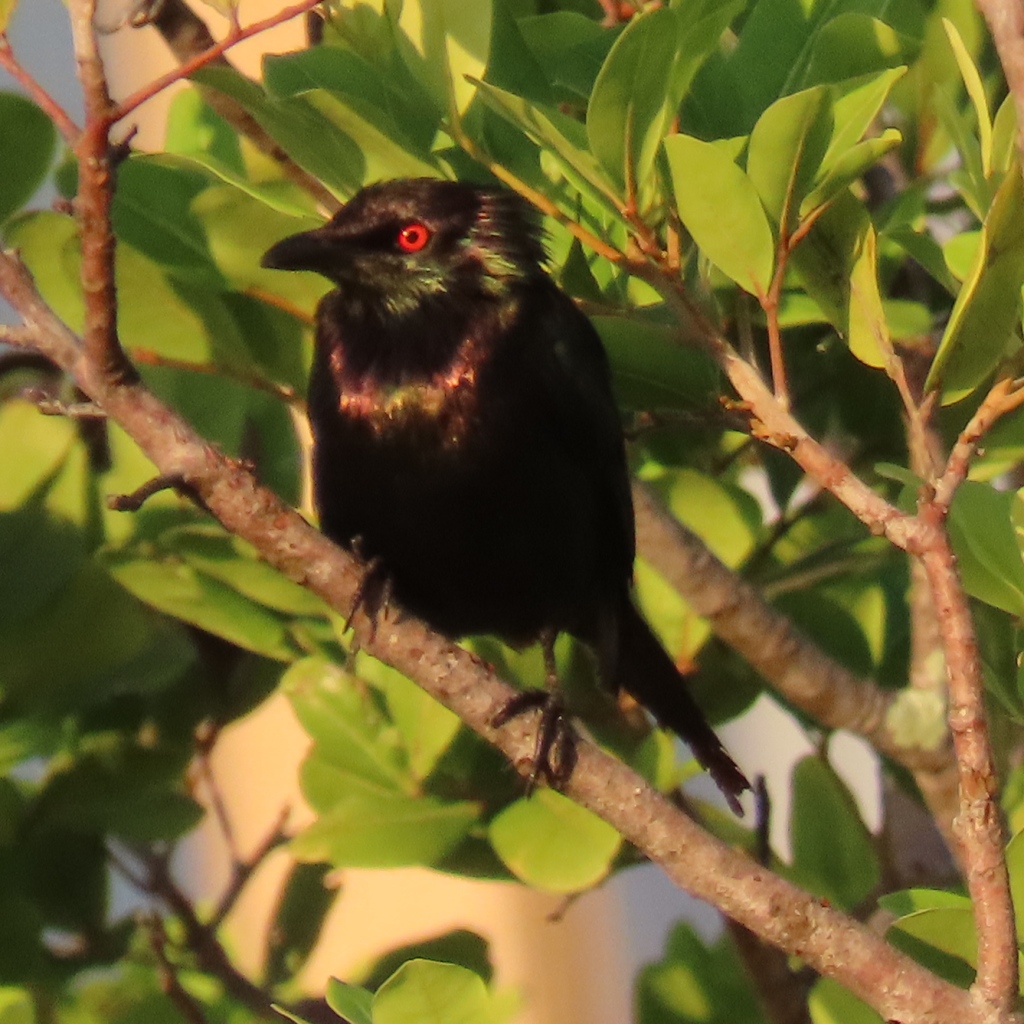
There were large numbers of Metallic Starlings, congregating in trees and shimmering in the sun. This is another first sighting for me! Unlike the Common Starling, which was introduced to Australia, these Metallic Starlings are indigenous to North East Queensland:
I hope you’ve enjoyed this brief glimpse into the birds of Far North Queensland. I hope to travel up there again sometime soon. It’s a unique area of the world.

Straw-necked Ibis
This is another of my bird sightings from a recent trip to Far North Queensland: A Straw-necked Ibis. It was patrolling a large area of cut grass:

The name “straw-necked” comes from the bunch of thin, straw-like feathers at the base of the bird’s neck.
Down in Sydney, the Australian White Ibis (dubbed the bin chicken by locals) is a common sight. But I haven’t seen a Straw-necked Ibis before. According to my bird book, they’re roughly the same size and weight. However, this particular bird seemed heavier and stronger than the ibises I’ve seen up to now.
Common name: Straw-necked Ibis
Scientific name: Threskiornis spinicollis
Approximate length: 60-70 cm
Date spotted: 17 May 2022 (dry season)
Location: Port Douglas, Far North Queensland, Australia: 16°30’42.2″S 145°27’44.2″E

Magpie Goose with chick
In May I visited Port Douglas in Far North Queensland. Strolling along a quiet road was this Magpie Goose and its chick:

These are large birds, at around 80 cm long with a wingspan of 1.5 metres in an adult. Even the chick is a large bird. Magpie Geese are easy to recognise, because of the weird knob on the top of their heads. I see that the baby doesn’t have a head knob yet.

Magpie Geese are found only in Australia and New Guinea. Evidently they’re not “true geese”. Their family branched off earlier than other ducks and geese, and so they’re considered to be a more ancient lineage. They do look a little prehistoric! Their feet are only partially webbed, they have strong claws, and they don’t moult all their flight feathers at the same time. As a result, they can fly all through their moulting.
Common name: Magpie Goose
Scientific name: Anseranas semipalmata
Approximate length: 75-90 cm
Date spotted: 17 May 2022 (dry season)
Location: Port Douglas, Far North Queensland, Australia: 16°30’42.2″S 145°27’44.2″E

Birds from a boat on the Daintree River
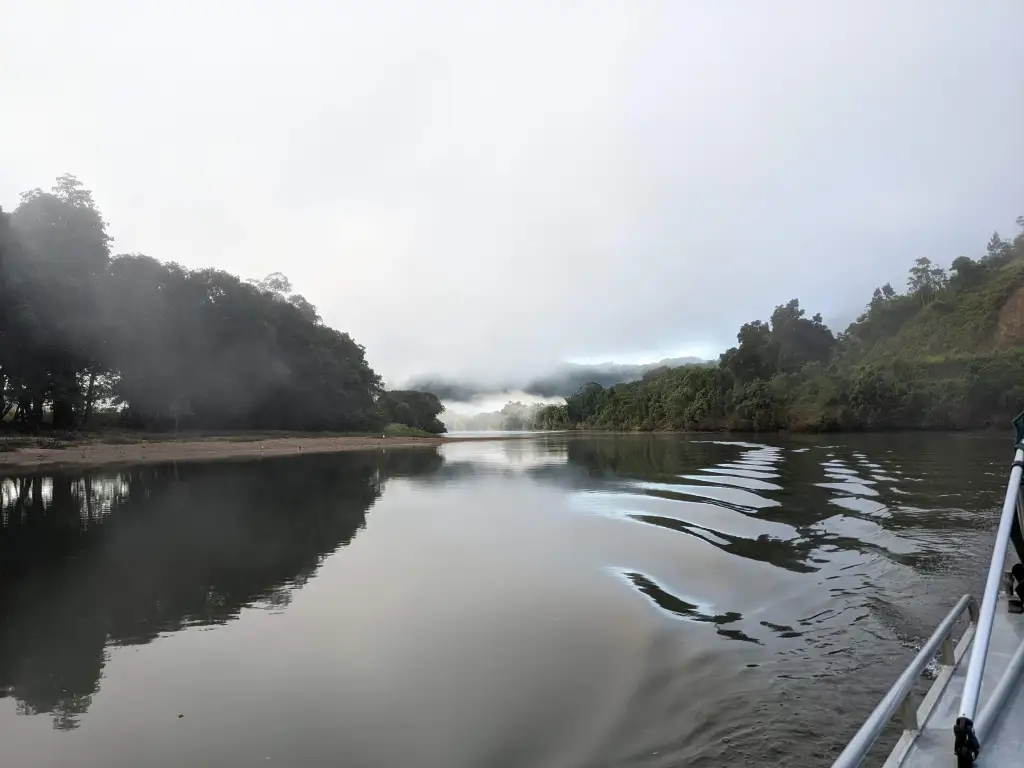
In May this year I was lucky enough to visit Far North Queensland. While there, I took an early morning boat trip on the Daintree River (map). The tour, run by Ian “Sauce” Worcester, was called the Daintree River Wild Watch. Highly recommended!
The river is gorgeous in the early morning chill:
We saw a number of kingfishers on the banks of the river. This one is a Sacred Kingfisher:
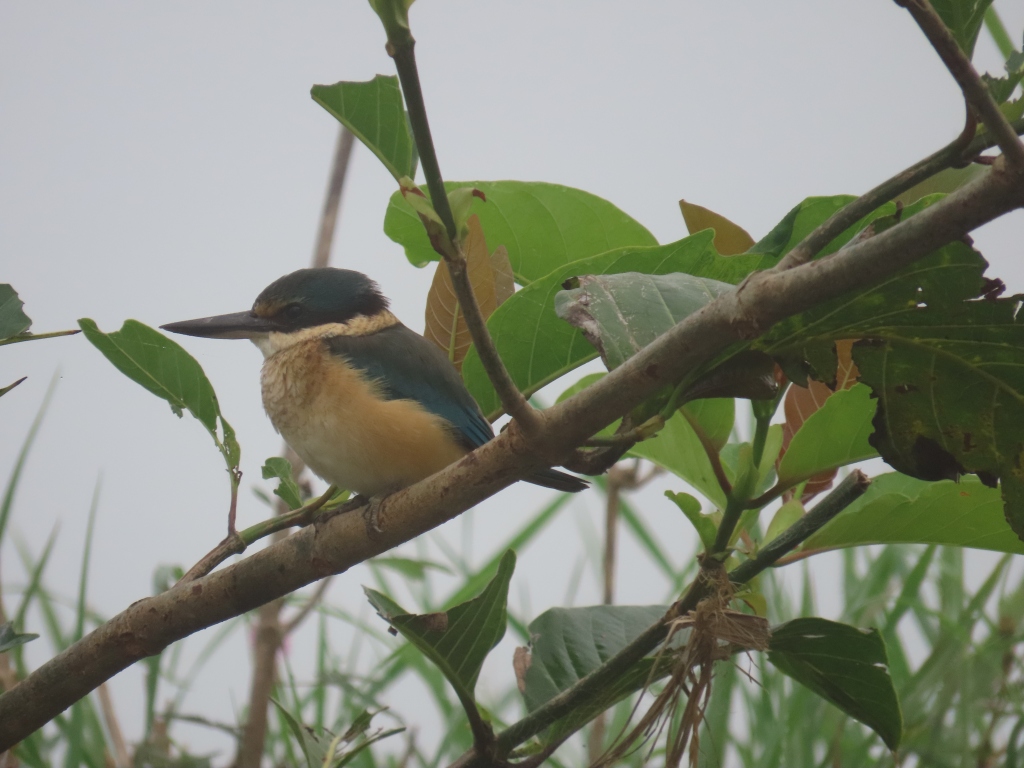
Another Sacred Kingfisher:

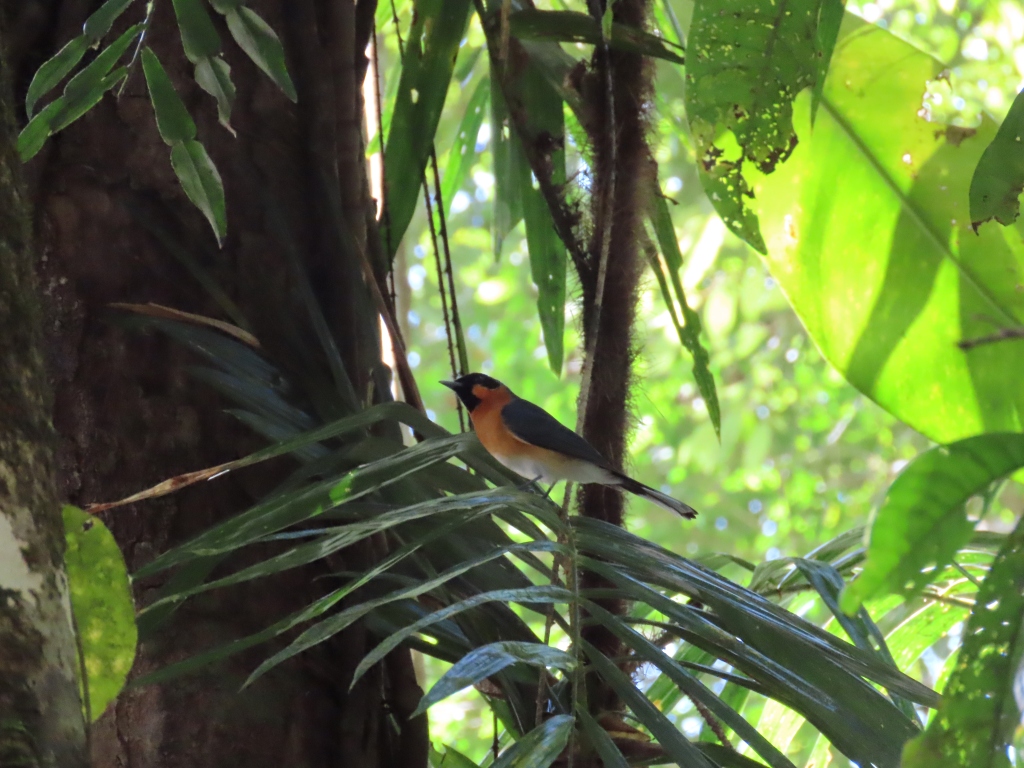
A Spectacled Monarch hid in the undergrowth of the mangrove forest. Our boat followed it quietly until it came into easy view:
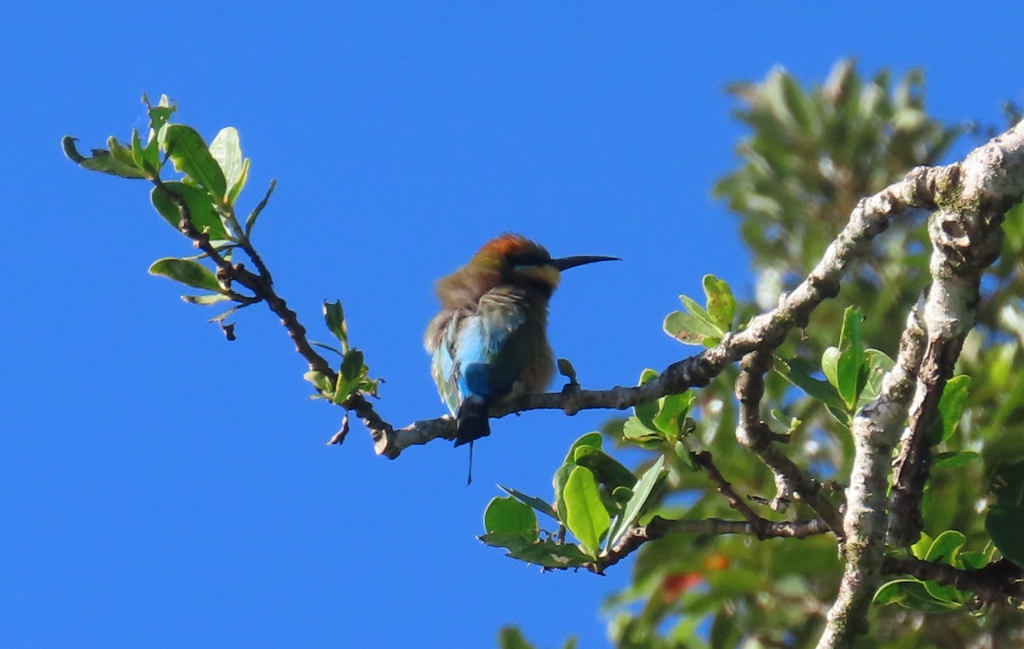
As the sun came up, a Rainbow Bee-eater landed on a high-up tree branch and fluffed out its feathers to take advantage of the warmth:
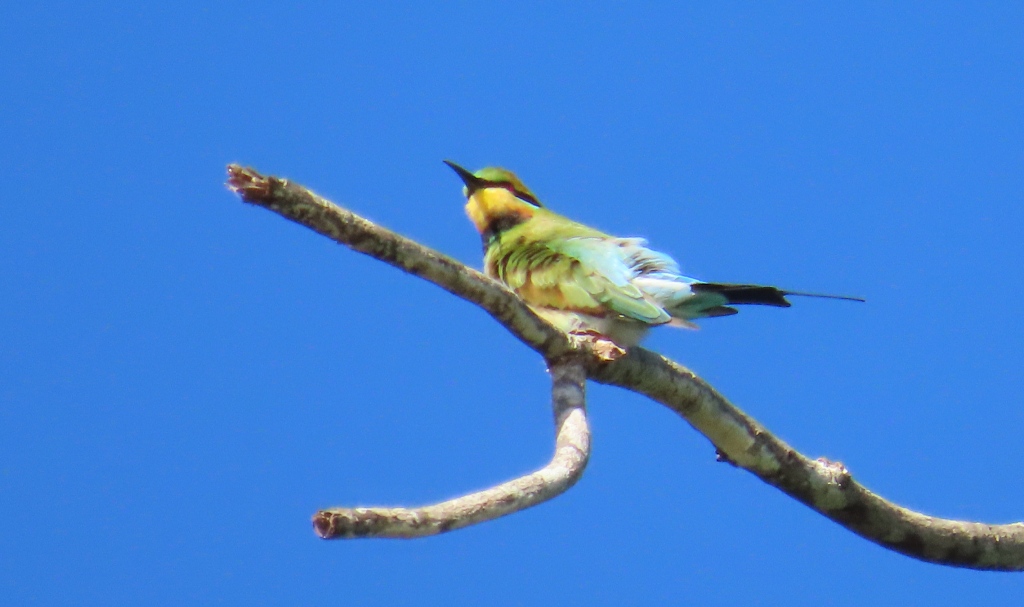
Here’s another view of the Rainbow Bee-eater:
The river banks were at times covered in mangrove forests or fig trees. High above our heads, flowers bloomed:
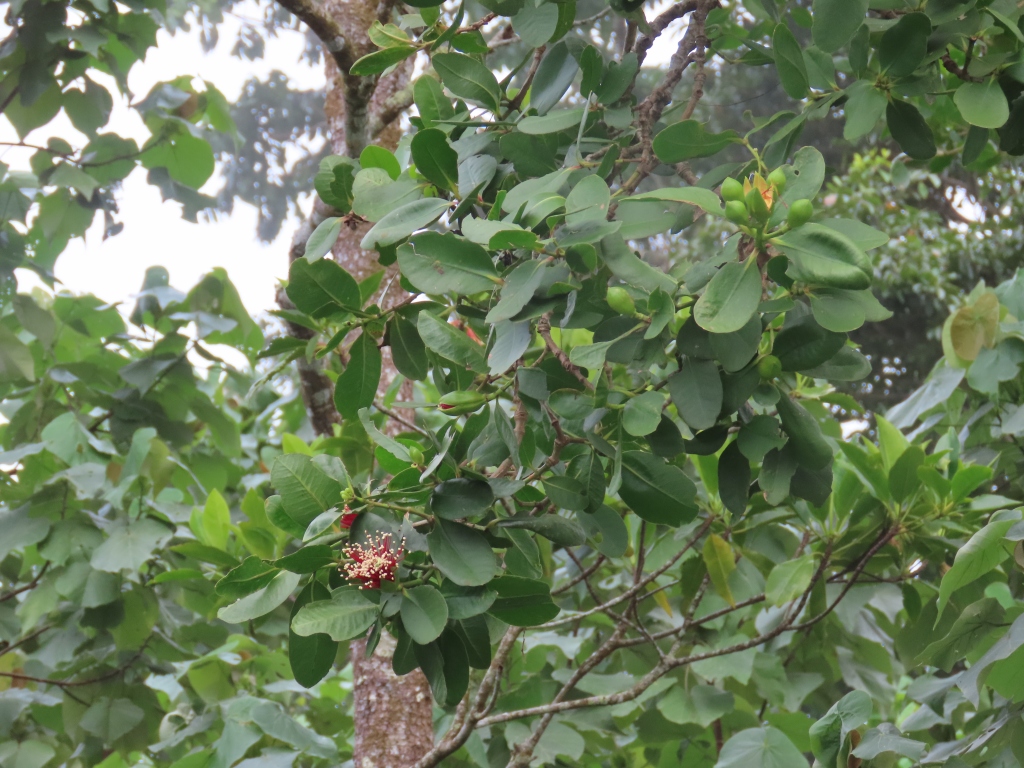
Waterbirds included these colourful Radjah Shelducks, sometimes called Burdekin ducks:

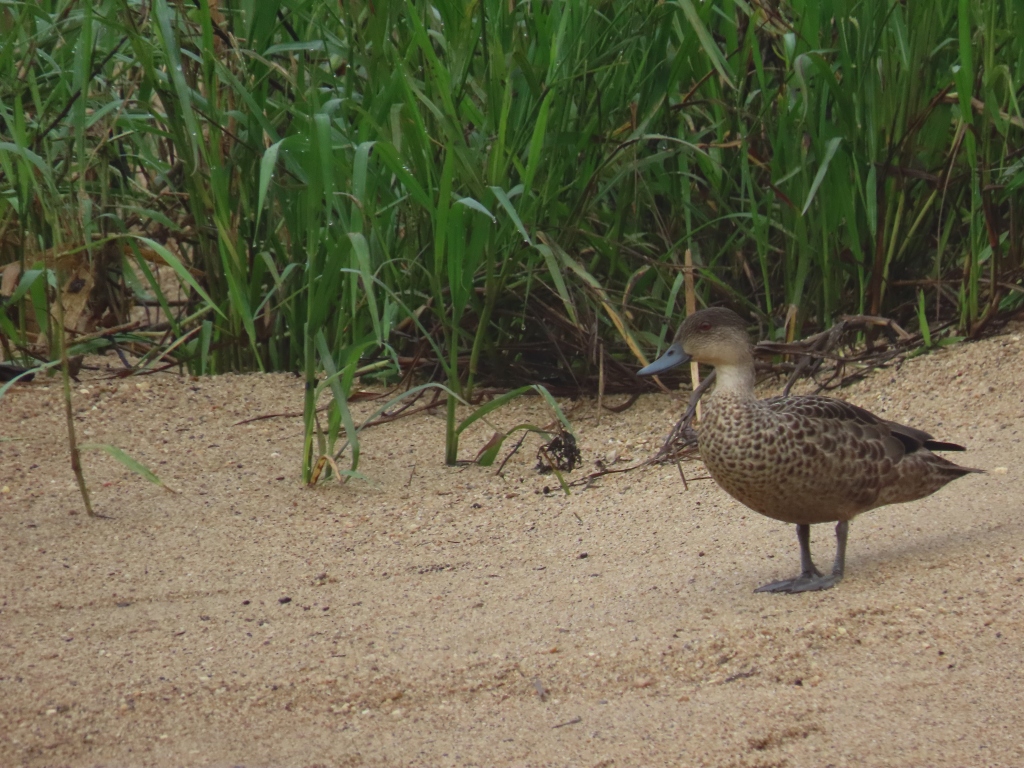
Another non-descript-looking duck caused some excitement, as our tour guide thought it might be a whistling duck but I can’t identify it. If anyone can say what it is, let me know:
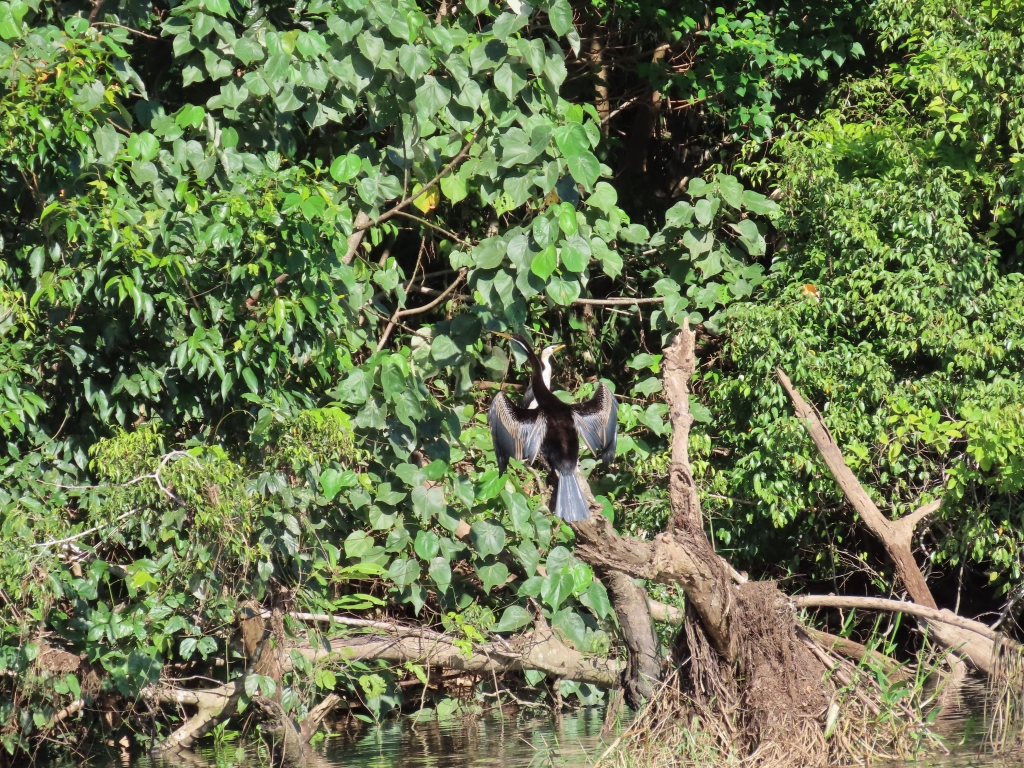
We saw a Darter roosting close to a Little Pied Cormorant. In this photo, the cormorant is behind the darter looking towards the right. The darter is in front, with its back to us, looking towards the left:
Three Little Pied Cormorants kept us company on the water. You can see the dense forest that covered much of the river bank:

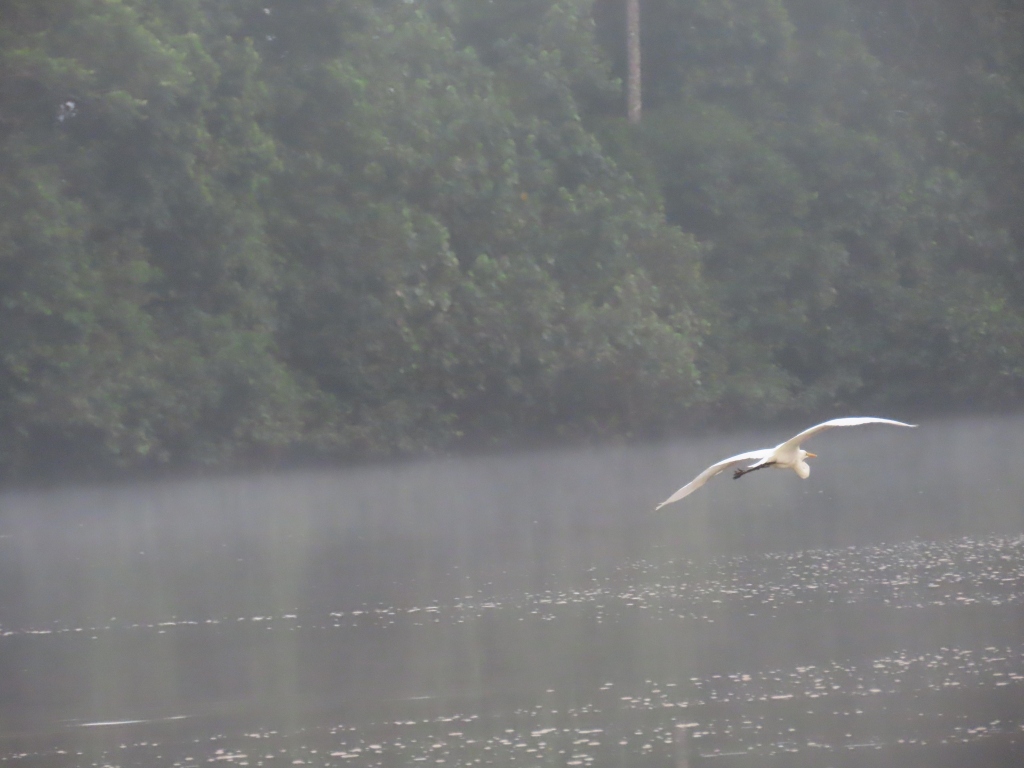
An egret kept pace for a while too:

Red-whiskered Bulbul
Red-whiskered Bulbuls are evidently quite common around Sydney, but this is the first time I’ve seen one! It’s a pretty little bird, with striking black, red, and white markings and a tall crest on its head like a woodpecker.
In this video, the bird is very far away and I had to do some radical zooming with my camera. You can hear the bulbul’s pretty call:
These birds are native to south Asia, and introduced into Sydney in the late 1800s. They tend to stay in areas close to human habitation.
Here’s a still picture of the bird:

Common name: Red-whiskered Bulbul
Scientific name: Pycnonotus jocosus
Approximate length: 20 cm
Date spotted: 5 June 2022 (winter)
Location: Dobroyd Head, Sydney Harbour, Australia: 33°48’38.6″S 151°16’05.4″E

Those magnificent black cockatoos are back!
For the past couple of years, a group of Yellow-tailed Black Cockatoos has visited our garden to snack on our Banksia tree when the seeds are ripe. This happens around May-June and again in October. It’s a real privilege to have such magnificent birds in the garden. At approximately 65 cm (more than 2 feet) from head to tail, they’re much larger than the more common white Sulphur-crested Cockatoos (50 cm).
The bird on the left is a female. Toward the end of the video, you see the male higher up in the tree (he’ll be near the top right), keeping watch. You can tell the male by the pinkish colour of the ring surrounding his eye.
The bird on the right at the start of the video (in the middle when all three birds are in view) is making a constant low crooning sound. I think the noisy one must be a juvenile, because I’ve noticed that the juvenile birds of many species keep up a constant noise, perhaps to reassure their parents that they’re still around. Early on in the video, the female on the left calls out in that lovely, wild squeal that’s characteristic of these birds. They also chitter companionably to each other throughout.
Here’s a still picture of the male:
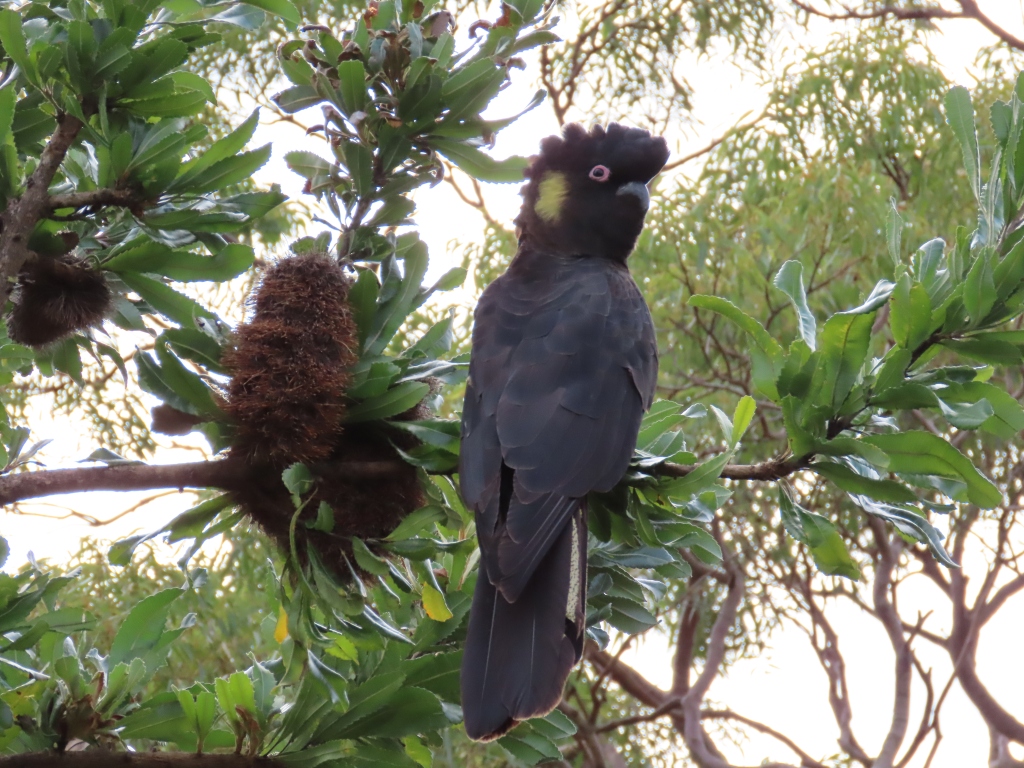
The next video shows one of the birds (probably the female, though it might be the juvenile) tucking into a Banksia seed pod:
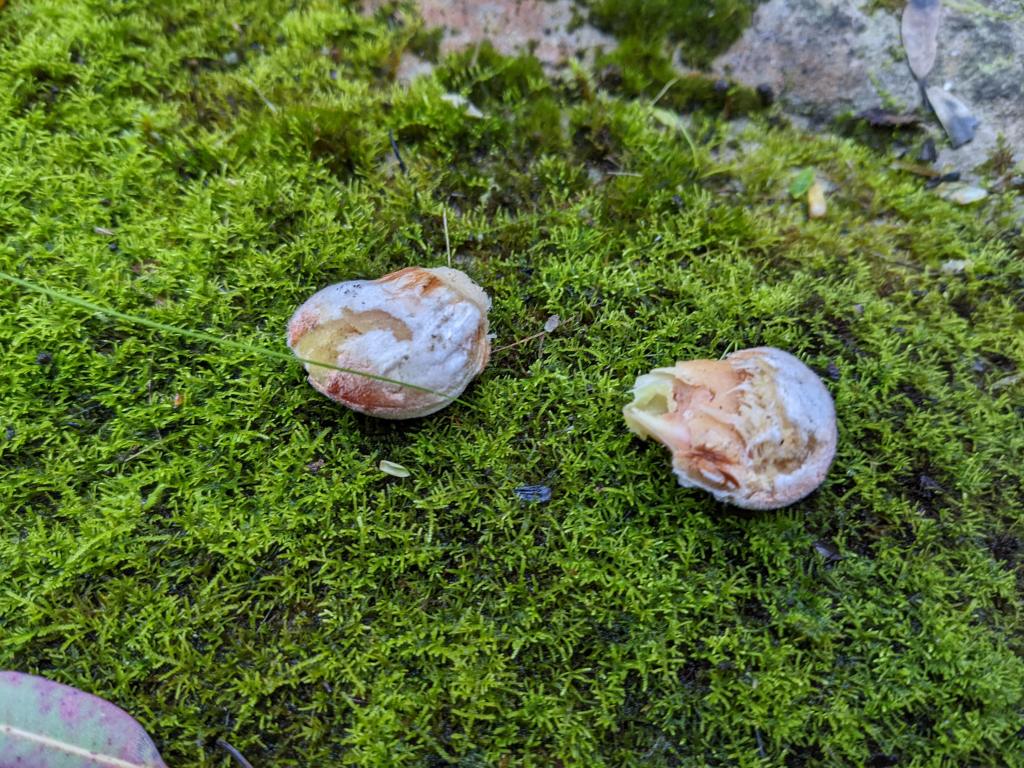
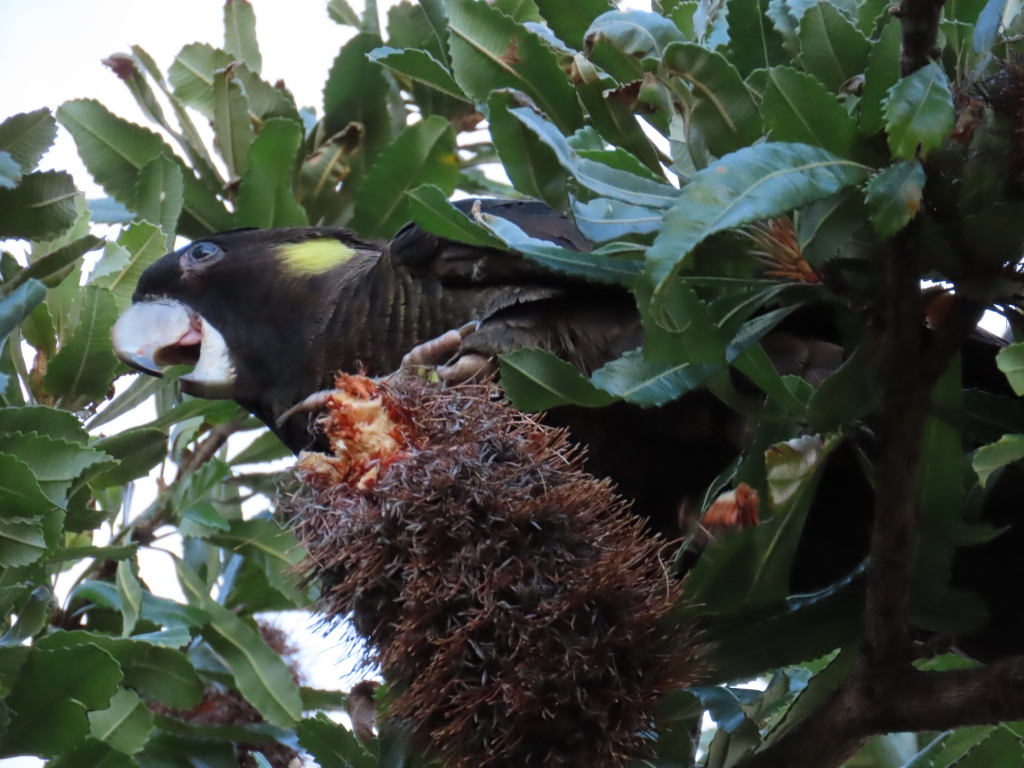
It’s funny to see how ruthless the bird is. She basically tears the dead flower apart, chucking bits onto the floor seemingly at random, until she finds a tasty morsel. Our neighbour was giggling from his verandah, from where he had a birds’ eye view of the feasting! Our garden quickly became littered with half-eaten seeds:
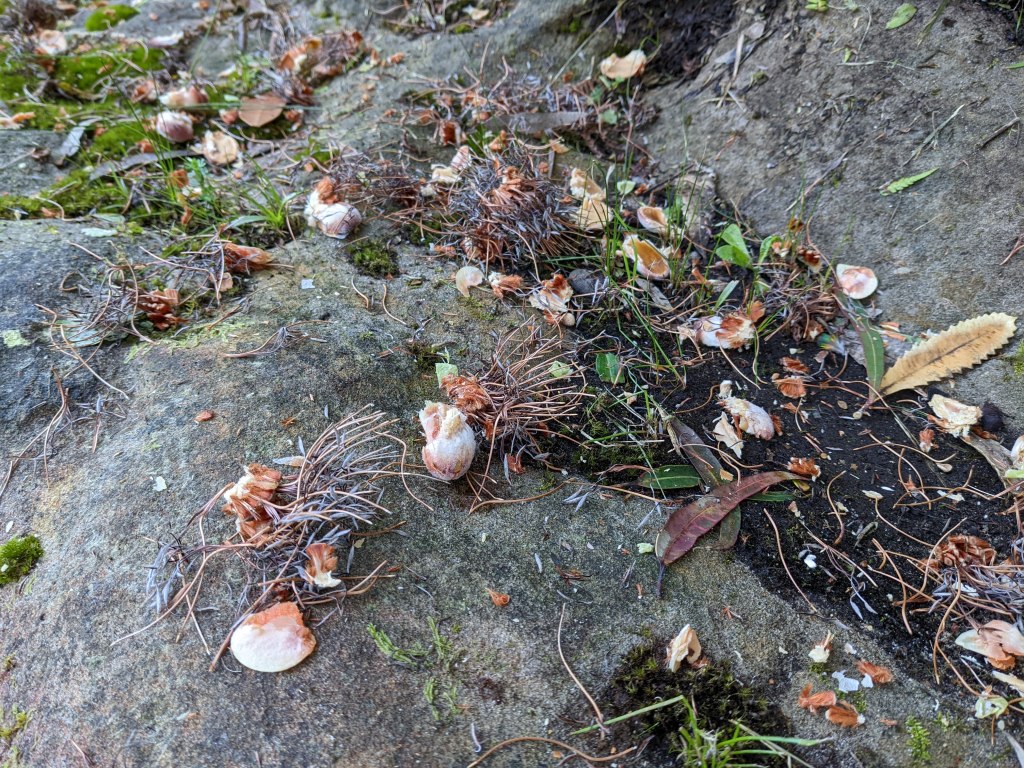
The tree is a Banksia serrata, also known as Old Man Banksia. See the marks of that huge beak on these seeds!
Here’s a closeup of a cockatoo on a seed pod:
The scientific name of these birds is Calyptorhynchus funereus. Evidently the funereus part of the name stems from the dark, somewhat gloomy colouring of the birds. George Shaw, the naturalist who first named the birds, thought that the colouring was suited to a funeral! The bird was even called the “funereal cockatoo” for a while.
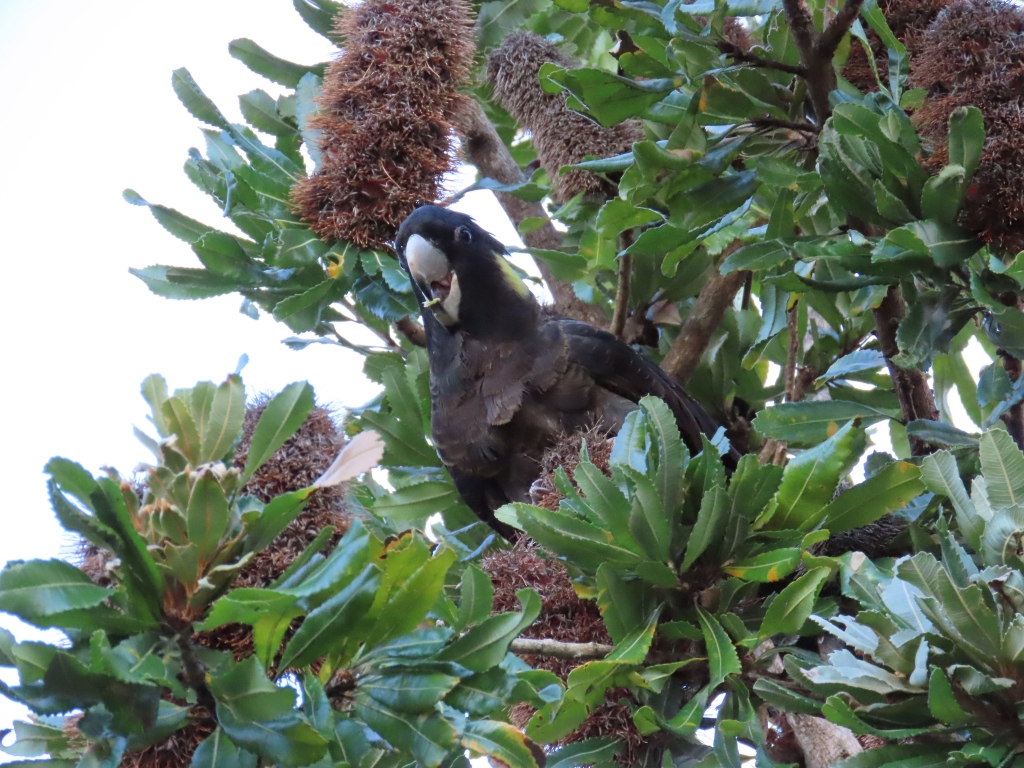
There’s also some dispute in the birding community about whether these birds are actually part of the genus Calyptorhynchus. Some people group them into a different genus, Zanda, based on genetic diversity.
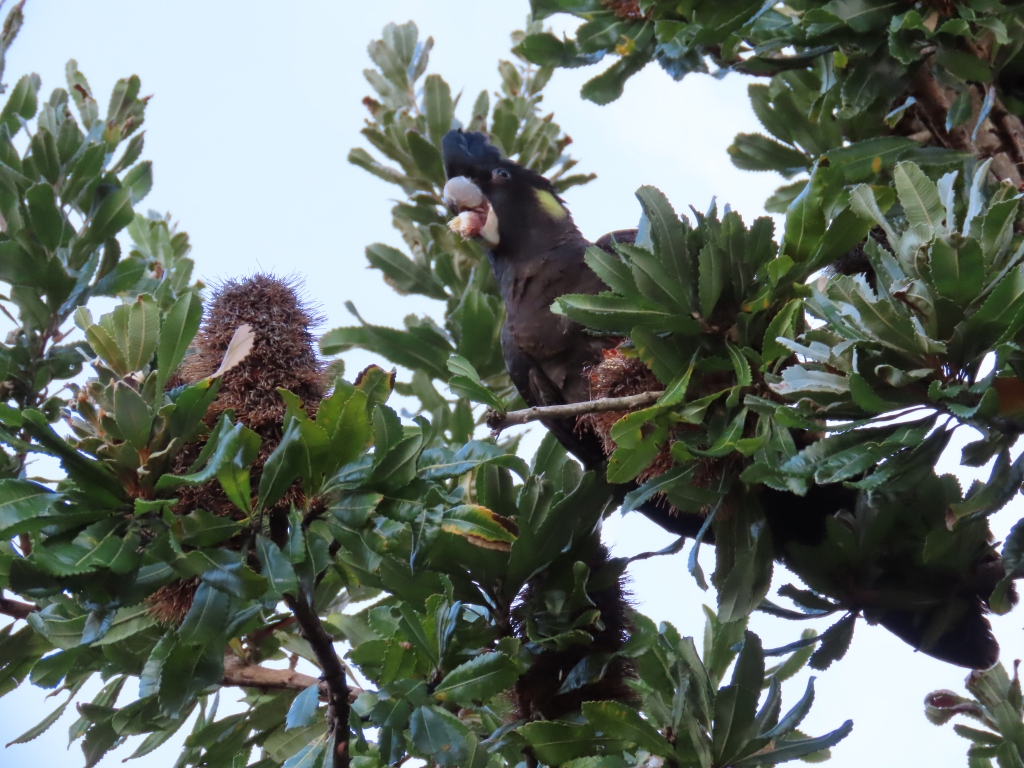
The next photo shows the bird that I think is a juvenile. With its beak feathers fluffed up, it seems to be sleepy or wanting attention!

A shot from the back gives a nice view of the crest on the bird’s head:
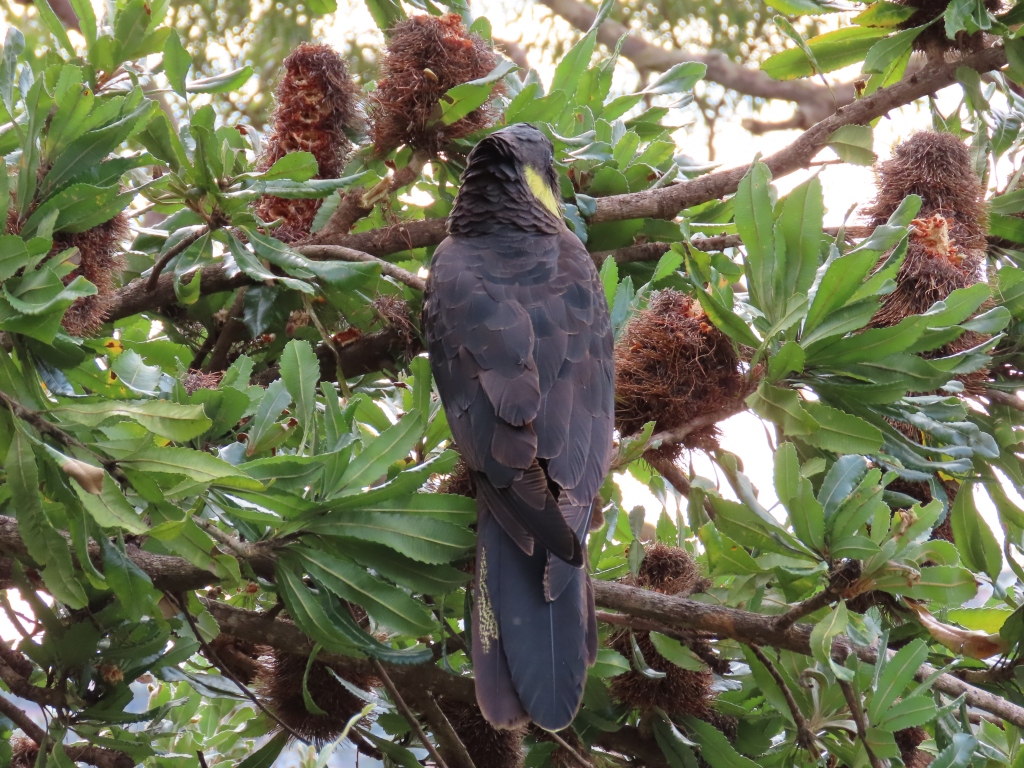
Common name: Yellow-tailed Black Cockatoo
Scientific name: Calyptorhynchus funereus or Zanda funereus
Length: 58-65 cm
Date spotted: 2nd and 3rd June 2022 (winter)
Location: Allambie Heights, NSW, Australia

Atmospheric pic of preening pelican in Cairns
I love the colours of this early-morning shot. The bird is an Australian Pelican, chilling out at the edge of the Coral Sea.
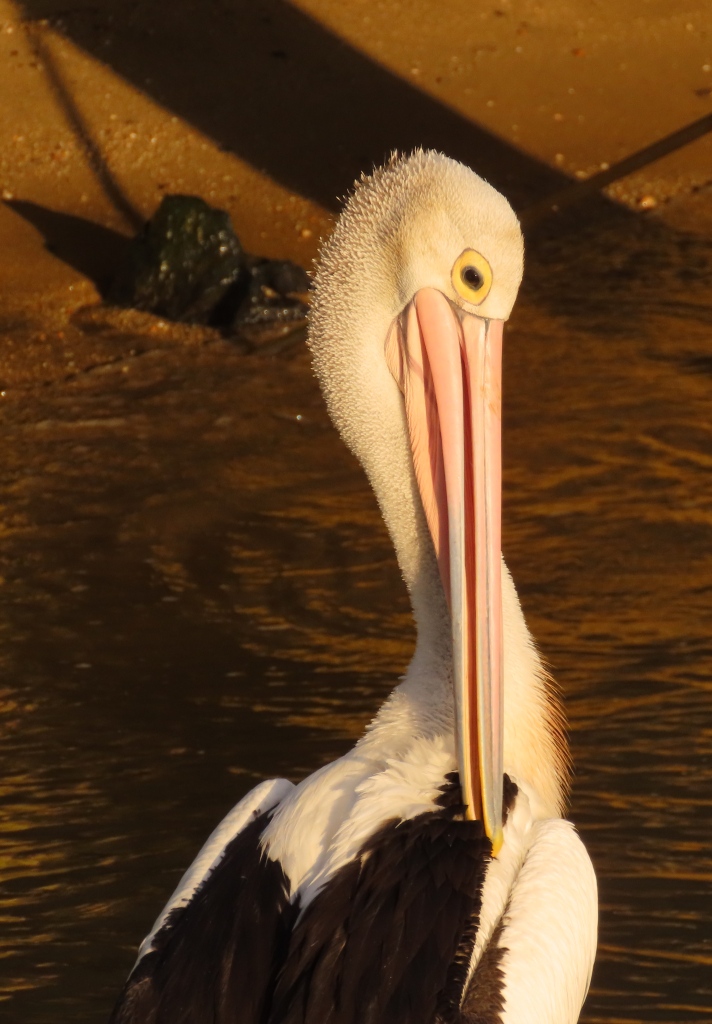
Common name: Australian Pelican
Scientific name: Pelecanus conspicillatus
Approximate length: 170 cm
Approximate wingspan: 2.5 m
Date spotted: 15 May 2022 (dry season)
Location: Cairns Esplanade, Far North Queensland, Australia: 16°55’05.0″S 145°46’33.3″E


