Blog Archives
Birdsong at dawn
Dawn is a calm time of day in early autumn in this part of the world. Calm, but not quiet. I shot this video from my lounge window two days ago. You can hear a cockatoo coughing and lorikeets chirruping. About half way through, a couple of magpies join in with their warbling:
Baby Noisy Miners doing well
Here’s an update on the nest of Australian Miners, also known as Noisy Miners, across the road from our house. The babies are getting bigger!
In this video, you see one of the chicks perched on the edge of the nest, making the incessant chirping that’s surely designed to drive a parent mad. One of the adults drops in with a quick morsel of food, and you can see both babies. I’m pretty sure there are only two chicks in the nest:
It’s quite a change since my previous post about the baby birds, just five days ago. This chick looks ready to take its first steps out of the nest:

Common name: Noisy Miner, also called Australian Miner
Scientific name: Manorina melanocephala
Approximate length: 26 cm
Date spotted: 30 March 2020 (late summer)
Location: Near Sydney, NSW, Australia
Young Channel-billed Cuckoo fed by a currawong
A plaintive caterwauling drew my attention to the treetops this morning. A large bird sat high in a tree, calling and flapping its wings. It was a juvenile Channel-billed Cuckoo, waiting to be fed. As I watched, the adoptive parent arrived: a currawong. The currawong stuffed some food down the baby’s throat:
The baby cuckoo is already larger than its adoptive parent. Channel-billed Cuckoos are very large birds. In fact, they’re the largest of all parasitic birds. The body of the adult is more than half a metre long, and the wingspan is almost a metre. As the term parasitic implies, the cuckoo parents lay their eggs in the nests of other birds—in this case, a currawong’s nest—and the hapless host then raises the cuckoo chick.
In the next video, the young cuckoo is more restful, which gives you a chance to see its colouring. The very young birds have yellowish and brown colouring, whereas adults are light grey and dark grey. This youngster is close to adult colouring, but you can still see yellow here and there. The chirping noise that you hear throughout is the cicada beetles that rule the bush at this time of year.
Near the start of the video, the bird takes a sudden dislike to a dead twig nearby. Who knows why. Perhaps the bird is bored. Then a Noisy Miner arrives to alleviate the boredom. Noisy Miners, also known as Australian Miners, are noisy, as you may have guessed. They broadcast an alert whenever anything unusual appears in their territory. The young cuckoo reacts with alarm. In the nick of time, the host currawong arrives with another tasty treat.
I noticed that the currawong retreats hastily after delivering each morsel of food, and the cuckoo gives chase. I’d probably retreat too if my baby were that size!
Here’s a still photo of the young cuckoo. It’s eyes have not yet reached the dramatic red of the adult Channel-billed Cuckoo:

Bits of yellow and brown are still visible in the feathers, but this young ‘un has nearly attained the grey colouring of the adult.

The next photo gives a good view of the youngster’s tail, which looks to be fully developed. I saw the bird flying from tree to tree, and it did a very good job of it. It will need its flying skills in a few weeks’ time, as these cuckoos are migratory. They come down the eastern coast of Australia in spring, around September, then fly back up north to Indonesia and other islands around March.
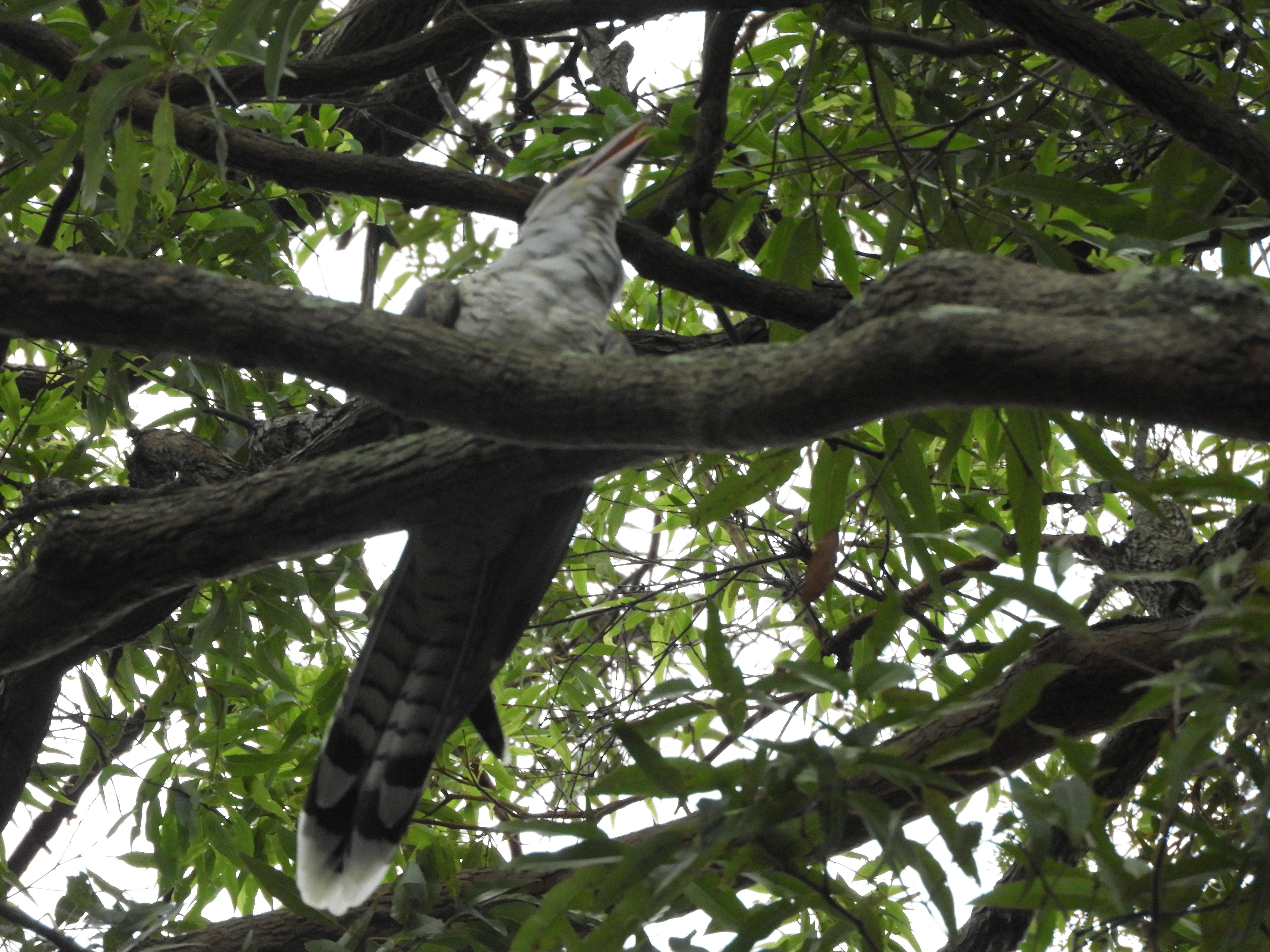
To see more pics and videos of these cuckoos, and to hear the horrendous noise the adults make, check out my list of cuckoo posts.
Common name: Channel-billed Cuckoo
Scientific name: Scythrops novaehollandiae
Approximate length: 58-65 cm
Date spotted: 25 January 2020 (summer)
Location: Manly Dam Reserve, New South Wales, Australia: 33°46’59.6″S 151°15’15.5″E
Yellow-tailed Black Cockatoo calling while keeping a lookout
Yesterday I saw a group of four Yellow-tailed Black Cockatoos. I love coming across these large birds, as they impart a feeling of calm and grace. I took a video of the bird that seemed to be the designated lookout, sitting on a branch while the others foraged on the ground. You can hear the eerie call that the bird makes. It sounds rather like a door opening on rusty hinges!
Common name: Yellow-tailed Black Cockatoo
Scientific name: Calyptorhynchus funereus
Approximate length: 65 cm
Date spotted: 9 November 2019 (spring)
Location: Manly Dam Reserve, New South Wales, Australia: 33°46’40.0″S 151°14’50.2″E
Song of the Golden Whistler
It was exciting to see this pretty little bird and hear its call. This is the first time I’ve seen a Golden Whistler, though my bird book says they’re common. This one is a male, brightly coloured with clearly-delineated yellow, black, and white patches. Its song ripples through the forest.
In this video, the Golden Whistler makes a brief appearance and utters its call. Off stage, a Sulphur-crested Cockatoo squawks, and the Golden Whistler dives for cover:
Here’s a still shot of the bird. My apologies for the fuzziness – the bird was high up and far away, and my camera lens is on maximum zoom. The moon-shaped white patch is the white throat of the bird:
Here’s another brief video of the bird calling before he darts off again:
In the next video, the Golden Whistler enters from the right and has his say. The shot is taken with a lower zoom, so there’s more chance to stay with the bird:
The last video doesn’t show the bird, but you can hear its call and enjoy a general view of the forest, including some fungus growing on a dead tree trunk. The Golden Whistler’s call is slightly different from the earlier videos:
Common name: Golden Whistler
Scientific name: Pachycephala pectoralis
Approximate length: 16-18 cm
Date spotted: 24 August 2019 (late winter)
Location: Manly Dam Reserve, New South Wales, Australia: 33°46’48.6″S 151°14’52.3″E
Australian Ravens building a nest and crooning
Nesting is a tricky business. If you’re an Australian Raven, there’s a lot of moaning involved. I heard the fuss while walking along a bush path, and peered up high into the trees to see what all the commotion was about. This video starts with the two ravens weaving twigs into their nest. The nest looks more like an untidy platform of sticks at this stage. The birds croon to each other throughout the process. One of the birds flies off. It lands close to me, grabs a stick, and makes a bit of a fuss about getting just the right grip before taking off for the nest:
Australian Ravens are large birds, with ice blue eyes, black plumage that shimmers blue in the sun, and a thick ruff of feathers under their beaks. When they’re flying, they make a long drawn-out cawing that can sound like a wailing cat.
The next video shows more of the nest building and crooning. At first one raven is alone in the nest, and takes time out to have a bit of a stretch. Then its partner arrives, and the serious business of nest building starts again. It’s funny how the birds’ voices wobble when they bob their heads up and down, trying to get those pesky sticks into the right position:
Common name: Australian Raven
Scientific name: Corvus coronoides
Approximate length: 50 cm
Date spotted: 24 August 2019 ( Late winter)
Location: Manly Dam Reserve, New South Wales, Australia: 33°46’59.7″S 151°15’14.8″E
Who said a Pardalote isn’t a dinosaur?
Well, I guess maybe nobody has ever said “a Pardalote isn’t a dinosaur”. I mean, why would you? Still, this little Pardalote’s plucky pose made me think of a dinosaur in a Spielberg movie. At the very least, it was considering auditioning for the role:

Although they’re only 10 centimetres tall, Spotted Pardalotes don’t seem to be daunted by huge creatures like me standing close by. This one was on a twig a few metres away, singing its heart out with a pause to grab a bite to eat:
It seemed to find me as interesting as I found it:
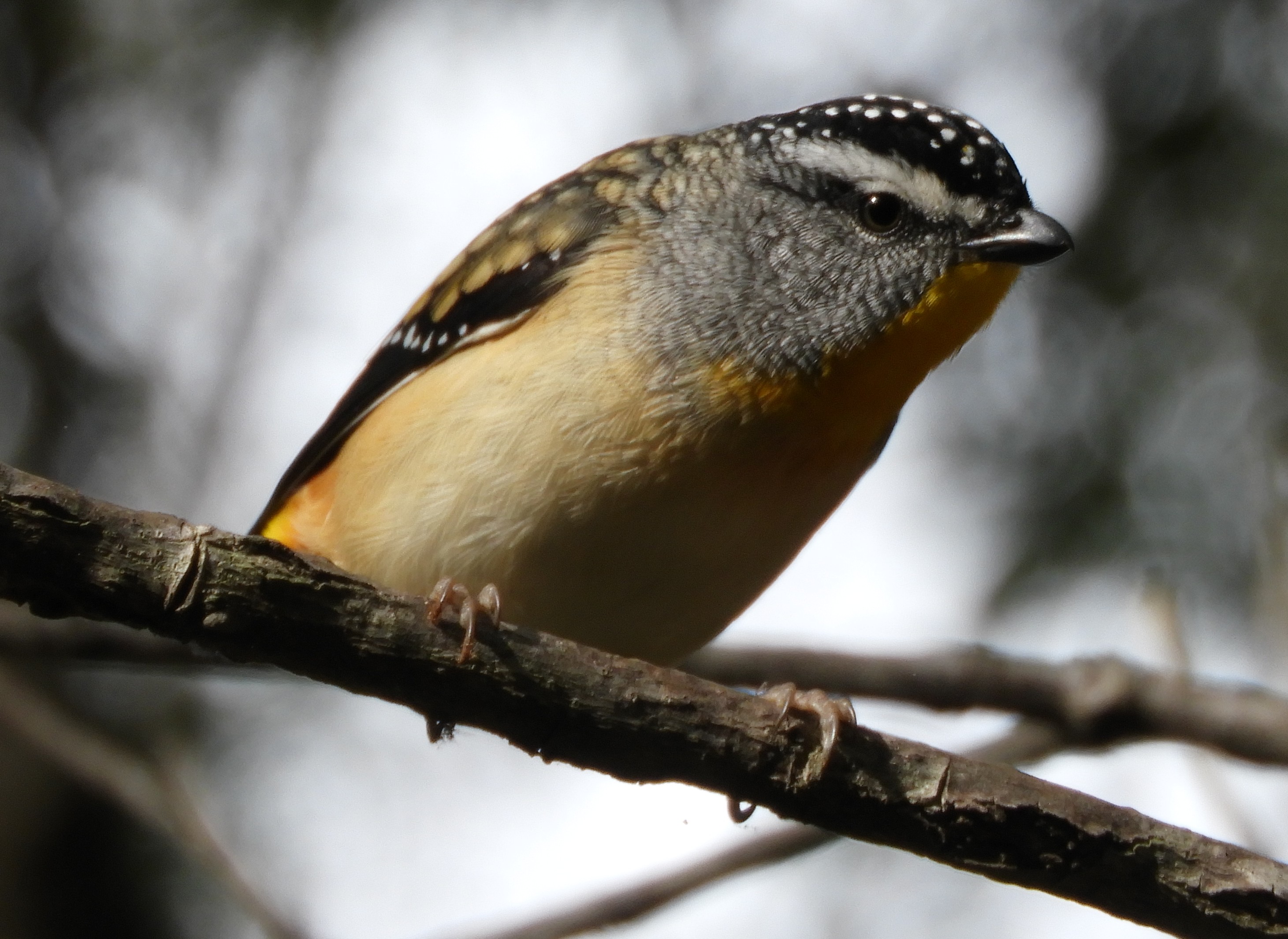
Did any dinosaur ever catch the sun as prettily as this?

Common name: Spotted Pardalote
Scientific name: Pardalotus punctatus
Approximate length: 10 cm
Date spotted: 22 July 2019 (Winter)
Location: Manly Dam National Park, New South Wales, Australia: 33°46’24.4″S 151°15’03.6″E
Magpie song with a touch of Star Wars
A sociable magpie dropped by the other day to try out its song on me. I think the bird is still a youngster, as its eyes are not yet the bright red of an adult. The magpie let me get up to about two metres away, and still happily continued its song. I didn’t try to get any closer. After all, it’s a wild bird and entitled to its space. Plus, magpies are known to fly off the handle at times.
As well as the usual magpie warbles, this bird adds a few extra whistles and chirps. Sometimes it sounds as if it’s been listening to a Star Wars sound track!
Common name: Australian Magpie
Scientific name: Gymnorhina tibicen
Approximate length: 40 cm
Date spotted: 24 December 2018 (Summer)
Location: Allambie Heights, NSW, Australia (near Sydney
Eastern Rosella calling and dancing
This has turned out to be parrot weekend in our garden. Yesterday four black cockatoos dropped by. Today it was two Eastern Rosellas. This is the first time I’ve managed to get a photo of one of these lovely birds. Its characteristic call drew me to the window. There it was on our Scribbly Gum tree right outside the window, dancing and chattering to its mate:
Knowing that these birds usually go about in pairs, I looked for the other one but didn’t see it until they both flew away, several minutes later. (The mate was higher up in the tree, hidden by the foliage.)
At 30 cm in length, Eastern Rosellas are slightly smaller than the Crimson Rosellas that we see more often in our area. This still shot shows the bird in all its beauty:

Common name: Eastern Rosella
Scientific name: Platycercus eximius
Approximate length: 30 cm
Date spotted: 21 October 2018 (Spring)
Location: Allambie Heights, NSW, Australia
Little Wattlebird calling, mate unimpressed
A male Little Wattlebird does its best to impress (or intimidate) the bird sharing its branch. The other bird is unimpressed. In fact, its reaction seems to be, “Oh, please, are you really going to keep doing that?”
The call of a Little Wattlebird is strange. It often starts with a click-clack, as if the calling mechanism is turning over before getting into full gear. Then out comes the harsh bray that’s characteristic of the male bird. It seems to take a fair bit of effort to make this noise, as you can see in the video:
I went back to the same spot a day later, and snapped a picture of this male Little Wattlebird. It’s probably the same bird, given their fierce territoriality:
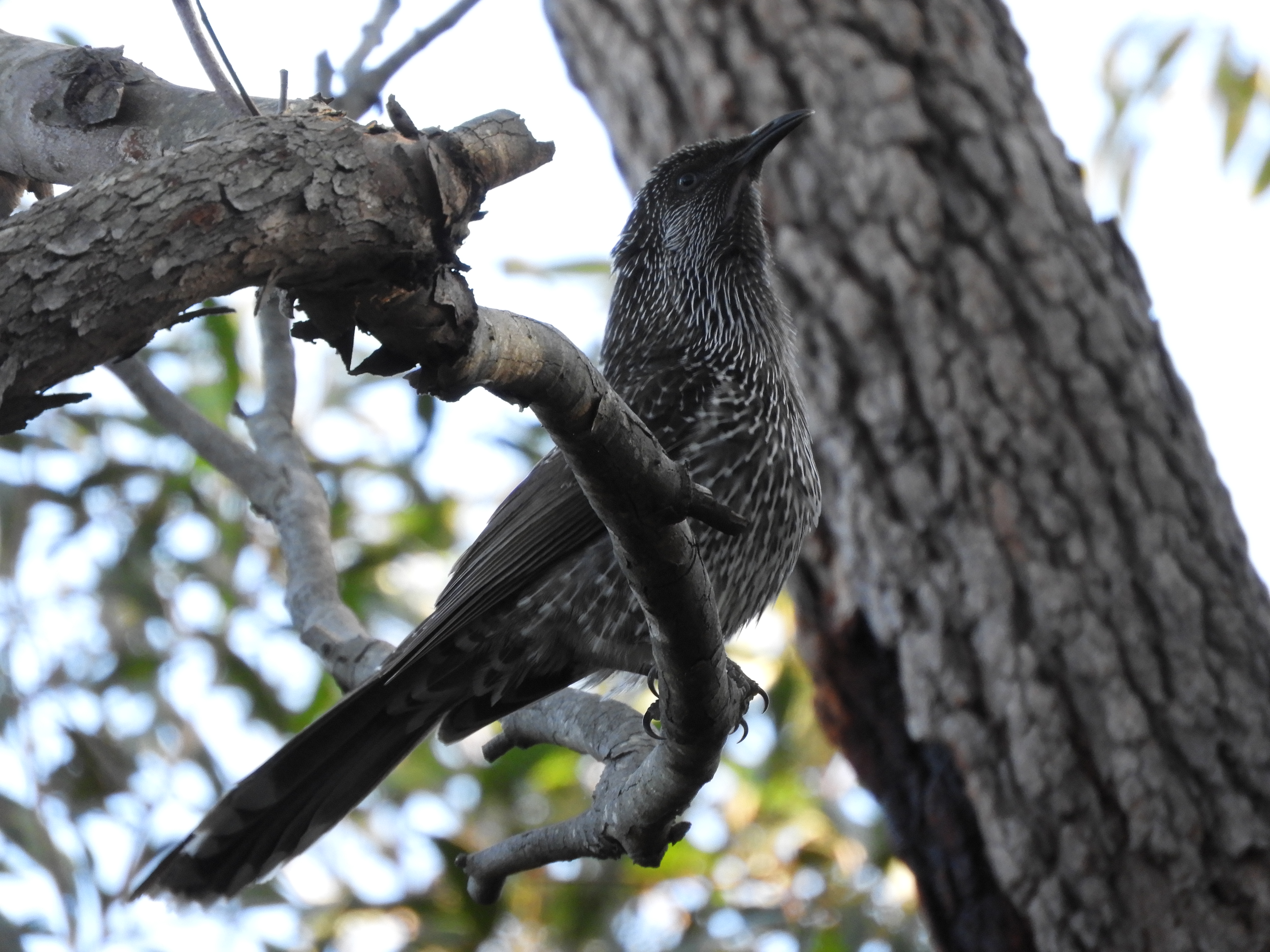
Common name: Little Wattlebird
Scientific name: Anthochaera chrysoptera
Approximate length: 30 cm
Date spotted: 7 July 2018 (Winter)
Location: Manly Dam National Park, New South Wales, Australia: 33°46’36.9″S 151°15’10.4″E


 Sydney Birder