Blog Archives

So cute! Baby kookaburra in nest
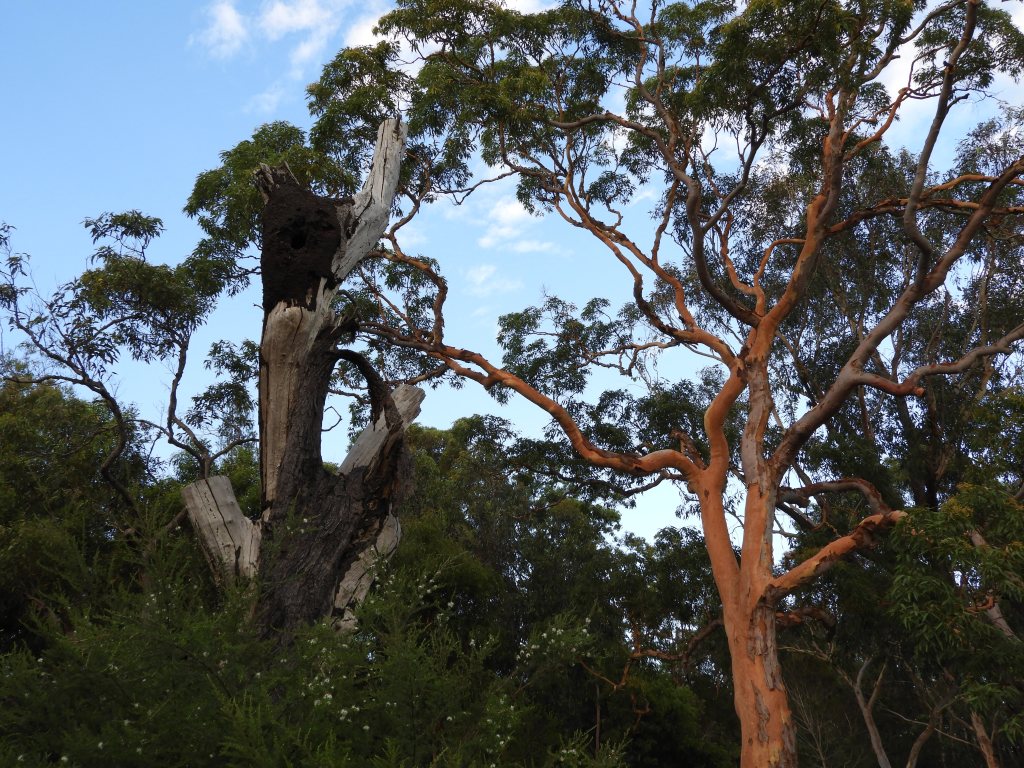
For the past few weeks, I’ve been following the progress of a baby kookaburra and its parents. The baby was housed in a termite nest on an old, dead tree. The first time that I noticed the nest was more than a month ago, on 17 November. At that time, the only sign of the baby was a faint crooning sound emerging from the termite nest. I’d heard baby kookaburras before, so I stuck around to see what would happen. Sure enough, an adult bird arrived with some food.
From that day on, I visited the nest regularly. And now, I’m delighted to report that the baby bird has safely left the nest and is being fed in the nearby trees.
The first video shows the baby kookaburra just a few days before it left the nest. The date was 14 December, almost a full month after I first noticed the nest. In the video, the baby peers curiously (and hungrily, no doubt) from the nest. You can hear an adult kookaburra off camera, calling to let the chick know that food is on its way. I moved the camera to take in the adult on a nearby branch. The bird checks the surroundings carefully, including me, to decide whether it’s safe to approach and feed the chick.
Meanwhile, the chick becomes more vociferous and sticks its head further out of the nest, impatient at the delay. The adult moved to a different branch to give itself a direct line of flight. I managed to catch a view of the adult there too, before moving back to the nest in time to see the adult arrive and feed the baby:
The parents were tireless and devoted in their care for the baby. On a couple of occasions, I spotted them foraging for food:

When the parents were not around, the chick eyed me from the safety of its home. The smallest scuffle was enough to bring an inquisitive eye to the hole in the nest:
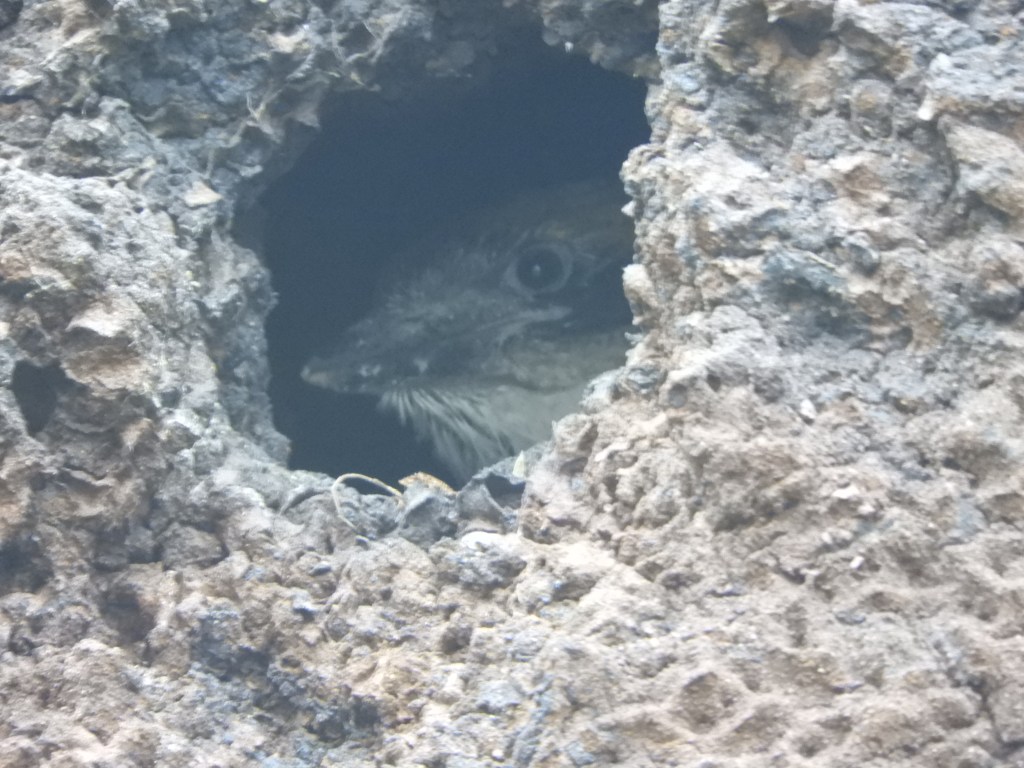
Partially hidden but oh so curious:
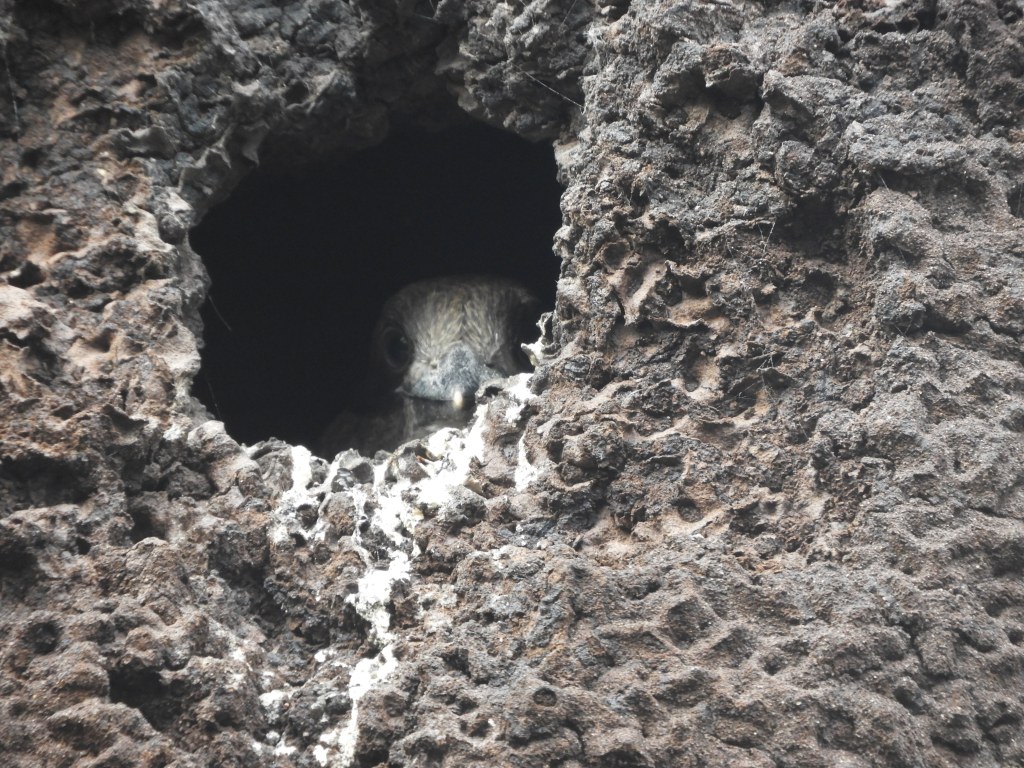
The nest was on the skeleton of a dead tree:
This is an earlier, short video (taken on 3 December) showing a parent arriving to feed the chick:
When I arrived on 17 December, the nest was quiet. Again the next day, there was no activity at the nest. I explored the area and soon heard the characteristic crooning of a kookaburra youngster. I found it in a quiet, tree-filled glen, being attended to two adults in turn. It was early in the morning, and the birds were high in the trees, so I didn’t manage to get a good photo. This is the glen:

This is the only photo I have of the youngster. Alas, I didn’t get the full head in the shot, but you can see the fluffiness of the feathers and the short tail:

Common name: Laughing Kookaburra
Scientific name: Dacelo novaeguineae
Approximate length: 47 cm
Date spotted: 18 December 2020 (summer)
Location: Manly Dam Park, New South Wales, Australia
This is the view the baby kookaburra had from its nest. It looks over Manly Dam towards the dam wall, with a bottlebrush bush glowing in the early morning light. A room with a view indeed:

Finally, here’s the view that the baby must have seen when it first emerged from its nest and could look in the other direction, up the length of Manly Dam:

Song of the Golden Whistler
In competition with the raucous remarks of a nearby cockatoo, this little Golden Whistler sings his heart out.
Golden Whistlers are also known as thunder birds, because evidently they tend to sing in response to loud noises. Maybe the calls of the cockatoo were actually encouraging the little songster!
Common name: Golden Whistler
Scientific name: Pachycephala pectoralis
Approximate length: 16-18 cm
Date spotted: 9 December 2020 (early summer)
Location: Manly Dam Park, New South Wales, Australia: 33°47’02.4″S 151°15’14.9″E

Strange call of the brush-turkey
Australian Brush-turkeys. They’re the bird everyone loves to hate. They’re not pretty to look at, and they have a habit of tearing up your garden to build their mounds. But they have a certain dignified strangeness that appeals to me.
One of the strange things about a brush-turkey is the noise it makes. The sound you’ll hear most often is a quiet grunt, like the cluck of a contented, somewhat deep-voiced domestic chicken.
But every now and then, male Australian Brush-turkeys make a weird, booming sound:
Oo-oo-oom
Listen to the sound of this male brush-turkey:
Did you hear the noise? Play the video again if you missed it. Making the noise seems to entail a lot of effort. The bird starts by ducking its head, a little like a pigeon doing a mating dance. Then it lifts its head, and the loose yellow skin hanging below its neck seems to be inflated with air. Perhaps expelling that air is what makes the noise?
Now that you’ve heard the noise, you may be able to make it out in the next video too. The bird makes the noise near the start of the video, but it’s a little masked by a chatty currawong.
Male brush-turkeys build a mound of leaves and other vegetation, then attract females to lay their eggs in the mound. The warmth from the compost heap keeps the eggs at the right temperature until they hatch. No sitting around on boring nests for this canny bird!
This particular bird seems to return to the same location to build its mound every year. The mound is uncomfortably positioned in a narrow strip between a road and a building. I guess the temperature must be just right. And maybe the presence of humans keeps predators at bay.
Here’s the proud father-to-be:
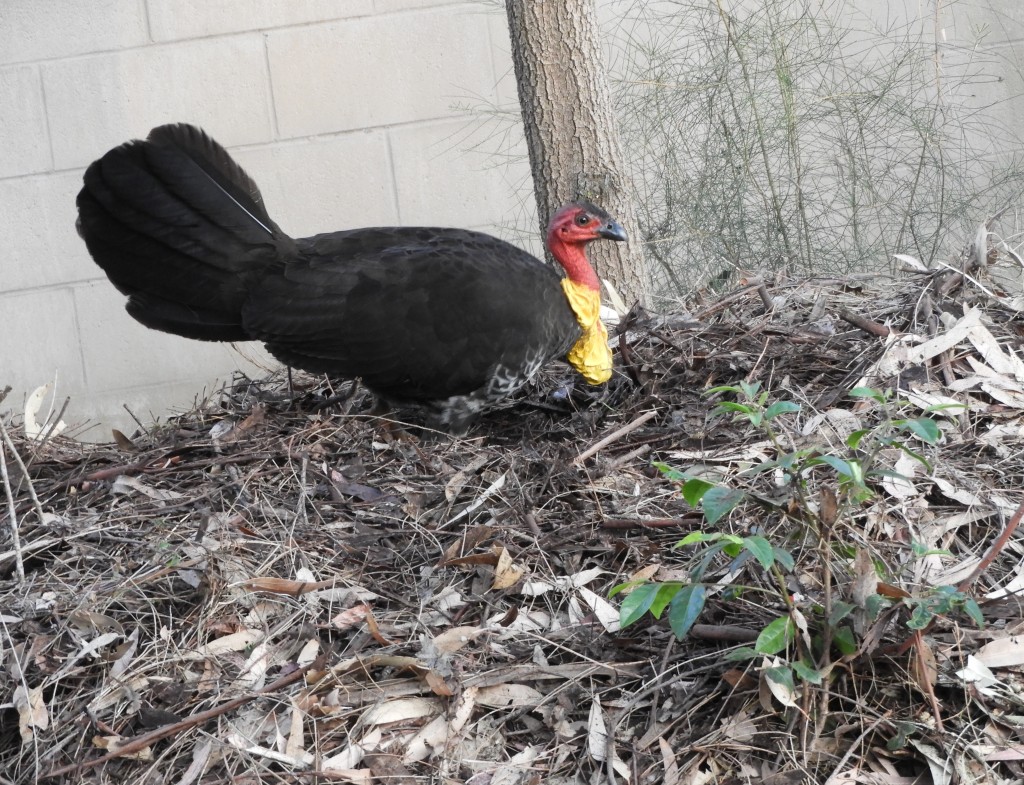
Common name: Australian Brush-turkey
Scientific name: Alectura lathami
Approximate length: 60-70 cm
Date spotted: 25 October 2020 (spring)
Location: Outside Manly Dam Park, New South Wales, Australia: 33°46’54.1″S 151°15’28.3″E

Noisy currawongs enjoying blueberry ash berries
Currawongs are intelligent, curious, and noisy birds. The Australian dawn and dusk ring with their calls. Yesterday I was walking along a bush path when I heard a tremendous ruckus up ahead in the treetops. Currawongs whistling and whooping, branches swishing, and twigs clattering to the ground.
“Uh-oh,” thought I. “What have they found? Some possum caught in the harsh light of the day, or a bird of prey that dared to venture into currawong territory?”
The sound was all round me. At first it was difficult to find a single bird to focus the camera on:
Drawing closer, I saw the source of all the fuss. The blueberry ash trees are fruiting. Here’s a closeup of the berries from one of the trees that the currawongs were feasting on. The berries are small, and a pretty blue in colour. If you look closely, you can see the characteristic tiny yellow spots on the berries:
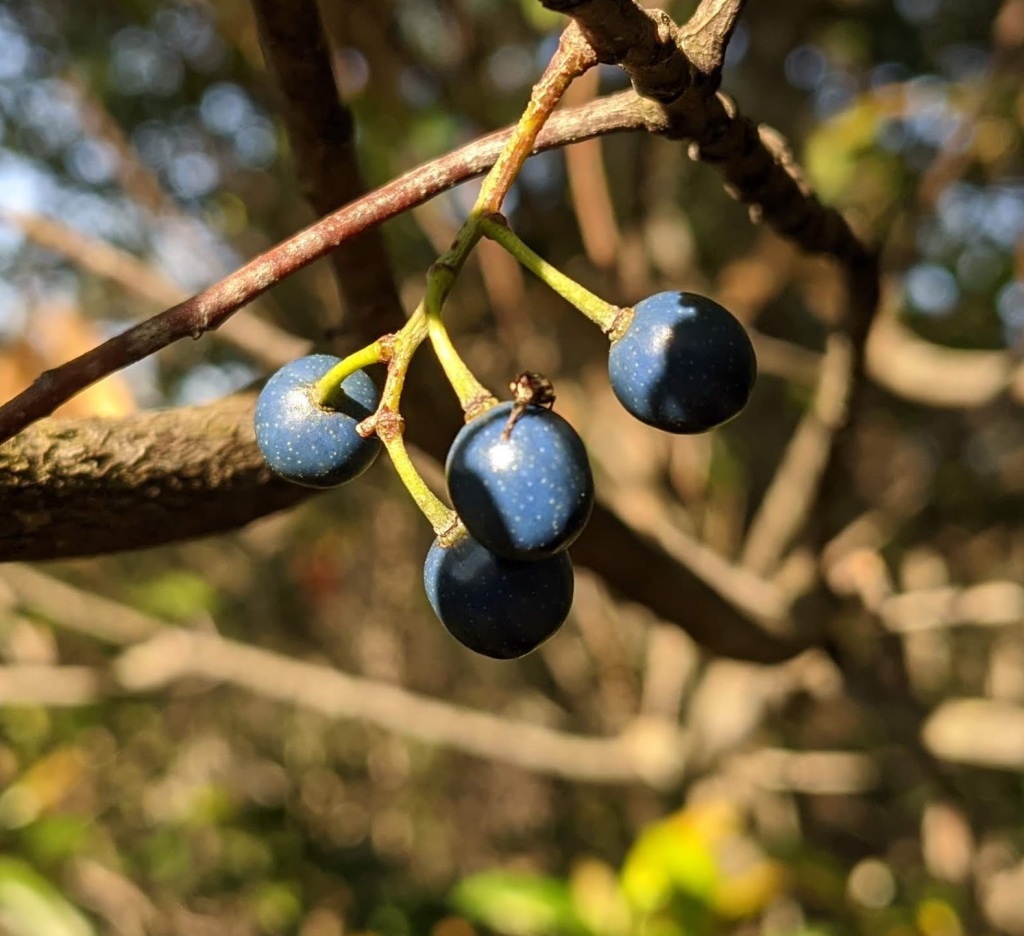
It seems these berries are irresistible to a currawong. What’s more, from all the commotion, you’d think there weren’t enough berries to go round! In the next video, I managed to catch some pictures of the currawongs themselves. At times you can hear a butcher bird interjecting too:
Here’s a cheeky glare from one of the critters making all the noise:
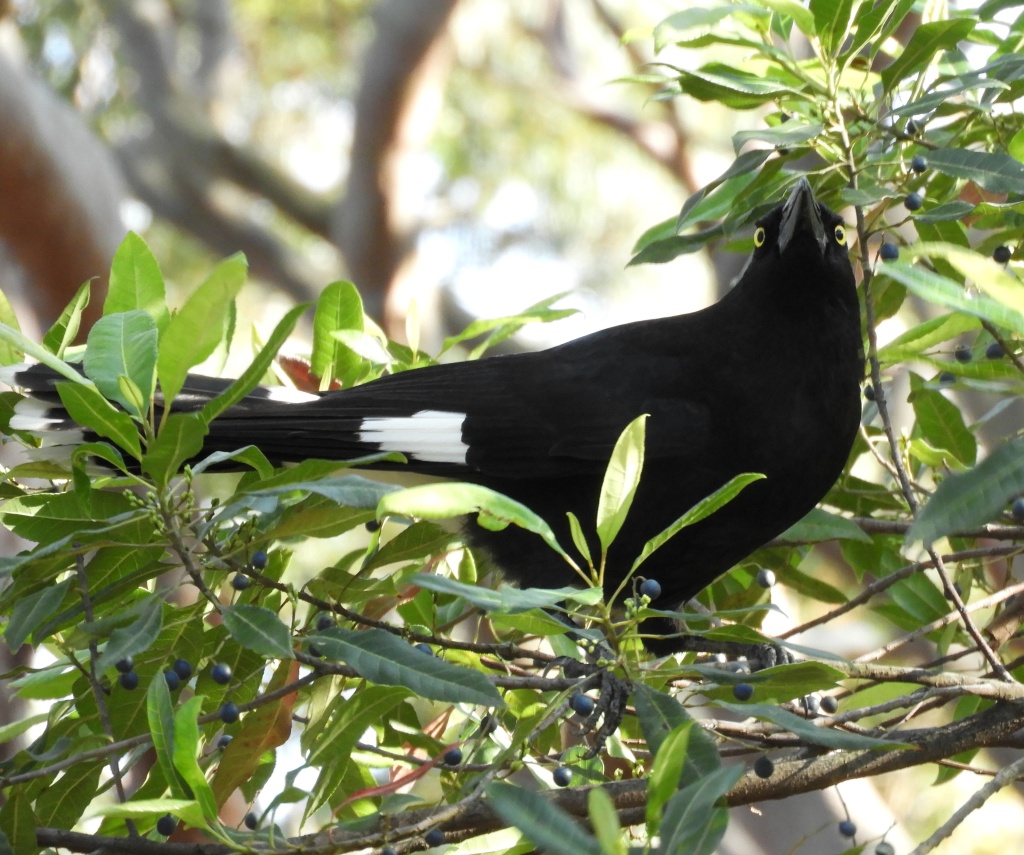
Common name: Pied Currawong
Scientific name: Strepera graculina
Approximate length: 45 cm
Date spotted: 3 October 2020 (spring)
Location: Manly Dam Park, New South Wales, Australia: 33°46’28.2″S 151°14’58.4″E
3 Glossy Black-Cockatoos and a tale of a Brush-turkey and a Raven
Two days ago, I encountered a group of three Glossy Black-Cockatoos on a Casuarina tree. These large cockatoos are not a very common sight. When I noticed them, I stopped walking and said “ooh” out loud. Luckily there was no-one around to hear, and the birds ignored me!
While I was watching the cockatoos, a couple of other characters appeared and contributed to the encounter. Read the story below!
First, the glossies
This picture shows two of the Glossy Black-Cockatoos. They’re quite different in appearance from the more common Yellow-tailed Black-Cockatoos. The feather arrangement around the glossies’ necks and the general setting of their heads make me think of a lion:

I think the bird on the left is a female, as she has a lot of yellow around her head. The one on the right is, I think, a male.
In the video below, the birds are munching happily on Casuarina seed pods. About half way through the video (at around 50-53 seconds on the timeline) the birds mutter to each other in low-pitched raspy calls. This munching and muttering is typical of the birds’ behaviour.
Below is a solo shot of the first of the three birds. This one has a lot of yellow around its head, which means it’s probably a female:
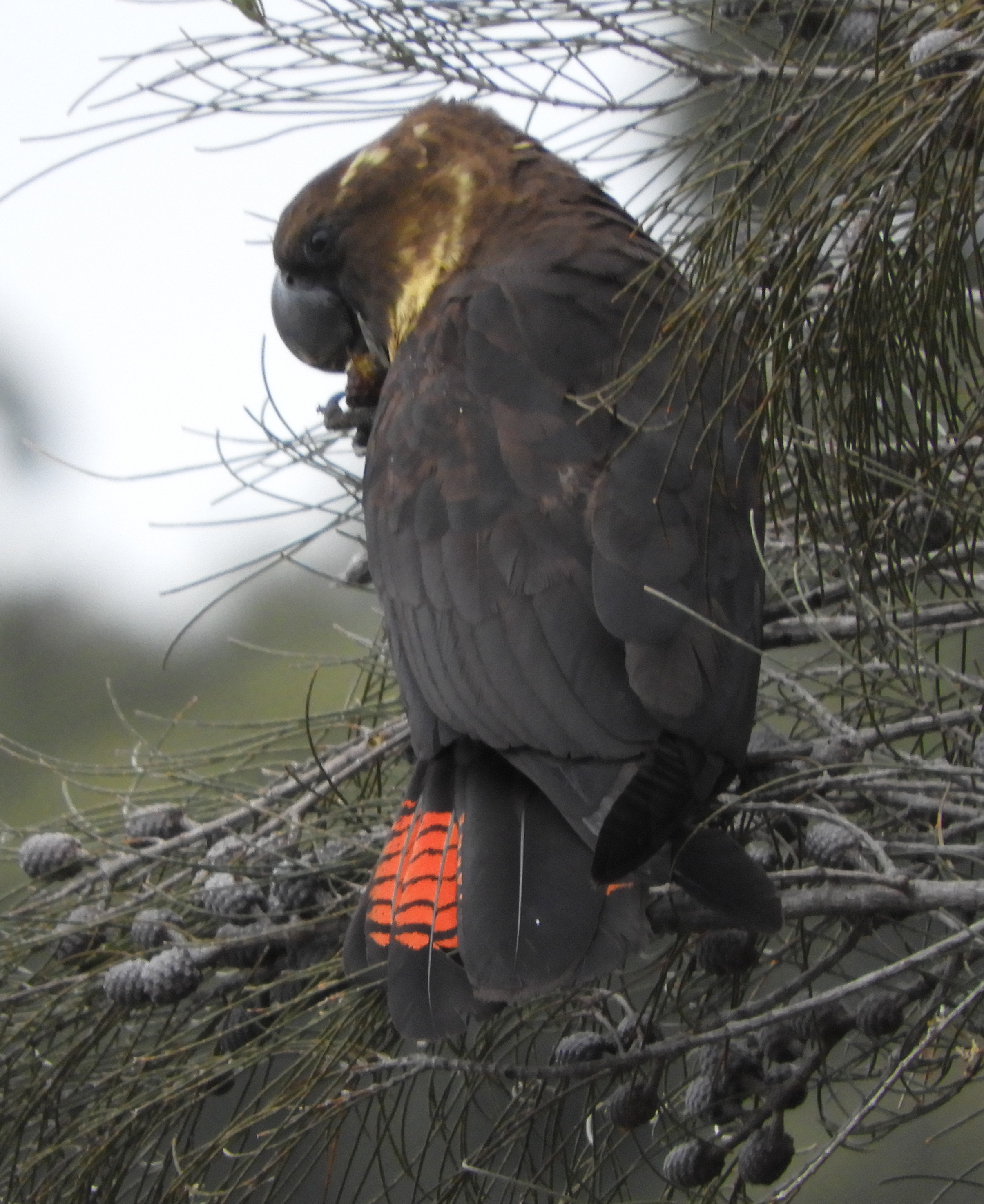
Glossy Black-Cockatoos depend on Casuarina seeds for their food. This choosiness puts the birds at risk when the tree coverage is depleted by land clearance or bush fires. Casuarinas, also called sheoaks or she-oaks, are a group of trees and shrubs native to Australia and other Asian countries. Evidently the name Casuarina is derived from cassowary (a big bird) because the branches look like cassowary feathers.
Next comes a solo shot of the second of the three birds. I think this one is a male. The feathers around its head and neck are quite brown in comparison to the darker black feathers on the rest of its body. The bird is holding a Casuarina seed pod. You can also see a few of the tree’s tiny red flowers:
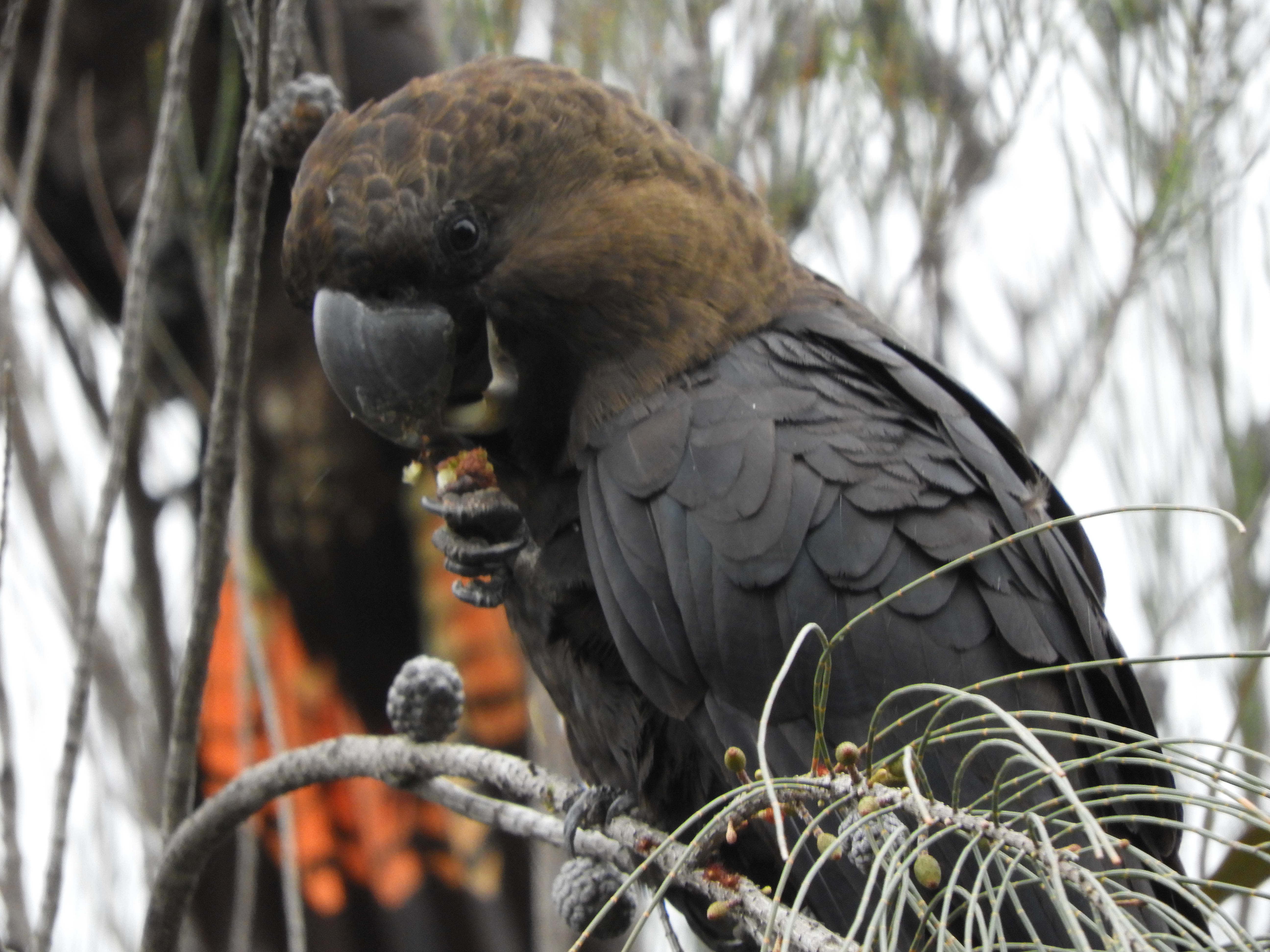
It’s a treat to see these unusual, gorgeous birds. Definitely a moment for oohing and aahing.
Unwell Glossy Black-Cockatoo – beak and feather disease?
One of the three cockatoos has an illness which has affected its beak. It may be Psittacine beak and feather disease, or some sort of cancer, or maybe the result of a fight or accident?

I didn’t notice the hole above the bird’s beak until I got the pictures home and put them on a big screen. The birds were quite a distance away, and I was using my camera’s super zoom to photograph them. But even from the long distance, I did think that the bird looked duller and more skeletal than the other two.
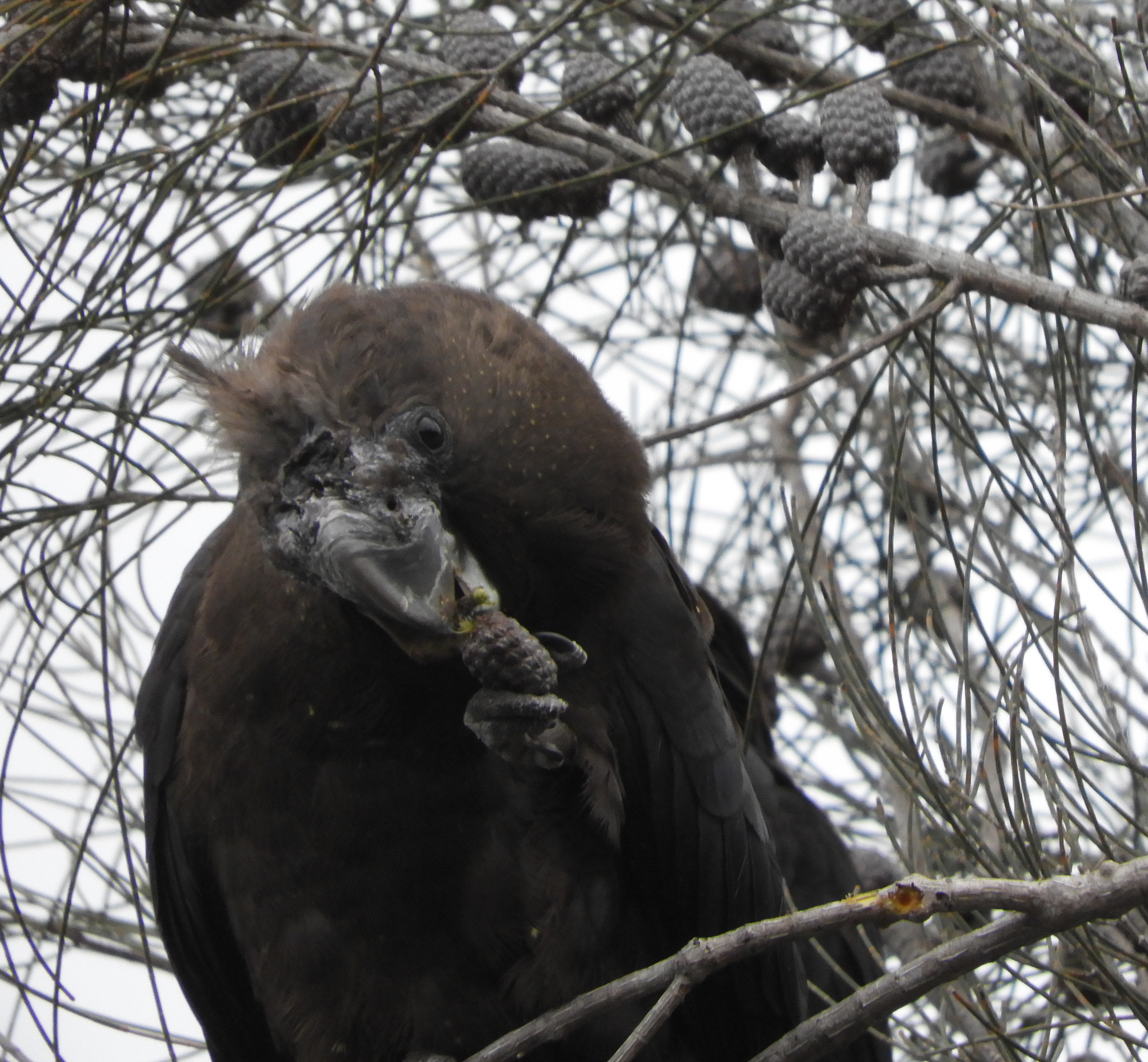
Poor bird, I hope the condition isn’t causing it too much discomfort.
Video featuring the female Glossy Black-Cockatoo
Here’s another video of two of the birds, this time featuring the female. Hint: At the start of the video you can hear a bit of thrashing around in the undergrowth. That background noise leads into the story below!
Common name: Glossy Black-Cockatoo
Scientific name: Calyptorhynchus lathami
Approximate length: 50cm
Date spotted: 18 September 2020 (spring)
Location: Manly Dam Park, near Sydney: 33°46’55.0″S 151°15’10.1″E
A tale of a Brush-turkey and an Australian Raven
If you listen carefully in the first half of the above video, you’ll hear a bit of a kerfuffle in the background. I heard it too, and turned to look when I stopped filming. I saw an Australian Brush-turkey flapping around among the trees a few metres away from me. “Ah, just a brush-turkey,” I thought, and turned back to the cockatoos. Brush-turkeys seem to specialize in making a fuss about nothing.
The kerfuffle turned into a whoosh of large wings, followed by a downdraft of air and the sound of claws on metal. I turned around again, to discover that the brush-turkey had landed on a gate less than two metres away from me. (The gate was one of those that the authorities use to close the park when the danger of bush fires is critical.)
“Hallo, mate,” said I. “What are you up to?” I do talk to birds when they approach me, partly to make us both feel comfortable.
The brush-turkey look at me, then teetered slightly and looked down at the ground with some apprehension. They do that, when they’re off the ground. They’re no doubt thinking, “I got myself up here, but now that ground is a long way down. How do I get down there?”
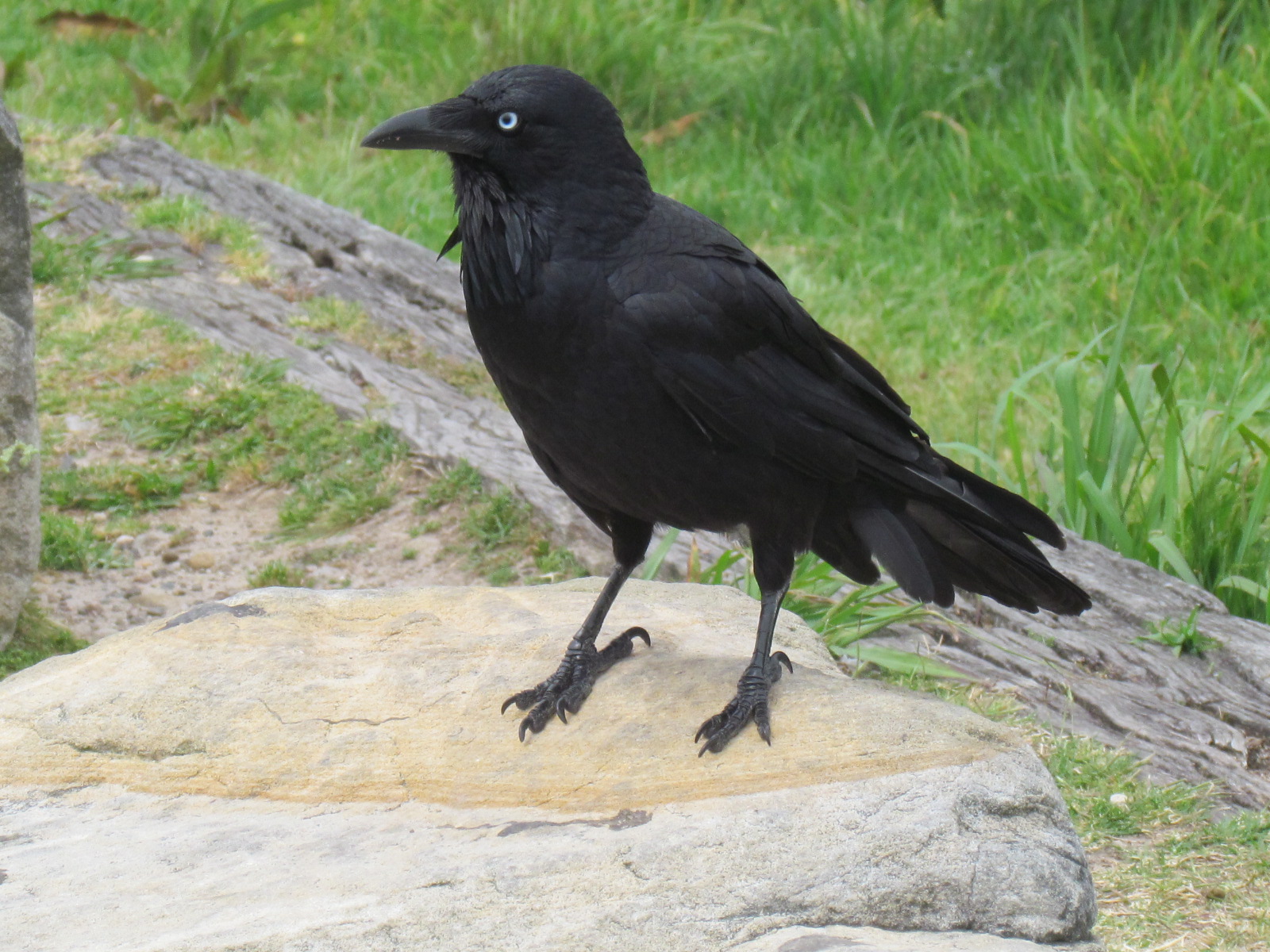
Two seconds later, a large, fierce Australian Raven arrived. Eyes ice blue. Beak long, strong, and pointy. Being the focus of that glare is rather daunting, even if you’re a large human.
The raven glared at me. I stood my ground. One point five metres of empty space between me and that beak.
The raven decided I wasn’t a threat, and turned its attention back to the brush-turkey. Obviously, the raven wanted to continue the altercation that had been the cause of all that kerfuffle in the trees.
The brush-turkey looked at the raven, looked at me, and hopped off the gate. A few hurried steps, and it was at my feet. It got as close to my knees as it could, then started walking round my legs. When it comes to a choice between a raven and me, it seems I’m a safe haven.
The raven looked thoroughly peeved. It leapt into the air and spotted the Glossy Black-Cockatoos, who were still peacefully munching and muttering in the Casuarinas. With a caw and a swoop, the raven dislodged the glossies. They floated into the air with easy grace, and came to land again a few trees away. “Ah, ravens,” the glossies were no doubt thinking. “They seem to specialize in making a fuss about nothing.”
The brush-turkey was still jittering around my legs. I wanted to continue filming the cockatoos, so I waited for a gap in the brush-turkey’s circle, and strode out along the path towards the cockatoos’ new roosting area.
Within a second, I heard the tick-tick-tick of brush-turkey claws on the path. The turkey had decided to stay with its safe haven for a while, in case that nasty bird with the ice-blue eyes and big strong beak came back.
So there we were, the cockatoos munching and muttering, I oohing and aahing, and the brush-turkey click-clacking companionably at my heels.
I wish I’d got all of that on camera! Anyway, I hope you enjoyed the story. 🙂
Here are a couple of pics of a brush-turkey and a raven, though these are not the same birds that appear in this story.

Two varieties of the Eastern Whipbird call
The call of the Eastern Whipbird is a fairly common sound, for those of us lucky enough to live near a patch of Australian bush. The birds make a weird whistling noise that ends in an abrupt burst of noise, a little like the crack of a whip. Hence the name whipbird.
In the first of these two videos, the bird ends its call with an upward tone, while in the second video it chooses a descending tone. First, the upward tone:
Next, the more squeaky downward ending:
The call seems to take a lot of effort, including a little hop and a flap of the wings. I was surprised at how short the bird’s wings are. They seem quite stubby, compared with the elegance of the rest of the body.
Whipbirds are shy, sticking to the undergrowth and making it difficult to get a good picture. Here’s a photo that shows the olive green colouring of the bird’s feathers:

Common name: Eastern Whipbird
Scientific name: Psophodes olivaceus
Approximate length: 30 cm
Date spotted: 3 September 2020 (early spring)
Location: Manly Dam National Reserve, New South Wales, Australia: 33°46’36.2″S 151°14’47.9″E
Masked Lapwing (Spur-winged Plover) screeching
A pair of Masked Lapwings (also known as Spur-winged Plovers) strutted companionably on the shore of Manly Dam. Every so often, one of them took off and flew a circuit around the area. The bird left on the ground started calling, and watched the progress of its companion carefully from the ground. The bird in the air replied occasionally, as if to assure its mate that it was still around.
To me, the yellow attachments on the faces of these birds seem rather strange. I guess they do make the birds stand out from other species. Not much chance of making a mistake when a bird is looking for a mate!
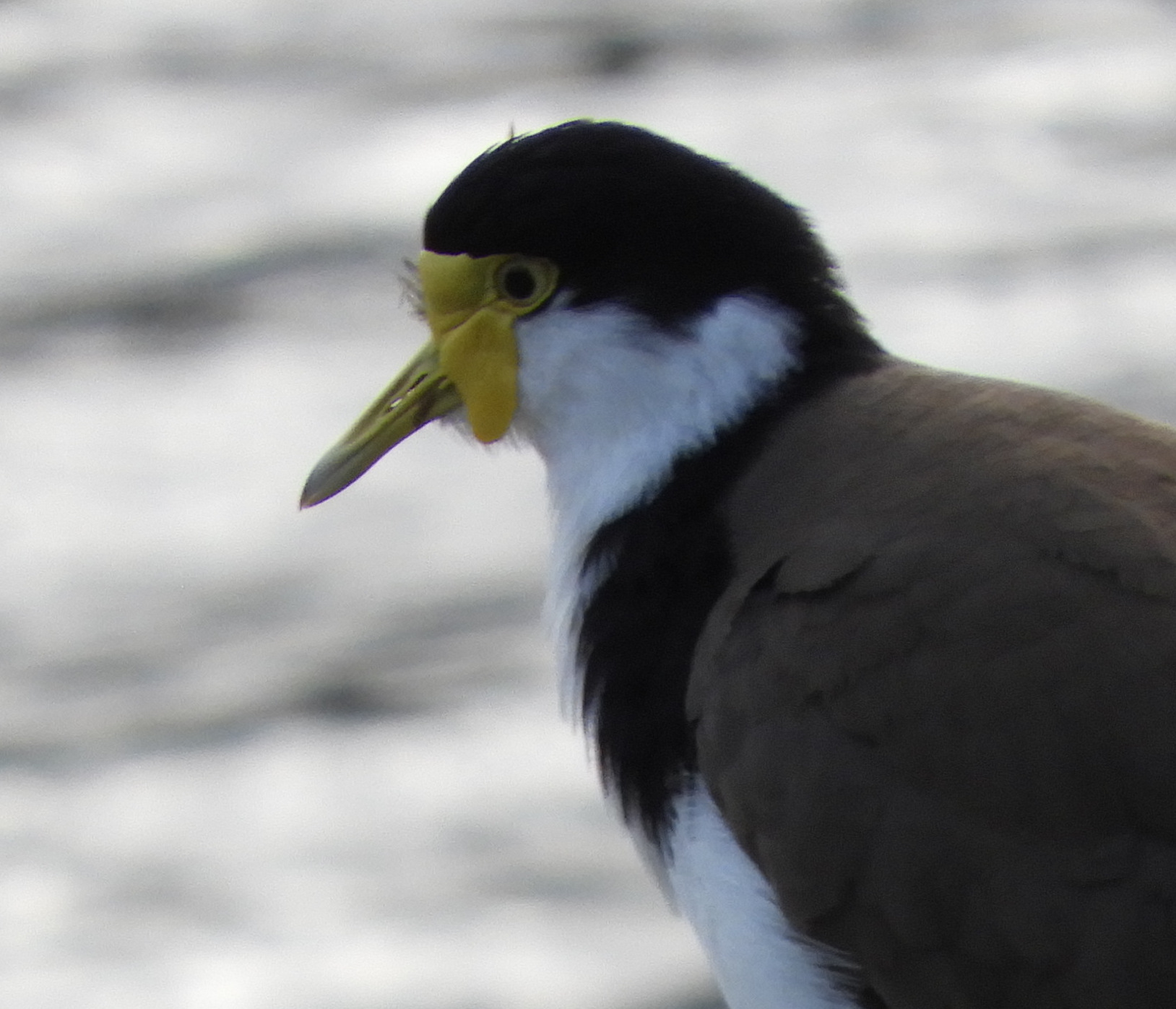
The birds have two names: Masked Lapwings, due to that strange yellow mask, and Spur-winged Plovers. The second name comes from the hooks (spurs) on the birds’ wings that they use to fend off any creature that threatens them or their young. If a Spur-winged Plover flies at you, it’s best to duck or hold your arms around your head!

Common name: Masked Lapwing, or Spur-winged Plover
Scientific name: Vanellus miles
Approximate length: 37 cm
Date spotted: 8 August 2020 (winter)
Location: Manly Dam Nature Reserve, New South Wales, Australia: 33°46’35.0″S 151°14’50.4″E
Little Corella and Sulphur-crested Cockatoo
Yesterday I came across a large group of Little Corellas on the sidewalk. In the midst of them was a Sulphur-crested Cockatoo. It was interesting to see the two birds up close, because from afar they look very similar. This video shows an interaction between the cockatoo and one of the corellas. You can also hear the corellas chatting to each other constantly.
These two corellas were cuddling up:
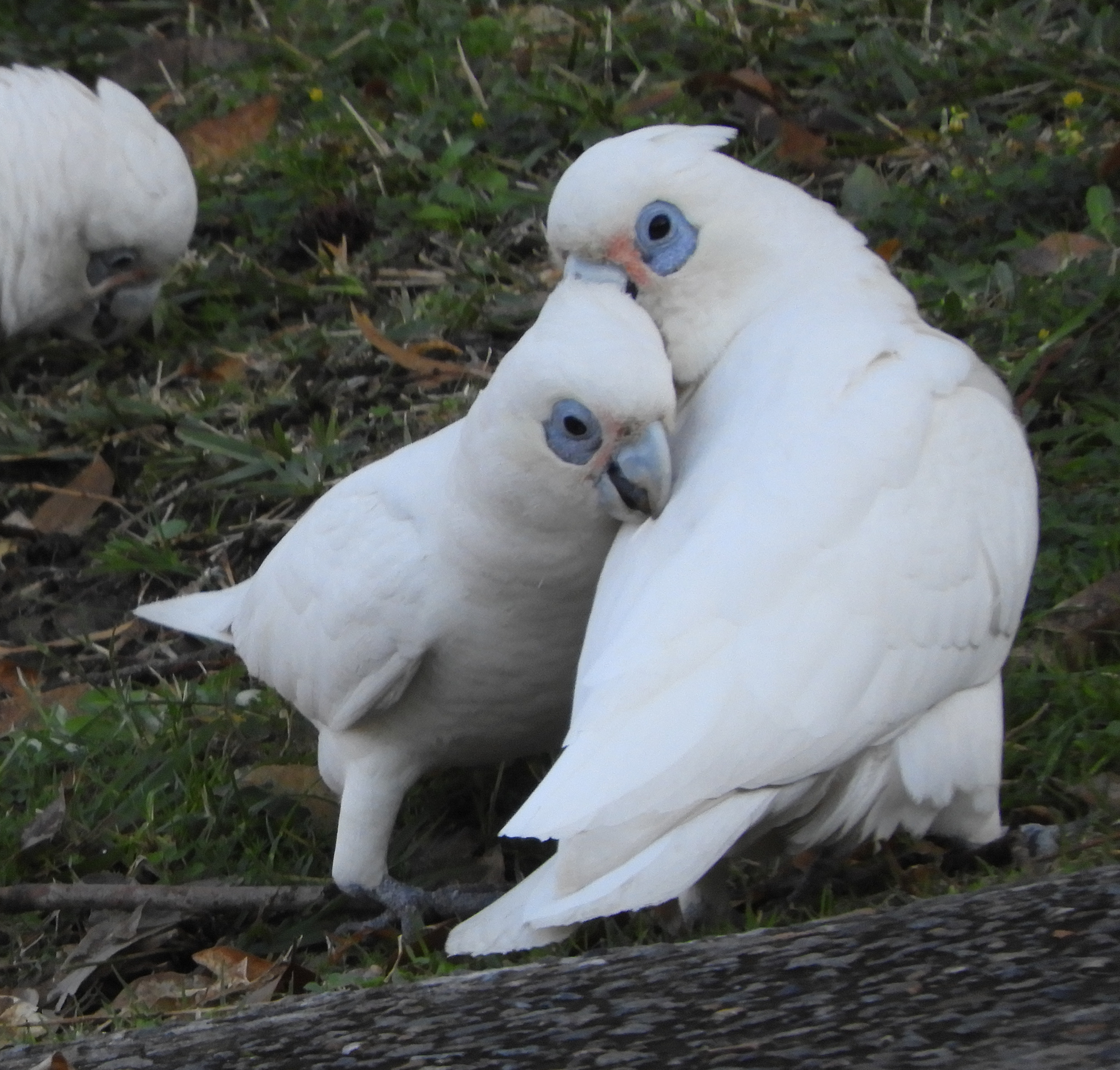
The crest of a Little Corella is white, and smaller than that of a Sulphur-crested Cockatoo:

Little Corellas have blue-grey feet, a blue patch of skin around the eye, and a pinkish patch of feathers between the eye and beak. The birds’ overall colouring makes them look rather cadaverous!
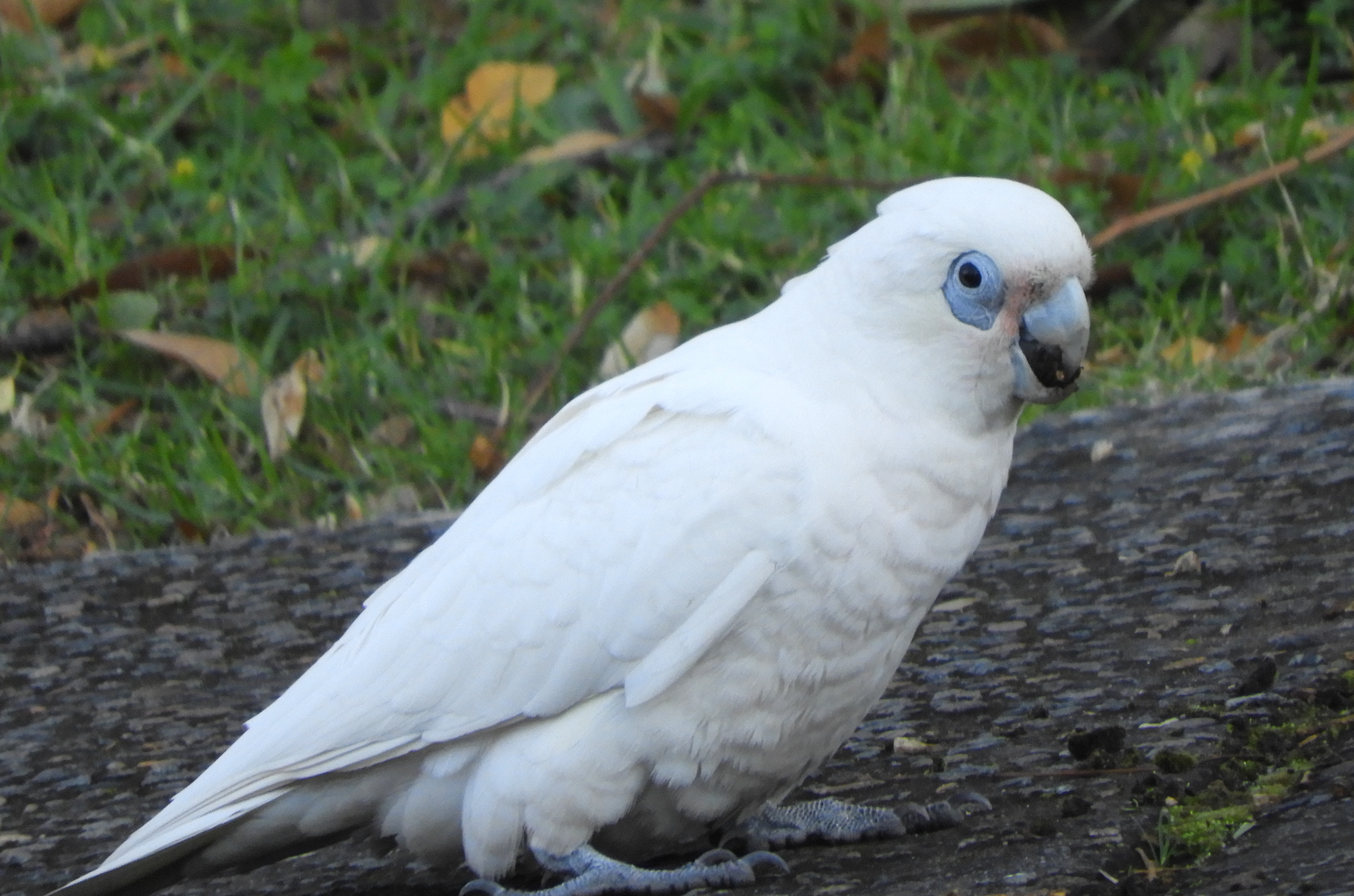
Common name: Little Corella
Scientific name: Cacatua sanguinea
Approximate length: 36-39 cm
Date spotted: 23 May 2020 (autumn)
Location: Allambie Heights near Sydney, Australia
Yellow-tailed Black Cockatoos in the garden
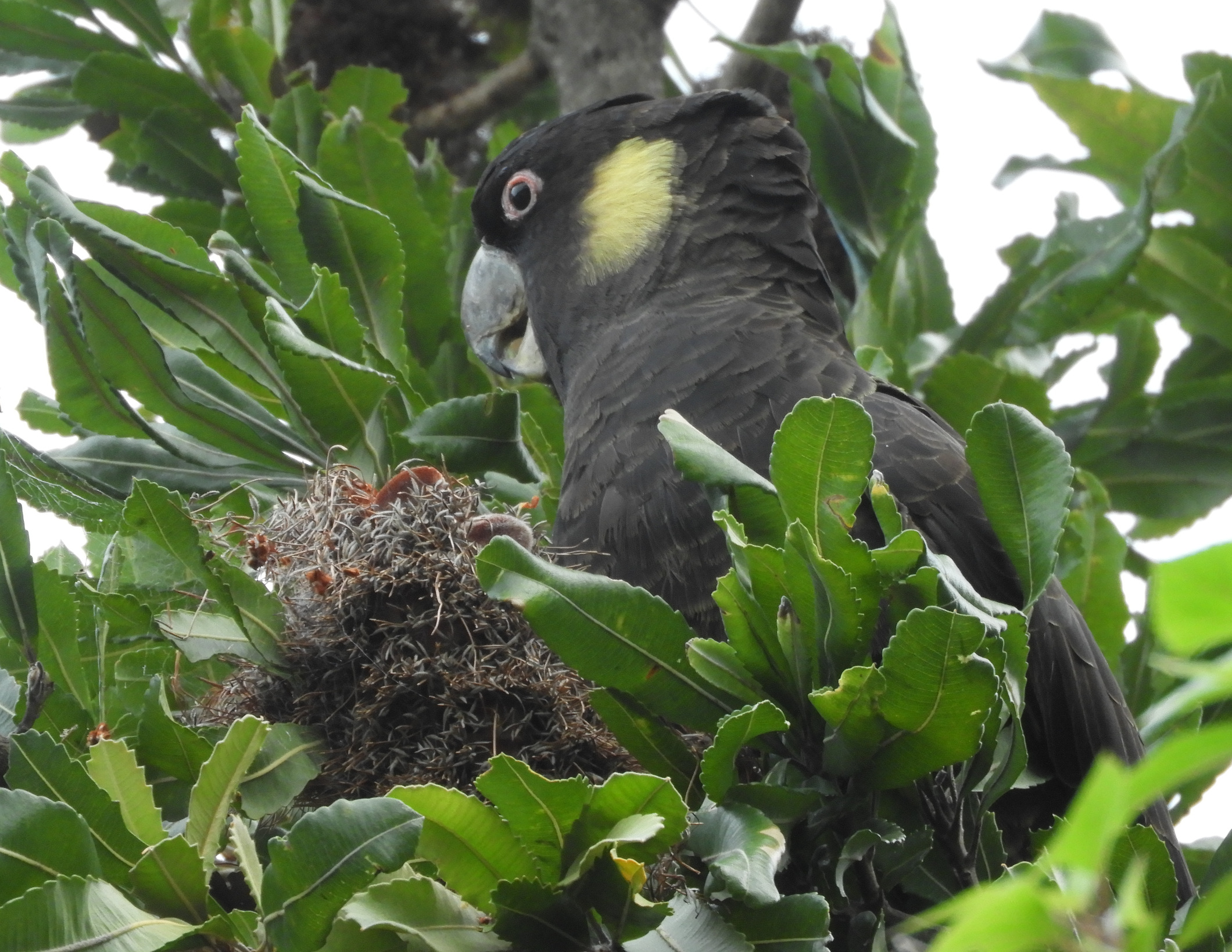
Three Yellow-tailed Black Cockatoos dropped in this afternoon. They chatted to each other with their weird squealing call, while demolishing parts of our Old Man Banksia bush.
Here’s one of the birds. The pink ring around the eye identifies it as a male:
In this short video, you can hear them chatting to each other:
It’s lovely to have these big, gracious birds paying us a call.
Common name: Yellow-tailed Black Cockatoo
Scientific name: Calyptorhynchus funereus
Approximate length: 65 cm
Date spotted: 20 May 2020 (autumn)
Location: Allambie Heights, NSW, Australia
Kookaburras at dawn
In my previous post about birdsong at dawn, I mentioned that dawn is a calm but not quiet time around here. One bird that was remarkable for its absence in yesterday’s video was the kookaburra. This morning the laughing cacklers made up for that!


 Sydney Birder