Blog Archives

Did the big scary lizard make the Mudlarks abandon their nest?
For a few weeks now, I’ve been watching a pair of Mudlarks building their nest. In fact, they’ve built two nests. The first one looked good and solid from my vantage point, far away and down at ground level. But a couple of days after they’d finished it, they abandoned it and started a new one higher up in the same tree.
Mudlarks, also called Magpie-larks or Peewees, build neat round nests that are basically bowls made of mud. This video shows a male Mudlark collecting mud and reeds at the water’s edge. When he has a good collection, he flies off towards the nest that he and his mate are constructing. As the bird flies, a couple of Kookaburras start cackling, and one of the Mudlarks gives its distinctive call: “pee-wee pee-wee pee-wee”.
Here’s the male Mudlark on mud collection duty:

The next video shows the first nest under construction. The bird prods and pushes mud into the walls of the nest, then sits flat and wiggles its tail end to shape the nest.
As well as building walls, nest construction also involves sitting on the nest and wiggling back and forth to get the shape right:

The nest was looking good, I thought. But several days later, a decision is made. The birds abandon their first attempt and start a new nest, higher up in the same tree:
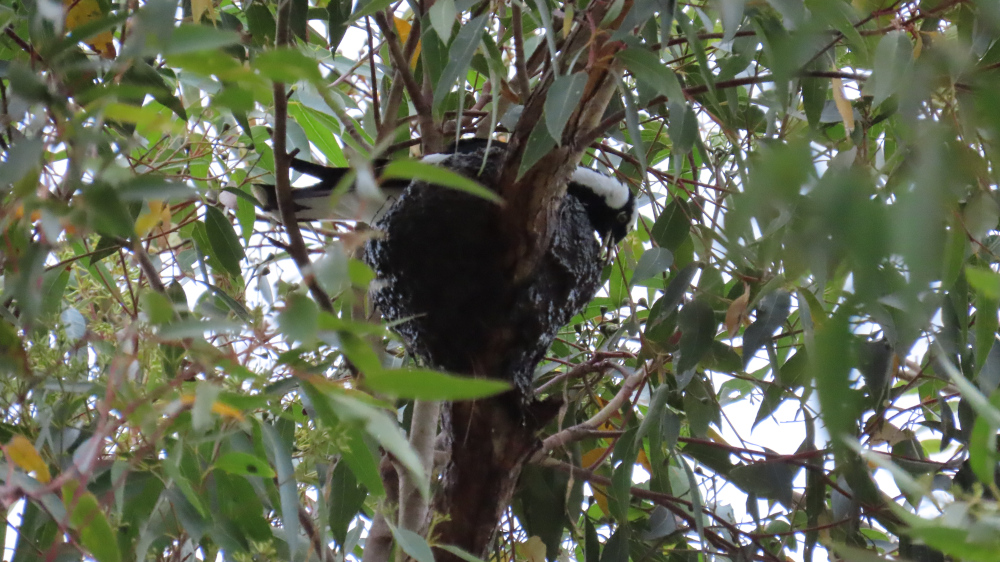
They’ve chosen a lovely spot, at the edge of Manly Dam. The next video shows one of the birds building the second nest. The second bird arrives with a beak-ful of mud, and takes over construction. The video then zooms out and in again to show the first nest on a lower branch, then zooms out further to show the dam and some of the neighbours (a Little Black Cormorant and a Great Egret).
Aside from the occasional noisy cockatoo, the neighbours are quiet for the most part — like this Great Egret:

And a few water dragons:

But the park does get quite busy over the weekend. Families hold picnics nearby, and children paddle in canoes. Perhaps the birds moved higher to avoid the weekend disturbance.
Perhaps the first nest didn’t meet quality assurance checks. Or perhaps the two parents-to-be spotted the large, scary intruder in the neighbourhood: a Lace Monitor lizard. I took this video of the lizard prowling around the tree where both nests are. Lace Monitors eat eggs and baby birds, and are very good at climbing trees. The Mudlarks’ second nest is higher in the tree and on thinner branches, which would make it much more difficult for the lizard to reach.
Lace Monitors are the second-largest lizards in Australia. They measure 1.5 to 2 metres long — longer than I am tall, and their hands are as big as mine! Here’s a close-up of the Lace Monitor on the move:
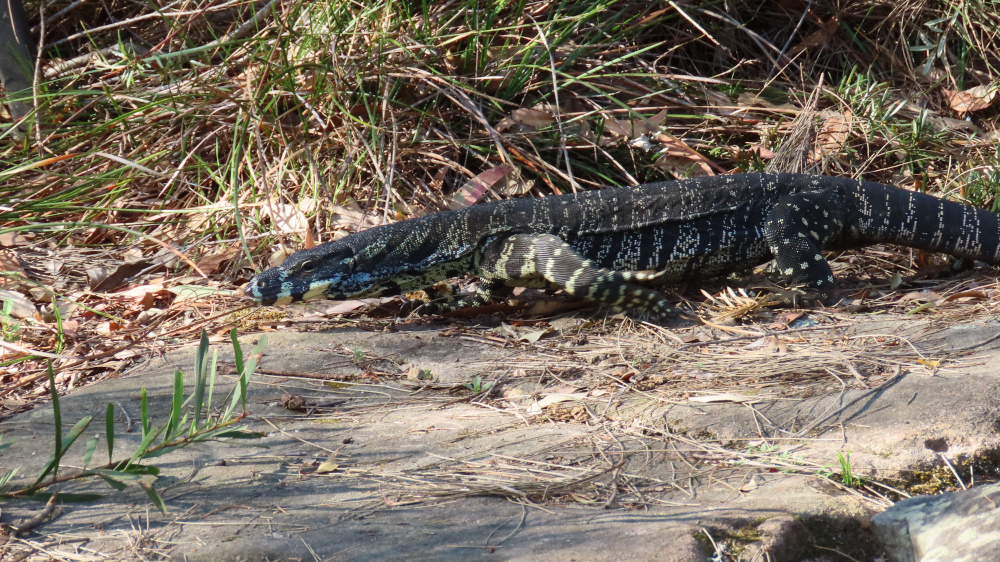
When I got too close with my camera, the lizard crouched down and went into stealth mode:

The Mudlarks are still sitting happily on their new nest. Here’s the male:

And here’s the female:
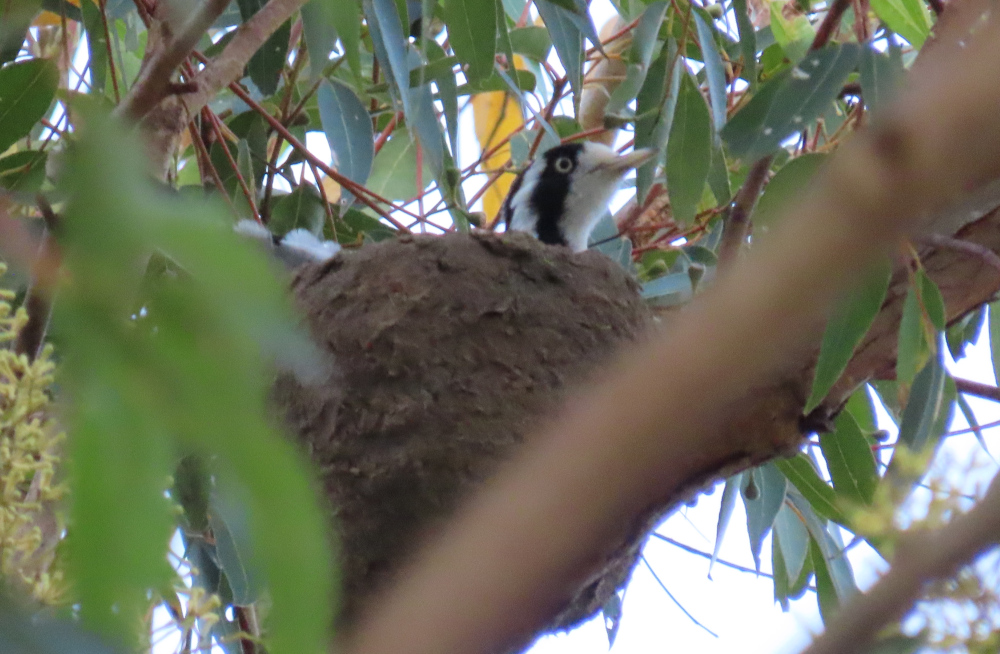
Good luck to them and their new family!
Common name: Magpie-lark, also called a Peewee or a Mudlark
Scientific name: Grallina cyanoleuca
Approximate length: 30 cm
Date spotted: August to September 2024 (summer)
Location: Manly Dam National Park, New South Wales, Australia

Call of the Sacred Kingfisher
Ever wondered what a kingfisher sounds like? Well, you’ll know after watching this video, for a Sacred Kingfisher anyway. The call is a series of chirps, all on more or less the same note. Not very exciting really, for such a pretty bird! You hear them mostly around breeding time, when the calls can be quite insistent.
At the start of the video, you see and hear the kingfisher calling. The camera then zooms out to show the surroundings, including a Great Egret, a Darter, and a Coot. The scene is set at Manly Dam in Sydney’s Northern Beaches.
Set the video settings to HD for best results:
Despite their name, these kingfishers don’t often eat fish! Instead, they prey on small reptiles and large insects, and occasional crustaceans from the water’s edge.
Common name: Sacred Kingfisher
Scientific name: Todiramphus sanctus
Length: 20-23 cm
Date spotted: 8 September 2024 (spring)
Location: Manly Dam Park, New South Wales, Australia: 3°46’31.2″S 151°14’46.6″E

Currawong crazy hour
An excited group of currawongs made our backyard the centre of their activity yesterday afternoon. The commotion lasted at least half an hour. Birds dashed back and forth, calling and flying noisily past each other. Parents of young children will sympathise with the term “crazy hour”, sometimes called the “witching hour”, in late afternoon — it seems to apply to currawongs too!
Common name: Pied Currawong
Scientific name: Strepera graculina
Approximate length: 45 cm
Date spotted: 31 August 2024 (end of winter)
Location: Allambie Heights, north of Sydney, New South Wales, Australia

Golden Whistlers calling
It’s a lovely experience walking through an Australian forest, with Golden Whistlers calling around you. In this video, the bird appears only as a shape flashing through the branches. There’s also a Grey Fantail echoing the whistler’s call:
That video is from my Soothing Musings channel. I’ve included it here because it’s such a tranquil scene.
The next video shows one of the birds calling to his mates:
At the start of the video, some Sulphur-crested Cockatoos are screeching, but they quieten down eventually. You can also hear a Grey Fantail at about 26 seconds into the video and again at the end. There’s an Olive-backed Oriole calling in the distance too.
Golden Whistlers are small birds, about the size of a wren. They have a black head, a white bib, and the golden chest, underbelly, and collar that gives them their name.

Common name: Golden Whistler
Scientific name: Pachycephala pectoralis
Approximate length: 16-18 cm
Date spotted: 30 August 2024 (end of winter)
Location: Manly Dam Reserve, New South Wales, Australia: 33°46’50.3″S 151°14’51.7″E

Three whipbirds calling
The noise that whipbirds make is strange: “eeeuuw-phwit”. It reminds people of a whip whistling and cracking, and that’s what gives the bird its name.
In this video, at least three Eastern Whipbirds are calling to each other. Twice in the video, you can hear two of them doing the long drawn-out whistle at the same time: the whistle vibrates and little. When you hear two (or three) chirps after the whistle and crack, like “eeeuuw-phwit-pheeuw-pheeuw”, the last two (or three) chirps are actually made by a second bird. The final chirps come so close after the first call that it sounds like one bird.
As you can see in the video, whipbirds are very good at hiding in the bushes. It’s hard to get a good picture. They’re quite pretty, in a subdued, forest-loving way.
Here’s one of the birds:

Its head and neck are black and white, with a nice little crest. The back and tail are a soft forest green. Here’s the same bird from a different angle:

Common name: Eastern Whipbird
Scientific name: Psophodes olivaceus
Approximate length: 30 cm
Date spotted: 22 August 2024 (winter)
Location: Dobroyd Head in Sydney Harbour, NSW, Australia: 33°48’35.6″S 151°16’04.6″E

Lyrebird imitating a shooting game and several birds
It was a rare treat to find this Lyrebird in Sydney’s Northern Beaches. The bird was dancing, displaying his tail, and calling. He had an impressive repertoire, including the pieuw-pieuw sounds of an electronic shooting game and the calls of various birds.
Hint: For the best experience, increase the default quality of the video. (Use YouTube’s cog icon to update the settings.)
At the start of the video, the Lyrebird is searching through the leaves and twigs on the ground. The rushing noise in the background is a small waterfall nearby. The bird starts gently crooning and chirping to himself. (Turn up the volume to hear the mutterings.) Then the urge to sing overcomes him, and he starts his performance. The full display starts at about 50 seconds into the video, with the rattling and pieuw-pieuwing of an electronic shooting game accompanied by side-to-side and frontwards steps. He mingles some bird chirps into the shooting sounds for dramatic effect. Next come the bird sounds. I heard the start of a kookaburra call, though he didn’t get fully into it. (He did the full call in another performance, which I haven’t posted here.) He adds the calls of magpies, wattlebirds, lorikeets, and whipbirds. I think I hear a Yellow-tailed Black-cockatoo and a magpie in there too, and other birds that I haven’t identified.
Between performances, the little fellow spent some time resting and picking through the leaves before starting up again.
The bird kept to the shadiest spots, making it hard to get a good photo. This is the best that I managed:

Common name: Superb Lyrebird
Scientific name: Menura Novaehollandiae
Length: 80-95 cm
Date spotted: 18 July 2024 (winter)
Location: Sydney’s Northern Beaches, New South Wales, Australia

Butcherbirds sang to me!
Early one morning, at the place I was staying at near Brisbane, two Grey Butcherbirds dropped down and sang to me.
It felt very special to have these birds come so close and sing their song. I suspect they were hoping I’d produce a snack. This is the first time I’ve had this experience, though a few magpies have sung to me in the past.
Here’s a still picture of one of the birds:
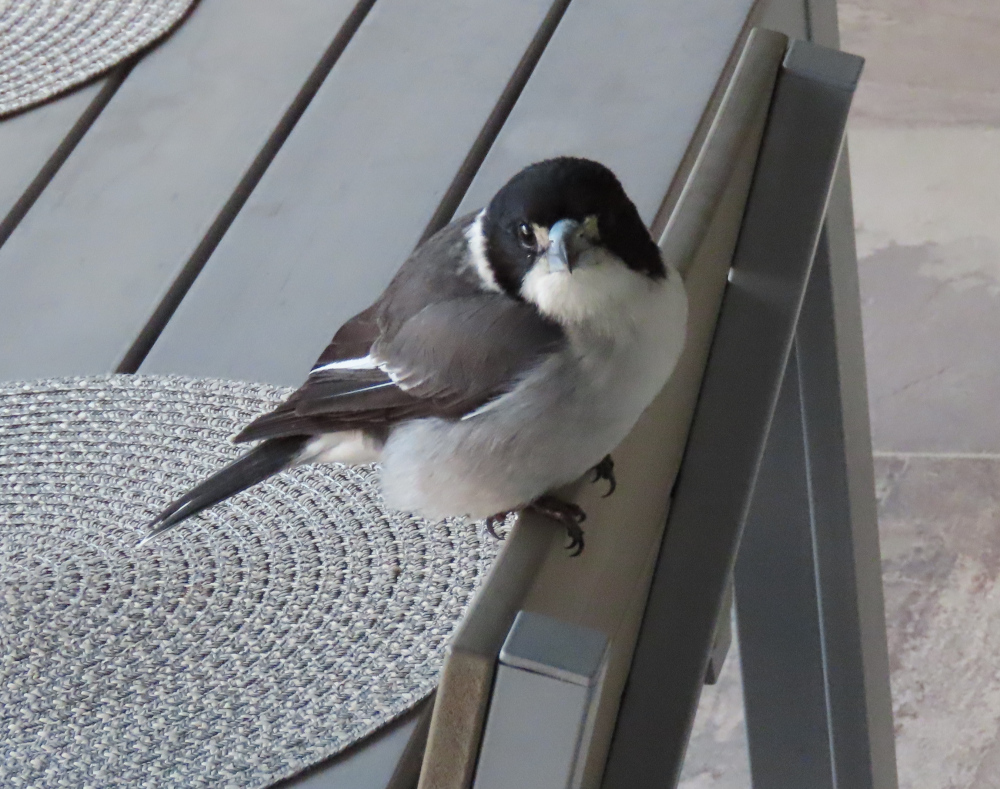
Butcherbirds are medium-sized songbirds, widely spread in Australia. They’re only distantly related to the South African shrikes that are also known as butcherbirds. Both groups of birds get their name from their habit of securing their captured prey on spikes or in crevices, to store the prey for youngsters or to make it easier to eat.
Common name: Grey Butcherbird
Scientific name: Cracticus torquatus
Approximate length: 30 cm
Date spotted: 6 July 2024 (winter)
Location: The Gap, Brisbane, Queensland, Australia: 27°26’55.3″S 152°55’50.2″E

Black Cockatoo feeding a youngster
Every six months or so, a group of Yellow-tailed Black Cockatoos come to our Banksia for a feed. They come for a few days in a row, then move on to find another feeding area.
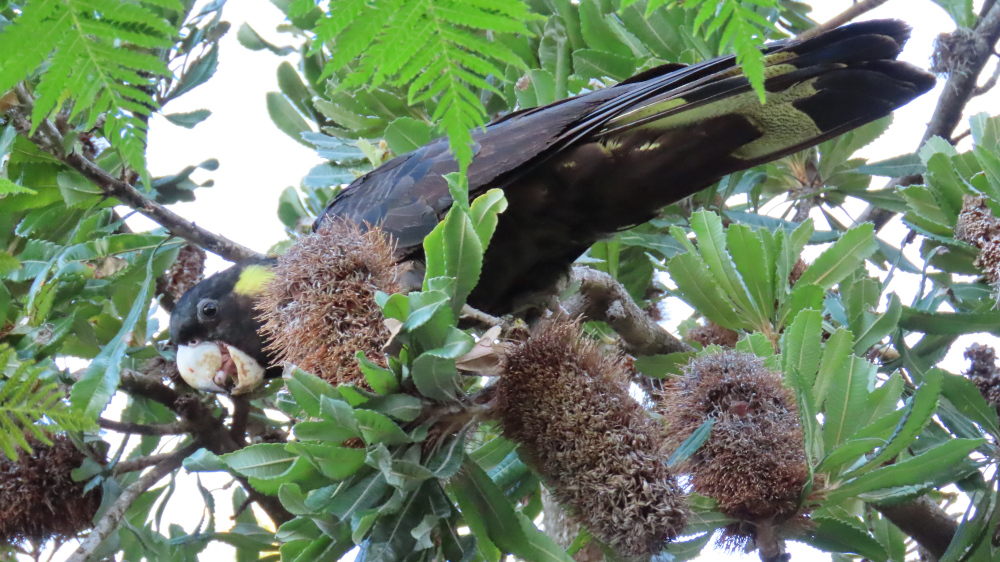
Sometimes they spend more time plucking and dropping than eating. Still, it always feels like such a privilege to have magnificent creatures like this just dropping by. I love the wild, screaming noise that they make. Some people call them the “squeaky door birds”:
The tree is a Banksia serrata, also known as Old Man Banksia.
On the birds’ second visit a day or so later, I filmed some interesting behaviour. One of the birds was making a continuous groaning noise. That’s not unusual, and I’ve wondered in the past if the bird is a youngster begging for food, or if it’s some kind of mating behaviour.
I think I have an answer! In this video, it looks like the male bird (he has a pink ring around his eye) is regurgitating food and then feeding it to the bird that’s making all the noise:
I added quite a lot of detail about these birds in a previous post: Those magnificent black cockatoos are back!
Common name: Yellow-tailed Black Cockatoo
Scientific name: Calyptorhynchus funereus or Zanda funereus
Length: 58-65 cm
Date spotted: 27th and 29th May 2024 (autumn)
Location: Allambie Heights, NSW, Australia

Evocative call of the Spiny-cheeked Honeyeater
This is the last of my posts from our recent trip out west into the Great Outback, and I’ve left the best to last. Like almost all my postings from this trip, this is a first sighting for me.
While I was wondering around on Mungo Lodge, on the outskirts of Lake Mungo, a beautiful, mournful whistle seemed to follow me. At first I thought a person was whistling. (There were other people taking photos in the area.)
Eventually, after ducking under the low branches of trees and taking plentiful photos and videos, I found the whistler: A Spiny-cheeked Honeyeater. Even then, I wasn’t sure, and asked for confirmation on r/AustralianBirds.
Here’s a Spiny-cheeked Honeyeater:

They’re distinctive-looking birds, with that pink line extending from the beak under the eye, a pale blue eye, and a cinnamon-yellow chest.
This video is a bit shaky, but shows one of the birds singing. The call that particularly struck me is the five-note, falling whistle, at 13 seconds into the video and then again at 25 seconds:
In the next video, it’s not as clear which birds are making the call, but there are some nice instances of the call itself, especially from 32 seconds into the video:
Another still shot of one of the birds:

Common name: Spiny-cheeked Honeyeater
Scientific name: Acanthagenys rufogularis
Approximate length: 23-26 cm
Date spotted: 20-21 May 2024 (autumn)
Location: Mungo Lodge, Mungo National Park, New South Wales, Australia: 33°44’31.4″S 143°00’06.1″E

Apostlebirds nesting and grooming
It’s been a long-time wish of mine to see an Apostlebird. In our recent Outback trip, my wish came true. Several of these birds congregated around Mungo Lodge, where we stayed during our two-day exploration of Lake Mungo and surrounds.
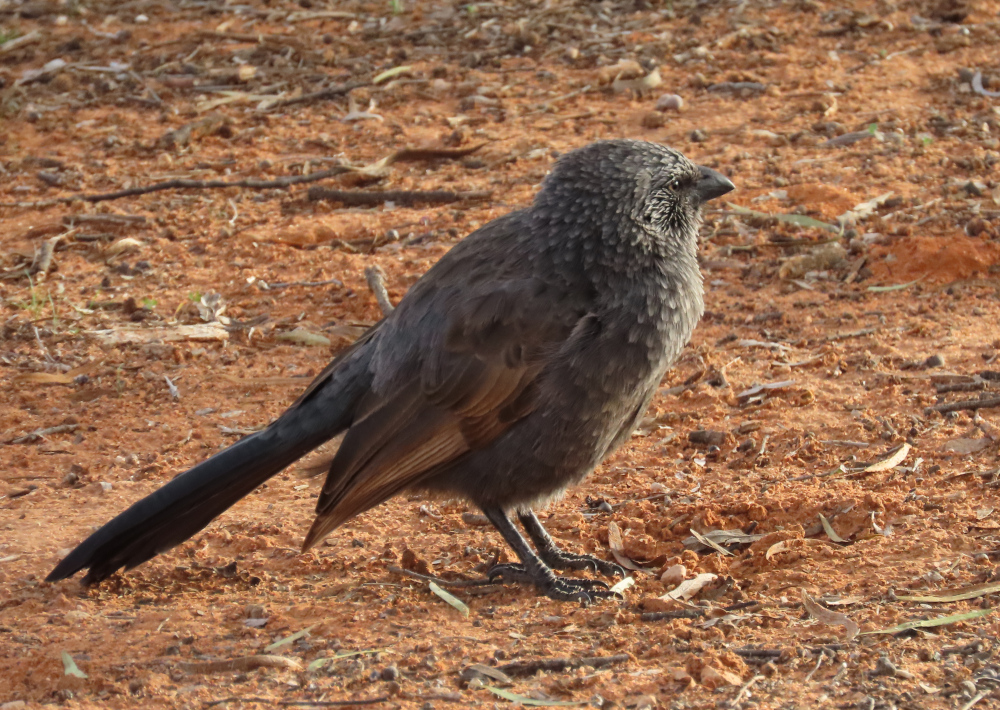
The birds have a characteristic dark mask around the eyes, which isn’t showing up as clearly as in some photos of these birds, because of the excellent mid-morning light. Here’s a half-profile shot, where you can just make out the mask leading from the beak and narrowly circling the eyes:

Two of the birds were nesting. I took the next shot in the early morning, when the sun was low in the sky. The photo shows one bird on the nest. Apostlebirds build their nests out of mud and clay. Since the soil is red in this area of the Outback, the nest is red too. It looks as if someone has put a round bowl in the tree, and the birds have hijacked it for a nest:

An early-morning grooming session was communal and chatty:
In the background sound of the above video, there’s a mournful falling whistle. This sound followed me around the area. I think it’s a Spiny-cheeked Honeyeater. I’ll blog about that bird soon.
The next video shows the two nesting birds again. It’s rather shaky and fuzzy, I’m afraid, due to my excitement and the poor light:
Common name: Apostlebird
Scientific name: Struthidea cinerea
Approximate length: 29-33 cm
Date spotted: 20-21 May 2024 (autumn)
Location: Mungo Lodge, Mungo National Park, New South Wales, Australia: 33°44’31.4″S 143°00’06.1″E


 Sydney Birder