Blog Archives
Eastern Spinebill near Sydney, Australia
This pretty little bird is fast-moving and hard to photograph. The trickling noise in the background is the waterfall at Manly Dam Reserve. Towards the end of the clip, you’ll hear first a Whipbird and then some tweeting that may be the Spinebill itself.
Here it is, an Eastern Spinebill dancing around as it catches insects. At least, I think that’s what it’s doing.
Common name: Eastern Spinebill
Scientific name: Acanthorhynchus tenuirostris
Approximate length: 15 cm
Date spotted: 6 March 2016
Season: Late summer
Location: Waterfall at Manly Dam Reserve, New South Wales, Australia
Latitude/longitude: 33°46’08.5″S 151°14’29.1″E
Swimming across the sky
Reflections at Manly Dam.
In the background you’ll hear Australian Ravens cawing, Wattlebirds croaking, and Whipbirds whistling.
Pacific Black Duck
Common name: Pacific Black Duck
Scientific name: Anas superciliosa
Approximate length: 45-60 cm
Date spotted: 25 December 2015
Season: Summer
Location: Manly Dam, New South Wales, Australia
Latitude/longitude: 33°46’55.0″S 151°15’19.7″E
Eurasian Coot
My bird book calls this coot dumpy. An interesting fact is that the coot has flattened toes rather than webbed feet for efficient swimming.
Common name: Eurasian Coot
Scientific name: Fulica atra
Approximate length: 35 cm
Date spotted: 25 December 2015
Season: Summer
Location: Manly Dam, New South Wales, Australia
Latitude/longitude: 33°46’55.0″S 151°15’19.7″E
Bird swathed in Christmas colours
This little Rainbow Lorikeet shows off its bright cloak of red, green, blue and yellow, perched on the greeny-white flower of an Old Man Banksia. Christmas colours indeed

Common name: Rainbow Lorikeet
Scientific name: Trichoglossus haematodus
Approximate length: 30 cm
Date spotted: 24 December 2015
Season: Summer
Location: Allambie Heights, New South Wales, Australia
Approximate latitude/longitude: 33°46’19.2″S 151°15’39.6″E
Female Superb Lyrebird at Katoomba
She was hanging out in a secluded glen at Katoomba in the Blue Mountains yesterday, when I happened by with my camera. She is a Superb Lyrebird, scratching through the undergrowth for food. She doesn’t have the fanned lyre tail of an adult male, and alas, she’s not making any interesting noises. Instead, she’s catching a quick snack with a couple of wrens in tow.
We arrived in Katoomba at around 9am, and took the Scenic Railway down into the valley. We were strolling along the wooden walkways when the Lyrebird came into view. They’re usually very shy and keep to the shadows, so it was a treat to see this one reasonably well.
Lyrebirds are amazing mimics. Check out a video about the sounds Lyrebirds make, by David Attenborough.
Common name: Superb Lyrebird
Scientific name: Menura novaehollandiae
Approximate length: 85 cm
Date spotted: 13 June 2015
Season: Winter
Location: Katoomba (down in the valley), New South Wales, Australia
Approximate latitude/longitude: 33°43’56.1″S 150°18’14.1″E
Galahs galore
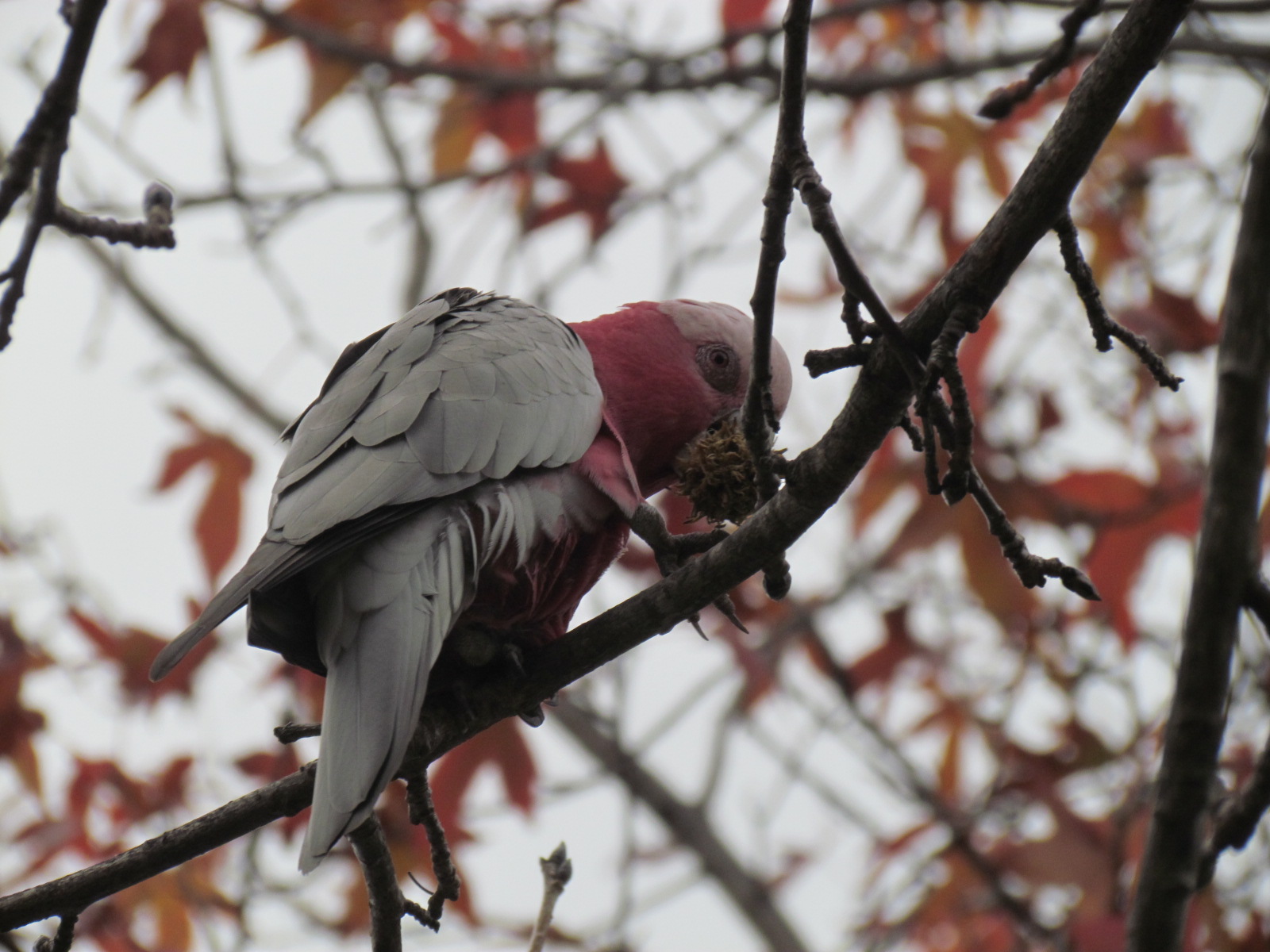
I’ve posted a few pictures of galahs on this blog. They’re gorgeous birds, a type of parrot with a distinctive call and an endearing habit of walking around on the ground in large groups, bobbing their white-capped heads at each other. If you do something silly, an Australian might fondly say, “You silly galah” – an affectionate nod to the slightly bumbling behaviour of the birds.
Yesterday I came across a group of them, all agog because a tree was dropping its seed balls. This bird peeks down at me while holding a seed ball in its beak:
In this video, you can hear the galahs chatting noisily to each other. Towards the end, something startles them and they take off, flying towards the camera with seed balls in their beaks:
Common name: Galah
Scientific name: Cacatua roseicapilla
Approximate length: 38 cm
Date spotted: 23 May 2015
Season: Winter
Location: Manly Vale, New South Wales, Australia
Latitude/longitude: 33°46’48.6″S 151°15’52.2″E
To find more about these pretty birds, see the galah category in this blog.
Pelican at Long Reef Headland, New South Wales
The closer you get to a pelican, the more beautiful it is. Those eyes are so huge and seem so wise. Then there’s that appealing fuzz of fine feathers on the back of the head and down the neck.

For more about these pelicans, see my post from March this year.
Common name: Australian Pelican
Scientific name: Pelecanus conspicillatus
Approximate length: 170 cm
Approximate wingspan: 2.5m
Date spotted: 1 January 2015
Season: Summer
Location: Long Reef Headland, New South Wales, Australia
Latitude/longitude: 33°44’15.2″S, 151°18’44.1″E
Dollarbird in Sydney
Update on 25 December 2014: It’s a Dollarbird, also called a Broad-billed Roller. Thanks to Hamish Robertson for identifying this bird! They’re migratory, arriving in Australia in September/October every year and leaving again in March. They spend the winter in New Guinea and other northern islands.
Does anyone know what bird this is? I heard it making an insistent chattering noise the other day. It was high up on an electric cable, so I couldn’t see it very well. It’s dark in colour, with a red beak. I’d guess its size to be roughly that of a magpie. Here’s the best shot I got of it:

Here’s a video, useful mainly for the sound. I had the camera on high zoom without a tripod, so it’s quite shaky, but you can hear the sound very well.
Common name: Dollarbird (Thanks to Hamish Robertson for identifying this bird!)
Scientific name: Eurystomus orientalis
Approximate length: 30 cm
Date spotted: 21 December 2014
Season: Summer
Location: Manly Dam Reserve, New South Wales, Australia
Latitude/longitude: 33°46’36.4″S 151°15’16.1″E
Sulphur-crested Cockatoo
Sulphur-crested Cockatoos are sociable creatures, often travelling in large groups. This one was with four others, but sat apart looking a bit grumpy.

It can be difficult to get a good photo of a cockatoo, because they’re so white that the sun gleams off them and the resulting glare removes all detail. So I was pretty please with these shots. Here’s a rear view:

Common name: Sulphur-crested Cockatoo
Scientific name: Cacatua galerita
Approximate length: 50 cm
Date spotted: 20 December 2014
Season: Summer
Location: Manly Dam Reserve, New South Wales, Australia
Latitude/longitude: 33°46’45.6″S 151°14’59.2″E
Ibis raiding the trash
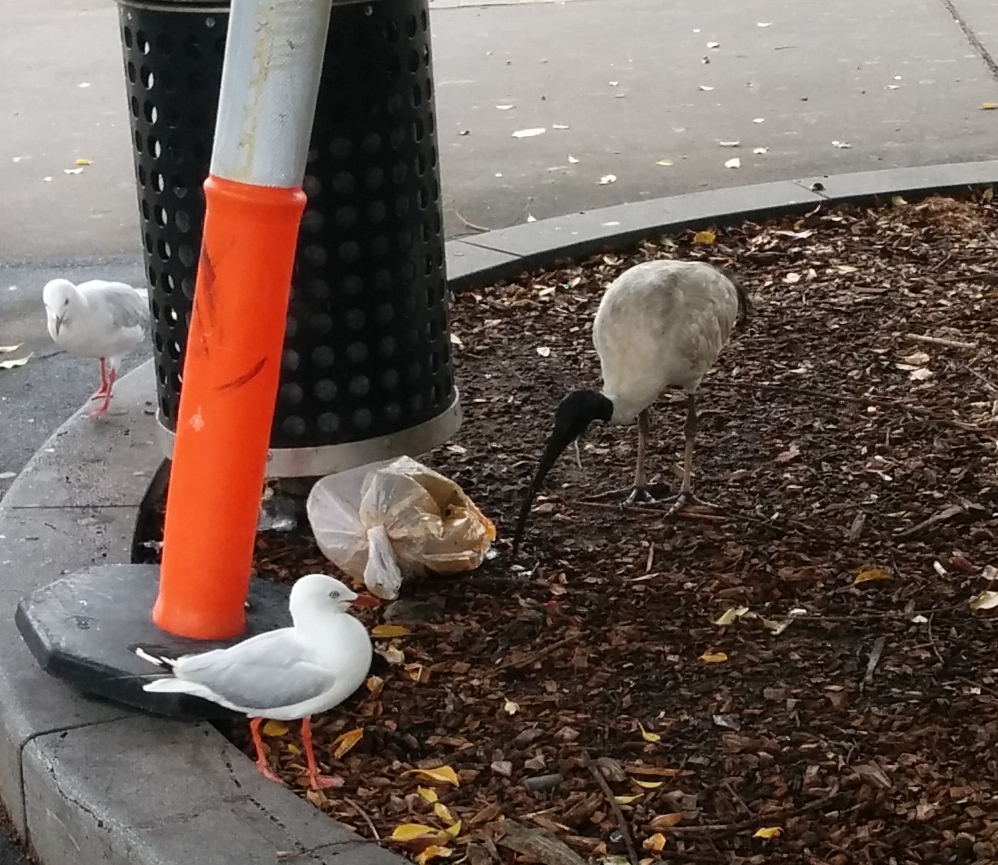
Australian White Ibises are a common sight in the city, raiding the trash or swooping between the buildings. Their natural habitat is near water, nesting in colonies on trees and bushes on the water’s edge.
This video shows an ibis in Pyrmont, Sydney, guarding its booty from other raiders: screaming, strutting Silver Gulls and a curious but cautious Common Myna.
Here’s a close-up of the ibis.
Common name: Australian White Ibis
Scientific name: Threskiornis molucca
Approximate length: 70 cm
Date spotted: 4 December 2014
Season: Summer
Location: Pyrmont, in Sydney, Australia
Latitude/longitude: 33°51’56.4″S 151°11’46.6″E
New Holland Honeyeater at Wineglass Bay Lookout
Not in Sydney this time, I was at Wineglass Bay Lookout in Tasmania when I saw a bush full of New Holland Honeyeaters. This video focuses on one of them, then draws back to show the gorgeous location it’s chosen for its foraging.
Here’s a still picture. Click on it to open it in a new window where you can zoom into the detail.

Common name: New Holland Honeyeater
Scientific name: Phylidonyris novaehollandiae
Approximate length: 17-19 cm
Date spotted: Sunday 9 November 2014
Season: Spring
Location: Wineglass Bay Lookout, Tasmania
Approximate latitude/longitude: 42°08’60.0″S 148°17’20.2″E


 Sydney Birder