Blog Archives

Beautiful red and brown Orb Weaving Spider
When walking along bush paths, especially early in the morning, I often walk through large spider webs spun across the path. Not infrequently, I end up with a spider in my hair or on my clothes.
Today I spotted the web and its occupant in time to avoid a collision! The spider was a Garden Orb Weaver (Eriophora sp). This individual was quite lovely, with red upper legs changing to black as they reached its body. Look at that cute furry head!

This was a large spider, its body about 2 cm long. We often see Garden Orb Weavers in our area, but I haven’t seen one with this colouring before. They come in a variety of sizes, shapes, and colours. (In fact, I wouldn’t be surprised if someone decides to do more research into these spiders and split up the classification a bit.) Here’s a side view of the one I saw yesterday:

I carefully walked around the web, using a tried-and-true method of waving a stick in front of me to detect stray strands of silk, and photographed the spider from the other side:

Garden Orb Weaving Spiders aren’t keen to bite you. If they do bite you, the symptoms are usually mild, usually limited to pain and swelling at the site of the bite. If you have worse symptoms or are concerned, seek medical advice. I haven’t yet been bitten. Long may that happy state of affairs last!
Location of the spider: Manly Dam Park, New South Wales, Australia: 33°46’51.5″S 151°14’51.0″E.
What about the birds, you may ask? Since this is primarily a blog about birds, where do they fit in? Birds do eat these spiders. Recently, an Australian Noisy Miner was extremely interested in a large Orb Weaver outside my window. The bird approached along the telephone line, then leapt into the air and hovered about a metre away from the spider. For some reason, the bird abandoned the attack. Maybe there wasn’t enough room for the bird to fly in, grab the spider, then swoop away before hitting the window.

Juvenile Channel-billed Cuckoo and female Koel Cuckoo
Today an unearthly caterwauling called my attention to a juvenile Channel-billed Cuckoo perched on a wire. It was crouched down, flapping its wings, and uttering harsh calls:

Even at this age, it’s a big bird. I’d guess it was already full size, at around 60 centimetres in length. A giant baby indeed. And one that needs a lot of feeding.
The youngster stretched out its neck and called even louder:

It peered up into the air expectantly:

I didn’t catch any pictures of the next stage, alas, because the bird flew to a leafy tree and was mostly hidden from view. I did see the dedicated proxy parent, a Currawong, feeding the youngster, accompanied by a frenzied gabbling noise from the demanding child.
Common name: Channel-billed Cuckoo
Scientific name: Scythrops novaehollandiae
Approximate length: 58-65 cm
Date spotted: 23 January 2021 (summer)
Location: Manly Dam Park, New South Wales, Australia: 33°46’06.4″S 151°14’52.6″E
In a nearby tree, a female Koel Cuckoo sat and watched the commotion:

Common name: Common Koel or Eastern Koel
Scientific name: Eudynamys scolopacea
Approximate length: 45 cm
Date spotted: 23 January 2021 (summer)
Location: Manly Dam Park, New South Wales, Australia: 33°46’06.4″S 151°14’52.6″E
Both Channel-billed and Koel cuckoos are parasitic cuckoos, which means that they lay their eggs in the nests of other birds, and leave it up to those other birds to feed and care for the youngsters. Bot cuckoo types are migratory, coming down to this part of Australia for the warmer summer months, then heading to more northern countries for the winter.
Want to know more? I’ve posted some pictures and stories about previous encounters with cuckoos.

Eat your greens! Baby swans growing up
Early in October I spotted a family of swans at Manly Dam. These are Australian Black Swans. When I first saw them, there were five baby swans (cygnets), closely watched over by two adults. This was one of the little ones, just a few days old then, I think:

Since then, I’ve been watching the cygnets grow. Alas, two of them disappeared over the weeks. But there are still three of the cygnets, still with their parents in late December, and much bigger and stronger.
The video below shows a cygnet and a parent feeding on water weeds. This was towards the end of November, when the cygnets were around six weeks old. Near the beginning of the video, the adult swan grabs a clump of weed and dumps it near the baby.
Eat your greens!
Later the video zooms out to show the entire family of three babies and two adults:
Here’s one of the cygnets swimming with an adult, also at around six weeks old:

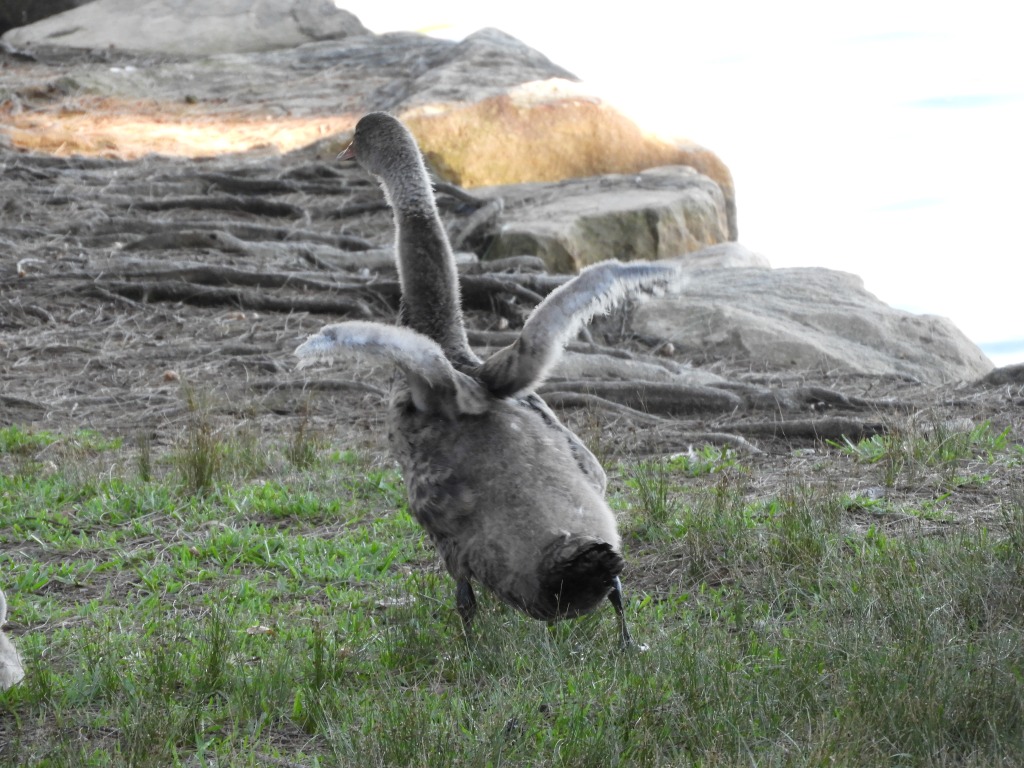
On 23 December, at ten to eleven weeks old, the cygnets are much bulkier and their faces look more swan-like:

Even at this age, their wings are still small and stumpy, nowhere near ready for flight:
Common name: Black Swan
Scientific name: Cygnus atratus
Approximate length of adult: 120 cm
Date spotted: 9 October 2020 (spring) through to 23 December 2020 (summer)
Location: Manly Dam Park, New South Wales, Australia: 33°46’58.5″S 151°15’18.6″E

So cute! Baby kookaburra in nest
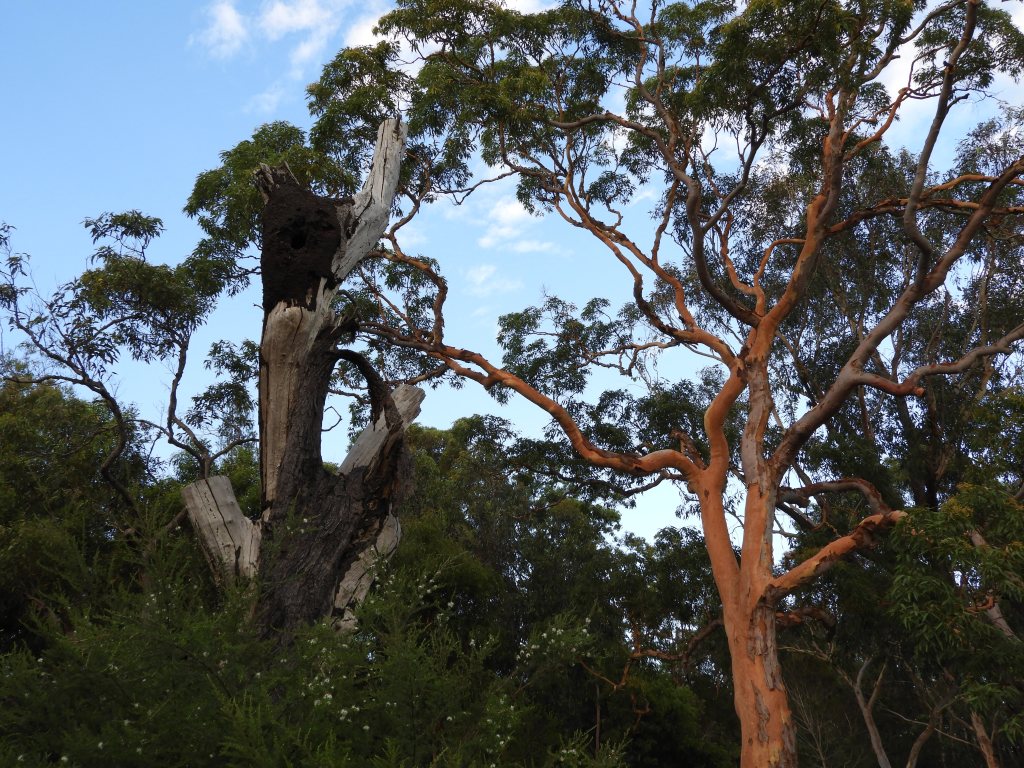
For the past few weeks, I’ve been following the progress of a baby kookaburra and its parents. The baby was housed in a termite nest on an old, dead tree. The first time that I noticed the nest was more than a month ago, on 17 November. At that time, the only sign of the baby was a faint crooning sound emerging from the termite nest. I’d heard baby kookaburras before, so I stuck around to see what would happen. Sure enough, an adult bird arrived with some food.
From that day on, I visited the nest regularly. And now, I’m delighted to report that the baby bird has safely left the nest and is being fed in the nearby trees.
The first video shows the baby kookaburra just a few days before it left the nest. The date was 14 December, almost a full month after I first noticed the nest. In the video, the baby peers curiously (and hungrily, no doubt) from the nest. You can hear an adult kookaburra off camera, calling to let the chick know that food is on its way. I moved the camera to take in the adult on a nearby branch. The bird checks the surroundings carefully, including me, to decide whether it’s safe to approach and feed the chick.
Meanwhile, the chick becomes more vociferous and sticks its head further out of the nest, impatient at the delay. The adult moved to a different branch to give itself a direct line of flight. I managed to catch a view of the adult there too, before moving back to the nest in time to see the adult arrive and feed the baby:
The parents were tireless and devoted in their care for the baby. On a couple of occasions, I spotted them foraging for food:

When the parents were not around, the chick eyed me from the safety of its home. The smallest scuffle was enough to bring an inquisitive eye to the hole in the nest:
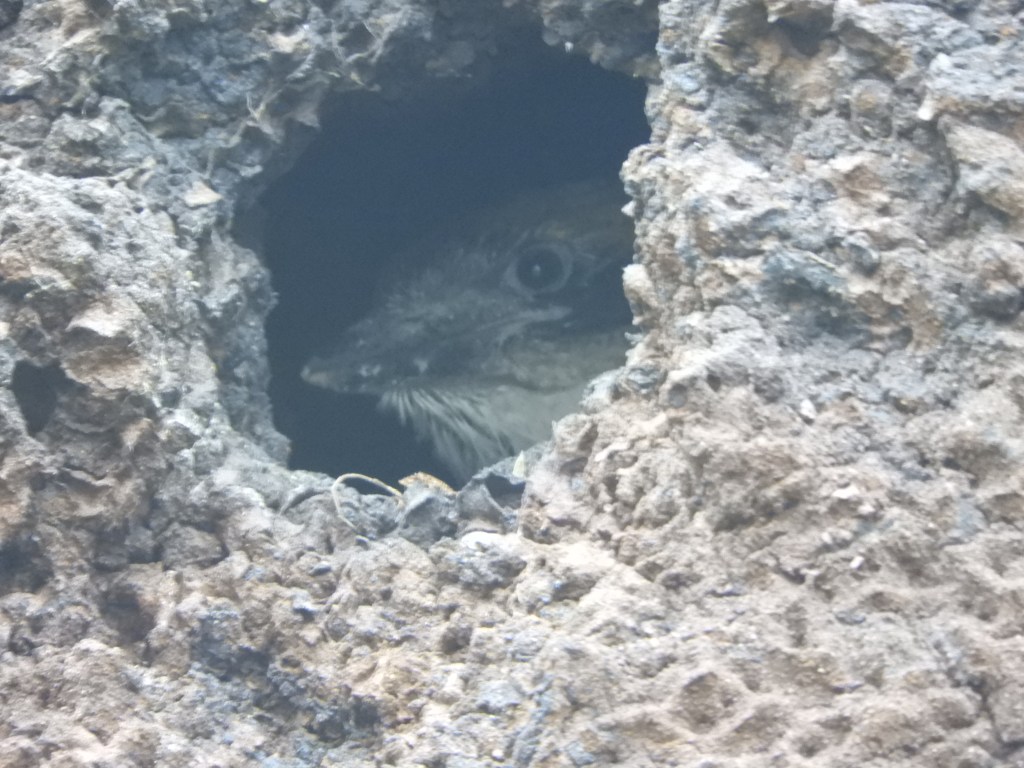
Partially hidden but oh so curious:
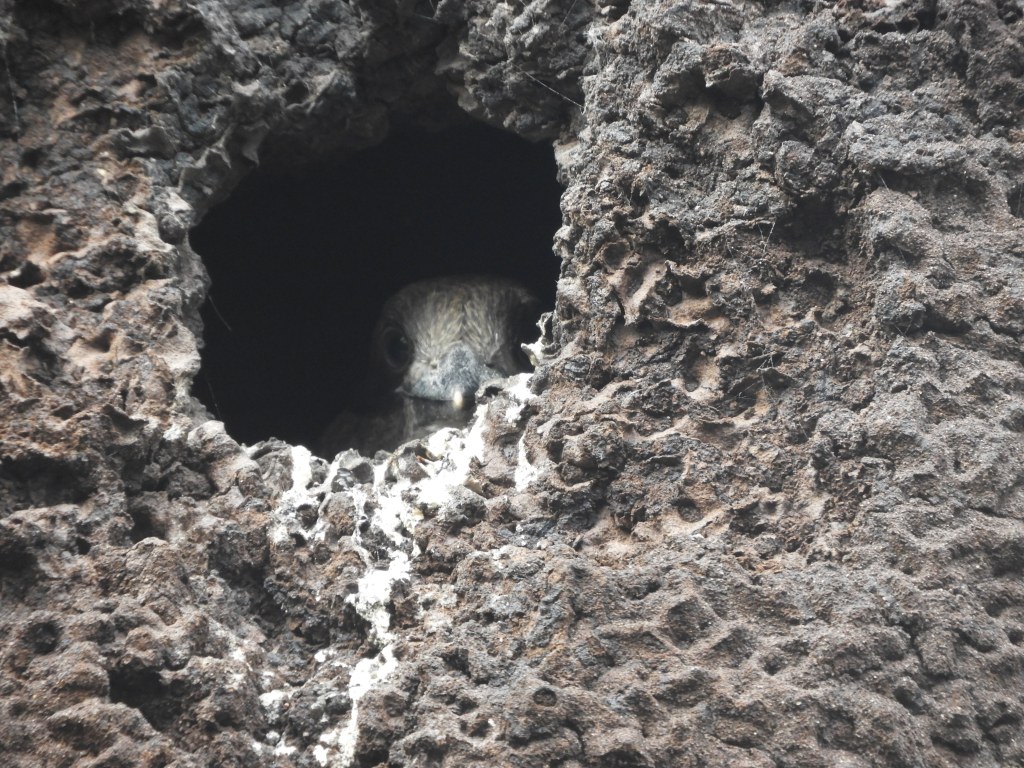
The nest was on the skeleton of a dead tree:
This is an earlier, short video (taken on 3 December) showing a parent arriving to feed the chick:
When I arrived on 17 December, the nest was quiet. Again the next day, there was no activity at the nest. I explored the area and soon heard the characteristic crooning of a kookaburra youngster. I found it in a quiet, tree-filled glen, being attended to two adults in turn. It was early in the morning, and the birds were high in the trees, so I didn’t manage to get a good photo. This is the glen:

This is the only photo I have of the youngster. Alas, I didn’t get the full head in the shot, but you can see the fluffiness of the feathers and the short tail:

Common name: Laughing Kookaburra
Scientific name: Dacelo novaeguineae
Approximate length: 47 cm
Date spotted: 18 December 2020 (summer)
Location: Manly Dam Park, New South Wales, Australia
This is the view the baby kookaburra had from its nest. It looks over Manly Dam towards the dam wall, with a bottlebrush bush glowing in the early morning light. A room with a view indeed:

Finally, here’s the view that the baby must have seen when it first emerged from its nest and could look in the other direction, up the length of Manly Dam:


Male and female Brush-turkeys getting affectionate plus bonus baby
Over the past few weeks I’ve been watching the action at a Brush-turkey mound. The male bird is very attentive, keeping the mound in good shape and calling to attract females.
Every so often, a female arrives and starts taking the mound apart! At first I thought the male was annoyed when he pecked at the female. But watch what happens at about one minute into the video. The male is the one with the long yellow flaps hanging below its beak:
Male Australian Brush-turkeys build huge mounds of leaves and other plant matter each year. They lovingly tend the mound, spending hours every day reorganizing the leaves. Every now and then, the male utters a strange booming call (I managed to make a video of this male calling a few weeks ago) to let females know he’s ready for business.
Females come and inspect the male’s work. If they approve, the birds mate and eventually the female lays eggs in the mound. The chicks hatch of their own accord, and are immediately independent of their parents.
Several females have visited this particular mound over the weeks. I’ve been waiting for chicks to appear, but haven’t seen any yet.
In the meantime, in another area of the park today, this cute little young Brush-turkey flew past me at knee height. It was about the size of a large fist. I didn’t know they could fly at this age!
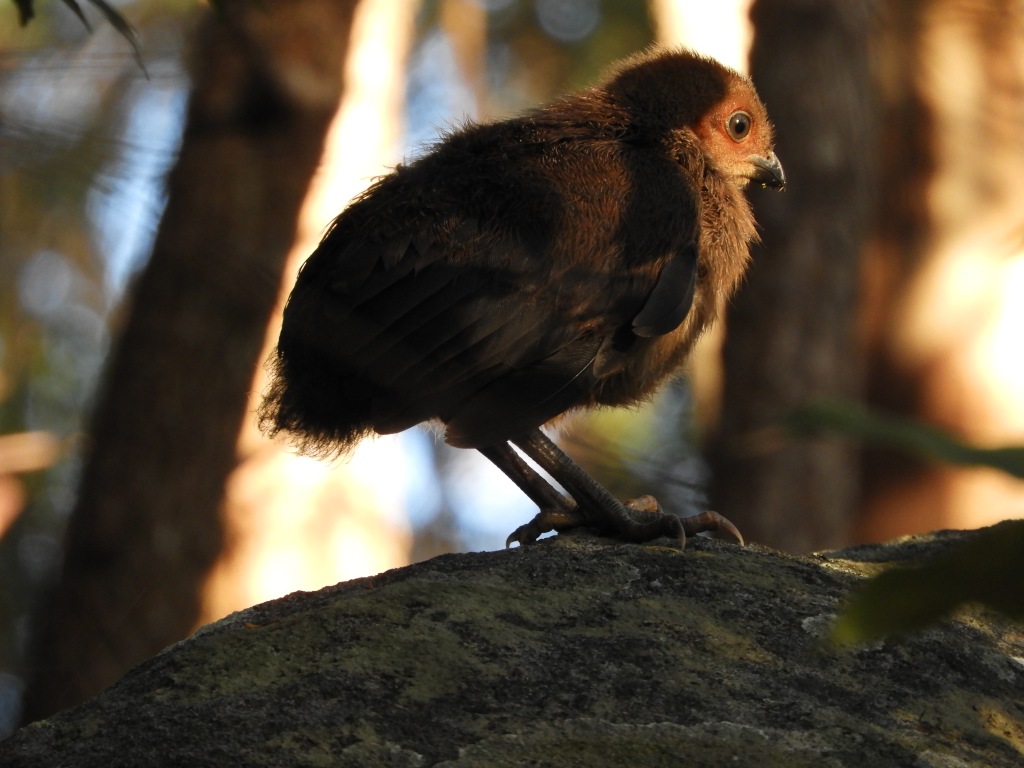
Common name: Australian Brush-turkey
Scientific name: Alectura lathami
Approximate length of adult: 60-70 cm
Date spotted: 13 December 2020 (summer)
Location of the chick: Manly Dam Park, New South Wales, Australia: 33°46’55.6″S 151°15’05.3″E
Song of the Golden Whistler
In competition with the raucous remarks of a nearby cockatoo, this little Golden Whistler sings his heart out.
Golden Whistlers are also known as thunder birds, because evidently they tend to sing in response to loud noises. Maybe the calls of the cockatoo were actually encouraging the little songster!
Common name: Golden Whistler
Scientific name: Pachycephala pectoralis
Approximate length: 16-18 cm
Date spotted: 9 December 2020 (early summer)
Location: Manly Dam Park, New South Wales, Australia: 33°47’02.4″S 151°15’14.9″E

Magpie-lark eating a cicada
This Magpie-lark, also known as a Mudlark or a Peewee, has caught a cicada for breakfast.
Cicadas are large beetles that appear around Sydney in summer and drive us all crazy with their singing. You can hear the harsh, ringing sound of the cicadas in the video.
There are a few different types of cicadas, many of them quite lovely. Take a look at these posts to see some that I’ve photographed on other occasions.
Back to the bird! This Magpie-lark is a male. You can tell by the colour of its throat, which is black. Female birds have a white throat.

Common name: Magpie-lark, also called a Peewee or a Mudlark
Scientific name: Grallina cyanoleuca
Approximate length: 30 cm
Date spotted: 28 November 2020 (spring)
Location: Manly Dam National Park, New South Wales, Australia: 33°46’35.5″S 151°14’50.3″E

(Sad) Nest of Black-faced Cuckoo-shrike disappeared
Black-faced Cuckoo-shrikes are smart-looking birds, with a neat covering of smooth grey feathers and a dark face. I was delighted when I noticed a nesting couple on one of my regular walks, and have been watching their progress with pleasure.
Here’s a photo of one of the parent birds, taken on 17 October:

Common name: Black-faced Cuckoo-shrike, also called a shufflewing
Scientific name: Coracina novaehollandiae
Approximate length: 35 cm
Location: Manly Dam Park, New South Wales, Australia: 33°46’35.5″S 151°14’51.2″E
Here’s a parent sitting on the nest (photo taken on 11 November):

And a side view, taken on 17 October:
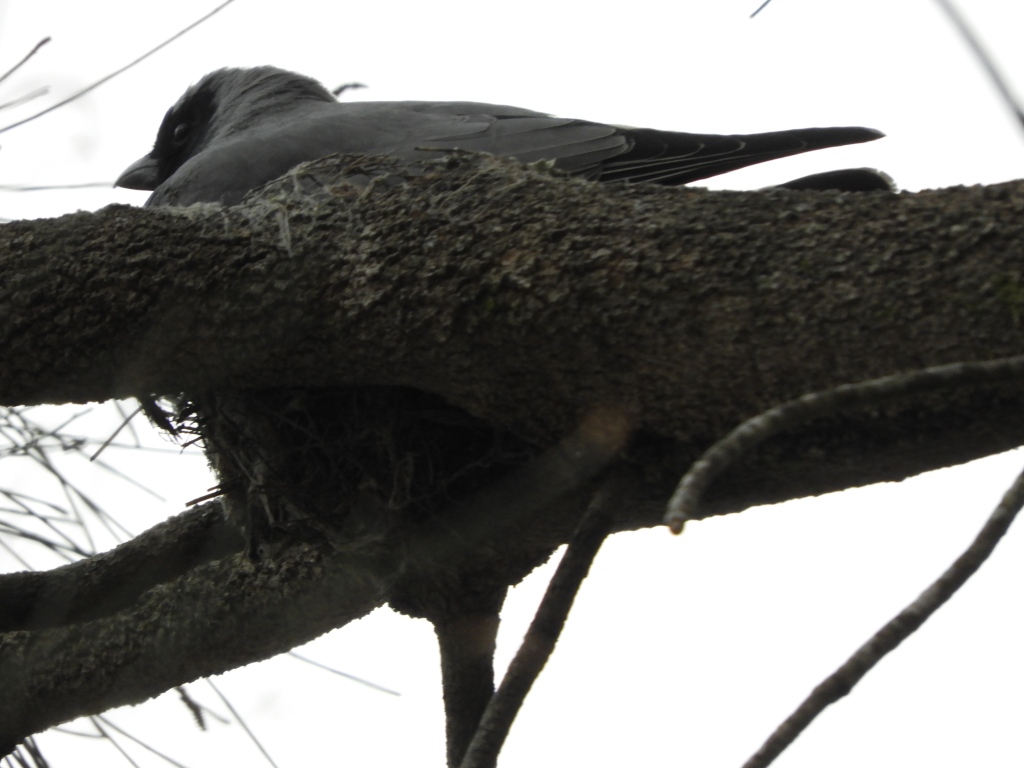
This is the nest, taken while both parents were briefly out of view (4 November):

This video shows the first time, and alas the last time, that I caught a glimpse of the chicks. The images are in silhouette, because it was early in the morning with the bright sky behind the birds. Even so, you can see the beak of a young chick. It’s also interesting to see how the parent cleans the nest after feeding its young:
I shot the above video on Wednesday 11 November, just a few days ago. On Thursday and Friday, I walked past the tree and saw the birds sitting on the nest as usual. Today, Sunday, I went back to the area and the nest has completely disappeared.

It’s likely that the birds had a visit from a monitor lizard, or a possum, or even a human. (The nearby picnic area had been significantly vandalised too.)
It’s so sad to see all that effort by the parent birds go to waste, and to think what may have been the fate of the chicks. I do hope the parents survived to have another family next year.

Oriole singing and mimicking other birds
A little Olive-backed Oriole had me intrigued for a while. I couldn’t see the bird, but I could hear a mixture of lyrical calls that seemed to come from a variety of birds. Eventually I tracked down the singer.

This looks like a young male bird. It has the dark head of a male, but its eyes are brown rather than red. It was lively and curious, hopping from branch to branch and examining its surrounds with evident interest. Or perhaps it was hungry and looking for food!
In this video, the oriole starts with a good preening session then launches into song. You can’t see the bird very well but you can hear its song:
Common name: Olive-backed Oriole
Scientific name: Oriolus sagittatus
Approximate length: 25-28 cm
Date spotted: 10 November 2020 (spring)
Location: Manly Dam Park, New South Wales, Australia: 33°46’52.3″S 151°15’07.9″E
Emu, turkey, and peacock at Walkabout Wildlife Sanctuary
Today we visited the Walkabout Wildlife Sanctuary, which is about 75 km north of Sydney (map). We spent the day among the animals and walking the bush trails. It’s a lovely, relaxing place to visit.
While there, I took some videos of the birds that stroll around the pathways. First, an emu. Emus are large native Australian birds. This one came a little closer than I was expecting when I started filming it!
Next, some turkeys. These birds are from North America rather than Australia. They’re busily showing off their tails to each other. A couple of emus stroll past in the midst of the show:
Encouraged by the turkeys’ display, a peacock showed its gorgeous tail and did a bit of strutting around too. This type of peacock originated in India:
It’s well worth a visit to the Walkabout Wildlife Sanctuary (map). There’s plenty to do, whether you like to sit and watch the birds walk by, or go for a stroll along the bush paths, or hear about the animals from the rangers in the park.


 Sydney Birder