Blog Archives

Wombat sick with mange (reported to WIRES)
A few days ago, we were in a remote region of New South Wales near the Abercrombie River National Park. We saw a sick wombat on the side of the road. It was clear that the animal was in a lot of pain, but we didn’t know what was wrong with it.
Here’s a picture of the wombat having a rest after walking up a small incline. (Note: There’s a video later in this post, which can be distressing to watch. However, it shows that the wombat has a lot of energy and is eating well.)
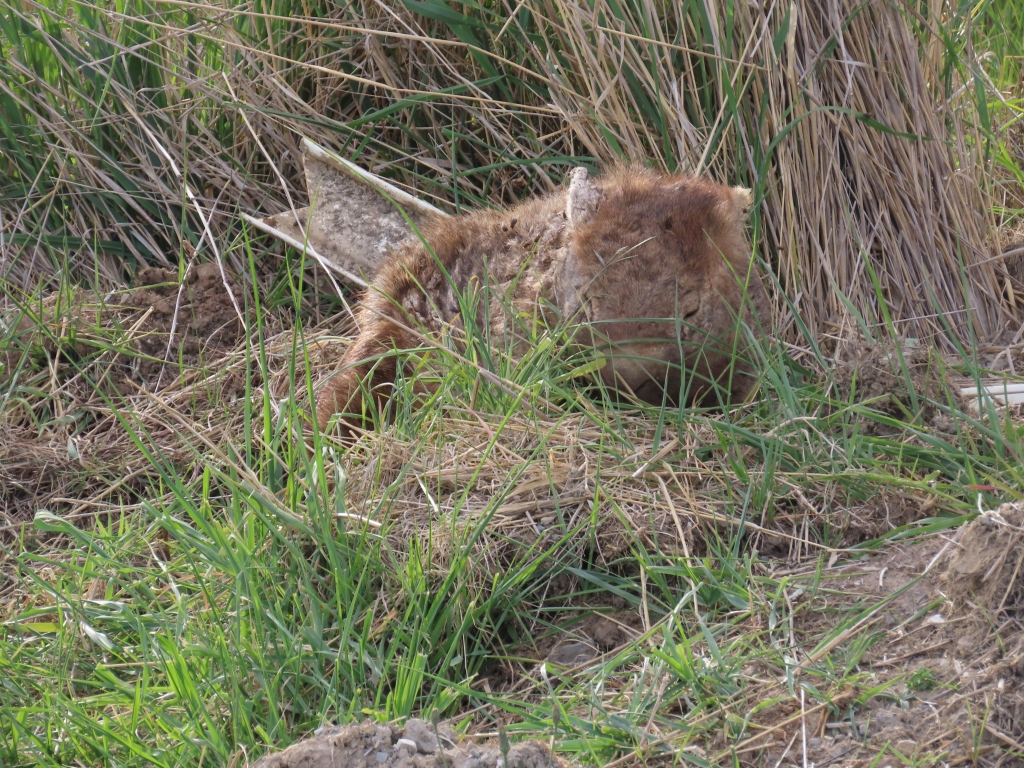
We passed the spot in the car, then turned round and went back to see if there was anything we could do to help. At first we thought maybe the animal had been hit by a car, because it was having obvious difficulty walking. It was eating well, which we took to be a good sign.
I didn’t get too close, because wombats are wild animals and deserve respect. The zoom on my camera was very useful in showing the animal’s condition.
I’d heard that a disease called mange is currently causing many wombats to fall ill, and I wondered if mange was the problem for this poor creature. But at that stage I didn’t know much about the condition.
We took some photos, then as soon as we had mobile service, we lodged an online report with WIRES, the Australian Wildlife Rescue Organization. We were able to give a Google Maps reference of the location of the animal. WIRES phoned us a couple of hours later, and confirmed the details. They then phoned us again the next day for further clarification, at which stage we were able to upload all our photos and the video too. A volunteer from nearby (that is, one and a half hours’ drive away!) would go out to look for the sick animal.
Mange is a skin disease, caused by tiny mites that burrow into the animal’s skin. It’s related to scabies in humans. One of the symptoms is the mass of flies attracted to the animal’s skin, which you can see if you magnify the photo in this post.
Evidently, treating a wombat with mange can be very successful. In most cases, treatment involves installing a flap on the entrance to wombat’s burrow and putting medication on the flap. The wombat thus gets dosed every time it enters and leaves home.
To compare this poor little wombat with a healthy one, take a look at the photos of a parent and baby wombat which we saw some distance away in Abercrombie River National Park.
Thank you and Kudos to Wires. Dealing with the people from WIRES was a very pleasant experience. I very much appreciate the hard work and dedication that the members of the organization and their network of volunteers put into rescuing wildlife in trouble.

Baby wombat in Abercrombie River National Park
In the lovely Abercrombie River National Park this weekend, I was lucky to come across a baby wombat and it’s parent on an early morning stroll. When I came on the scene, the parent nudged the baby towards a hole that led into its burrow. They stood there for a short time, then presumably decided I was safe enough, and continued their amble along the river bank.
Here they are in a lovely still photo. This was just after I saw them, and before I took the video. It looks as if the baby is emerging from another entrance to their burrow, though I didn’t go close enough to see:
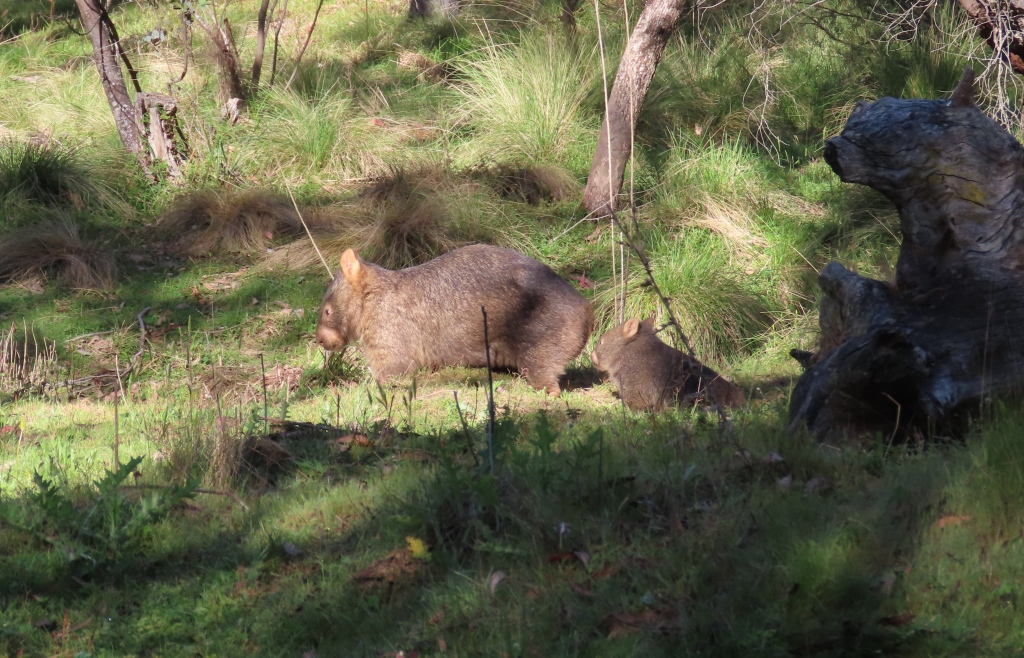
I count myself very lucky to have seen these animals, and such lovely healthy ones in such peaceful surroundings. Wombats are found only in Australia. Like many animals here, they’re marsupials. They’re also the koala’s closest relative.
They’re large, as far as burrowing animals go, at up to 1.3 metres in length and weighing more than 35 kilograms. They can also move very fast when they want to, although if you keep well away you’ll usually see them trundling along in a leisurely fashion like these two.

Two Sacred Kingfishers at Manly Dam
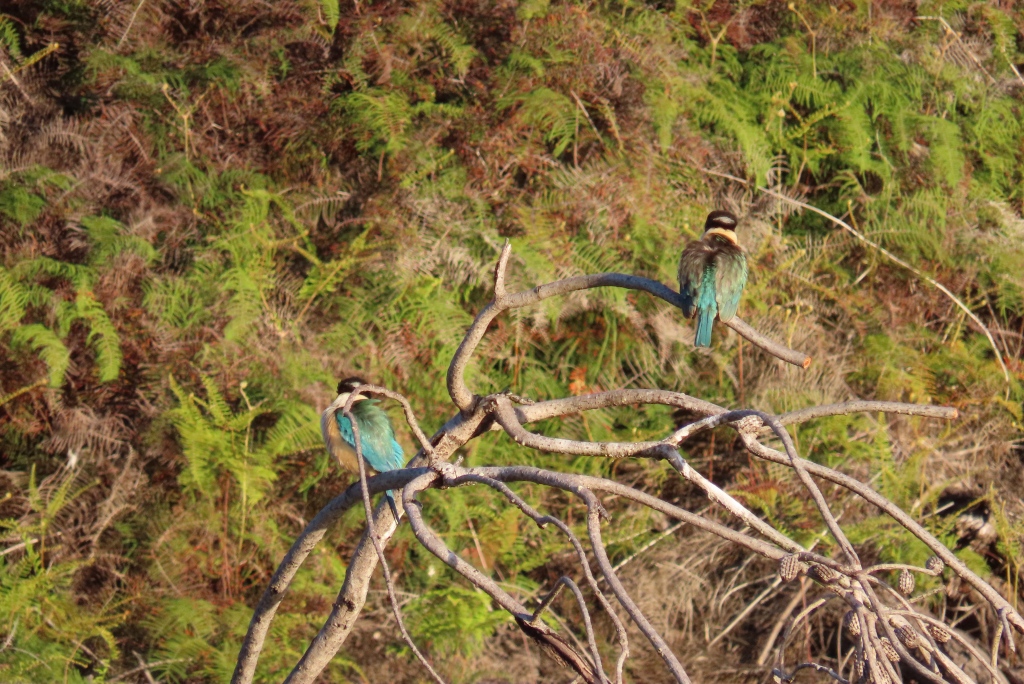
A rare treat! This morning I saw two Sacred Kingfishers resting on a clump of dry bush at the edge of Manly Dam. I’ve seen a kingfisher at Manly Dam twice before, both near the dam wall. These two were in a different area, at an inlet on the north west side of the dam.

Before I saw the birds, I’d heard their call, though I didn’t know what it was at the time. It was a fairly high-pitched, insistent sound, uttered in groups of two to four squawks: “kik-kik-kik-kik”.
I think the one on the left might be male, and the one slightly higher up on the right might be female. Females have more green and less blue on their wings than the males do.
Kingfishers are related to kookaburras. (See my earlier posts for pictures of kookaburras.) But whereas Laughing Kookaburras are quite large (47 centimetres from head to tail), Sacred Kingfishers measure only 20 centimetres.
For comparison, here’s a kookaburra from another day:

Back to today’s Sacred Kingfishers: At one stage, both birds turned round to show me the backs of their heads. They look much more like colourful kookaburras now:
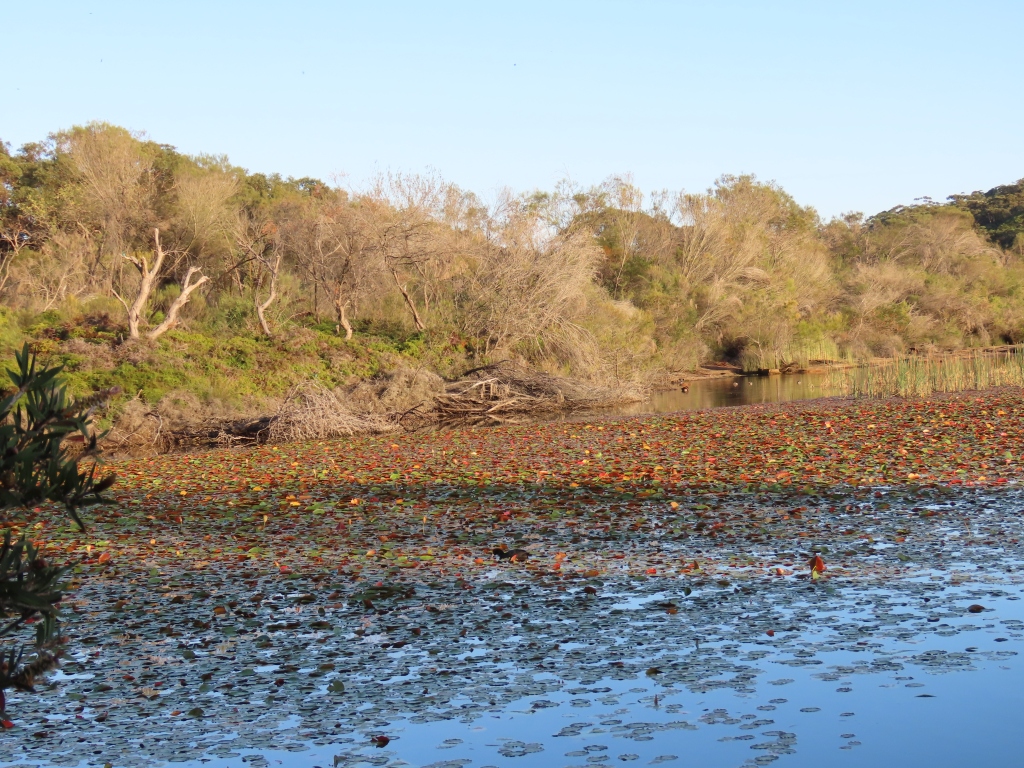
The next picture shows the bank of the dam where the birds were sitting. I was on the far side of the inlet. You might just be able to make out one of the kingfishers on the clump of dead bush towards the middle left of the picture. The other kingfisher had been chased away by a Willy Wagtail!
Common name: Sacred Kingfisher
Scientific name: Todiramphus sanctus
Approximate length: 20 cm
Date spotted: Saturday 14 October 2023 (spring)
Location: Manly Dam Park, New South Wales, Australia: 33°46’34.4″S 151°14’48.9″E

Gorgeous male Fairy-wren with glossy blue tail
I took a number of shots of this lovely little Variegated Fairy-wren. As usual, only one of the shots was anywhere near usable. Here it is:

Like many bird names in Australia, the name “fairy-wren” is misleading. These birds aren’t actually wrens. They’re related to honeyeaters and pardalotes.
This one is a male, and in full breeding colour. I haven’t seen such a glossy blue tail before!
Common name: Variegated Fairy-wren
Scientific name: Malurus lamberti
Approximate length: 13 cm
Date spotted: 5 October 2023 (spring)
Location: Manly Dam Park, New South Wales, Australia: 33°47’00.6″S 151°15’19.5″E

Amazing bats: Flying Foxes near Sydney
Flying Foxes, also called fruit bats, are large bats with grey and red fur. Their bodies are about the size of a kitten, and they look cute and cuddly. Then you add the claws that allow them to hang from trees and street lamps, and the large membranous black wings that allow them to fly at over 20 kilometres per hour, and you have a truly wondrous creature.
A colony of Flying Foxes roosts in a nature patch in Balgowlah, near Sydney. Patches of trees inhabited by these bats are called camps. I walked around the edges of the camp and took a few photos and videos.
While walking around the edges of the camp, I was careful not to get too close or to walk under any branches where bats were hanging. These bats aren’t aggressive but they do carry nasty diseases, so it pays to be wary. Evidently you won’t be infected by any diseases from the bats unless you come into close contact with one of them. Still, cuddly as they look, they’re wild creatures and deserve respect.
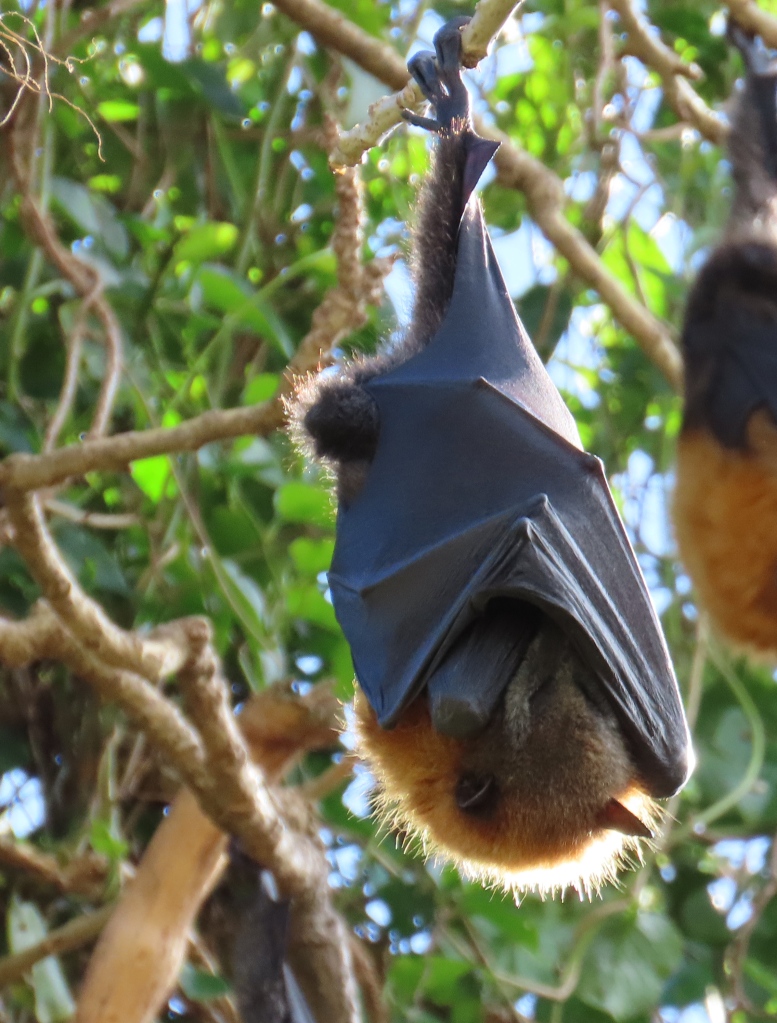
Here’s a closeup of one of the bats, neatly wrapped up in its own wings and hanging from a branch by its feet:
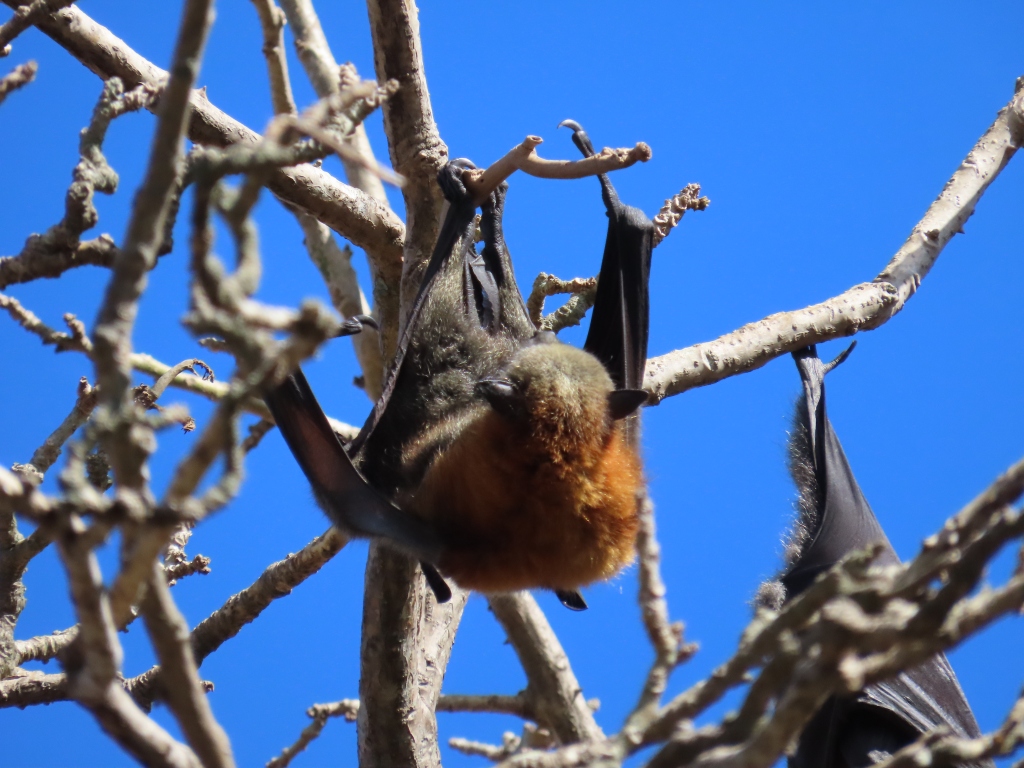
In the next photo, a bat decided to change position. Here it’s moving from the upside down roosting position to what we’d call the right way up:
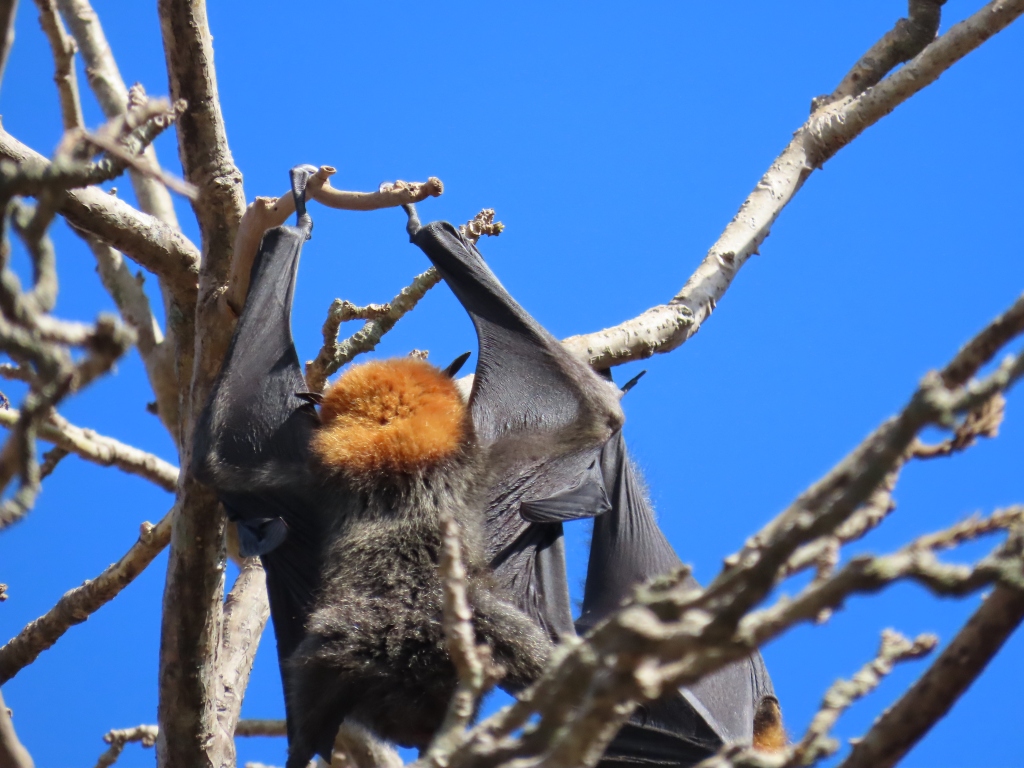
Now the bat is hanging by its front feet, facing away from us, with its ears sticking out sideways:
The next video shows another area of the bat camp. As I was recording the video, there was a short series of bangs, probably from the nearby road. The noise disturbed the bats. They started chittering more loudly than ever, and a few of them took flight:
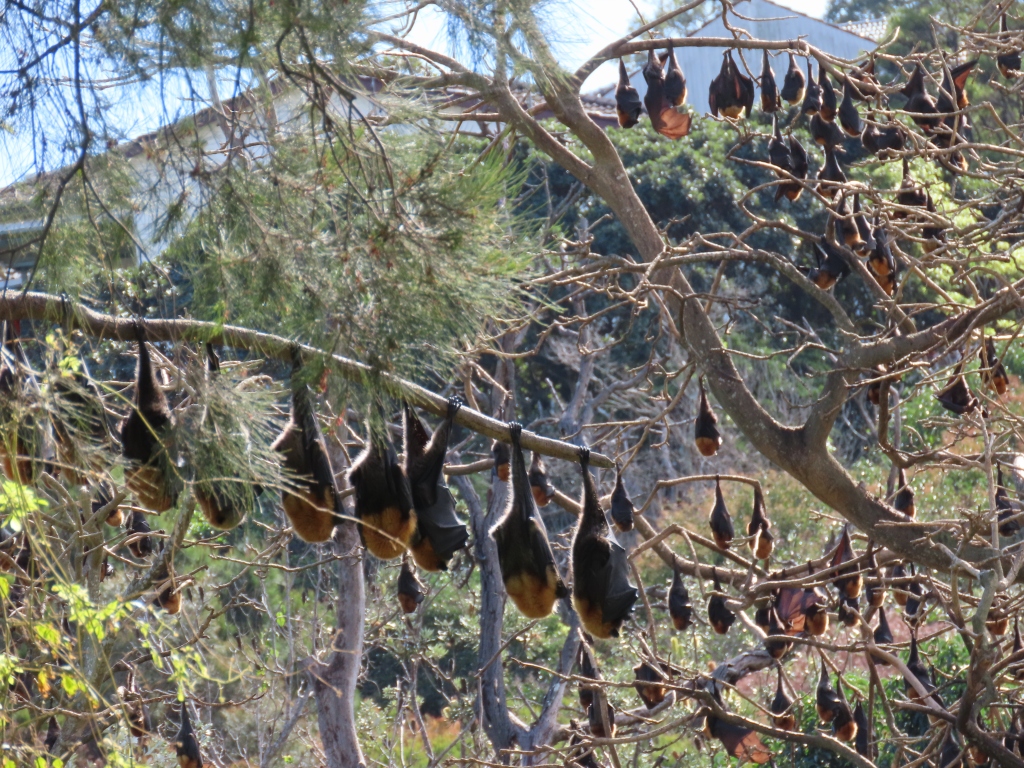
These are Grey-headed Flying Foxes, one of three types of Flying Foxes in the Sydney area. At dusk, we occasionally see large numbers of bats rising into the air and heading off to feed. They’re nocturnal, and they feed on flowers and fruit. With their large, strong wings, they can travel long distances.
The next video shows one of the animals coming in to land in a tree inhabited by the colony:
The next few pics zoom out to show the size of the colony:
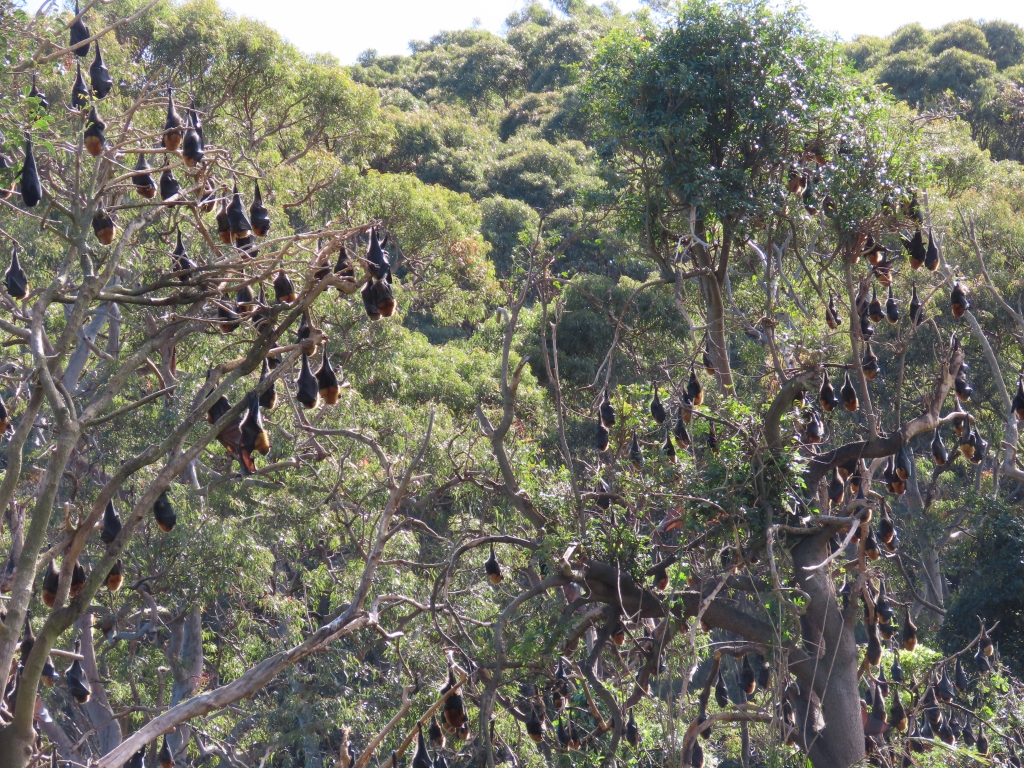
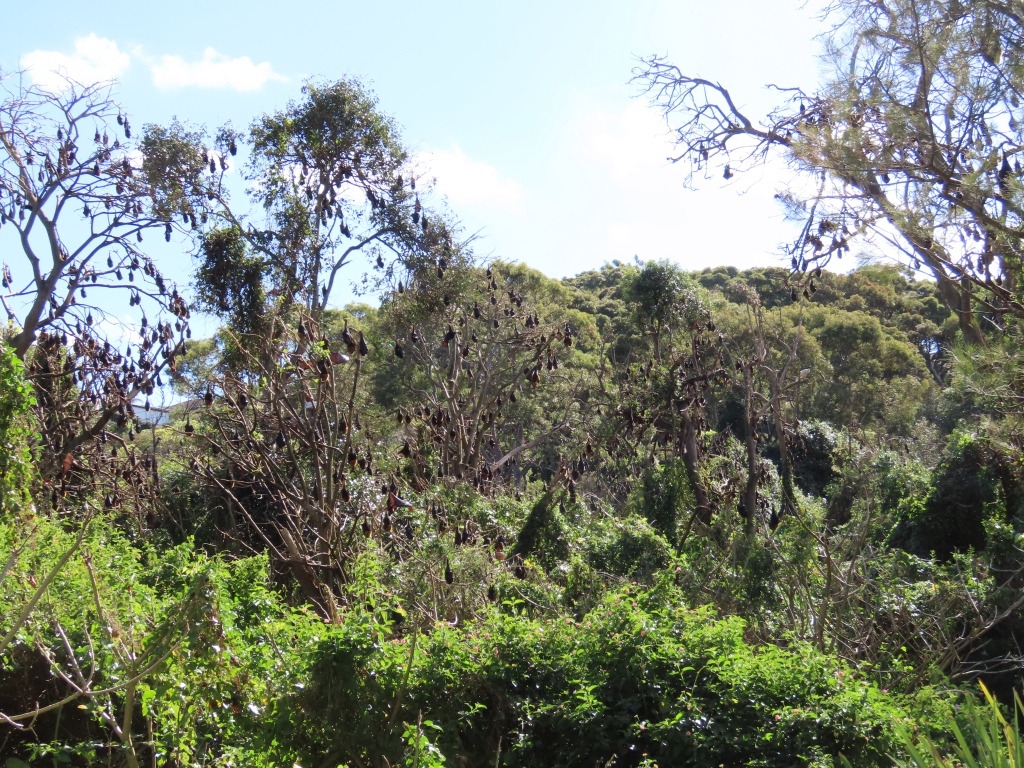
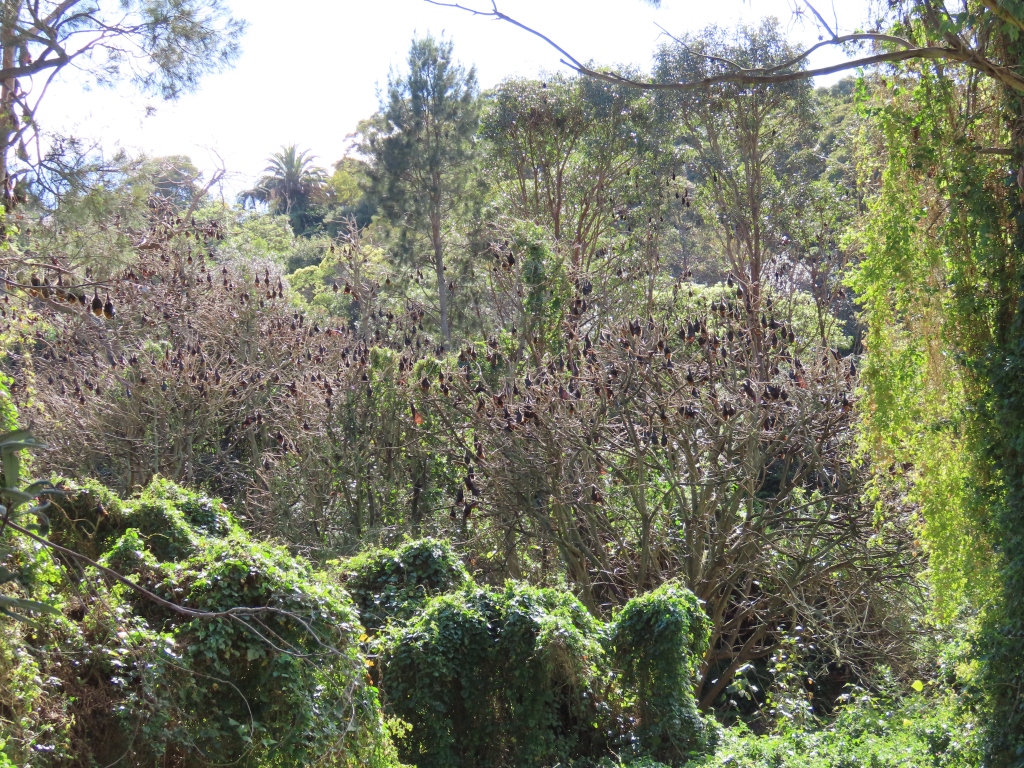
Let’s end with a row of bats neatly lined up:
Pair of White-faced Herons in Sydney Harbour
A pretty pair of White-faced Herons were strutting their stuff at Forty Baskets Beach this morning. They were quite interested in each other, and the feathery plumes on their backs were quite noticeable. It looks as if breeding season has started.
In this video, the pair of herons are on a small boat moored just off the beach. All is peaceful until the seagulls start bullying the herons. After ducking a few incoming gulls, the herons take off and fly past me, landing on some rocks near by. Along comes a small dog (off scene). The dog owner tells the dog to wait. The dog doesn’t threaten the birds in any way, but they decide it’s politic to move to a different spot. They fly past me again, and come to rest in a quiet little bay.
Aside from the noise made by the seagulls and the sea, you can hear some raucous Sulphur-crested Cockatoos in the background. And, if you listen very carefully, you can hear the softer grunting croaks of the herons as they fly past me and then land on the rocks.
Scientific name: Ardea novaehollandiae
Approximate length: 66-69 cm
Date spotted: 5 August 2023 (winter)
Location: Forty Baskets Beach, Sydney Harbour, New South Wales, Australia: 33°48’15.8″S 151°16’13.9″E

Grey Goshawk in quiet contemplation
On a walk through the Australian forests near Sydney, I stopped on a rocky ledge to take in the view. Then I noticed a Grey Goshawk on a branch close by, also gazing out across the valley.
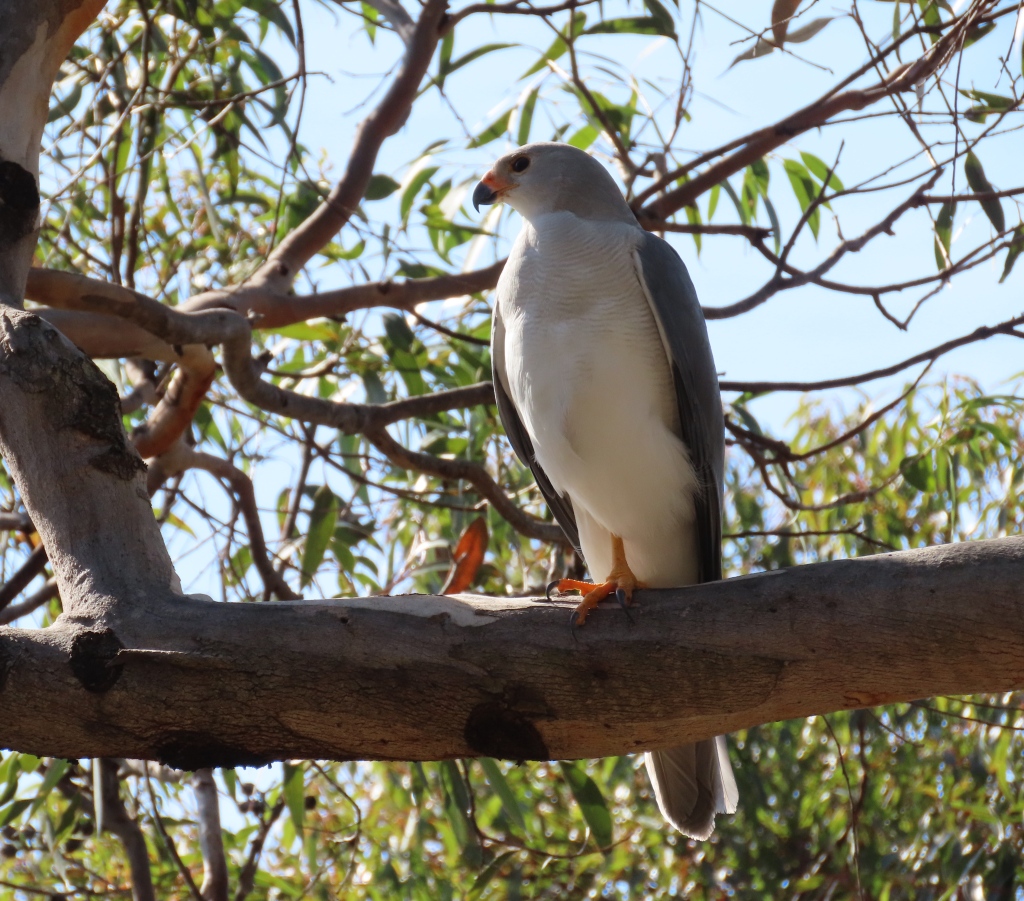
These beautiful birds of prey are quite sturdy, about 55 cm in length from head to tail, and have a wingspan of about one metre. Their chest and belly feathers are white with light grey horizontal bars. The head is grey, with large dark eyes outlined in yellow, and a yellow beak tipped in dark grey. Add the dark grey wings and tail feathers, and you have a very striking bird.
The goshawk was standing on one leg, with the other foot tucked under its belly feathers. The bird turned its head to see whether I posed it any danger, then went back to quiet contemplation of the view.

After five minutes or so, it hopped off the branch and glided away.
This is only the second time I’ve managed to snap some photos of a goshawk, though I’ve seen them a couple more times.
Common name: Grey Goshawk
Scientific name: Accipiter novaehollandiae
Approximate length: 40-55 cm. Wing span: 70-110 cm.
Date spotted: 4 August 2023 (winter)
Location: Manly Dam Reserve, New South Wales, Australia: 33°46’54.8″S 151°15’03.5″E

Pardalotes nesting on a Sydney beach
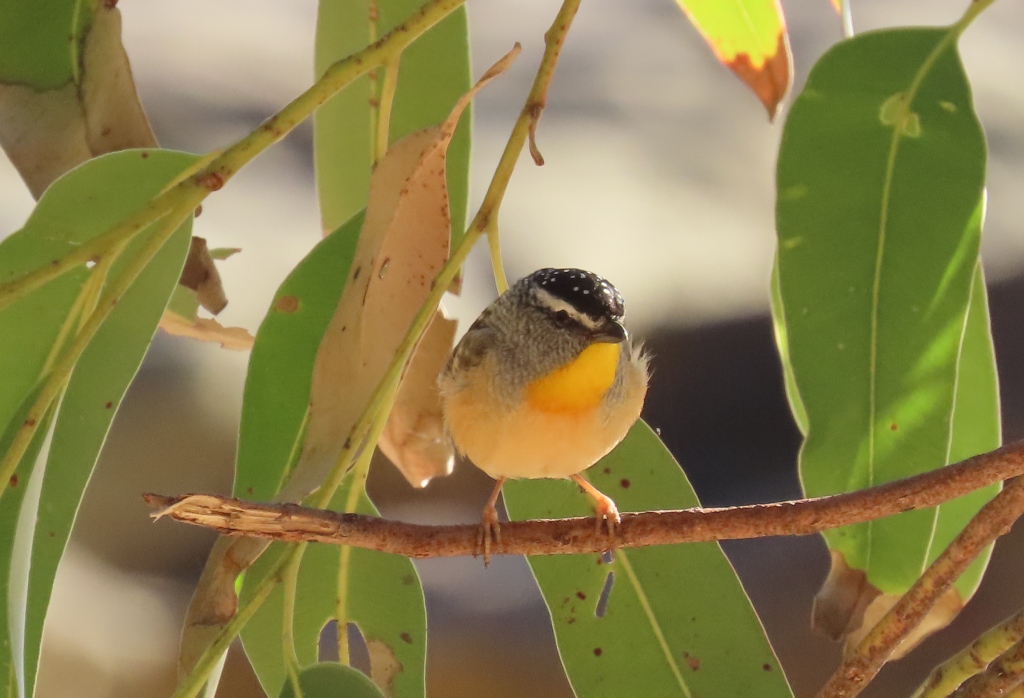
Pardalotes are unusual in that they build their nests underground, usually at around ankle height. This morning I spotted a couple of the birds flitting around a grassy bank on a beach in Sydney Harbour. With a bit of patience and the benefit of my camera’s super zoom, I was able to see the birds going in and out of their nesting tunnel.
The next video shows the male bird waiting on a tree branch until the coast is clear, then flitting off towards the nest:
Here’s the female, also checking for danger near the nest:
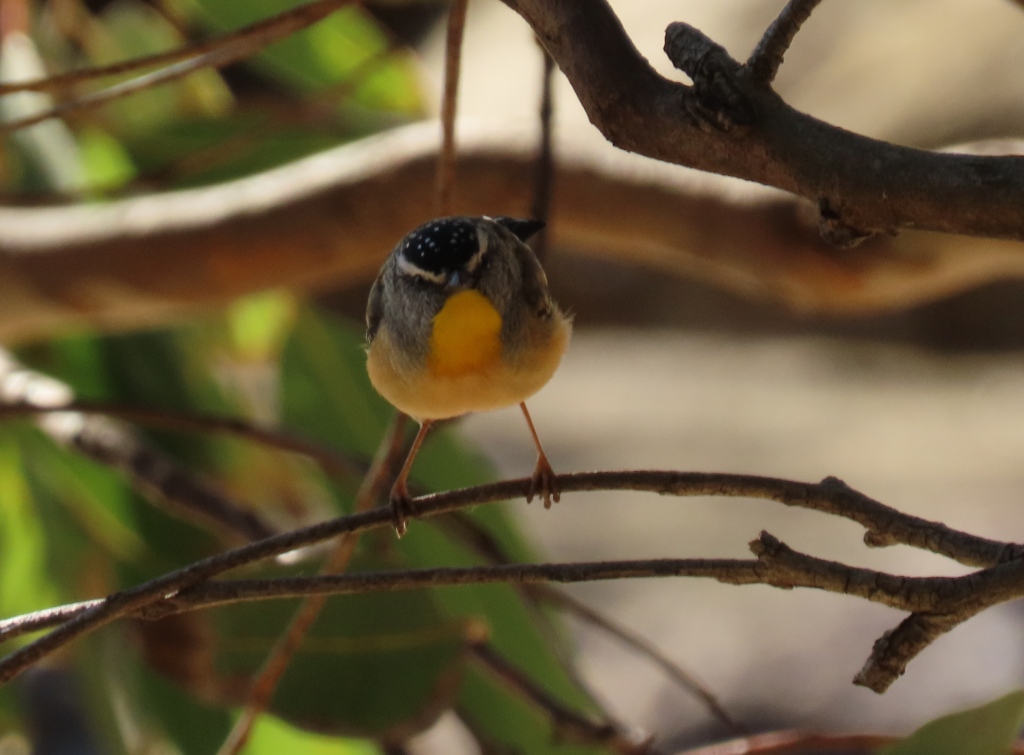
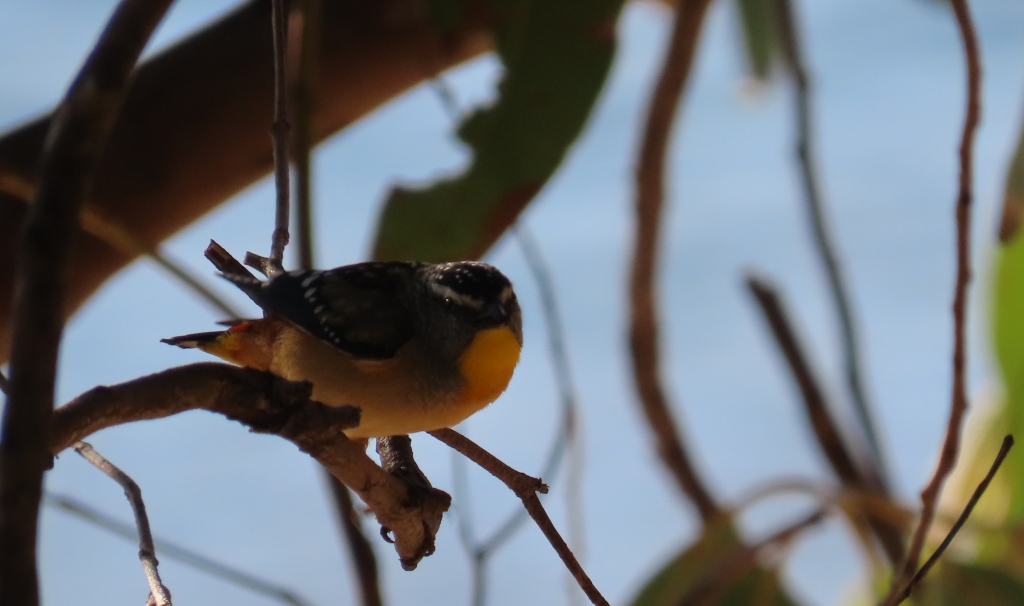
These are Spotted Pardalotes, also called Diamondbirds. They’re one of the smallest of Australian birds, at approximately 10 cm from head to tail. I’m often surprised at how unbothered they seem by my presence.
The female has a pale, faun-coloured chest. Her head and back are prettily dotted with spots, and her tail is aflame with red and yellow.

The male has an orange-yellow chest. The white stripes across its eyes are more pronounced than those of the femail, and there’s more black on the head and back, making the white spots stand out.
Common name: Spotted Pardalote or Diamondbird
Scientific name: Pardalotus punctatus
Approximate length: 10 cm
Date spotted: 29 July 2023 (winter)
Location: Reef Beach in Sydney Harbour

Spitfire grubs and Kookaburras
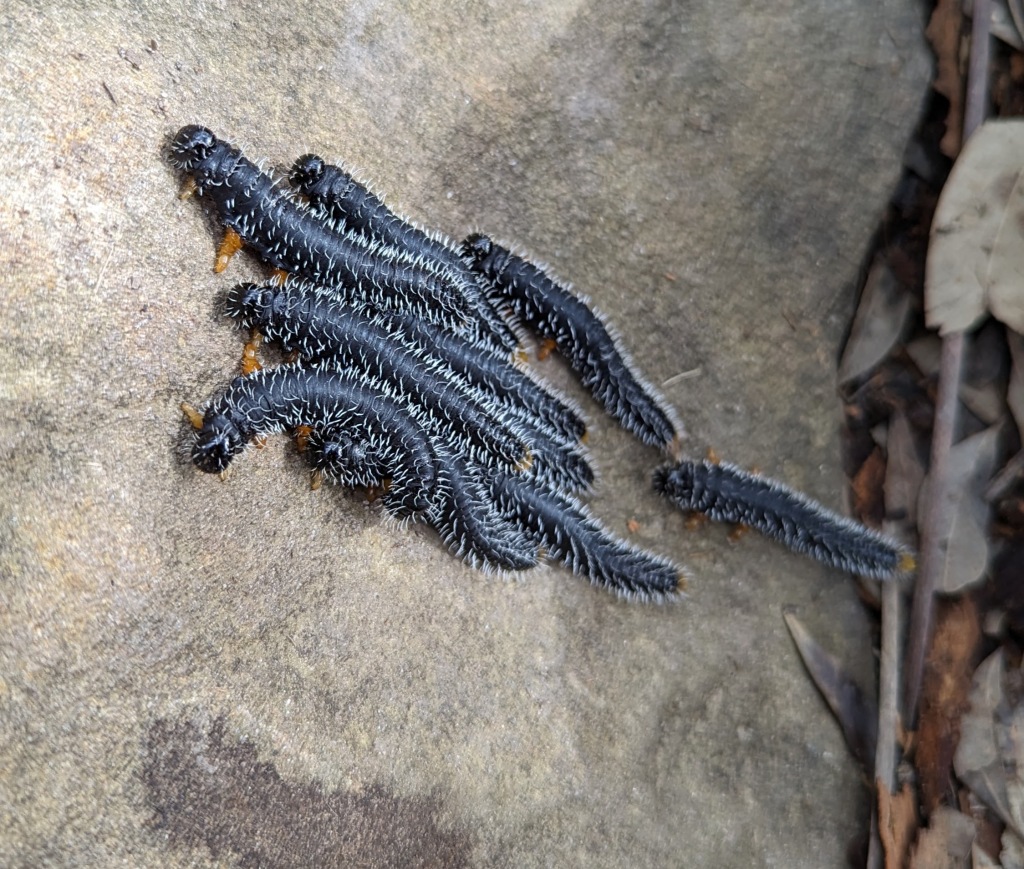
While wandering along a bush path, I came across a curious collection of grubs:
They’re spitfire grubs, which are the larvae of a type of wasp called a sawfly. The grubs look quite a lot like caterpillars with a don’t-mess-with-me attitude. They’re black and shiny, with white bristles, yellow feet, and a yellow tail. They’re quite long and fat: about the size of my little finger.
Despite the name “spitfire”, the grubs don’t actually spit anything, but if you touch them you can get a burning sting from the spikes. The grubs also spew out a thick yellow liquid from their mouths when threatened, but the liquid isn’t harmful to people. It’s made from eucalyptus oil, since the grubs feed on eucalyptus leaves.
In the video, you can see them tapping their tails on the rock. They do that to communicate their whereabouts with each other.
Here’s a close-up of some of their heads:
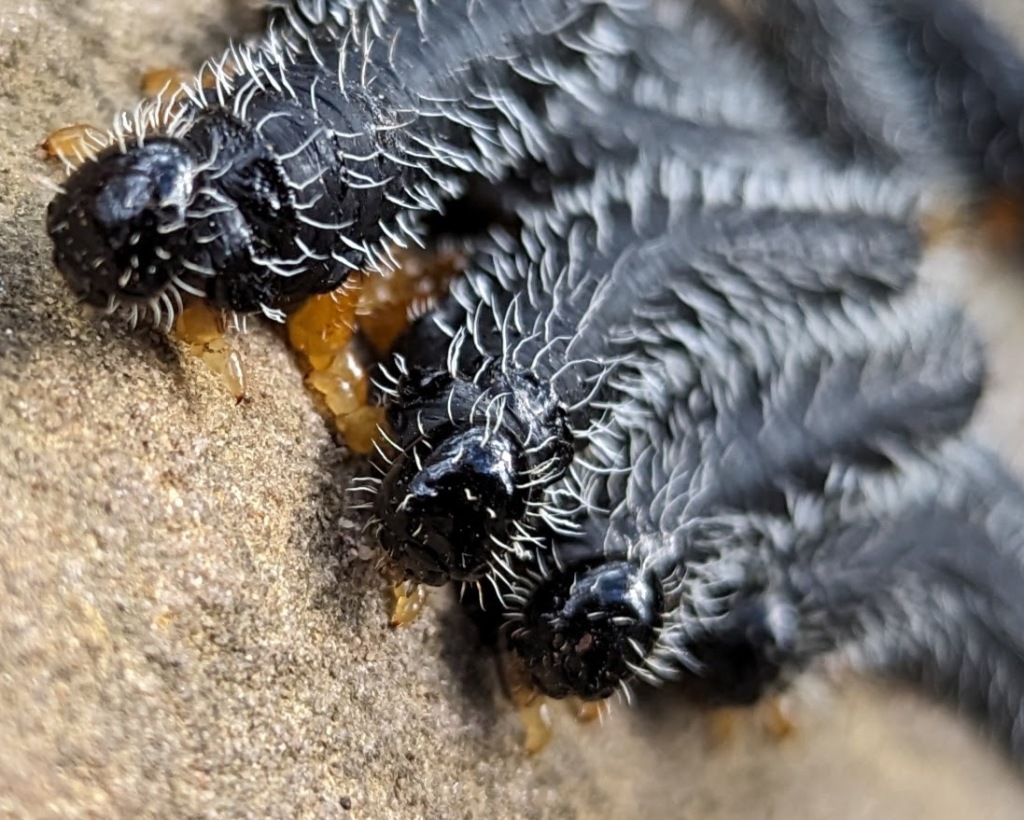
There were ten grubs in the clump:
Next on the scene was a riot of Kookaburras! The birds gathered above me while I was bent over the clutch of spitfire grubs. I was worried that the Kookaburras might swoop down and grab a grub as a snack!
The Kookaburras left the grubs alone. I guess they don’t taste great!
Common name: Laughing Kookaburra
Scientific name: Dacelo novaeguineae
Approximate length: 47 cm
Date spotted: 18 July 2023 (winter)
Location: Manly Dam park, New South Wales, Australia: 33°46’56.0″S 151°15’05.4″E

Spiffy little Red-browed Finches and a Pardalote
In the muted tones of a wintry day in the bush after rain, the green and red colouring of the Red-browed Finches stands out cheerily:
Red-browed finches are small (about 12 centimetres from beak to tail) and fast-moving. The red on their brow and tail can be quite vivid, as in this little one.

Common name: Red-browed Finch
Scientific name: Neochmia temporalis
Approximate length: 12 cm
Date spotted: 17 July 2023 (winter)
Location: Manly Dam park, near Sydney: 33°46’48.7″S 151°15’03.9″E
There were a couple of Pardalotes hopping around too:
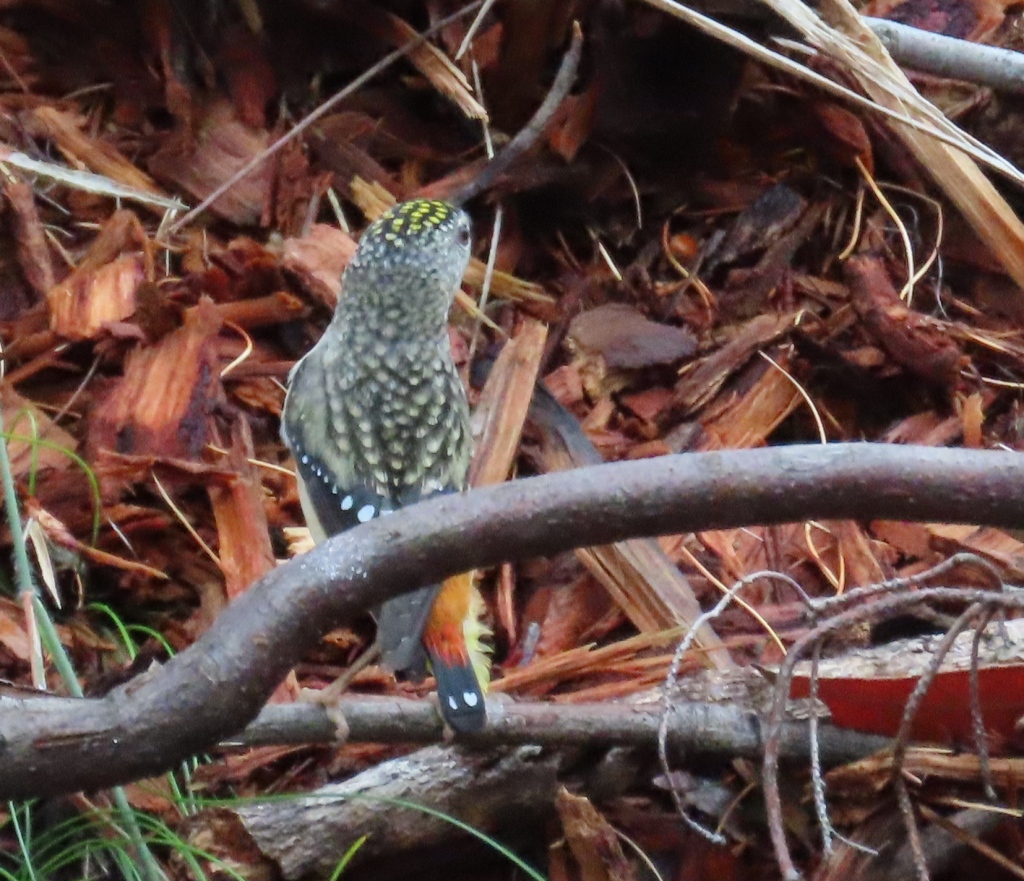
I’ve shown better pics of Pardalotes in earlier posts.
Common name: Spotted Pardalote
Scientific name: Pardalotus punctatus
Approximate length: 10 cm
Date spotted: 17 July 2023 (winter)
Location: Manly Dam park, near Sydney: 33°46’48.7″S 151°15’03.9″E


 Sydney Birder