
Magpie-lark eating a cicada
This Magpie-lark, also known as a Mudlark or a Peewee, has caught a cicada for breakfast.
Cicadas are large beetles that appear around Sydney in summer and drive us all crazy with their singing. You can hear the harsh, ringing sound of the cicadas in the video.
There are a few different types of cicadas, many of them quite lovely. Take a look at these posts to see some that I’ve photographed on other occasions.
Back to the bird! This Magpie-lark is a male. You can tell by the colour of its throat, which is black. Female birds have a white throat.

Common name: Magpie-lark, also called a Peewee or a Mudlark
Scientific name: Grallina cyanoleuca
Approximate length: 30 cm
Date spotted: 28 November 2020 (spring)
Location: Manly Dam National Park, New South Wales, Australia: 33°46’35.5″S 151°14’50.3″E

(Sad) Nest of Black-faced Cuckoo-shrike disappeared
Black-faced Cuckoo-shrikes are smart-looking birds, with a neat covering of smooth grey feathers and a dark face. I was delighted when I noticed a nesting couple on one of my regular walks, and have been watching their progress with pleasure.
Here’s a photo of one of the parent birds, taken on 17 October:

Common name: Black-faced Cuckoo-shrike, also called a shufflewing
Scientific name: Coracina novaehollandiae
Approximate length: 35 cm
Location: Manly Dam Park, New South Wales, Australia: 33°46’35.5″S 151°14’51.2″E
Here’s a parent sitting on the nest (photo taken on 11 November):

And a side view, taken on 17 October:
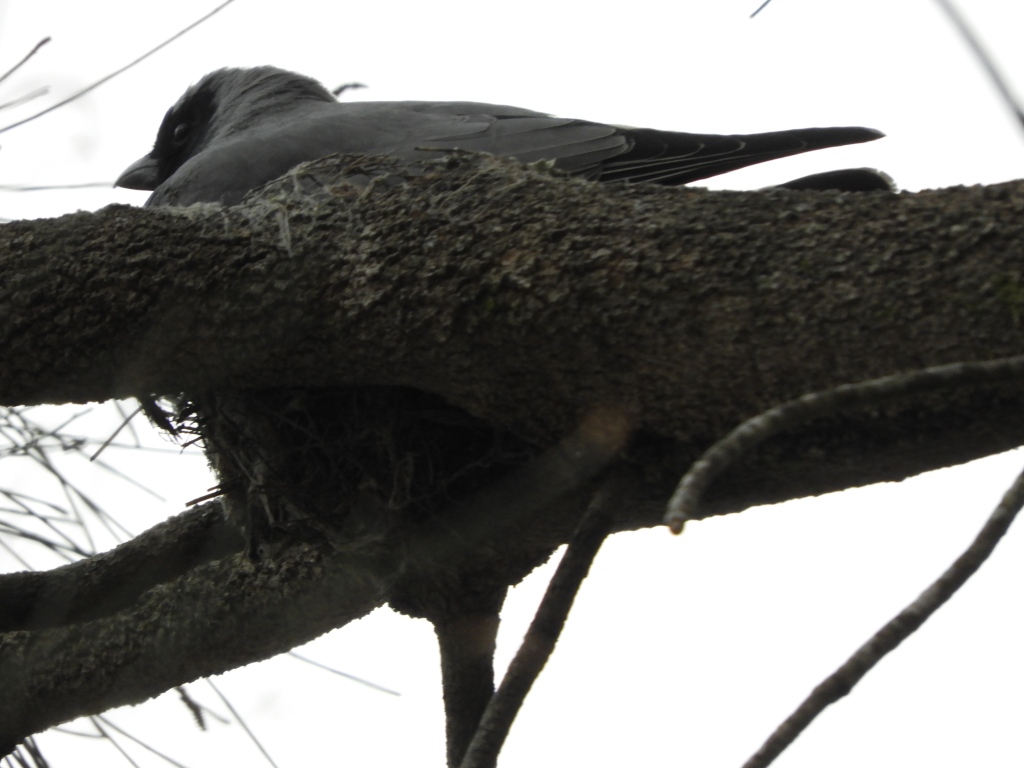
This is the nest, taken while both parents were briefly out of view (4 November):

This video shows the first time, and alas the last time, that I caught a glimpse of the chicks. The images are in silhouette, because it was early in the morning with the bright sky behind the birds. Even so, you can see the beak of a young chick. It’s also interesting to see how the parent cleans the nest after feeding its young:
I shot the above video on Wednesday 11 November, just a few days ago. On Thursday and Friday, I walked past the tree and saw the birds sitting on the nest as usual. Today, Sunday, I went back to the area and the nest has completely disappeared.

It’s likely that the birds had a visit from a monitor lizard, or a possum, or even a human. (The nearby picnic area had been significantly vandalised too.)
It’s so sad to see all that effort by the parent birds go to waste, and to think what may have been the fate of the chicks. I do hope the parents survived to have another family next year.

Oriole singing and mimicking other birds
A little Olive-backed Oriole had me intrigued for a while. I couldn’t see the bird, but I could hear a mixture of lyrical calls that seemed to come from a variety of birds. Eventually I tracked down the singer.

This looks like a young male bird. It has the dark head of a male, but its eyes are brown rather than red. It was lively and curious, hopping from branch to branch and examining its surrounds with evident interest. Or perhaps it was hungry and looking for food!
In this video, the oriole starts with a good preening session then launches into song. You can’t see the bird very well but you can hear its song:
Common name: Olive-backed Oriole
Scientific name: Oriolus sagittatus
Approximate length: 25-28 cm
Date spotted: 10 November 2020 (spring)
Location: Manly Dam Park, New South Wales, Australia: 33°46’52.3″S 151°15’07.9″E
Emu, turkey, and peacock at Walkabout Wildlife Sanctuary
Today we visited the Walkabout Wildlife Sanctuary, which is about 75 km north of Sydney (map). We spent the day among the animals and walking the bush trails. It’s a lovely, relaxing place to visit.
While there, I took some videos of the birds that stroll around the pathways. First, an emu. Emus are large native Australian birds. This one came a little closer than I was expecting when I started filming it!
Next, some turkeys. These birds are from North America rather than Australia. They’re busily showing off their tails to each other. A couple of emus stroll past in the midst of the show:
Encouraged by the turkeys’ display, a peacock showed its gorgeous tail and did a bit of strutting around too. This type of peacock originated in India:
It’s well worth a visit to the Walkabout Wildlife Sanctuary (map). There’s plenty to do, whether you like to sit and watch the birds walk by, or go for a stroll along the bush paths, or hear about the animals from the rangers in the park.

Strange call of the brush-turkey
Australian Brush-turkeys. They’re the bird everyone loves to hate. They’re not pretty to look at, and they have a habit of tearing up your garden to build their mounds. But they have a certain dignified strangeness that appeals to me.
One of the strange things about a brush-turkey is the noise it makes. The sound you’ll hear most often is a quiet grunt, like the cluck of a contented, somewhat deep-voiced domestic chicken.
But every now and then, male Australian Brush-turkeys make a weird, booming sound:
Oo-oo-oom
Listen to the sound of this male brush-turkey:
Did you hear the noise? Play the video again if you missed it. Making the noise seems to entail a lot of effort. The bird starts by ducking its head, a little like a pigeon doing a mating dance. Then it lifts its head, and the loose yellow skin hanging below its neck seems to be inflated with air. Perhaps expelling that air is what makes the noise?
Now that you’ve heard the noise, you may be able to make it out in the next video too. The bird makes the noise near the start of the video, but it’s a little masked by a chatty currawong.
Male brush-turkeys build a mound of leaves and other vegetation, then attract females to lay their eggs in the mound. The warmth from the compost heap keeps the eggs at the right temperature until they hatch. No sitting around on boring nests for this canny bird!
This particular bird seems to return to the same location to build its mound every year. The mound is uncomfortably positioned in a narrow strip between a road and a building. I guess the temperature must be just right. And maybe the presence of humans keeps predators at bay.
Here’s the proud father-to-be:
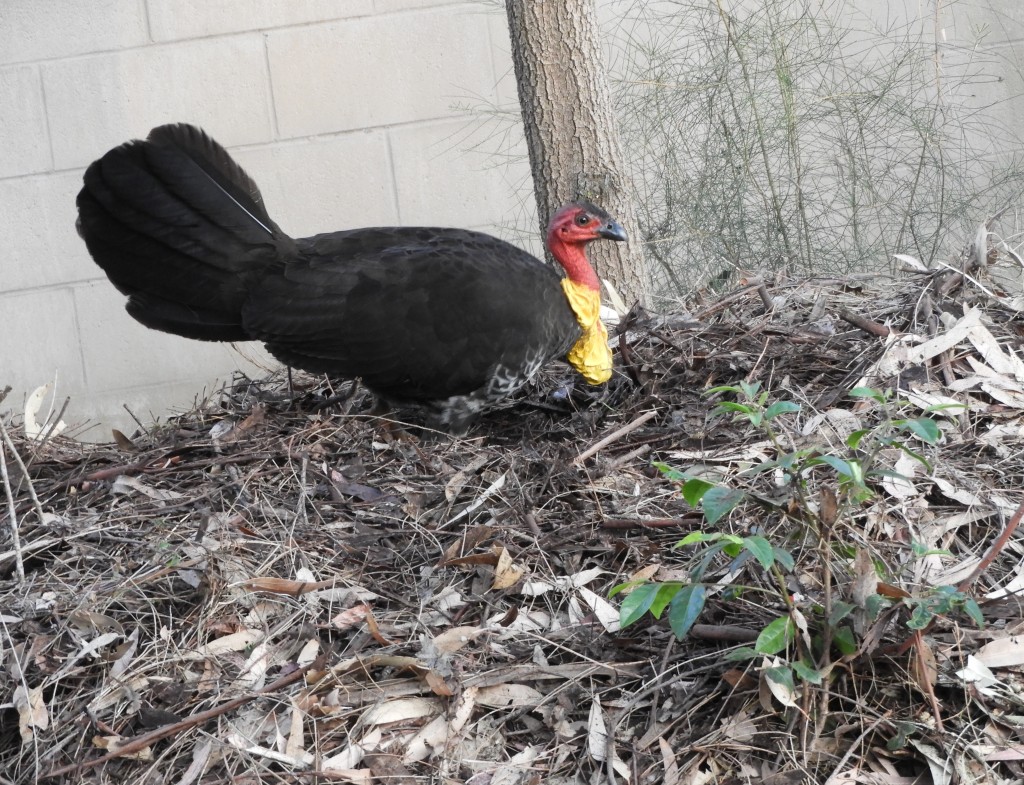
Common name: Australian Brush-turkey
Scientific name: Alectura lathami
Approximate length: 60-70 cm
Date spotted: 25 October 2020 (spring)
Location: Outside Manly Dam Park, New South Wales, Australia: 33°46’54.1″S 151°15’28.3″E
Royal Spoonbill at Manly Beach
Today I saw a Royal Spoonbill for the first time. The bird was strutting along the bank of Manly Creek, right where the lagoon opens into the Queenscliff end of Manly Beach. The spoonbill was accompanied by a White-faced Heron.
A Royal Spoonbill is a large white bird with a black face, a spoon-shaped beak, and black legs. Spoonbills feed by dragging their beaks through the water. In the video below, the bird hops into the water and trawls for food. During mating season (which is now), Royal Spoonbills have an impressive crest of long white feathers on the back of their heads. Thanks to the wind today, you can see this bird’s fine crest blowing around its head.
Common name: Royal Spoonbill
Scientific name: Platalea regia
Approximate length: 75-80 cm
Date spotted: 25 October 2020 (spring)
Location: Manly Beach, New South Wales, Australia: 33°47’06.8″S 151°17’16.3″E

Baby black swans and ducklings
Baby swans are called cygnets. Pictures of cygnets from white swans are quite common, but what do baby black swans look like? Very similar to the white-swan babies, it turns out. They’re grey and fluffy, with black eyes, feet, and beak. I was delighted to spot a family of black swans while out walking a couple of days ago.

The parent swans were watchful, taking care to keep their little ones in a group. A male swan is called a cob, and a female is a pen. Five babies! That’s a lot of curiosity and cuteness to look after.

Did I say five babies? Yes. One of the cygnets was fossicking around in the undergrowth at the water’s edge. You can see the fifth little one in this video:
Common name: Black Swan
Scientific name: Cygnus atratus
Approximate length of adult: 120 cm
Date spotted: 9 October 2020 (spring)
Location: Manly Dam Park, New South Wales, Australia: 33°46’58.5″S 151°15’18.6″E
Nearby was a family of Australian Wood Ducks. The ducklings are almost as cute as the cygnets. But not quite!
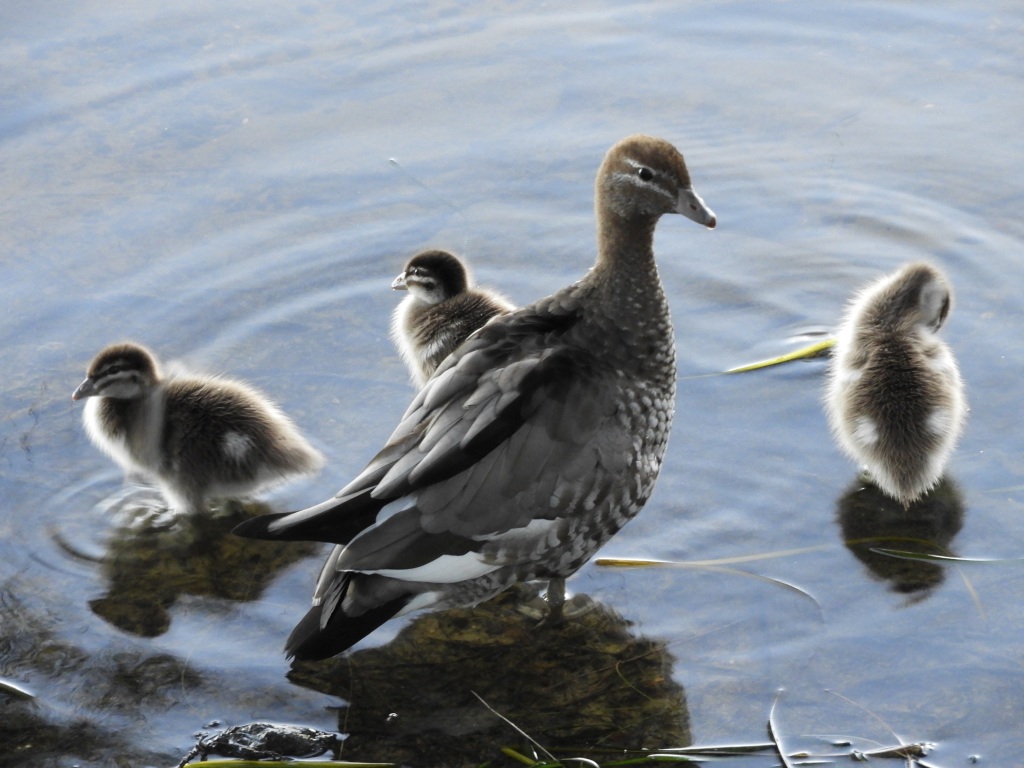
Common name: Australian Wood Duck
Scientific name: Chenonetta jubata
Approximate length of adult: 50 cm
Date spotted: 9 October 2020 (spring)
Location: Manly Dam Park, New South Wales, Australia: 33°46’58.5″S 151°15’18.6″E

Cormorant with view of Bantry Bay
This morning I went for a long walk along one side of Bantry Bay, an inlet of Sydney harbour. The area is in the lovely Garigal National Park. Along the way, I spotted this Little Pied Cormorant:
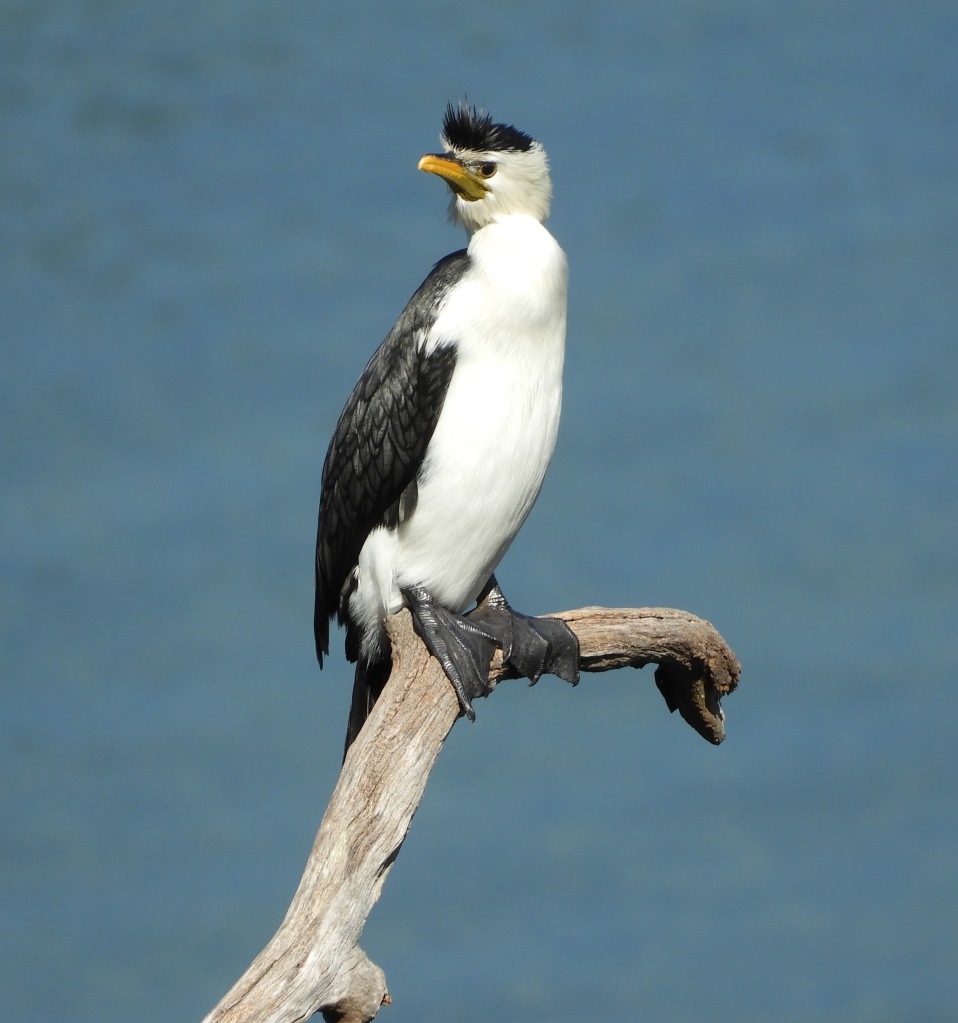
The bird had chosen a perch with a stunning view of Bantry Bay. Here’s a zoomed out picture of the bird on its skeleton-tree perch (the bird is at the end of the bottom branch on the right), with the clear water and mangroves of Bantry bay, and couple of canoeists in the distance:
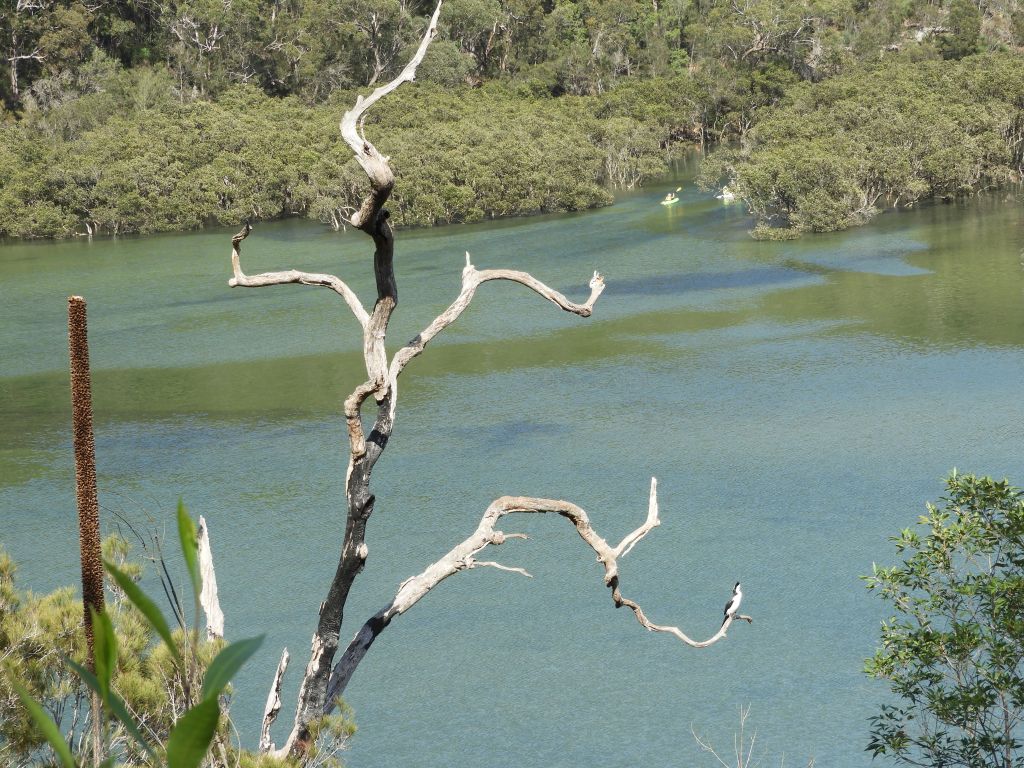
The next picture shows more of the view, following the bay inland:

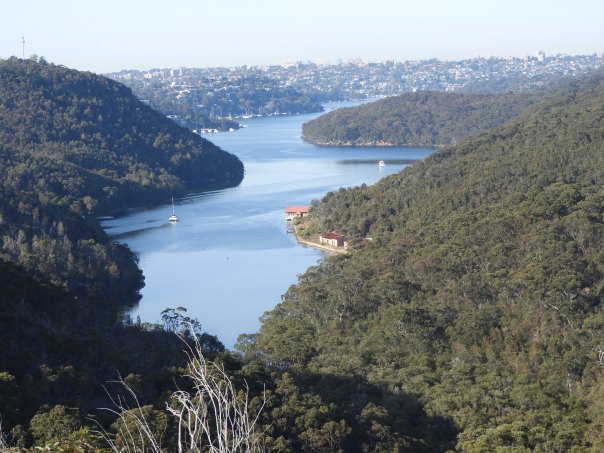
Here’s a view of the bay taken (on another day) from The Bluff, the highest point overlooking the water:
Common name: Little Pied Cormorant
Scientific name: Phalacrocorax melanoleucos
Approximate length: 60 cm
Date spotted: 4 October 2020 (spring)
Location: The Bluff Track, Middle Harbour, New South Wales, Australia: 33°46’23.9″S 151°13’52.8″E

Noisy currawongs enjoying blueberry ash berries
Currawongs are intelligent, curious, and noisy birds. The Australian dawn and dusk ring with their calls. Yesterday I was walking along a bush path when I heard a tremendous ruckus up ahead in the treetops. Currawongs whistling and whooping, branches swishing, and twigs clattering to the ground.
“Uh-oh,” thought I. “What have they found? Some possum caught in the harsh light of the day, or a bird of prey that dared to venture into currawong territory?”
The sound was all round me. At first it was difficult to find a single bird to focus the camera on:
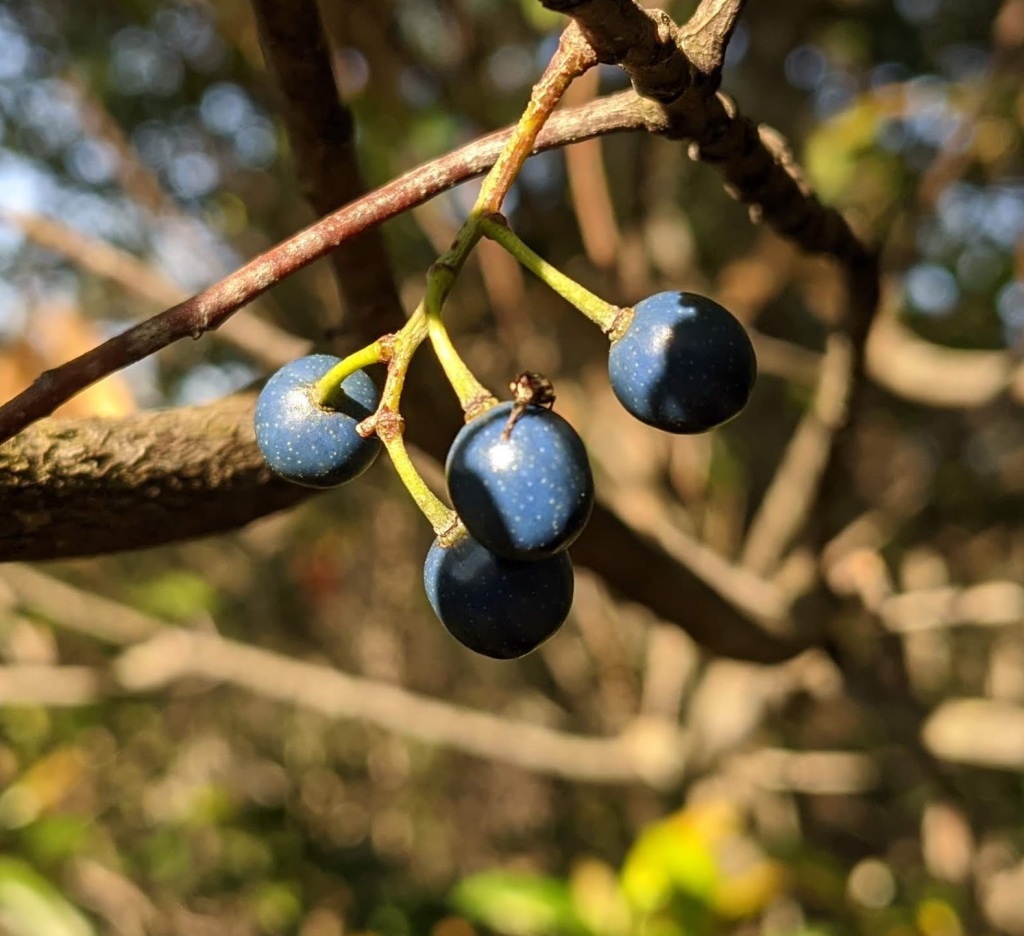
Drawing closer, I saw the source of all the fuss. The blueberry ash trees are fruiting. Here’s a closeup of the berries from one of the trees that the currawongs were feasting on. The berries are small, and a pretty blue in colour. If you look closely, you can see the characteristic tiny yellow spots on the berries:
It seems these berries are irresistible to a currawong. What’s more, from all the commotion, you’d think there weren’t enough berries to go round! In the next video, I managed to catch some pictures of the currawongs themselves. At times you can hear a butcher bird interjecting too:
Here’s a cheeky glare from one of the critters making all the noise:
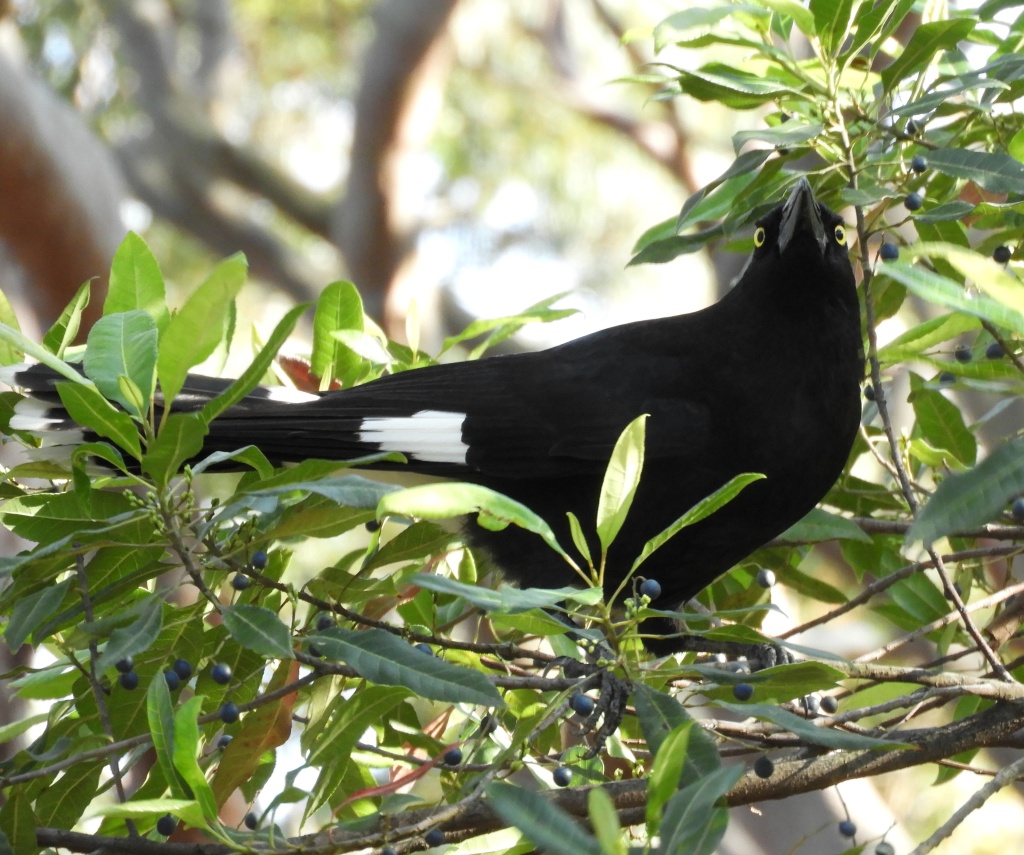
Common name: Pied Currawong
Scientific name: Strepera graculina
Approximate length: 45 cm
Date spotted: 3 October 2020 (spring)
Location: Manly Dam Park, New South Wales, Australia: 33°46’28.2″S 151°14’58.4″E
Yaayyy a Fairy-wren
Fairy-wrens are a reasonably common sight in this area of Australia. What’s not common is my being fast enough to catch one of them in the camera lens! Most of my photos of Fairy-wrens show a blue blur or an empty branch.
Today I managed to catch this male Variegated Fairy-wren fairly and squarely in my sights:
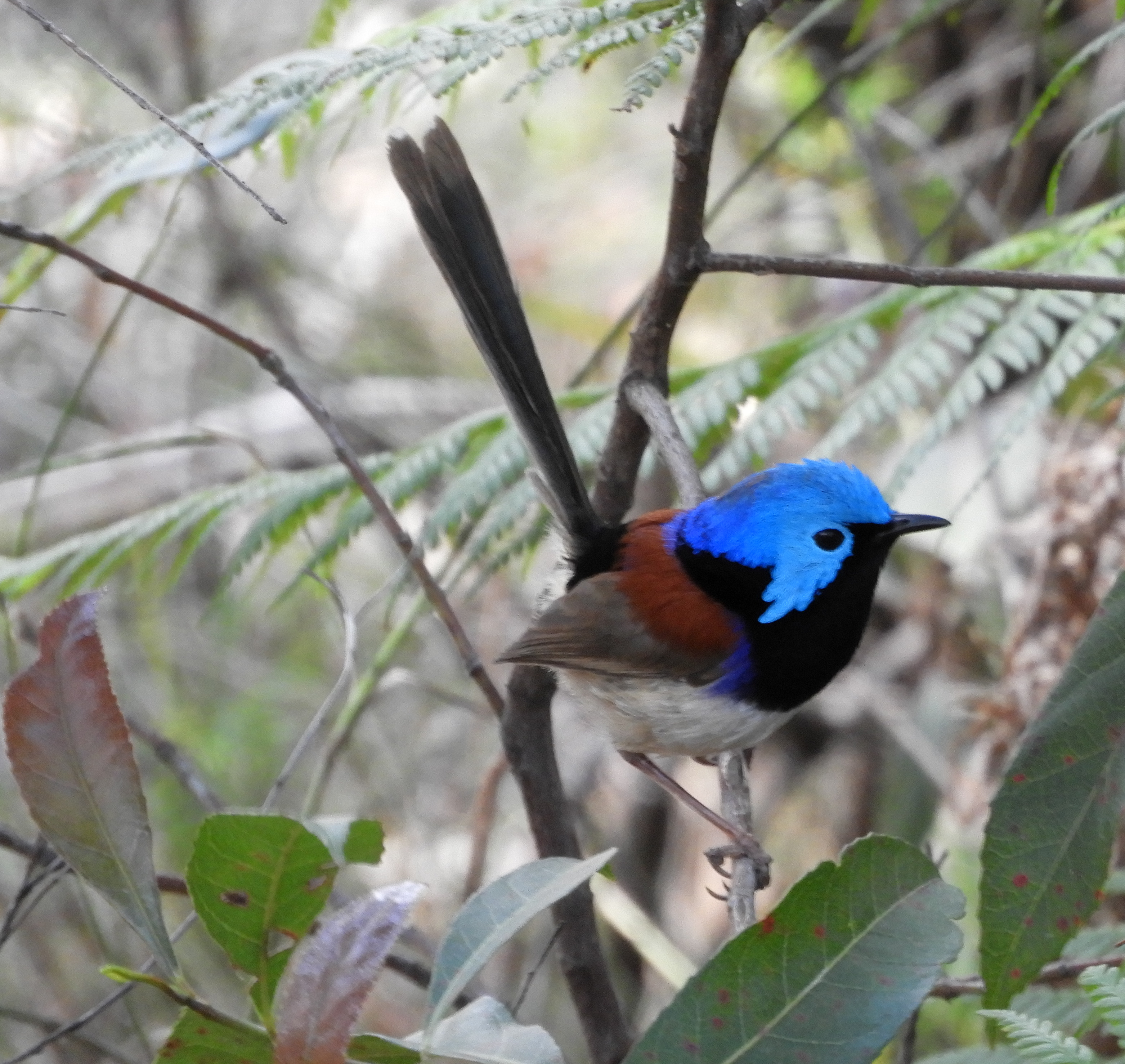
There’s something about the solid blocks of colour on this bird that makes it difficult to capture a clear image, even when the bird is still long enough for a photo.
The bird was with two other males, which is also fairly uncommon. Usually I’ve seen a male with a group of females.
That ridiculous tail, so much at odds with the round puffy appearance of the rest of the bird, makes you think there’s something wrong with the photo:
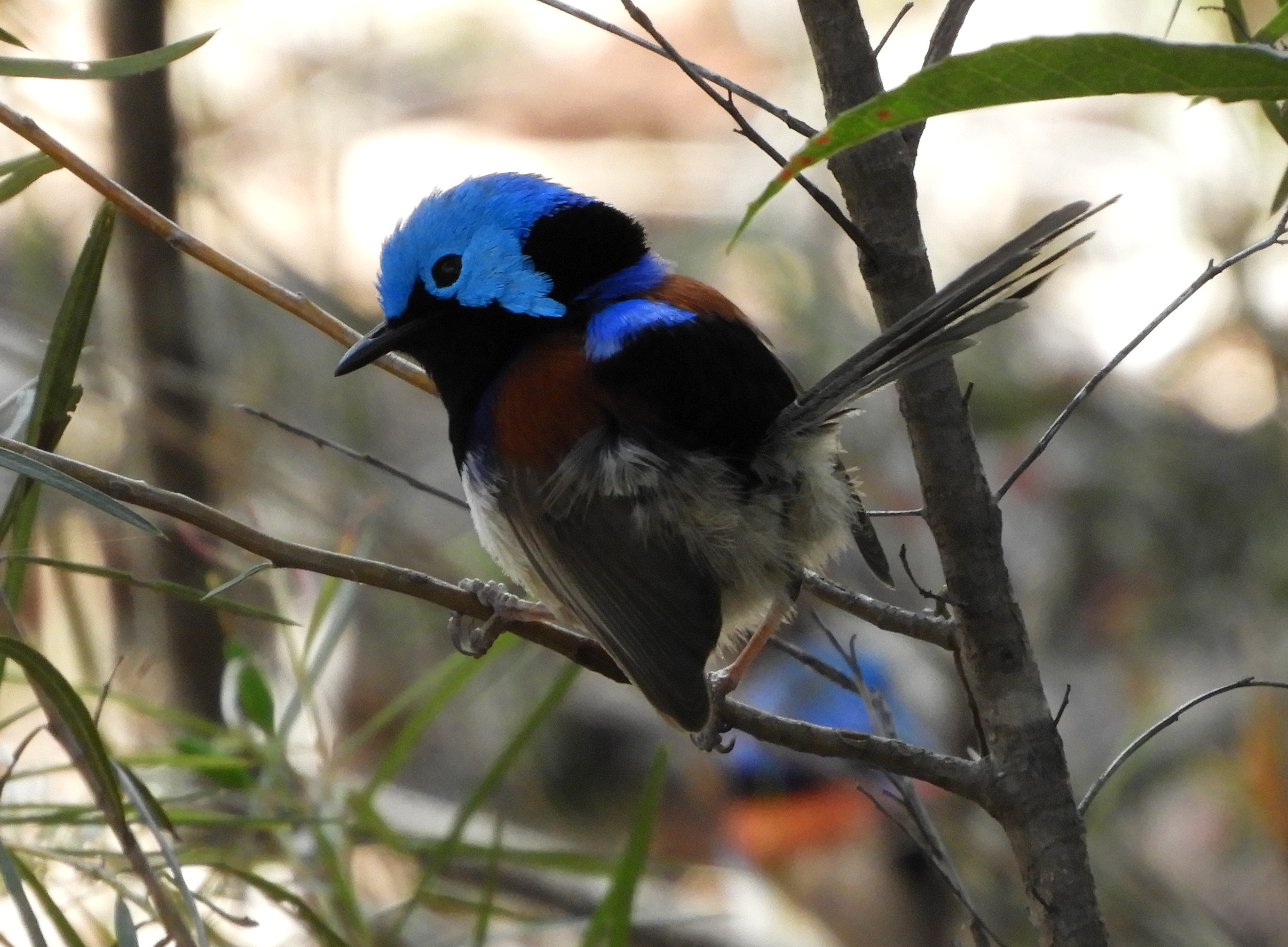
Common name: Variegated Fairy-wren
Scientific name: Malurus lamberti
Approximate length: 13 cm
Date spotted: 25 September 2020 (spring)
Location: Manly Dam Park, New South Wales, Australia: 33°46’50.6″S 151°15’04.7″E


 Sydney Birder