
My first Scarlet Honeyeater
Flashes of scarlet against the orange of a Banksia bloom first drew my attention to this tiny bird. It moved fast, never staying still for long. I managed to snap a couple of photos, though none very clear alas. I think it’s a Scarlet Honeyeater:

What a pretty little thing! I’ve been back to the same area a couple of times but not seen the bird again. Here’s another photo of the same bird after it moved to a different tree:

Common name: Scarlet Honeyeater
Scientific name: Myzomela sanguinolenta
Approximate length: 10 cm
Date spotted: 18 May 2021 (autumn)
Location: Manly Dam Park, New South Wales, Australia: 33°46’54.2″S 151°15’08.2″E

Yellow Figbird in Tropical North Queensland
Last weekend I was at Mission Beach in Tropical North Queensland. While there, I spotted a group of figbirds. The colouring of the males was quite different from the figbirds of the Sydney region. The northern variation (Sphecotheres viridis flaviventris) is called the Yellow Figbird for good reason:
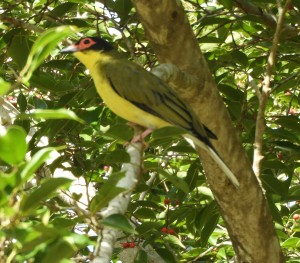
Common name: Yellow Figbird
Scientific name: Sphecotheres viridis flaviventris
Approximate length: 29 cm
Date spotted: 15 May 2021 (autumn)
Location: Mission Beach, Tropical North Queensland, Australia: 17°51’56.6″S 146°06’33.5″E
Compare the more subdued colouring of this male figbird in the Sydney region:
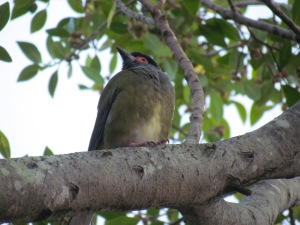

In search of a dinosaur uh Cassowary
(Not in Sydney.) This weekend I’m in Tropical North Queensland with my family. On Saturday, we drove up the east coast of Australia from Townsville, heading north for three hours until we reached the town of Mission Beach. This stretch of coast is the one place in the world where you’re most likely to meet a real live dinosaur.
Well, it’s not an actual dinosaur. What we were looking for was a Cassowary, the closest thing to a living dinosaur that I can imagine. A Cassowary is a large bird, ranging from one-and-a-half to two metres tall and weighing in at around 60 to 70kg. That means the bird is about the same height and weight as I am, or even larger!
Upon entering the area of Mission Beach, we came across enticing road signs like this one:

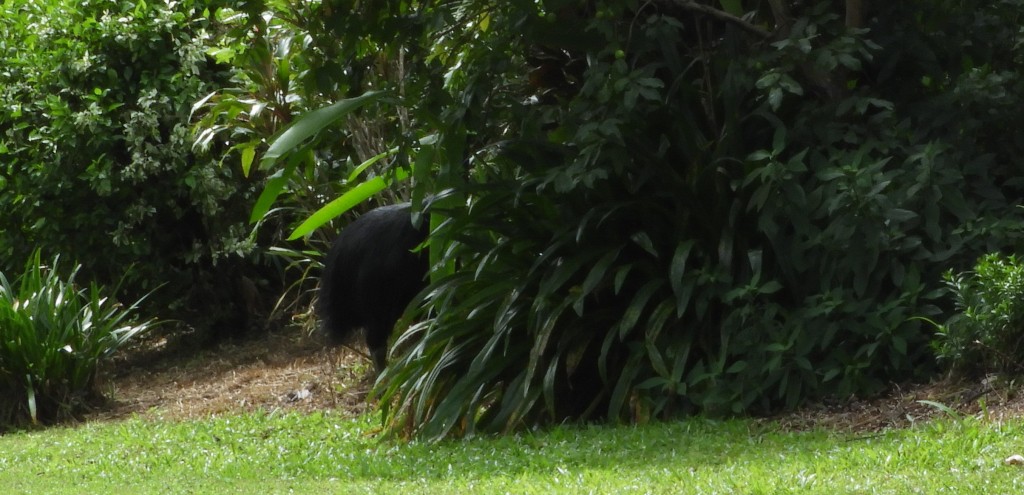
Cassowaries are usually timid and avoid contact with humans. Before setting out, I’d done some research about where we’d be most likely to see one, if we were lucky. And yes, we were lucky! Within an hour or so of starting our wandering around the southern areas of Mission Beach, we spotted a Cassowary. My first photo shows this intriguing rear end poking out from behind a bush:
Soon the bird appeared in full view:
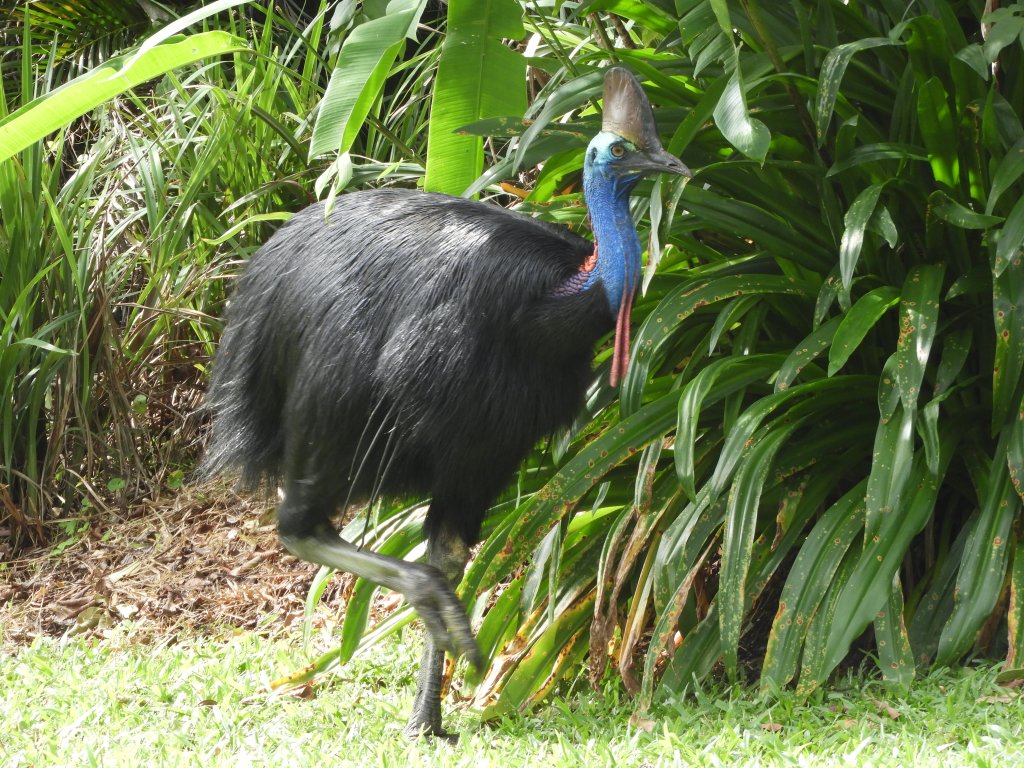
What a magnificent creature! We stayed well out of its way. Cassowaries are formidable. Quite apart from being large and fast, they have a big, strong beak and a twelve-centimeter-long, sharp claw on each foot, fit to disembowel any unwary adversary.
The curved bit that sticks up on the bird’s head is a hard, bony protrusion called a casque. Nobody is quite sure of its purpose. One theory is that the casque provides a sounding chamber that helps the bird make its deep, booming call. The colours on the bird’s head and in those red hanging wattles get brighter when the bird is agitated. Cassowaries can’t fly, but they can run up to 50 kilometres per hour, jump 2 metres straight up into the air, and swim well too.
This video shows the Cassowary quietly exploring the plants, looking for an edible treat:
Common name: Southern Cassowary
Scientific name: Casuarius casuarius johnsonii
Approximate height: Up to 2 metres
Date spotted: 15 May 2021 (autumn)
Location: South Mission Beach, Tropical North Queensland, Australia: Map

Call of the Red Wattlebird
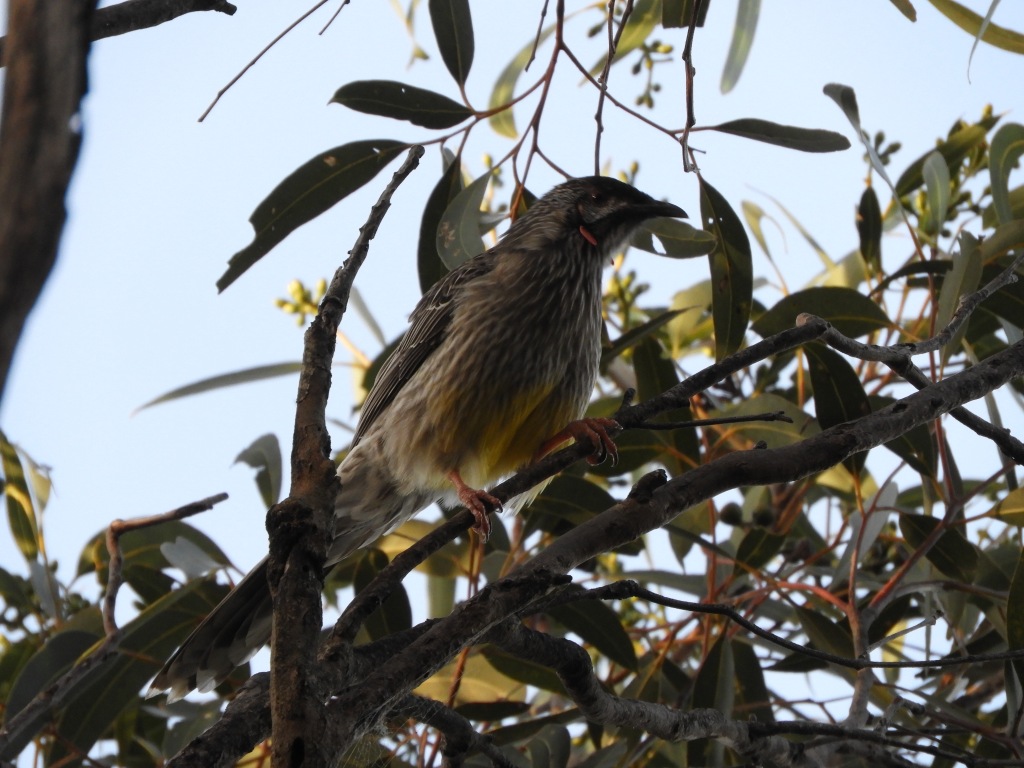
This Red Wattlebird was quite chatty in the crisp morning air.
Usually when walking in the bush I hear the more raucous croaks of this bird and its cousin, the Little Wattlebird. So it was nice to hear something a little more melodious.
Here’s a still picture of the Red Wattlebird, showing the red flap below its eye which gives the bird its name:
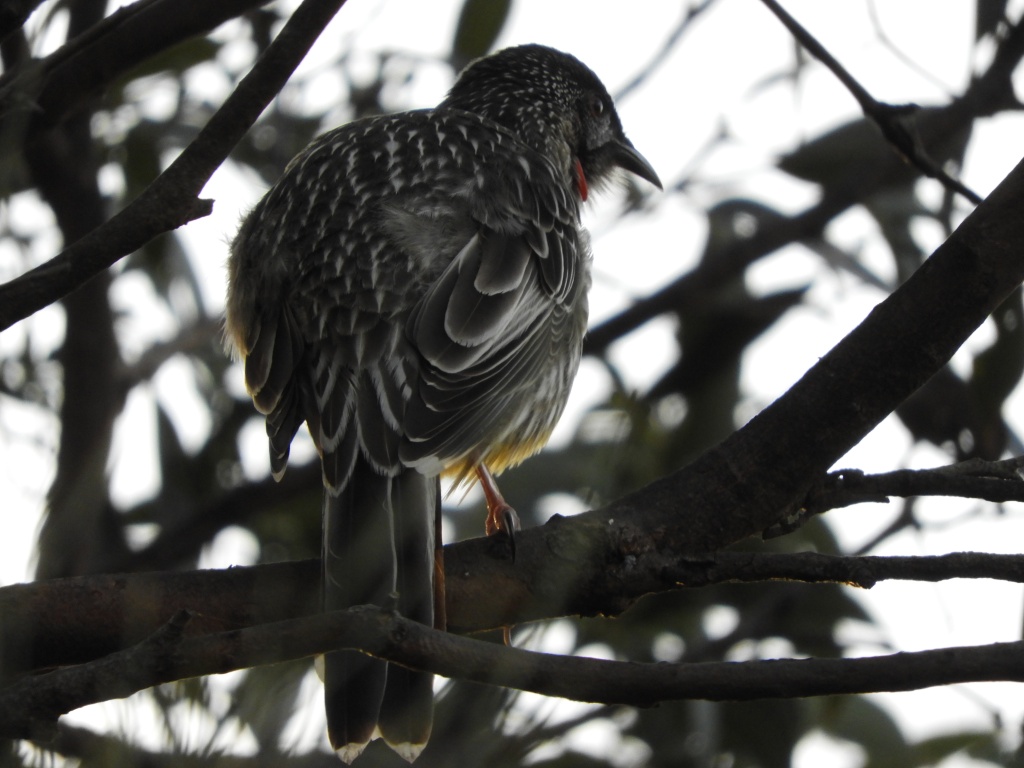
The feathers on its back are quite decorative, and a sun ray lights up the yellow on the bird’s belly:
Common name: Red Wattlebird
Scientific name: Anthochaera carunculata
Approximate length: 35 cm
Date spotted: 24 April 2021 (autumn)
Location: Manly Dam Park, New South Wales, Australia: 33°46’10.0″S 151°14’53.6″E

Magpie scolds tree feller
The time has come for the felling of some huge gum trees in our neighbourhood. I’m hoping only some of the trees in the row will go, but I don’t know what the intention is. The trees are magnificent, but they’re a danger to the houses beneath them. I live in the next block, and had a bird’s eye view of the felling.
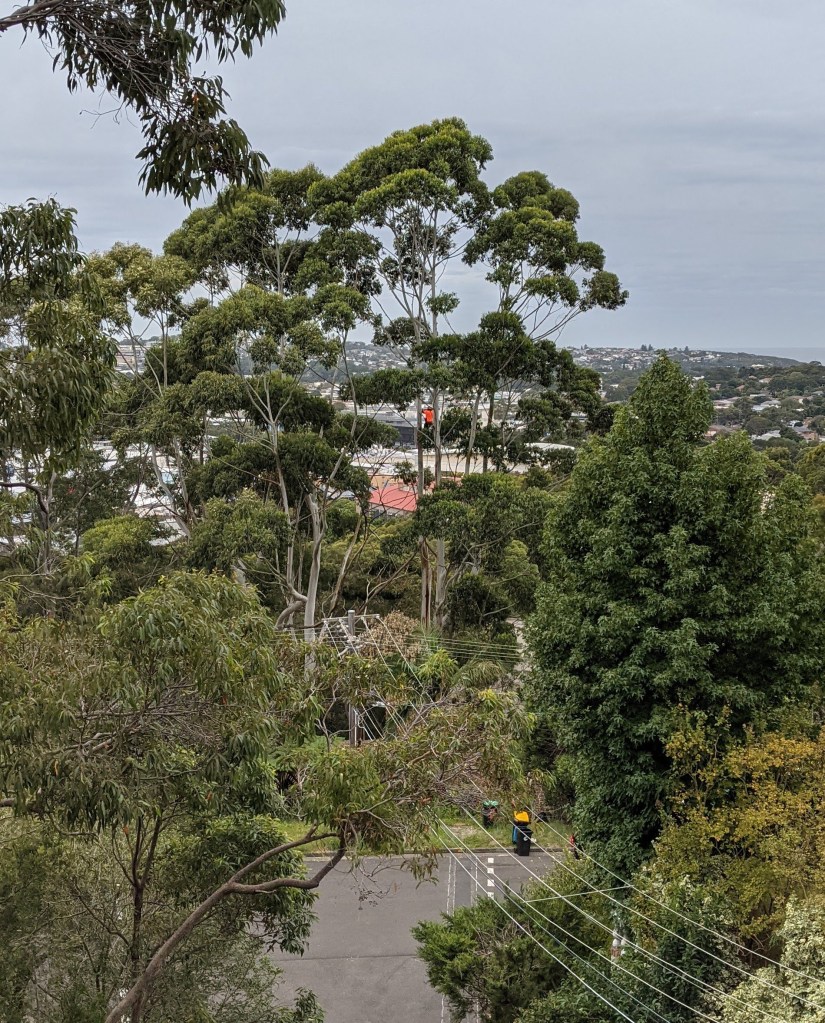
Over the past few weeks, there’s been some trimming of branches and undergrowth. Today was the big day for the removal of the trees. This photo shows the row of trees at the start of the day — they’re the white-barked giants in the middle of the picture, above the rubbish bins. See the orange blotch part-way up a tree on the right of the row? That’s the tree feller checking out the situation.

The trees are even higher than you think. The plot on which they’re growing is below the level of the road — in fact, the roof of the house is below the level of the road. So, the trees start about two stories below road level.
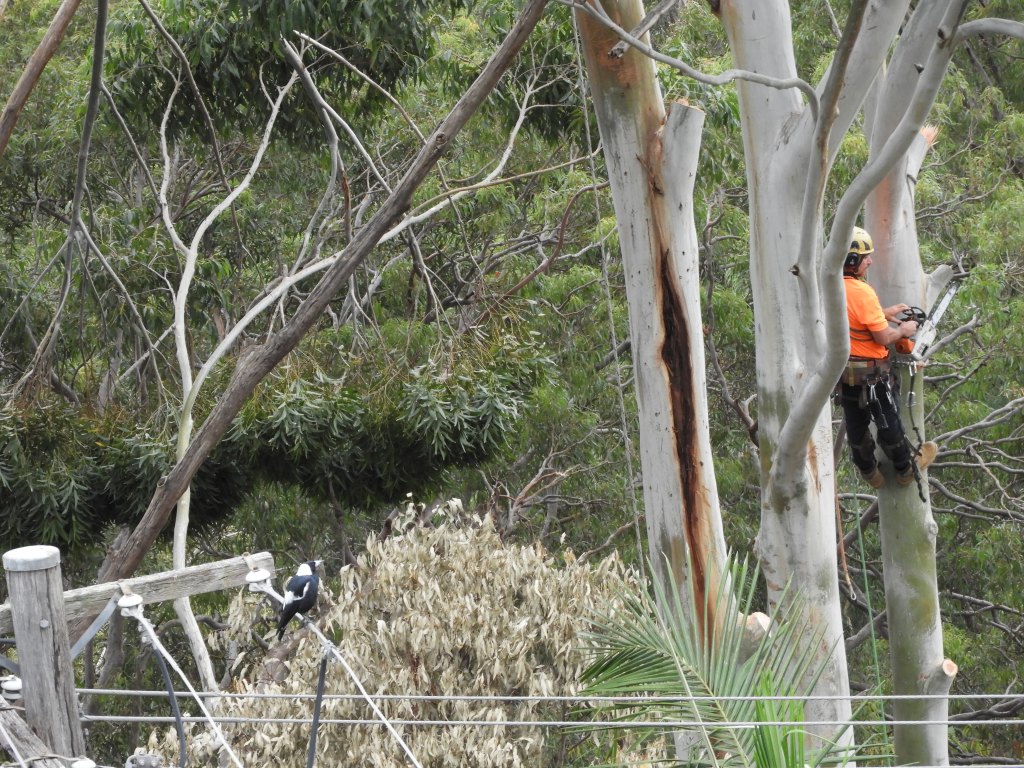
In the next photo, the tree feller has climbed higher and is attaching a harness and sling:
I take my hat off to the people who undertake tasks like this. So high!
This video shows one of the trees falling. It was the fourth one to go down. This one landed on the roof of the house below, which as far as I could tell was not the intention:
The neighbourhood birds were quite distressed about the whole experience. Rainbow Lorikeets zoomed away when the first tree came down. A couple of King Parrots swooped around calling, landing in our trees, then taking off again. An Australian Magpie sat in one of the trees outside my window and watched the proceedings. After the first tree came down, the Maggie swooped down to the power line near the row of trees and sang at the tree feller for about five minutes non-stop. I’m sure the Maggie was telling him off roundly:
The next video shows the tree feller climbing one of the trees. What a job!
Here’s the view the next morning:
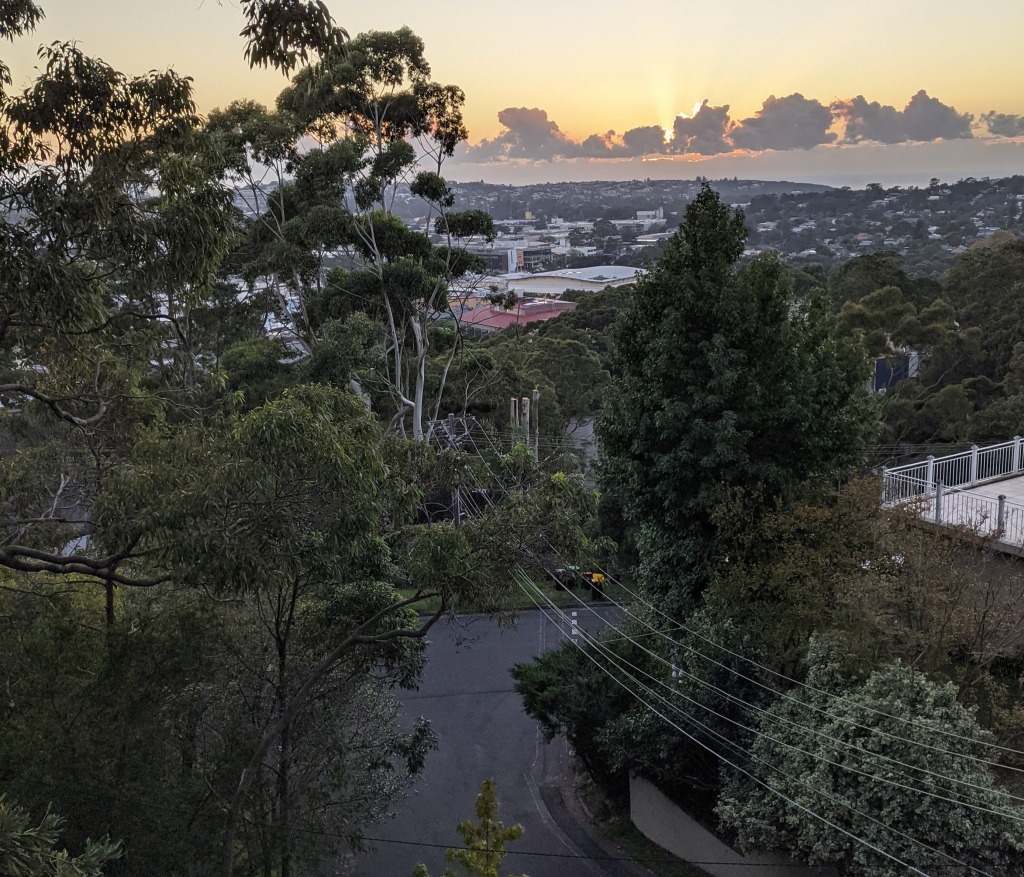
I’m sad to see these grand old trees go, but I do understand the need to ensure the safety of the people living beneath them.

Eastern Rosella a frequent visitor
How lucky am I? This gorgeous bird has taken to dropping by frequently, and hanging out on our telephone line. It’s a male Eastern Rosella. Often the female comes along too, but she’s more shy and flies off when I appear.

Eastern Rosellas are medium-sized parrots, at about 30cm from head to tail. This one usually makes his presence known with a distinctive twittering call. The phone line is below the level of my lounge window, so he has to look up to spot me.

Common name: Eastern Rosella
Scientific name: Platycercus eximius
Approximate length: 30 cm
Date spotted: 10 April 2021 (autumn)
Location: Allambie Heights, NSW, Australia

Scrubwren at a forest pool
Yesterday I spent some time sitting near a forest creek. Birds flitted around me. A Red Wattlebird dived repeatedly into the water and retreated to a branch for some serious grooming. A little scrubwren explored the mossy rock near the pools and running streams formed by the creek.

An aerial view showing the bird’s back:

Here’s one with a somewhat whimsical view of the water:

Common name: White-browed Scrubwren
Scientific name: Sericornis frontalis
Approximate length: 12 cm
Date spotted: 12 April 2021 (autumn)
Location: Manly Creek, New South Wales, Australia: 33°45’49.6″S 151°14’14.7″E

Diamond Python in Banksia tree
A couple of days ago, when walking along a bush bath in the Manly Dam park, I met a man carrying an empty cloth bag attached to a stick. I said hallo, received a friendly greeting in return, then asked him what he was capturing. He said, “Releasing, not capturing.”
“OK, what are you releasing?” said I.
“A Diamond Python.” When I responded with a delighted smile rather than a fearful gasp, he said, “Would you like to see it?” He led me down a path and pointed to the snake, which was making its way happily up a Heath Banksia tree.
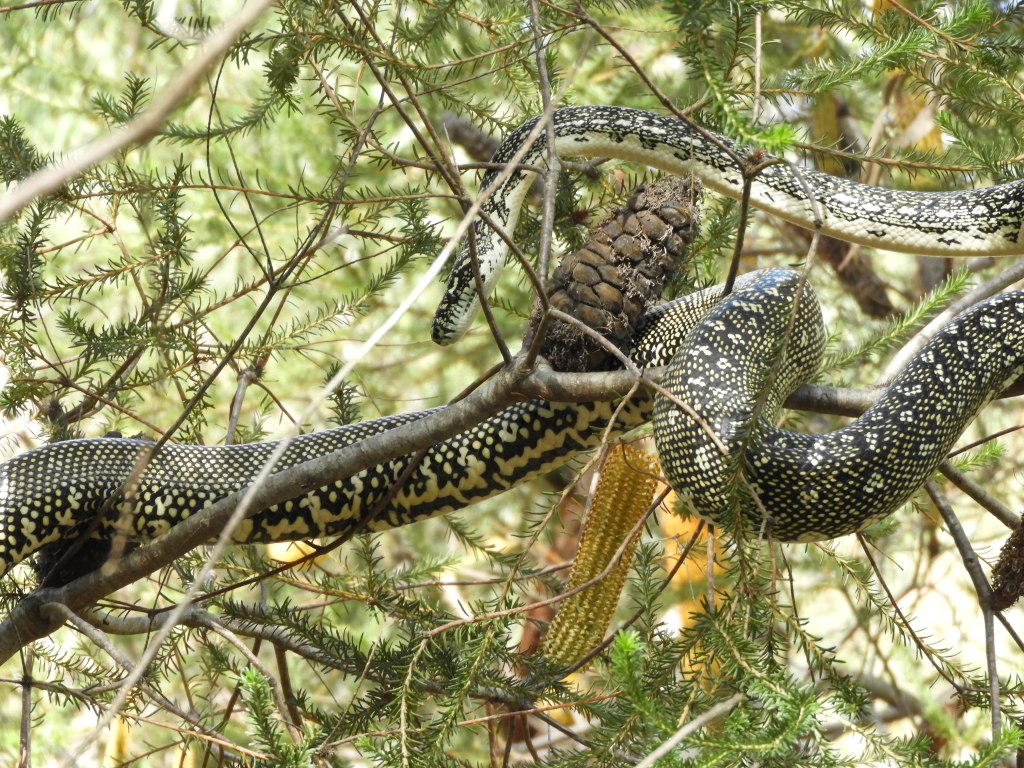
The markings on the snake’s skin are amazingly intricate. And such a gorgeous face:

The snake catcher said that the snake had been found on the roof of someone’s car in a nearby suburb. He’d been called to remove the snake, and Manly Dam park is a great place to release creatures like this.
Diamond Pythons are related to Carpet Pythons, and are native to the eastern coast of Australia (which is where I am). They’re the most southerly occurring python in the world. This one was about two metres long, I think. They can grow up to three metres.
Here’s a short video showing the snake’s lazy movement as it slides along the branches of the Heath Banksia tree:
Thank you to Chris Zabriskie for the video soundtrack:
What True Self, Feels Bogus, Let’s Watch Jason X by Chris Zabriskie is licensed under a Creative Commons Attribution 4.0 license. https://creativecommons.org/licenses/by/4.0/
Source: http://chriszabriskie.com/reappear/
Artist: http://chriszabriskie.com/
What about the birds, you may ask? Since this is primarily a blog about birds, where do they fit in? Diamond Pythons do eat birds, but their typical prey is small animals and reptiles. The python lies in wait for its prey, sometimes for days on end. Then the snake snatches the creature, wraps itself around it, and smothers it to death before swallowing it whole.

Swans enjoying flooded picnic area
It’s been a bit wet on the east coast of Australia. For many people, the recent floods have been devastating and very sad. I’ve been lucky to be largely unaffected. I’m so sorry for all those who’re still suffering the effects of the flood
Yesterday it stopped raining and I went for a walk. I came across these swans exploring a picnic area:
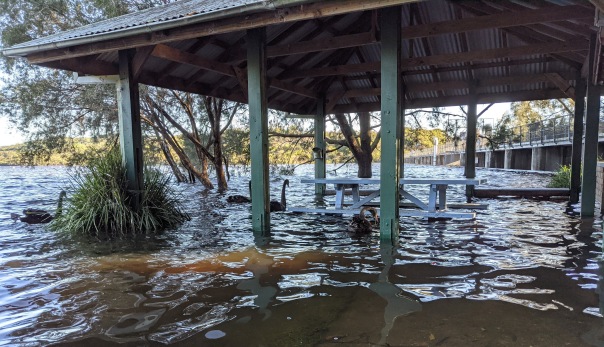
Today the water has already receded quite a bit:
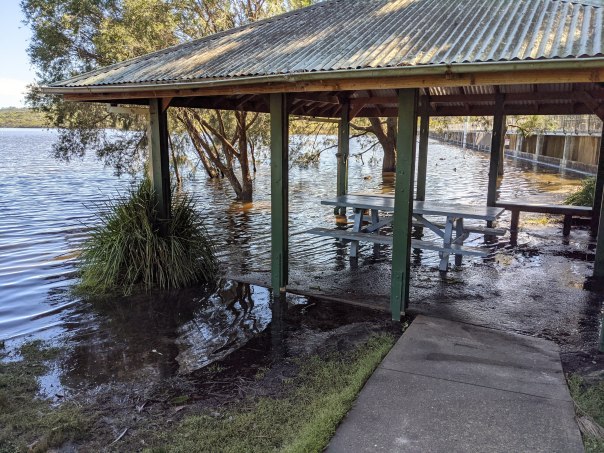
The swans are nearby, relaxing on the recently-emerged grass:

For those who’ve seen my posts about the family of swans over the past few months: yes, this is the same family. The babies are pretty much grown up already.
Common name: Black Swan
Scientific name: Cygnus atratus
Approximate length: 120 cm
Date spotted: 25 March 2021 (autumn)
Location: Manly Dam Park, New South Wales, Australia: 33°46’58.5″S 151°15’18.6″E

Beautiful red and brown Orb Weaving Spider
When walking along bush paths, especially early in the morning, I often walk through large spider webs spun across the path. Not infrequently, I end up with a spider in my hair or on my clothes.
Today I spotted the web and its occupant in time to avoid a collision! The spider was a Garden Orb Weaver (Eriophora sp). This individual was quite lovely, with red upper legs changing to black as they reached its body. Look at that cute furry head!

This was a large spider, its body about 2 cm long. We often see Garden Orb Weavers in our area, but I haven’t seen one with this colouring before. They come in a variety of sizes, shapes, and colours. (In fact, I wouldn’t be surprised if someone decides to do more research into these spiders and split up the classification a bit.) Here’s a side view of the one I saw yesterday:

I carefully walked around the web, using a tried-and-true method of waving a stick in front of me to detect stray strands of silk, and photographed the spider from the other side:

Garden Orb Weaving Spiders aren’t keen to bite you. If they do bite you, the symptoms are usually mild, usually limited to pain and swelling at the site of the bite. If you have worse symptoms or are concerned, seek medical advice. I haven’t yet been bitten. Long may that happy state of affairs last!
Location of the spider: Manly Dam Park, New South Wales, Australia: 33°46’51.5″S 151°14’51.0″E.
What about the birds, you may ask? Since this is primarily a blog about birds, where do they fit in? Birds do eat these spiders. Recently, an Australian Noisy Miner was extremely interested in a large Orb Weaver outside my window. The bird approached along the telephone line, then leapt into the air and hovered about a metre away from the spider. For some reason, the bird abandoned the attack. Maybe there wasn’t enough room for the bird to fly in, grab the spider, then swoop away before hitting the window.


 Sydney Birder