
Majestic Glossy Black-Cockatoo pair
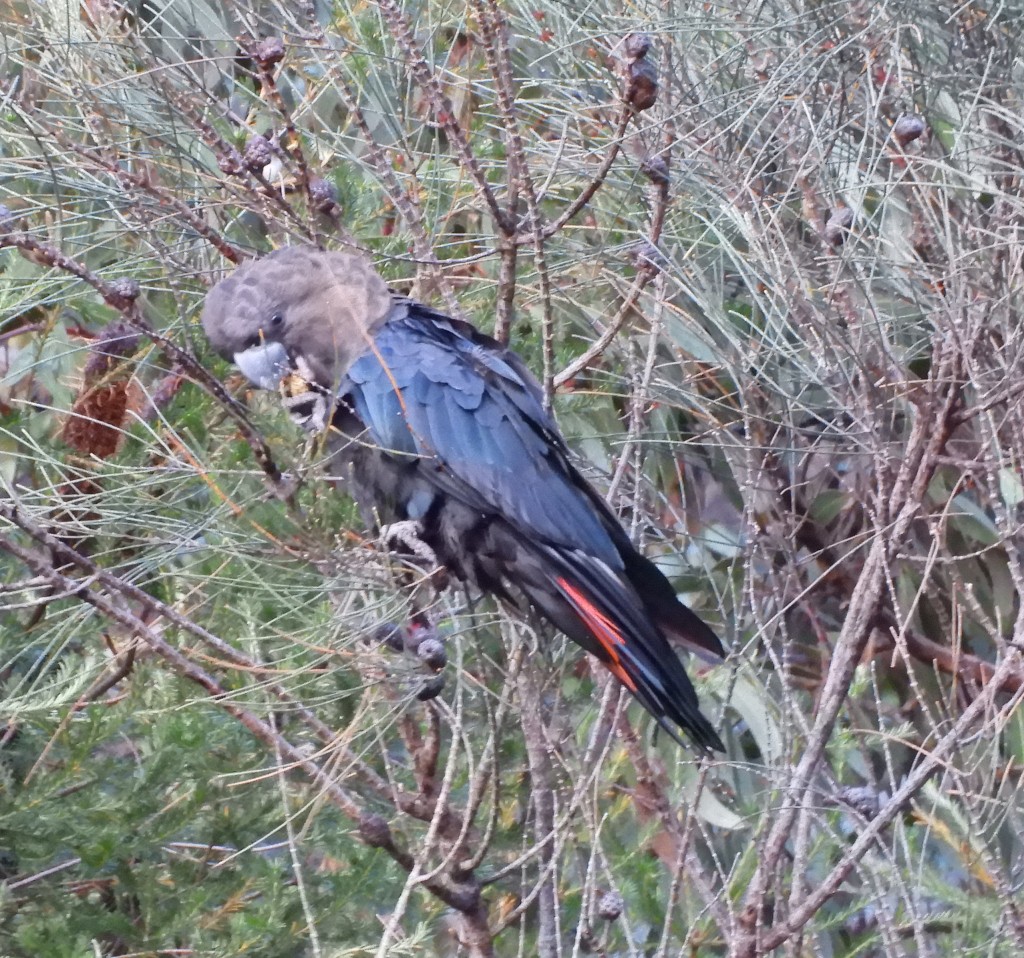
Two Glossy Black-Cockatoos have taken to hanging out at Manly Dam. The Casuarina trees are currently full of seed pods, which are this bird’s favourite food. In fact, Glossies feed almost exclusively on Casuarina seeds.
This video shows the male bird first, its feathers gleaming a soft blue in the early morning light, and the red tail flares standing out nicely. Then the view moves to the female feeding on a nearby tree.
Glossy Black-Cockatoos are large parrots at around 15 cm in length. We’re lucky to see four different types of cockatoos in this area. Glossies are heavier than the white Sulphur-crested Cockatoos and Corellas, and shorter in length than the Yellow-tailed Black Cockatoos. Of the four types, Glossies are by far the least common.
This is the male bird, with that blueish gleam lent by the early morning light, and those red tail flares:
The female has yellow markings around her neck, and her tail flares are yellow and a softer shade of orange-red than the male’s:
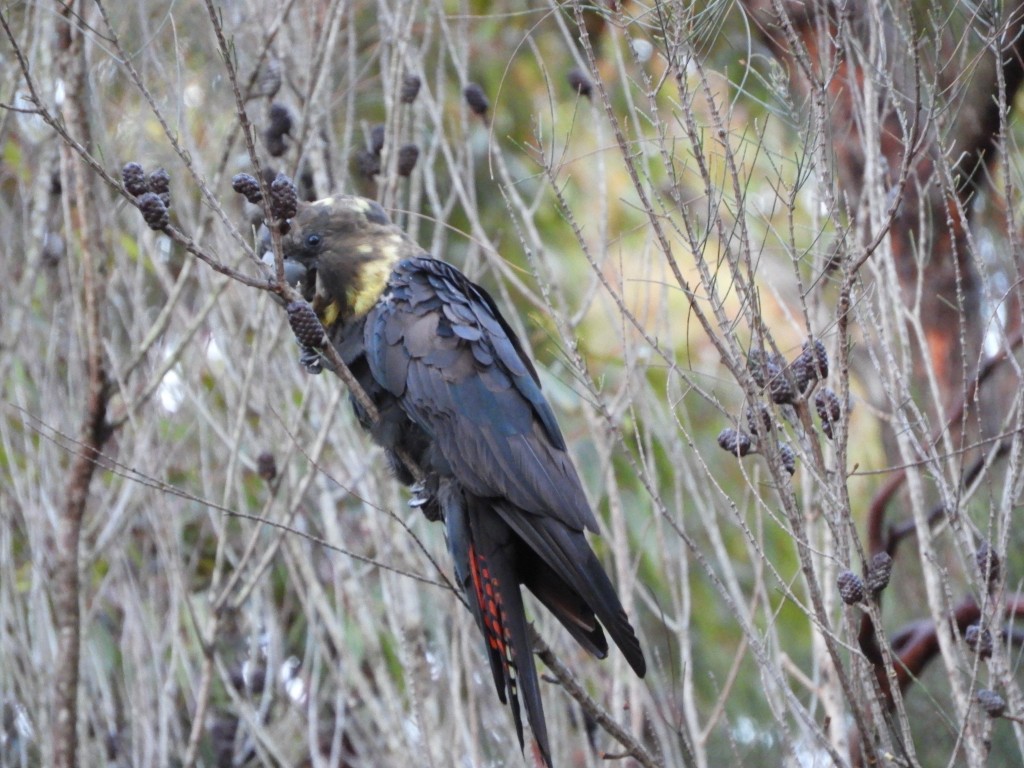
With their large heads and that mane of feathers, Glossies sometimes remind me of a bear. Here’s a close up of the male bird, taken a few days before the above shots:

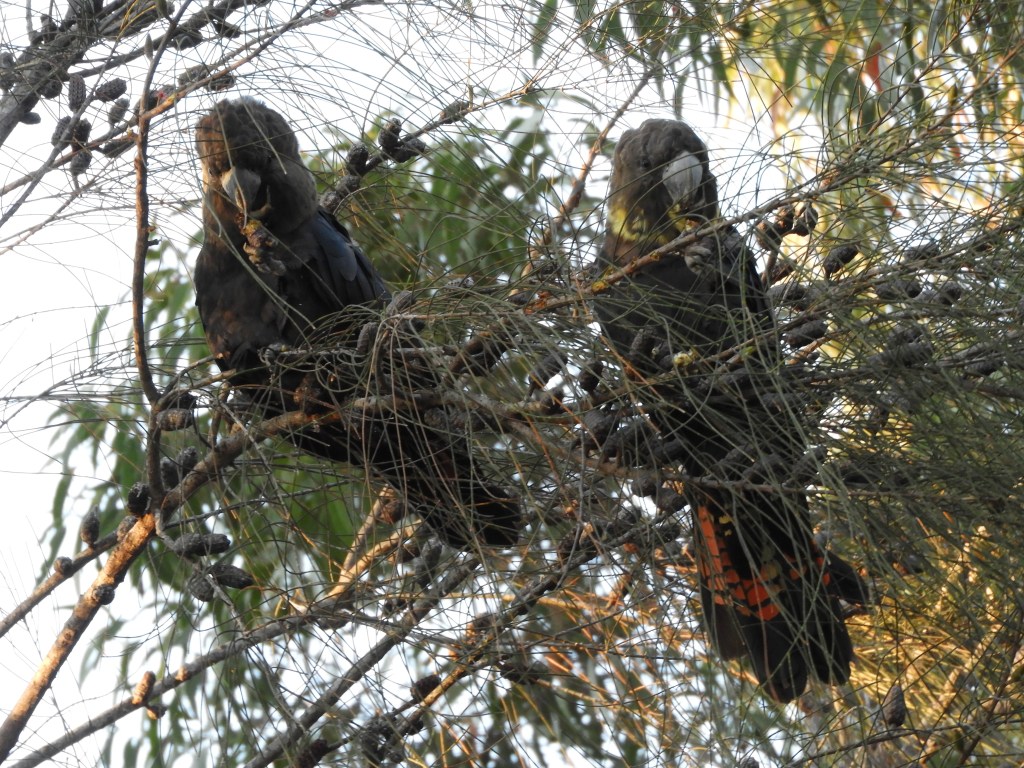
Here are both birds, sharing a tree this time:
Common name: Glossy Black-Cockatoo
Scientific name: Calyptorhynchus lathami
Approximate length: 50cm
Date spotted: 5 October and 15 October 2021 (spring)
Location: Manly Dam Park, near Sydney: 33°46’56.5″S 151°15’10.3″E

Channel-billed Cuckoo laying egg in Currawong nest
This little episode happened in my garden today. It was interesting and exciting to watch!
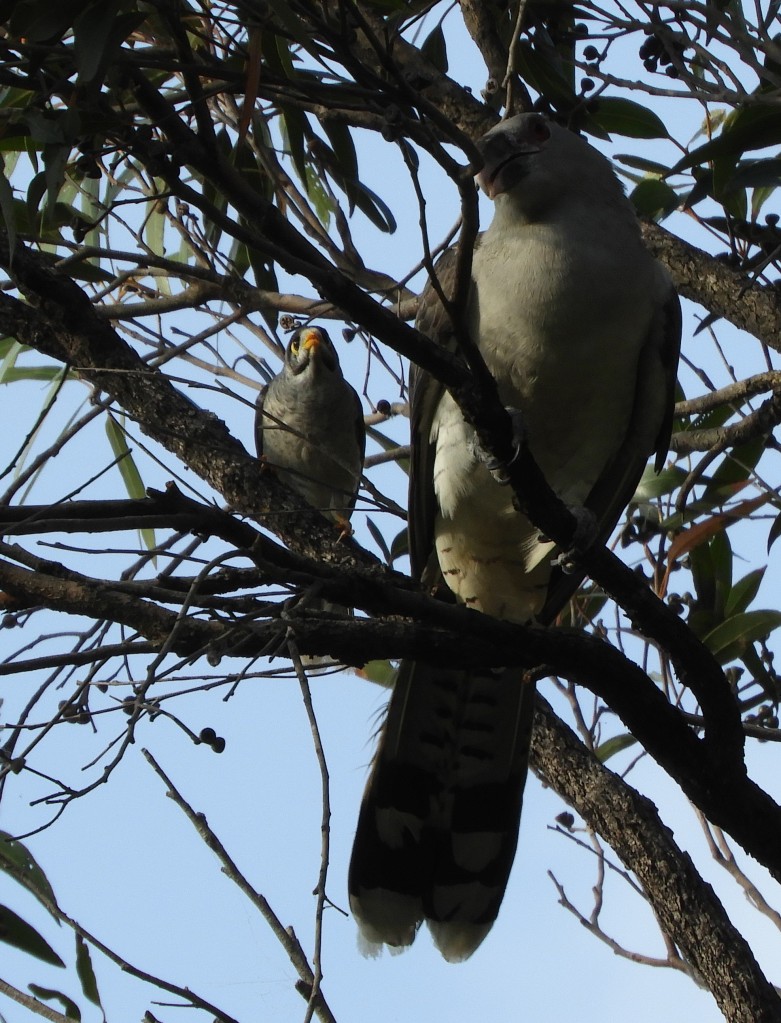
A cacophany of Noisy Miners and Currawongs drew me out into the garden to see what was up. High in a gum tree were two Channel-billed Cuckoos, being harassed as usual by the other birds. I only managed to get one of the cuckoos into my camera sights. Luckily, it turned out to be the female bird.
Here’s the Channel-billed Cuckoo on the right, with a little Noisy Miner by its side:
In this short video, you can hear the Noisy Miners peeping incessantly. The cuckoo emits a loud, harsh caw and cedes ground:
Next, the local Currawongs join the attack. The musical, bell-like tones are the Currawongs. The cuckoo flinches and utters its harsh croak. Then I noticed that there’s a Currawong nest just below where the cuckoo is sitting!
Like most cuckoos, Channel-billed Cuckoos are parasitic. They don’t build nests of their own. Instead, they look for a likely host (a Currawong does very nicely, thank you) and lay an egg in the chosen host’s nest. The Currawongs take over all parental duties, looking after the egg along with those of their own, then feeding the baby bird.
Channel-billed Cuckoo chicks don’t turf the other chicks out of the nest (many types of cuckoo chicks do) but they do eat a lot, and grow significantly bigger than the Currawong chicks.
Having decided that the neighbourhood is reasonably quiet and safe for a bit, the cuckoo eyes the nest and starts its approach:
Quick as a flash, it hops up into the nest and lays its egg:
Below is a still picture of the Currawong’s nest. I’ll keep an eye on it, in case I can spot the Currawong and cuckoo chicks when they arrive:

Channel-billed Cuckoo | Scythrops novaehollandiae | Approximate length: 58-65 cm
Noisy Miner, also called Australian Miner | Manorina melanocephala | Approximate length: 26 cm
Pied Currawong | Strepera graculina | Approximate length: 45 cm
Date spotted: 10 October 2021 (spring)
Location: Allambie Heights, New South Wales, Australia

Noisy Miner babies
For a couple of weeks, we had the pleasure of hosting a nest of Noisy Miners in our garden. The adults built the nest in a tree fern, right in the hollow where the new fern leaves sprout. This picture shows the tree fern, with the nest and one of the adult birds in attendance:
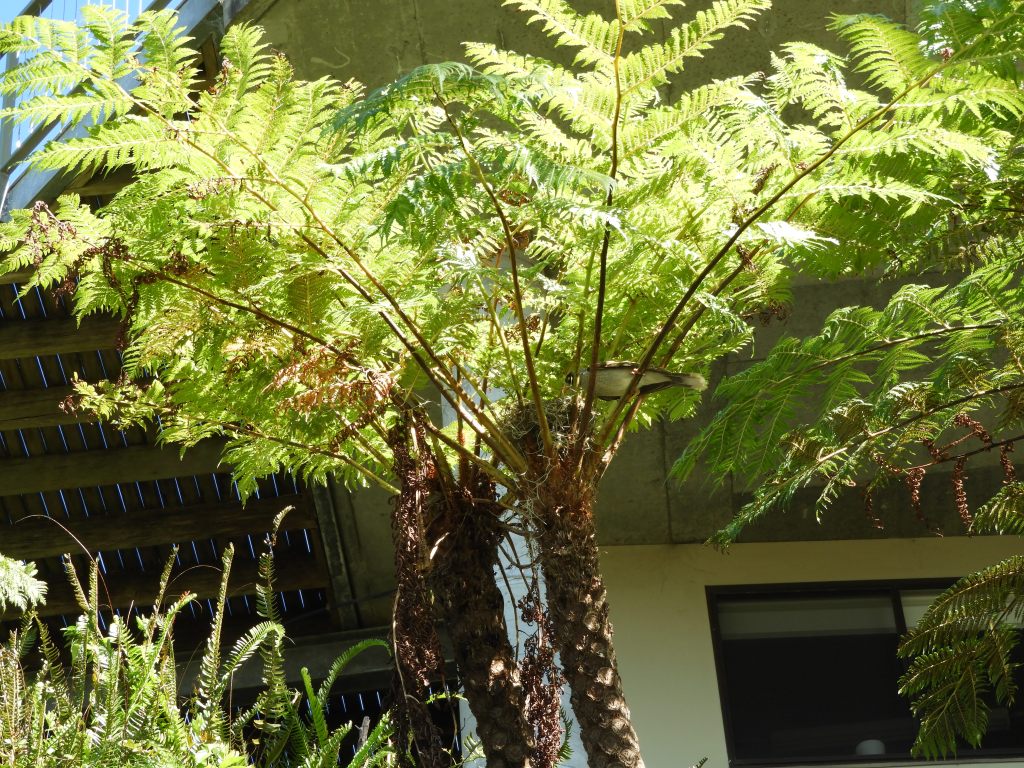
It’s a good thing that little Noisy Miners grow so fast. A few years ago, some Red Wattle Birds attempted the same thing, and were forced to abandon the nest when the fern leaves pushed it out of place!
This video shows an adult bird feeding the babies:
With Noisy Miners, feeding the little ones is a communal responsibility. You can’t tell which are the parents. We sometimes saw three birds waiting in line with a goody for the growing babies.
In the above video, the adult is regurgitating nectar or other food. Its long, thin tongue flicks out occasionally. In the next video, a bird brings a large green bug and passes it to the babies. I’m not sure if the bug is a mantid or something else. It’s too early in the season for cicadas:
Here’s a still picture of the little ones begging for food:

After a couple of weeks of feeding and fast growing babies, the nest became pretty full. Then one day, the little ones left the nest. I wasn’t there to see this exciting event, alas. I took this video the day before the nest was suddenly empty:
The little ones are now all round the garden, peeping constantly to get the adults’ attention. For the most part, they’re tucked away safely in the foliage, hard to find from my vantage point on the ground. This picture is of one of the little ones, a few days after leaving the nest:

Here’s the empty nest, with a clothes peg for scale:

Common name: Noisy Miner, also called Australian Miner
Scientific name: Manorina melanocephala
Approximate length of adult bird: 26 cm
Date spotted: September 2021 (spring)
Location: Near Sydney, NSW, Australia
Magpies carolling with a view of Sydney Harbour
This morning I walked along a path overlooking Sydney Harbour and the headlands that act as a gateway to the ocean. A treeful of Australian Magpies provided musical accompaniment.
Common name: Australian Magpie
Scientific name: Gymnorhina tibicen
Approximate length: 40 cm
Date spotted: 3 October 2021 (spring)
Location: Dobroyd Head, Sydney Harbour: 33°48’36.7″S 151°16’03.4″E

First Channel-billed Cuckoo of the season
It’s spring down under, and the cuckoos are back on the east coast of Australia. Last week I heard the calls of Koel Cuckoos and Channel-billed Cuckoos. Now I’ve seen my first one of the season: A Channel-billed Cuckoo sheltering from the local birds in a gum tree.
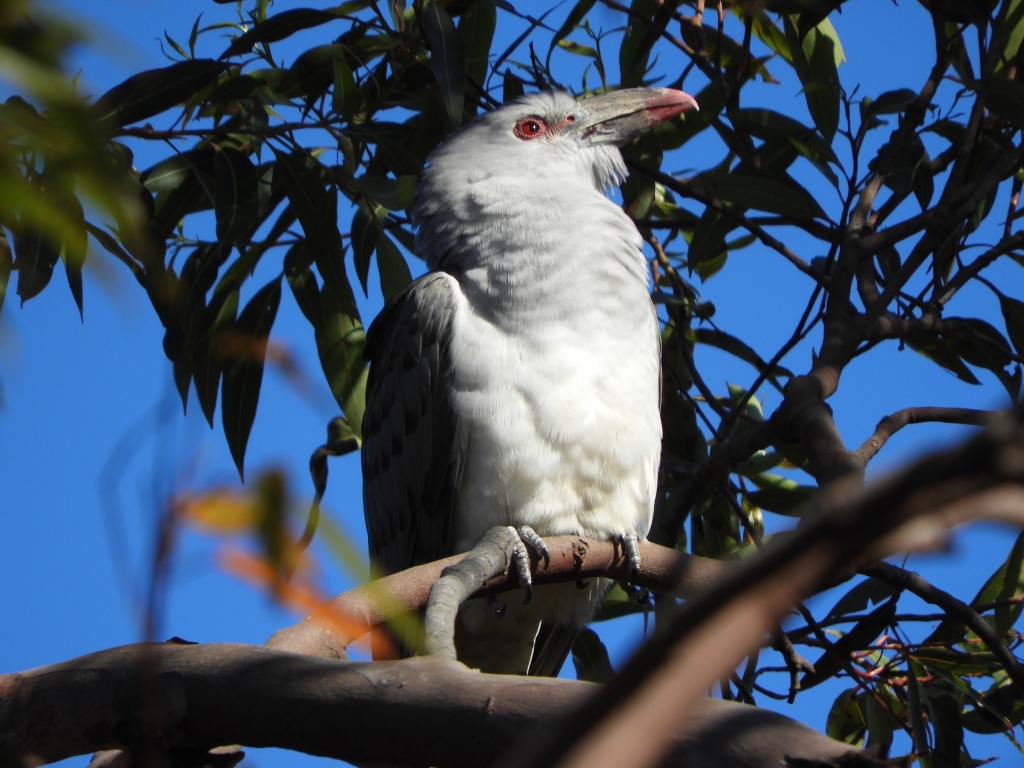
Channel-billed Cuckoos are large birds (approximately 60 cm long) with red eyes and a big beak. They often look a little scruffy, even ghoulish. The other birds seem to think so too, because they spend a lot of time dive-bombing the cuckoos and shouting at them. Usually the Noisy Miners (living up to their name) are the noisiest of the birds that strive to make the cuckoos feel unwelcome, but other birds play their part too.
This video shows the cuckoo enjoying the peace and quiet of a gum tree. At the start of the video, a Currawong swoops past in a threatening flyby. You don’t actually see the Currawong, but you can hear it and see the cuckoo flinch:
Here’s a photo showing the full length of the cuckoo, including its long, barred tail:
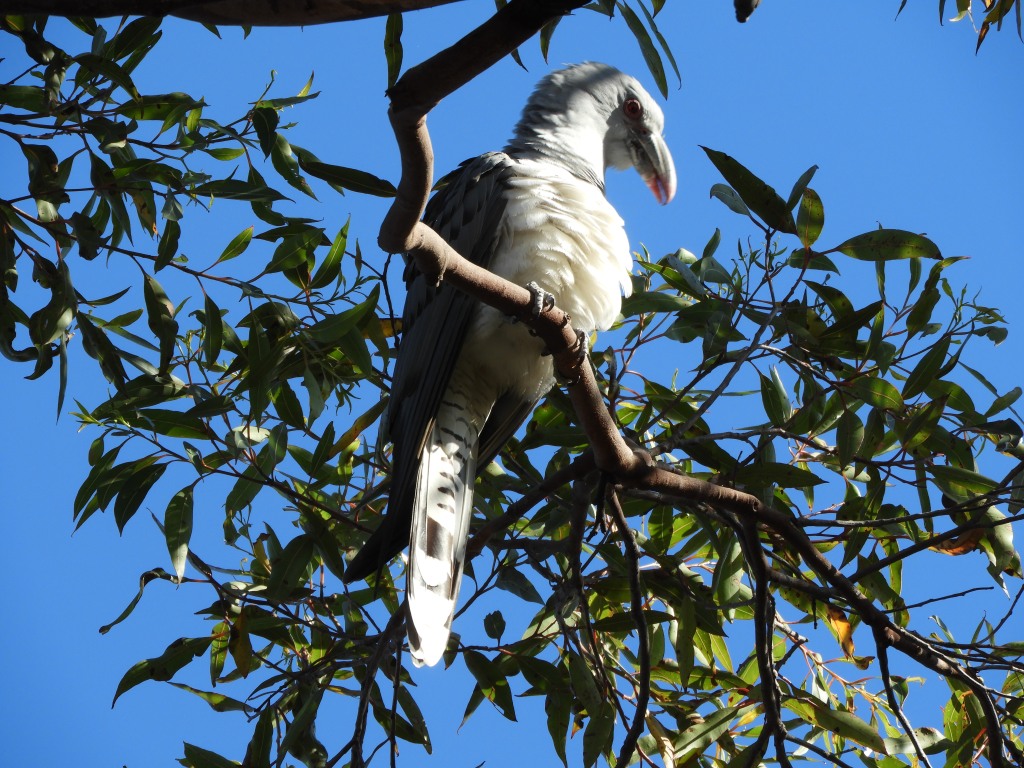
Here’s a view from the back:

Common name: Channel-billed Cuckoo
Scientific name: Scythrops novaehollandiae
Approximate length: 58-65 cm
Date spotted: 19 September 2021 (spring)
Location: Manly Dam Park, New South Wales, Australia: 33°46’33.8″S 151°15’17.8″E
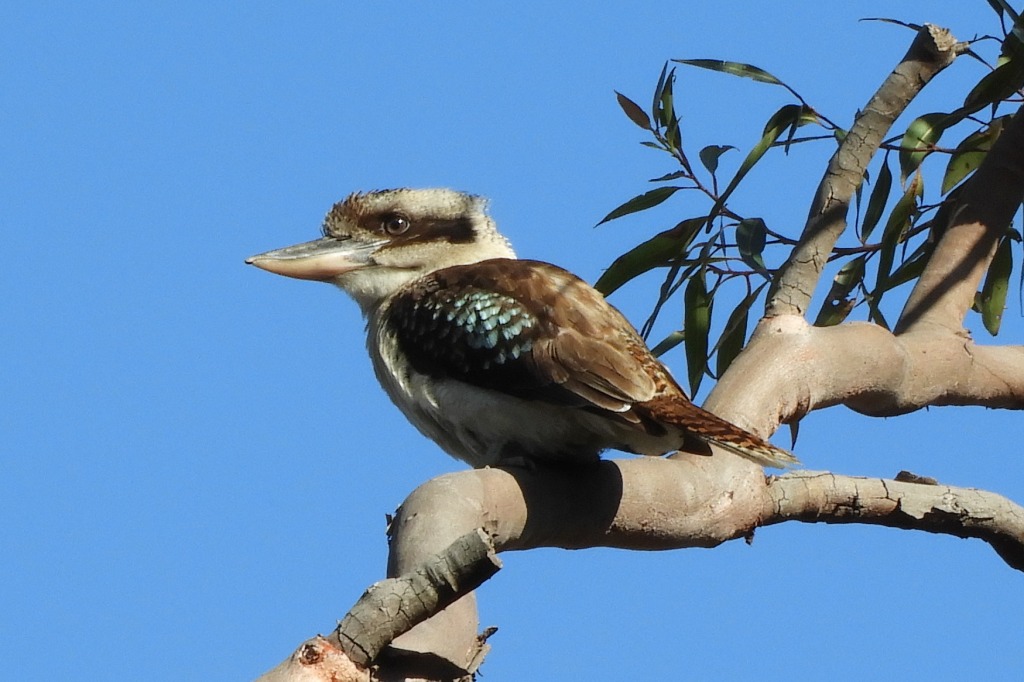
A bonus bird: Just after the Channel-billed Cuckoo flew off, a kookaburra landed on a nearby branch:

Spitfire Sawfly larva – the caterpillar that wasn’t
(Not a bird, but a creature that birds no doubt encounter either on the ground or high up in a gum tree.)
Walking along a bush path the other day, I saw a strange-looking caterpillar. It was large and black with short yellow spikes. Its front end was quite pudgy, but its body tapered off toward the back end.

When moving along, it often lifted up its front end to show its yellow legs:

After doing a bit of research, I realized that this interesting creature is a larva, not a caterpillar. Specifically, it’s the larva of the Spitfire Sawfly. Sawflies are related to wasps, ants, and bees.
Despite the name “Spitfire”, these larvae don’t actually spit anything, but if you touch them you can get a burning sting from the spikes. The larvae also spew out a thick yellow liquid from their mouths when threatened, but the liquid isn’t harmful. They often collect together in big clusters on a gum tree.
Here’s a short video of the larva moving across the forest floor:

Fairy-wrens in full finery
Variegated Fairy-wrens are quite common in my neck of the woods, but they’re very difficult to photograph. They move fast, pause only briefly, and prefer to keep hidden in the shrubbery. I took these shots over a few days, collecting mosquito bites at the same time as usable photos.
It’s spring, and the males are decked out in their breeding finery. They’re like blue fireflies lighting up the bush:
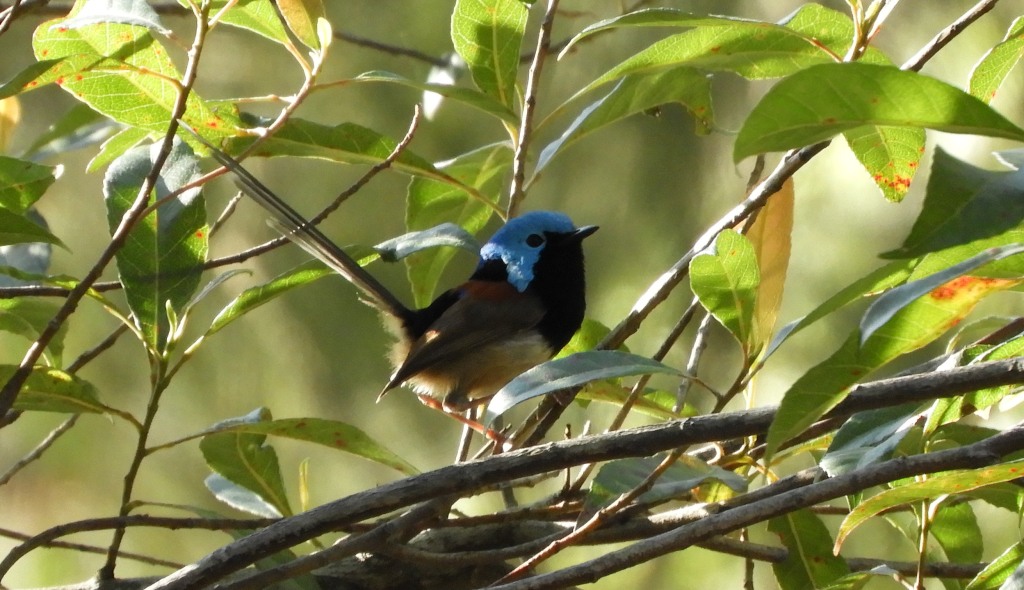
The long tail often sticks straight up. It must present quite a challenge to dashing around the shrubbery:

The females are a soft brown with pale blue hints in the tail. They have a red eye mask which can make them look slightly sardonic:
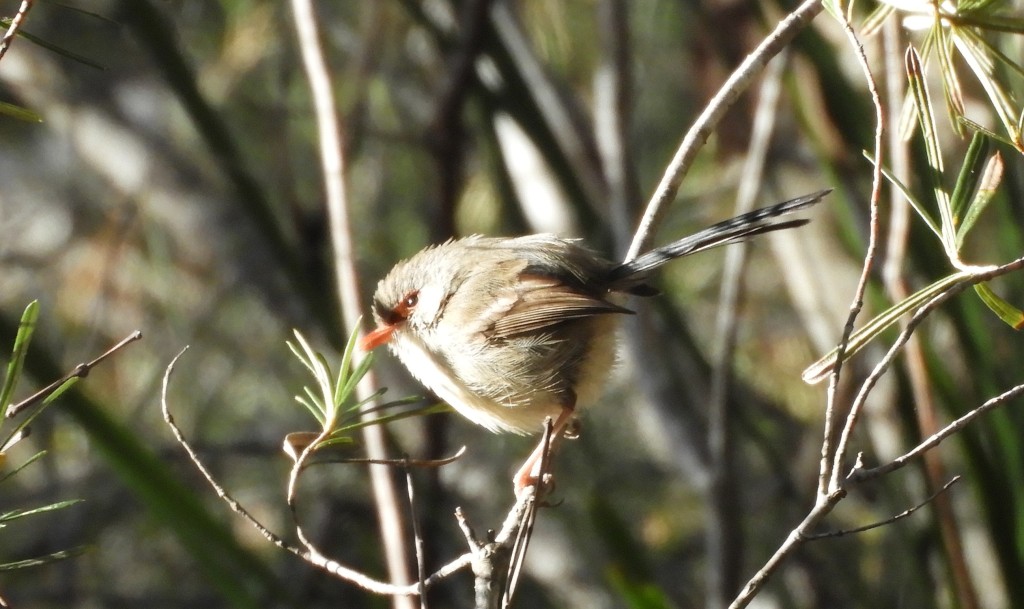
They’re like tiny little puffballs:

Like many bird names in Australia, the name “fairy-wren” is misleading. These birds aren’t actually wrens. They’re related to honeyeaters and pardalotes.
Common name: Variegated Fairy-wren
Scientific name: Malurus lamberti
Approximate length: 13 cm
Date spotted: September 2021 (spring)
Location: Manly Dam Park, New South Wales, Australia: 33°46’49.9″S 151°15’04.2″E (the male) and 33°46’20.8″S 151°14’30.6″E (the female)
More calls of the Grey Shrike-thrush including a sneeze
A few weeks ago, I posted my first video featuring the call of the Grey Shrike-thrush. I’d read that these birds make a variety of calls. Here are two more to add to the collection: A, short, high-pitched shriek and a longer call interrupted by what sounds like a sneeze or a snort!
When I first heard the sneeze-interrupted song, I thought the bird had made a mistake. But it made the same call consistently over quite a few minutes. Maybe the call is this bird’s variation on a theme, or perhaps the bird is a juvenile who’s still perfecting its song!
Common name: Grey Shrike-thrush
Scientific name: Colluricincla harmonica
Approximate length: 23 cm.
Date spotted: 8 September 2021 (spring)
Location: Manly Dam Reserve, New South Wales, Australia: 33°46’15.6″S 151°14’51.5″E

A honeyeater and a view from Dobroyd Head
Dobroyd Head is one of the headlands that juts out into Sydney Harbour, on Australia’s east coast. The walking track leading around Dobroyd Head is part of the Manly to Spit Bridge Trail. It offers plenty of bird life and gorgeous views.
When taking this picture, I was at Fairlight Lookout on Dobroyd Head, looking north east across the harbour towards Manly. On the other side of Manly is the Pacific Ocean. Next stop Fiji and then the United States.

This pretty little bird is a New Holland Honeyeater, its white ear patch tousled by the breeze:

Common name: New Holland Honeyeater
Scientific name: Phylidonyris novaehollandiae
Approximate length: 17-19 cm
Date spotted: 28 August 2021 (winter)
Location: Dobroyd Head, New South Wales, Australia: 33°48’34.7″S 151°16’18.2″E
Currawong snacks on brush-turkey’s scrapings
Spring is approaching, and male Australian Brush-turkeys are busily preparing their mounds in the hopes of attracting a female. This year there seem to be more brush-turkeys in my area than ever before. On the plus side, they do a great job of clearing the ground near their chosen location for a mound. On the minus side, the mound itself is a little unsightly. Unless you happen to be a brush-turkey, of course.
A canny currawong hung around close to this particular busy brush-turkey, snapping up the beetles and grubs that the brush-turkey’s scraping exposed:
The brush-turkey was scraping the leaves methodically and energetically in a single direction. His destination lay behind him. So I went round and found the large pile that he was creating. It was already over a metre high and three to four metres across.
A day later, I returned to the area and found the brush-turkey close to his mound:

Common name: Australian Brush-turkey
Scientific name: Alectura lathami
Approximate length: 60-70 cm
Date spotted: 25 August 2021 (winter)
Location: Manly Dam Park, New South Wales, Australia: 33°46’37.7″S 151°14’48.8″E


 Sydney Birder