
Black Butcherbird in Far North Queensland
A few days ago, I was visiting Port Douglas in Far North Queensland. Many of the birds up there have quite different calls from those further south. This Black Butcherbird is an example:
As you can see, the lighting was difficult. I did manage to get a couple of clearer still shots of the bird:
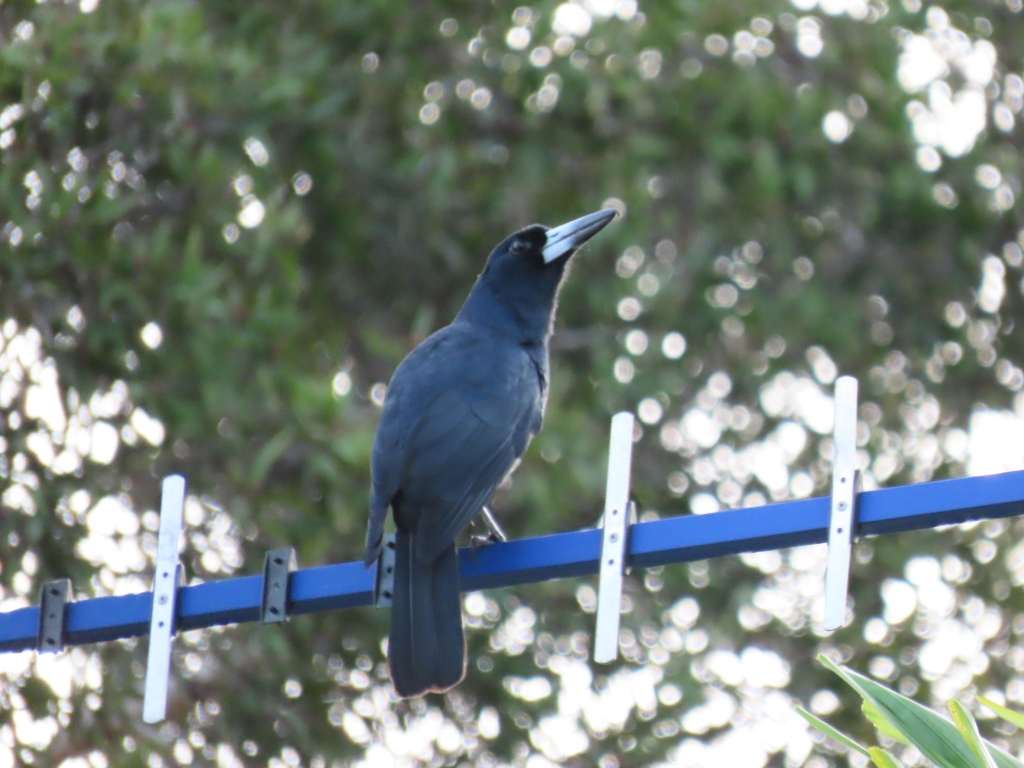
Black Butcherbirds are, as the name implies, entirely black. In Australia, they’re found only in the far north of the continent. Down near Sydney, where I’m based, I’ve only ever seen the Grey Butcherbird, which has a lot of white and grey as well as black plumage. According to my bird book, some Black Butcherbirds (the rulescens race) can be brownish as juveniles.
This is my first sighting of a Black Butcherbird! Here’s another picture of the same bird in full song:

Common name: Black Butcherbird
Scientific name: Cracticus quoyi
Approximate length: 38-44 cm
Date spotted: 17 May 2022 (autumn)
Location: Port Douglas, Far North Queensland, Australia: 16°30’42.2″S 145°27’44.2″E

Pelicans at Cairns Esplanade
I’m in Cairns for a couple of days! Cairns is in Far North Queensland, about 2,000 kilometres from Sydney as the crow flies. Early this morning, before the tropical heat set in, I took a stroll along the Esplanade.
This lovely sculpture by Brian Robinson is called Citizens Gateway to the Great Barrier Reef:

I love the way the artwork frames the bay and the entrance to the Coral Sea.
A little further along the Esplanade, two Australian Pelicans were chilling out in the shelter of the boardwalk:

Common name: Australian Pelican
Scientific name: Pelecanus conspicillatus
Approximate length: 170 cm
Approximate wingspan: 2.5m
Date spotted: 14 May 2022 (autumn)
Location: Cairns Esplanade, Far North Queensland, Australia: 16°55’05.0″S 145°46’33.3″E

Cockatoo sculpted by sunlight
It can be difficult to get a good photo of a white cockatoo, because they’re so uniformly white. My camera tends to treat them as an uninteresting blob of uniform colour, unless I can get really close to the bird. I was quite pleased with this shot. Even though the bird was high in a tree, the early morning sun glows nicely through the cockatoo’s yellow crest and adds contour to the bird’s body:

The video of the same cockie is also rather nice. The bird is screeching and waving its head around, as they often do. It’s having fun with a small pool of water in a tree hollow, dipping its beak in and throwing water droplets around:
Common name: Sulphur-crested Cockatoo
Scientific name: Cacatua galerita
Approximate length: 50 cm
Date spotted: 3 April 2022 (autumn)
Location: Angophra Track, Balgowlah Heights, New South Wales, Australia: 33°48’20.9″S 151°16’17.8″E

Big Kookaburra in Kurri Kurri
Australia is a big place. Dotted around its landscape is an array of big animal statues. (Actually, the statues are of assorted things, not just animals, but most people think of them as big animals.) A couple of weeks ago, I was in Kurri Kurri and saw the town’s big Kookaburra:

The town of Kurri Kurri lies in the east of Australia, a couple of hours’ drive north of Sydney and close to the coastal city of Newcastle.
The Kurri Kurri Kookaburra is a sculpture by Chris Fussell, erected in 2009. Here’s another view of it:

If you’d like to know more about the town of Kurri Kurri, take a look at my travelling bookmark’s post: Kurri Kurri Kookaburra and murals.

Sleepy Corellas in Newcastle
A few days ago, I was in the city of Newcastle on Australia’s east coast. The city lies about two hours’ drive north of Sydney. Like its namesake in the UK, this Newcastle too is known as a coal-shipping port. A river runs through the city. In a small green area on the river bank, in the middle of the city, a large number of Corellas roost.
When we saw them, most of the Corellas looked sleepy:

This one looks like a cuddly toy nestled in a Christmas tree:

Little Corellas are a type of cockatoo. To me, they look rather ghostly, with their pale beaks and that ring of pale blue around their eyes.
The next one looks more interested in what’s happening:

If you’d like to see more pictures of the city of Newcastle itself, take a look at my travelling bookmark’s blog.
Common name: Little Corella
Scientific name: Cacatua sanguinea
Approximate length: 36-39 cm
Date spotted: 11 March 2022 (late summer)
Location: Newcastle, New South Wales, Australia: 32°55’32.3″S 151°46’45.4″E
Crested Tern taking a bath at Newcastle Ocean Baths
Yesterday I visited the city of Newcastle for the first time. This is Newcastle on the eastern coast of Australia, not the one in the UK. While strolling along the prom, approaching the Newcastle Ocean Baths, I saw a Crested Tern enjoying a bath in the rock pool that lies on one side of the baths:
Common name: Crested Tern
Scientific name: Sterna bergii
Approximate length: 45 cm
Date spotted: 11 March 2022 (late summer)
Location: Newcastle, New South Wales, Australia: -32.929794, 151.789490
Here’s a picture of the building that you glimpse at the end of the video — the Newcastle Ocean Baths:

Young Kookaburra learning call from adult
The bush is alive with the sound of young Kookaburras practising their call. They sound like rusty saws, or motor engines that can’t quite start. After crooning away to itself for a while, this little one approached an adult for a lesson!
Common name: Laughing Kookaburra
Scientific name: Dacelo novaeguineae
Approximate length: 47 cm
Date spotted: 3 March 2022 (summer)
Location: Manly Dam Park, New South Wales, Australia: 33°46’56.3″S 151°15’10.4″E

Moody pics of Huntsman spider on my bannister
Early one morning a few weeks ago, I encountered a huntsman spider on the bannister of a staircase inside my house. I was coming up the stairs from below, and was moving my hand along the top of the railing as I went. Then my head came level with the railing, and there was the spider at eye level.
First wildlife close encounter of the day, and I hadn’t even been outside yet! Life in Oz. 🙂
This is a big spider, about the size of the palm of my hand.
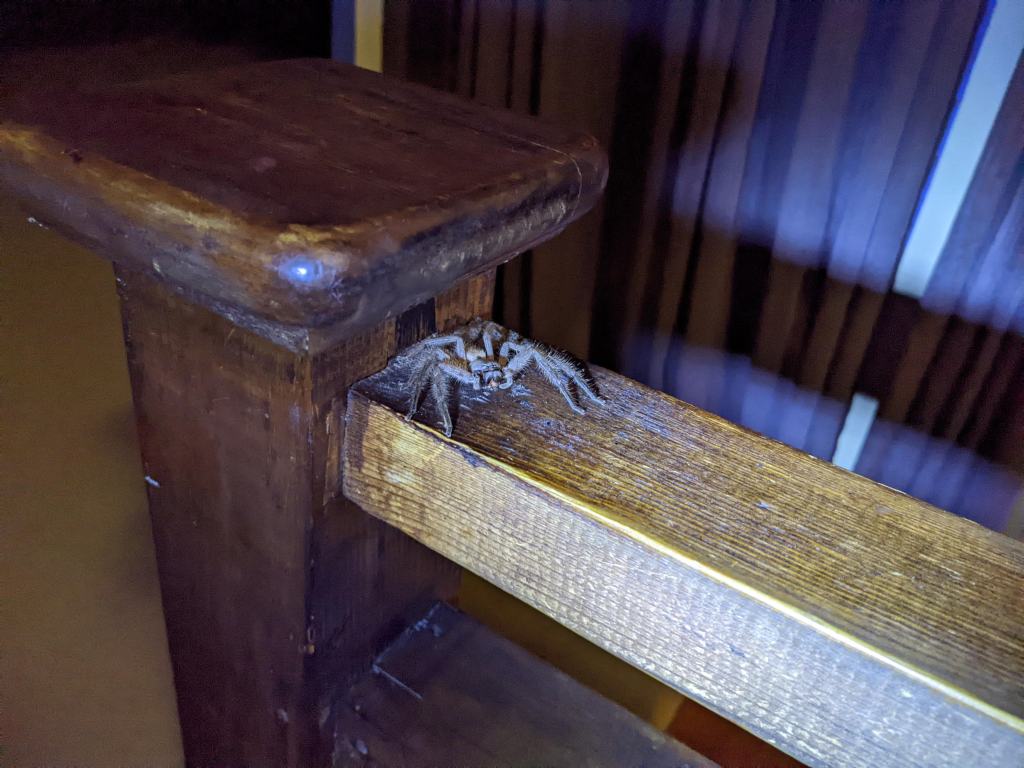
It looked as surprised as I was!
It was still dark and the lighting in this area of the house isn’t bright. I didn’t like using the flash on my phone too much, in case it damaged the spider’s eyes, so I found a torch. Hence the bluesy tone of this next photo:
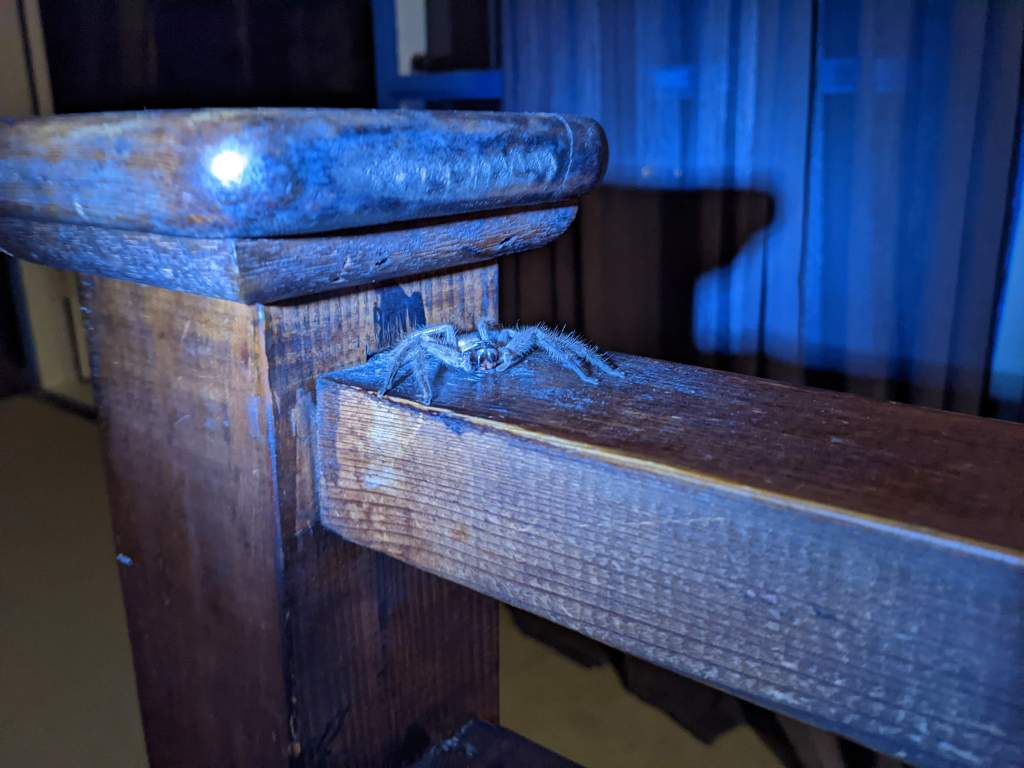
Huntsman spiders are big and scary, but they avoid contact with people if they can, and their venom isn’t too bad if they do bite. They won’t kill you, like some of the other Australian spiders.
Huntsmen generally run away from humans. They don’t go out of their way to bite unless actively threatened. This one might have had good reason to feel threatened by my hand coming towards it along the bannister, though!
And though we see them fairly often and I know they always run away, I do admit to uttering a restrained (not so much) gasp when I saw this one at eye level.
I was heading out for a walk, so I left the spider there, on the bannister, with a scribbled note next to it saying “spider” and an eloquent arrow, so that my husband wouldn’t have the same close encounter that I did.
When I came back, the spider had gone and my husband hadn’t seen it. Who knows where it is now? I’m sure I’ll see it again some early morning!

Large net-casting spider
While doing some gardening a couple of weeks ago, I came across this large, unique-looking spider. It was on my green bin, where I was about to deposit a load of garden trimmings. I didn’t want to hurt the spider, so I carefully moved it onto the nearby vegetation, after taking a couple of photos.
Here’s the spider, with my finger for scale:

It has its legs neatly clumped together in four groups of two. The body is long and thin, with two little humps on the sides about half way down the length. It’s head, seen from above, forms a neat triangle with two bulbs at the front.
Today I spent some time figuring out what type of spider it is. It turns out to be a net-casting spider. I wish I’d know that at the time! Evidently the spider has two huge eyes (under those bulbs seen here from above) and its face looks a little scary. As well as earning the name net-casting spiders, they’re also called ogre-faced spiders! I wish I’d got down onto the ground and looked at the spider from below, so that I could see its eyes and ogre face.
Here’s another picture, without the finger this time:

Why the name net-casting spider? These creatures spin a small square of web each night, which they hold in their front legs and cast over their prey. That’s why they have big eyes: to be able to see their prey in the dark.
Fascinating. It’s a jungle out there.

St Andrew’s Cross spider mother and babies
In mid January, in the heat of an Australian summer, a St Andrew’s Cross spider built her web outside my window.

The photo shows the underneath of the spider, a few blobs of dead insect matter, and the characteristic thickened web lines radiating out from the spider’s legs. This cross-shaped formation is what gives the spider its name.
A few days after she arrived, she created an egg sac in the corner of the window sill. The sac was about the size of the top part of my finger, and had an unusual spoon shape. I wasn’t sure what it was — maybe some form of wasp nest? I didn’t really want one of those just outside the window, which is always open in the summer heat, so I moved the little sac down into another part of the garden.
The next day, another egg sac appeared, looking exactly the same as the first one. I decided it must belong to the spider, who had now moved her web even closer to the egg sac. So I let it be.

Here it is from a different angle:

Two weeks later, the spiders hatched! I saw them for the first time early one morning. A cloud of baby St Andrews Cross spiders, just hatched, glowing in the early sun:

The mother hung above on her web, silhouetted against the rising sun:

Evidently the mother will eat the babies if any of them strays onto her web. She’s also partial to chomping off a leg or two from the male spider while mating.
Nine hours later, it was mid afternoon and the sun had moved off the web. The babies had clumped together in a different pattern:

Early the next morning, the cloud-like formation was back. There was still a bit of clumping, though, as shown by the shadows:

It’s a little like a slow-motion kaleidoscope!
The next day, all the little ones were gone, leaving behind an empty shell of an egg sac. Baby St Andrew’s Cross spiders travel by floating away on a strand of silk.
The mother is still at my window, safe and sound.


 Sydney Birder