
Osprey chased off by raven and noisy miners
At Long Reef Headland today, an Eastern Osprey sat peacefully on a branch. Then an Australian Raven dived at the osprey, cawing and moaning. The resident Noisy Miners heard the fracas and joined in. After a few seconds, the Osprey decided enough was enough and took off to find a quieter spot.
Eastern Ospreys are magnificent birds. They measure up to 65 centimetres from head to tail, and have a wingspan of up to 1.7 metres. They eat fish, which they catch by diving into the water from a height and dragging the fish out of the water in their claws.
We first spotted this osprey perched on the edge of a cliff. Later, we saw it a few metres further on, in a tree high on a ledge above the beach.
Here’s the osprey enjoying the sun and the view, before the other birds arrive:
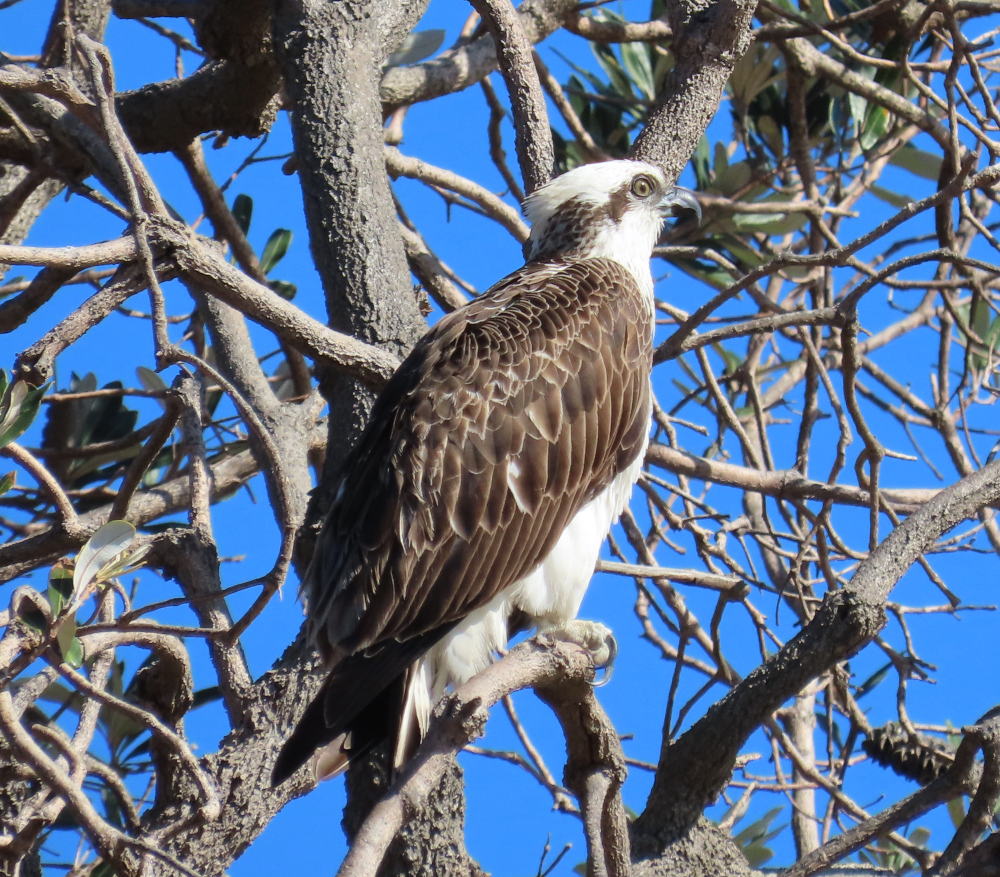
Then the Australian Raven arrived. Here the Osprey is warning the raven off:

That’s when I started the video recording, which you can watch at the top of this post.
Here’s the best picture I have of the osprey in flight:

Common name: Eastern Osprey
Scientific name: Pandion cristatus
Approximate length: 57 cm
Date spotted: 19 June 2024 (winter)
Location: Long Reef Aquatic Reserve, Collaroy, New South Wales, Australia: 33°44’19.7″S 151°18’42.0″E

Grey Fantail catching the sun
Early one morning, after some fairly ferocious rain, everyone was seeking sunlight and somewhere to dry out. This little Grey Fantail sat still on a branch for several minutes. Well, what passes for still, in a fantail’s world!
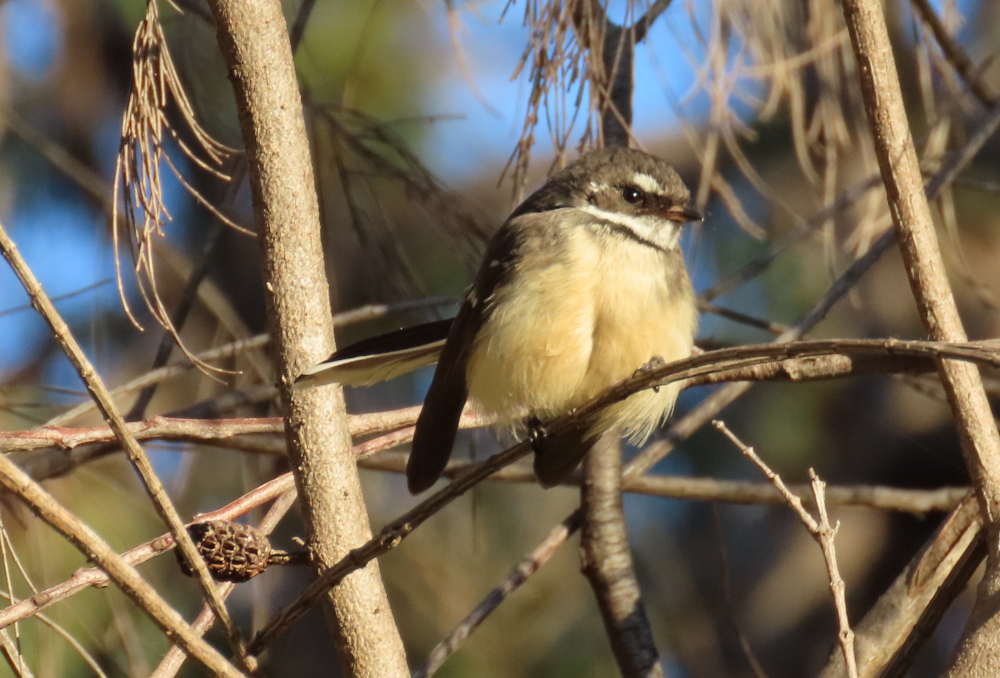
From the way it’s fluffing out its feathers and holding its wings, I’m sure it’s exposing as much of itself to the sun as possible!

Common name: Grey Fantail
Scientific name: Rhipidura fuliginosa
Approximate length: 14-17 cm
Date spotted: 3 June 2024 (winter)
Location: Manly Dam Reserve, New South Wales, Australia: 33°47’01.7″S 151°15’10.3″E

Black Cockatoo feeding a youngster
Every six months or so, a group of Yellow-tailed Black Cockatoos come to our Banksia for a feed. They come for a few days in a row, then move on to find another feeding area.
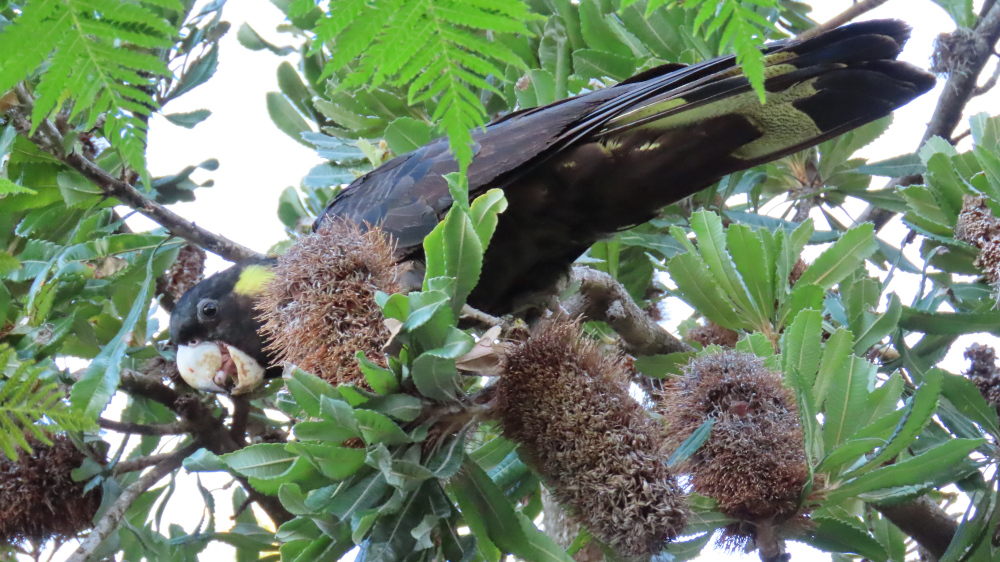
Sometimes they spend more time plucking and dropping than eating. Still, it always feels like such a privilege to have magnificent creatures like this just dropping by. I love the wild, screaming noise that they make. Some people call them the “squeaky door birds”:
The tree is a Banksia serrata, also known as Old Man Banksia.
On the birds’ second visit a day or so later, I filmed some interesting behaviour. One of the birds was making a continuous groaning noise. That’s not unusual, and I’ve wondered in the past if the bird is a youngster begging for food, or if it’s some kind of mating behaviour.
I think I have an answer! In this video, it looks like the male bird (he has a pink ring around his eye) is regurgitating food and then feeding it to the bird that’s making all the noise:
I added quite a lot of detail about these birds in a previous post: Those magnificent black cockatoos are back!
Common name: Yellow-tailed Black Cockatoo
Scientific name: Calyptorhynchus funereus or Zanda funereus
Length: 58-65 cm
Date spotted: 27th and 29th May 2024 (autumn)
Location: Allambie Heights, NSW, Australia

Incoming!
I took this photo so that I could identify the black and white birds on a far off skeleton tree. I only saw the incoming missile when I examined the photos at home:
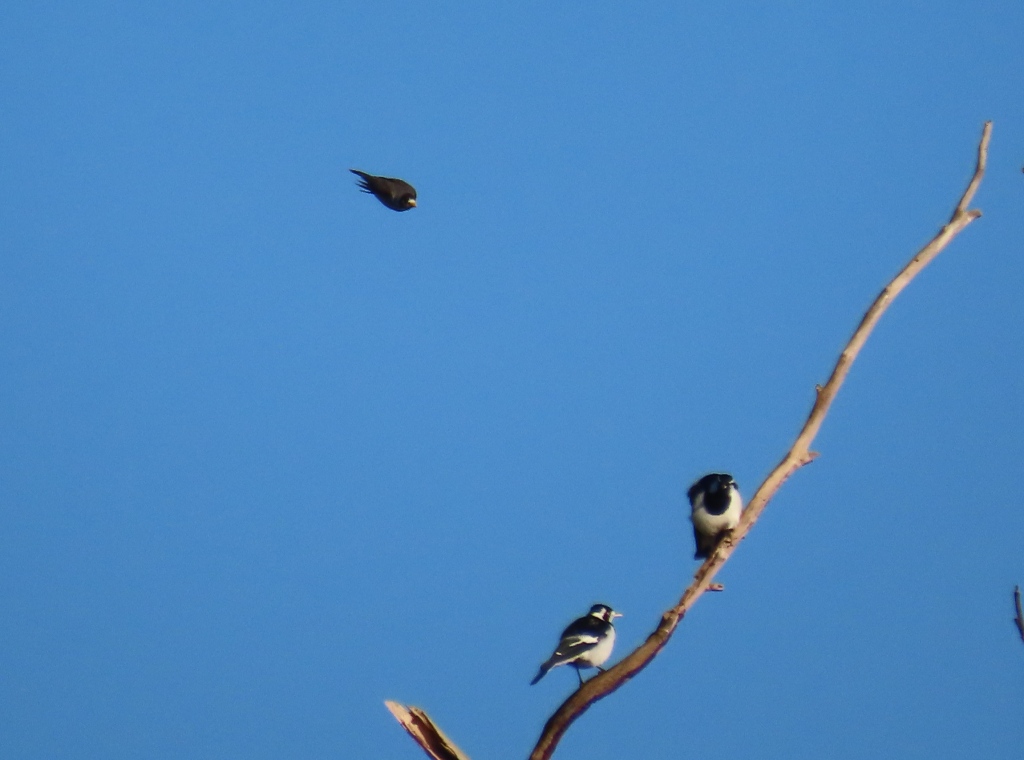
I think the missile is probably a Noisy Miner. The two birds on the tree are Magpie-larks. I’ve often seen Noisy Miners sitting on this strategically-placed dead tree branch, which has a good view over Manly Dam. I’ve seen several types of birds perched there, but the Magpie-larks are usually closer to the water rather than high in a tree.
Date spotted: 30 May 2024

Willie Wagtail enchanted by Grebe
This little Willie Wagtail seems intrigued by the way a Grebe keeps disappearing under the water and popping up again:
My camera battery died as I was taking the above video, which is a pity because the birds were quite close to me. Here’s another video, a bit noisy due to a plane flying overhead, and the birds are further away:
It’s funny how the Coot seems to be surprised by the Grebe’s disappearance too. I love Coots!
I watched the two birds for about fifteen minutes, as the Willie Wagtail tirelessly followed the Grebe around this reedy inlet of Manly Dam. I wonder if the Willie Wagtail was hoping for some insects to fly up each time the Grebe surfaced. Perhaps the Grebe’s activities would disturb a lily pad and cause an insect to jump?

Common names: Australasian Grebe and Willie Wagtail
Scientific names: Tachybaptus novaehollandiae and Rhipidura leucophrys
Approximate length: 23-25 cm and 20 cm
Date spotted: 5 June 2024 (autumn)
Location: Manly Dam Park, near Sydney, Australia: 33°46’34.8″S 151°14’49.6″E

Evocative call of the Spiny-cheeked Honeyeater
This is the last of my posts from our recent trip out west into the Great Outback, and I’ve left the best to last. Like almost all my postings from this trip, this is a first sighting for me.
While I was wondering around on Mungo Lodge, on the outskirts of Lake Mungo, a beautiful, mournful whistle seemed to follow me. At first I thought a person was whistling. (There were other people taking photos in the area.)
Eventually, after ducking under the low branches of trees and taking plentiful photos and videos, I found the whistler: A Spiny-cheeked Honeyeater. Even then, I wasn’t sure, and asked for confirmation on r/AustralianBirds.
Here’s a Spiny-cheeked Honeyeater:

They’re distinctive-looking birds, with that pink line extending from the beak under the eye, a pale blue eye, and a cinnamon-yellow chest.
This video is a bit shaky, but shows one of the birds singing. The call that particularly struck me is the five-note, falling whistle, at 13 seconds into the video and then again at 25 seconds:
In the next video, it’s not as clear which birds are making the call, but there are some nice instances of the call itself, especially from 32 seconds into the video:
Another still shot of one of the birds:

Common name: Spiny-cheeked Honeyeater
Scientific name: Acanthagenys rufogularis
Approximate length: 23-26 cm
Date spotted: 20-21 May 2024 (autumn)
Location: Mungo Lodge, Mungo National Park, New South Wales, Australia: 33°44’31.4″S 143°00’06.1″E

Silly Galahs but so pretty
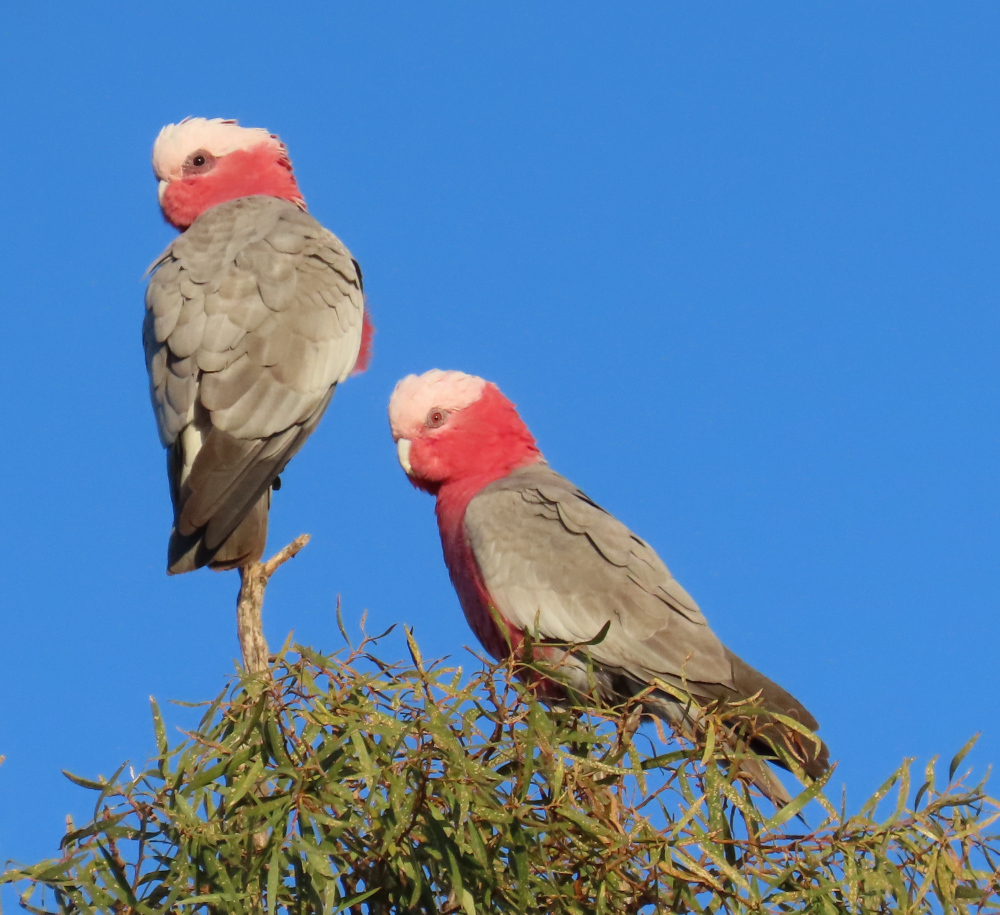
When someone does something daft, Australians affectionately say, “Silly Galah!” That saying is a reference to these birds:

They’re Galahs, a type of cockatoo found across most of Australia. I saw these two on the outskirts of Lake Mungo in the Australian Outback. The one on the left is a male (brown eyes) and the one on the right is female (pink eyes).
The birds were looking particularly pretty, outlined by the early morning sun.
Galahs do sometimes behave in a way that people see as silly. And here is perhaps a case in point…
The day after seeing the birds at Lake Mungo, we were on the road again. Near Griffith in central New South Wales, a large flock of Galahs had for some reason taking a liking to the tarmac. Despite the oncoming vehicles, the birds kept wheeling around and landing on the road. We stopped, and drove slowly, careful not to collide with any of the birds.
Let’s finish off with another two Galahs, again looking pretty at Lake Mungo:
Common name: Galah
Scientific name: Cacatua roseicapilla
Approximate length: 35-38 cm
Date spotted: 20 May 2024 (autumn)
Location: Mungo Lodge, Mungo National Park, New South Wales, Australia: 33°44’31.4″S 143°00’06.1″E

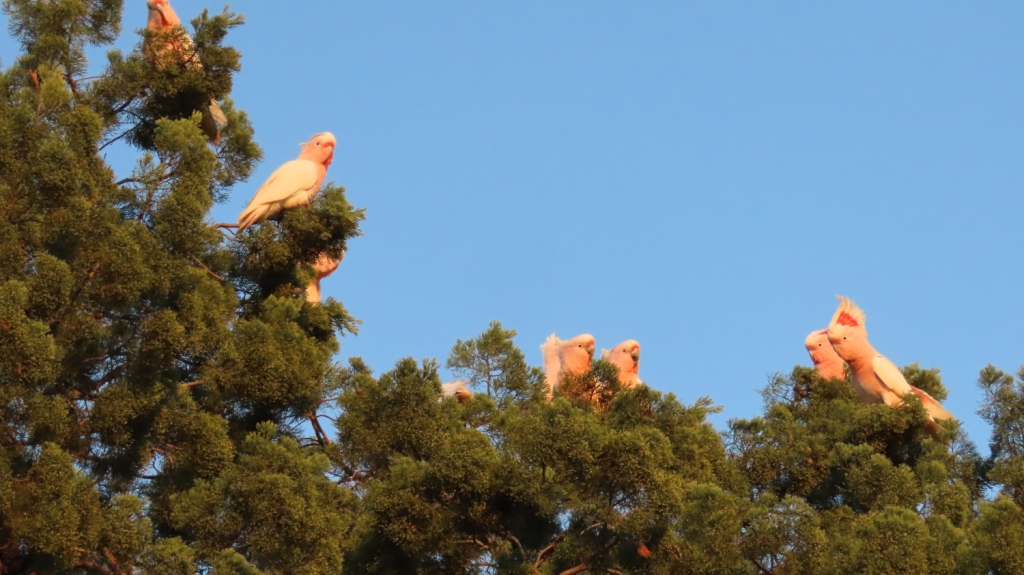
A tree full of Pink Cockatoos at Lake Mungo
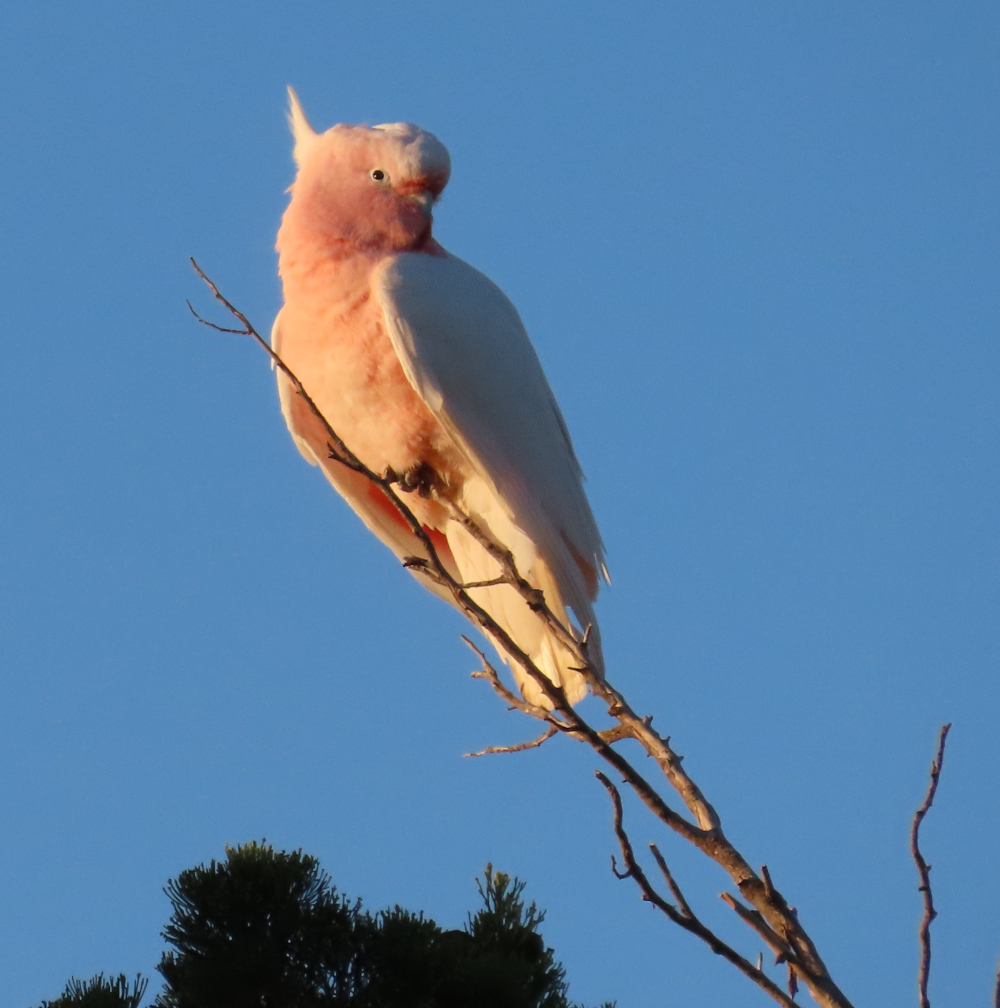
I came across a tree full of Pink Cockatoos at Mungo Lodge, on the outskirts of Lake Mungo in the Australian Outback. The alternative name for these birds is Major Mitchell’s Cockatoo and they were also previously known as Leadbeater’s Cockatoo.
Here’s a portrait of one of these spectacular birds:
They’re gregarious and chatty birds. This video shows them in a quieter moment, enjoying the early sunlight at the top of a tree:
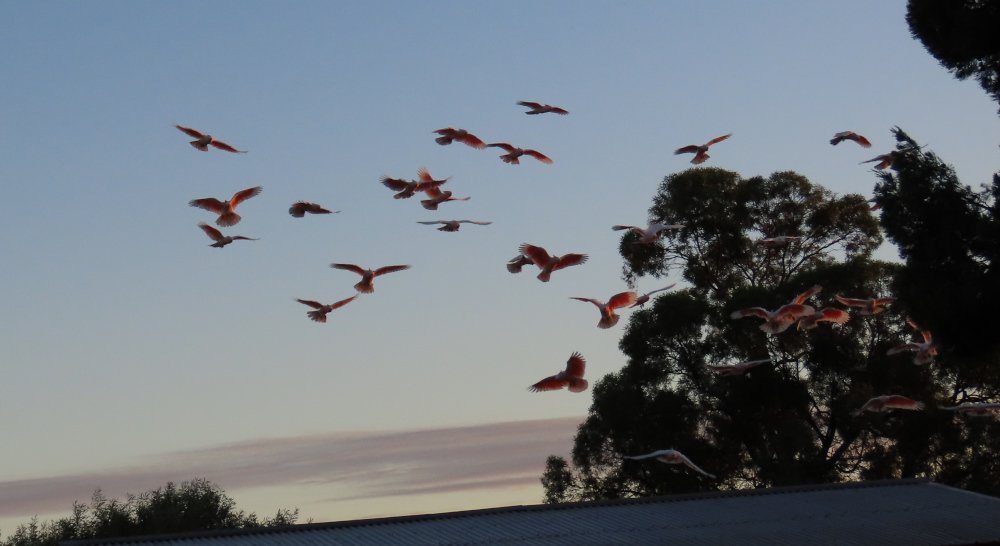
It was exciting to see these birds. Pink Cockatoos are uncommon, and are considered endangered. Here’s a still picture of part of the tree full of birds:
In September 2023, Birdlife Australia published an intention to change the common name of these birds from Major Mitchell’s to Pink Cockatoo, because Major Mitchell played a major part in the massacre of Aboriginal people in the 19th century.
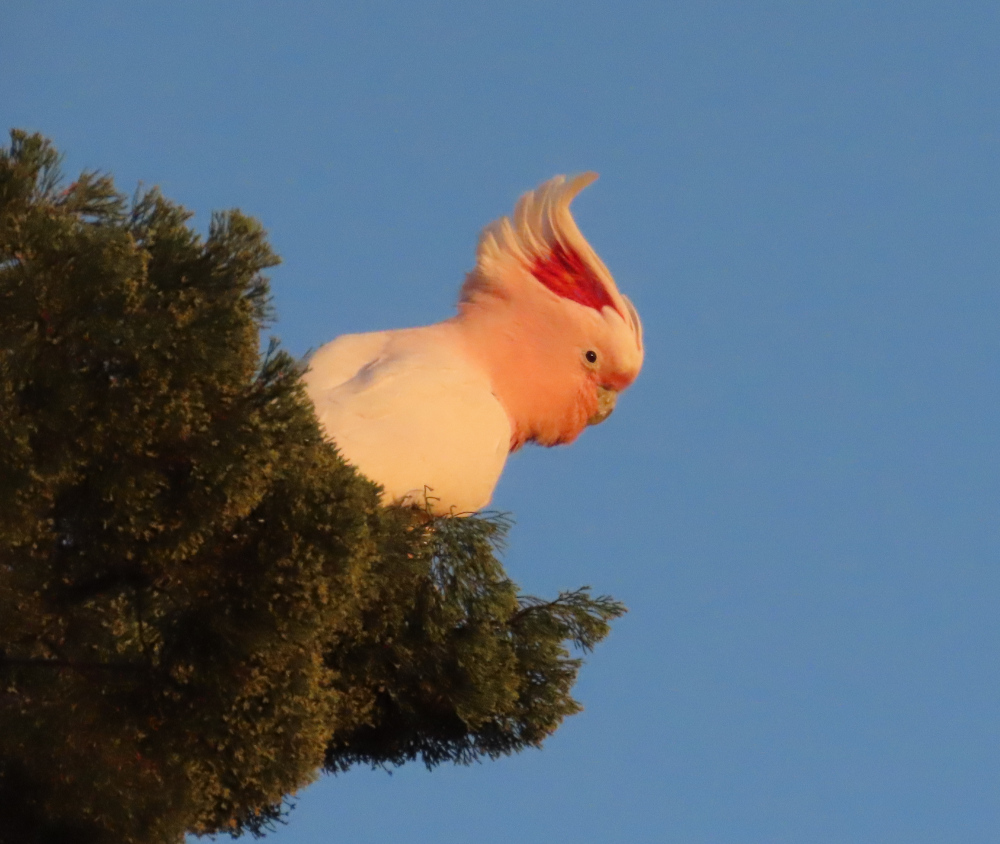
It’d be a pity to taint the beauty of these birds with such a memory. The birds have a delicate beauty, the pink colour changing in the light from soft pink to quite dramatic colouring:
At 35-40 centimetres from head to tail, these birds are about the same size as a Galah. They’re smaller than the well-known Sulphur-crested Cockatoo (45-50 cm).
A final shot of a group of birds coming in to land:
Common name: Pink Cockatoo (alternative name: Major Mitchell’s Cockatoo)
Scientific name: Cacatua leadbeateri
Approximate length: 35-40 cm
Date spotted: 20-21 May 2024 (autumn)
Location: Mungo Lodge, Mungo National Park, New South Wales, Australia: 33°44’31.4″S 143°00’06.1″E

Pied Butcherbird makes 3 out of 4
There are four types of Butcherbird in Australia: Grey Butcherbirds, Black Butcherbirds, Black-backed Butcherbirds, and Pied Butcherbirds. Grey Butcherbirds are common on Australia’s east coast, where I live. I’ve seen a Black Butcherbird when travelling in the far north of Australia. And now, travelling west of Sydney into the Outback, I spotted a Pied Butcherbird. Three out of four ain’t bad!

The white collar of this bird extends in a straight line, all the way round the back of the neck, whereas the Grey Butcherbird’s collar is narrower and doesn’t go all the way round.
Common name: Pied Butcherbird
Scientific name: Cracticus nigrogularis
Approximate length: 33-36 cm
Date spotted: 21 May 2024 (autumn)
Location: Mungo Lodge, Mungo National Park, New South Wales, Australia: 33°44’31.4″S 143°00’06.1″E

Yellow-throated Miners see off a Noisy Friarbird
At first, I thought these birds were Noisy Miners, which are very common on the east coast of Australia where I live. However, we were out west at Mungo National Park, and the birds were Yellow-throated Miners.
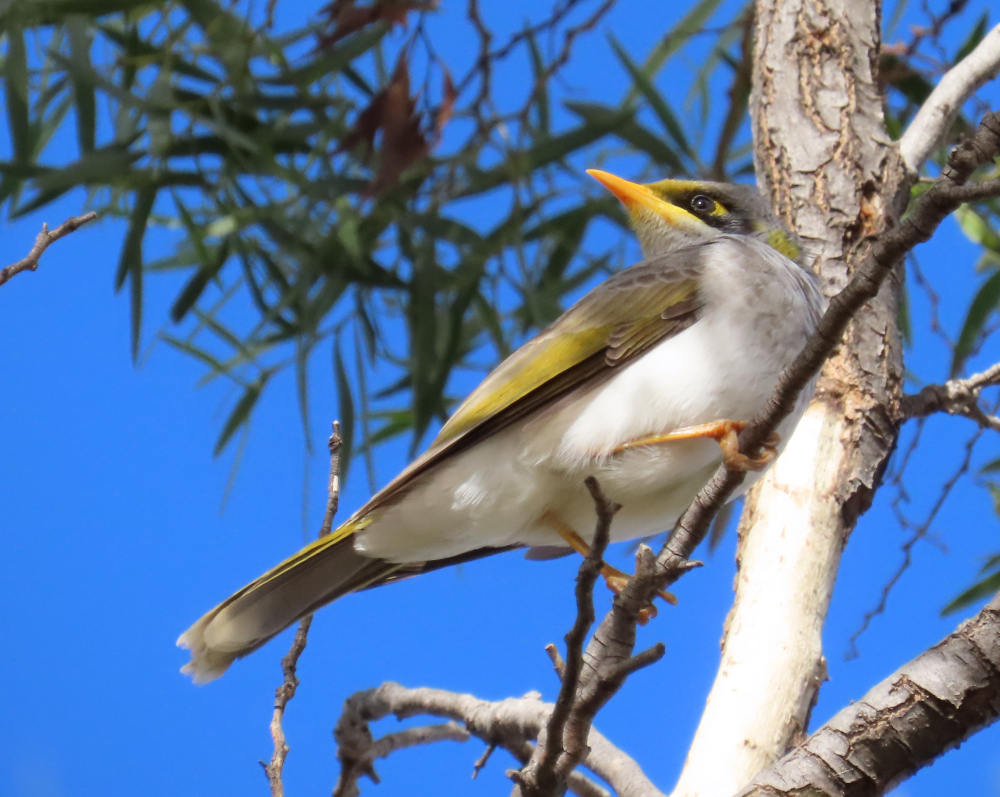
Common name: Yellow-throated Miner
Scientific name: Manorina favigula
Approximate length: 26-28 cm
Date spotted: 20-21 May 2024 (autumn)
Location: Mungo Lodge, Mungo National Park, New South Wales, Australia: 33°44’31.4″S 143°00’06.1″E
As you’d expect from the name, this bird has more yellow around its face and head than does the Noisy Miner. Here’s a Noisy Miner for comparison:

Just like their noisy cousins, it seems that the Yellow-throated Miners are territorial and fear nothing. These two were seeing off a Noisy Friarbird:
I have better pictures of Noisy Friarbirds in another post.


 Sydney Birder