Category Archives: Swamphen

Lost! Baby Purple Swamphen
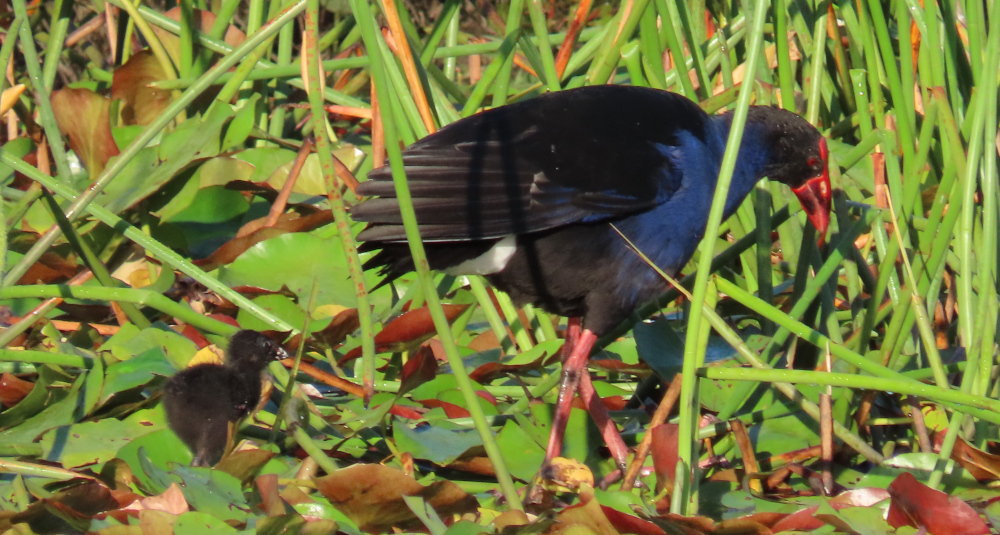
A baby Purple Swamphen hops around the lily pads, sticking close to the safety of her mother. But where is her little brother?
I love the baby birds’ tiny little wings. They look like little arms flapping about. At first, I thought that the baby had caught a frog. No, it’s just those little wing stubs.
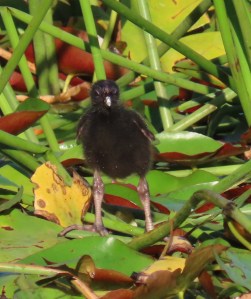
But where is her brother? Another tiny little Purple Swamphen is lost amongst the reeds! It’s hard to see how such a tiny thing can find his way back to his mother and sister, so far away among the giant lily pads:
I don’t know whether these birds are male or female, so I’ve just picked pronouns at random. Both sexes of Purple Swamphens look after their young, and they’re hard to tell apart.
Mother might not have the most beautiful face, but she offers safety and comfort:
Will the little one find his way back? His sister gazes across the lily pads, as if searching for him:
At last, the wanderer spots his family and hurries across the lily pads. His sister greets him warmly, while mother looks on fondly:
Common name: Purple Swamphen
Scientific name: Porphyrio porphyrio
Approximate length of adult: 50 cm
Date spotted: 5 February 2025 (summer)
Location: Manly Dam Reserve, New South Wales, Australia: 33°46’35.4″S 151°14’49.1″E

Bird spotting with Aussie Bird Tours
Yesterday my family and I went on a bird-spotting trip with Aussie Bird Tours. Mike Barrow led us on a wonderful half-day tour around the Dee Why Lagoon, Warriewood Wetlands, and Irrawong Reserve. We spotted a large number of birds (40-50 types) and heard others too. Here are the ones that I managed to get a half-decent photo of.
Our tour started at Dee Why Lagoon, where we saw a number of water birds: a darter, cormorants, ducks, a black swan, coots, a Silver Gull, and more. Songbirds were there too. A Magpie-lark strutted over the mud. Welcome Swallows darted across the water. A Willie Wagtail chirped in the distance. An Eastern Whipbird spent many minutes exploring the dense reeds a couple of metres from our feet. We could hear its characteristic chattering, but only saw it when it made a break for the higher foliage.
This male Olive-backed Oriole (Oriolus sagittatus) posed for a profile shot against the blue sky:
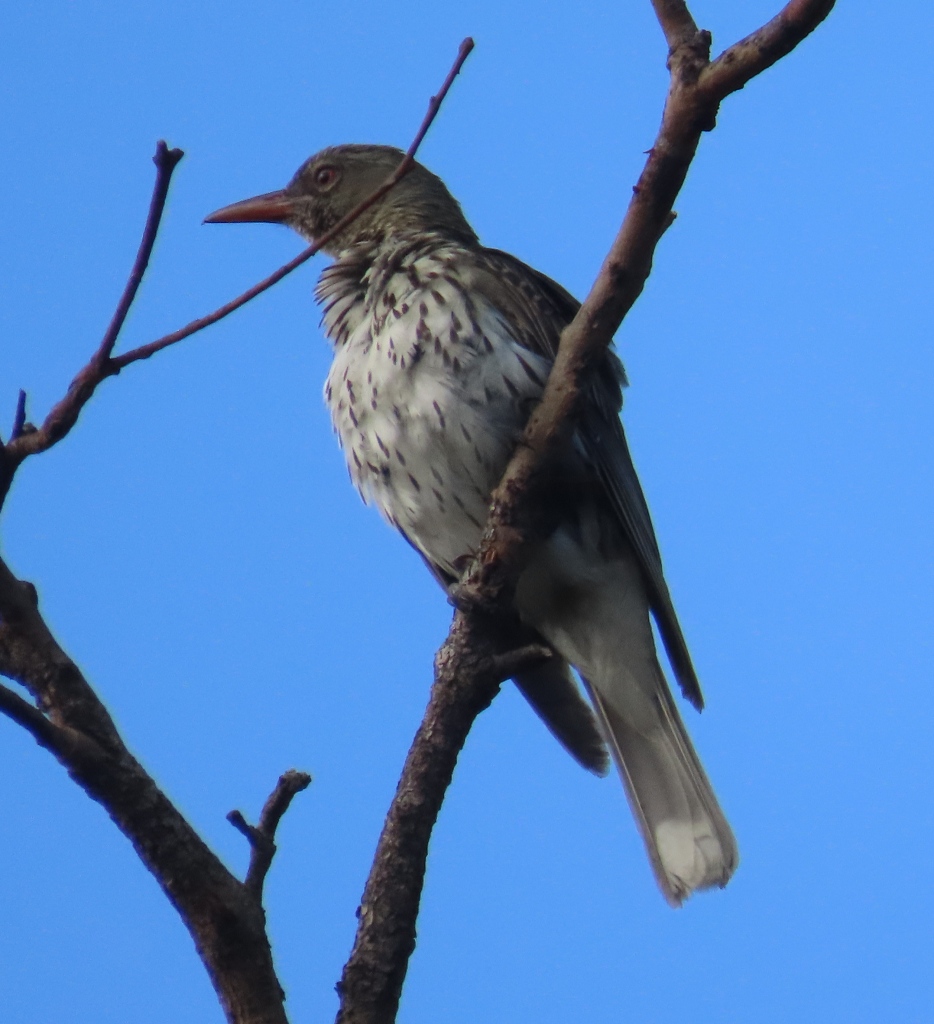
On this trip I learned what Olive-backed Orioles sound like (you can hear their call on eBird). I also learned the call of the Darter (hear it on xeno-canto). The latter sounds very like a Dollarbird, and I’ve probably mixed up those two calls in the past.
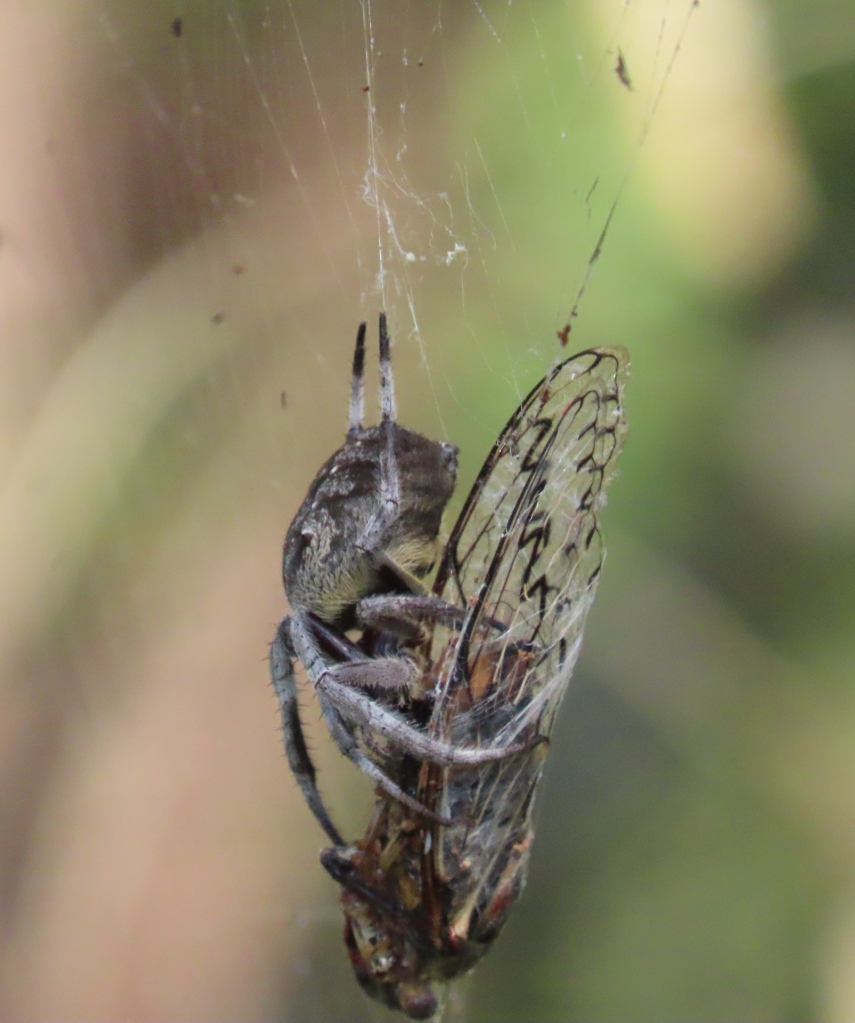
Our next stop was the Warriewood Wetlands, which is an interesting patch of swampy bushland. A raised path leads you across the reeds and water, with great views of wetlands all round you. The cicadas were out in full force, deafening us while providing food to other creatures. Here, a large spider has caught a cicada in its web and is having a feast:
Discarded cicada husks stuck to tree trunks, shed when the cicada larva emerges from the ground and morphs into the winged insect:

Bell Miners (Manorina melanophrys) have moved into the Warriewood Wetlands in large numbers. The call of these honeyeaters is a clear, single, oft-repeated clink, like the sound of a bell. They’re quite attractive birds, with olive wings and back, and a pale yellow chest:
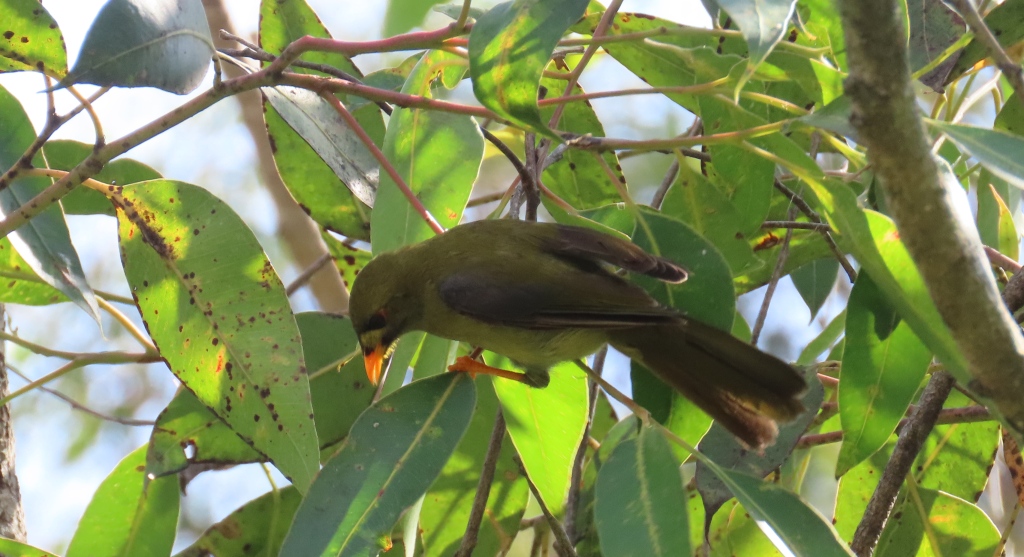
What with the screeching of the cicadas and the pinging of the Bell Miners, this was a noisy patch of bush!
The noise didn’t seem to bother the Purple Swamphens (Porphyrio porphyrio), who carried out a lively courtship beneath the wooden walkway:
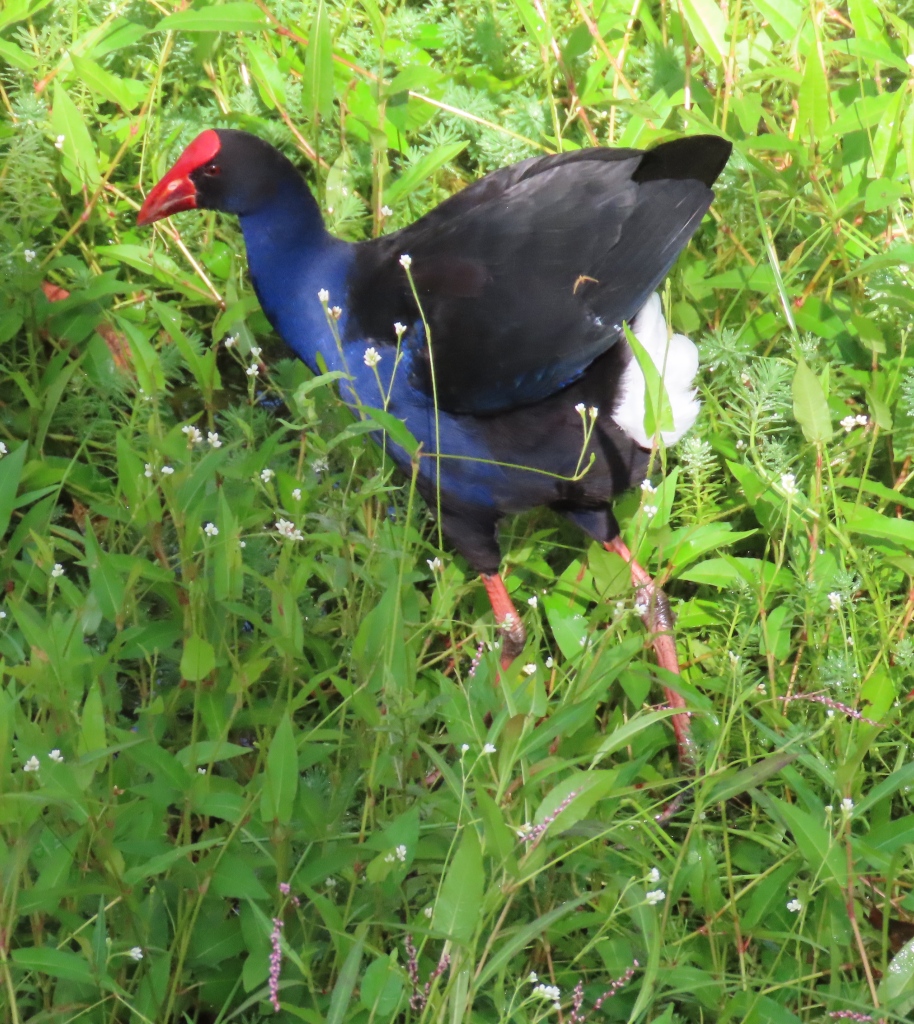
A small water dragon looked on:

A Dusky Moorhen (Gallinula tenebrosa) showed up in bold orange and yellow:

We didn’t see any snakes, though evidently they’re around. We did see a couple of largish skinks, like this one:
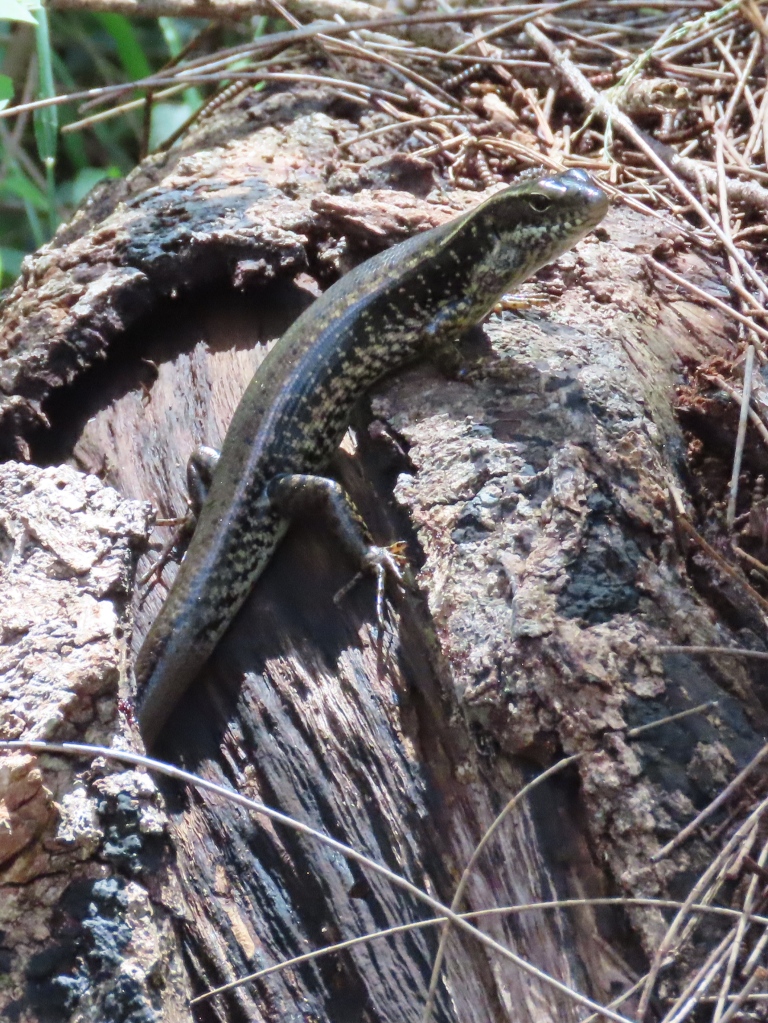
Striking dark grass flowers lined the way:
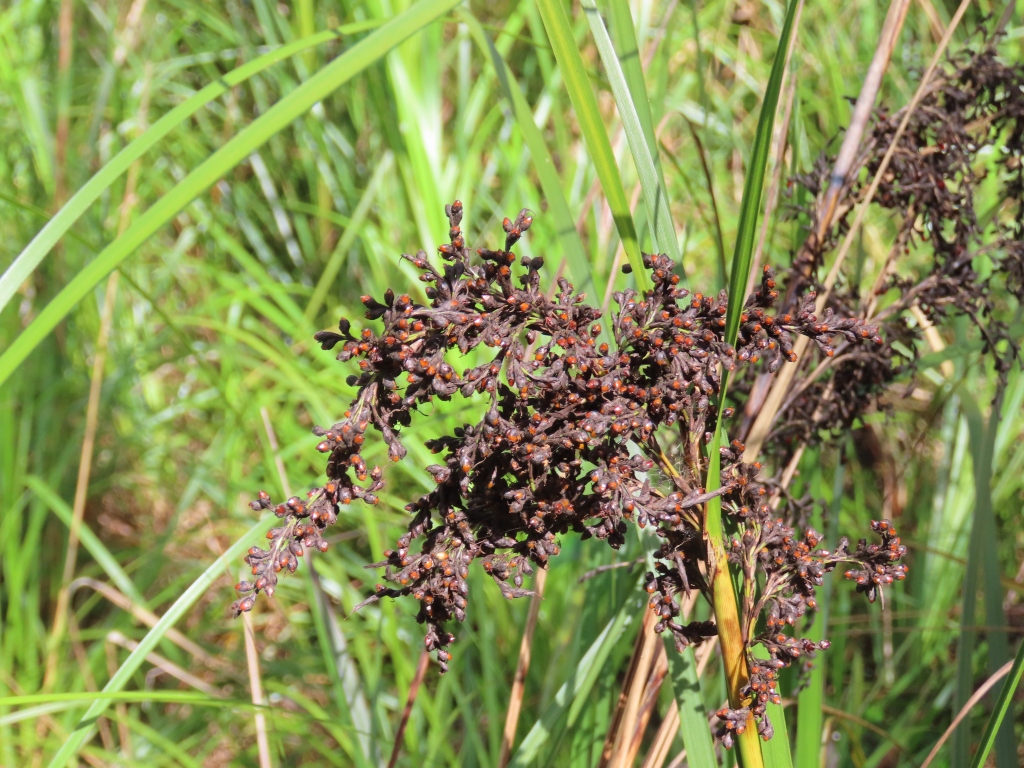
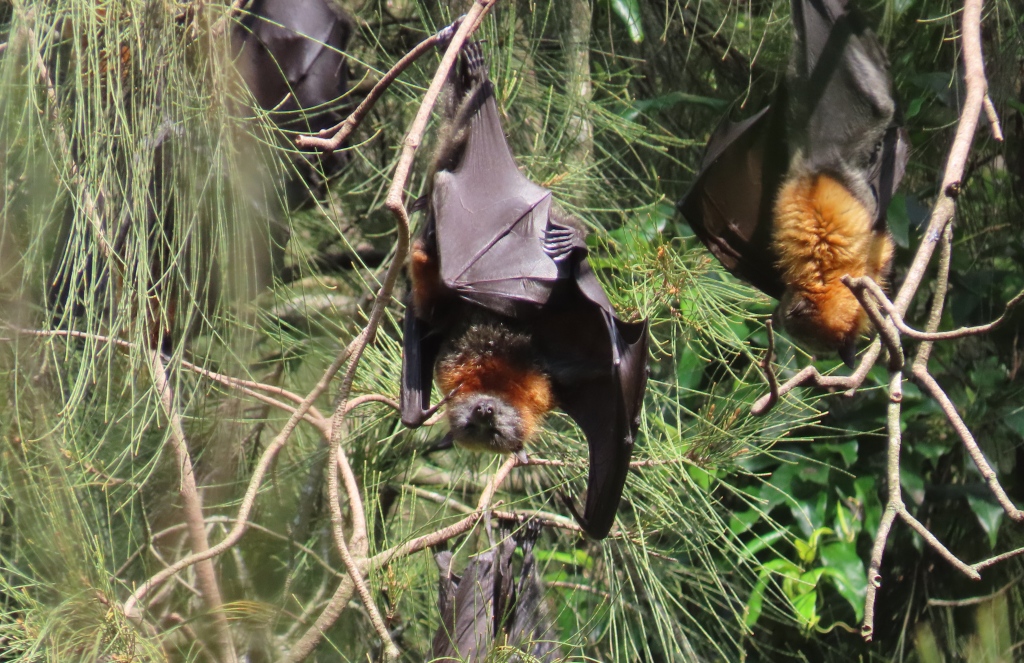
A colony of Flying Foxes (large fruit bats) occupies one corner of the wetlands:

Here’s a close-up of one of these attractive, intriguing mammals. They have a grey face, with a reddish fur collar and back. Their wings are black and leathery, strong enough to support these large bats in their long cross-country flights:
After the Warriewood Wetlands, we visited Irrawong Reserve. A Golden Whistler (Pachycephala pectoralis) carolled in the dense bush. This is the male bird:
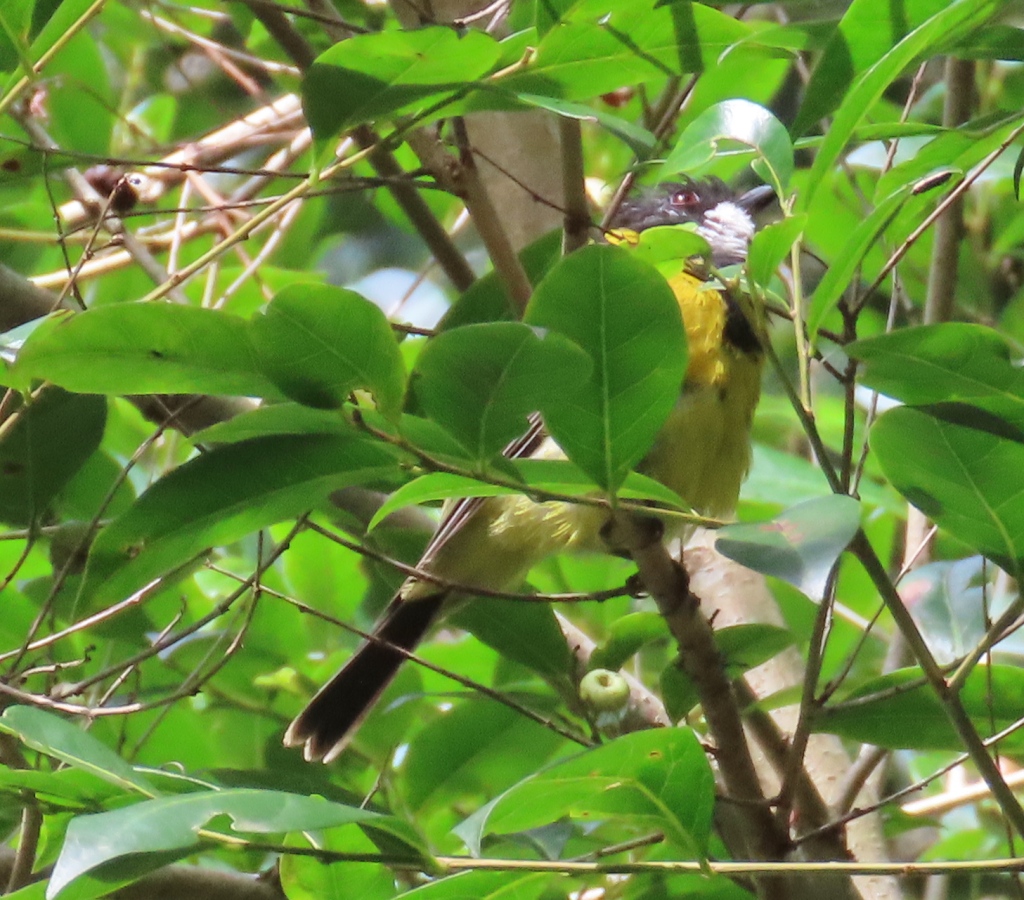
As you can see, it’s adept at hiding behind the foliage. Here’s another shot of the same bird, with its tail fanned:

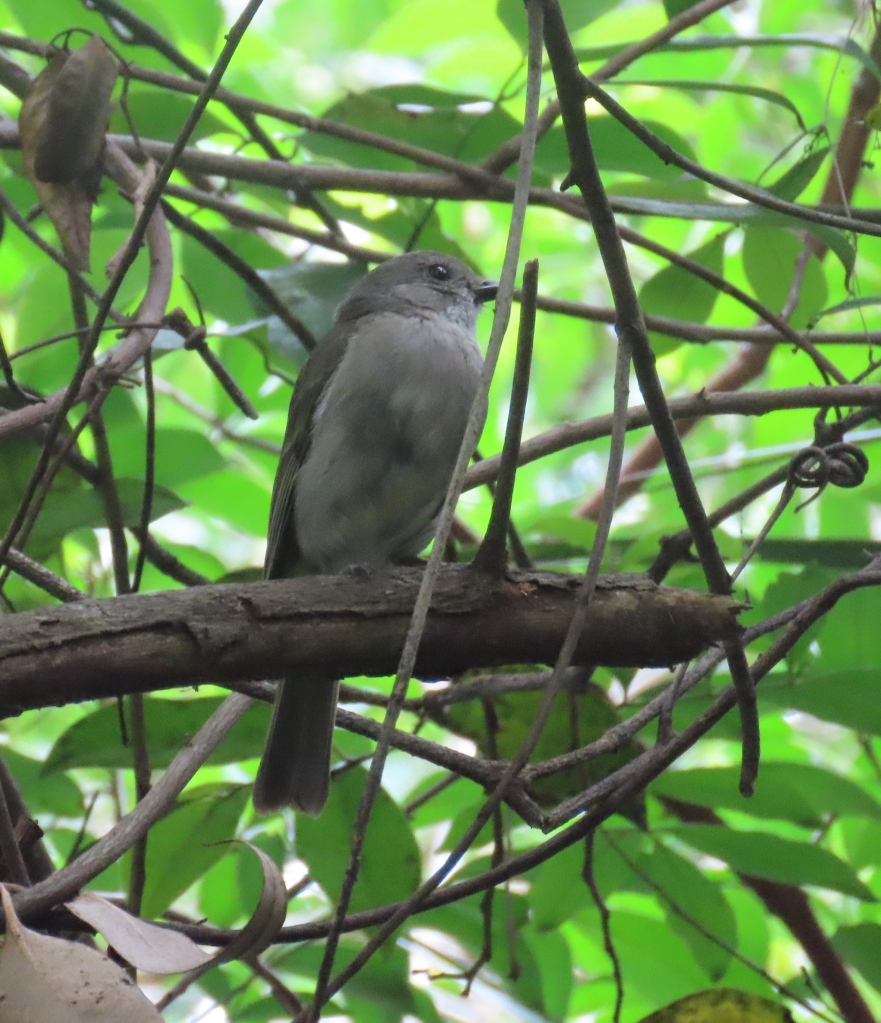
I think the next bird is a female Golden Whistler. They’re harder to identify because of their soft colouring:
The next bird is a first sighting for me: a pretty Rufous Fantail (Rhipidura rufifrons):
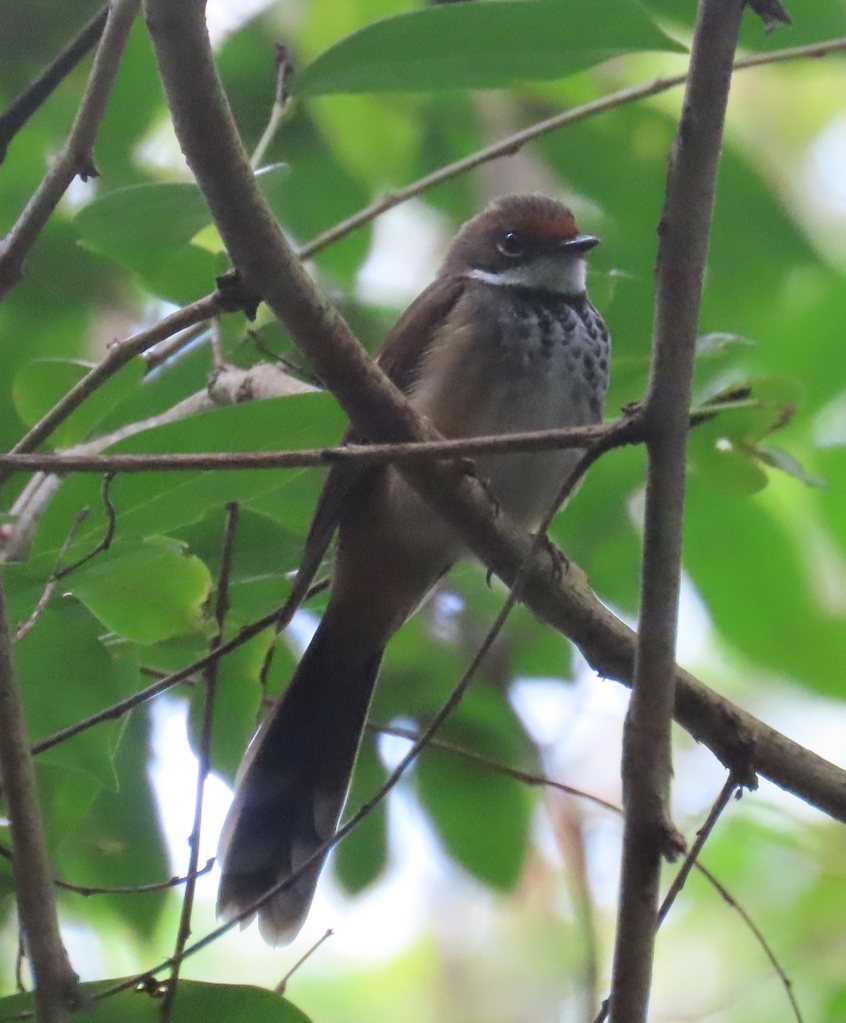
This video is rather blurry, but it’s useful because you can hear the characteristic song of the fantail, similar to that of the Grey Fantail and Willie Wagtail:
My last bird of the day is a Brown Gerygone (Gerygone mouki), another first sighting for me:

The photograph of this bird is very similar to the earlier one of the female Golden Whistler. However, the Gerygone has grey markings running from beak to eye. The Gerygone (9-11 cm) is also smaller than the Golden Whistler (16-18 cm), though that’s hard to tell from the photos.
Purple Swamphens tending a nest
A pair of Purple Swamphens busily tends a nest. This video shows the changing of the guard, as one parent arrives to relieve the other from nest duties.
Sometime later, the bird on the nest had been calling for some time, perhaps growing lonely or bird. The roaming parent suddenly started flapping its wings and making a big fuss about approaching the nest. But then it veered away and continued foraging, apparently not yet ready to resume nest sitting.
I don’t know if there are eggs in the nest yet, though the way the bird moves around in the second half of the video makes me think it’s carefully positioning itself over an egg or two.
Common name: Purple Swamphen
Scientific name: Porphyrio porphyrio
Approximate length: 50 cm
Date spotted: 29 January 2017
Season: Summer
Location: Manly Dam Reserve, New South Wales, Australia: 33°46’35.4″S 151°14’49.1″E
Purple Swamphen chick
So cute and fluffy! This little Purple Swamphen chick treads lightly on the lily pads, learning survival skills from its mother.
Here’s a nice shot of its stubby wings, and its well-developed feet under a couple of centimetres of water:

Setting off on a bit of exploration:

But staying close to mother:

Common name: Purple Swamphen
Scientific name: Porphyrio porphyrio
Approximate length: 50 cm
Date spotted: 30 October 2016
Season: Spring
Location: Manly Dam Reserve, New South Wales, Australia
Latitude/longitude: 33°46’36.1″S 151°14’48.8″E
Purple Swamphens playing coy
The first sight of the Purple Swamphens in this video is their unique tracks in the sand. Then we hear a peeping and a squawking and a bit of a kerfuffle behind the reeds. A bird emerges for a quick appearance, before going back to the more interesting companionship of its fellows. A few minutes later, I came across another pair of birds out in the open, and filmed them too. Notice their big feet as they walk across the lily pads.
Common name: Purple Swamphen
Scientific name: Porphyrio porphyrio
Approximate length: 50 cm
Date spotted: 6 March 2016
Season: Late summer
Location: Manly Dam Reserve, New South Wales, Australia
Latitude/longitude: 33°46’26.6″S 151°14’44.3″E
Swamphens and Moorhens at Manly Dam
Purple Swamphens and Dusky Moorhens look similar, but are quite easy to tell apart once you’ve seen them together. Purple Swamphens are altogether showier: bigger, with brighter colours, and a more confident way of tackling the world. Dusky moorhens are smaller, and move in short dashes, accompanied by a lot of jerking of the head and tail. They almost seem to apologise for their presence. The Purple Swamphen’s beak is entirely red, whereas the Dusky Moorhen has a yellow tip to its beak.
I spotted both birds on the same patch of water at Manly Dam. First, a Purple Swamphen:
Here’s a close-up of those amazing feet, shot when the bird obligingly came up on shore close by me:
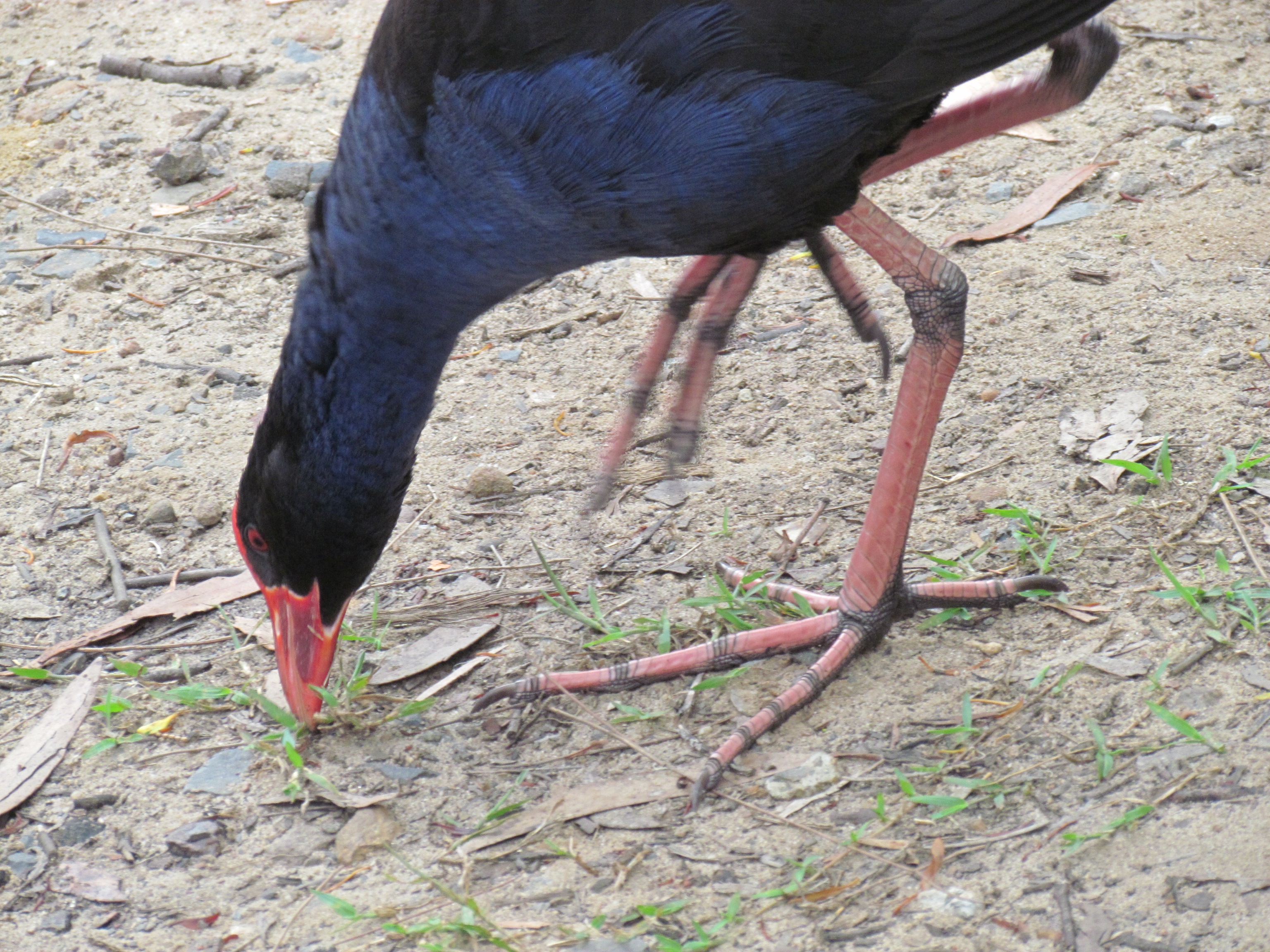
Common name: Purple Swamphen
Scientific name: Porphyrio porphyrio
Approximate length: 50 cm
Date spotted: 29 December 2013
Season: Summer
Location: Manly Dam Reserve, New South Wales, Australia
Latitude/longitude: -33.776626,151.246762
Next, a Dusky Moorhen:
Here’s a nice still of the moorhen sharing the shot with a water lily:
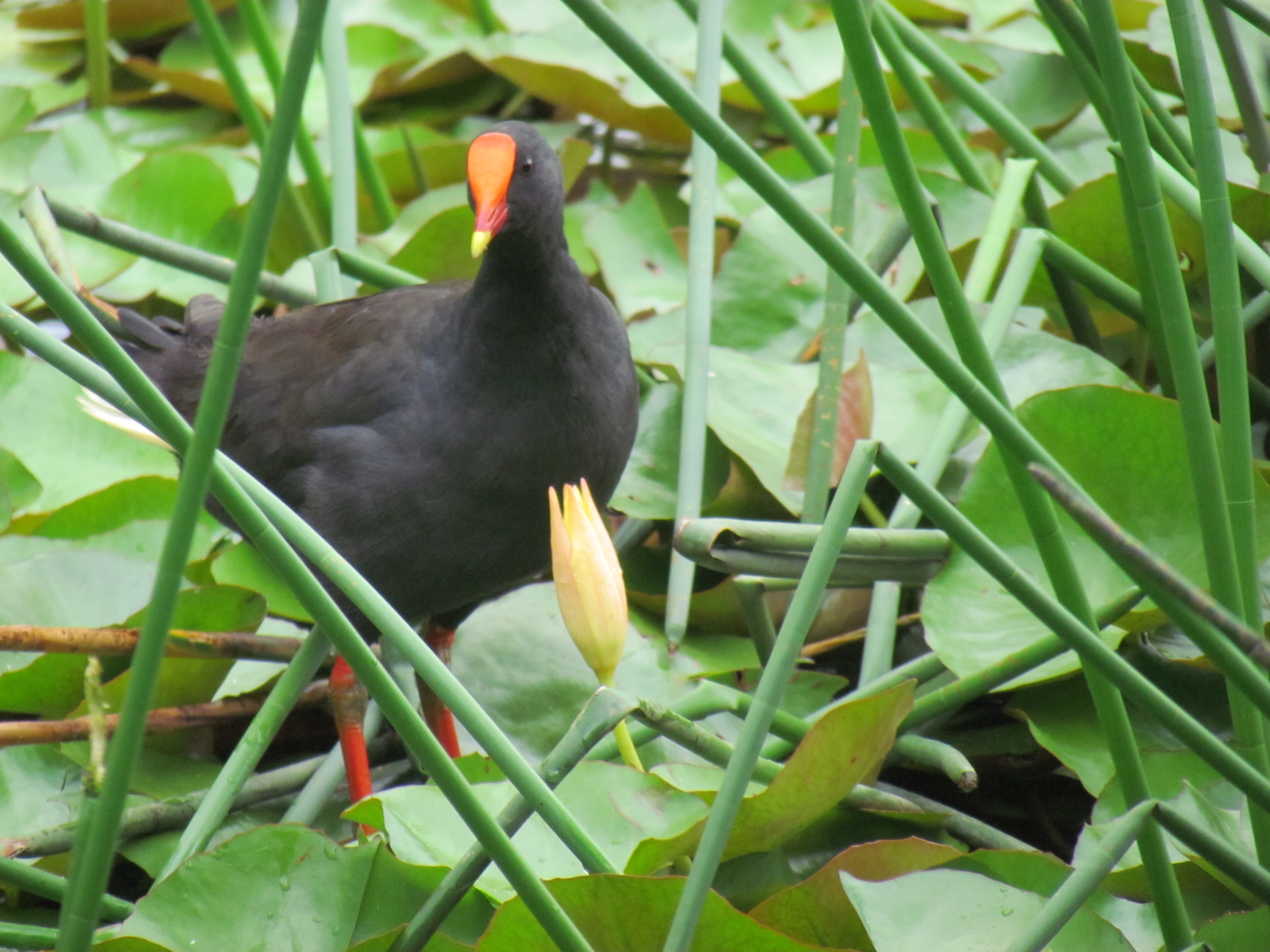
Common name: Dusky Moorhen
Scientific name: Gallinula tenebrosa
Approximate length: 40 cm
Date spotted: 29 December 2013
Season: Summer
Location: Manly Dam Reserve, New South Wales, Australia
Latitude/longitude: -33.776626,151.246762


 Sydney Birder