Category Archives: Parrot

Corellas chewing yacht ropes
A group of Little Corellas has lately taken a shine to the Forty Baskets Beach area in Balgowlah, NSW. They spend their time in the nearby trees and on the rocks.

The corellas seem to enjoy the sea water trapped in crevices on the rocks. Or perhaps it’s rain water.
The corellas are beautiful, and fun to watch, but I’m rather glad that I don’t have a yacht moored there.

The birds really get into the ropes, watched by their friends:
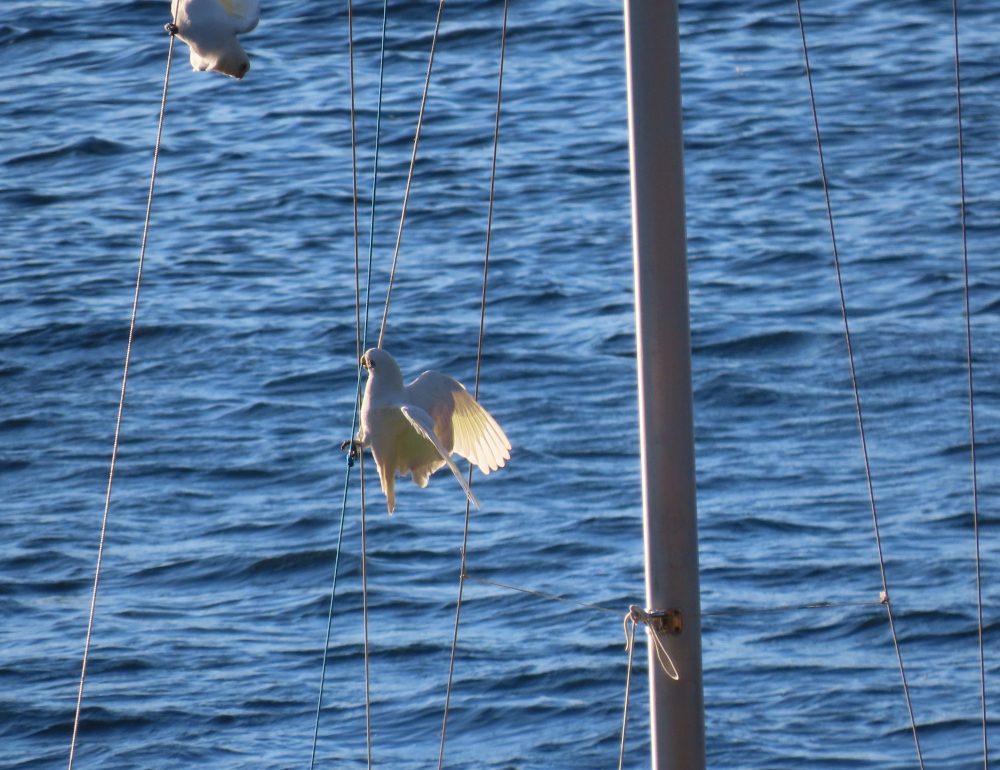

It’s a good time for all.

When fun at the beach palls, it’s time to find a nook for a bit of canoodling:

This grooming session ended in a squabble:
Common name: Little Corella
Scientific name: Cacatua sanguinea
Approximate length: 36-39 cm
Date spotted: 28 July 2024 (winter)
Location: Forty Baskets Beach, Sydney Harbour, New South Wales, Australia: 33°48’15.8″S 151°16’13.9″E
Pale-headed Rosella, my first
I recently paid a visit to Brisbane and stayed in an Airbnb with a gorgeous garden. Every morning, as the sun came up, birds visited the flowering Grevilleas outside our window. One morning, this beautiful bird was among them:
It’s my first sighting of a Pale-headed Rosella. They’re not found in the Sydney area, but are common further north in NSW and Queensland. I love the soft colours and gentle manner of this bird.
Common name: Pale-headed Rosella
Scientific name: Platycercus adscitus
Approximate length: 28-32 cm
Date spotted: 6 July 2024 (winter)
Location: The Gap, Brisbane, Queensland (approximate map reference)

Black Cockatoo feeding a youngster
Every six months or so, a group of Yellow-tailed Black Cockatoos come to our Banksia for a feed. They come for a few days in a row, then move on to find another feeding area.
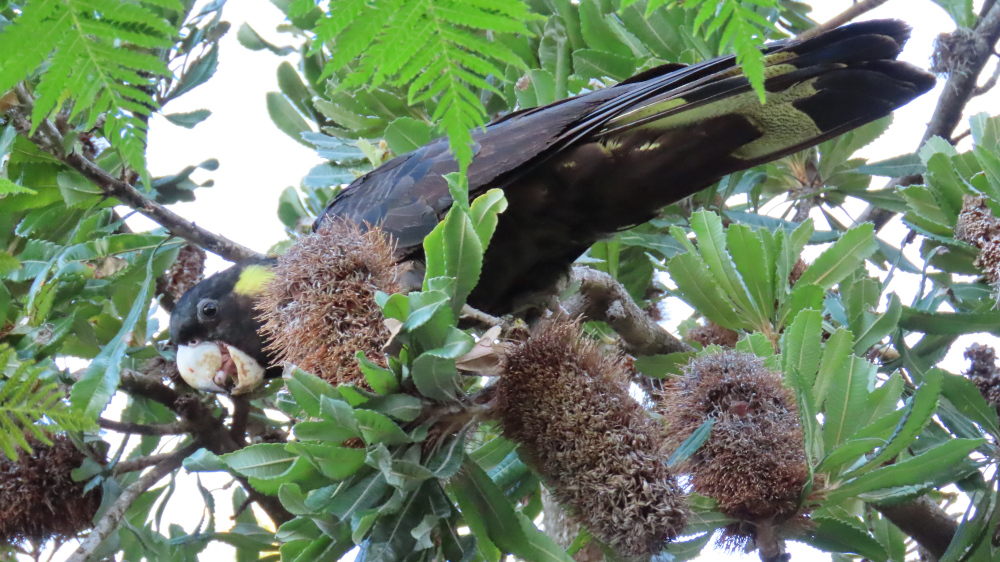
Sometimes they spend more time plucking and dropping than eating. Still, it always feels like such a privilege to have magnificent creatures like this just dropping by. I love the wild, screaming noise that they make. Some people call them the “squeaky door birds”:
The tree is a Banksia serrata, also known as Old Man Banksia.
On the birds’ second visit a day or so later, I filmed some interesting behaviour. One of the birds was making a continuous groaning noise. That’s not unusual, and I’ve wondered in the past if the bird is a youngster begging for food, or if it’s some kind of mating behaviour.
I think I have an answer! In this video, it looks like the male bird (he has a pink ring around his eye) is regurgitating food and then feeding it to the bird that’s making all the noise:
I added quite a lot of detail about these birds in a previous post: Those magnificent black cockatoos are back!
Common name: Yellow-tailed Black Cockatoo
Scientific name: Calyptorhynchus funereus or Zanda funereus
Length: 58-65 cm
Date spotted: 27th and 29th May 2024 (autumn)
Location: Allambie Heights, NSW, Australia

Silly Galahs but so pretty
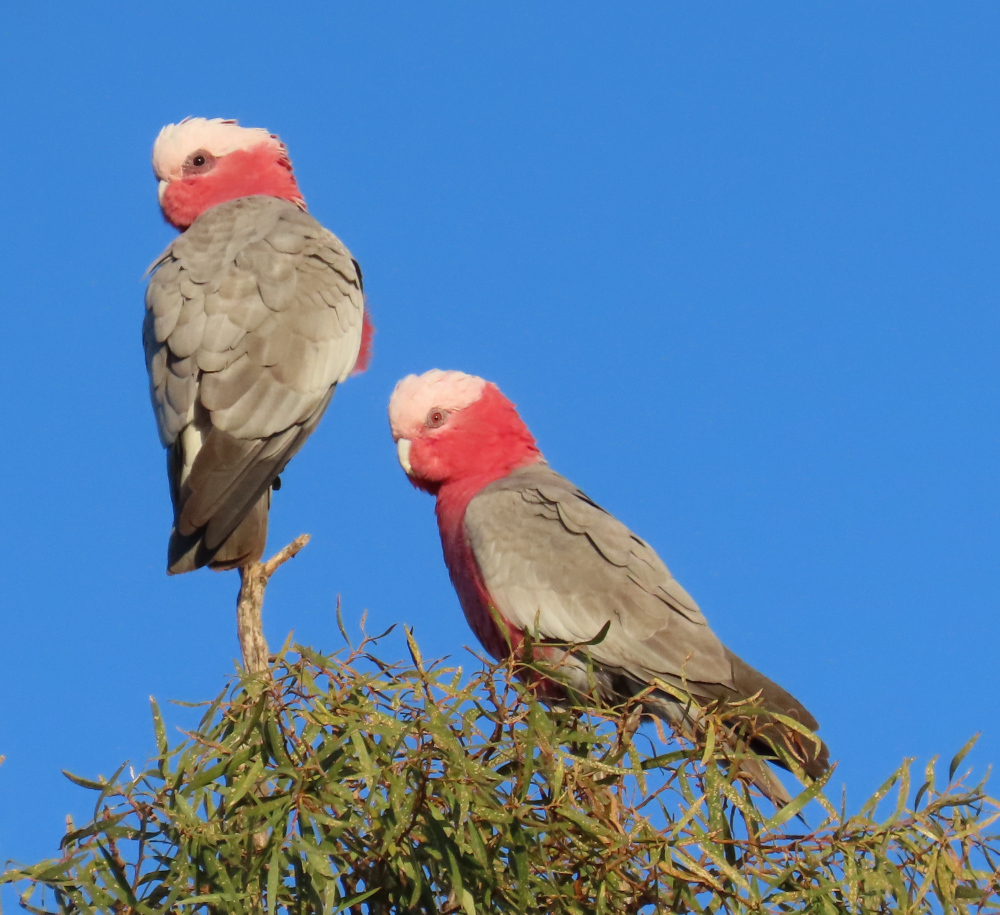
When someone does something daft, Australians affectionately say, “Silly Galah!” That saying is a reference to these birds:

They’re Galahs, a type of cockatoo found across most of Australia. I saw these two on the outskirts of Lake Mungo in the Australian Outback. The one on the left is a male (brown eyes) and the one on the right is female (pink eyes).
The birds were looking particularly pretty, outlined by the early morning sun.
Galahs do sometimes behave in a way that people see as silly. And here is perhaps a case in point…
The day after seeing the birds at Lake Mungo, we were on the road again. Near Griffith in central New South Wales, a large flock of Galahs had for some reason taking a liking to the tarmac. Despite the oncoming vehicles, the birds kept wheeling around and landing on the road. We stopped, and drove slowly, careful not to collide with any of the birds.
Let’s finish off with another two Galahs, again looking pretty at Lake Mungo:
Common name: Galah
Scientific name: Cacatua roseicapilla
Approximate length: 35-38 cm
Date spotted: 20 May 2024 (autumn)
Location: Mungo Lodge, Mungo National Park, New South Wales, Australia: 33°44’31.4″S 143°00’06.1″E

A tree full of Pink Cockatoos at Lake Mungo
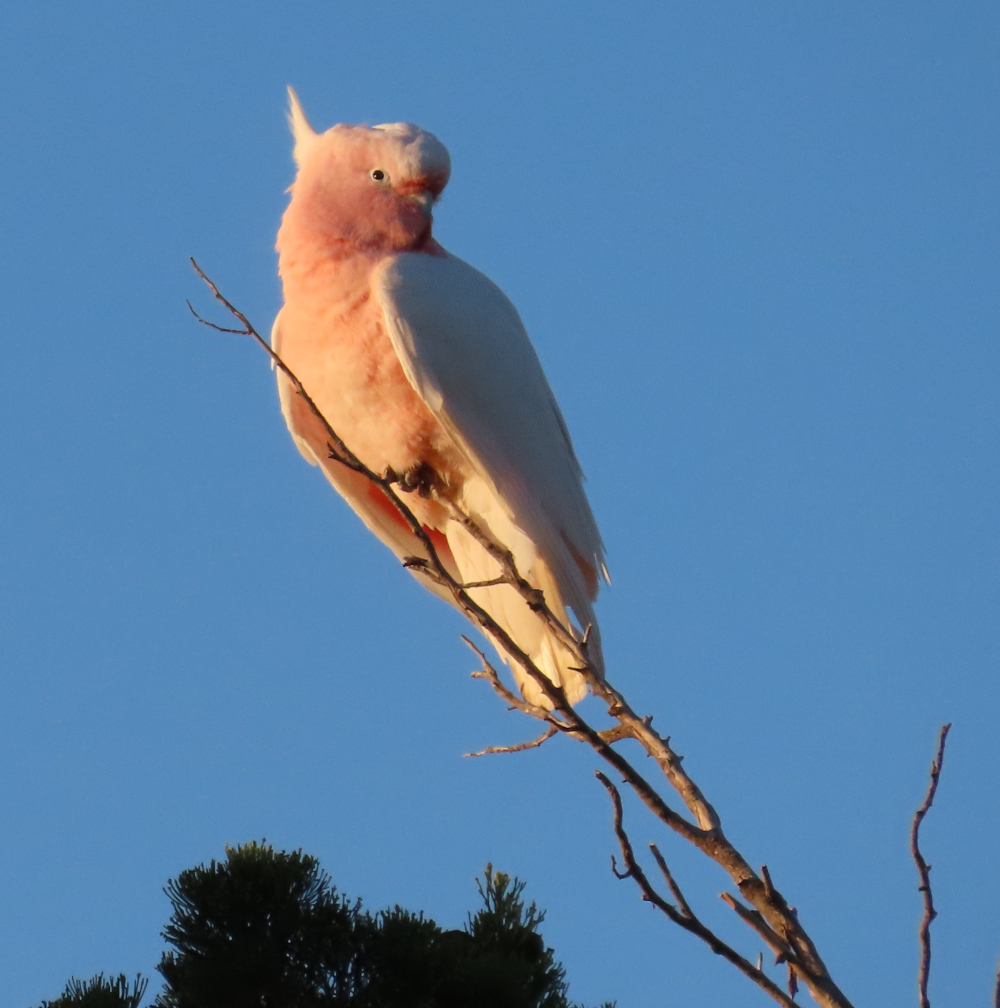
I came across a tree full of Pink Cockatoos at Mungo Lodge, on the outskirts of Lake Mungo in the Australian Outback. The alternative name for these birds is Major Mitchell’s Cockatoo and they were also previously known as Leadbeater’s Cockatoo.
Here’s a portrait of one of these spectacular birds:
They’re gregarious and chatty birds. This video shows them in a quieter moment, enjoying the early sunlight at the top of a tree:
It was exciting to see these birds. Pink Cockatoos are uncommon, and are considered endangered. Here’s a still picture of part of the tree full of birds:
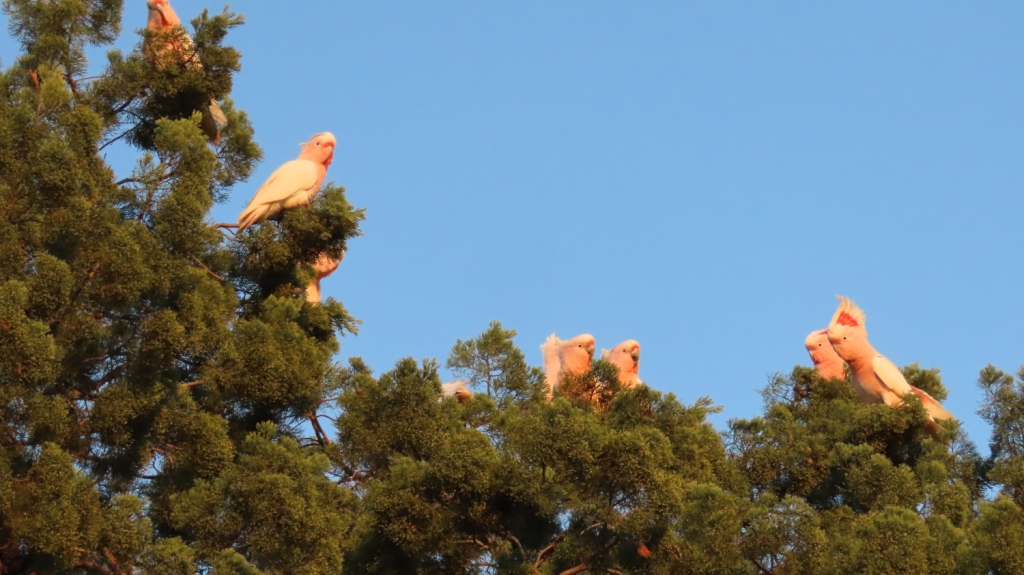
In September 2023, Birdlife Australia published an intention to change the common name of these birds from Major Mitchell’s to Pink Cockatoo, because Major Mitchell played a major part in the massacre of Aboriginal people in the 19th century.
It’d be a pity to taint the beauty of these birds with such a memory. The birds have a delicate beauty, the pink colour changing in the light from soft pink to quite dramatic colouring:
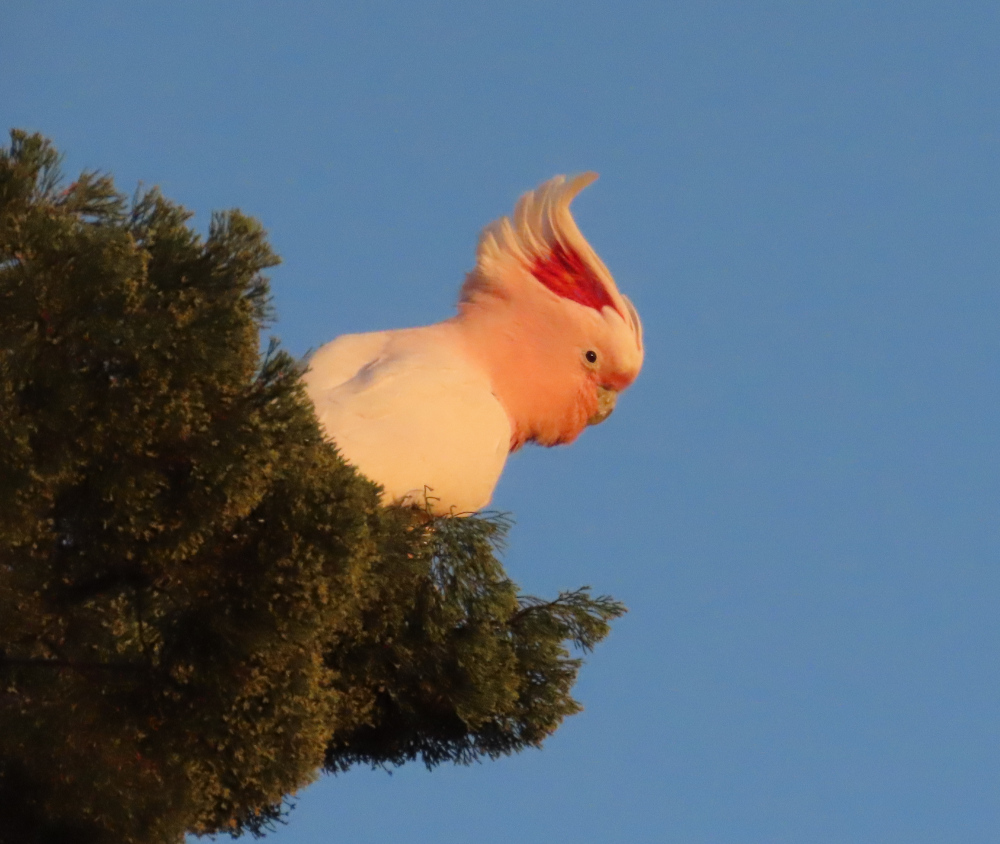
At 35-40 centimetres from head to tail, these birds are about the same size as a Galah. They’re smaller than the well-known Sulphur-crested Cockatoo (45-50 cm).
A final shot of a group of birds coming in to land:
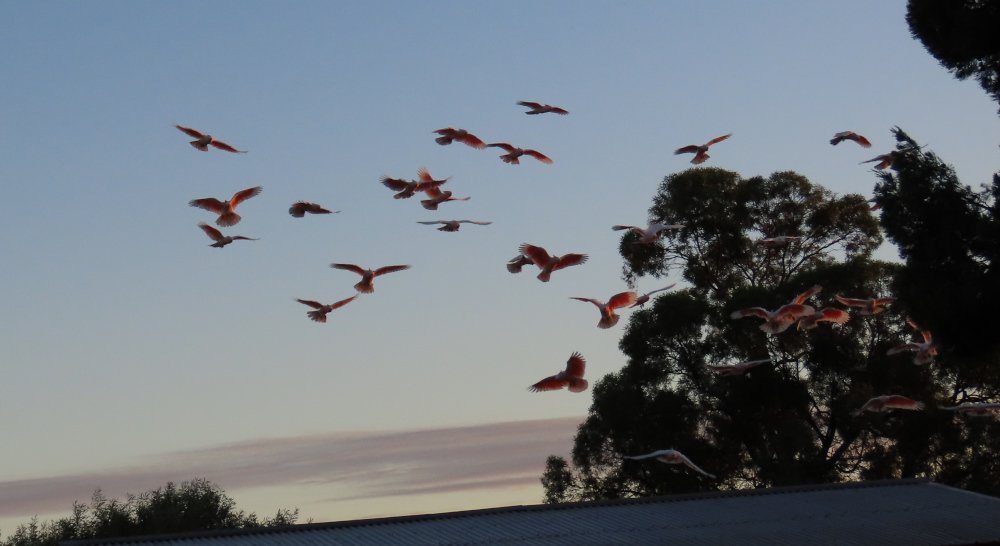
Common name: Pink Cockatoo (alternative name: Major Mitchell’s Cockatoo)
Scientific name: Cacatua leadbeateri
Approximate length: 35-40 cm
Date spotted: 20-21 May 2024 (autumn)
Location: Mungo Lodge, Mungo National Park, New South Wales, Australia: 33°44’31.4″S 143°00’06.1″E

Blue Bonnet: a new parrot for me
I love parrots, and it’s always exciting to see a new type. This is my first sighting of a Blue Bonnet. It was at Mungo Lodge, during our recent Outback trip.

Of course, as so often happens with birds, it was difficult to get a good shot. For the above photo, the bird turned its back. The next one is totally out of focus, but gives a good idea of the colouring around the bird’s face:

Common name: Blue Bonnet
Scientific name: Northiella haematogaster
Approximate length: 27-34 cm
Date spotted: 20 May 2024 (autumn)
Location: Mungo Lodge, Mungo National Park, New South Wales, Australia: 33°44’31.4″S 143°00’06.1″E

Australian Ringneck parrot at Cobar
First sightings are rolling in for me, thanks to my recent trip into the Australian Outback. We stopped for lunch at a town called Cobar in central New South Wales. A couple of Australian Ringneck parrots hid in the shade near our picnic place.
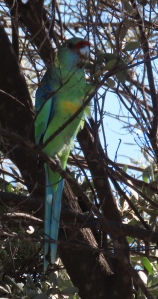
The shots are a little fuzzy, due to the lighting. Still, it’s worth sharing these shots as I’m unlikely to see these birds again for a while.
This particular variety of Australian Ringneck is called a Mallee Ringneck. The name “ringneck” comes from the narrow collar that this parrot shares with other varieties in the same species.

Common name: Australian Ringneck, subspecies Mallee Ringneck
Scientific name: Barnardius zonarius barnardi
Approximate length: 34-38 cm
Date spotted: 18 May 2024 (autumn)
Location: Cobar, New South Wales, Australia: 31°29’53.6″S 145°50’21.7″E

So lucky! King Parrots and Eastern Rosellas come to visit
Two days ago, a couple of Eastern Rosellas dropped by. The next day, I was getting ready to write this blog post when two King Parrots came visiting. We’re so lucky, to have such beautiful birds in the area.
Eastern Rosellas
It’s quite odd: we have visits from two of these little parrots at around this time every year. The pattern is always the same: I hear them twittering, and lean out of the window. A male perches on our telephone line, or on a branch near by, and gives a little show for his lady friend. The show consists of some twittering, and bit of feather fluffing and scratching, and some wing shuffling. Then, after a few minutes they fly away.
Eastern Rosellas are medium-sized parrots, measuring about 30cm from head to tail. This is the male:

Here he’s in the middle of a wing shuffle:

The female looks on:

Common name: Eastern Rosella
Scientific name: Platycercus eximius
Approximate length: 30 cm
Date spotted: 19 February 2024 (summer)
Location: Allambie Heights, NSW, Australia
King Parrots
Sitting in the lounge the next afternoon, I heard a soft thunk and then an inquisitive chirp from the veranda. A female King Parrot perched on the window sill, looking in to see what was happening:

The male sat on a branch close by, keeping watch:

At 44cm from head to tail, King Parrots are quite a bit larger than the Eastern Rosellas (30cm). The birds stayed for around 15 minutes. Of course, I talked to them, as you do. The female let me get within a couple of metres.
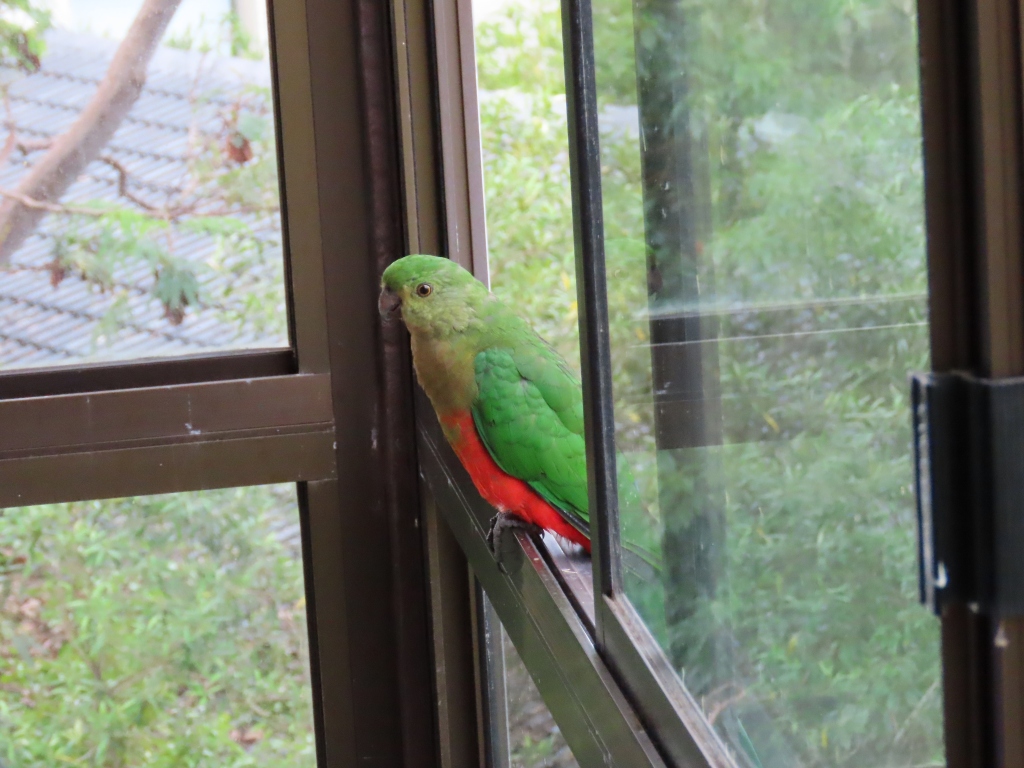
She was quite happy to turn her back on me and check out the goings on outside:

At the start of this video, the female perches on the window sill, peering in. I then find the male outside the window. The view judders a bit, as I need to kneel down to get the male in view. A cockatoo squawks as it flies past:
In the next video, the female is perched on the window sill looking outwards. If you turn up the volume, you’ll hear her soft chirps at around 6 to 12 seconds into the video. Then I manoeuvred carefully around some obstacles on the veranda, and moved the camera to outside the window. Now you can see the female’s head peering out at the bottom of the view, and the male perched on a branch higher up (and also reflected in the window pane). An Australian Raven wails. The camera pans out to show the view.
It felt like a huge privilege to be able to chat to these quiet, majestic birds.
Eventually, the female flew out onto a branch:
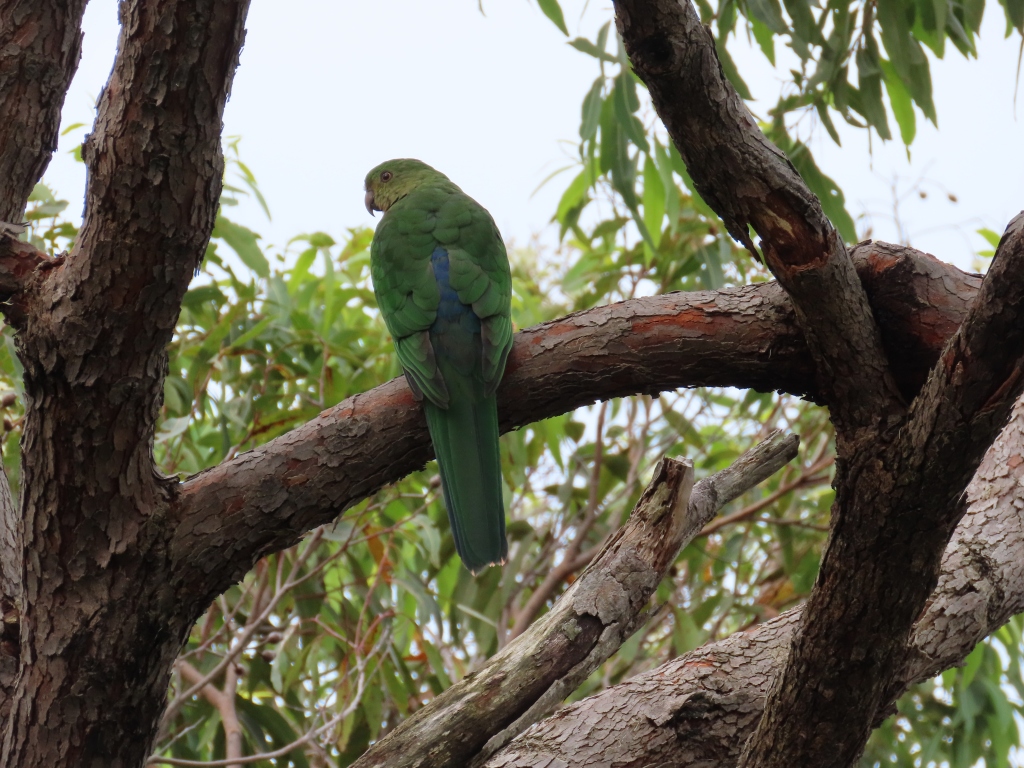
Both birds stuck around for a while. Maybe they were enjoying the view! Then they swooped away to grace another house or tree.
Common name: Australian King Parrot
Scientific name: Alisterus scapularis
Approximate length: 44 cm
Date spotted: 20 February 2024 (summer)
Location: Allambie Heights, New South Wales, Australia

Rainbow Lorikeet
A brightly coloured Rainbow Lorikeet posed in the early morning light:

Common name: Rainbow Lorikeet
Scientific name: Trichoglossus haematodus
Approximate length: 30 cm
Date spotted: 1 January 2024 (summer)
Location: Dobroyd Head, Sydney Harbour, Australia: 33°48’38.6″S 151°16’05.4″E

Post-fire scenes from the Australian bush
The National Parks and Wildlife Service recently conducted a hazard reduction burn in one of my favourite bush-walking areas. The NPWS lights these controlled fires to burn away excess vegetation, which reduces the chance of a more severe fire raging out of control during fire season.
Many of the plants in the Australian bush are adapted to cope with fires. For example, these Hakea seedpods popped open after the fire, allowing the seeds to escape:
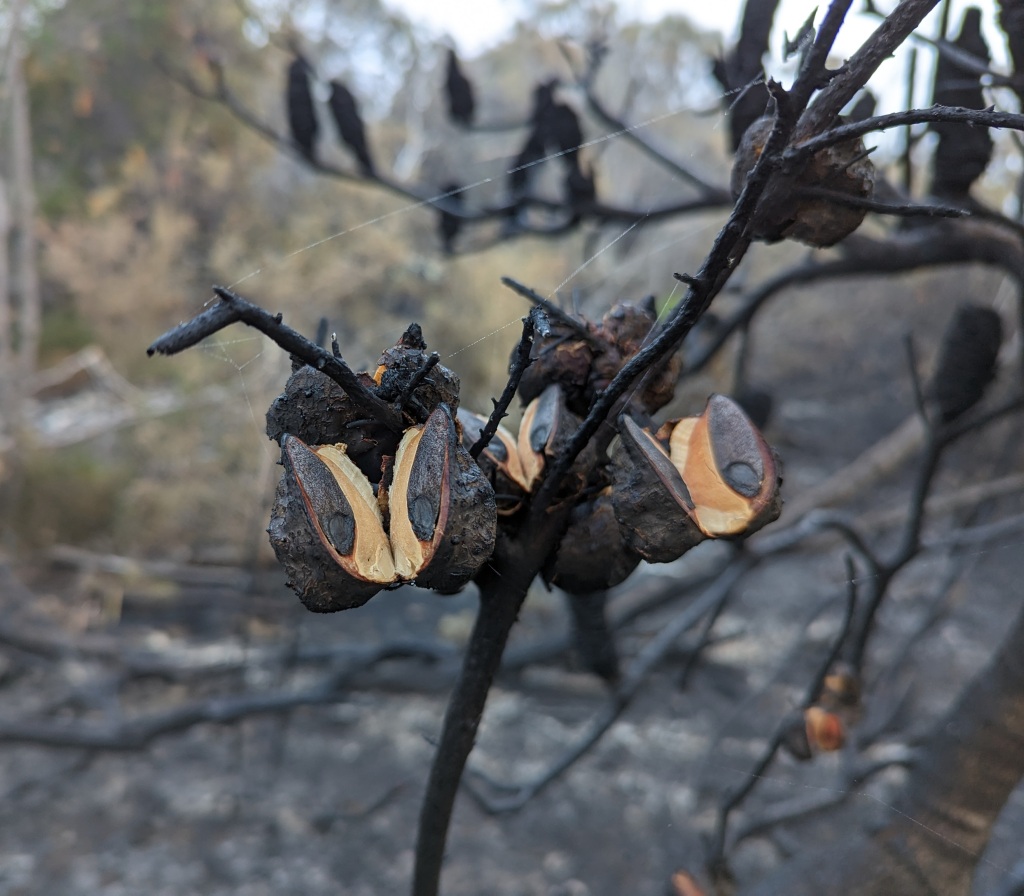
The above seed pods have both seeds still in place — the seeds are black and oval-shaped. Each seed is attached to a thin membrane, which acts as a wing: when the seed is released, it spirals gently to the ground. If there’s any wind around, the seed can travel a short distance from its parent bush.
In the next photo, only one of the seeds remains in the pod:

The next photo shows the seed head of a Banksia bush, also popped open to release the seeds. The open pods look like smiling mouths:

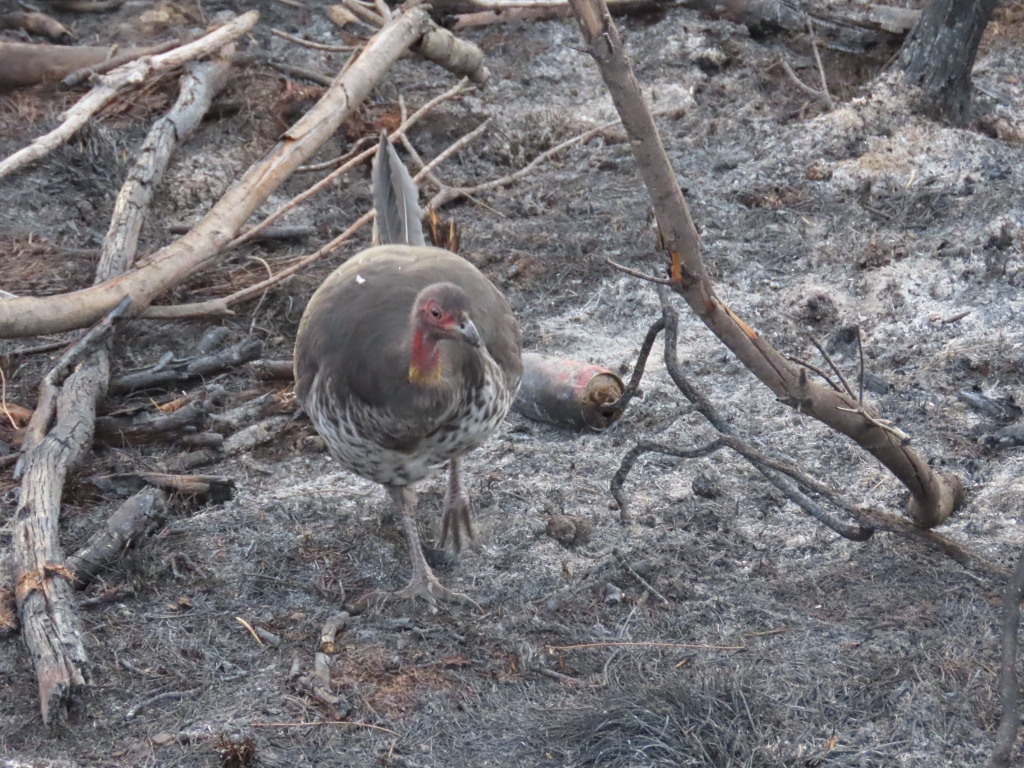
An Australian Brush-turkey wanders over the ashes, looking for pickings. A discarded can echoes the bird’s colouring:
Nearby, Australian Ravens look for insects and other goodies:

A Currawong keeps a watchful eye over the proceedings:

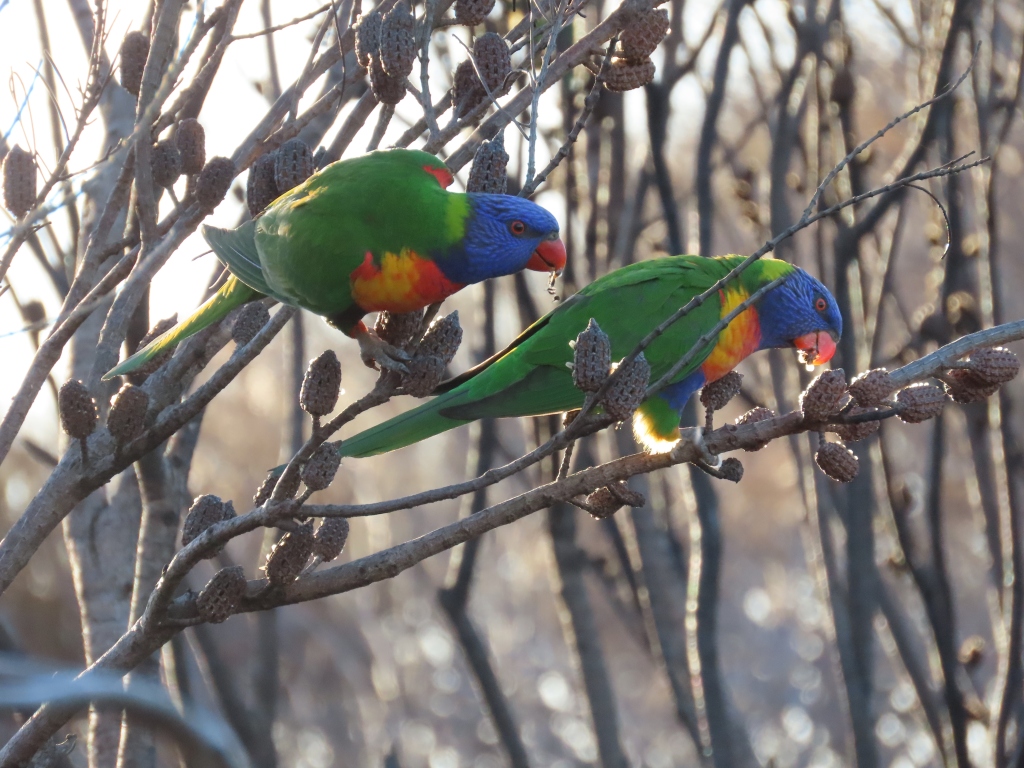
A Rainbow Lorikeet adds a splash of colour, hoping to snag a Casuarina seed or two:
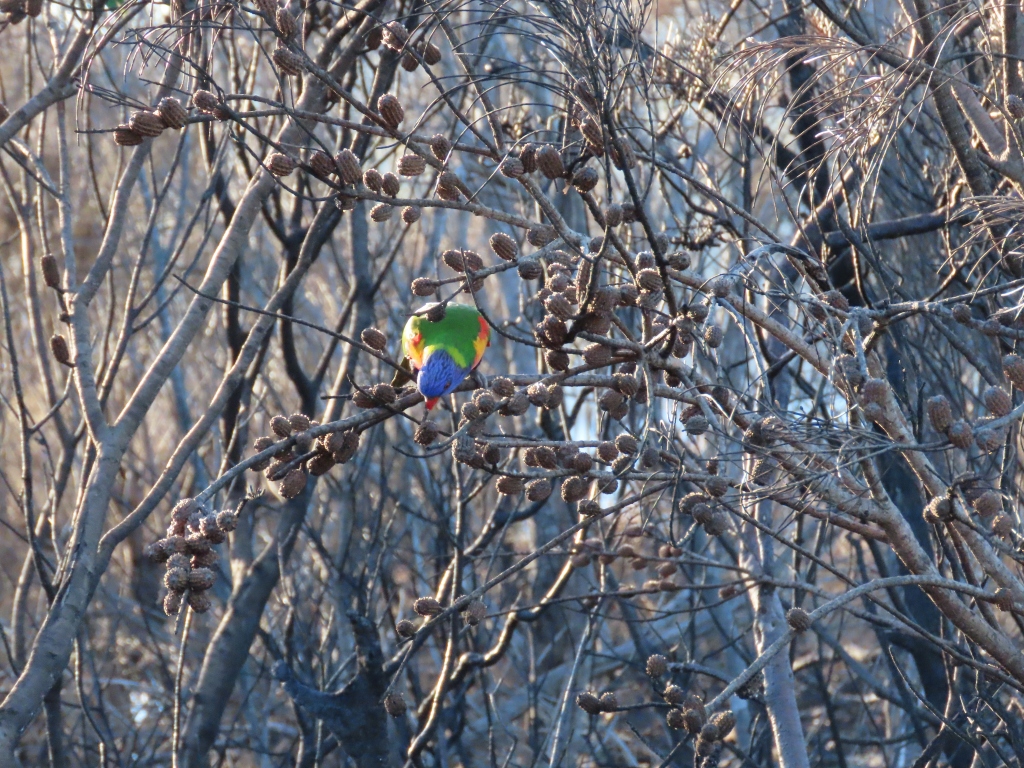
It’s much easier to grab a seed now that the fire has dried out the seedpods!
A week later, a Swamp Wallaby shared the browns and greys of the burned area too:
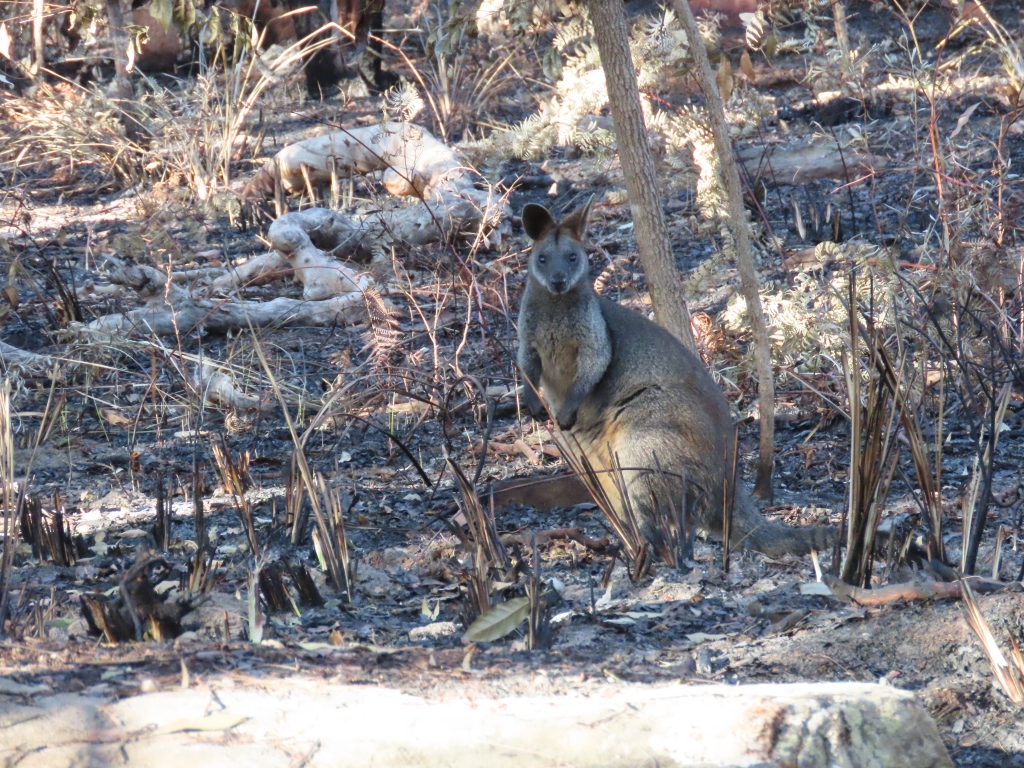
Here’s a video of the wallaby. At one stage, a plane flies overhead and a group of birds squawk loudly. The wallaby looks at me, checking whether I’m the cause of the disturbance, then goes calmly about its business:
To close, here’s a restful scene of the post-fire forest in the early morning light:

Date spotted: Early June, 2023
Location: Dobroyd Head, Sydney Harbour, NSW, Australia; between this point and this point on the map.


 Sydney Birder