Category Archives: Parrot
Local group of Glossy Black-Cockatoos now six strong!
Every now and then over the last few years, I’ve seen a group of Glossy Black-Cockatoos on the banks of Manly Dam. They have a few favourite spots, always where the Casuarina trees are in seed.
For the first couple of years, there were always three birds in the group. I don’t know if they were the same birds each time. Then suddenly there were five. And yesterday, for the first time, there were six. Glossies are rare compared to the other types of cockatoos in our area (Sulphur-crested, Yellow-tailed Black, and Corellas), so it’s wonderful to see this group growing in size.
Yesterday was a muggy, grey day. My camera kept misting up due to the high humidity. Every now and then the mist turned to light, drifting rain that settled into blotches on the lens. Still, the video gives you and idea of the gentle, calm presence of these large birds.
Glossies are a type of parrot. In Australia we have 56 species of parrots, including cockatoos, lorikeets, rosellas, ringnecks and budgerigars. Check out my previous sightings of Glossy Black-Cockatoos.
Common name: Glossy Black-Cockatoo
Scientific name: Calyptorhynchus lathami
Approximate length: 50cm
Date spotted: 19 March 2026 (autumn)
Location: Manly Dam Park, near Sydney: 33°46’23.8″S 151°14’39.5″E

Red-rumped Parrots in Merriwa and Denman
Recently, I spent a couple of days in the area around Denman and Merriwa, New South Wales. The bird life there is abundant, with some birds that we don’t see in my area (the eastern coast near Sydney). Among those are Red-rumped Parrots. This is my second sighting of these birds, and this week I was lucky enough to see three groups of them.
My first sighting was in Denman, in the early morning when the lighting was too dim for good photographs. I’ve posted just one photograph, because it’s my only shot of a female Red-rumped Parrot:

In Merriwa, the birds were busy in the middle of the day, when the lighting was much brighter. First, a video of a male bird foraging amongst the grass stalks:
Here’s a still photo of the same male bird:

Red-rumped Parrots get their name from the red patch on their backs, near the base of the tail. This photo shows the red rump nicely:
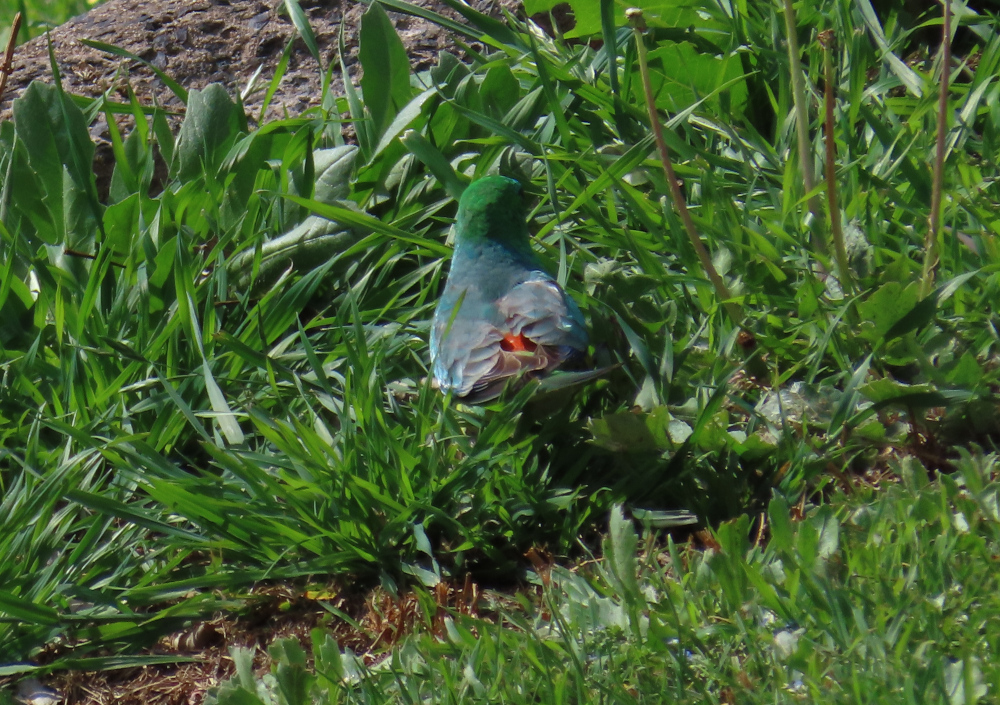
These little parrots are small and hard to spot when they’re on the ground. Often, all that you see is an eye looking at you:

Common name: Red-rumped Parrot
Scientific name: Psephotus haematonotus
Approximate length: 26-28 cm
Date spotted: 12 September 2025 (spring)
Location: Merriwa, New South Wales, Australia: 32°08’18.7″S 150°20’58.8″E

Crimson Rosella looking gorgeous
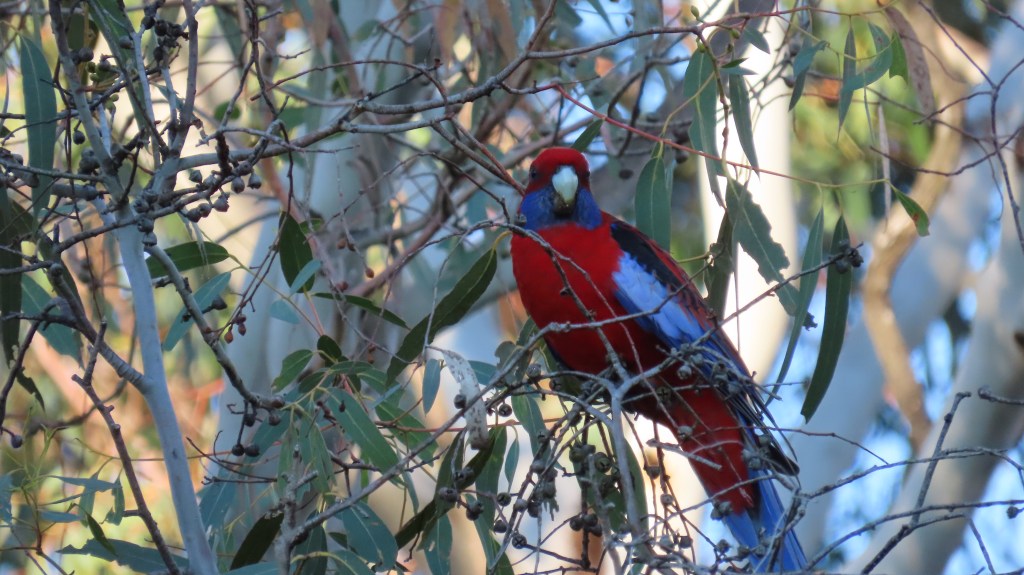
This stunning Crimson Rosella was browsing on the seeds of a gum tree late one afternoon. We were at the Macquarie Woods Forestry Reserve Campground, to the west of the Blue Mountains in New South Wales. These parrots are quite common in eastern Australia. Even so, their beauty is always amazing.
This bird is a male, with his purple and crimson colouring. The females have more green on their bodies and wings, like the one I saw a few months ago in Whitfield, Victoria.
Common name: Crimson Rosella
Scientific name: Platycercus elegans elegans
Approximate length: 35 cm
Date spotted: 16 May 2025 (autumn)
Location: Macquarie Woods Forestry Reserve Campground, Vittoria, NSW, Australia: 33°24’29.0″S 149°18’41.8″E

Little Corella enjoying a snack
This Little Corella was one of a group enjoying a tasty snack (fruit from a nearby fir tree of some kind):
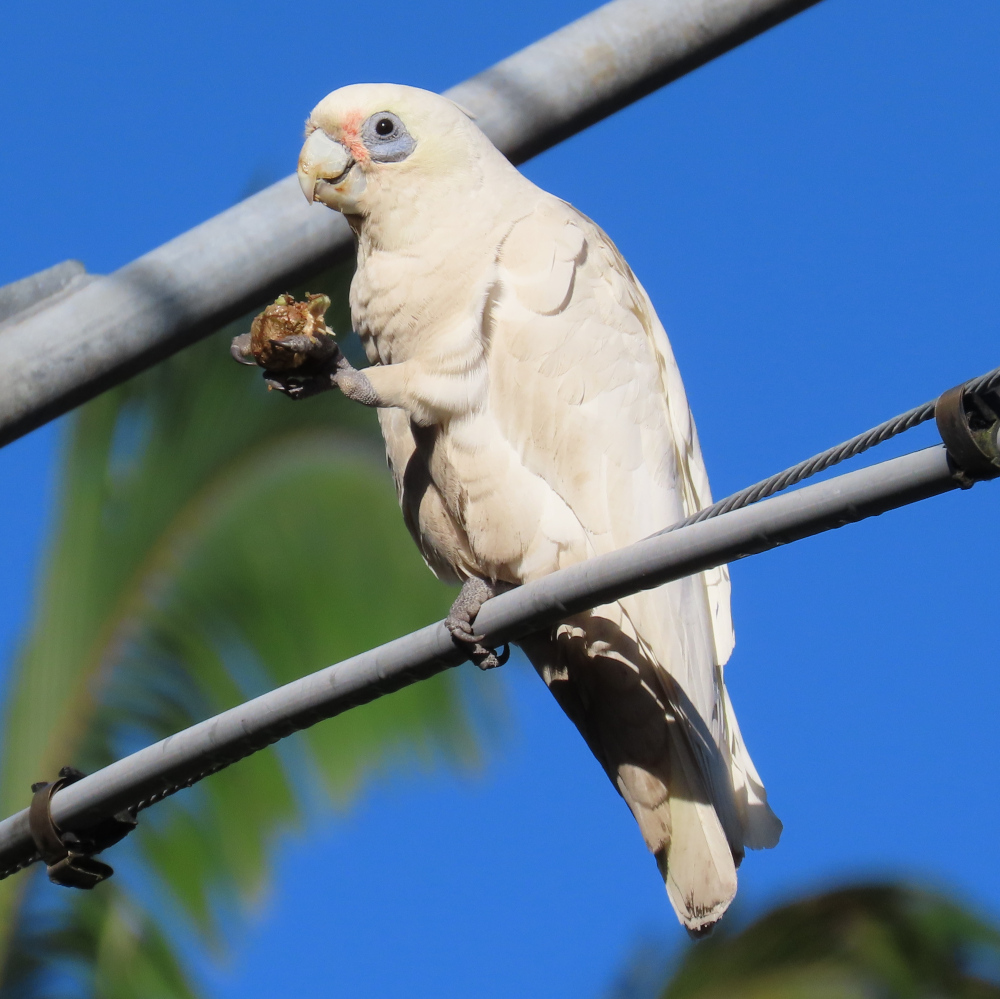
People have a love-hate with these birds. On the one hand, corellas are cute, pretty, and smart. On the other hand, they’re noisy and fiendishly good at destroying property!
Common name: Little Corella
Scientific name: Cacatua sanguinea
Approximate length: 36-39 cm
Date spotted: 22 April 2025 (autumn)
Location: Balgowlah, New South Wales, Australia: 33°47’57.2″S 151°15’50.9″E

Beautiful female Crimson Rosella
In my recent travels in the Victorian High Country, I came across a gorgeous female Crimson Rosella. She was a little coy. It was great to see her looking so colourful and smart, as the females often look a little dowdy in comparison to the males.

It was interesting to see the greyish colour around her eye, where my bird book shows a continuation of the yellow-green of the head and back.
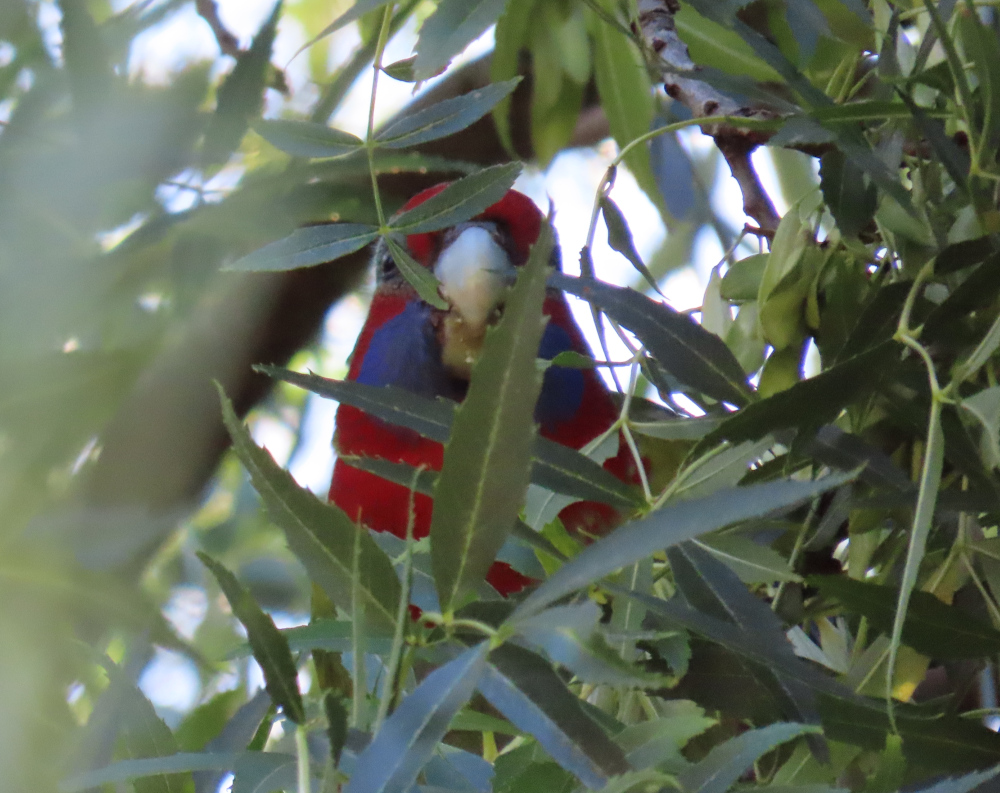
The next morning, I saw another female which might or might not have been the same bird. An early morning stretch shows off her gorgeous plumage:

Nibbling a bit of breakfast:
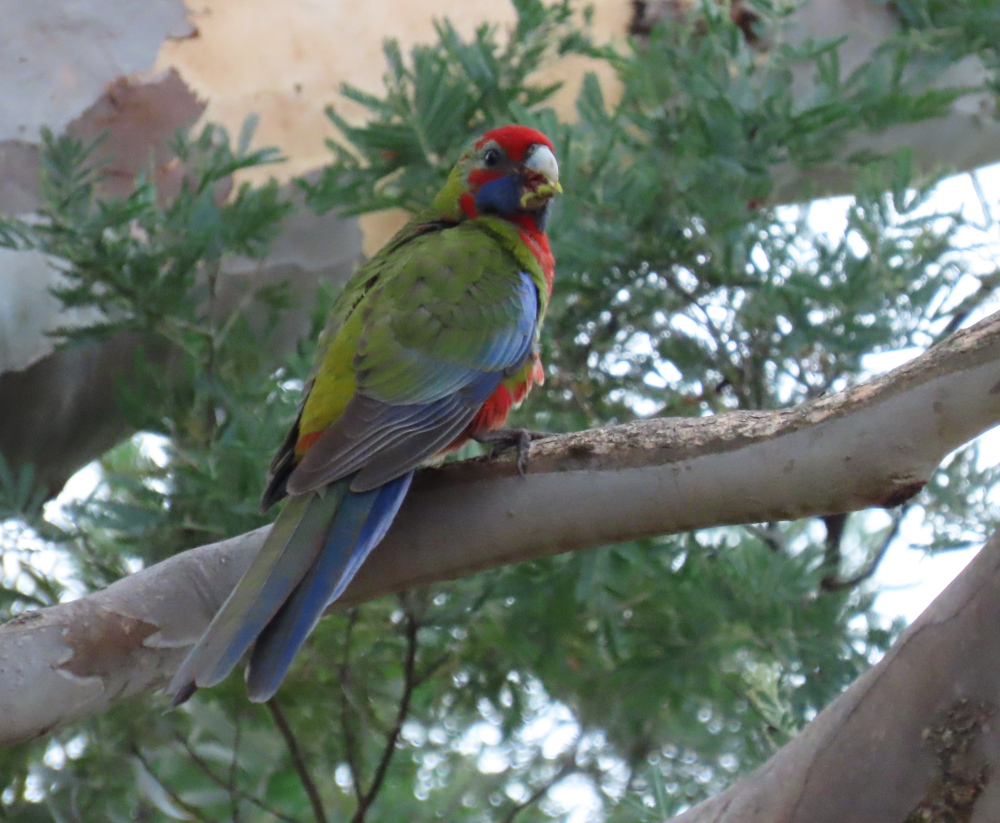
Common name: Crimson Rosella
Scientific name: Platycercus elegans elegans
Approximate length: 35 cm
Date spotted: 17-18 February 2025 (summer)
Location: Whitfield, Victoria, Australia: 36°45’43.2″S 146°24’53.4″E

King Parrots amongst Grevillea flowers
On a recent walk in the bush, I came across a pair of King Parrots. In this video, the female bird feeds amongst the white flowers of a Grevillea bush:
In the background of the video, you can hear two types of cuckoos that have arrived in the area for the summer. First an Eastern Koel, then the raucous hoots of a Channel-billed Cuckoo. Just before the parrot flies off, a Peewee (Mud-lark) shrieks in the distance too.
King Parrots are fairly large parrots, most often seen in pairs. The female has a green chest and neck:
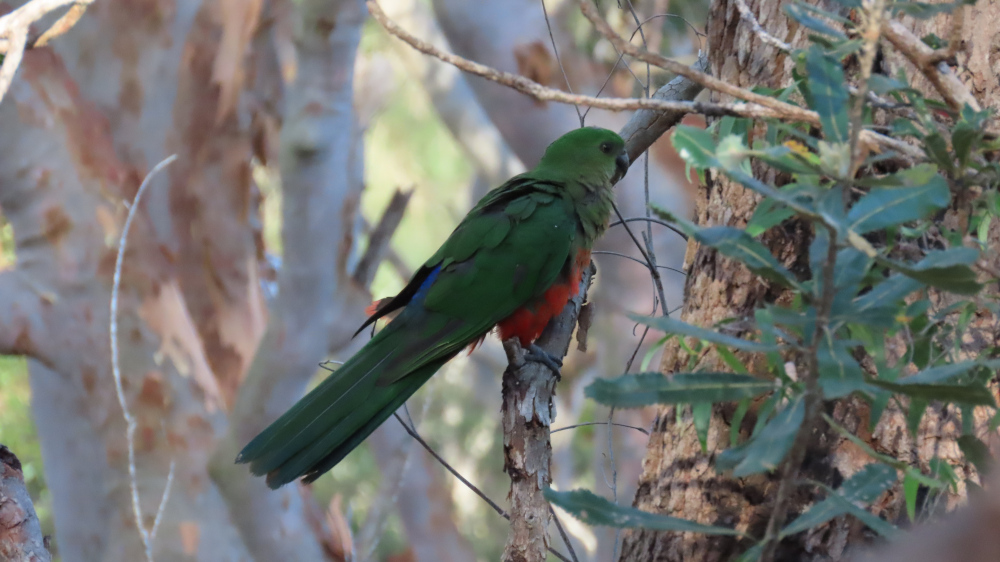
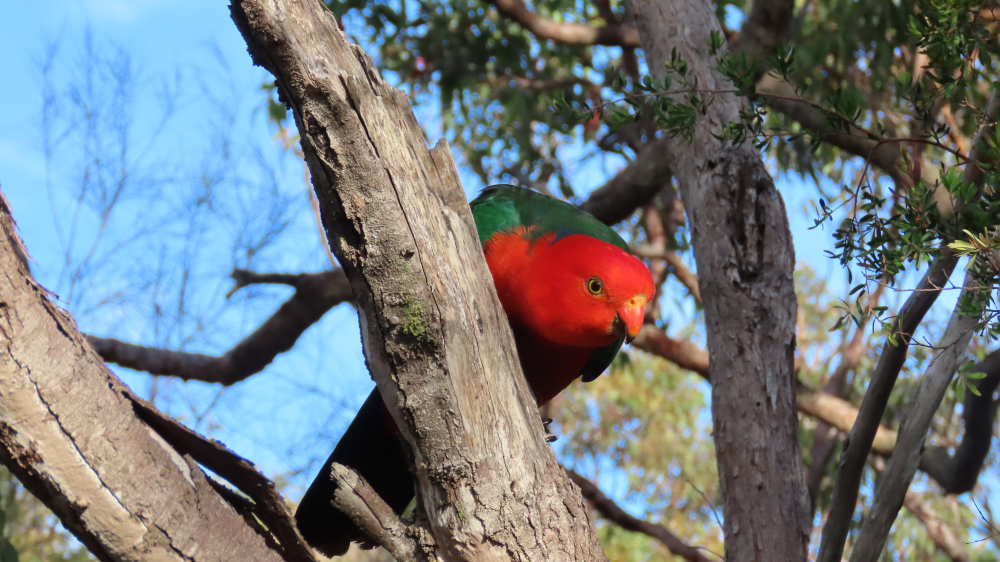
The male’s body and head are bright red. In fact, the male and female look so different that for a while, people thought they belonged to different species:

Here’s the male again, peering cheekily at the camera:
Common name: Australian King Parrot
Scientific name: Alisterus scapularis
Approximate length: 44 cm
Date spotted: 21 November 2024 (spring)
Location: Manly Dam reserve, New South Wales, Australia: 33°46’40.6″S 151°14’50.1″E
Cockatoos on a shed roof
A gang of Sulphur-crested Cockatoos dropped by to examine our shed roof and munch some grass seeds. One of the birds rather liked the noise the roof made when he jumped on it. Another bird is rather mucky, with brownish feathers. Perhaps he’s been dumpster diving? It’s interesting watching the interaction between the birds as they share a spray of grass flowers.

Bird on a wire – Eastern Rosella
Eastern Rosellas are medium-sized parrots, found on the east coast of Australia. We’re lucky enough to be visited regularly by a pair of them. I don’t know if it’s the same two birds each time, or if our phone line is somehow part of the flight lines for a family of birds.
In this video, the male Eastern Rosella struts along a phone line, spiffy in his breeding colours. Alas, the background sound is noisy, but you can just hear the bird chirping as he does his little hello dance:
The next picture is somewhat whimsical. It’s what my camera made up when the bird flew off. I love the colours and motion in this picture, even if the bird’s head is off camera:

The female glowed in the sunlight:

The male’s colours are brighter, with the divisions between the coloured sections more clearly defined. Deep blue and black scallops outline the wings, while the rest of the bird is yellow and black, and red and white:
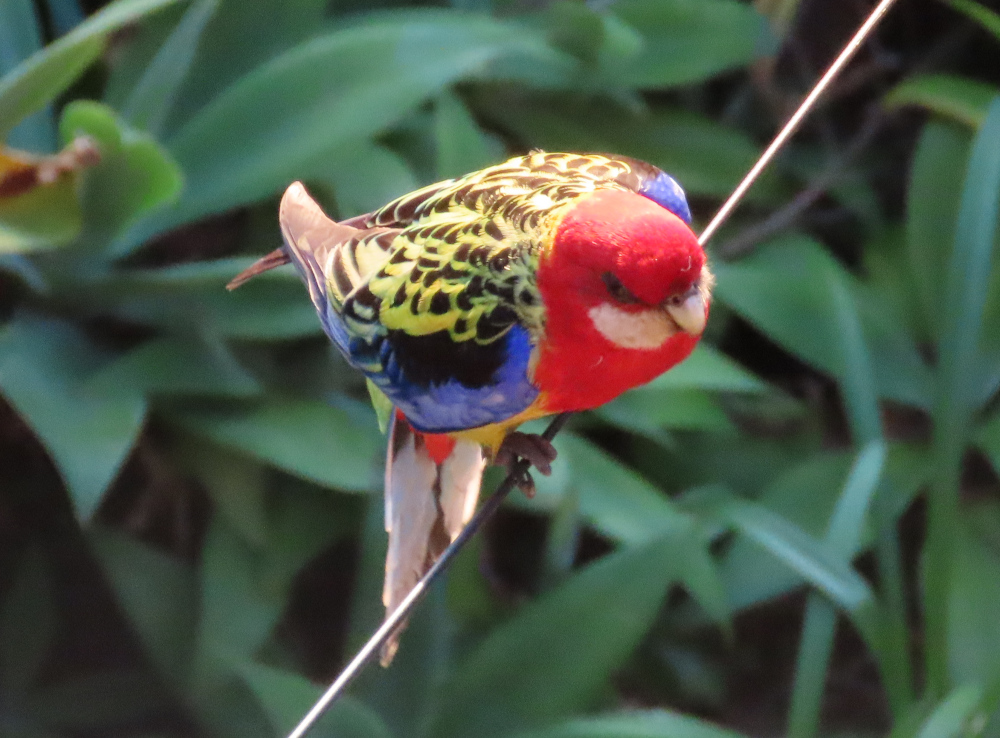
He knows he’s gorgeous!
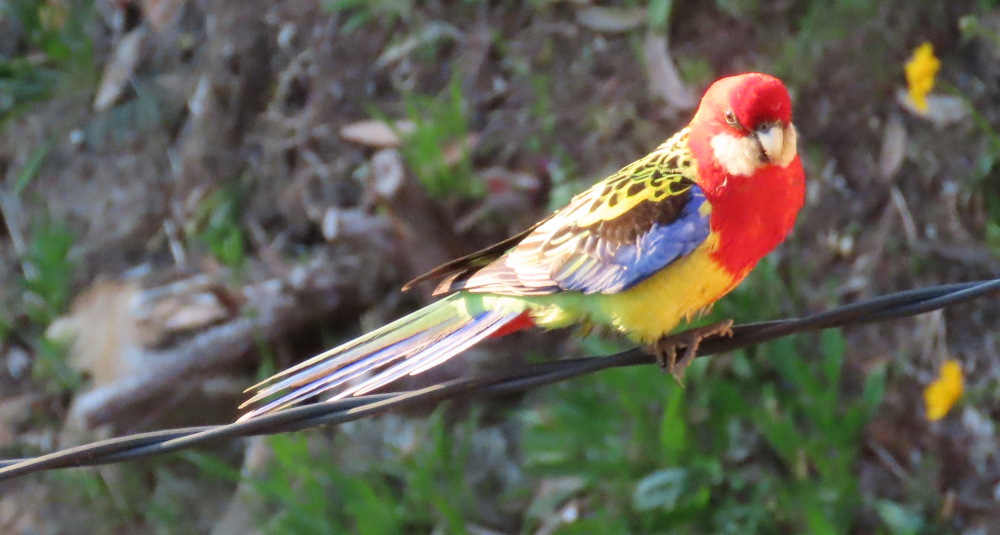
Common name: Eastern Rosella
Scientific name: Platycercus eximius
Approximate length: 30 cm
Date spotted: 28 October 2024 (spring)
Location: Allambie Heights, NSW, Australia

Mmm, Mountain Devil flowers make a nice change from those tough Banksia pods!
A Yellow-tailed Black-cockatoo contemplates life while demolishing the flower of a Mountain Devil bush.
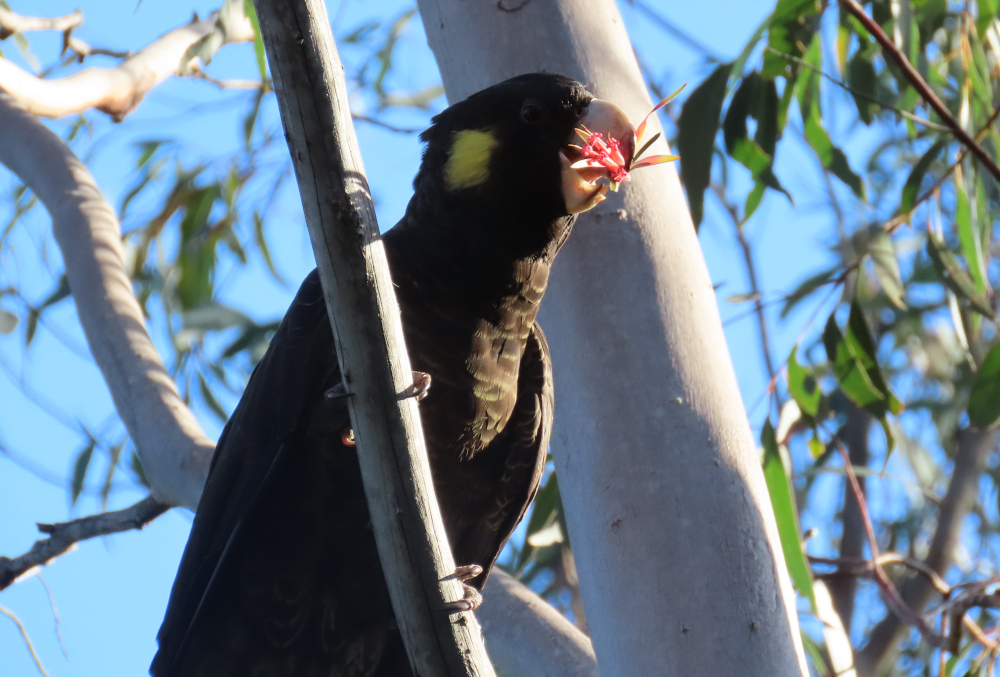
Common name: Yellow-tailed Black Cockatoo
Scientific name: Calyptorhynchus funereus or Zanda funereus
Length: 58-65 cm
Date spotted: 26 October 2024 (spring)
Location: Manly Dam Reserve, New South Wales, Australia: 33°46’40.0″S 151°14’50.2″E

The tranquil parrot: Glossy-black Cockatoos
Of all the various types of cockatoos that we get in our area of Australia, the Glossy-blacks are by far the most restful to be with. When they chatter to each other, their call is a restful croon. They seem to take life easy, with few sudden moves. Watch this one going with the flow while the wind tosses her perch back and forth:
Casuarina seeds are just about the only food that Glossy-black Cockatoos eat. I usually find the birds by the comfortable munching noises that they make, rather than the noisy fuss that other types of cockatoos are fond of making!

This family of three birds has been visiting the Casuarina trees beside one of my current favourite bush walks.

I took these pictures over the period of a week.
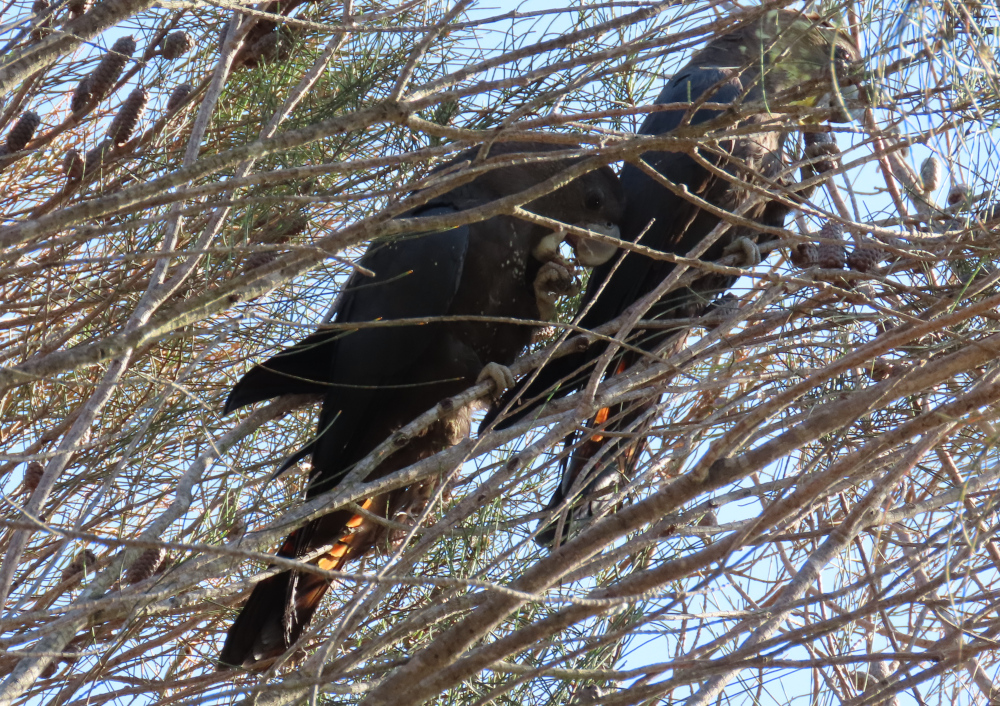
It’s interesting that I almost always see these birds in groups of three, most likely an adult male and female, and a juvenile. The bird with yellow around her head is the female of the group. I think this one is the adult male:
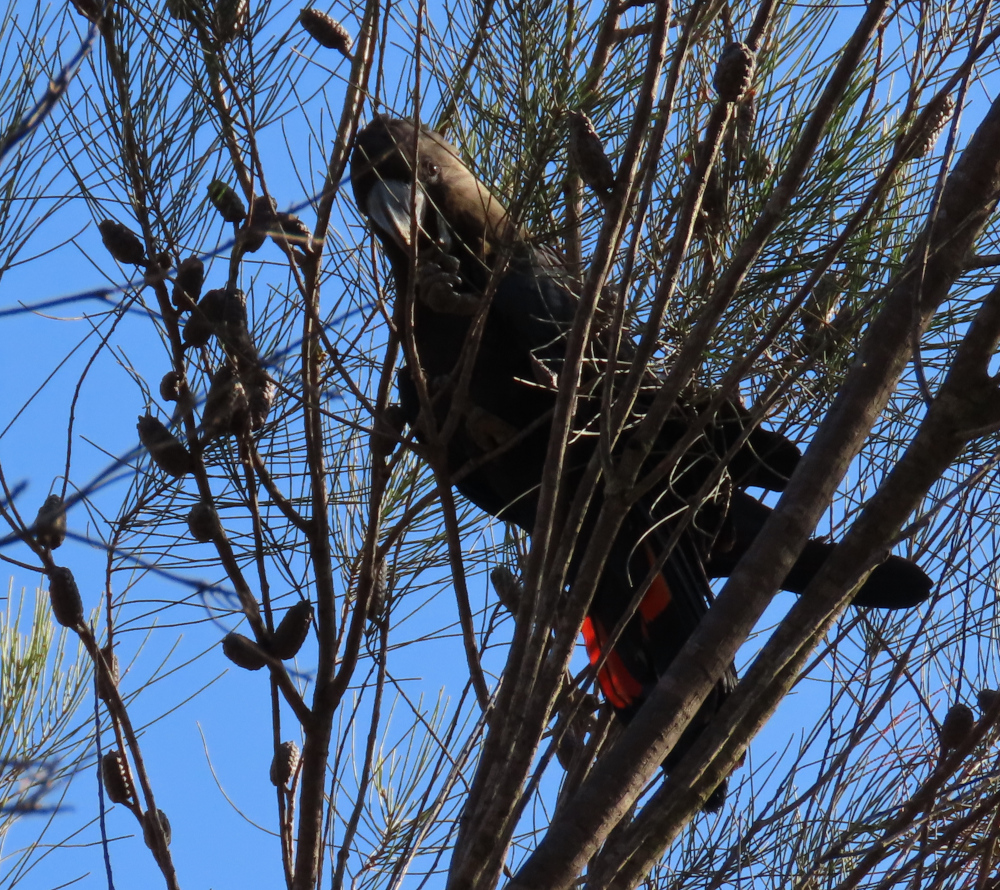
Check out some previous sightings of these gorgeous birds.
Common name: Glossy Black-Cockatoo
Scientific name: Calyptorhynchus lathami
Approximate length: 50cm
Date spotted: 23-27 September 2024 (spring)
Location: Manly Dam Park, near Sydney: 33°46’16.4″S 151°14’30.9″E


 Sydney Birder