Category Archives: nest

Mudlarks building nest of mud
A few weeks ago, I watched a pair of Mudlarks building their nest. Mudlarks get their name from their construction of nests made of mud and reeds. Despite their name, Mudlarks are not larks. Another name for them is Magpie-larks — but they’re not Magpies either! Yet another name for them is Peewees, which is an imitation of the noise they make: pee-wee, pee-wee.
Building a good nest takes a lot of patience and skill. The birds use their beaks to pile globules of mud on top of each other to form a bowl, increasing the circumference of the bowl with each layer. Every now and then, the birds sit in the growing nest and wiggle their bodies around to smooth out the inside and make sure the nest is the right size and shape. Watch this video to see the nest-building:
The birds collect mud and reeds from a nearby river or lake. Here’s a pair of them (male and female) collecting reeds at Manly Dam in NSW, Australia:
Here’s the female sitting in the nest, making sure it’s the right size and shape:

Here’s a still shot of the male gathering mud and reeds:
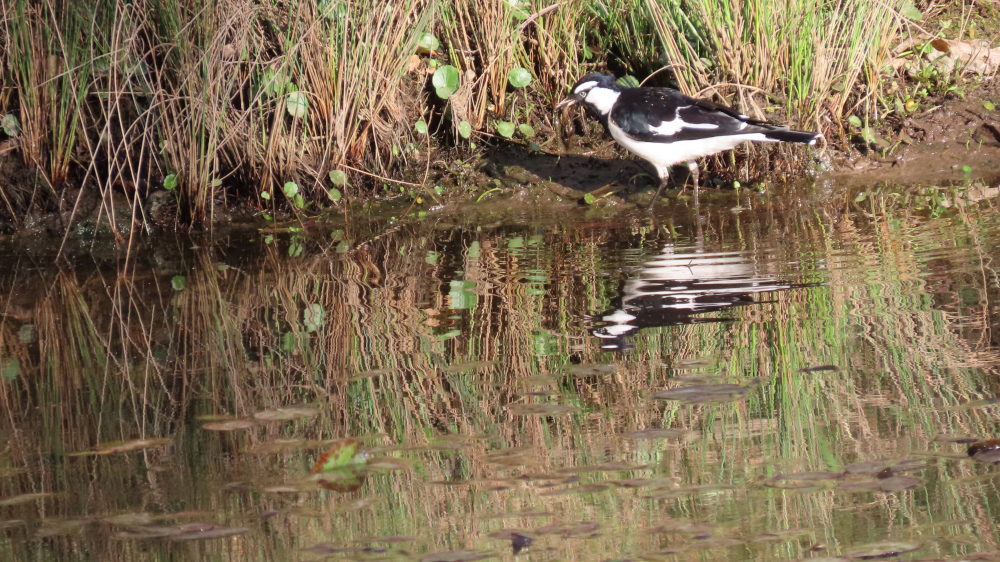
Common name: Magpie-lark, also called a Peewee or a Mudlark
Scientific name: Grallina cyanoleuca
Approximate length: 30 cm
Date spotted: 18 September 2025 (spring)
Location: Manly Dam National Park, New South Wales, Australia

Brush-turkey mound: I think she likes it!
Here’s a male Australian Brush-turkey showing a lady around his mound. The male is the one in front, with the bright yellow pouch dangling around his neck:

This particular Brush-turkey has been perfecting his mound for weeks. It’s good to see he’s getting some interest. Both birds are looking smart in their spring plumage.
This second picture is for scale, to show the size of the mound relative to some tree trunks and a fire gate:

The male builds and maintains the mound and invites a female to it. If she’s impressed, the female consents to mate with him and then lays her eggs in the mound. The eggs incubate and hatch without help, and the chicks emerge ready to take on the world.
Common name: Australian Brush-turkey
Scientific name: Alectura lathami
Approximate length: 60-70 cm
Date spotted: 23 September 2025 (spring)
Location: Manly Dam, New South Wales, Australia: 33°46’55.5″S 151°15’09.6″E

Alas, butcherbirds nest abandoned when tree fern sprouted
In my previous post, I wrote about a pair of Grey Butcherbirds that had built their nest in a tree fern below our house. The problem with tree ferns is that they sprout new fronds from the centre of the trunk, exactly where the birds had built their nest.
The photos of the nest in my earlier post were taken on the 18th of September. Just a few days later, the tree fern did indeed sprout a new frond, putting the nest at an uncomfortable angle. Still, the butcherbirds persevered. This photo, taken on the 25th of September shows one of the birds sitting determinedly on a very slanted nest, which presumably still contained the three eggs:
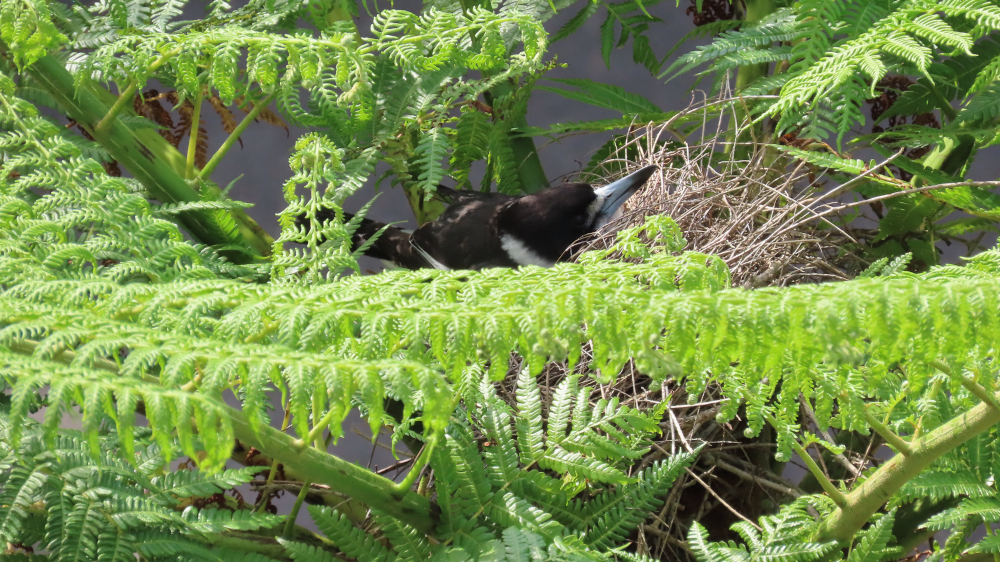
Just a day later, the birds had abandoned the nest. I don’t know if the eggs were still in the nest. The tree fern is way too high for me to go up and take a look:

By yesterday, the 5th of October, the new fern frond had pushed the nest to the top of the canopy:

Never mind little butcherbirds, there’s still plenty of time left this season to try again. Or next year perhaps.
Perhaps they’ll have learned something about real estate from this experience. Grey Butcherbirds live for around 20 years, so there’s plenty of time for learning!
Common name: Grey Butcherbird
Scientific name: Cracticus torquatus
Approximate length: 30 cm
Date spotted: 18 September to 5 October 2025 (spring)
Location: Allambie Heights, NSW, Australia

Butcherbird nest in tree fern – hope it survives
A pair of Grey Butcherbirds have built their nest in a tree fern below our house. The problem with tree ferns is that they sprout new fronds from the centre of the trunk, exactly where the nest is now. And these are big fronds! I hope the butcherbirds manage to hatch the eggs and raise their young before the next sprouting happens.
Here’s the nest with a butcherbird sitting on the eggs:

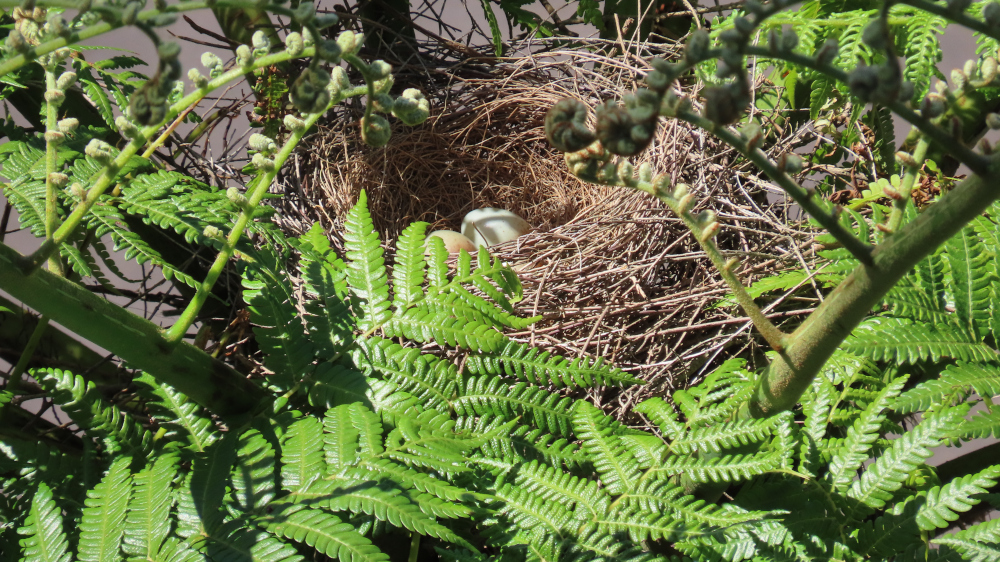
There are at least two eggs, maybe three, in the nest. Here’s a shot taken when the nest was briefly unattended:
Here’s another shot of the bird on the nest, not as closely zoomed in:

This is the tree fern, as seen from my window without zooming in:

It’s interesting to see that inexperienced avian parents can make mistakes about where to place their nests. A while ago, a Red Wattlebird nest appeared in a similar tree fern in another area of our garden. Alas, that nest was very soon skewed and then skewered by a new frond, and had to be abandoned. However, a family of Noisy Miners was more successful.
Grey Butcherbirds incubate the eggs for about 25 days, and the fledgelings leave the nest after about four weeks. Evidently Grey Butcherbirds live around 20 years. That’s a long time, and gives them plenty of time to learn about the best place to build their homes.
Good luck, little butcherbirds!
Common name: Grey Butcherbird
Scientific name: Cracticus torquatus
Approximate length: 30 cm
Date spotted: 18 September 2025 (spring)
Location: Allambie Heights, NSW, Australia

Longest nest-sitting ever: Black Swans abandon nest after 8 months (part 2 of story)
Over the past 8 months, two Black Swans have been diligently tending a nest in Manly Dam Park, in Sydney’s Northern Beaches. In the early days (August 2024), spring was in the air. Nature was blooming and the swans were devoted and diligent. As spring turned to summer, the heat bore down. Cicadas shrieked, reeds grew up and died down again. Still, the pair tended the nest, rebuilding regularly, looking after each other, and clearing the water around their nest. (Story of two nesting Black Swans: Part 1)
Yesterday (9 April 2025), for the first time, the nest was empty when I walked past. The nest is the large circle of brown reeds lying horizontal behind the green reeds:

A hundred metres away, one of the swans was drifting on the water, hooting quietly and persistently:
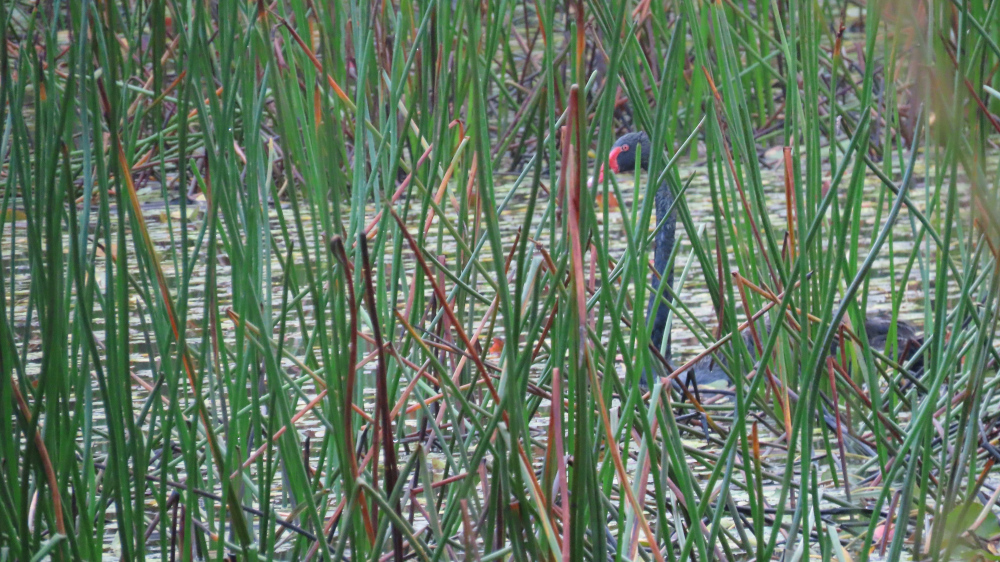
Once or twice I heard the other swan replying from deep in the reeds, but I didn’t see it.
At my previous visit a week ago, the swans had moved their nest to a slightly different location, just ten metres or so away from the original location. I wondered if this meant that at last, there was hope for an egg or two. Who knows, perhaps the pair will proudly emerge with a train of cygnets to show. Alas, though, I doubt that there were ever any eggs in the nest. From a discussion on Reddit, it seems that the most likely explanation is that the swans are two males, practising nest-building and nest-sitting in the absence of a female to lay an egg.
Here’s a photo from October 2024, showing both swans at the nest:

Here’s one of the swans in early February 2025, off shift for a moment while its partner sits on the nest:
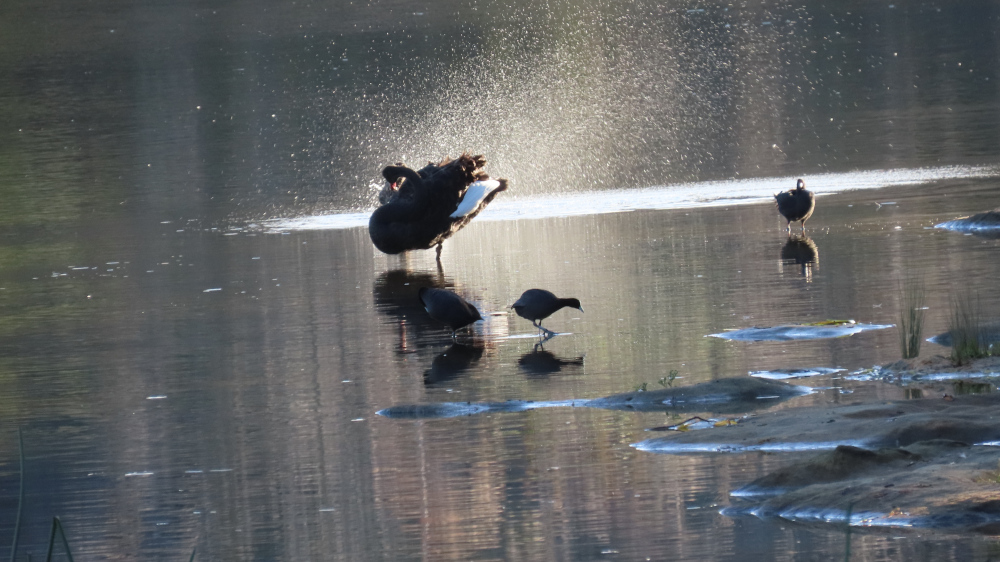
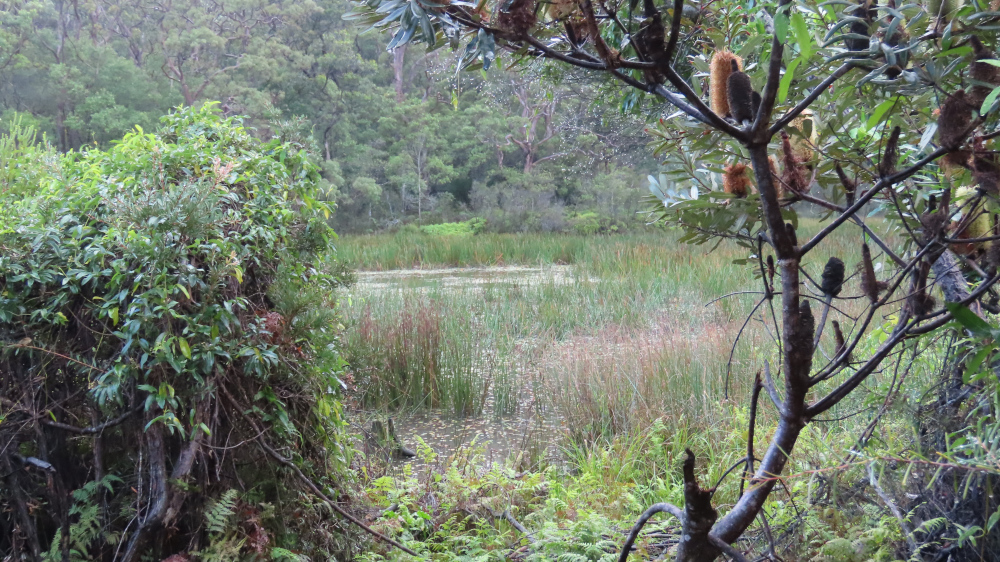
This is the tranquil site of the nest, now empty, but ready perhaps for a new attempt come spring:
Common name: Black Swan
Scientific name: Cygnus atratus
Approximate length: 120 cm
Date spotted: 23 August through to 9 April 2025 (late winter, through spring and summer, into autumn)
Approximate location: Manly Dam Park, New South Wales, Australia

Termites and kookaburras
Termites are very active in our area of the world at the moment: the east coast of Australia just north of Sydney. When walking along a road that passes through a park area, it’s common to see low mud tunnels crossing the road. Termites build these tunnels to shelter in when they’re on their travels. Recently, I’ve also seen long trains of termites venturing out without any cover at all.
Here’s a stream of termites crossing the road. They’ve even built themselves a junction so that they can head off in different directions:
Termites’ mud tunnels often go up the outside of a tree:
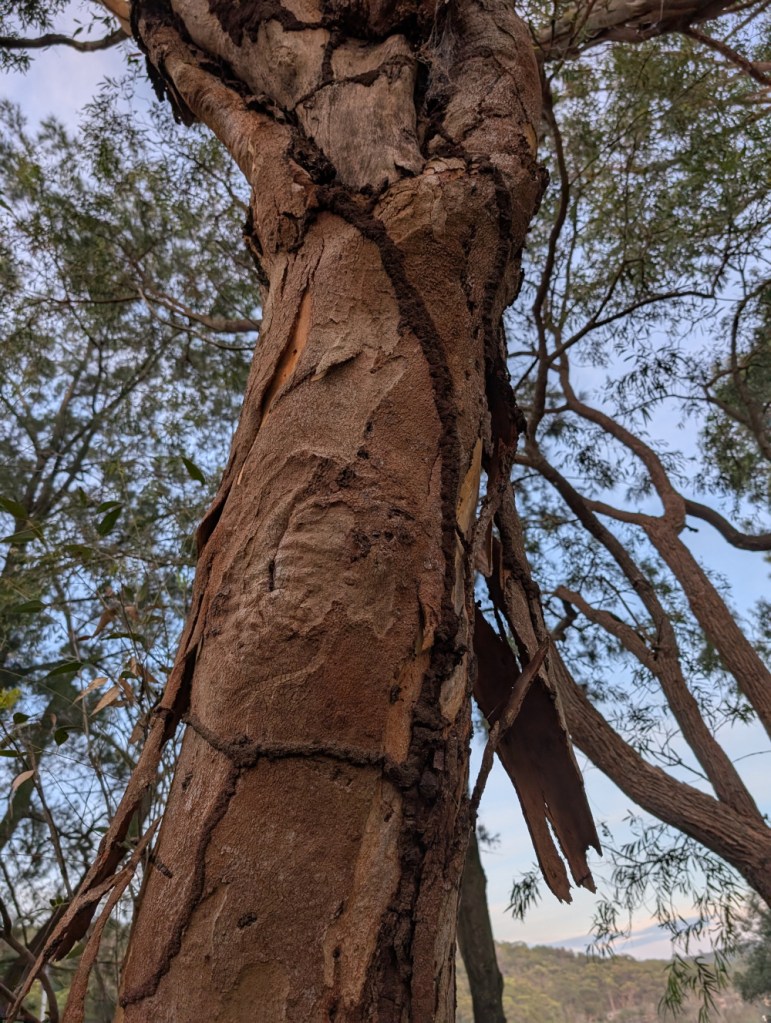
The termites in this part of Australia build their nests as large mud mounds, stuck high up in a tree:

Termite nests make a handy home for monitor lizards, kookaburras, kingfishers, and other creatures. In an earlier post, I showed pictures of a termite nest that had been adopted by kookaburras as a home for their young family: Baby kookaburras out of their nest.
In the next video, two young kookaburras attack the side of a termite nest, slowly digging a hole in the nest. They’re probably thinking ahead to the next breeding season, when such a home will come in useful:
In the video, you can hear the two kookaburras chattering, and other kookaburras giving the full laughing cackle in the background. There are also cicadas singing, and a butcherbird calls at one time too.
Common name: Laughing Kookaburra
Scientific name: Dacelo novaeguineae
Approximate length: 47 cm
Date spotted: 13 January 2025 (summer)
Location: Manly Dam near Sydney, New South Wales, Australia

Baby kookaburras out of nest
For the past month, I’ve been watching a termite nest that housed two Laughing Kookaburra chicks. The kookaburra parents had set up house in an old termite nest in a dead tree. The sound of the chicks crooning drew me to the tree on November 21st. The chicks were still very young, and it wasn’t possible to see them. But after waiting around a while, I did see the parents bringing food to the nest:
A month later, on December 20th, the chicks were right at the opening of the nest, peering out at the world. This photo shows one of the babies — you can see one eye clearly on the right, then the beak and white bib and the other eye on the left:

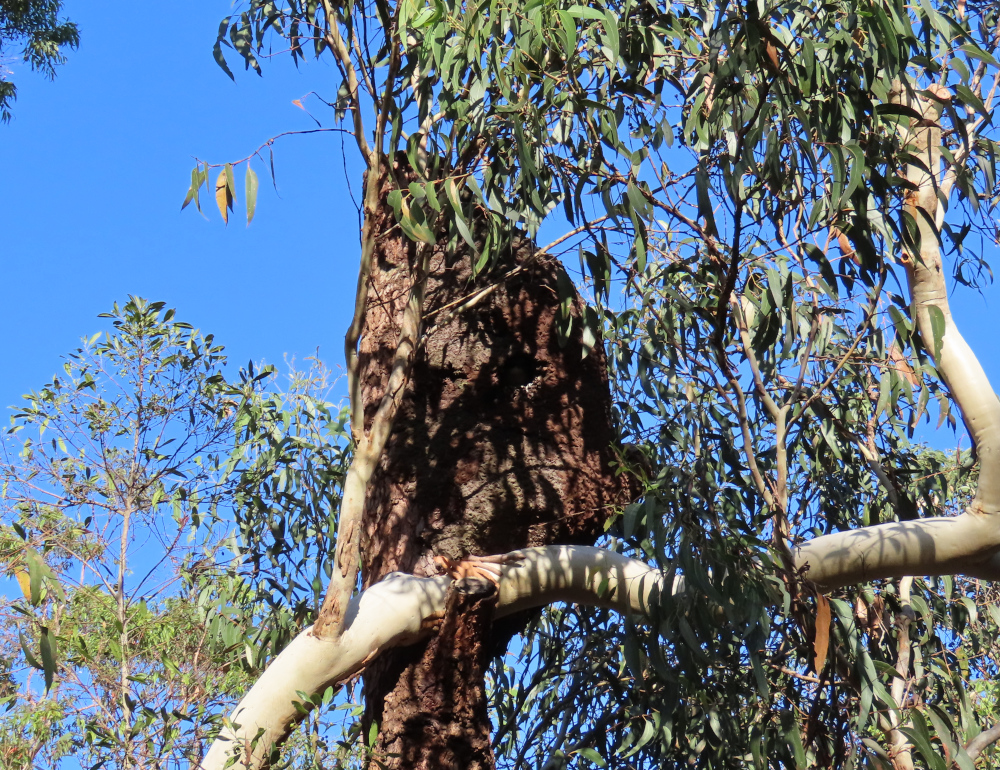
Here’s a view of the termite nest at the top of a dead tree. The nest projects from the top the right of the dead trunk, nicely protected by the branches of a living tree:
Here’s one of the parents with a morsel of food — a winged insect of some kind:

By my next visit, on December 23rd, the nest was empty. Both babies were out and about, calling and being fed by the adult birds.
One of the babies was on the ground when I got there, but soon managed to fly up onto a tree branch. The parents were nearby and attentive:
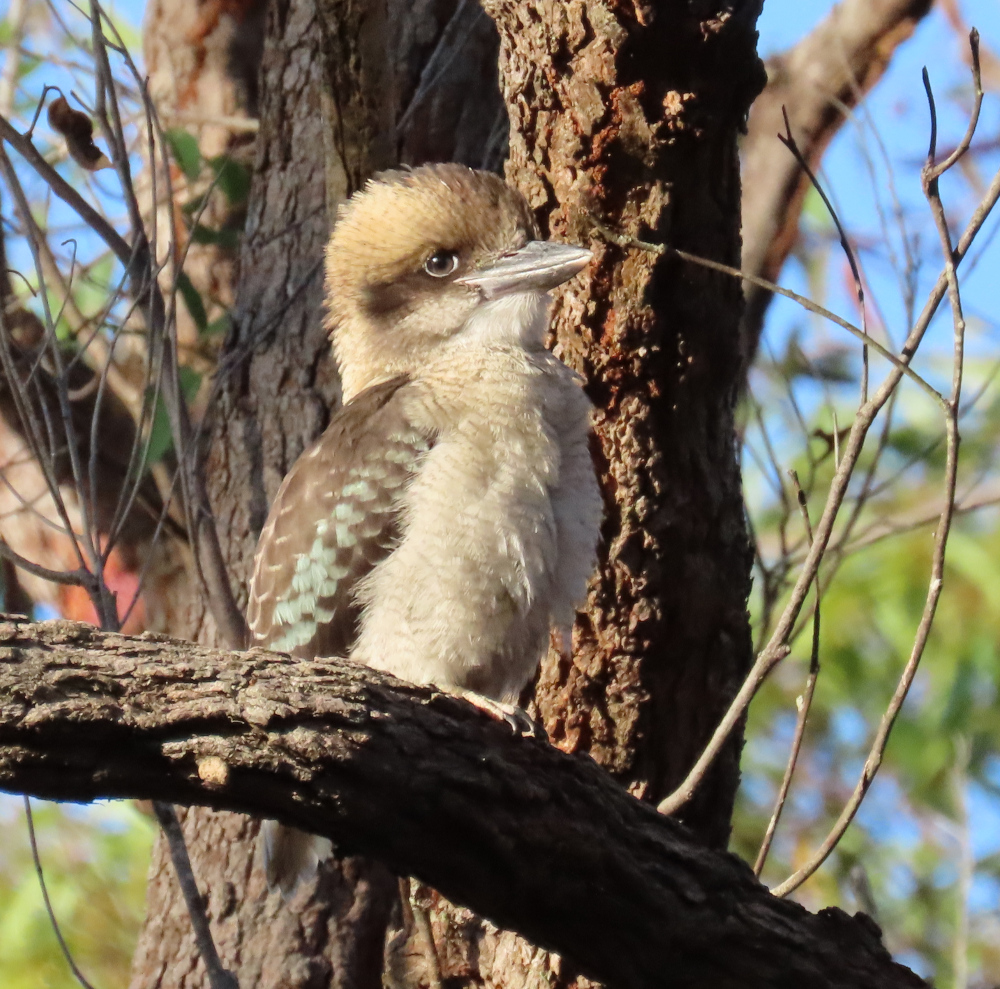
The youngsters are a bit smaller than the adults, and more fluffy. Their feathers aren’t yet fully developed, especially on the head and wings, and the tails are noticeably shorter.
The other youngster was on a nearby branch, also crooning:
This photo shows the youngster’s short tail:
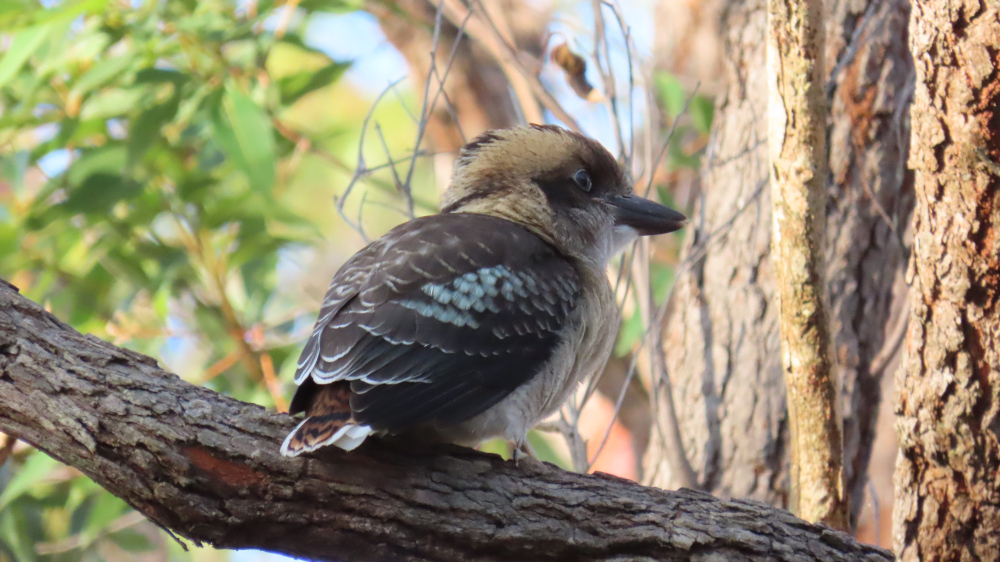
To close off, here’s the same youngster from another angle:
Common name: Laughing Kookaburra
Scientific name: Dacelo novaeguineae
Approximate length (adult): 47 cm
Date spotted: 21 November to 23 December 2024 (summer)
Location: Manly Dam near Sydney, New South Wales, Australia

Story of two nesting Black Swans: Part 1
This is part 1 of a story about a pair of nesting Black Swans. At this point, I’m concerned about the state of the swans’ eggs. I don’t know what part 2 will hold, but I do hope for a happy ending.
These two swans have been sitting on their nest since late August. I first saw them sitting on 23 August, and a park ranger told me that they’d been sitting for at least a few days by then. It’s now 9 December. That’s more than 15 weeks — more than 105 days.
The eggs of Black Swans usually hatch after 39-45 days.
This photo is from the first time that I saw the nest, on 23 August:
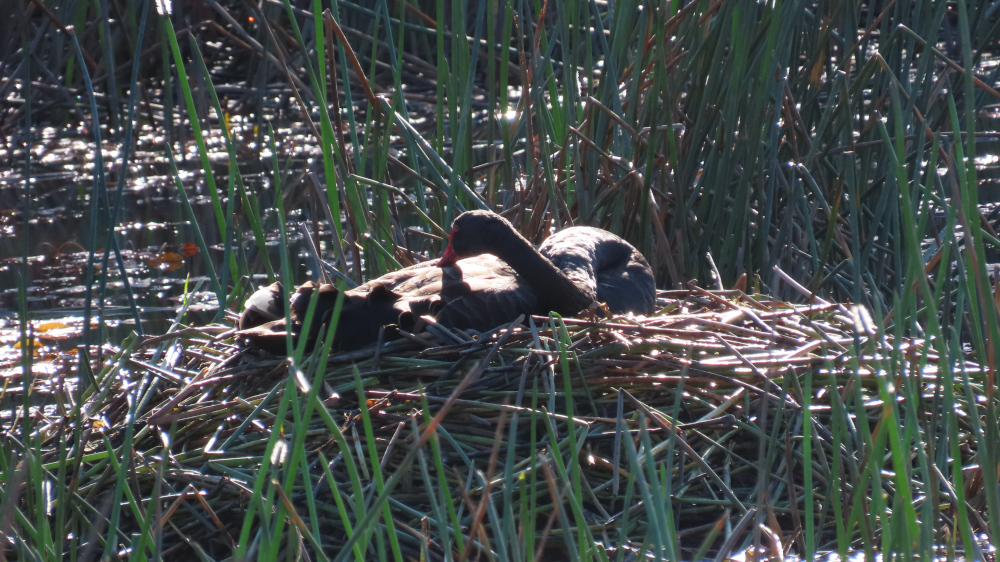
(Photo taken on 23 August 2024)
The swan’s nest is a large pile of reeds, positioned in shallow water in the middle of a large reed bed. It’s quite a distance from the shore on both sides, and well screened from entrance on the water too. From the shore, it’s not possible to see into the nest. I’m assuming there are eggs, because the swans are very diligent about sitting on the nest and occasionally it looks as if they gently prod the eggs with their beaks.
Here’s another photo from the early days:
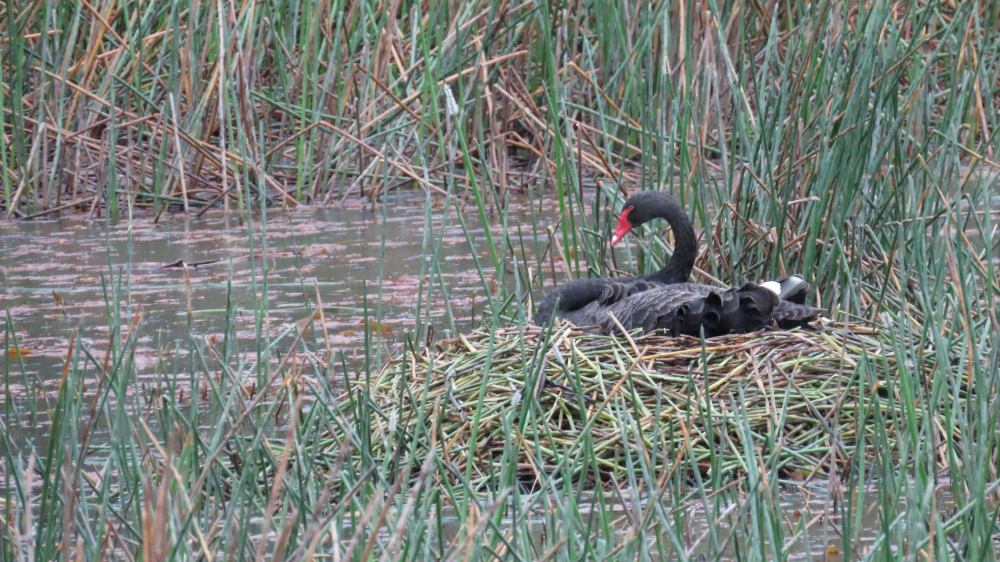
(Photo taken on 24 August 2024)
The setting is tranquil and pretty:
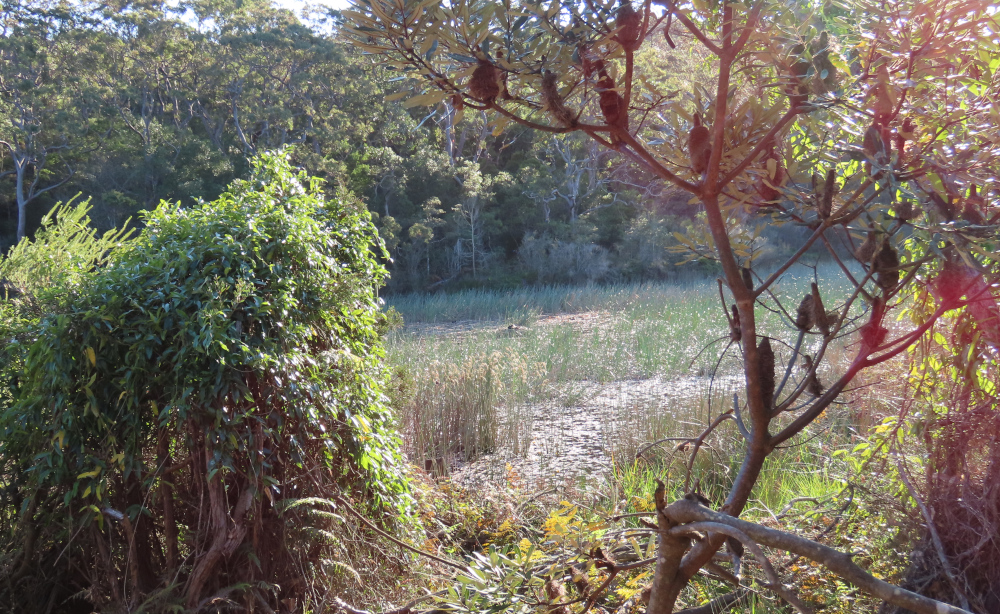
(Photo taken on 2 September 2024)
The nest is near a popular bush walking path, and I’ve walked past it every few days. When the first period of 45 days went by with no cygnets appearing, I thought maybe the parents had decided that their first batch of eggs was infertile and had started again.
But now the second period of 45 days is well and truly passed, and I’m worried.
Both the male and the female swan are still actively looking after the nest. I’ve seen each of them sitting on the nest alone, and occasionally both of them tending the nest together. The nest is never without one of the swans sitting or standing over it.

(Photo taken on 3 October 2024)
The male and female take turns to sit on the nest. The next video shows the changing of the guard. One bird has been sitting all night, the other has arrived for the morning shift. One of the birds grooms itself, and they both do a bit of nest maintenance. If you listen carefully, you can hear the swans’ soft hoots as they chat to each other:
(Video taken on 1 October 2024)
Every now and then, the swans spend quite some time and energy clearing the reeds around the nest and building up the nest:

(Photo taken on 3 October 2024)
Despite the nest’s seclusion, plenty of ducks, coots, and moorhens swim around the nest, keeping the swans company. Every now and then other visitors appear, like this kookaburra:

(Photo taken on 4 October 2024)
And this Eastern Water Dragon:

(Photo taken on 17 November 2024)
On 1 October, a beautiful light-coloured Grey Goshawk made an appearance near the nest, and was chased away by currawongs and cockatoos:

(Photo taken on 1 October 2024. I wrote another post about the goshawk.)
Here’s a nice video of one of the swans seating itself carefully on the nest:
(Video taken on 28 October 2024)
In more recent days, the site of the nest has become less tranquil. Cicadas have crept up from the earth to celebrate the summer full blast, as only cicadas can do. Sulphur-crested Cockatoos collect in the tree tops, high above the nest. The cockatoos squawk and yell, outdoing even the cicadas. It’s a very noisy environment for a nest, but at least it gives the parent swans some company. At this stage, they’d been sitting on the nest for more than 100 days:
(Video taken on 29 November 2024)
When it’s their turn for a break from sitting on the nest, one of the adults heads off to another part of the dam to stretch and feed. Here, a pelican keeps the off-duty swan company:
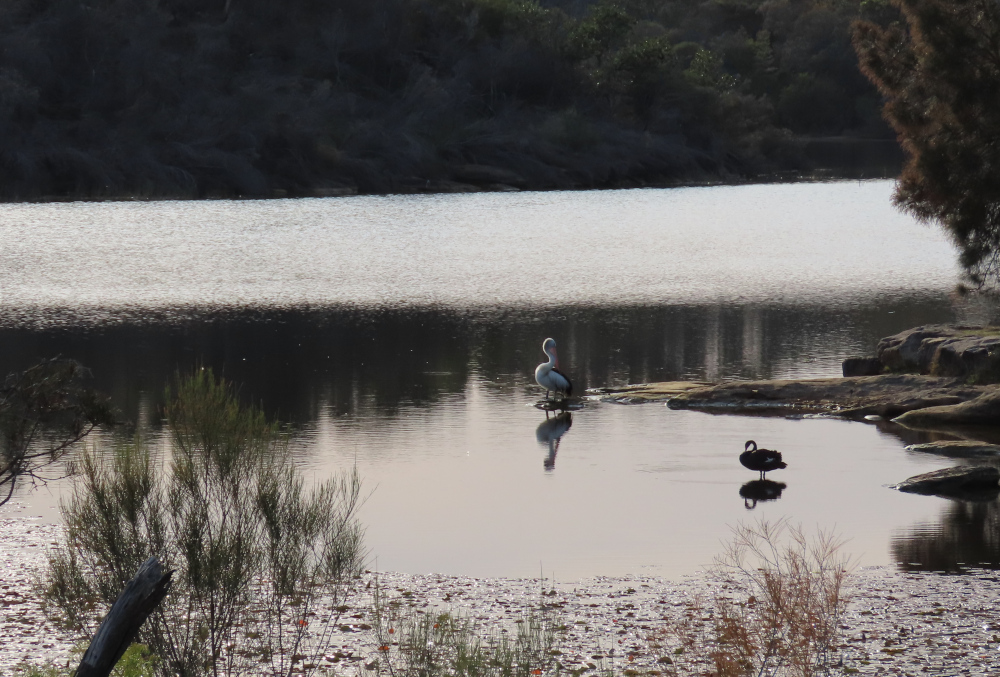
(Photo taken on 9 September 2024)
It’s good to stretch and preen:
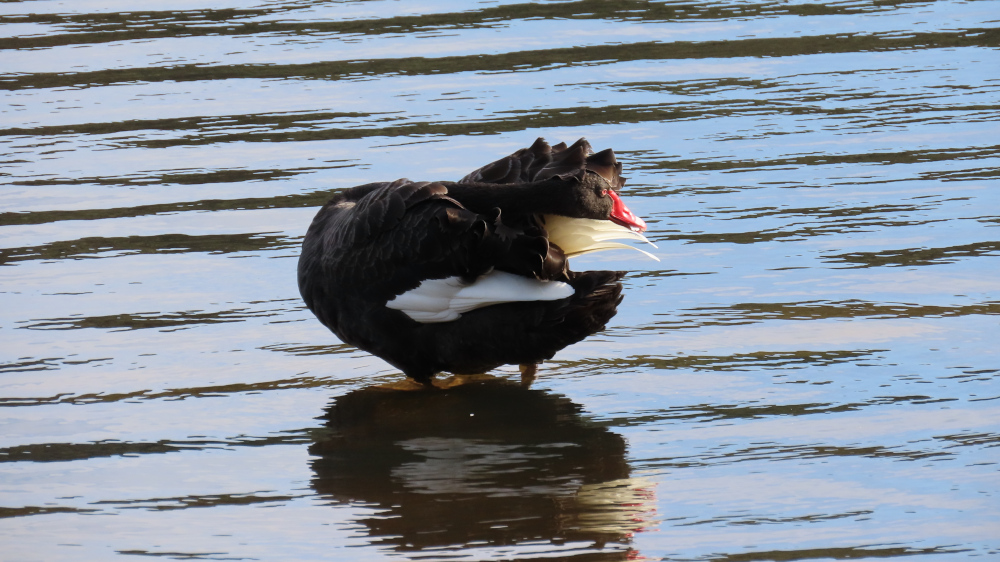
(Photo taken on 9 September 2024)
In the next video, one of the swans comes in close to shore for a good stretch. Eastern Koel cuckoos and cicadas dominate the sound waves. On a rock nearby, an Eastern Water Dragon looks on:
(Video taken on 21 November 2024)
In the next video, a Great Cormorant watches on as the swan preens and fluffs its wings. Cockatoos, Eastern Koels, and Channel-billed cuckoos call in the distance:
(Video taken on 29 November 2024)
As I write this post, December has arrived and the bush has a surfeit of insects. It’s very noisy at the swans’ nest. Two kookaburras dropped by and chatted a bit. Moths flap past, cicadas shriek, and a dead heat beats down on the nest:
(Video taken on 6 December 2024)
The last time I visited the nest was yesterday, 8 December. The swans were still sitting. Two kookaburras dropped by again and the cicadas were still very noisy.
I’ll keep a look out to see what’s happening at the nest next time I pass. I do hope to see the two swans relieved of their nesting duties. It would be wonderful to see some little ones to reward their amazing dedication. Even if there are no cygnets, though, it’d be good to see the adults roaming free again, ready for another go at raising a family next year.

(Photo taken on 8 December 2024)
Good luck, patient swans!
Update on 10 April 2025: Black Swans abandon nest after 8 months (part 2 of story).
Common name: Black Swan
Scientific name: Cygnus atratus
Approximate length: 120 cm
Date spotted: 23 August through to 8 December, 2024 (late winter, through spring, going into early summer)
Approximate location: Manly Dam Park, New South Wales, Australia

Did the big scary lizard make the Mudlarks abandon their nest?
For a few weeks now, I’ve been watching a pair of Mudlarks building their nest. In fact, they’ve built two nests. The first one looked good and solid from my vantage point, far away and down at ground level. But a couple of days after they’d finished it, they abandoned it and started a new one higher up in the same tree.
Mudlarks, also called Magpie-larks or Peewees, build neat round nests that are basically bowls made of mud. This video shows a male Mudlark collecting mud and reeds at the water’s edge. When he has a good collection, he flies off towards the nest that he and his mate are constructing. As the bird flies, a couple of Kookaburras start cackling, and one of the Mudlarks gives its distinctive call: “pee-wee pee-wee pee-wee”.
Here’s the male Mudlark on mud collection duty:

The next video shows the first nest under construction. The bird prods and pushes mud into the walls of the nest, then sits flat and wiggles its tail end to shape the nest.
As well as building walls, nest construction also involves sitting on the nest and wiggling back and forth to get the shape right:

The nest was looking good, I thought. But several days later, a decision is made. The birds abandon their first attempt and start a new nest, higher up in the same tree:
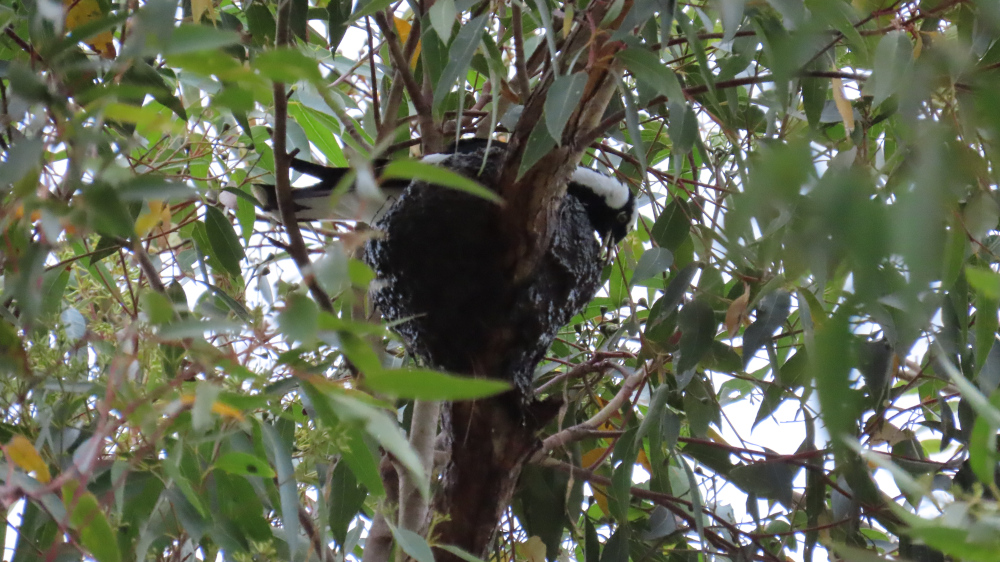
They’ve chosen a lovely spot, at the edge of Manly Dam. The next video shows one of the birds building the second nest. The second bird arrives with a beak-ful of mud, and takes over construction. The video then zooms out and in again to show the first nest on a lower branch, then zooms out further to show the dam and some of the neighbours (a Little Black Cormorant and a Great Egret).
Aside from the occasional noisy cockatoo, the neighbours are quiet for the most part — like this Great Egret:

And a few water dragons:

But the park does get quite busy over the weekend. Families hold picnics nearby, and children paddle in canoes. Perhaps the birds moved higher to avoid the weekend disturbance.
Perhaps the first nest didn’t meet quality assurance checks. Or perhaps the two parents-to-be spotted the large, scary intruder in the neighbourhood: a Lace Monitor lizard. I took this video of the lizard prowling around the tree where both nests are. Lace Monitors eat eggs and baby birds, and are very good at climbing trees. The Mudlarks’ second nest is higher in the tree and on thinner branches, which would make it much more difficult for the lizard to reach.
Lace Monitors are the second-largest lizards in Australia. They measure 1.5 to 2 metres long — longer than I am tall, and their hands are as big as mine! Here’s a close-up of the Lace Monitor on the move:
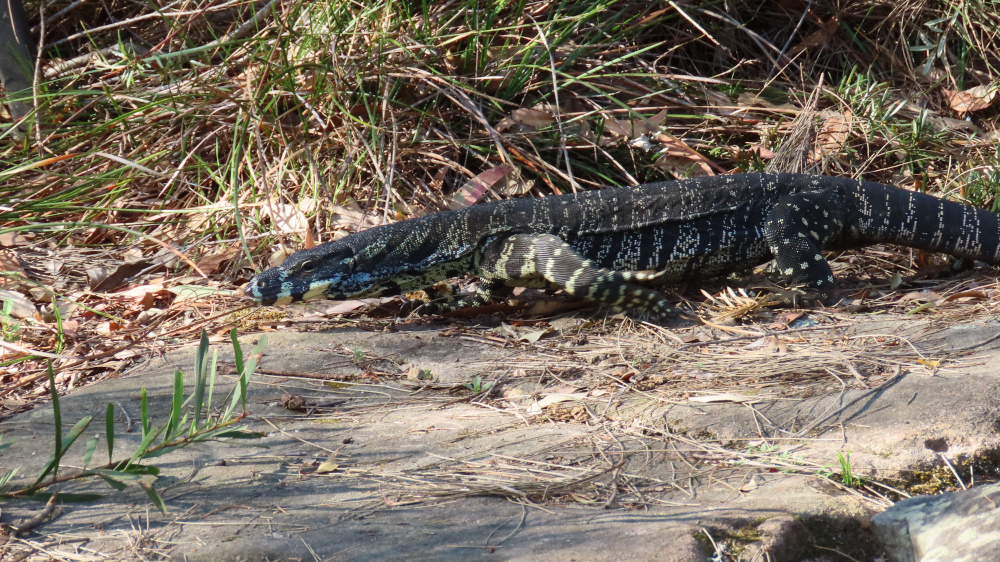
When I got too close with my camera, the lizard crouched down and went into stealth mode:

The Mudlarks are still sitting happily on their new nest. Here’s the male:

And here’s the female:
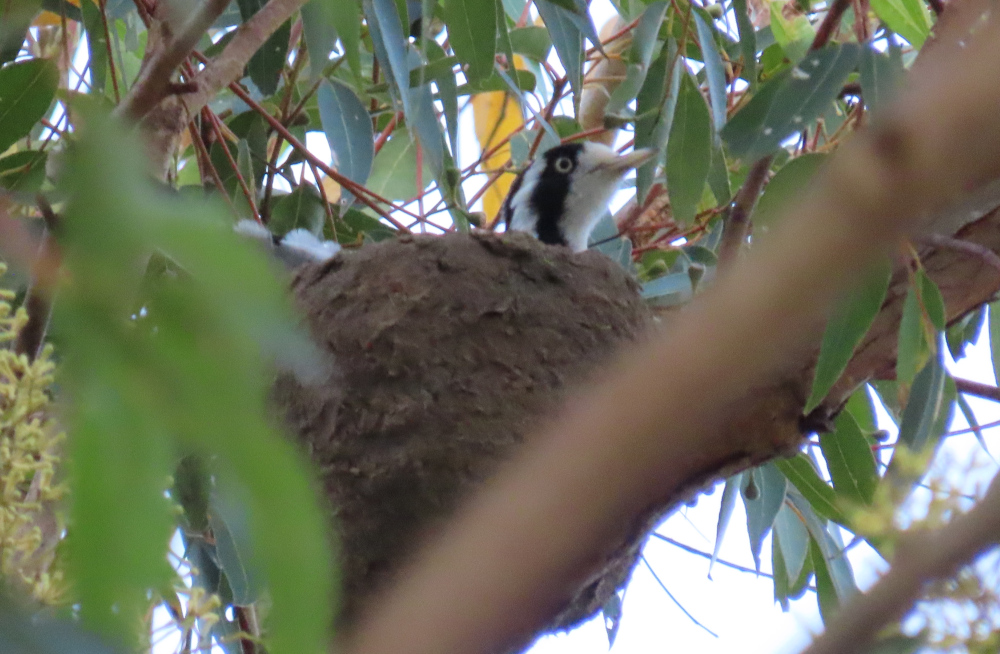
Good luck to them and their new family!
Common name: Magpie-lark, also called a Peewee or a Mudlark
Scientific name: Grallina cyanoleuca
Approximate length: 30 cm
Date spotted: August to September 2024 (summer)
Location: Manly Dam National Park, New South Wales, Australia

Apostlebirds nesting and grooming
It’s been a long-time wish of mine to see an Apostlebird. In our recent Outback trip, my wish came true. Several of these birds congregated around Mungo Lodge, where we stayed during our two-day exploration of Lake Mungo and surrounds.
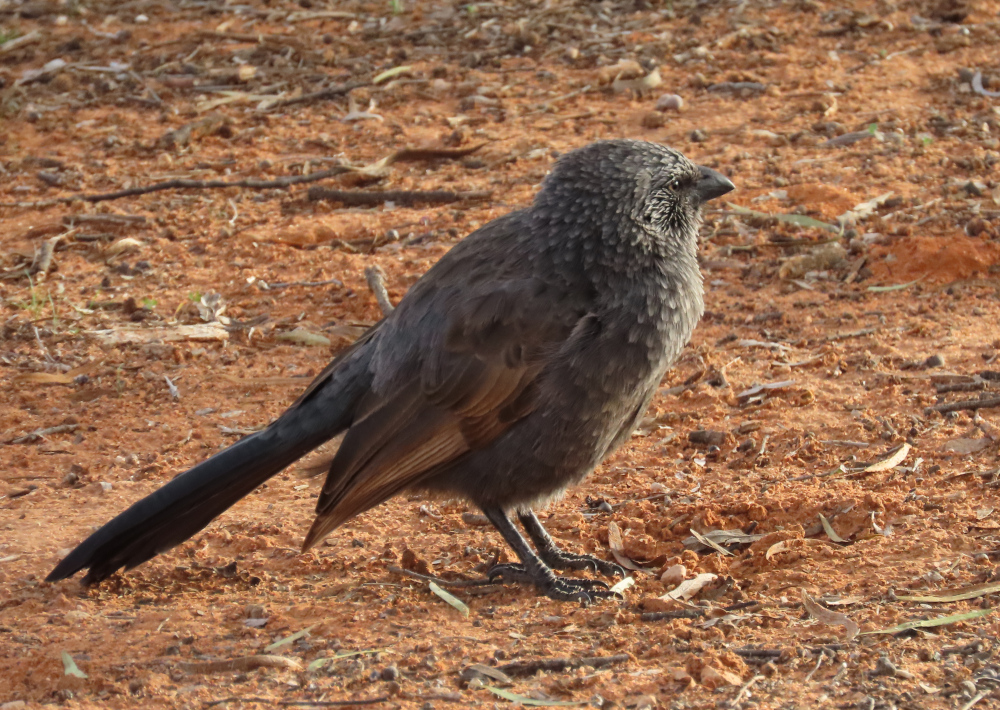
The birds have a characteristic dark mask around the eyes, which isn’t showing up as clearly as in some photos of these birds, because of the excellent mid-morning light. Here’s a half-profile shot, where you can just make out the mask leading from the beak and narrowly circling the eyes:

Two of the birds were nesting. I took the next shot in the early morning, when the sun was low in the sky. The photo shows one bird on the nest. Apostlebirds build their nests out of mud and clay. Since the soil is red in this area of the Outback, the nest is red too. It looks as if someone has put a round bowl in the tree, and the birds have hijacked it for a nest:

An early-morning grooming session was communal and chatty:
In the background sound of the above video, there’s a mournful falling whistle. This sound followed me around the area. I think it’s a Spiny-cheeked Honeyeater. I’ll blog about that bird soon.
The next video shows the two nesting birds again. It’s rather shaky and fuzzy, I’m afraid, due to my excitement and the poor light:
Common name: Apostlebird
Scientific name: Struthidea cinerea
Approximate length: 29-33 cm
Date spotted: 20-21 May 2024 (autumn)
Location: Mungo Lodge, Mungo National Park, New South Wales, Australia: 33°44’31.4″S 143°00’06.1″E


 Sydney Birder