Category Archives: Kookaburra

Termites and kookaburras
Termites are very active in our area of the world at the moment: the east coast of Australia just north of Sydney. When walking along a road that passes through a park area, it’s common to see low mud tunnels crossing the road. Termites build these tunnels to shelter in when they’re on their travels. Recently, I’ve also seen long trains of termites venturing out without any cover at all.
Here’s a stream of termites crossing the road. They’ve even built themselves a junction so that they can head off in different directions:
Termites’ mud tunnels often go up the outside of a tree:
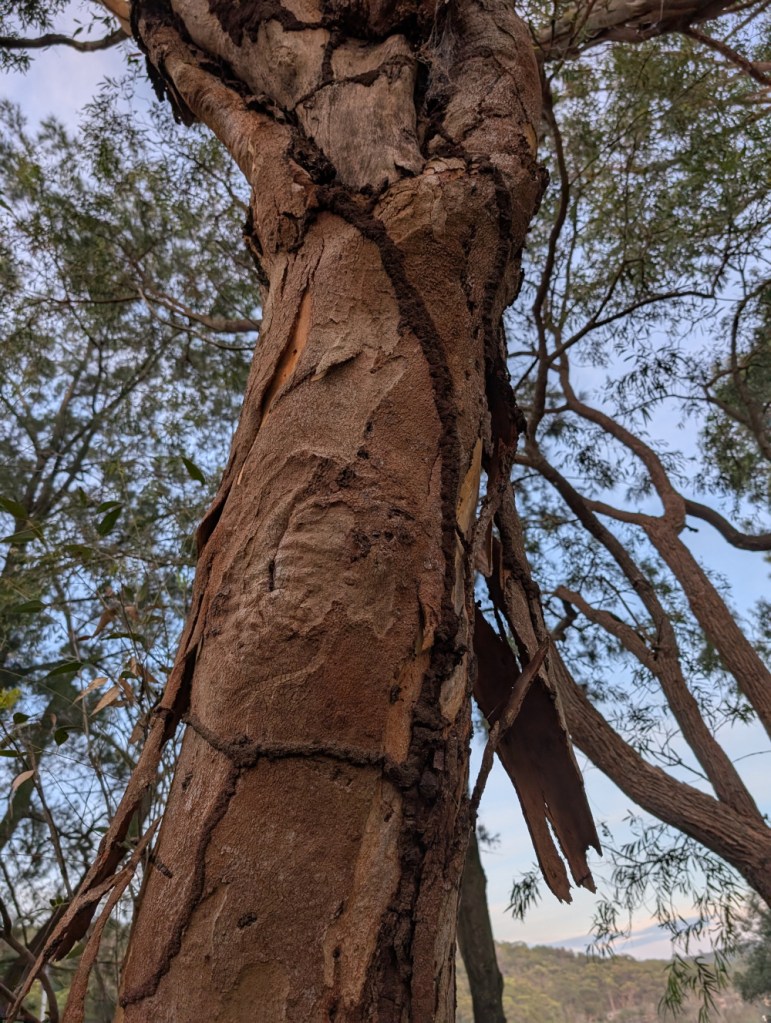
The termites in this part of Australia build their nests as large mud mounds, stuck high up in a tree:

Termite nests make a handy home for monitor lizards, kookaburras, kingfishers, and other creatures. In an earlier post, I showed pictures of a termite nest that had been adopted by kookaburras as a home for their young family: Baby kookaburras out of their nest.
In the next video, two young kookaburras attack the side of a termite nest, slowly digging a hole in the nest. They’re probably thinking ahead to the next breeding season, when such a home will come in useful:
In the video, you can hear the two kookaburras chattering, and other kookaburras giving the full laughing cackle in the background. There are also cicadas singing, and a butcherbird calls at one time too.
Common name: Laughing Kookaburra
Scientific name: Dacelo novaeguineae
Approximate length: 47 cm
Date spotted: 13 January 2025 (summer)
Location: Manly Dam near Sydney, New South Wales, Australia

Baby kookaburras out of nest
For the past month, I’ve been watching a termite nest that housed two Laughing Kookaburra chicks. The kookaburra parents had set up house in an old termite nest in a dead tree. The sound of the chicks crooning drew me to the tree on November 21st. The chicks were still very young, and it wasn’t possible to see them. But after waiting around a while, I did see the parents bringing food to the nest:
A month later, on December 20th, the chicks were right at the opening of the nest, peering out at the world. This photo shows one of the babies — you can see one eye clearly on the right, then the beak and white bib and the other eye on the left:

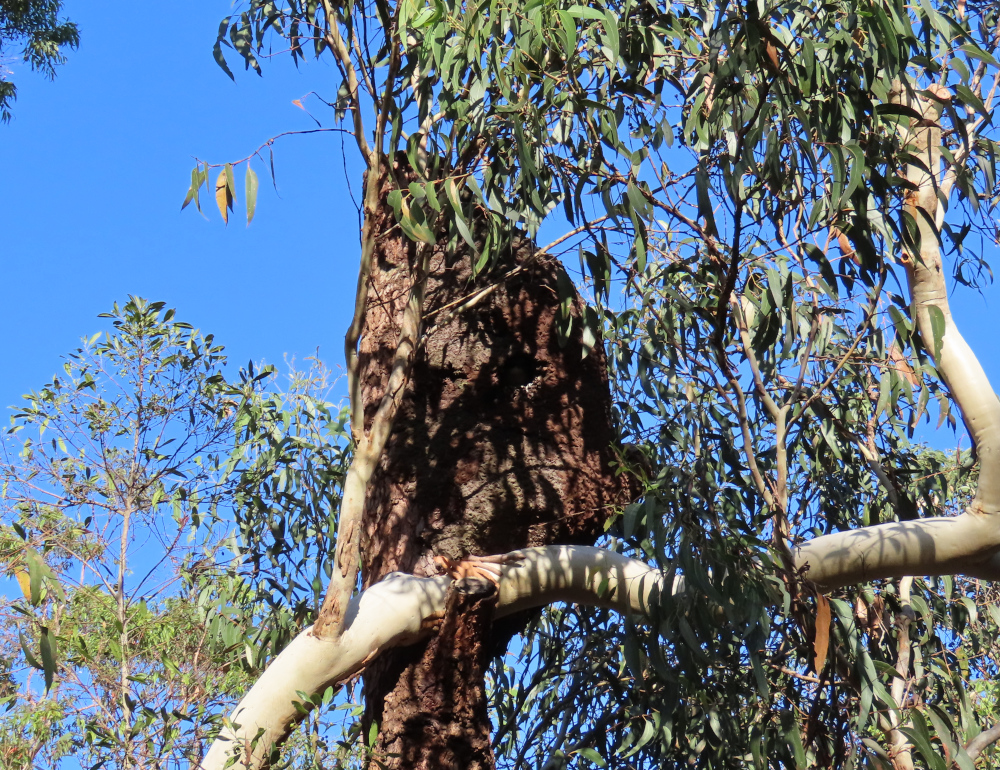
Here’s a view of the termite nest at the top of a dead tree. The nest projects from the top the right of the dead trunk, nicely protected by the branches of a living tree:
Here’s one of the parents with a morsel of food — a winged insect of some kind:

By my next visit, on December 23rd, the nest was empty. Both babies were out and about, calling and being fed by the adult birds.
One of the babies was on the ground when I got there, but soon managed to fly up onto a tree branch. The parents were nearby and attentive:
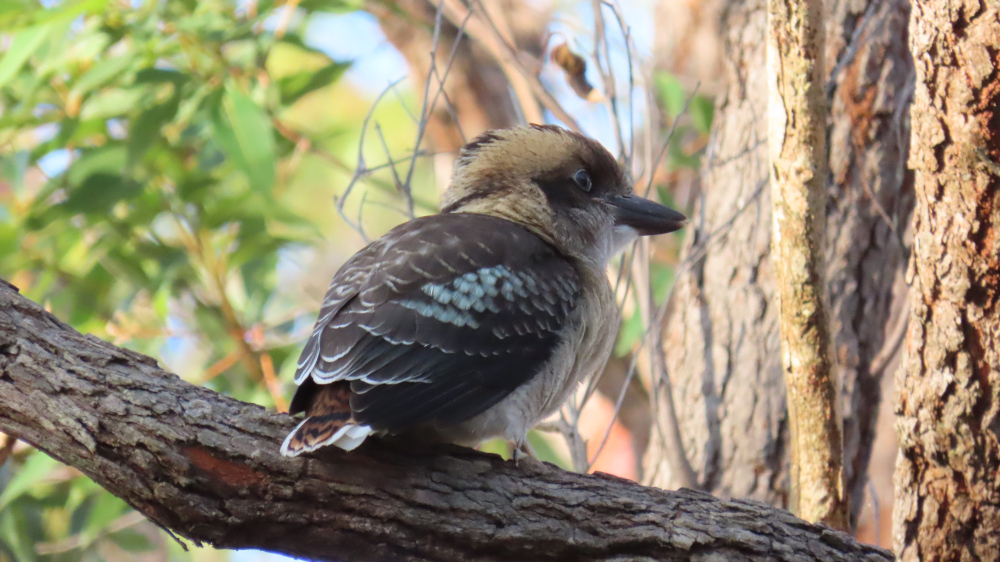
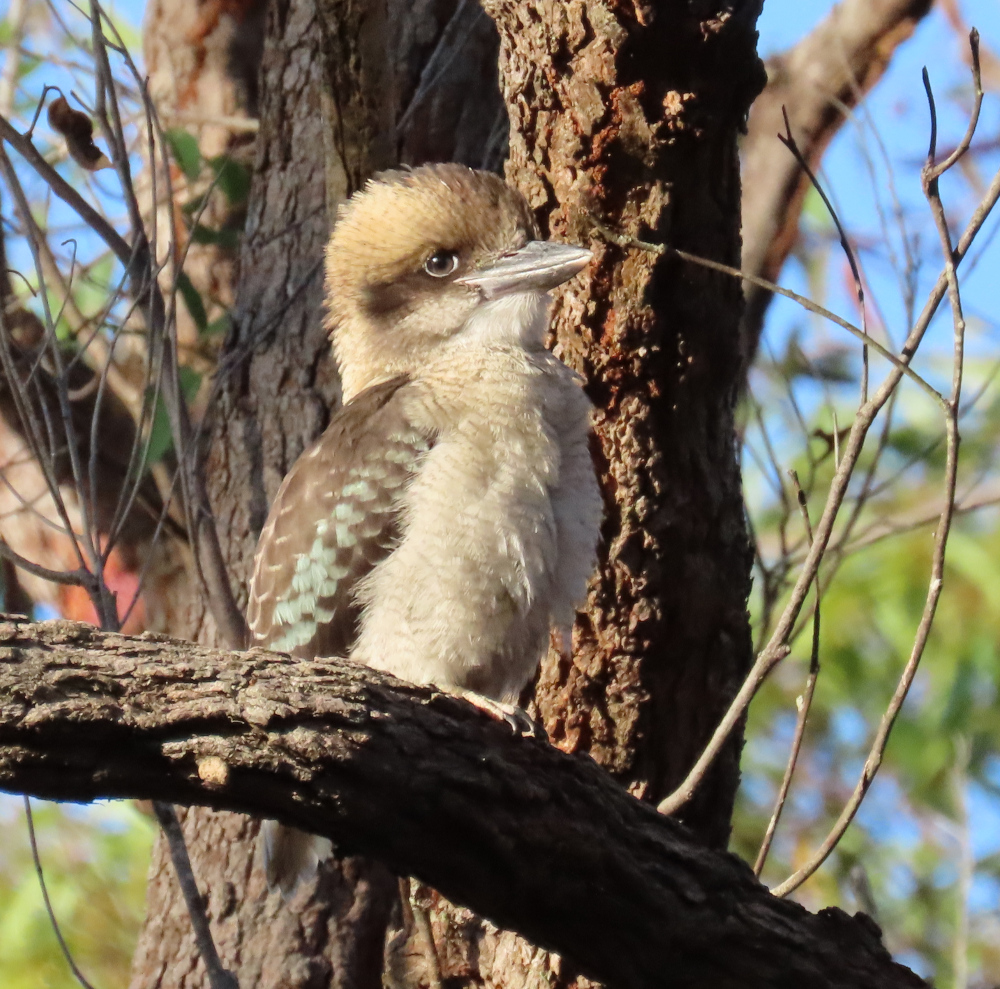
The youngsters are a bit smaller than the adults, and more fluffy. Their feathers aren’t yet fully developed, especially on the head and wings, and the tails are noticeably shorter.
The other youngster was on a nearby branch, also crooning:
This photo shows the youngster’s short tail:
To close off, here’s the same youngster from another angle:
Common name: Laughing Kookaburra
Scientific name: Dacelo novaeguineae
Approximate length (adult): 47 cm
Date spotted: 21 November to 23 December 2024 (summer)
Location: Manly Dam near Sydney, New South Wales, Australia

An intrepid Kookaburra and a fallen tree
A tree came down in our neighbourhood this week. A Kookaburra decided to keep an eye on the resulting activity, despite all the heavy machinery and noise.
If you look carefully, you can just make out the Kookaburra perched on the trunk of the fallen tree, right next to that big, thrumming truck:

After surveying the activity at ground level (and snacking on a passing worm or lizard), the bird flew up onto the street lamp on the newly-erected power post. The tree had taken down the old post and all the power lines. Getting a bird’s eye view:

The team of electricians down below needed to reset the switches at the top of the post. They used a long, bright green pole to do this. The bird stayed right where it was, checking the job with interest:

This video gives a good idea of the noise and machinery at work down below:
I’ve noticed before how fearless Kookaburras are, and how they seem to be interested in what we humans are doing. This particular Kookaburra takes the cake!
Common name: Laughing Kookaburra
Scientific name: Dacelo novaeguineae
Approximate length: 47 cm
Date spotted: 23 April 2024 (autumn)
Location: Near Sydney, New South Wales, Australia

Bad hair day and goofy look from this Kookaburra
Yesterday I encountered a Kookaburra. It sat still on a branch, as they do, letting me take copious photos, as they do. (Why don’t other birds take a leaf out of a Kookaburra’s book?) Here’s the bird in half profile, looking cute and kind of noble:

However, the other profile gives a different impression. A twig is tangled in the feathers on the Kookie’s head. Bad hair day?

Here’s a shot of that goofy look they have when they gaze right at you:

Common name: Laughing Kookaburra
Scientific name: Dacelo novaeguineae
Approximate length: 47 cm
Date spotted: 8 April 2024 (autumn)
Location: Manly Dam park, New South Wales, Australia: 33°46’52.4″S 151°15’08.3″E

Two Sacred Kingfishers at Manly Dam
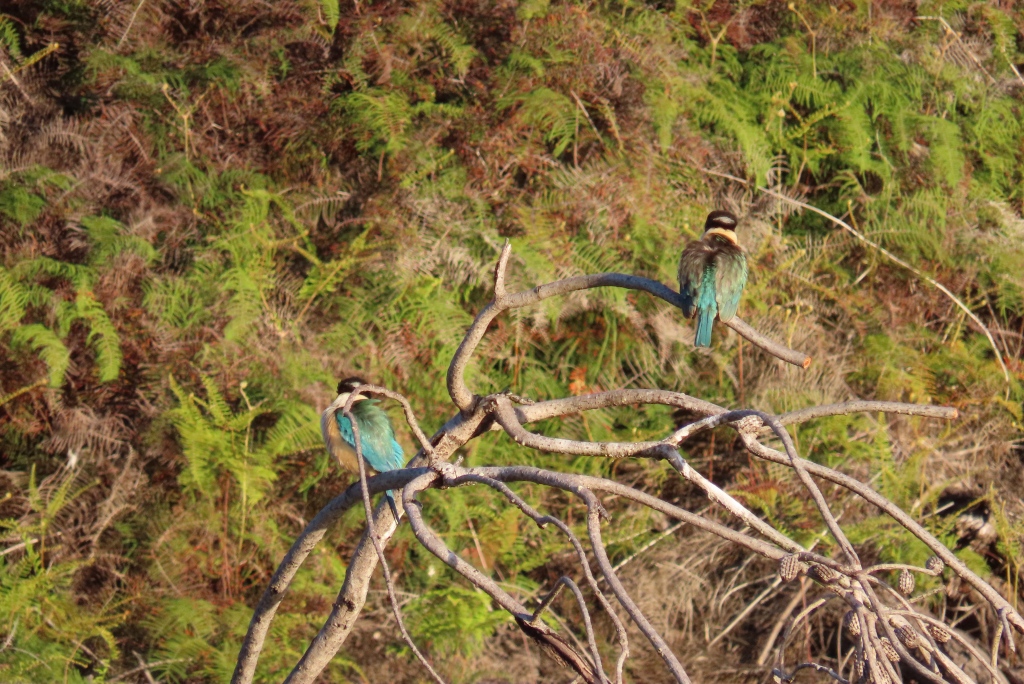
A rare treat! This morning I saw two Sacred Kingfishers resting on a clump of dry bush at the edge of Manly Dam. I’ve seen a kingfisher at Manly Dam twice before, both near the dam wall. These two were in a different area, at an inlet on the north west side of the dam.

Before I saw the birds, I’d heard their call, though I didn’t know what it was at the time. It was a fairly high-pitched, insistent sound, uttered in groups of two to four squawks: “kik-kik-kik-kik”.
I think the one on the left might be male, and the one slightly higher up on the right might be female. Females have more green and less blue on their wings than the males do.
Kingfishers are related to kookaburras. (See my earlier posts for pictures of kookaburras.) But whereas Laughing Kookaburras are quite large (47 centimetres from head to tail), Sacred Kingfishers measure only 20 centimetres.
For comparison, here’s a kookaburra from another day:

Back to today’s Sacred Kingfishers: At one stage, both birds turned round to show me the backs of their heads. They look much more like colourful kookaburras now:
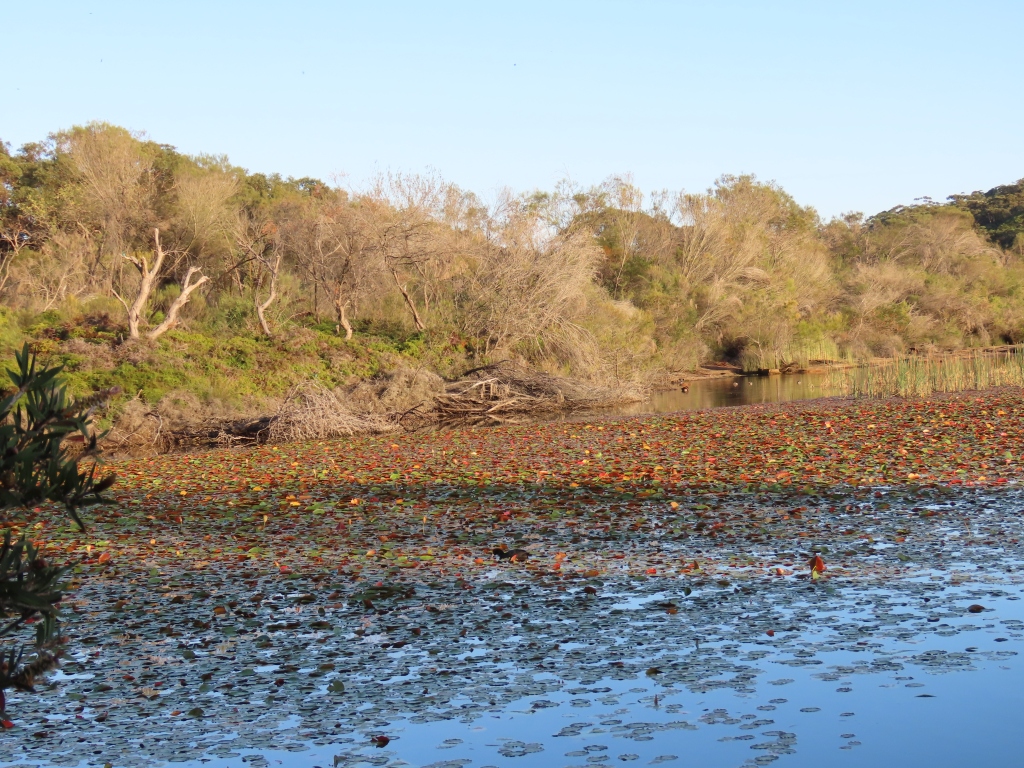
The next picture shows the bank of the dam where the birds were sitting. I was on the far side of the inlet. You might just be able to make out one of the kingfishers on the clump of dead bush towards the middle left of the picture. The other kingfisher had been chased away by a Willy Wagtail!
Common name: Sacred Kingfisher
Scientific name: Todiramphus sanctus
Approximate length: 20 cm
Date spotted: Saturday 14 October 2023 (spring)
Location: Manly Dam Park, New South Wales, Australia: 33°46’34.4″S 151°14’48.9″E

Spitfire grubs and Kookaburras
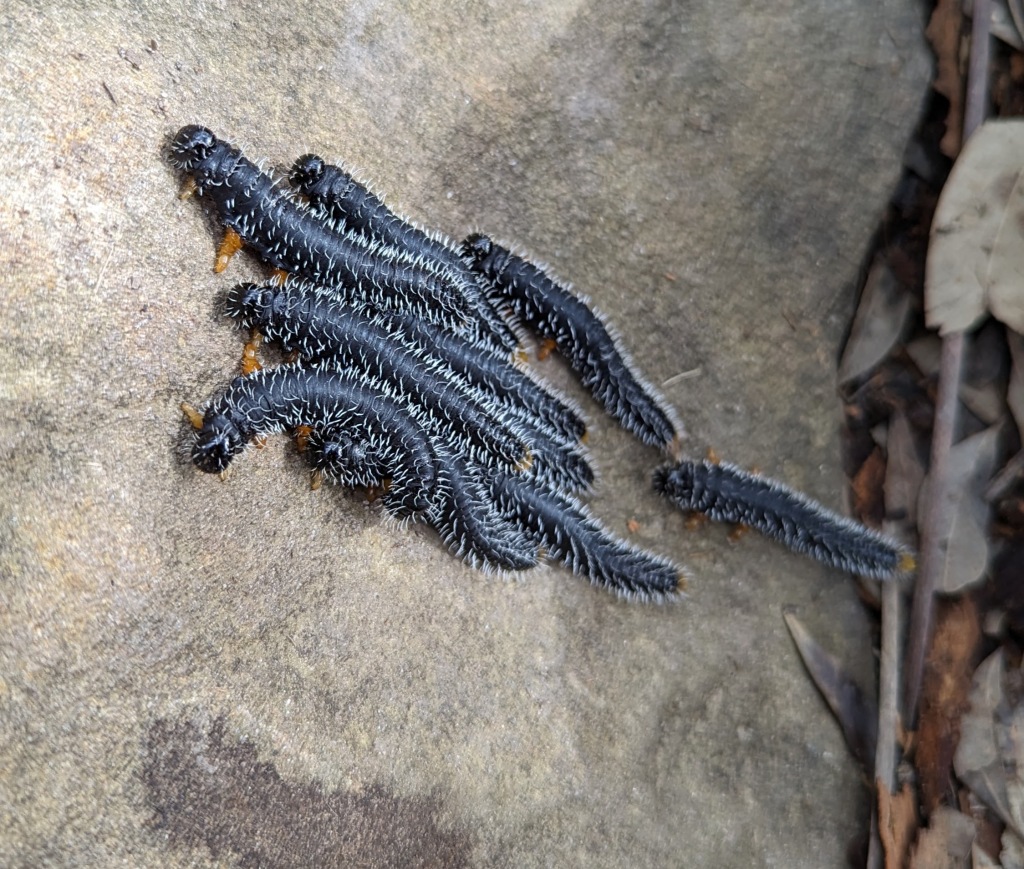
While wandering along a bush path, I came across a curious collection of grubs:
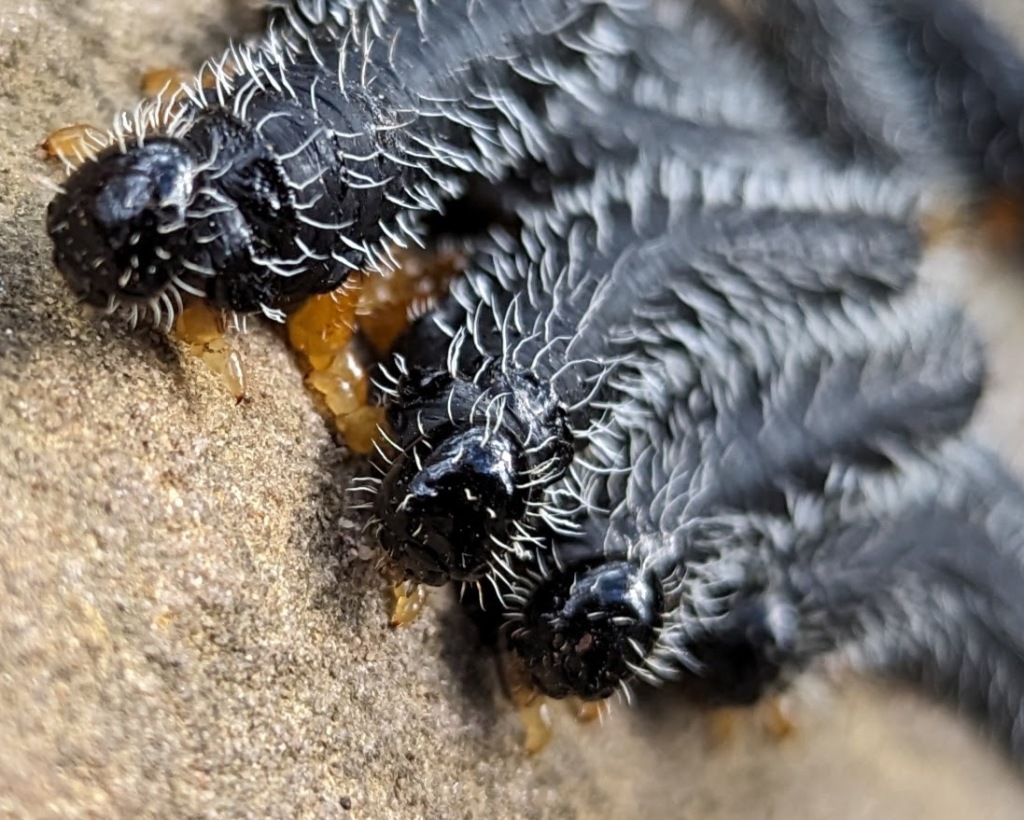
They’re spitfire grubs, which are the larvae of a type of wasp called a sawfly. The grubs look quite a lot like caterpillars with a don’t-mess-with-me attitude. They’re black and shiny, with white bristles, yellow feet, and a yellow tail. They’re quite long and fat: about the size of my little finger.
Despite the name “spitfire”, the grubs don’t actually spit anything, but if you touch them you can get a burning sting from the spikes. The grubs also spew out a thick yellow liquid from their mouths when threatened, but the liquid isn’t harmful to people. It’s made from eucalyptus oil, since the grubs feed on eucalyptus leaves.
In the video, you can see them tapping their tails on the rock. They do that to communicate their whereabouts with each other.
Here’s a close-up of some of their heads:
There were ten grubs in the clump:
Next on the scene was a riot of Kookaburras! The birds gathered above me while I was bent over the clutch of spitfire grubs. I was worried that the Kookaburras might swoop down and grab a grub as a snack!
The Kookaburras left the grubs alone. I guess they don’t taste great!
Common name: Laughing Kookaburra
Scientific name: Dacelo novaeguineae
Approximate length: 47 cm
Date spotted: 18 July 2023 (winter)
Location: Manly Dam park, New South Wales, Australia: 33°46’56.0″S 151°15’05.4″E
Six kookies a-cackling
This morning I was treated to the sight of six kookaburras in a row, perched on the horizontal bar of an outlet pipe, all cackling away to each other. Australians fondly call these birds “kookies”. So, here you go, six kookies a-cackling:
Towards the end of the video, you’ll hear a jogger running up to me in excitement, exclaiming that she wished she had a camera. She obviously didn’t realize I was videoing!
After the birds flew off, I spotted two perched on a nearby TV antenna. It’s probably two of the six in the video, but not necessarily — there were quite a few kookaburras around:

Common name: Laughing Kookaburra
Scientific name: Dacelo novaeguineae
Approximate length: 47 cm
Date spotted: 28 January 2023 (summer)
Location: Balgowlah, New South Wales, Australia: 33°48’01.4″S 151°15’53.0″E

Kookaburra, grass trees, and the Australian bush after a fire
It’s early summer now in Australia, and the weather is still relatively cool. It’s a good time for the Parks and Wildlife services to do a hazard reduction burn, before the weather gets too extreme. They set fire to selected parts of the bush, after plenty of ground clearing and other preparatory work. On the day of the burn, the fire services are on hand to keep the fire within its boundaries. (This doesn’t always go according to plan, though!) The goal is to burn away undergrowth that could later result in a fierce, uncontrolled fire.
In the days since a recent burn in my area, I’ve noticed that a kookaburra often spends time in a particular area of the burned forest. Presumably there are small creatures around, even in the burned area, that offer a tempting snack.
This picture shows a kookaburra surveying the forest floor carefully. The blackened trunks and rocks are evidence of a burn that’s a few weeks old:

Here’s a closer view of the kookaburra:

The trees and many of the native plants survive fast-moving, relatively cool fires. Even the trees with blackened trunks are alive inside, and their leaves at the top of the canopy often remain green.
One plant that survives a fire amazingly well is the iconic grass tree (Xanthorrhoea). The trunk of a grass tree burns black, and sometimes all the spiky leaves are burned away. At other times, the leaves after a fire form a multi-coloured fan of green, orange, and brown.

The above grass tree is a few decades old. They grow very slowly, at the rate of 2 cm a year, and it can take about 20 years for them to form a trunk. Before that, they’re just a clump of spiky leaves sticking out of the ground.
Here’s a wider scene with a few small grass trees:

The next photo shows a bush area a couple of years after a burn. There’s plenty of regrowth happening:

And here’s a kookaburra under a bright blue sky, in a different area of Sydney:

I love walking in the post-fire forest in the early morning. Well, I love walking in any forest at any time, but after a fire there’s a surreal quality to the air. The Sydney Red Gums glow orange. Every sound is magnified, because there’s no muffling undergrowth. The rock formations show the structure of the land, usually hidden by plants. And bits of green start appearing almost immediately.


I hope you’ve enjoyed a stroll through some Ozzie bush, blackened but not daunted by hazard reduction burns.

Kookaburra snagged a goldfish from someone’s pond!
Kookaburras are members of the kingfisher family, after all, and it looks as if this kookaburra has raided someone’s garden pond!

I feel sorry for the fish. It looks very sad. I think it’s a goldfish, because of its size, but it could be a koi or something else. There might be some pond owners near by, wondering where their fish are disappearing to!

Common name: Laughing Kookaburra
Scientific name: Dacelo novaeguineae
Approximate length: 47 cm
Date spotted: 1 September 2022 (spring)
Location: Allambie Heights near Sydney, New South Wales, Australia
Laughing Kookaburras with a drop-in Australian Raven
As I was crossing the dam wall at Manly Dam, a couple of Laughing Kookaburras landed on the railing a few metres away and started cackling. I managed to get my camera out in time to recorded some of their song. (That’s unusual, because most kookaburras stop and look at you when you stop and look at them!)
A few seconds into their song, an Australian Raven appeared as if from nowhere and landed on one side of the kookaburras. They seemed annoyed. Then the raven hopped into the air above the kookaburras. It’s funny to see the kookies stretch their necks upwards to keep the raven in view. The raven, ever annoying, then landed on the opposite side of the kookies. At that stage, the kookies decided enough was enough, and flew away.
Laughing Kookaburra (Dacelo novaeguineae) — approximate length: 47 cm
Australian Raven (Corvus coronoides) — approximate length: 50 cm
Date spotted: 13 August 2022 (winter)
Location: Manly Dam Park, New South Wales, Australia: 33°46’53.9″S 151°15’20.2″E


 Sydney Birder