Category Archives: Fantail

Grey Fantail catching the sun
Early one morning, after some fairly ferocious rain, everyone was seeking sunlight and somewhere to dry out. This little Grey Fantail sat still on a branch for several minutes. Well, what passes for still, in a fantail’s world!
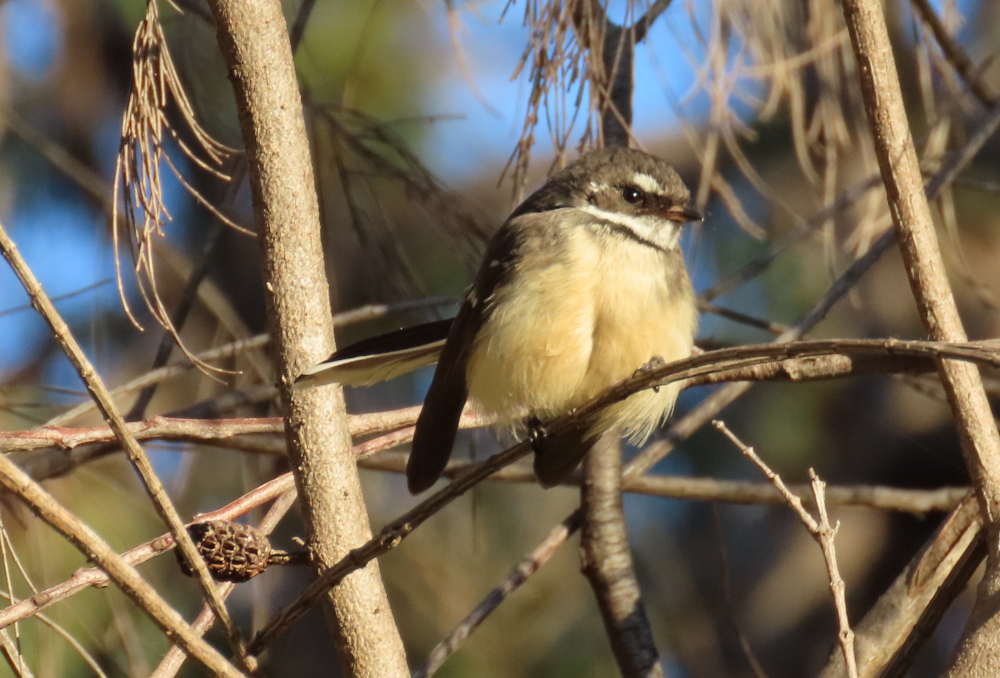
From the way it’s fluffing out its feathers and holding its wings, I’m sure it’s exposing as much of itself to the sun as possible!

Common name: Grey Fantail
Scientific name: Rhipidura fuliginosa
Approximate length: 14-17 cm
Date spotted: 3 June 2024 (winter)
Location: Manly Dam Reserve, New South Wales, Australia: 33°47’01.7″S 151°15’10.3″E

Willie Wagtail enchanted by Grebe
This little Willie Wagtail seems intrigued by the way a Grebe keeps disappearing under the water and popping up again:
My camera battery died as I was taking the above video, which is a pity because the birds were quite close to me. Here’s another video, a bit noisy due to a plane flying overhead, and the birds are further away:
It’s funny how the Coot seems to be surprised by the Grebe’s disappearance too. I love Coots!
I watched the two birds for about fifteen minutes, as the Willie Wagtail tirelessly followed the Grebe around this reedy inlet of Manly Dam. I wonder if the Willie Wagtail was hoping for some insects to fly up each time the Grebe surfaced. Perhaps the Grebe’s activities would disturb a lily pad and cause an insect to jump?

Common names: Australasian Grebe and Willie Wagtail
Scientific names: Tachybaptus novaehollandiae and Rhipidura leucophrys
Approximate length: 23-25 cm and 20 cm
Date spotted: 5 June 2024 (autumn)
Location: Manly Dam Park, near Sydney, Australia: 33°46’34.8″S 151°14’49.6″E

Bird spotting with Aussie Bird Tours
Yesterday my family and I went on a bird-spotting trip with Aussie Bird Tours. Mike Barrow led us on a wonderful half-day tour around the Dee Why Lagoon, Warriewood Wetlands, and Irrawong Reserve. We spotted a large number of birds (40-50 types) and heard others too. Here are the ones that I managed to get a half-decent photo of.
Our tour started at Dee Why Lagoon, where we saw a number of water birds: a darter, cormorants, ducks, a black swan, coots, a Silver Gull, and more. Songbirds were there too. A Magpie-lark strutted over the mud. Welcome Swallows darted across the water. A Willie Wagtail chirped in the distance. An Eastern Whipbird spent many minutes exploring the dense reeds a couple of metres from our feet. We could hear its characteristic chattering, but only saw it when it made a break for the higher foliage.
This male Olive-backed Oriole (Oriolus sagittatus) posed for a profile shot against the blue sky:
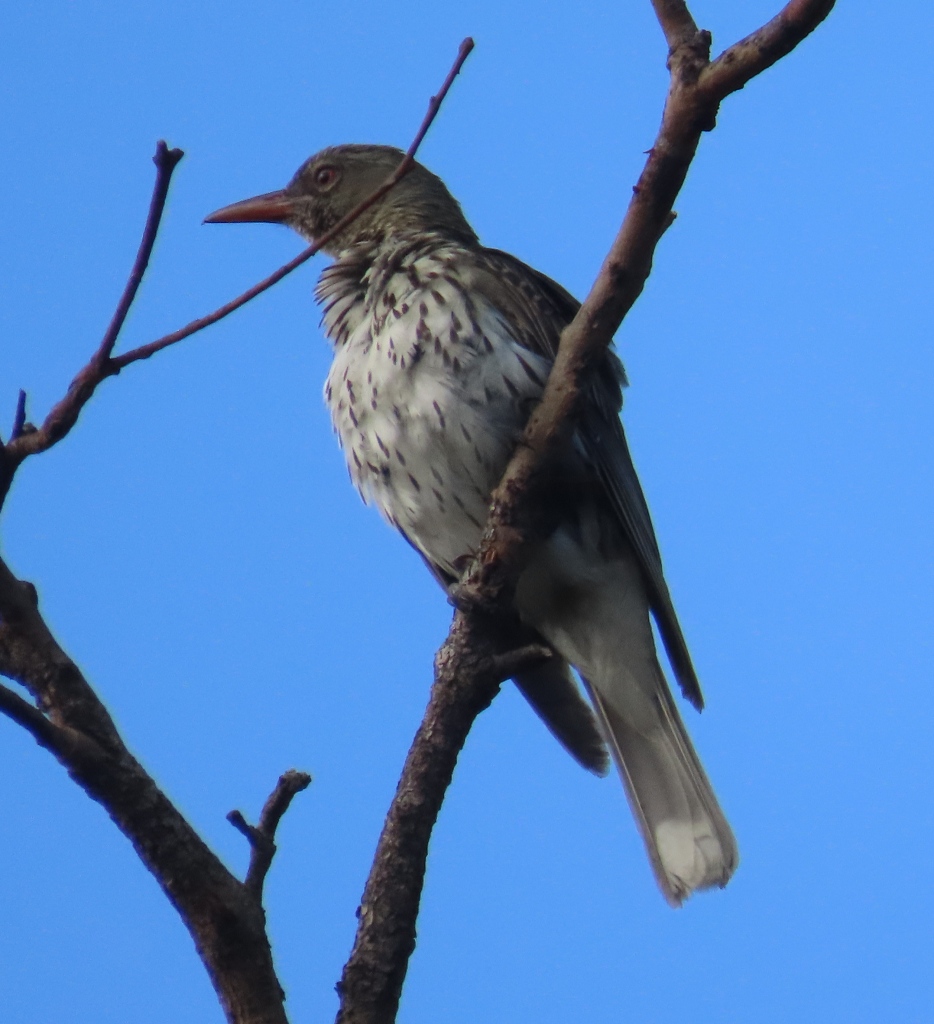
On this trip I learned what Olive-backed Orioles sound like (you can hear their call on eBird). I also learned the call of the Darter (hear it on xeno-canto). The latter sounds very like a Dollarbird, and I’ve probably mixed up those two calls in the past.
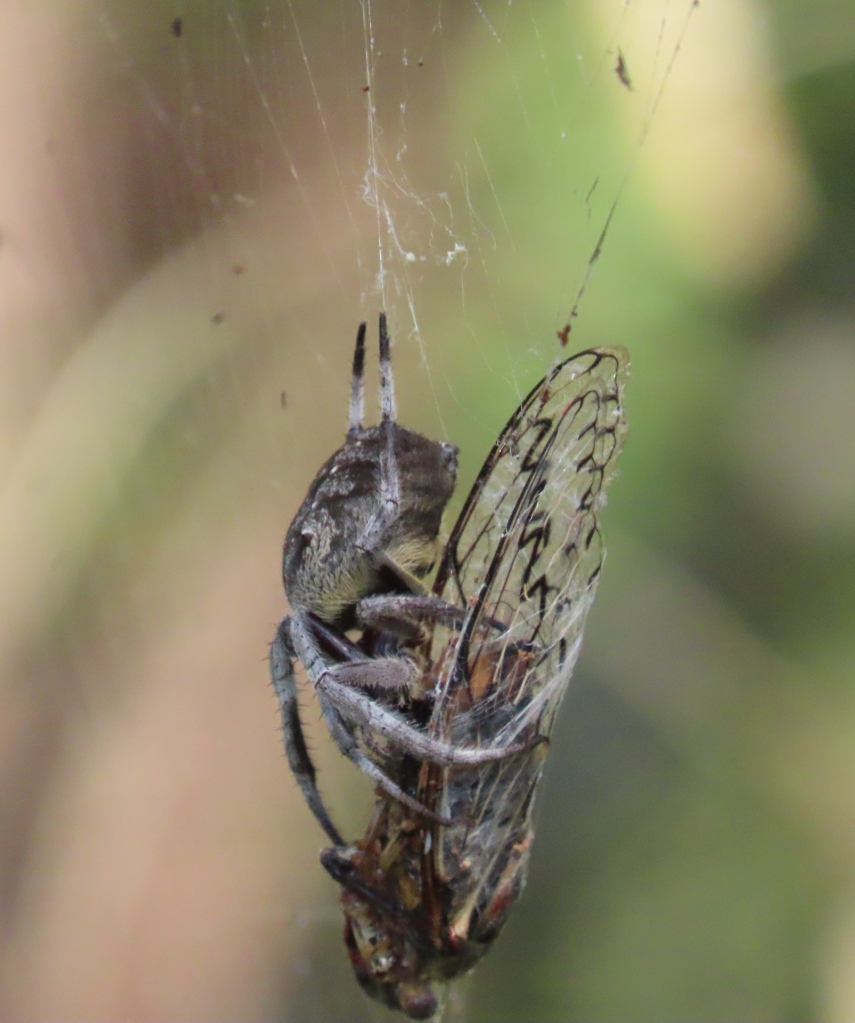
Our next stop was the Warriewood Wetlands, which is an interesting patch of swampy bushland. A raised path leads you across the reeds and water, with great views of wetlands all round you. The cicadas were out in full force, deafening us while providing food to other creatures. Here, a large spider has caught a cicada in its web and is having a feast:
Discarded cicada husks stuck to tree trunks, shed when the cicada larva emerges from the ground and morphs into the winged insect:

Bell Miners (Manorina melanophrys) have moved into the Warriewood Wetlands in large numbers. The call of these honeyeaters is a clear, single, oft-repeated clink, like the sound of a bell. They’re quite attractive birds, with olive wings and back, and a pale yellow chest:
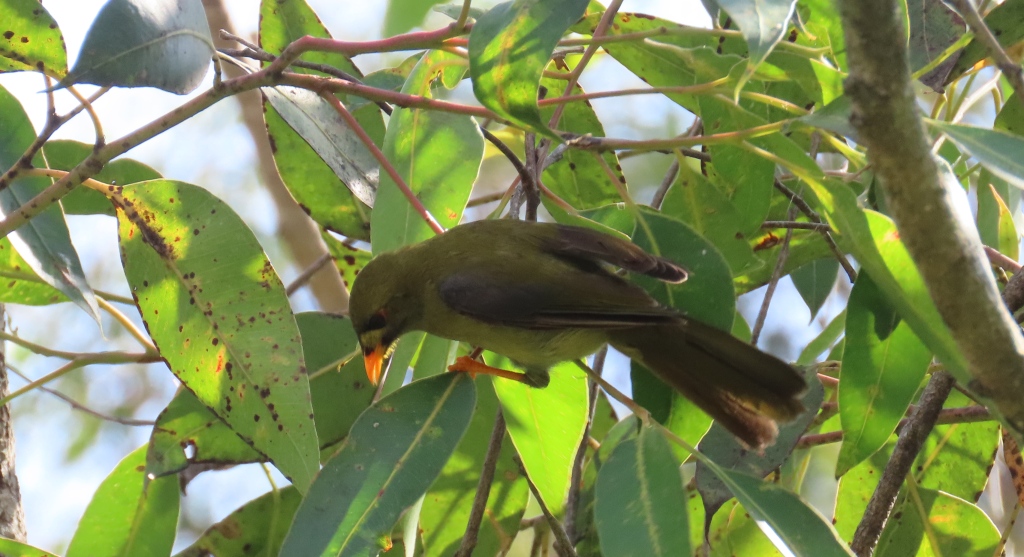
What with the screeching of the cicadas and the pinging of the Bell Miners, this was a noisy patch of bush!
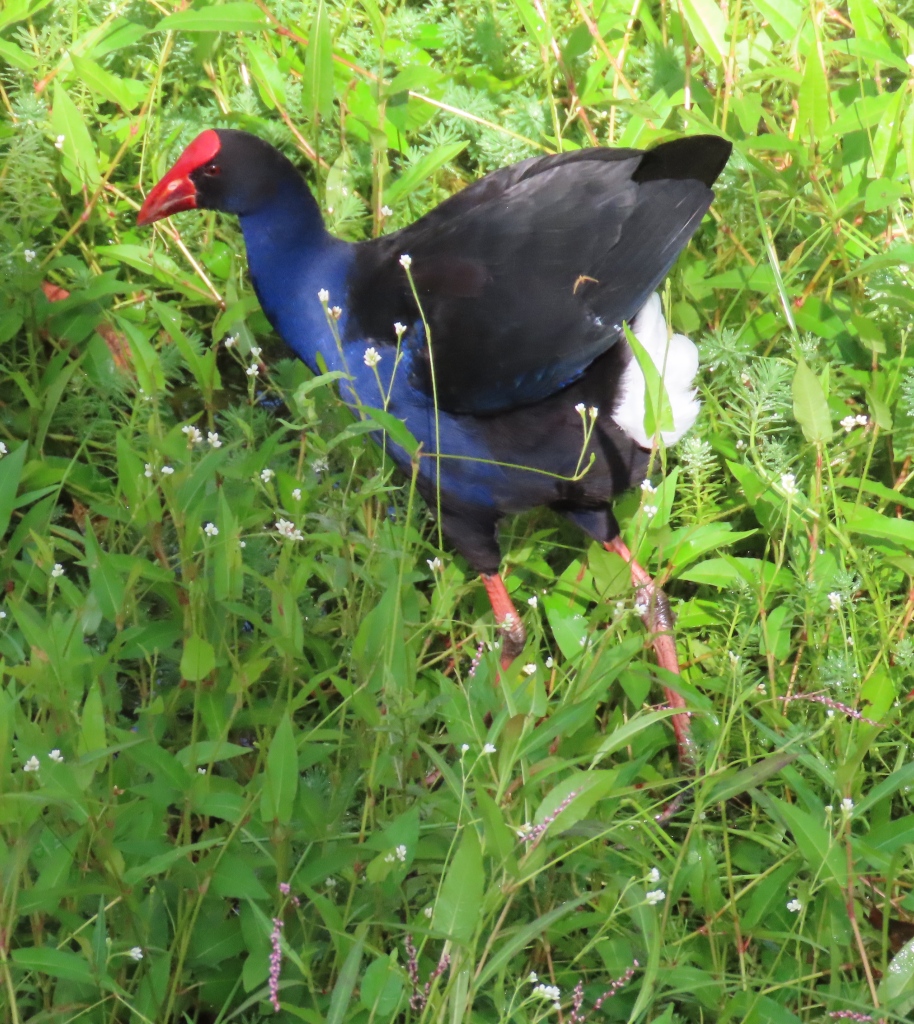
The noise didn’t seem to bother the Purple Swamphens (Porphyrio porphyrio), who carried out a lively courtship beneath the wooden walkway:
A small water dragon looked on:

A Dusky Moorhen (Gallinula tenebrosa) showed up in bold orange and yellow:

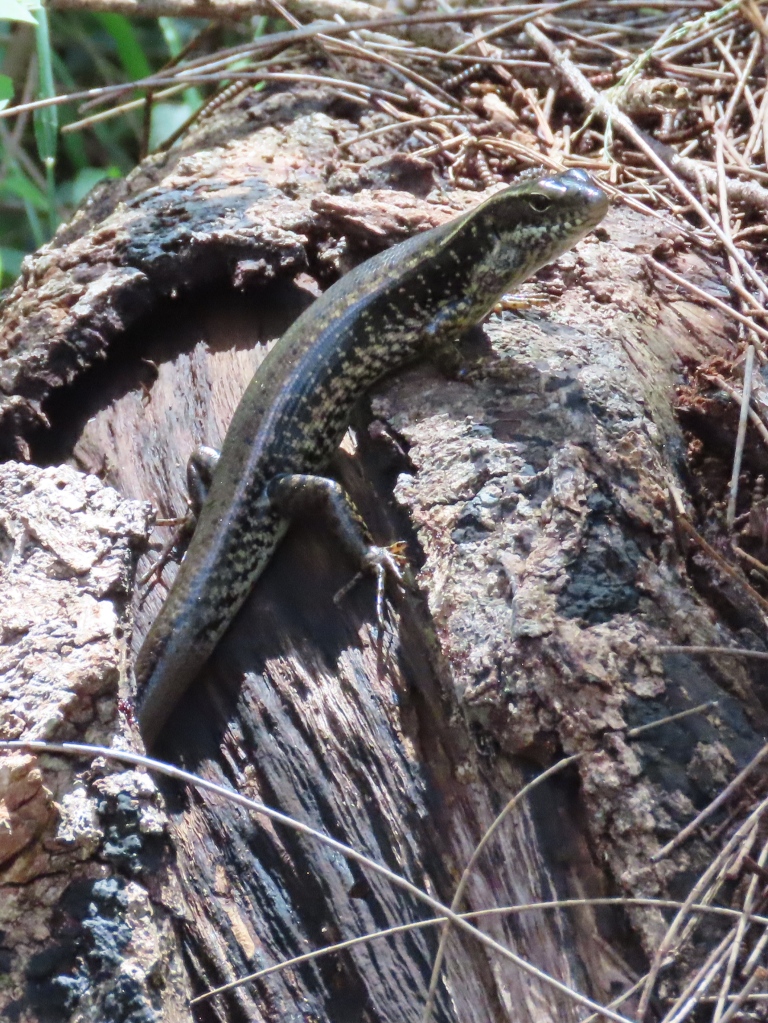
We didn’t see any snakes, though evidently they’re around. We did see a couple of largish skinks, like this one:
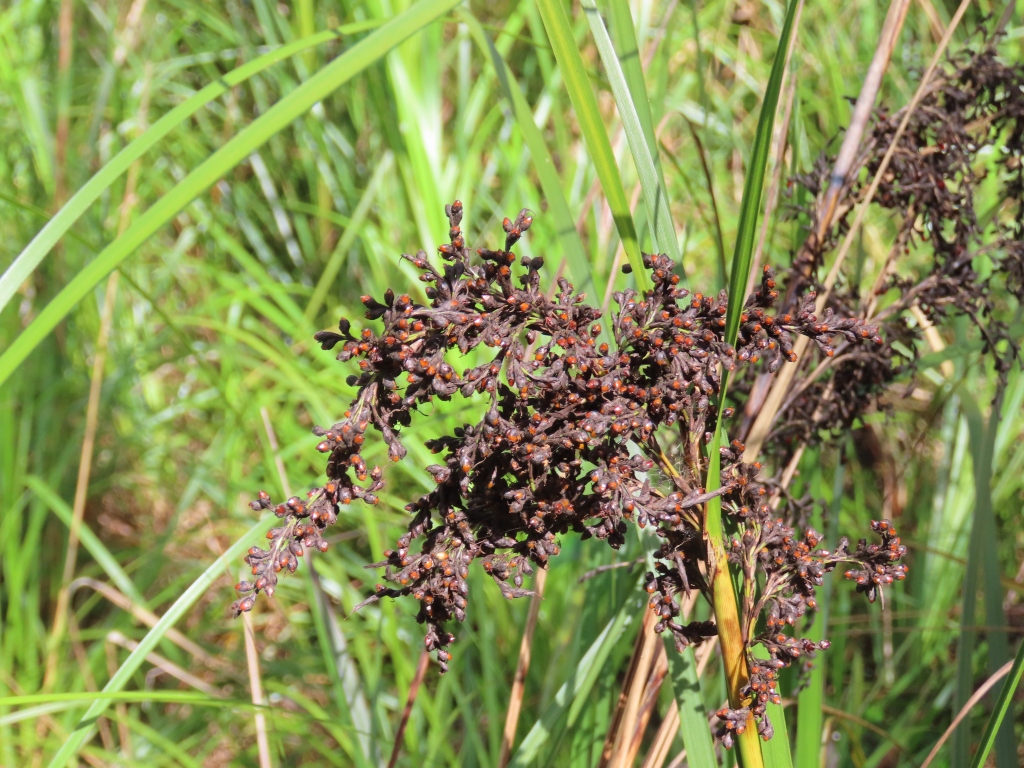
Striking dark grass flowers lined the way:
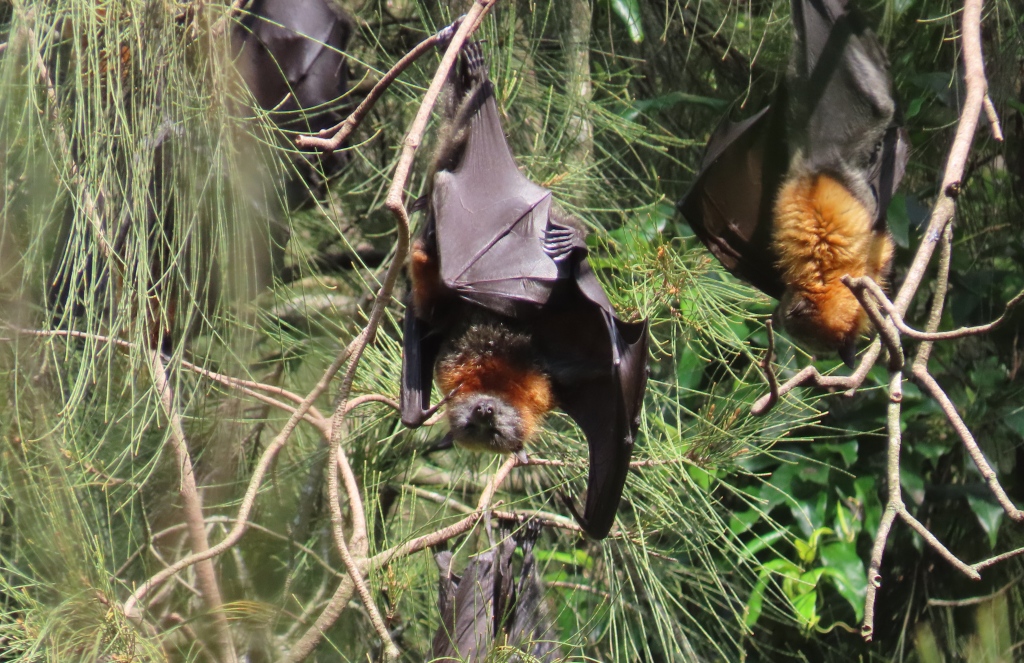
A colony of Flying Foxes (large fruit bats) occupies one corner of the wetlands:

Here’s a close-up of one of these attractive, intriguing mammals. They have a grey face, with a reddish fur collar and back. Their wings are black and leathery, strong enough to support these large bats in their long cross-country flights:
After the Warriewood Wetlands, we visited Irrawong Reserve. A Golden Whistler (Pachycephala pectoralis) carolled in the dense bush. This is the male bird:
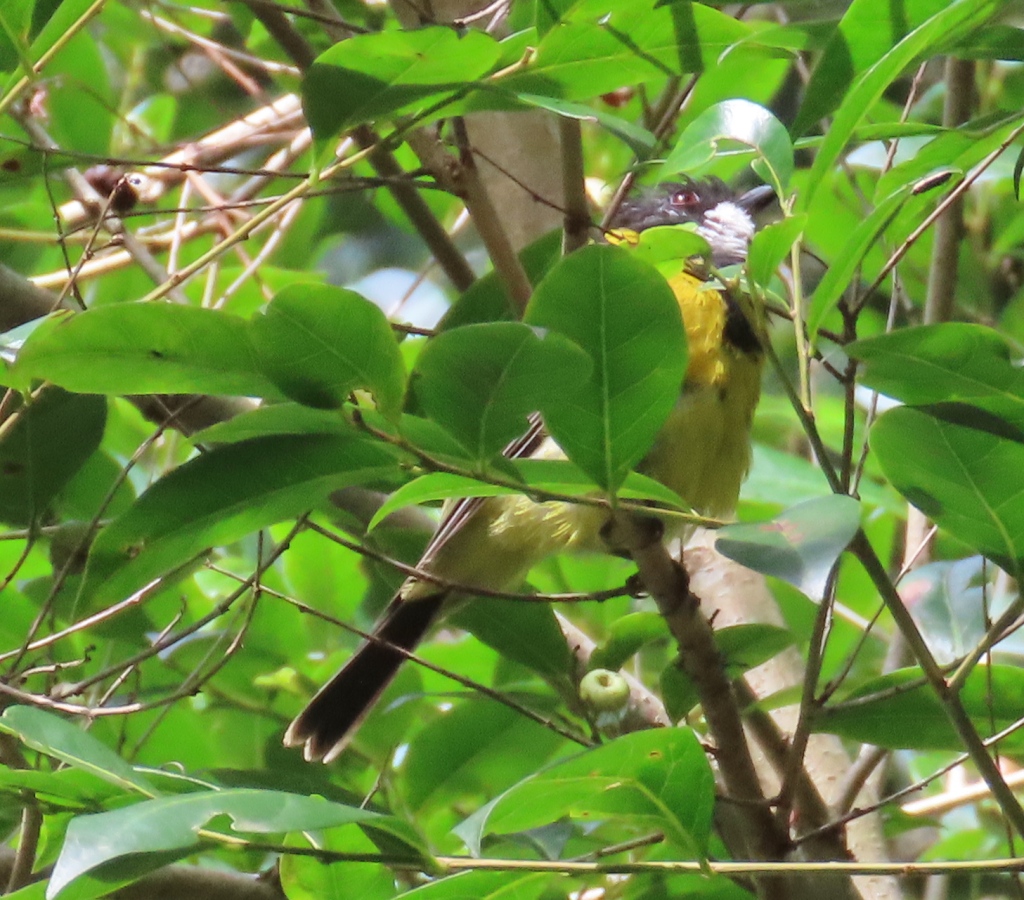
As you can see, it’s adept at hiding behind the foliage. Here’s another shot of the same bird, with its tail fanned:

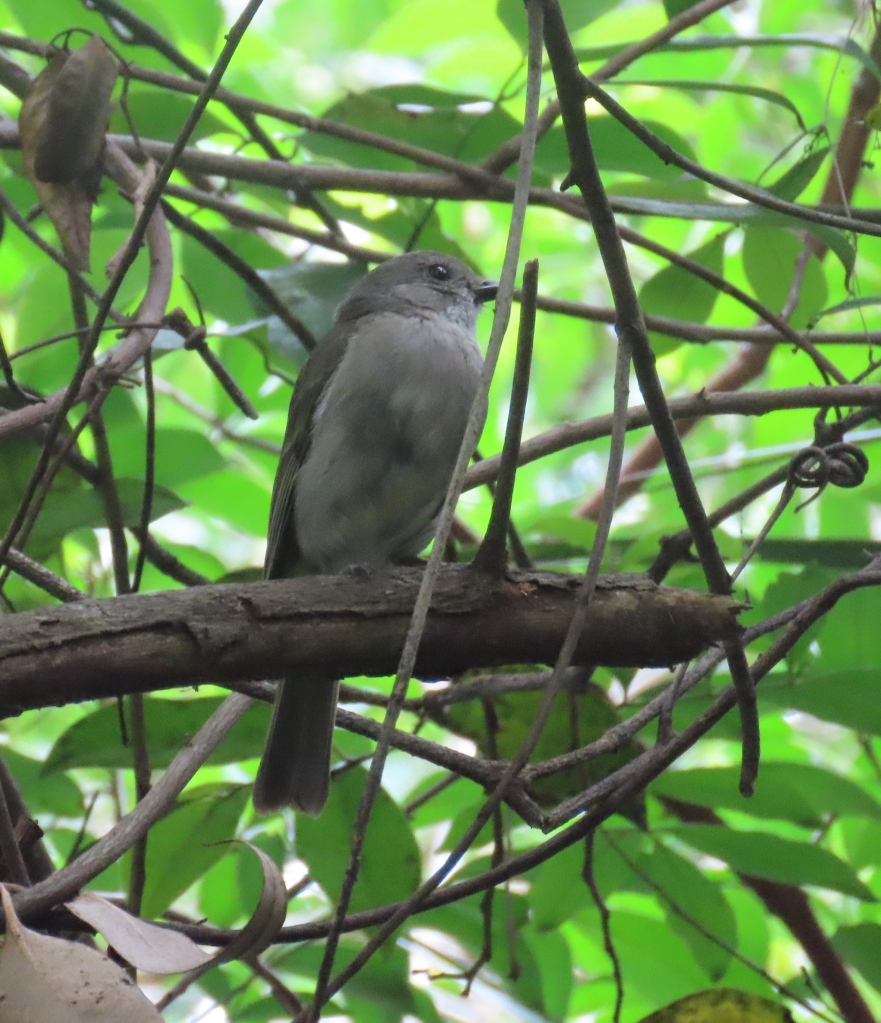
I think the next bird is a female Golden Whistler. They’re harder to identify because of their soft colouring:
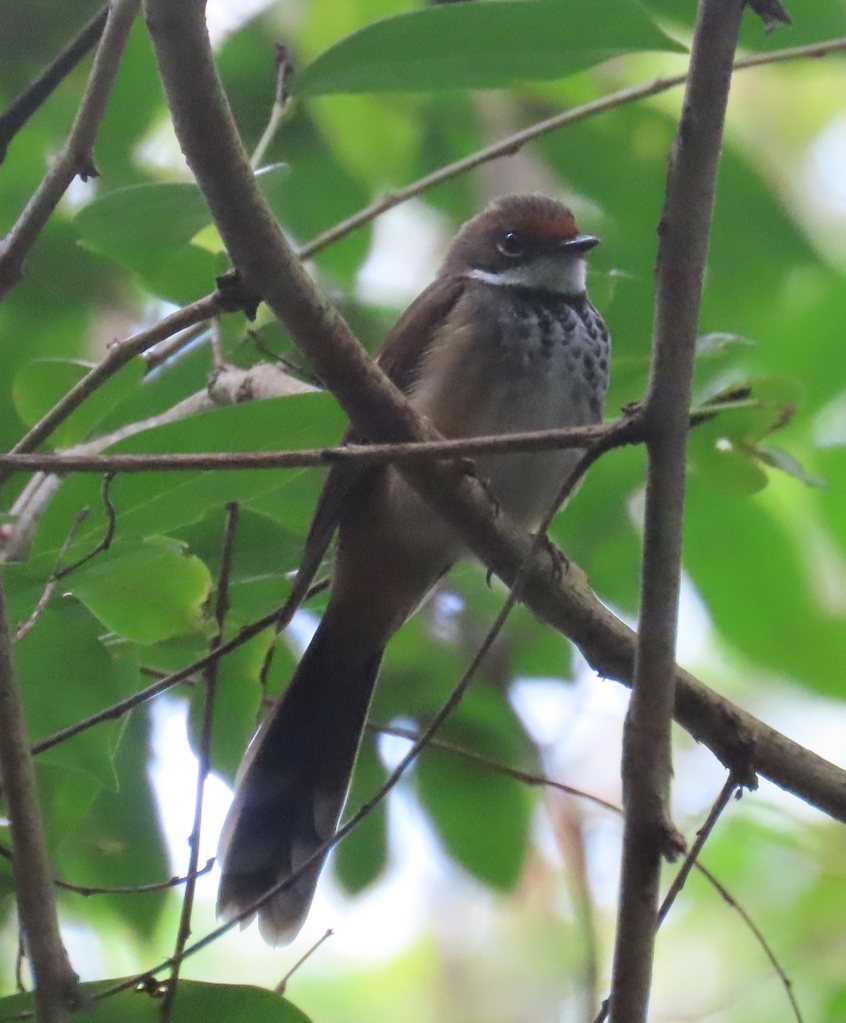
The next bird is a first sighting for me: a pretty Rufous Fantail (Rhipidura rufifrons):
This video is rather blurry, but it’s useful because you can hear the characteristic song of the fantail, similar to that of the Grey Fantail and Willie Wagtail:
My last bird of the day is a Brown Gerygone (Gerygone mouki), another first sighting for me:

The photograph of this bird is very similar to the earlier one of the female Golden Whistler. However, the Gerygone has grey markings running from beak to eye. The Gerygone (9-11 cm) is also smaller than the Golden Whistler (16-18 cm), though that’s hard to tell from the photos.

Grey Fantail waving its tail
Grey Fantails are fairly common around my neck of the woods. The problem is that they move so fast, it’s hard to get them in a camera frame. A couple of days ago, one of the little birds kept going back to the same tree to show off its skills. So, with a bit of patience, I was able to get some video footage:
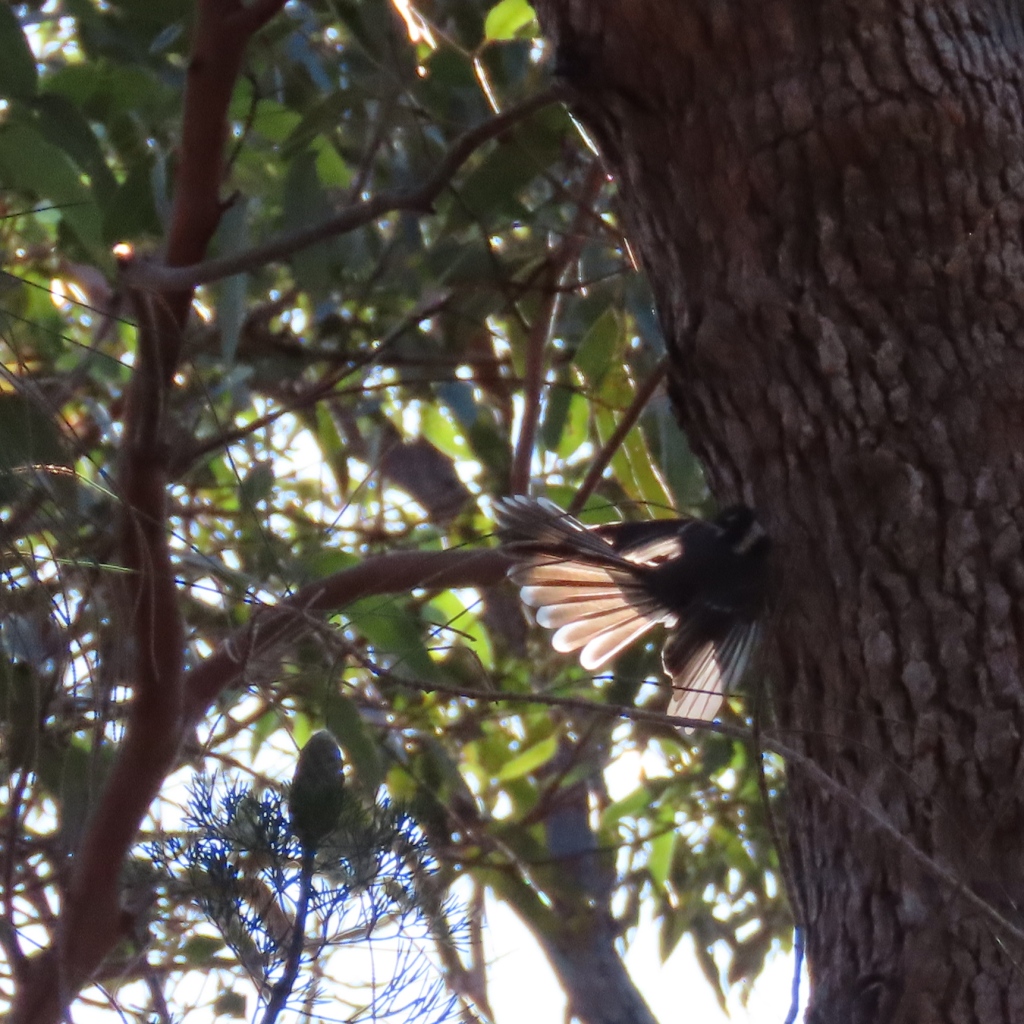
In the video, you can see the bird’s typical behaviour pattern: it makes its way up a tree trunk, waving its tail, then it drops suddenly down to ground level, before starting again. In the background, the orange Banksia flower heads glow in the sunlight.
Here’s a still picture of that fanned tail catching the light:
A couple of slightly-fuzzy images give you a better idea of what the bird looks like:
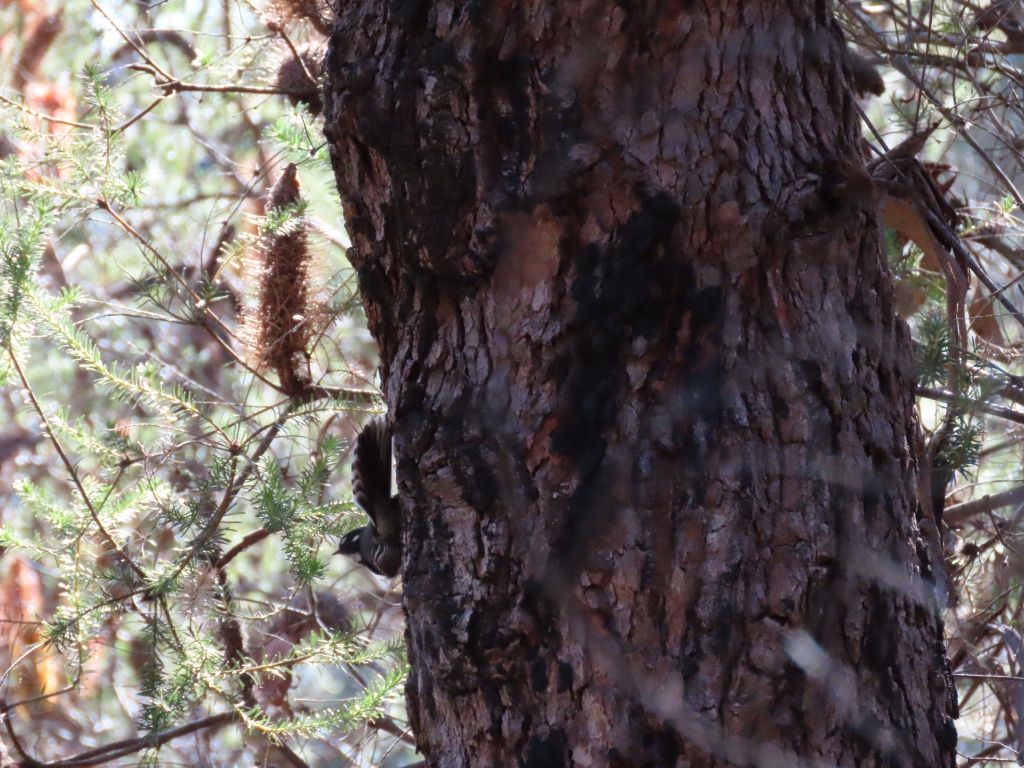
It’s a small bird (about 15 cm from head to tail). This one is quite dark in colour, with its black head and collar markings below the white throat.
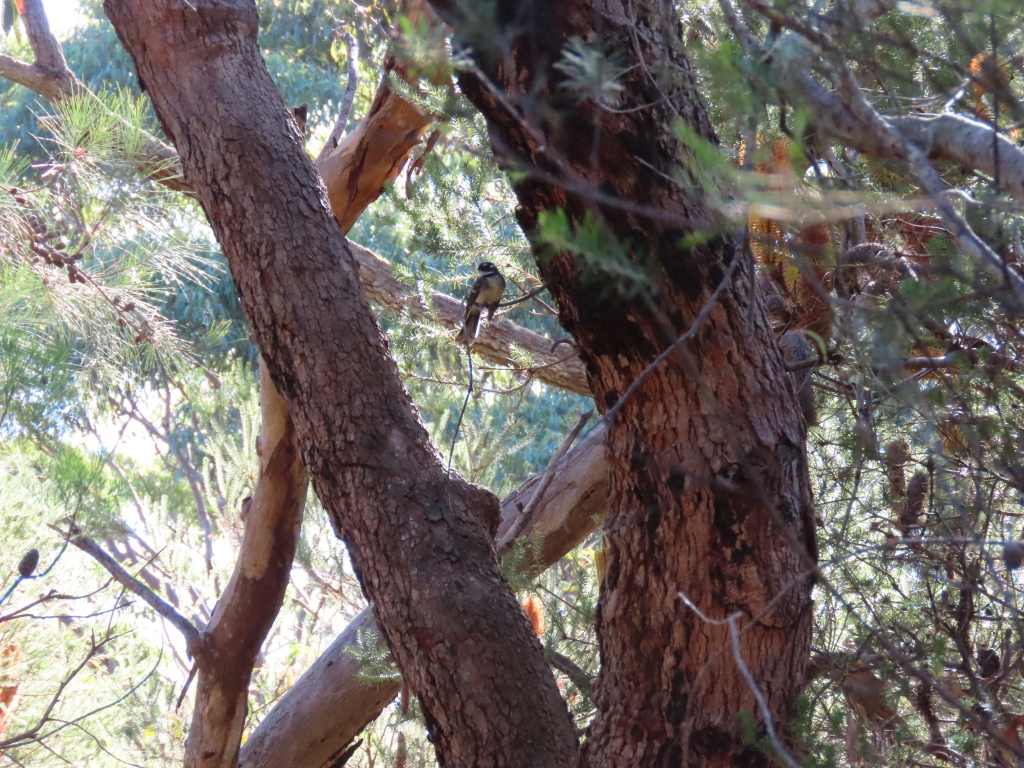
A few weeks ago, I saw another Grey Fantail in a location close to this one. Both birds were on the shores of Manly Dam, about 700 meters apart. This one is quite a lot lighter in colour:


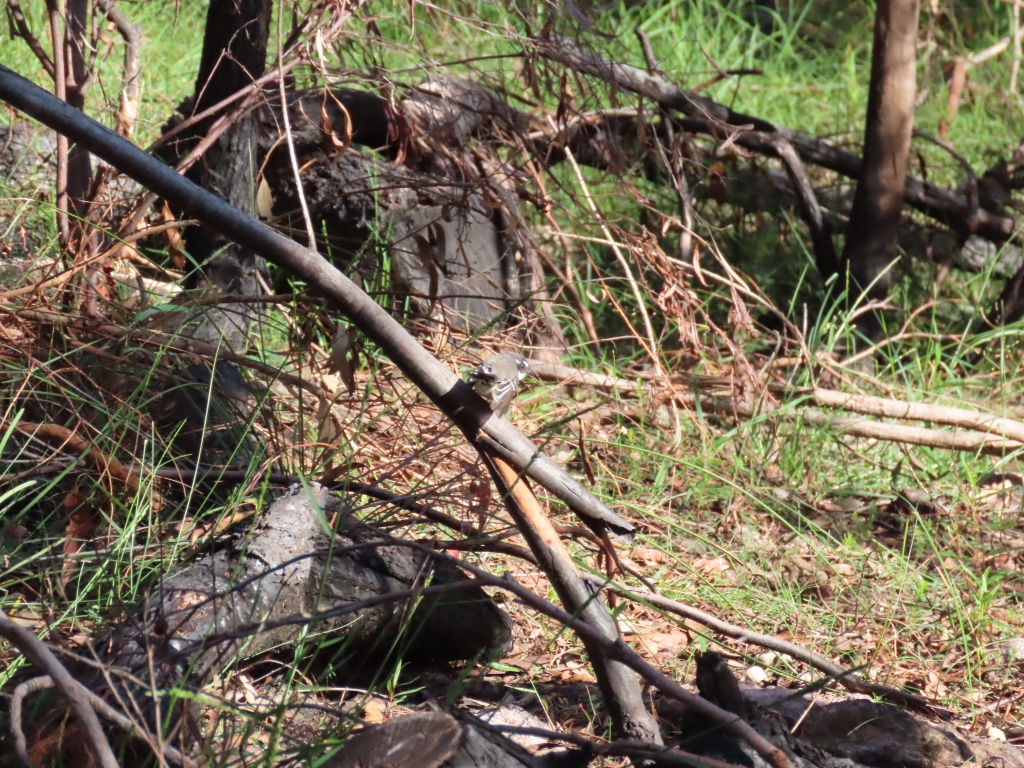
If you’d like to hear what Grey Fantails sound like (squeaky) or see other videos and photos of these birds, check out the list of my fantail blog posts.
Common name: Grey Fantail
Scientific name: Rhipidura fuliginosa
Approximate length: 14-17 cm
Date spotted: 16 June and 10 June, 2023 (winter)
Location: Manly Dam Reserve, New South Wales, Australia: 33°46’52.4″S 151°15’07.2″E and 33°46’37.9″S 151°14’48.5″E
Grey Fantail
This is only the second time I’ve managed to get a picture of a Grey Fantail. Grey Fantails are smaller than Willie Wagtails, and softer in colouring. They make a similar squeaky call, but not quite as piercing as Willie Wagtail.
I’ll try to get a good photo of a Grey Fantail, if one of them will stay still long enough! In the meantime, here’s the earlier video that I took of one of these birds, about three years ago. The bird was showing off its tail-fanning skills.
Common name: Grey Fantail
Scientific name: Rhipidura fuliginosa
Approximate length: 14-17 cm
Date spotted: 4 September 2020 (spring)
Location: Manly Dam Reserve, New South Wales, Australia: 33°46’23.8″S 151°15’05.8″E
Willie Wagtail
Each time I walk around a particular area of the Manly Dam national park, there’s a little Willie Wagtail darting from branch to branch. I don’t know if it’s the same bird each time. It’s cute and cheeky. In this shot, I caught the bird in a rare contemplative mood:
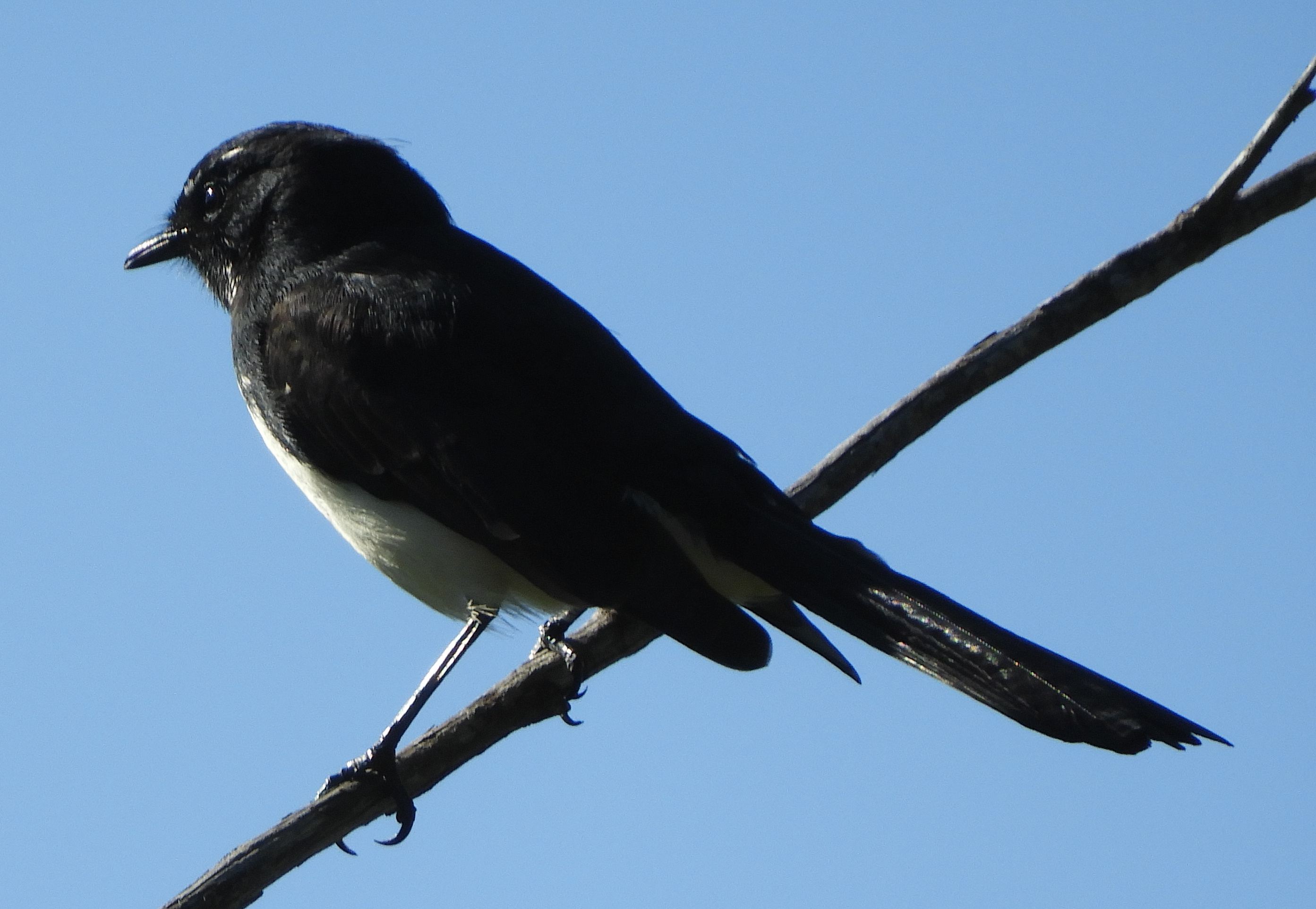
In a previous post, I published a couple of videos of a Willie Wagtail in Pyrmont, near the Sydney city centre. In particular, the first video shows the bird carolling its song to all passers-by, with the Sydney harbour in the background. It’s worth a look: Willie Wagtail sings to beauty at dawn.
Common name: Willie Wagtail
Scientific name: Rhipidura leucophrys
Approximate length: 20 cm
Date spotted: 6 May 2020 (autumn)
Location: Manly Dam National Park, New South Wales, Australia: 33°46’34.3″S 151°14’47.4″E
Willie Wagtail sings to beauty at dawn
It’s early on a cold morning in Pyrmont. A little Willie Wagtail perches on a bollard and sings its heart out. Shades of silver dapple the water. Sydney Harbour Bridge decorates the skyline. All the requisites for an atmospheric scene are present and correct.
Apologies for the low quality of the picture. I was using my mobile phone to film the scene, and had to zoom because the bird was so small. However, this little Willie Wagtail has a big voice and a big heart.
In this second video, a Willie Wagtail harasses a Currawong, chittering and swooping at it. The birds are in the same place as the previous video, so it’s probably the same Willie Wagtail. It’s a common sight in Australia, to see the little birds chasing away the big ones.
Despite their name, Willie Wagtails are actually fantails rather than wagtails. The latter tend to waggle their tails up and down rather than side to side. However, Australians chose the name Willie Wagtail and it stuck.
Here’s a still photo of the same bird, also taken with my mobile phone, so also not wonderfully in focus.
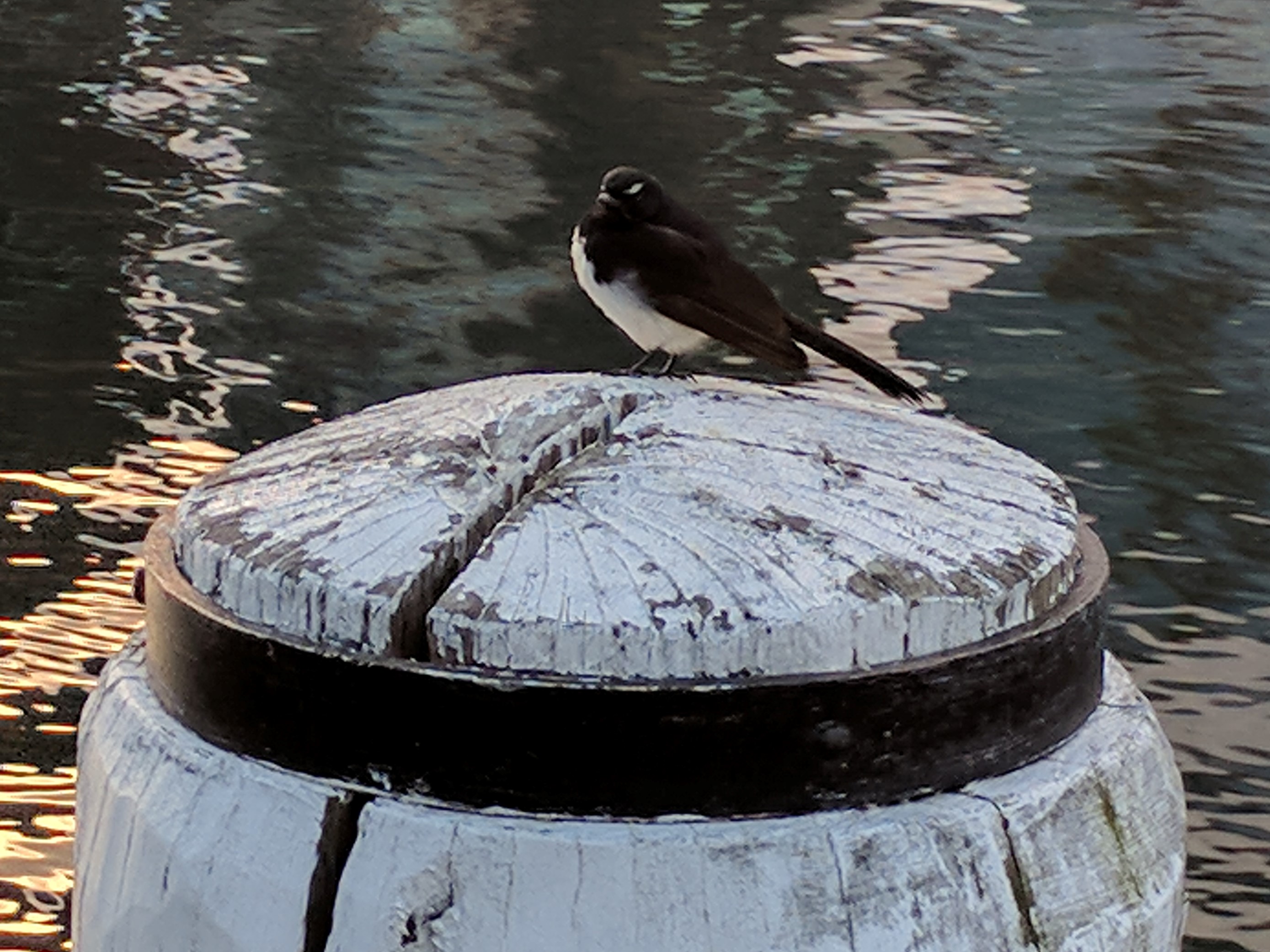
Common name: Willie Wagtail
Scientific name: Rhipidura leucophrys
Approximate length: 20 cm
Date spotted: August 2017 (Winter)
Location: Pyrmont, Sydney: 33°51’57.3″S 151°11’47.9″E
Grey Fantail fluttering and waving its tail
Every now and then, while walking in the bush near Sydney, I see a bird fluttering up and down a tree and waving its tail in a merry dance. These birds move fast and don’t stay in one place for long. It’s hard to take a photo, especially as they’re usually deep in the undergrowth.
Today I managed to video one of these showoffs. As you’ll see, I had to follow the bird in its random jaunts to various branches of the tree. Now that I had a video, I could identify the bird. It’s a Grey Fantail, according to my bird book. Specifically, I think it’s one the alisteri race, which is the most common in the Sydney region.
Common name: Grey Fantail
Scientific name: Rhipidura fuliginosa
Approximate length: 15 cm
Date spotted: 13 August 2017 (Early spring)
Location: Manly Dam National Reserve, New South Wales, Australia: 33°46’16.1″S 151°14’47.5″E
Willie Wagtail attacks Raven
Australian Ravens are big, fierce birds. Willie Wagtails are round little balls of fluff with a faintly ridiculous habit of waving their tails around. But don’t let appearances deceive you. Willie Wagtails are plucky, if reckless. This one took objection to the spot a raven had chosen for a perch, and pestered the larger bird until it flew away.
The characters:
- Willie Wagtail (Rhipidura leucophrys), approximate length 20 cm
- Australian Raven (Corvus coronoides), approximate length: 50 cm
Date spotted: 29 January 2017
Season: Summer
Location: Manly Dam Reserve, New South Wales, Australia: 33°46’35.0″S 151°14’48.5″E
Willie Wagtail at Manly Dam
So much restless energy. A Willie Wagtail flits from spot to spot, flicking and fanning his tail for anyone who may be watching.
Willie Wagtails are members of the fantail family. Most of those I’ve seen wave their tails from side to side, rather than fanning them. But this one does occasionally show a bit of fan action.
Here’s a still photo, with a nice view of the bird’s white eyebrow:

Common name: Willie Wagtail
Scientific name: Rhipidura leucophrys
Approximate length: 20 cm
Date spotted: 13 June 2016
Season: Winter
Location: Manly Dam Reserve, New South Wales, Australia
Latitude/longitude: 33°46’36.5″S 151°15’16.1″E


 Sydney Birder