Category Archives: Cockatoo
Local group of Glossy Black-Cockatoos now six strong!
Every now and then over the last few years, I’ve seen a group of Glossy Black-Cockatoos on the banks of Manly Dam. They have a few favourite spots, always where the Casuarina trees are in seed.
For the first couple of years, there were always three birds in the group. I don’t know if they were the same birds each time. Then suddenly there were five. And yesterday, for the first time, there were six. Glossies are rare compared to the other types of cockatoos in our area (Sulphur-crested, Yellow-tailed Black, and Corellas), so it’s wonderful to see this group growing in size.
Yesterday was a muggy, grey day. My camera kept misting up due to the high humidity. Every now and then the mist turned to light, drifting rain that settled into blotches on the lens. Still, the video gives you and idea of the gentle, calm presence of these large birds.
Glossies are a type of parrot. In Australia we have 56 species of parrots, including cockatoos, lorikeets, rosellas, ringnecks and budgerigars. Check out my previous sightings of Glossy Black-Cockatoos.
Common name: Glossy Black-Cockatoo
Scientific name: Calyptorhynchus lathami
Approximate length: 50cm
Date spotted: 19 March 2026 (autumn)
Location: Manly Dam Park, near Sydney: 33°46’23.8″S 151°14’39.5″E

Cockatoo chases off a falcon
I was walking along a bush path at Manly Dam when I heard a cockatoo making a big fuss on the other side of the creek that feeds into the dam. I looked across the water in time to see the cockatoo leaping off its perch and launching itself towards a branch not far away. As the cockatoo landed on its new perch, a dark shape took off from that same branch and floated away to another tree.
I grabbed my camera and zoomed in on the bird that the cockatoo had chased off. It was a Nankeen Kestrel:
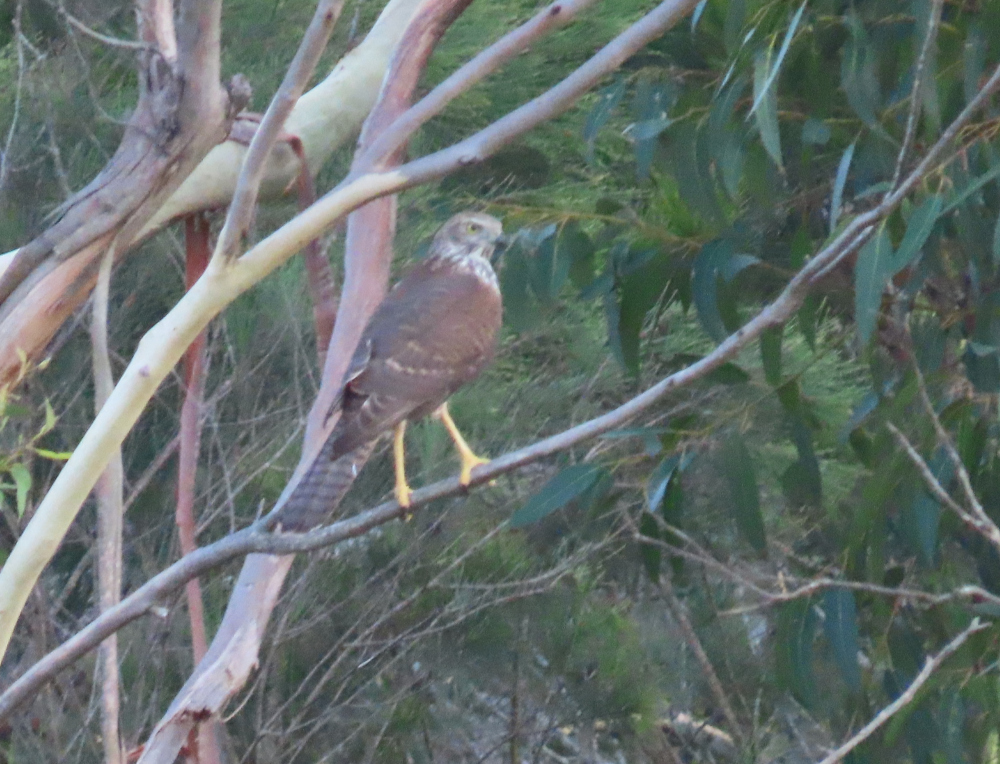
It looks like a female bird, with its light-coloured head and the dark-grey “tear mark” going down vertically from its eye.
Common name: Nankeen Kestrel
Scientific name: Falco cenchroides
Length: 30-35 cm; wing span: 60-80 cm
Date spotted: 29 January 2026 (summer)
Location: Manly Dam Park, New South Wales, Australia: 33°46’19.8″S 151°14’35.5″E
The Sulphur-crested Cockatoo looked very pleased with itself, now owning the area where the hawk had been resting:
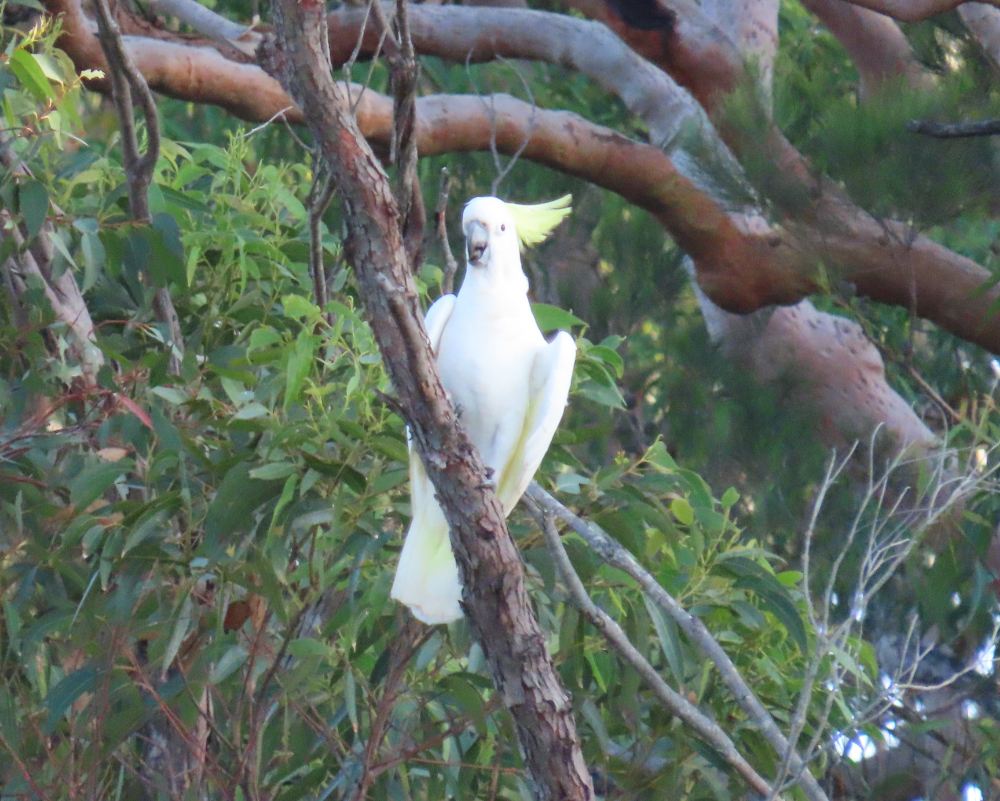
Common name: Sulphur-crested Cockatoo
Scientific name: Cacatua galerita
Approximate length: 50 cm; wing span: up to 103 cm
It takes a brave bird to attack a falcon. On the other hand, it takes a brave bird to stand up to a cockatoo, especially when the cockatoo is bigger than you. I think the falcon was vulnerable as it was perched on a branch. If it had been in the air, the cockatoo might have come off worse.
The photos aren’t very clear, since the birds were far away on the opposite side of the dam. Still, they’re good enough to identify the birds.
After a couple of minutes of enduring the cockatoo’s screeching and prancing, the kestrel decided enough was enough. It floated away in search of a quieter location:
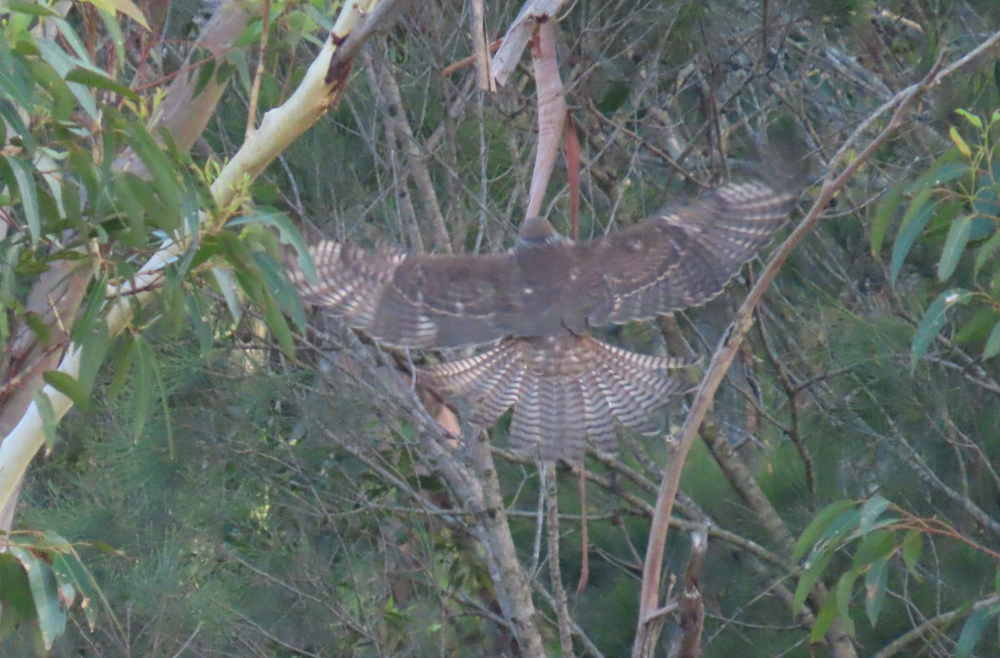
Nankeen Kestrels are small falcons, quite common in Australia. They feed on small mammals and birds, reptiles, and insects.
This is only the second time that I’ve spotted a Nankeen Kestrel. My first sighting was of a male bird in Victoria.
Happy bush-walking all!

Wild cockatoos come up close for a chat
This morning, I was out for a walk in the bush near Sydney, Australia, when I spotted two Sulphur-crested Cockatoos on a bush overhanging the path. As I came along the path, I spoke softly to the birds, as I often do. It’s partly because they’re so friendly-looking (anthropomorphism, I know!) and partly in the hope that I won’t scare them unduly. Many birds seem to respond well to being spoken to.
When I was close, the two cockatoos glided down to join their mates on the bank of a creek just below. I crouched down to take some photos. After a couple of minutes, the group of birds fluttered up and joined me on my rocky outcrop. They were on the ground next to me, just a foot or so away. It was a lovely, though slightly daunting, experience.
In the video, you can hear some Grey Fantails and a Golden Whistler, as well as the cockatoos.
Here’s one of the cockatoos on the bush overhanging the path, before the bird dropped down to join the gang on the bank of the creek. It’s enjoying an Acacia seed pod:

Common name: Sulphur-crested Cockatoo
Scientific name: Cacatua galerita
Approximate length: 50 cm
Date spotted: 29 August 2025 (winter)
Location: Manly Dam Reserve, New South Wales, Australia: 33°46’50.9″S 151°14’52.3″E
Learning how to be a Yellow-tailed Black Cockatoo
Strolling along a path at Manly Dam, I came across a group of Yellow-tailed Black Cockatoos. It’s always a treat being with these birds. They’re the quiet giants of the cockatoos in south eastern Australia. They sit on Banksia trees or, in this case, Casuarinas, chewing the seeds and chuntering to each other. Occasionally, one of the birds floats up into the air and glides to another branch.
In the group were two juveniles, making that almost-constant crooning noise that characterises them. I think it’s partially a request for food, and partially a reminder to the adult birds of where the little ones have got too.
This youngster hasn’t quite figured out what to do with a Casuarina seed pod. He finds one on the ground, touches it to his beak, then drops it. Nearby, an adult shows him how it’s done:
A little later, the youngster has climbed into a tree. Instead of tackling those hard seed pods, though, he practices wielding his beak on the bark:
Common name: Yellow-tailed Black Cockatoo
Scientific name: Calyptorhynchus funereus or Zanda funereus
Length: 58-65 cm
Date spotted: 24 July 2025 (winter)
Location: Manly Dam Reserve, New South Wales, Australia: 33°46’42.5″S 151°14’59.1″E

Little Corella enjoying a snack
This Little Corella was one of a group enjoying a tasty snack (fruit from a nearby fir tree of some kind):
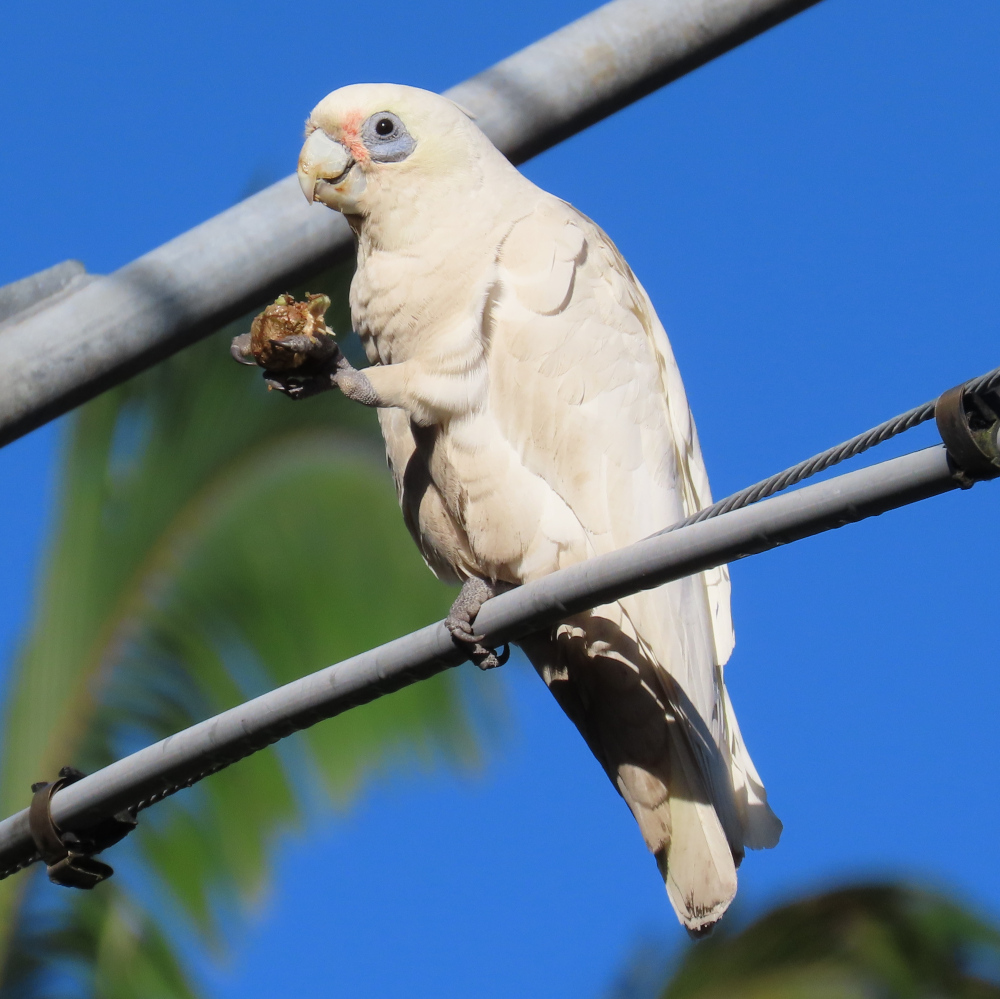
People have a love-hate with these birds. On the one hand, corellas are cute, pretty, and smart. On the other hand, they’re noisy and fiendishly good at destroying property!
Common name: Little Corella
Scientific name: Cacatua sanguinea
Approximate length: 36-39 cm
Date spotted: 22 April 2025 (autumn)
Location: Balgowlah, New South Wales, Australia: 33°47’57.2″S 151°15’50.9″E

A row of cockatoos and one raven

The arrival of the raven: It’s pouring with rain. Several Sulphur-crested Cockatoos line up on the wall of Manly Dam. Clumping together for company in the dismal weather. An Australian Raven joins the line-up. The cockatoos eye the interloper up and down, but don’t make too much of a fuss. Some of them get bored and head for a nearby tree:
Off camera: A runner arrives and the rest of the cockatoos depart for the tree. The raven doesn’t budge. Another raven arrives.
The return of the cockatoos: They need to reclaim their perch! The strategy seems to be simply to pile into the line-up until it becomes too uncomfortable for the ravens. One raven departs quickly, the other sticks it out for a while, then decides to retreat to a higher roost and gaze down at the silly, squawking cockatoos:
Common name: Sulphur-crested Cockatoo
Scientific name: Cacatua galerita
Approximate length: 50 cm
Common name: Australian Raven
Scientific name: Corvus coronoides
Approximate length: 50 cm
Date spotted: 28 March 2025 (autumn)
Location: Manly Dam, New South Wales, Australia: 33°46’55.3″S 151°15’20.1″E

Gang-gang Cockatoos on a river bank
I’ve been in the Victorian High Country for the last few days. This part of the state of Victoria features gorgeous countryside, steep mountain sides, deep valleys, and wide rivers.
In this lovely setting, I spotted my first Gang-gang Cockatoos. It was a great pleasure and privilege to see a group of these quiet birds feeding and chatting in the early morning. Gang-gangs are on the endangered list, considered to be at high risk of extinction in the wild.
In this video, a female Gang-gang Cockatoo stands on a rock at the edge of the Mitta Mitta River, nibbling at the water weeds. It was early morning, and the light was dim. I’d heard the odd creaky noises that this bird and her companions were making, and went to investigate. To make the video, I stood on a footbridge over the river at Taylor’s Crossing Campground.
I love the noises that these birds make. A mix of creaks and growls. It was the sound that led me to investigate, like a cross between the call of a raven and the squawk of a cockatoo. You can hear some of the bird’s soft creaks at the start of the above video.
The name “gang-gang” comes from the Wiradjuri language, and maybe from other Aboriginal Australian languages too. It’s most likely an onomatopoeic word, echoing the noises that the birds make.
It also interesting to see a cockatoo eating a water weed. She chewed through the entire long strand, consuming the whole thing with evident enjoyment.
There were four Gang-gangs at the river: two females, an adult male, and a juvenile male. My photos are a bit fuzzy, due to the early morning dimness.
Here’s the adult male, with his bright red head and crest:

The next photo shows an immature male. The red on his head and crest is just starting to come in. (Ignore the red leaf at the end of the bird’s tail):
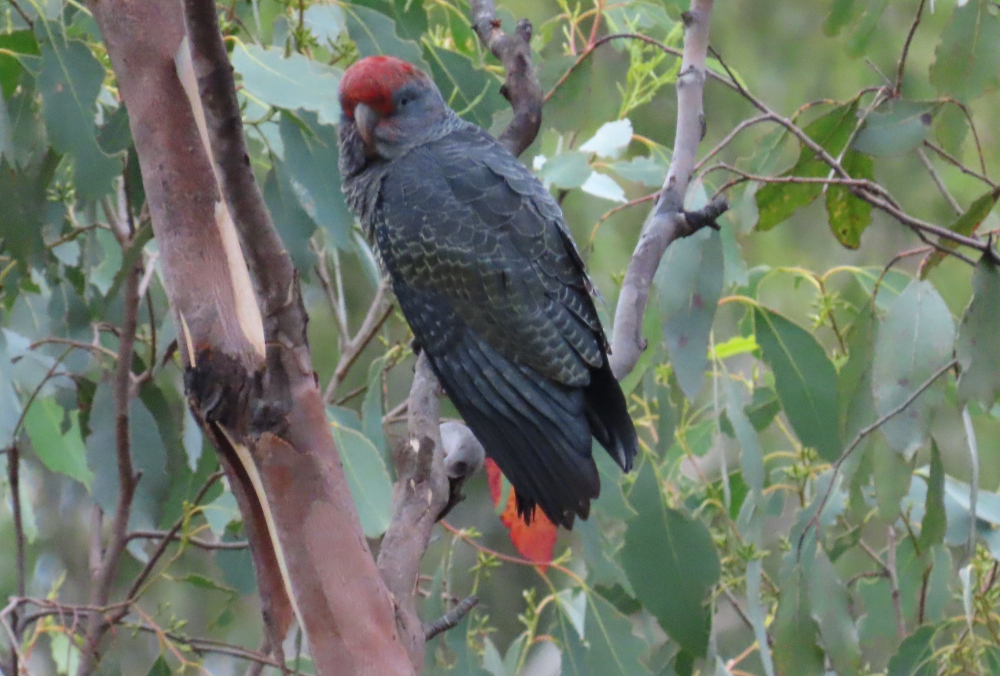
Here’s a photo of the female down on the river bank:
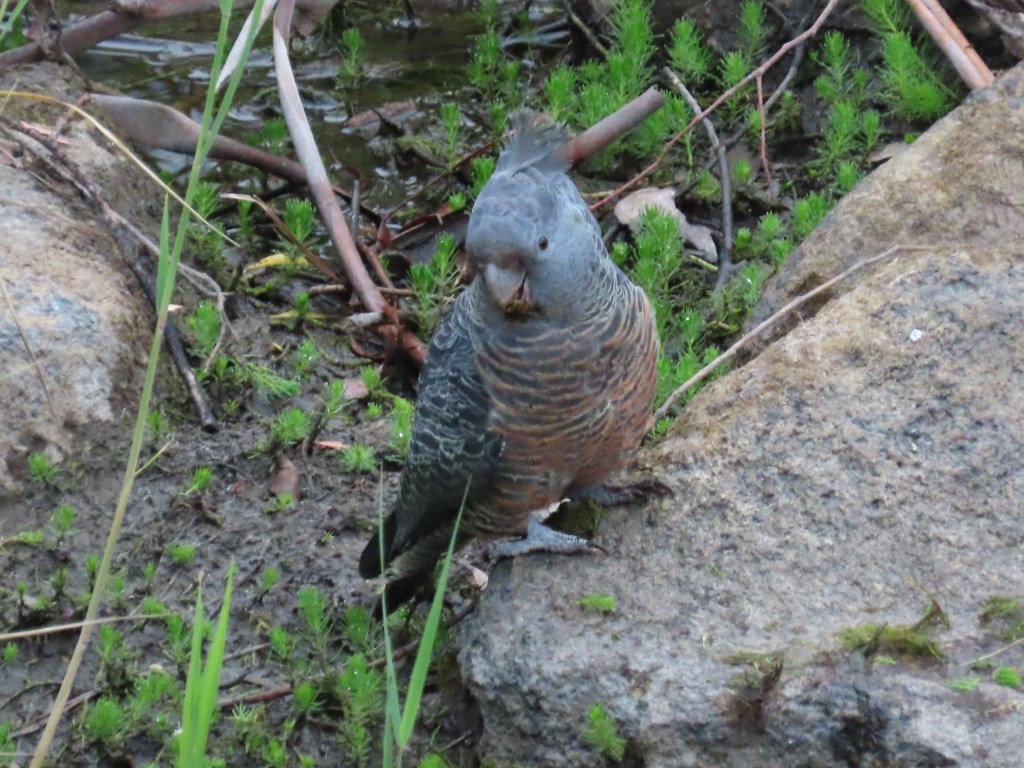
Her wispy crest is a soft grey, a bit like a feather duster:

Common name: Gang-gang Cockatoo
Scientific name: Callocephalon fimbriatum
Approximate length: 33-36 cm
Date spotted: 25 February 2025 (summer)
Location: Taylors Crossing Campground, Mitta Mitta River, Victorian High Country, Australia: 36°49’33.7″S 147°39’40.6″E
Cockatoos on a shed roof
A gang of Sulphur-crested Cockatoos dropped by to examine our shed roof and munch some grass seeds. One of the birds rather liked the noise the roof made when he jumped on it. Another bird is rather mucky, with brownish feathers. Perhaps he’s been dumpster diving? It’s interesting watching the interaction between the birds as they share a spray of grass flowers.

Glossy Black-Cockatoo
Five Glossy-Black Cockatoos are frequent visitors to the Casuarina trees on the edge of Manly dam at the moment. Here’s one of the birds:
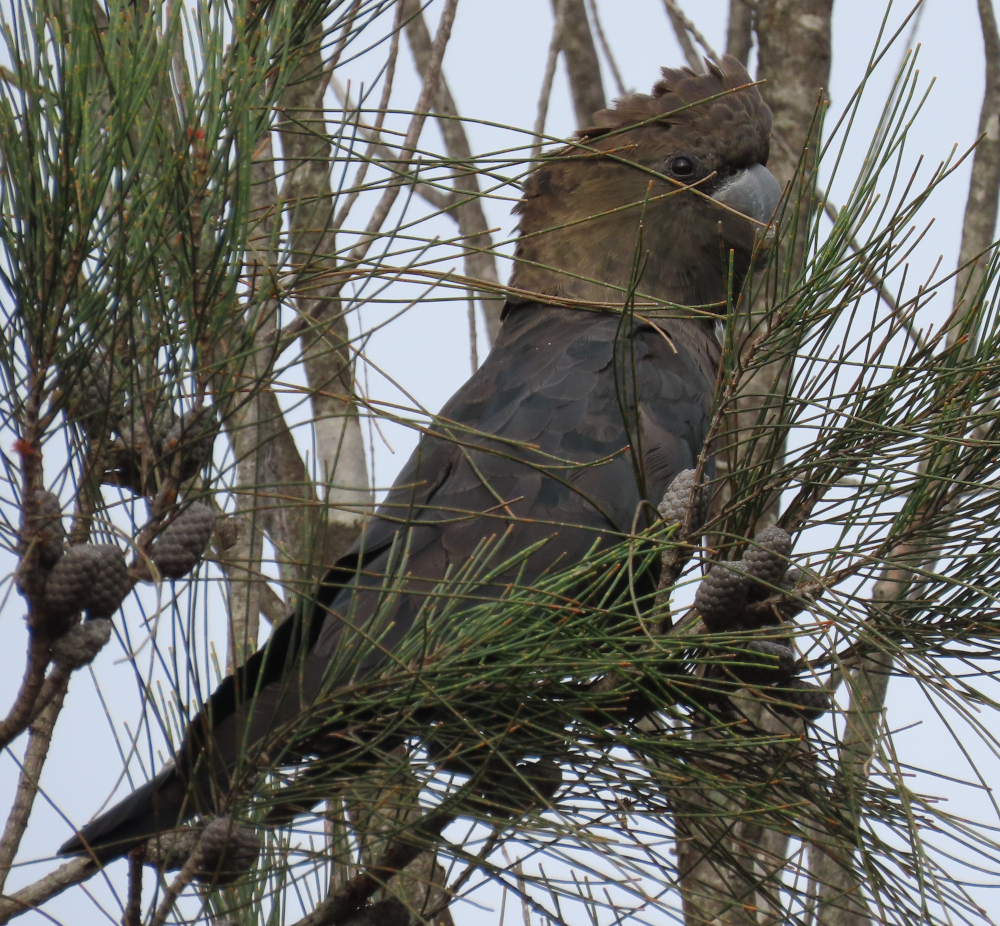
Common name: Glossy Black-Cockatoo
Scientific name: Calyptorhynchus lathami
Approximate length: 50cm
Date spotted: 27 October 2024 (spring)
Location: Manly Dam Park, near Sydney: 33°46’16.4″S 151°14’30.9″E

Mmm, Mountain Devil flowers make a nice change from those tough Banksia pods!
A Yellow-tailed Black-cockatoo contemplates life while demolishing the flower of a Mountain Devil bush.
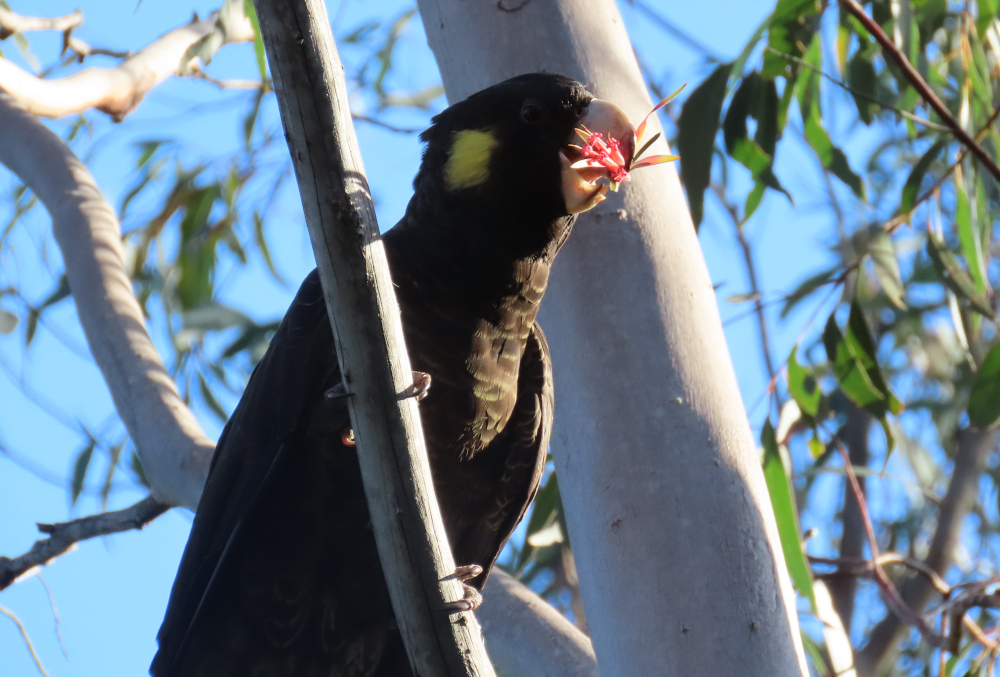
Common name: Yellow-tailed Black Cockatoo
Scientific name: Calyptorhynchus funereus or Zanda funereus
Length: 58-65 cm
Date spotted: 26 October 2024 (spring)
Location: Manly Dam Reserve, New South Wales, Australia: 33°46’40.0″S 151°14’50.2″E


 Sydney Birder