Category Archives: Brush-turkey
3 Glossy Black-Cockatoos and a tale of a Brush-turkey and a Raven
Two days ago, I encountered a group of three Glossy Black-Cockatoos on a Casuarina tree. These large cockatoos are not a very common sight. When I noticed them, I stopped walking and said “ooh” out loud. Luckily there was no-one around to hear, and the birds ignored me!
While I was watching the cockatoos, a couple of other characters appeared and contributed to the encounter. Read the story below!
First, the glossies
This picture shows two of the Glossy Black-Cockatoos. They’re quite different in appearance from the more common Yellow-tailed Black-Cockatoos. The feather arrangement around the glossies’ necks and the general setting of their heads make me think of a lion:

I think the bird on the left is a female, as she has a lot of yellow around her head. The one on the right is, I think, a male.
In the video below, the birds are munching happily on Casuarina seed pods. About half way through the video (at around 50-53 seconds on the timeline) the birds mutter to each other in low-pitched raspy calls. This munching and muttering is typical of the birds’ behaviour.
Below is a solo shot of the first of the three birds. This one has a lot of yellow around its head, which means it’s probably a female:
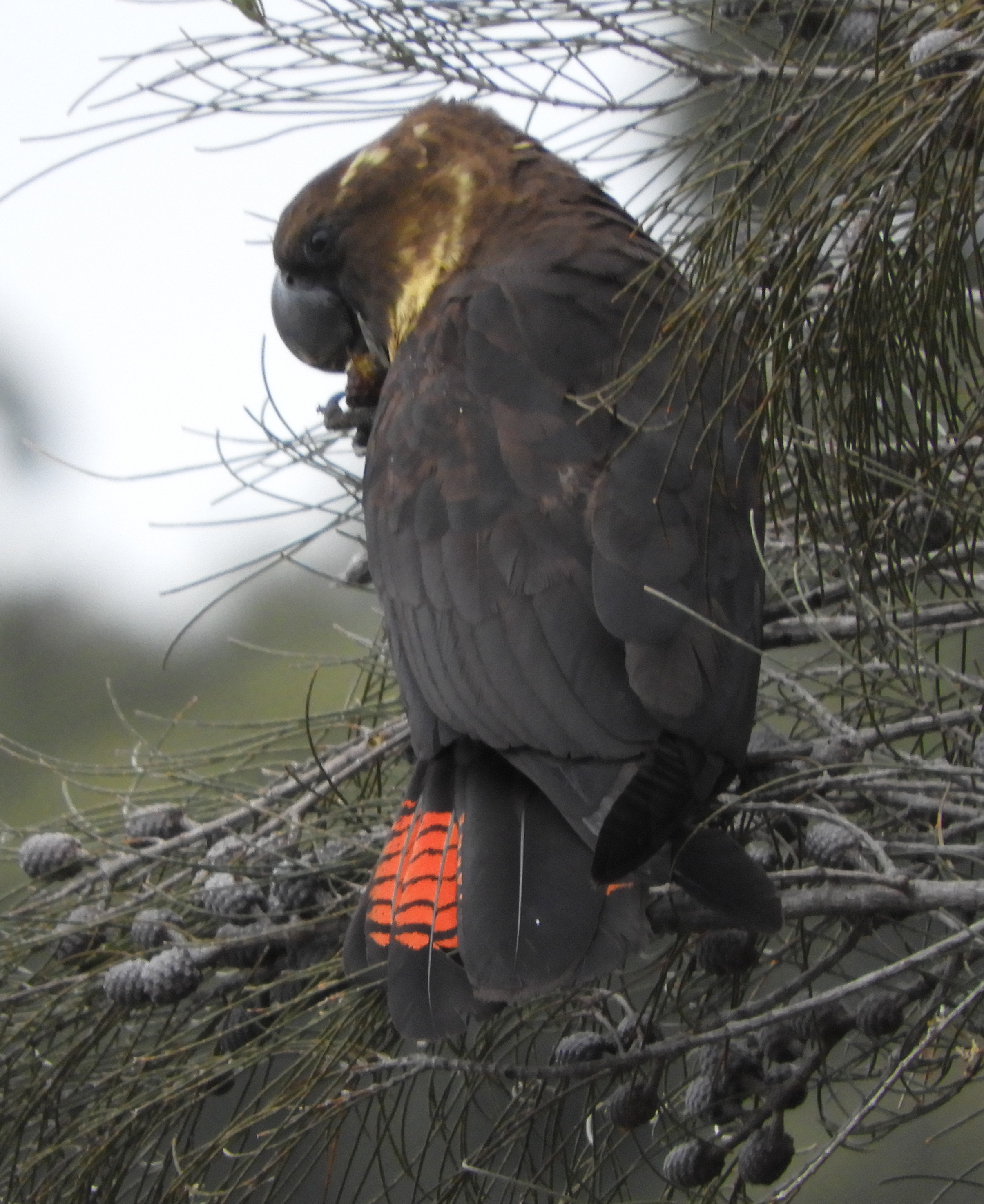
Glossy Black-Cockatoos depend on Casuarina seeds for their food. This choosiness puts the birds at risk when the tree coverage is depleted by land clearance or bush fires. Casuarinas, also called sheoaks or she-oaks, are a group of trees and shrubs native to Australia and other Asian countries. Evidently the name Casuarina is derived from cassowary (a big bird) because the branches look like cassowary feathers.
Next comes a solo shot of the second of the three birds. I think this one is a male. The feathers around its head and neck are quite brown in comparison to the darker black feathers on the rest of its body. The bird is holding a Casuarina seed pod. You can also see a few of the tree’s tiny red flowers:
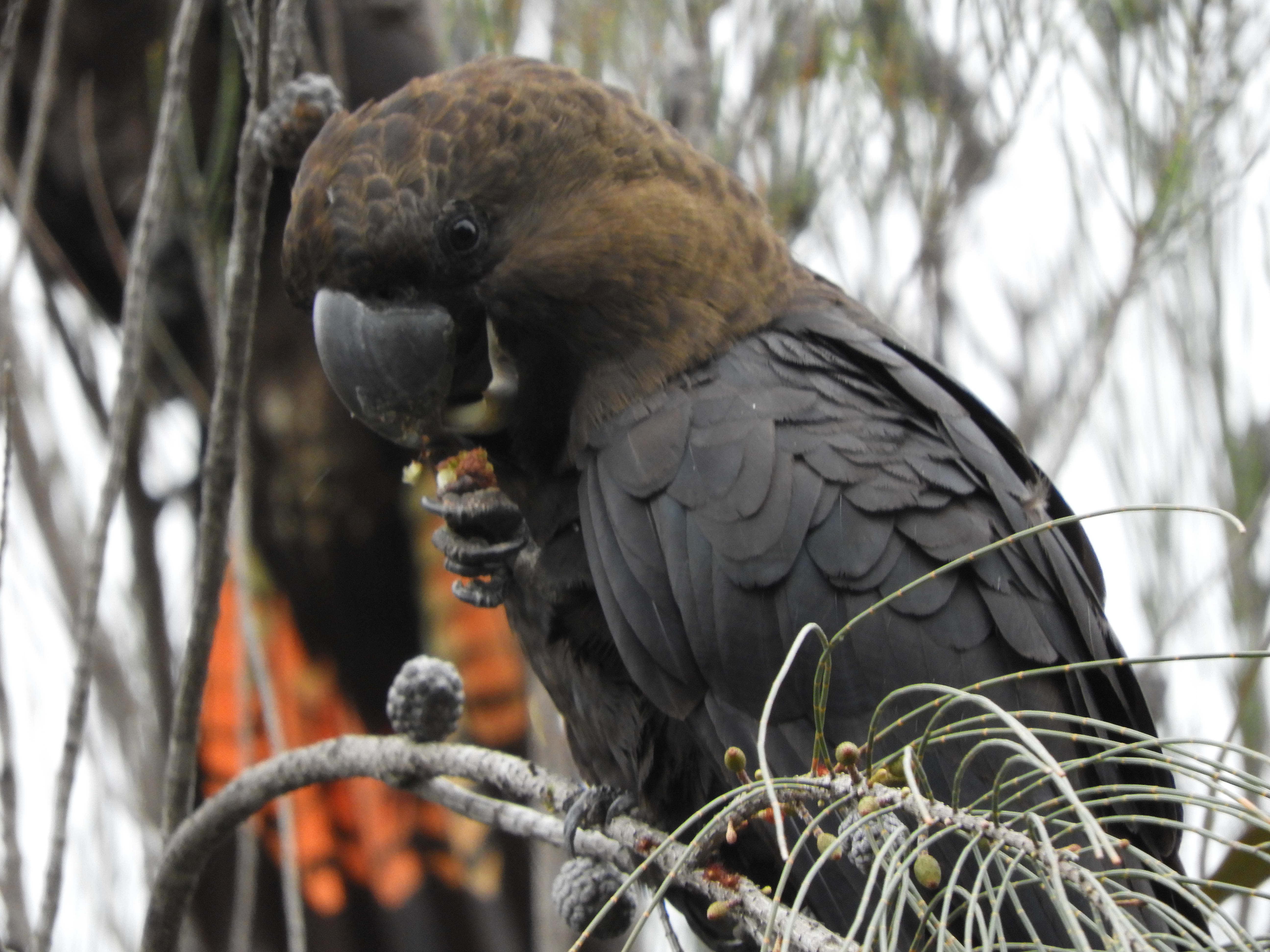
It’s a treat to see these unusual, gorgeous birds. Definitely a moment for oohing and aahing.
Unwell Glossy Black-Cockatoo – beak and feather disease?
One of the three cockatoos has an illness which has affected its beak. It may be Psittacine beak and feather disease, or some sort of cancer, or maybe the result of a fight or accident?

I didn’t notice the hole above the bird’s beak until I got the pictures home and put them on a big screen. The birds were quite a distance away, and I was using my camera’s super zoom to photograph them. But even from the long distance, I did think that the bird looked duller and more skeletal than the other two.
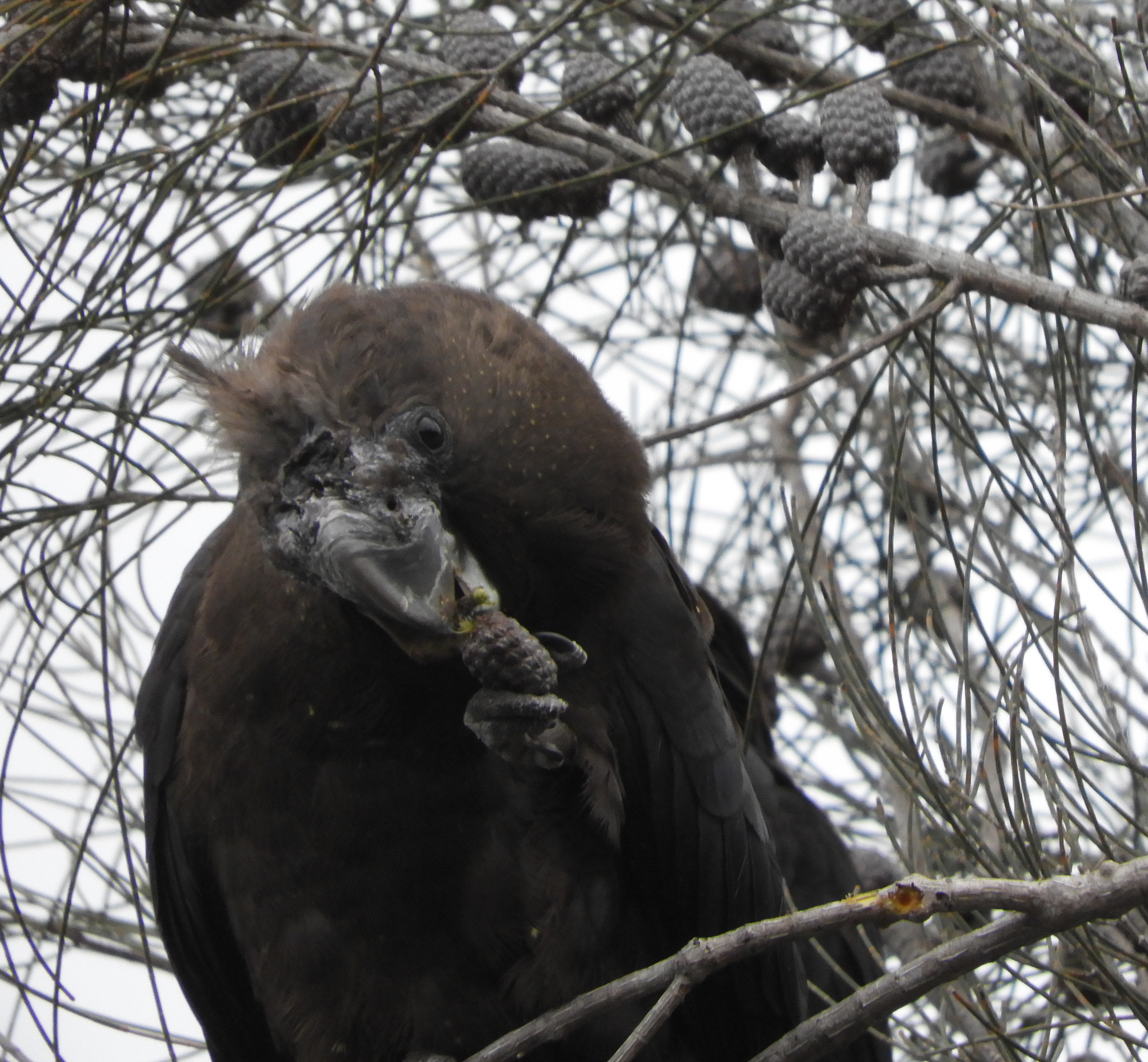
Poor bird, I hope the condition isn’t causing it too much discomfort.
Video featuring the female Glossy Black-Cockatoo
Here’s another video of two of the birds, this time featuring the female. Hint: At the start of the video you can hear a bit of thrashing around in the undergrowth. That background noise leads into the story below!
Common name: Glossy Black-Cockatoo
Scientific name: Calyptorhynchus lathami
Approximate length: 50cm
Date spotted: 18 September 2020 (spring)
Location: Manly Dam Park, near Sydney: 33°46’55.0″S 151°15’10.1″E
A tale of a Brush-turkey and an Australian Raven
If you listen carefully in the first half of the above video, you’ll hear a bit of a kerfuffle in the background. I heard it too, and turned to look when I stopped filming. I saw an Australian Brush-turkey flapping around among the trees a few metres away from me. “Ah, just a brush-turkey,” I thought, and turned back to the cockatoos. Brush-turkeys seem to specialize in making a fuss about nothing.
The kerfuffle turned into a whoosh of large wings, followed by a downdraft of air and the sound of claws on metal. I turned around again, to discover that the brush-turkey had landed on a gate less than two metres away from me. (The gate was one of those that the authorities use to close the park when the danger of bush fires is critical.)
“Hallo, mate,” said I. “What are you up to?” I do talk to birds when they approach me, partly to make us both feel comfortable.
The brush-turkey look at me, then teetered slightly and looked down at the ground with some apprehension. They do that, when they’re off the ground. They’re no doubt thinking, “I got myself up here, but now that ground is a long way down. How do I get down there?”
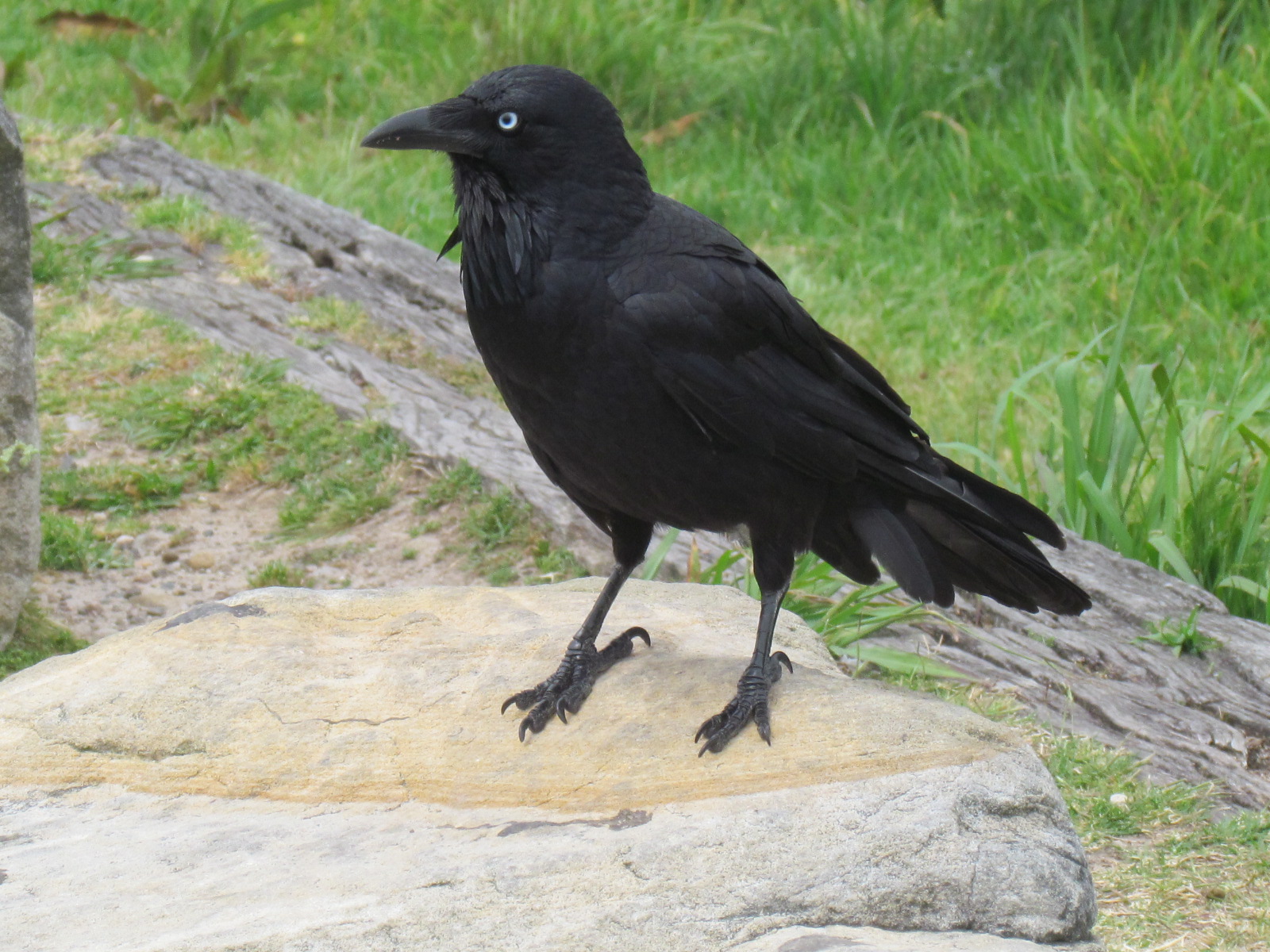
Two seconds later, a large, fierce Australian Raven arrived. Eyes ice blue. Beak long, strong, and pointy. Being the focus of that glare is rather daunting, even if you’re a large human.
The raven glared at me. I stood my ground. One point five metres of empty space between me and that beak.
The raven decided I wasn’t a threat, and turned its attention back to the brush-turkey. Obviously, the raven wanted to continue the altercation that had been the cause of all that kerfuffle in the trees.
The brush-turkey looked at the raven, looked at me, and hopped off the gate. A few hurried steps, and it was at my feet. It got as close to my knees as it could, then started walking round my legs. When it comes to a choice between a raven and me, it seems I’m a safe haven.
The raven looked thoroughly peeved. It leapt into the air and spotted the Glossy Black-Cockatoos, who were still peacefully munching and muttering in the Casuarinas. With a caw and a swoop, the raven dislodged the glossies. They floated into the air with easy grace, and came to land again a few trees away. “Ah, ravens,” the glossies were no doubt thinking. “They seem to specialize in making a fuss about nothing.”
The brush-turkey was still jittering around my legs. I wanted to continue filming the cockatoos, so I waited for a gap in the brush-turkey’s circle, and strode out along the path towards the cockatoos’ new roosting area.
Within a second, I heard the tick-tick-tick of brush-turkey claws on the path. The turkey had decided to stay with its safe haven for a while, in case that nasty bird with the ice-blue eyes and big strong beak came back.
So there we were, the cockatoos munching and muttering, I oohing and aahing, and the brush-turkey click-clacking companionably at my heels.
I wish I’d got all of that on camera! Anyway, I hope you enjoyed the story. 🙂
Here are a couple of pics of a brush-turkey and a raven, though these are not the same birds that appear in this story.

Australian Brush-turkey, so ugly it’s beautiful
An Australian Brush-turkey pops its head up from a sea of fern fronds. Up periscope!

I was walking the Gibberagong trail in Ku-ring-gai parkland when the brush-turkey appeared. The bird puttered around me for a while, went down to the creek, then came back past me:
Just look at the size of those feet. The bird is a member of the megapode family. Megapode means “big feet”.
The Australian Brush-turkey is not a very pretty bird, but its surrounds made up for that. On one side of the path was Cockle Creek:
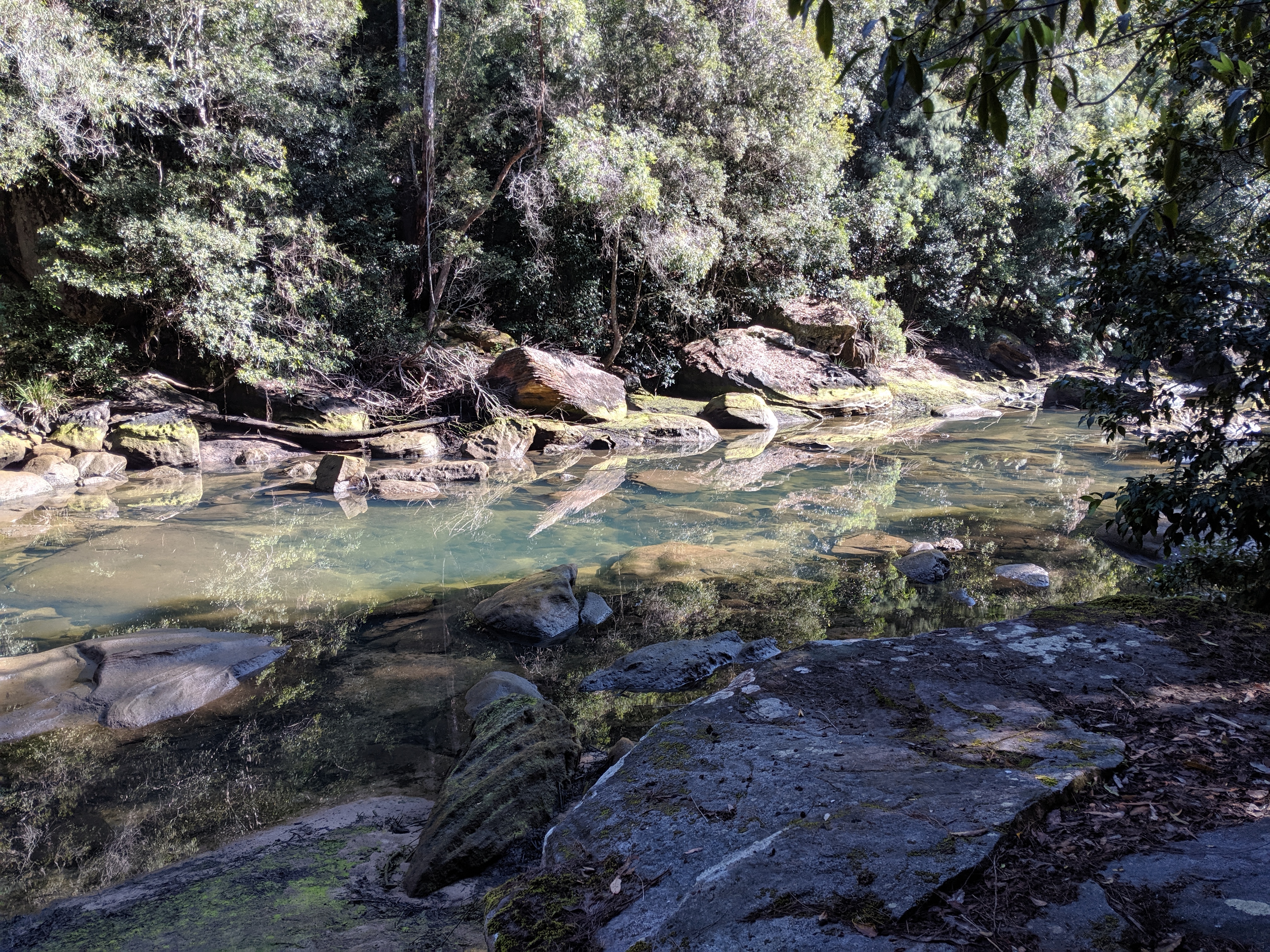
On the other side of the path, and in fact all round, the Australian forest:

Common name: Australian Brush-turkey
Scientific name: Alectura lathami
Approximate length: 60 cm
Date spotted: 28 August 2019 (late winter)
Location: Bobbin Head, Ku-ring-gai Chase National Park, New South Wales, Australia: 33°40’11.0″S 151°08’59.5″E
Noisy Miner attacking a Brush-turkey
It’s a common sight in Australia, especially in spring: a small bird dive-bombing a larger one. The small bird is usually a Noisy Miner, although other types do it too. The larger bird can be a kookaburra, a raven, a cuckoo – you name it. In fact, Australian birds are likely to attack anything, including people.
On Thursday morning this week, I saw a Brush-turkey under attack from a Noisy Miner. The first couple of videos are in a fairly low resolution, because I was using my phone camera.
Late that afternoon I passed by the same spot, and the miner and turkey were still at it! Two very stubborn birds. This video shows why Australians who are fond of their gardens tend not to be so fond of the Brush-turkeys. You’ll see a cunning dive from the miner at one point too:
Eventually, the Brush-turkey decided discretion is the better part of valour and headed out into suburbia. I had my Canon camera with me this time, so you can see the turkey in full splendour:
Peace at last, although you can still hear the Noisy Miners heckling:
The Noisy Miner:
Common name: Noisy Miner
Scientific name: Manorina melanocephala
Approximate length: 26 cm
The Brush-turkey:
Common name: Australian Brush-turkey
Scientific name: Alectura lathami
Approximate length: 60 cm
Date spotted: 27 November 2014
Season: Late spring
Location: Allambie, New South Wales, Australia
Latitude/longitude: 33°46’18.0″S 151°15’42.6″E
Australian Brushturkey kicking up leaves
The Australian Brushturkey, also called a Bush Turkey or a Scrub Turkey, is a truly weird bird. This male is a lovely specimen: large, with a bright red head and long yellow dewlaps, officially called a wattle, hanging from its neck. I followed it round a corner, where it started doing what these birds are known and loved (or hated) for: kicking up the leaves and dirt with its big strong feet. They can make a real mess of your garden.
Brushturkeys do fly, though they’re a little ungainly in the air.
Common name: Australian Brushturkey
Scientific name: Alectura lathami
Approximate length: 75 cm
Date spotted: 6 November 2011
Season: Summer
Location: Manly Dam Reserve, New South Wales, Australia
Latitude/longitude: -33.782572,151.255698


 Sydney Birder