Author Archives: Sarah Maddox

First Channel-billed Cuckoo of the season
It’s spring down under, and the cuckoos are back on the east coast of Australia. Last week I heard the calls of Koel Cuckoos and Channel-billed Cuckoos. Now I’ve seen my first one of the season: A Channel-billed Cuckoo sheltering from the local birds in a gum tree.
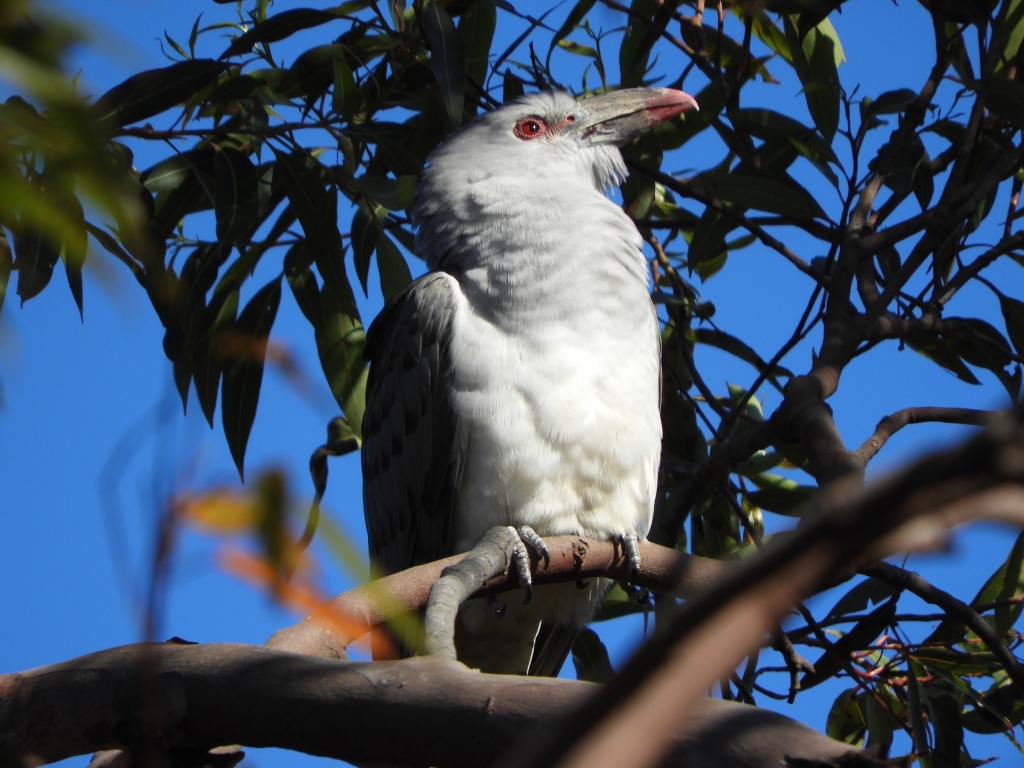
Channel-billed Cuckoos are large birds (approximately 60 cm long) with red eyes and a big beak. They often look a little scruffy, even ghoulish. The other birds seem to think so too, because they spend a lot of time dive-bombing the cuckoos and shouting at them. Usually the Noisy Miners (living up to their name) are the noisiest of the birds that strive to make the cuckoos feel unwelcome, but other birds play their part too.
This video shows the cuckoo enjoying the peace and quiet of a gum tree. At the start of the video, a Currawong swoops past in a threatening flyby. You don’t actually see the Currawong, but you can hear it and see the cuckoo flinch:
Here’s a photo showing the full length of the cuckoo, including its long, barred tail:
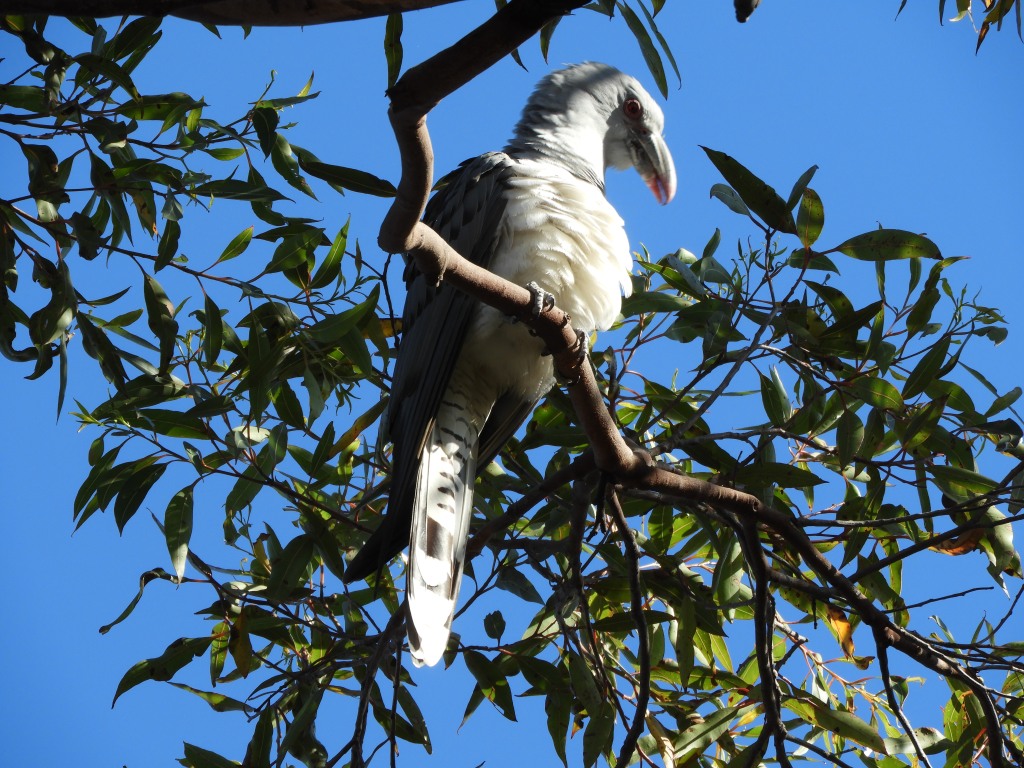
Here’s a view from the back:

Common name: Channel-billed Cuckoo
Scientific name: Scythrops novaehollandiae
Approximate length: 58-65 cm
Date spotted: 19 September 2021 (spring)
Location: Manly Dam Park, New South Wales, Australia: 33°46’33.8″S 151°15’17.8″E
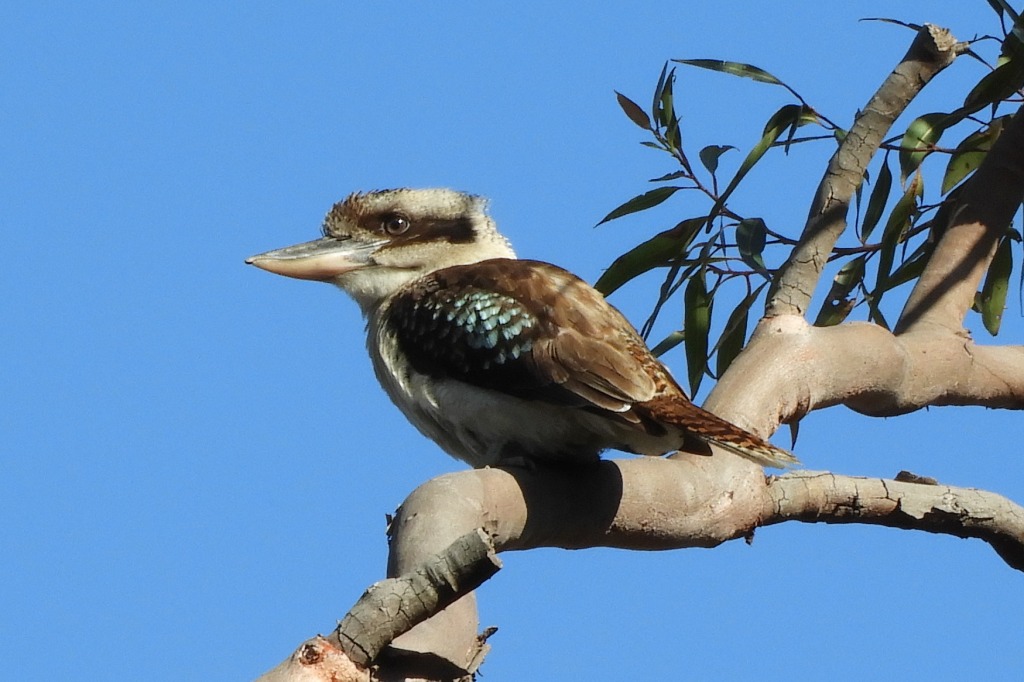
A bonus bird: Just after the Channel-billed Cuckoo flew off, a kookaburra landed on a nearby branch:

Spitfire Sawfly larva – the caterpillar that wasn’t
(Not a bird, but a creature that birds no doubt encounter either on the ground or high up in a gum tree.)
Walking along a bush path the other day, I saw a strange-looking caterpillar. It was large and black with short yellow spikes. Its front end was quite pudgy, but its body tapered off toward the back end.

When moving along, it often lifted up its front end to show its yellow legs:

After doing a bit of research, I realized that this interesting creature is a larva, not a caterpillar. Specifically, it’s the larva of the Spitfire Sawfly. Sawflies are related to wasps, ants, and bees.
Despite the name “Spitfire”, these larvae don’t actually spit anything, but if you touch them you can get a burning sting from the spikes. The larvae also spew out a thick yellow liquid from their mouths when threatened, but the liquid isn’t harmful. They often collect together in big clusters on a gum tree.
Here’s a short video of the larva moving across the forest floor:

Fairy-wrens in full finery
Variegated Fairy-wrens are quite common in my neck of the woods, but they’re very difficult to photograph. They move fast, pause only briefly, and prefer to keep hidden in the shrubbery. I took these shots over a few days, collecting mosquito bites at the same time as usable photos.
It’s spring, and the males are decked out in their breeding finery. They’re like blue fireflies lighting up the bush:
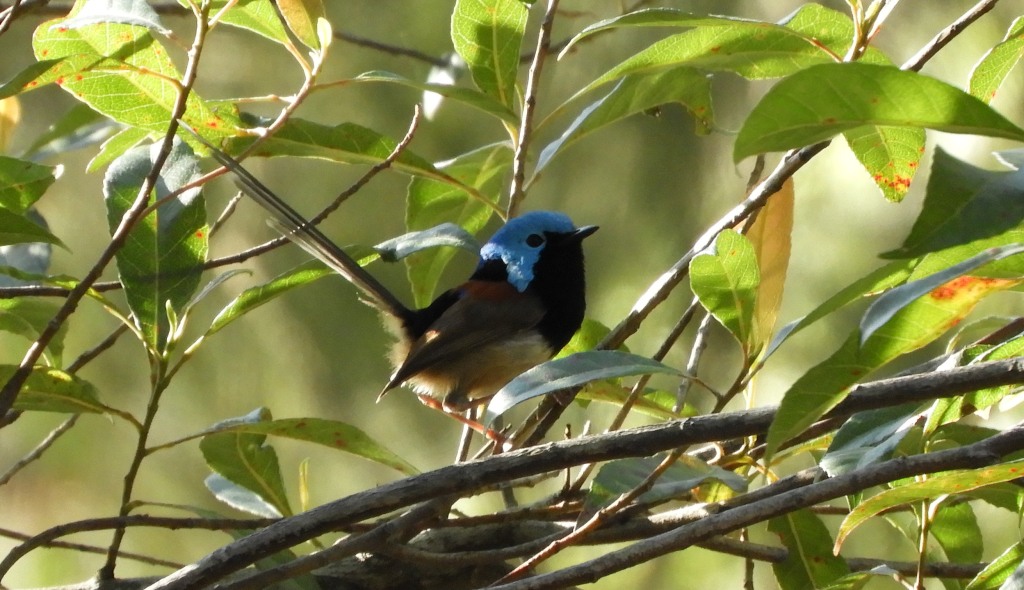
The long tail often sticks straight up. It must present quite a challenge to dashing around the shrubbery:

The females are a soft brown with pale blue hints in the tail. They have a red eye mask which can make them look slightly sardonic:
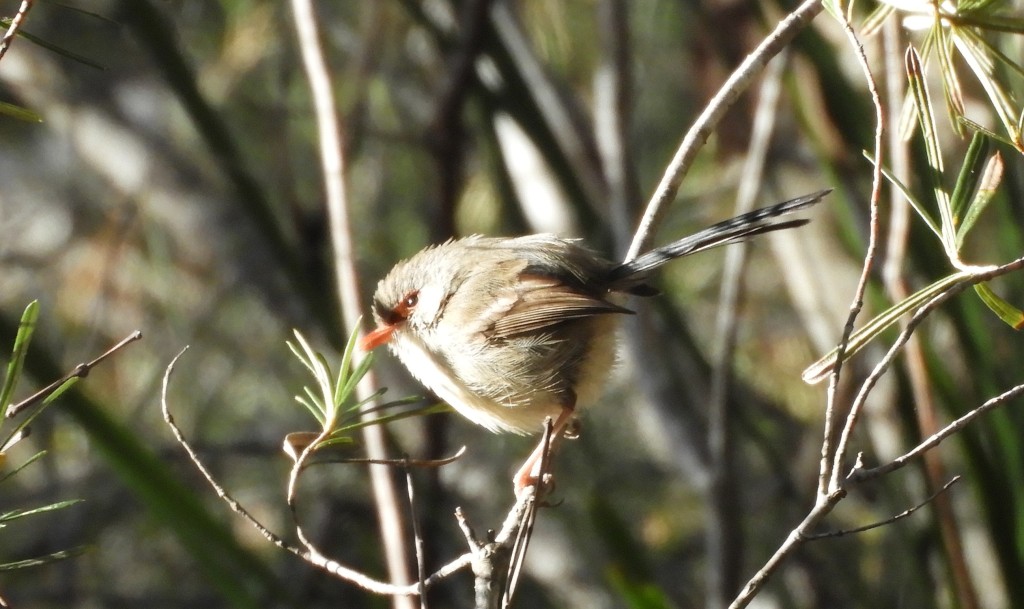
They’re like tiny little puffballs:

Like many bird names in Australia, the name “fairy-wren” is misleading. These birds aren’t actually wrens. They’re related to honeyeaters and pardalotes.
Common name: Variegated Fairy-wren
Scientific name: Malurus lamberti
Approximate length: 13 cm
Date spotted: September 2021 (spring)
Location: Manly Dam Park, New South Wales, Australia: 33°46’49.9″S 151°15’04.2″E (the male) and 33°46’20.8″S 151°14’30.6″E (the female)
More calls of the Grey Shrike-thrush including a sneeze
A few weeks ago, I posted my first video featuring the call of the Grey Shrike-thrush. I’d read that these birds make a variety of calls. Here are two more to add to the collection: A, short, high-pitched shriek and a longer call interrupted by what sounds like a sneeze or a snort!
When I first heard the sneeze-interrupted song, I thought the bird had made a mistake. But it made the same call consistently over quite a few minutes. Maybe the call is this bird’s variation on a theme, or perhaps the bird is a juvenile who’s still perfecting its song!
Common name: Grey Shrike-thrush
Scientific name: Colluricincla harmonica
Approximate length: 23 cm.
Date spotted: 8 September 2021 (spring)
Location: Manly Dam Reserve, New South Wales, Australia: 33°46’15.6″S 151°14’51.5″E

A honeyeater and a view from Dobroyd Head
Dobroyd Head is one of the headlands that juts out into Sydney Harbour, on Australia’s east coast. The walking track leading around Dobroyd Head is part of the Manly to Spit Bridge Trail. It offers plenty of bird life and gorgeous views.
When taking this picture, I was at Fairlight Lookout on Dobroyd Head, looking north east across the harbour towards Manly. On the other side of Manly is the Pacific Ocean. Next stop Fiji and then the United States.

This pretty little bird is a New Holland Honeyeater, its white ear patch tousled by the breeze:

Common name: New Holland Honeyeater
Scientific name: Phylidonyris novaehollandiae
Approximate length: 17-19 cm
Date spotted: 28 August 2021 (winter)
Location: Dobroyd Head, New South Wales, Australia: 33°48’34.7″S 151°16’18.2″E
Currawong snacks on brush-turkey’s scrapings
Spring is approaching, and male Australian Brush-turkeys are busily preparing their mounds in the hopes of attracting a female. This year there seem to be more brush-turkeys in my area than ever before. On the plus side, they do a great job of clearing the ground near their chosen location for a mound. On the minus side, the mound itself is a little unsightly. Unless you happen to be a brush-turkey, of course.
A canny currawong hung around close to this particular busy brush-turkey, snapping up the beetles and grubs that the brush-turkey’s scraping exposed:
The brush-turkey was scraping the leaves methodically and energetically in a single direction. His destination lay behind him. So I went round and found the large pile that he was creating. It was already over a metre high and three to four metres across.
A day later, I returned to the area and found the brush-turkey close to his mound:

Common name: Australian Brush-turkey
Scientific name: Alectura lathami
Approximate length: 60-70 cm
Date spotted: 25 August 2021 (winter)
Location: Manly Dam Park, New South Wales, Australia: 33°46’37.7″S 151°14’48.8″E

Call of the Grey Shrike-thrush
I’ve heard the lovely, clear calls of this bird a few times, always in the same spot on one of my favourite walks. Now at last I’ve identified the bird. It’s a Grey Shrike-thrush (I’m pretty sure) and this is only the second time I’ve managed to get some pictures of one of these birds.
In this short video, you can see glimpses of the bird and hear its call:
Evidently these birds have a variety of calls. In the next video, the same bird is singing a slightly different tune:
The next video gives a much better view of the thrush in its favourite gum tree, but the bird is taking a break from singing. In the background are the harsh calls of a wattle bird:
The bird is rounder and more fluffy than the drawings in my bird book, but the colouring and the song seem right for a Grey Shrike-thrush. I think the difference arises from the fact that there are different races of this bird in various areas of Australia.

The wing feathers have a lovely olive tinge, blending in nicely with the gum nuts and leaves:

Common name: Grey Shrike-thrush
Scientific name: Colluricincla harmonica
Approximate length: 23 cm.
Date spotted: 16 August 2021 (winter)
Location: Manly Dam Reserve, New South Wales, Australia: 33°46’07.4″S 151°14’36.8″E

Pacific Baza pays a visit
Exciting! We had a visit from a rare bird this morning. A juvenile Pacific Baza took refuge in the trees in our garden for a short time.
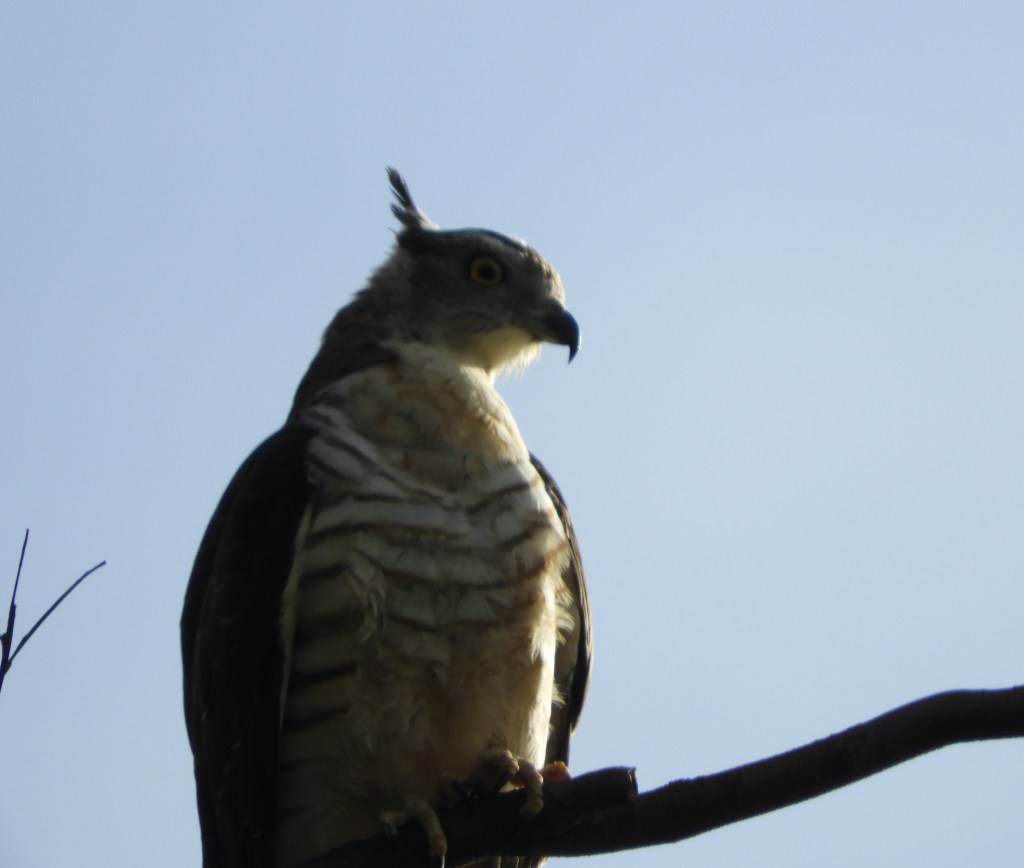
A Pacific Baza is a large bird of prey with a funny-looking crest on its head. The adults have a white head, neck, and shoulders, whereas this one still has the cinnamon colouring of a juvenile.
These birds are uncommon, mostly found in north and north-east Australia, and are rare in New South Wales (where I am). They eat small reptiles, and praying mantises and stick insects (both of which can be quite large in Australia).
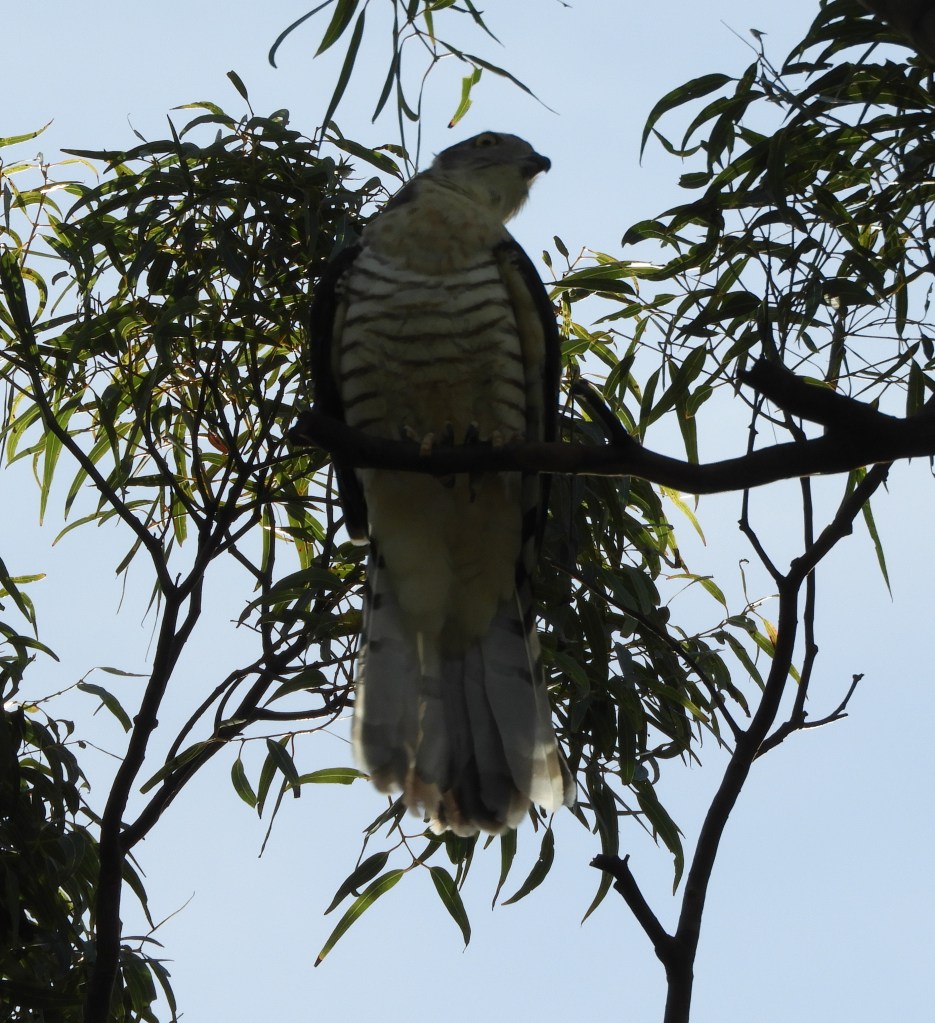
Common name: Pacific Baza
Scientific name: Aviceda subcristata
Length: 35-45 cm
Wing span: 1 metre
Date spotted: 6 July 2021 (winter)
Location: Allambie Heights, NSW, Australia

Sea-Eagles at Manly Dam
For the second time ever, I spotted a White-bellied Sea-Eagle at Manly Dam, north of Sydney. This one was circling high in the sky:

Common name: White-bellied Sea-Eagle
Scientific name: Haliaeetus leucogaster
Approximate length: 85 cm. Wing span: 2.2 m
Date spotted: 3 July 2021 (winter)
Location: Manly Dam Reserve, New South Wales, Australia: 33°46’59.2″S 151°15’19.4″E
These eagles are large, imposing creatures. The last time I saw one at the dam was back in April 2017. I didn’t post any pictures then, but now I’ve gone back and rooted out a video of that bird. The eagle was very far away then too, and I had my camera on maximum zoom.
This video, from April 2017, shows the bird coming in to land at a small beach on the opposite side of the dam from where I was:
One day, with luck, I’ll see one of these eagles from closer by!

Cuddly Tawny Frogmouths
Tawny Frogmouths have to be the cuddliest birds in the world! Today I came across these two huddled up together in the winter cold:
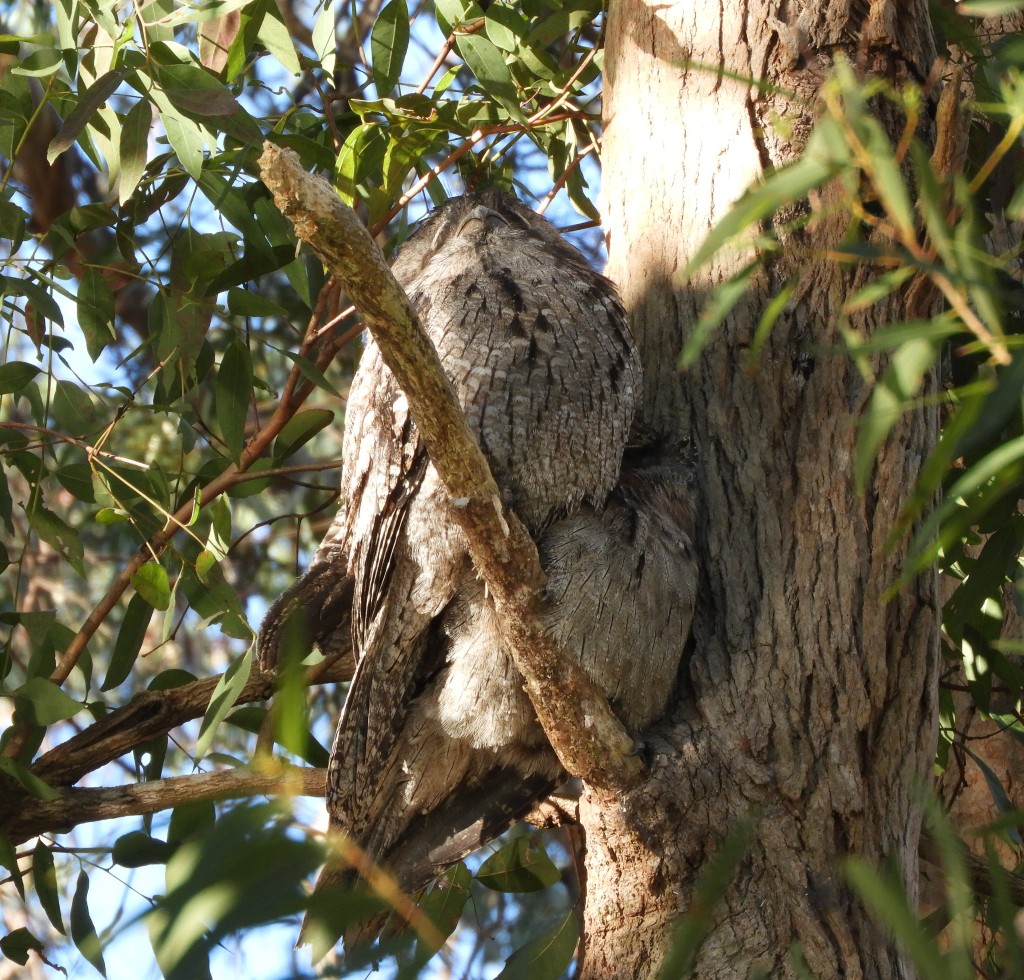
Do you find it difficult to distinguish the birds from each other and from the bark on the tree? That’s by design! Their camouflage is extraordinary. In fact, it took me ages to spot these birds. A bush walker had told me where they were, and even so it took me three trips to the park on three separate days, a second encounter with the same bush walker, and many minutes of looking before I found them.
Here’s a closer view of the Tawny Frogmouth at the top of the two-bird pile:

See the two large eyes and the upside-down smile of the beak? Tawny Frogmouths eat insects and spiders, and other small prey, which they catch in their beaks.
Around the beaks they have some rather endearing tufts of hair. People aren’t quite sure what the purpose is of the tufts. Some people think that the tufts help the birds detect insects and other prey flying around them. Other people think that the tufts keep potentially-harmful prey, like a centipede, away from the bird’s eyes and mouth until the bird has crushed it in its beak. No matter, I think the tufts make the bird look a little goofy:

Tawny Frogmouths are nightjars, though people often mistake them for owls. They’re nocturnal. During the day, they huddle together pretending to be parts of a tree.
Here’s a close view of the bird that’s lower down in the two-bird pile. In the middle, near the top of the picture, you can see one eye and the beak, and half of the bird’s body. On the left is the other bird’s body, on the right is the tree:
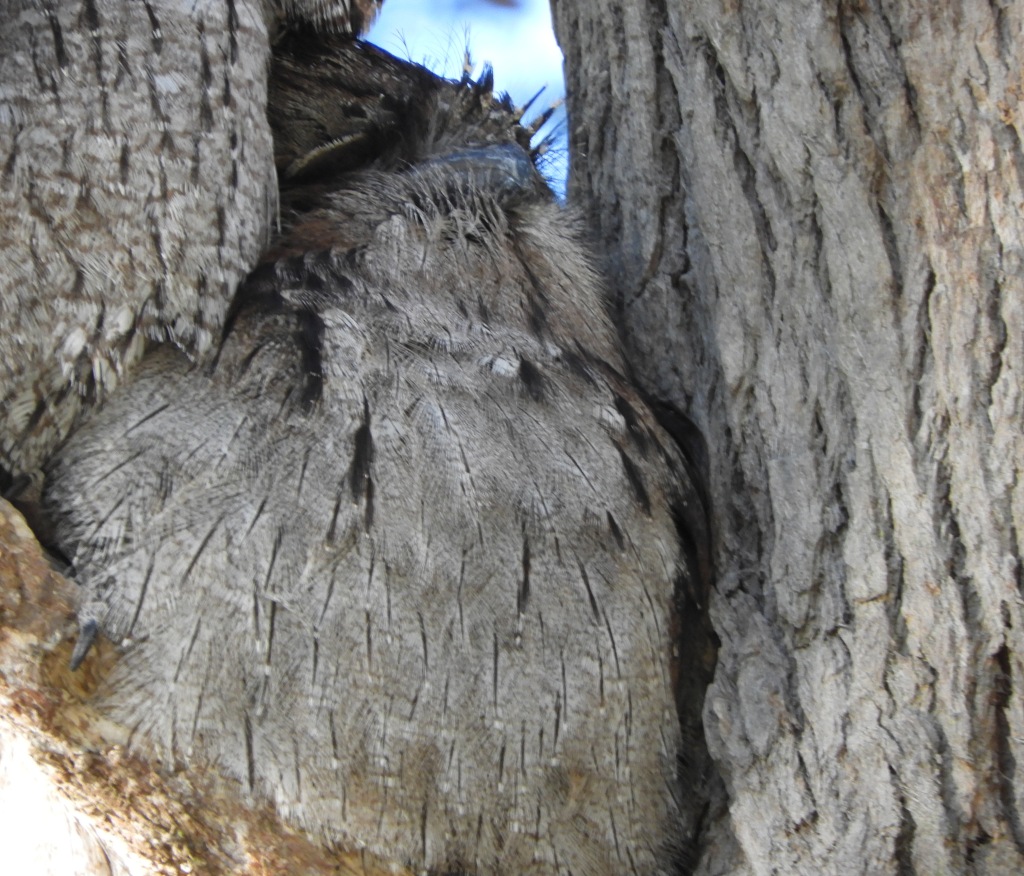
What a face!
Here’s a zoomed-out view of the birds in the tree. Spot them if you can!

To finish, here’s another angle on the top bird:

Common name: Tawny Frogmouth
Scientific name: Podargus strigoides
Approximate length: 34-52 cm
Date spotted: 27 June 2021 (winter)
Location: Manly Dam Park, New South Wales, Australia: 33°46’58.3″S 151°15’19.0″E
Update on 3 July: Here’s another photo of the birds on another day. They’d posed at a slightly different angle, which made it easier to capture a profile and a good view of the feather markings on one of them.


 Sydney Birder