Sacred Kingfisher dives on a robin
This morning, I was trying to get a good photo of this Eastern Yellow Robin:

The robin took flight and I followed it with my camera. Suddenly, a splash of bright colours dived at the robin, there was a flurry of dust and a soft thunk, and the robin took cover in the low bushes. A kingfisher had taken umbrage with the robin! Or perhaps the two birds had simply made a beeline for the same tasty-looking insect.
The kingfisher perched nearby to check for other interlopers, or perhaps to recover from the mid-air collision:
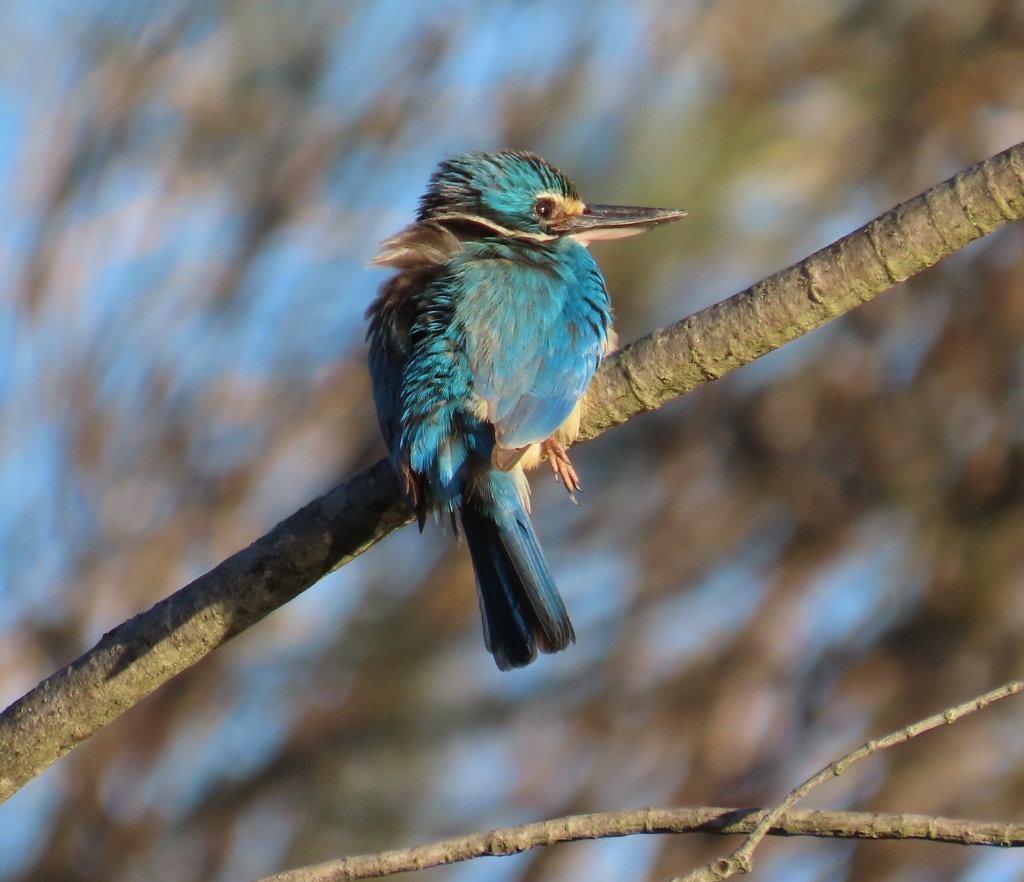
I think it’s a Forest Kingfisher, but it could be a Sacred Kingfisher. They’re very similar, but the Sacred Kingfisher is usually more green in colour.
Update on 31 December: Thank you to Andrew for the comment below, identifying the bird as a Sacred Kingfisher.
Here’s another view of the bird:
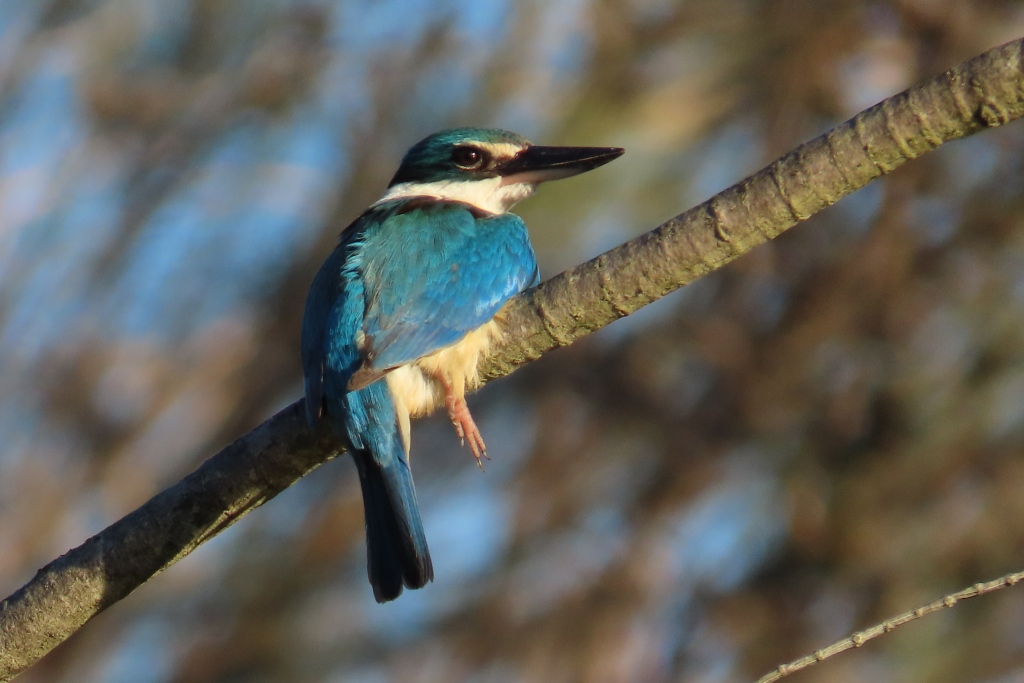
It’s interesting to see how the kingfisher seems to rest on its stomach, with its foot hanging down alongside the branch. Perhaps it’s perching on the other leg.
The next photo shows the strong blue colouring of the bird in the bright sunlight:

Common name: Sacred Kingfisher
Scientific name: Todiramphus sanctus
Length: 20-23 cm
Date spotted: Saturday 30 December 2023 (summer)
Location: Manly Dam Park, New South Wales, Australia: 3°46’31.2″S 151°14’46.6″E

Posted on 2023/12/30, in Birds, Kingfisher, Robin and tagged australia, birds, birds of prey, birdwatching, Eastern Yellow Robin, Forest Kingfisher, Kingfisher, Robin, Sacred Kingfisher, Sydney birds. Bookmark the permalink. 4 Comments.


 Sydney Birder
It’s a Sacred Kingfisher.
Forest is crisp dark blue & white and has a larger whiter loral spot.
Forest is rare south of Taree
Hallo Andrew
Thanks! I think you’re right. This particular bird is very blue rather than green, which is what led me to think it might be a Forest Kingfisher. My bird book (Michael Morcombe “Field Guide to Australian Birds”) shows the incinctus variation extending down the east coast into Victoria, but other sources agree with you that Forest Kingfishers are found largely further north. I’ll adjust the post. Thank you!
Cheers
Sarah
It’s a ID I’ve discovered I’ve got wrong more than once , when the bird flew.
The Australian Bird Guide by Menkhorst et al. is significantly better than Morcombe BTW
Oh ta, I’ll take a look at the Menkhorst et al guide.