Monthly Archives: October 2021

Common Bronzewing pigeon in Blue Mountains
This weekend I spent a day in the region of Kurrajong in the Blue Mountains area west of Sydney. On an early morning walk, I came across this large, colourful pigeon:

It’s a Common Bronzewing. I’d heard their calls from all round me in the bush: a deep, booming coo that sounds like something from Jurassic Park rather than from a pigeon!
Common name: Common Bronzewing
Scientific name: Phaps chalcoptera
Approximate length: 30-36cm
Date spotted: 31 October 2021 (spring)
Location: Grose Wold, New South Wales: 33°36’41.7″S 150°39’50.0″E

Majestic Glossy Black-Cockatoo pair
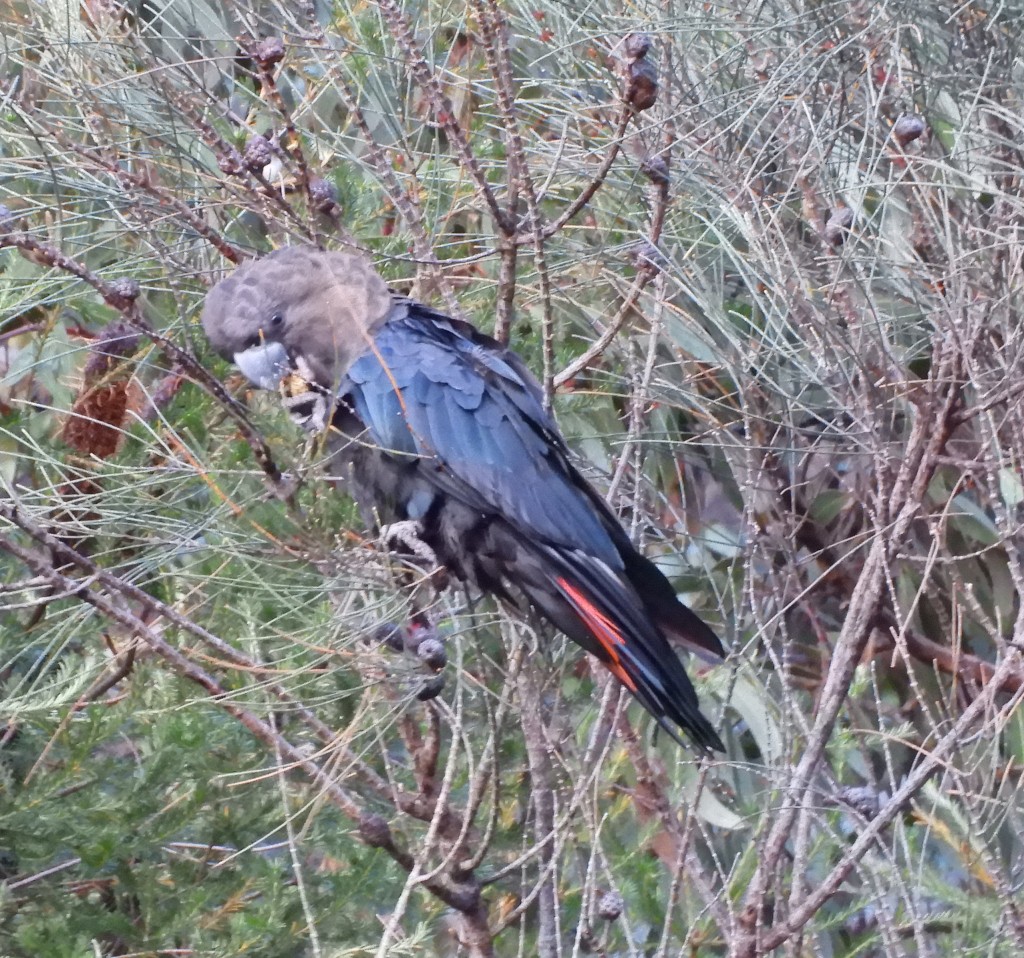
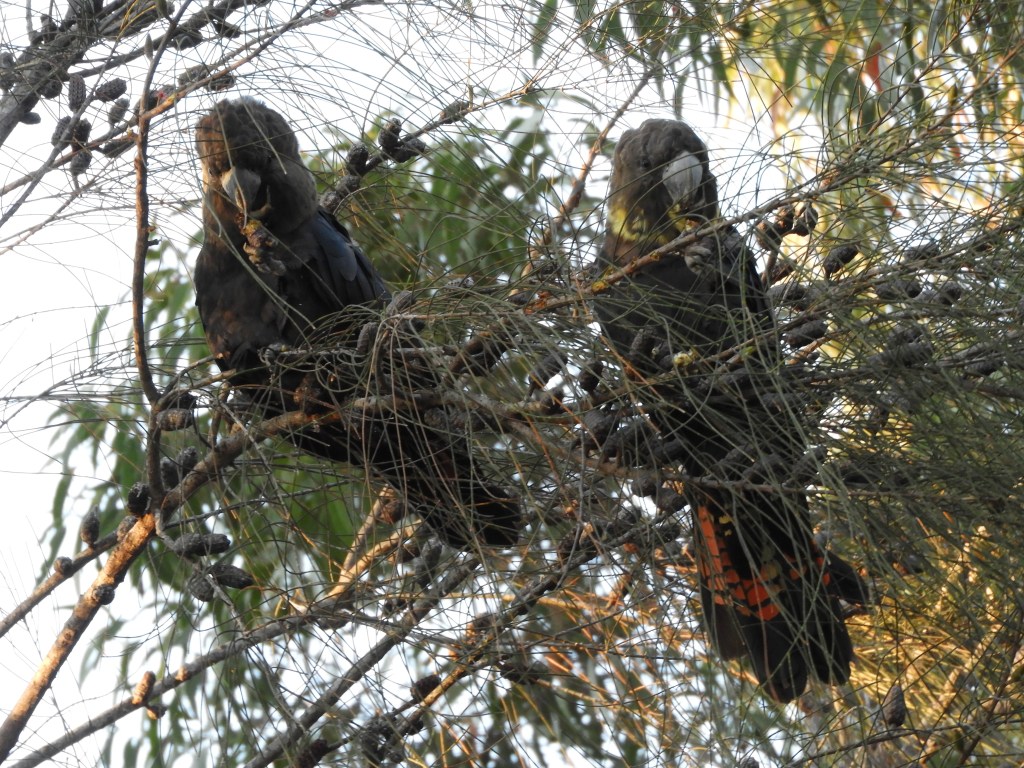
Two Glossy Black-Cockatoos have taken to hanging out at Manly Dam. The Casuarina trees are currently full of seed pods, which are this bird’s favourite food. In fact, Glossies feed almost exclusively on Casuarina seeds.
This video shows the male bird first, its feathers gleaming a soft blue in the early morning light, and the red tail flares standing out nicely. Then the view moves to the female feeding on a nearby tree.
Glossy Black-Cockatoos are large parrots at around 15 cm in length. We’re lucky to see four different types of cockatoos in this area. Glossies are heavier than the white Sulphur-crested Cockatoos and Corellas, and shorter in length than the Yellow-tailed Black Cockatoos. Of the four types, Glossies are by far the least common.
This is the male bird, with that blueish gleam lent by the early morning light, and those red tail flares:
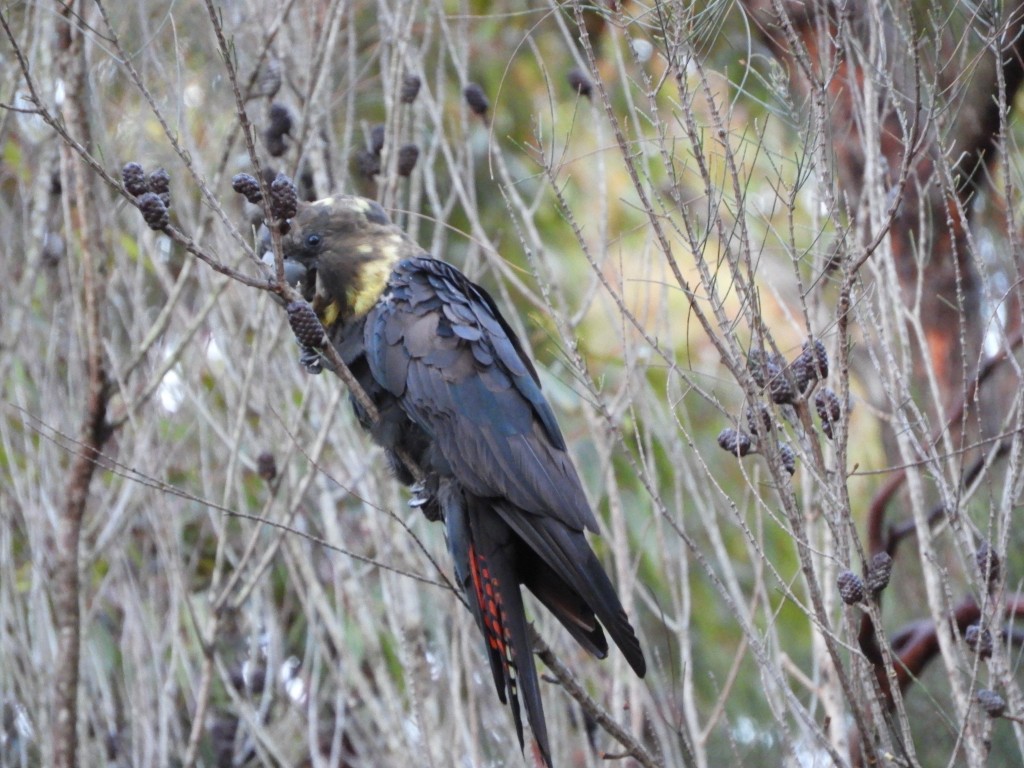
The female has yellow markings around her neck, and her tail flares are yellow and a softer shade of orange-red than the male’s:
With their large heads and that mane of feathers, Glossies sometimes remind me of a bear. Here’s a close up of the male bird, taken a few days before the above shots:

Here are both birds, sharing a tree this time:
Common name: Glossy Black-Cockatoo
Scientific name: Calyptorhynchus lathami
Approximate length: 50cm
Date spotted: 5 October and 15 October 2021 (spring)
Location: Manly Dam Park, near Sydney: 33°46’56.5″S 151°15’10.3″E

Channel-billed Cuckoo laying egg in Currawong nest
This little episode happened in my garden today. It was interesting and exciting to watch!
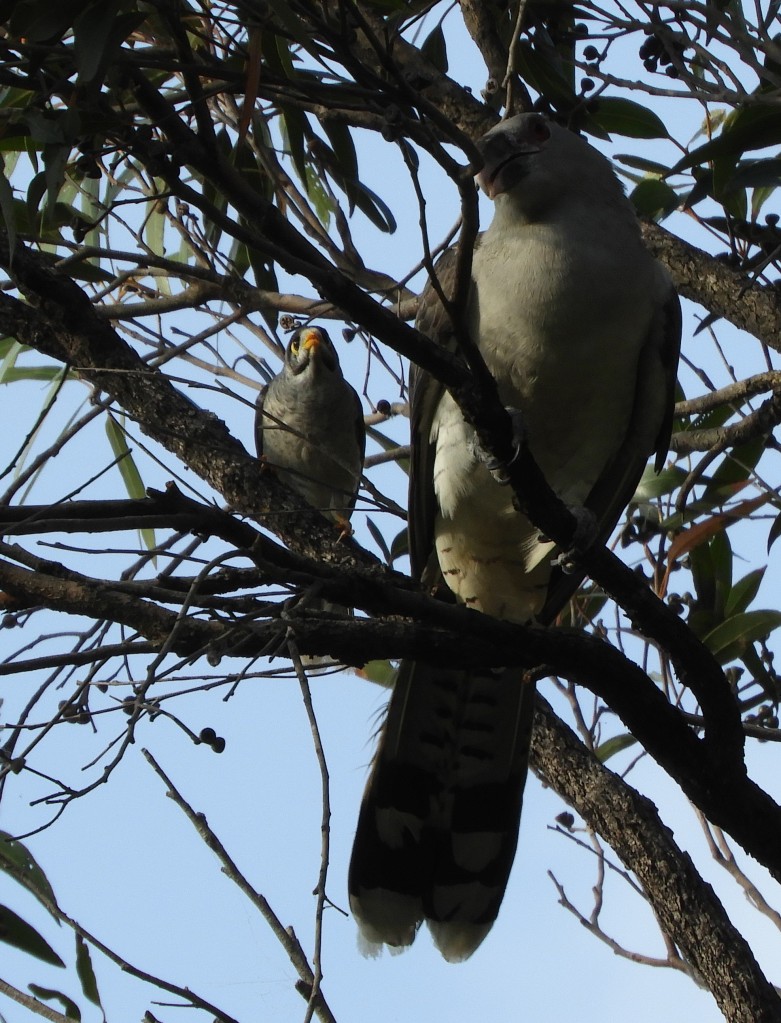
A cacophany of Noisy Miners and Currawongs drew me out into the garden to see what was up. High in a gum tree were two Channel-billed Cuckoos, being harassed as usual by the other birds. I only managed to get one of the cuckoos into my camera sights. Luckily, it turned out to be the female bird.
Here’s the Channel-billed Cuckoo on the right, with a little Noisy Miner by its side:
In this short video, you can hear the Noisy Miners peeping incessantly. The cuckoo emits a loud, harsh caw and cedes ground:
Next, the local Currawongs join the attack. The musical, bell-like tones are the Currawongs. The cuckoo flinches and utters its harsh croak. Then I noticed that there’s a Currawong nest just below where the cuckoo is sitting!
Like most cuckoos, Channel-billed Cuckoos are parasitic. They don’t build nests of their own. Instead, they look for a likely host (a Currawong does very nicely, thank you) and lay an egg in the chosen host’s nest. The Currawongs take over all parental duties, looking after the egg along with those of their own, then feeding the baby bird.
Channel-billed Cuckoo chicks don’t turf the other chicks out of the nest (many types of cuckoo chicks do) but they do eat a lot, and grow significantly bigger than the Currawong chicks.
Having decided that the neighbourhood is reasonably quiet and safe for a bit, the cuckoo eyes the nest and starts its approach:
Quick as a flash, it hops up into the nest and lays its egg:
Below is a still picture of the Currawong’s nest. I’ll keep an eye on it, in case I can spot the Currawong and cuckoo chicks when they arrive:

Channel-billed Cuckoo | Scythrops novaehollandiae | Approximate length: 58-65 cm
Noisy Miner, also called Australian Miner | Manorina melanocephala | Approximate length: 26 cm
Pied Currawong | Strepera graculina | Approximate length: 45 cm
Date spotted: 10 October 2021 (spring)
Location: Allambie Heights, New South Wales, Australia

Noisy Miner babies
For a couple of weeks, we had the pleasure of hosting a nest of Noisy Miners in our garden. The adults built the nest in a tree fern, right in the hollow where the new fern leaves sprout. This picture shows the tree fern, with the nest and one of the adult birds in attendance:
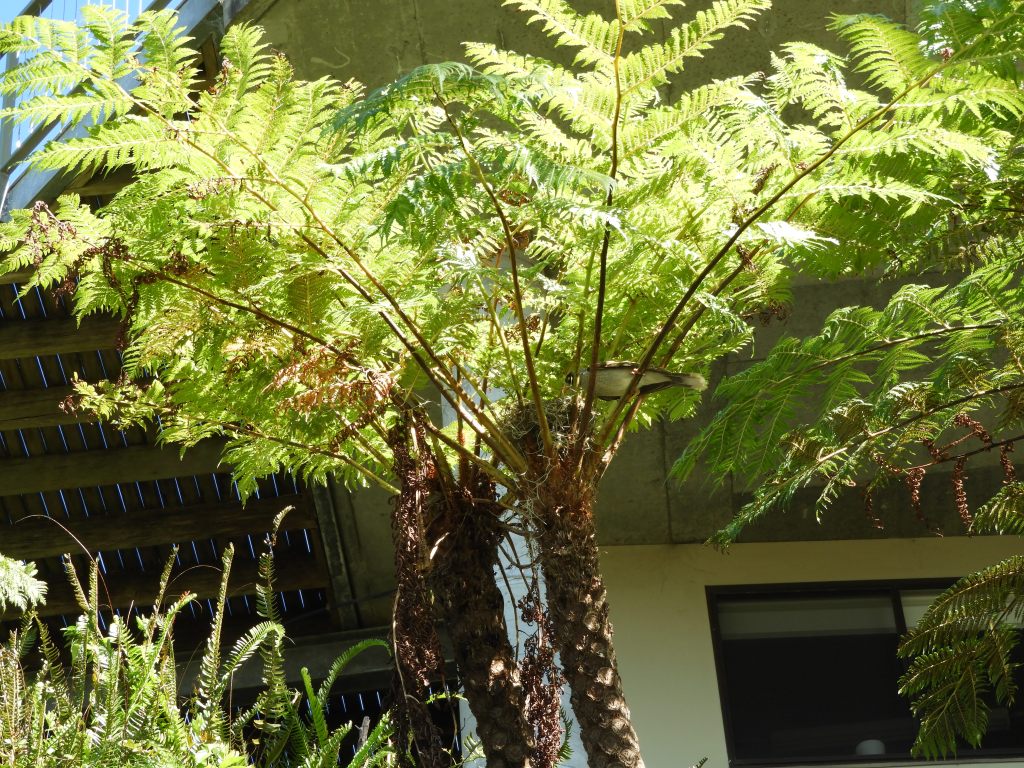
It’s a good thing that little Noisy Miners grow so fast. A few years ago, some Red Wattle Birds attempted the same thing, and were forced to abandon the nest when the fern leaves pushed it out of place!
This video shows an adult bird feeding the babies:
With Noisy Miners, feeding the little ones is a communal responsibility. You can’t tell which are the parents. We sometimes saw three birds waiting in line with a goody for the growing babies.
In the above video, the adult is regurgitating nectar or other food. Its long, thin tongue flicks out occasionally. In the next video, a bird brings a large green bug and passes it to the babies. I’m not sure if the bug is a mantid or something else. It’s too early in the season for cicadas:
Here’s a still picture of the little ones begging for food:

After a couple of weeks of feeding and fast growing babies, the nest became pretty full. Then one day, the little ones left the nest. I wasn’t there to see this exciting event, alas. I took this video the day before the nest was suddenly empty:
The little ones are now all round the garden, peeping constantly to get the adults’ attention. For the most part, they’re tucked away safely in the foliage, hard to find from my vantage point on the ground. This picture is of one of the little ones, a few days after leaving the nest:

Here’s the empty nest, with a clothes peg for scale:

Common name: Noisy Miner, also called Australian Miner
Scientific name: Manorina melanocephala
Approximate length of adult bird: 26 cm
Date spotted: September 2021 (spring)
Location: Near Sydney, NSW, Australia
Magpies carolling with a view of Sydney Harbour
This morning I walked along a path overlooking Sydney Harbour and the headlands that act as a gateway to the ocean. A treeful of Australian Magpies provided musical accompaniment.
Common name: Australian Magpie
Scientific name: Gymnorhina tibicen
Approximate length: 40 cm
Date spotted: 3 October 2021 (spring)
Location: Dobroyd Head, Sydney Harbour: 33°48’36.7″S 151°16’03.4″E


 Sydney Birder