Blog Archives

Little Wattlebird bathing in the tree tops
A Little Wattlebird, high in the gum trees, dives through the leaves. I’ve seen birds doing this a few times. They’re taking advantage of the early-morning dew to freshen up their feathers.
Here’s a still photo of the Little Wattlebird:

Common name: Little Wattlebird
Scientific name: Anthochaera chrysoptera
Approximate length: 30 cm
Date spotted: 1 April 2024 (autumn)
Location: Manly Dam Park, New South Wales, Australia: 33°46’39.6″S 151°14’55.7″E

Soft colours of a young Little Wattlebird
This bird was busy gathering food on an Old Man Banksia tree (Banksia serrata). It has a small insect in its beak:

I think the bird is a Little Wattlebird, though others that I’ve seen have been darker and greyer in colour. Perhaps it’s a juvenile. I considered an oriole, but the stripes on this bird’s chest are more like those of a wattlebird than an oriole, and the shapes of the beak and head are closer to those of a wattlebird too.

Little Wattlebirds don’t have the red wattles that give this genus its name. These birds are classified as honeyeaters, but like most honeyeaters they’ll grab a passing insect too. This bird was at Dobroyd Head, one of the pieces of land that jut into Sydney Harbour.
Here’s a view that shows more of the wings and back:

Common name: Little Wattlebird
Scientific name: Anthochaera chrysoptera
Approximate length: 30 cm
Date spotted: 11 March 2023 (autumn)
Location: Dobroyd Head Track, Balgowlah, New South Wales, Australia: 33°48’33.2″S 151°16’14.1″E

Call of the Red Wattlebird
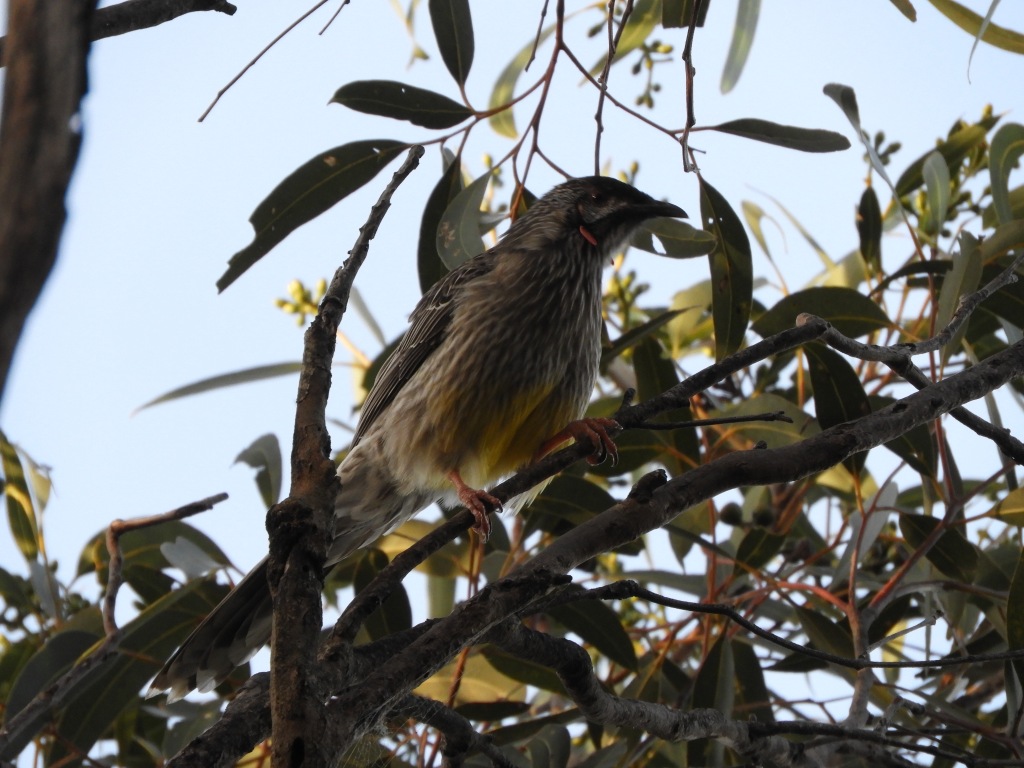
This Red Wattlebird was quite chatty in the crisp morning air.
Usually when walking in the bush I hear the more raucous croaks of this bird and its cousin, the Little Wattlebird. So it was nice to hear something a little more melodious.
Here’s a still picture of the Red Wattlebird, showing the red flap below its eye which gives the bird its name:
The feathers on its back are quite decorative, and a sun ray lights up the yellow on the bird’s belly:
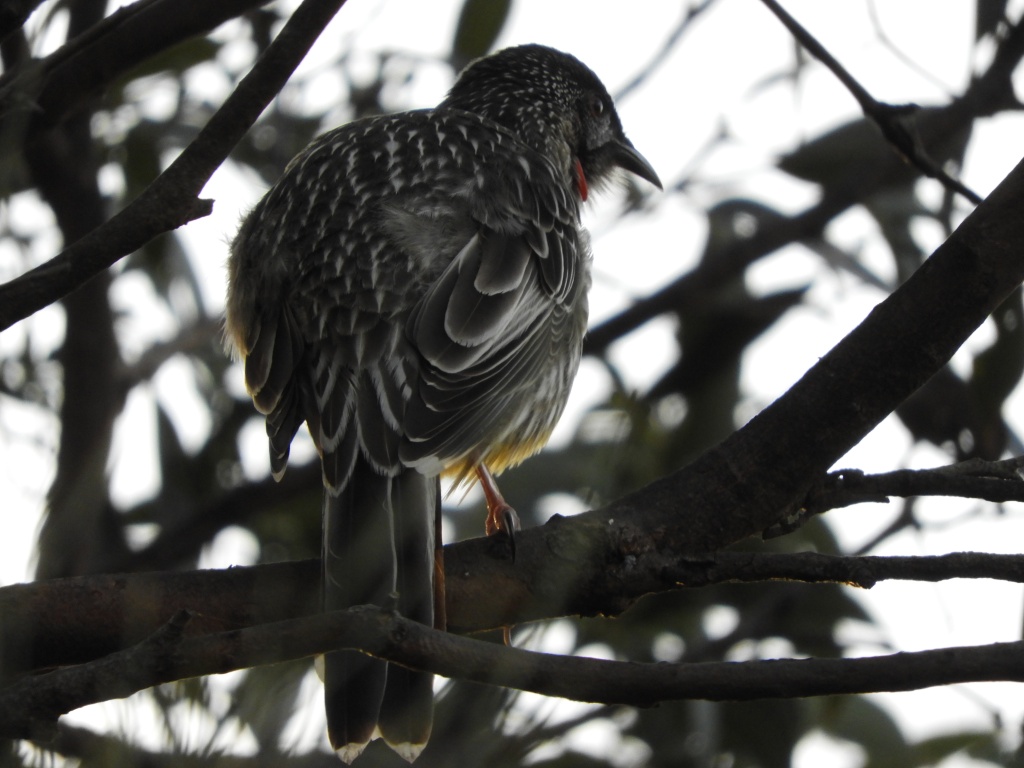
Common name: Red Wattlebird
Scientific name: Anthochaera carunculata
Approximate length: 35 cm
Date spotted: 24 April 2021 (autumn)
Location: Manly Dam Park, New South Wales, Australia: 33°46’10.0″S 151°14’53.6″E
Red Wattlebird on Banksia
Red Wattlebirds are large, noisy honeyeaters. They get their name from the red flaps of skin below their eyes. This one was feeding on the nectar of a Heath Banksia flower:

The next picture shows both wattles on the bird’s neck:
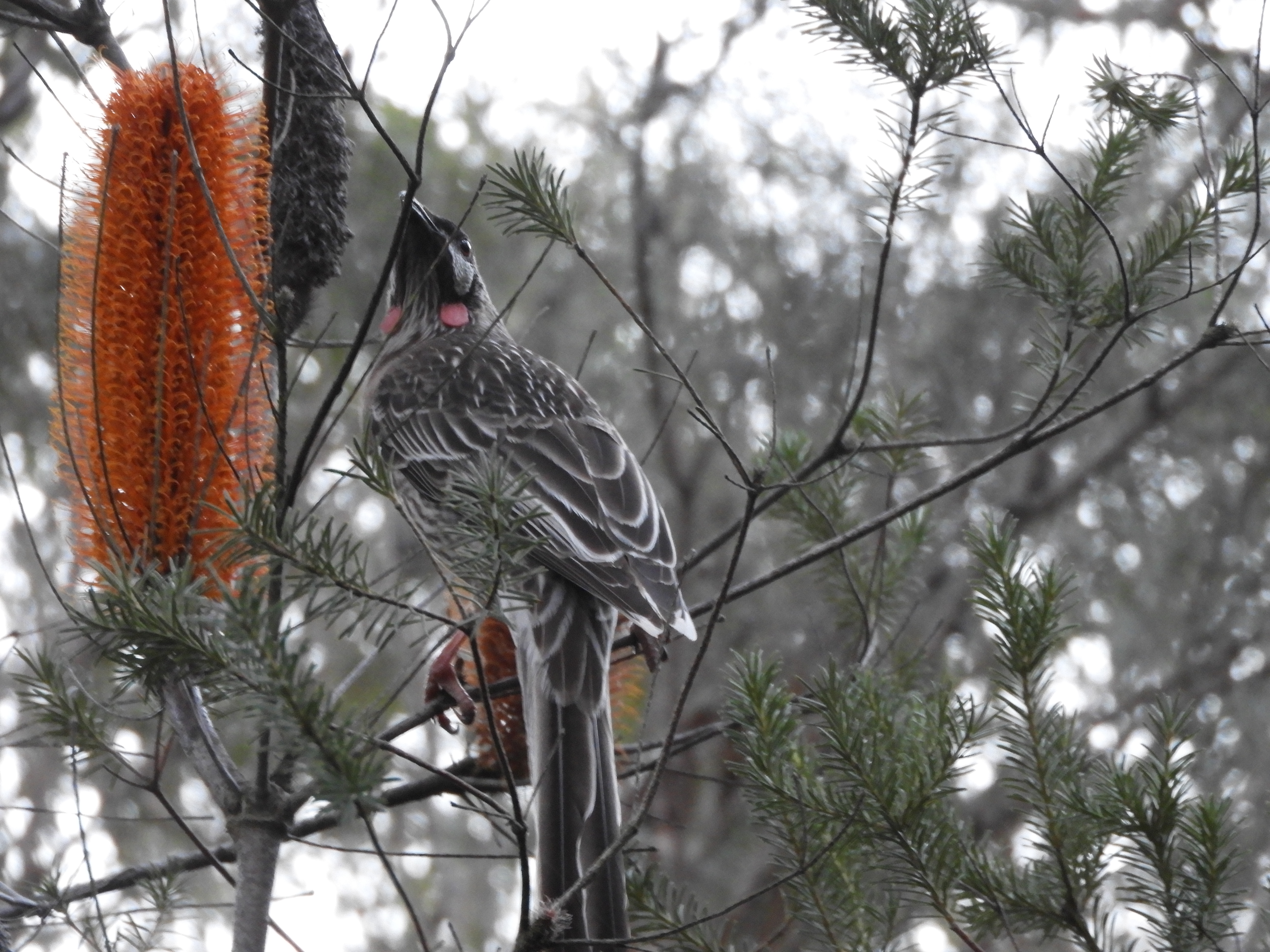
Common name: Red Wattlebird
Scientific name: Anthochaera carunculata
Approximate length: 35 cm
Date spotted: 18 July 2020 (winter)
Location: Manly Dam National Park, New South Wales, Australia. Approximate map reference: 33°46’27.0″S 151°14’57.6″E
Little Wattlebirds are common in the area too. The two birds can be hard to tell apart. Red Wattlebirds are larger (approx 35 cm from head to tail) whereas Little Wattlebirds measure approximately 30 cm. Little Wattlebirds don’t have the large red wattles. Here’s a Little Wattlebird that I photographed a while ago:

Little Wattlebird calling, mate unimpressed
A male Little Wattlebird does its best to impress (or intimidate) the bird sharing its branch. The other bird is unimpressed. In fact, its reaction seems to be, “Oh, please, are you really going to keep doing that?”
The call of a Little Wattlebird is strange. It often starts with a click-clack, as if the calling mechanism is turning over before getting into full gear. Then out comes the harsh bray that’s characteristic of the male bird. It seems to take a fair bit of effort to make this noise, as you can see in the video:
I went back to the same spot a day later, and snapped a picture of this male Little Wattlebird. It’s probably the same bird, given their fierce territoriality:
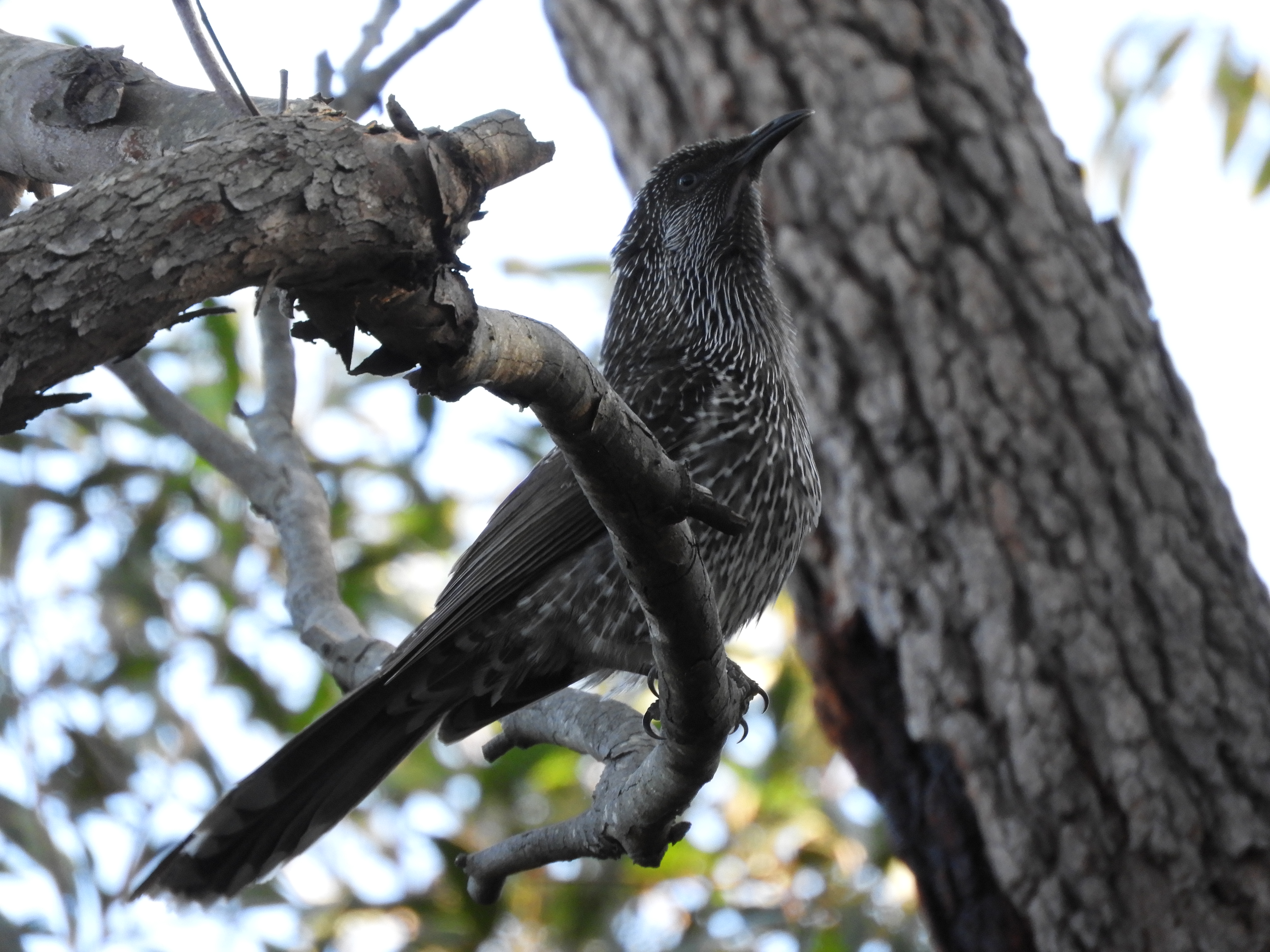
Common name: Little Wattlebird
Scientific name: Anthochaera chrysoptera
Approximate length: 30 cm
Date spotted: 7 July 2018 (Winter)
Location: Manly Dam National Park, New South Wales, Australia: 33°46’36.9″S 151°15’10.4″E
Little Wattlebird plumage like shooting stars
This shy Little Wattlebird led me a merry dance before letting me snap a picture. It has an intricately patterned plumage. The little bursts at the end of each stripe remind me of shooting stars.

Common name: Little Wattlebird
Scientific name: Anthochaera chrysoptera
Approximate length: 30 cm
Date spotted: 25 September 2016
Season: Spring
Location: Manly Dam National Park, Sydney, Australia
Latitude/longitude: 33°46’30.7″S 151°15’09.1″E
Little Wattlebird croaking
This Little Wattlebird appears quite drab when seen from afar, but from close up has a sleek coat of streaks with chestnut touches on its wings. Wattlebirds are one of the many types of honeyeaters found in Australia. As well as nectar, they eat berries and insects. And they’re noisy and argumentative.
In the video, the bird is uttering its characteristic scratchy croak.
From behind:

In full song:

Common name: Little Wattlebird
Scientific name: Anthochaera chrysoptera
Approximate length: 30 cm
Date spotted: Saturday 22 November 2014
Season: Spring
Location: Manly Dam National Park, Sydney, Australia
Latitude/longitude: 33°46’40.3″S 151°14’58.5″E


 Sydney Birder