Blog Archives

Did the big scary lizard make the Mudlarks abandon their nest?
For a few weeks now, I’ve been watching a pair of Mudlarks building their nest. In fact, they’ve built two nests. The first one looked good and solid from my vantage point, far away and down at ground level. But a couple of days after they’d finished it, they abandoned it and started a new one higher up in the same tree.
Mudlarks, also called Magpie-larks or Peewees, build neat round nests that are basically bowls made of mud. This video shows a male Mudlark collecting mud and reeds at the water’s edge. When he has a good collection, he flies off towards the nest that he and his mate are constructing. As the bird flies, a couple of Kookaburras start cackling, and one of the Mudlarks gives its distinctive call: “pee-wee pee-wee pee-wee”.
Here’s the male Mudlark on mud collection duty:

The next video shows the first nest under construction. The bird prods and pushes mud into the walls of the nest, then sits flat and wiggles its tail end to shape the nest.
As well as building walls, nest construction also involves sitting on the nest and wiggling back and forth to get the shape right:

The nest was looking good, I thought. But several days later, a decision is made. The birds abandon their first attempt and start a new nest, higher up in the same tree:
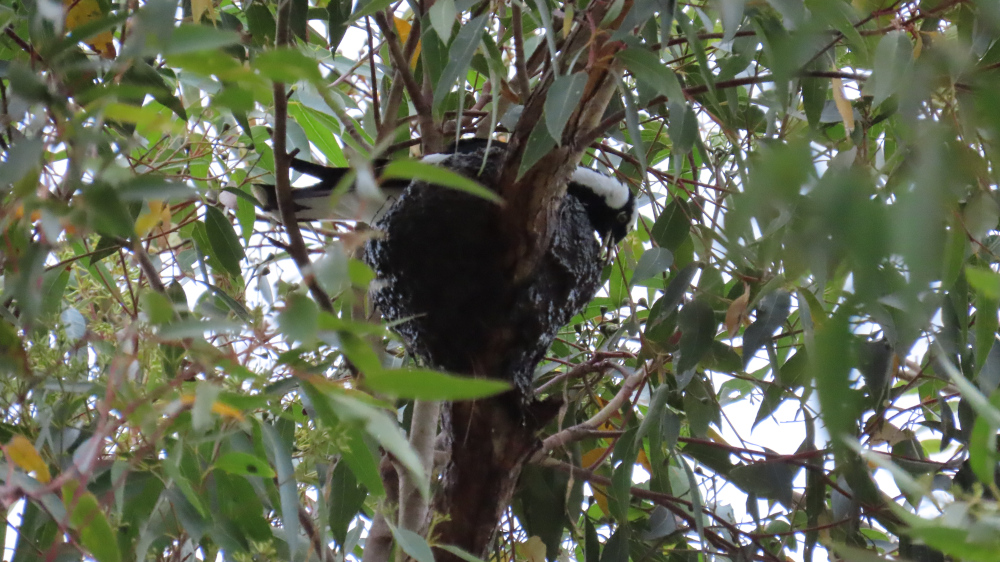
They’ve chosen a lovely spot, at the edge of Manly Dam. The next video shows one of the birds building the second nest. The second bird arrives with a beak-ful of mud, and takes over construction. The video then zooms out and in again to show the first nest on a lower branch, then zooms out further to show the dam and some of the neighbours (a Little Black Cormorant and a Great Egret).
Aside from the occasional noisy cockatoo, the neighbours are quiet for the most part — like this Great Egret:

And a few water dragons:

But the park does get quite busy over the weekend. Families hold picnics nearby, and children paddle in canoes. Perhaps the birds moved higher to avoid the weekend disturbance.
Perhaps the first nest didn’t meet quality assurance checks. Or perhaps the two parents-to-be spotted the large, scary intruder in the neighbourhood: a Lace Monitor lizard. I took this video of the lizard prowling around the tree where both nests are. Lace Monitors eat eggs and baby birds, and are very good at climbing trees. The Mudlarks’ second nest is higher in the tree and on thinner branches, which would make it much more difficult for the lizard to reach.
Lace Monitors are the second-largest lizards in Australia. They measure 1.5 to 2 metres long — longer than I am tall, and their hands are as big as mine! Here’s a close-up of the Lace Monitor on the move:
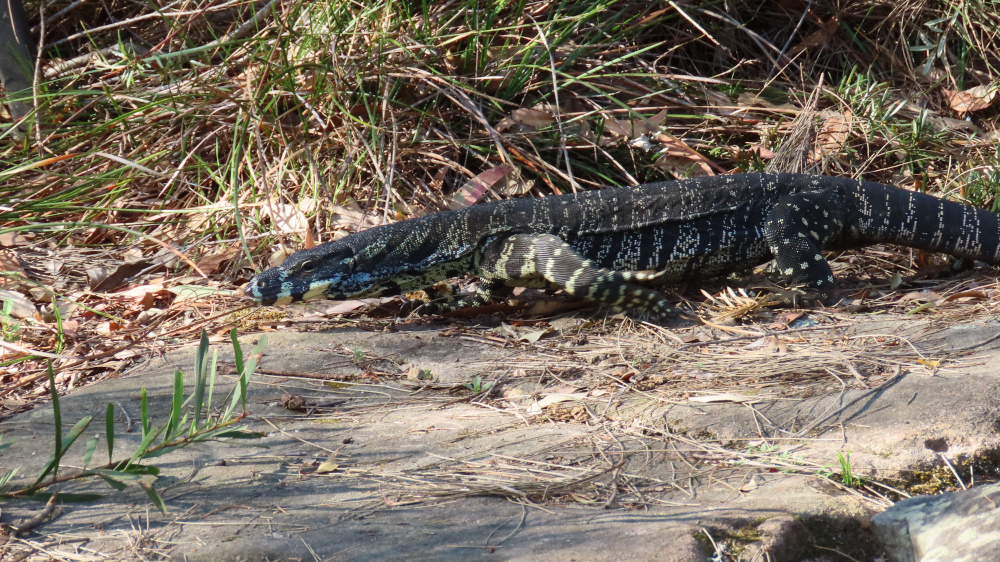
When I got too close with my camera, the lizard crouched down and went into stealth mode:

The Mudlarks are still sitting happily on their new nest. Here’s the male:

And here’s the female:
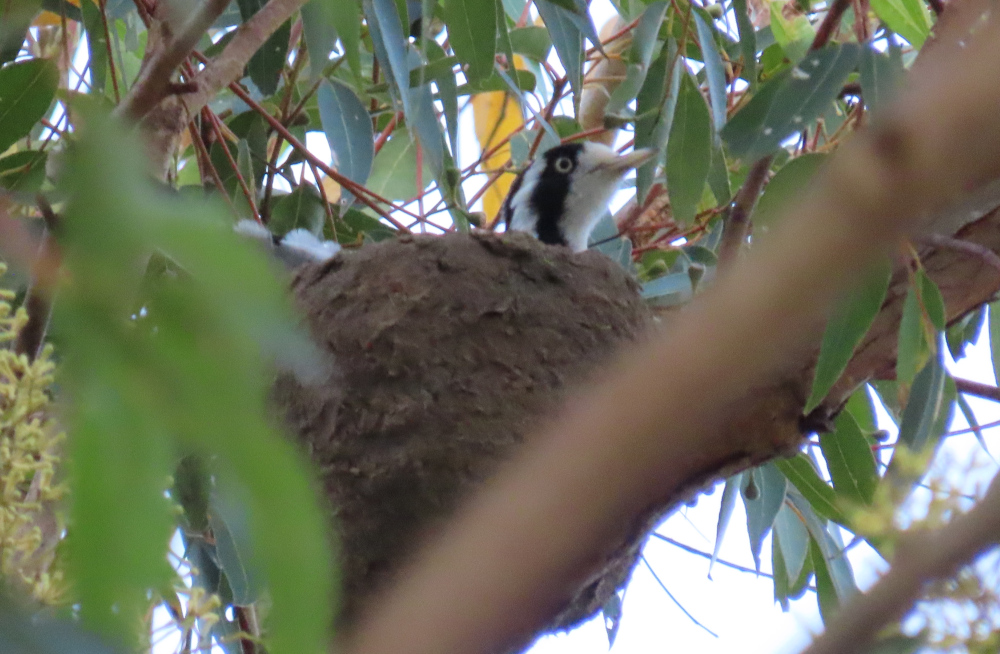
Good luck to them and their new family!
Common name: Magpie-lark, also called a Peewee or a Mudlark
Scientific name: Grallina cyanoleuca
Approximate length: 30 cm
Date spotted: August to September 2024 (summer)
Location: Manly Dam National Park, New South Wales, Australia

Water Dragon lurking under water (mostly)
Australian Water Dragons (Intellagama lesueurii) are large dragon lizards, reaching a length of more than two metres. You’ll often spot them close to creeks and other bodies of water (hence the name, Water Dragon). Sometimes, you’ll see them actually in the water:
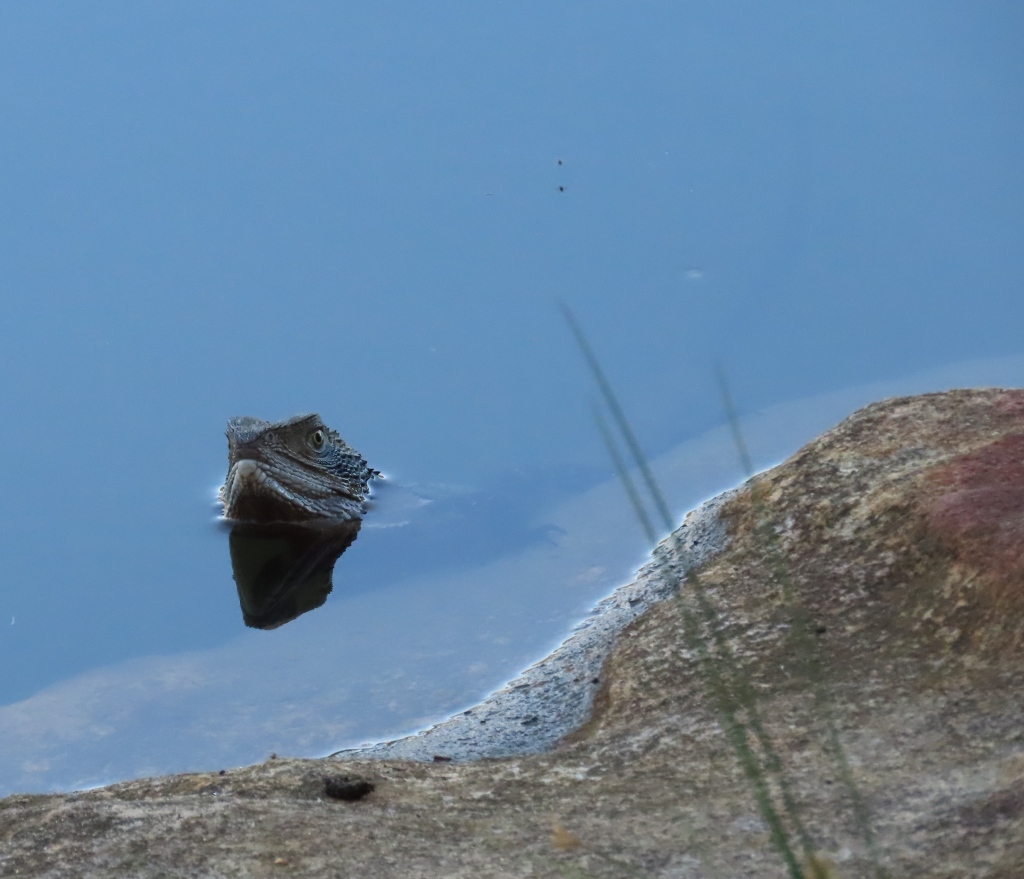
They can stay under water for an hour before coming up to breathe! From a distance, their heads are easy to mistake for a piece of log sticking up. As you draw closer, the rest of the body becomes clearer. This is a different dragon in a nearby spot:

They’re completely at home on the land too. When you approach them, they tend to stay still, pretending to be a tree stump, until you get too close.

Water Dragons eat insects, fruit, and flowers.
A few days ago, I came across a Water Dragon that had spotted a piece of litter (a wet tissue or picnic wipe) and was nosing it when I came along. The video shows the dragon’s characteristic side-to-side gait as it moves away from the litter. (I picked up the litter and took it away.)

Water dragon chillin’ in a tree
This Australian Water Dragon has draped itself over a tree branch, catching some sun on a cool wintry morning:
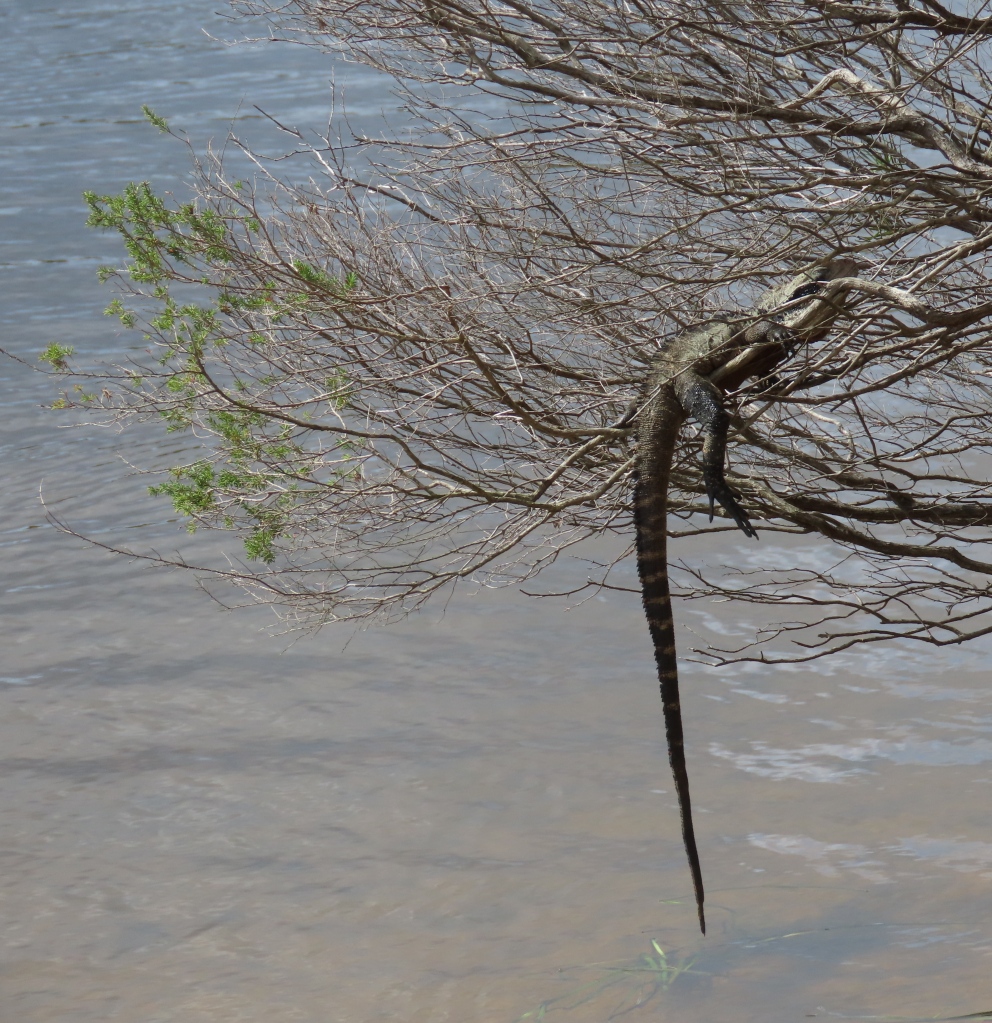
Here’s a close-up of that lovely head, eye closed in a lazy doze:
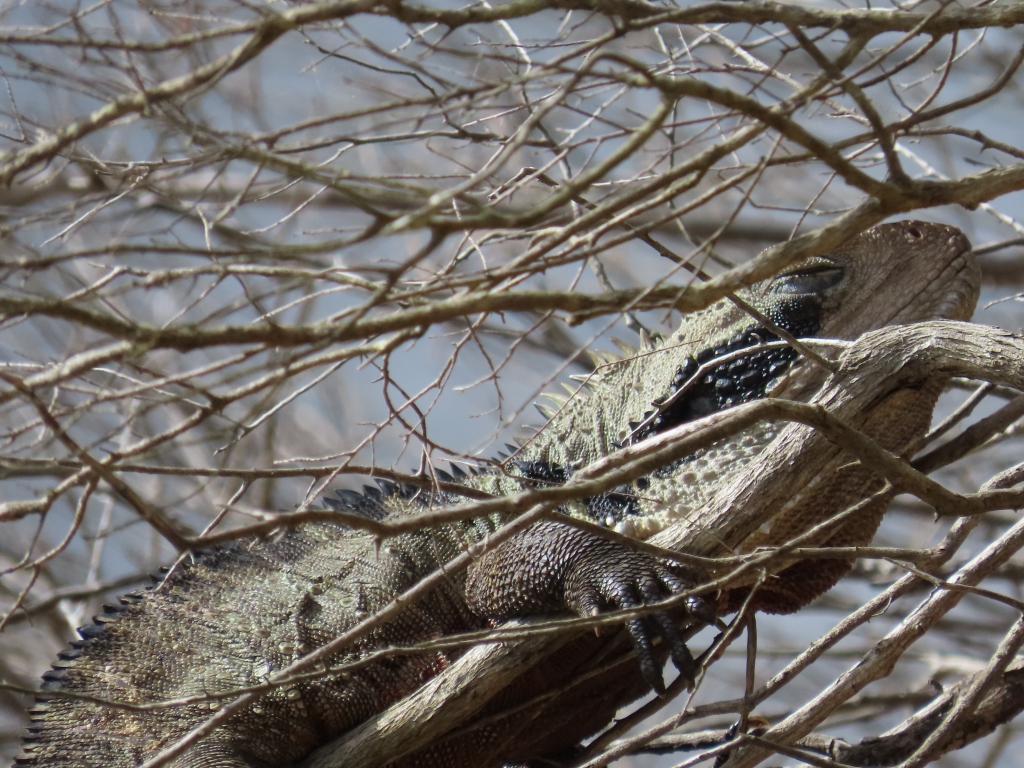
Australian Water Dragons (Intellagama lesueurii) are large dragon lizards, reaching a length of more than two metres. During the cold winter months, they burrow a hole for themselves, then slow down their metabolism and go into a state of brumation. We’re in the middle of autumn now — it must be about time for this one to head underground! They eat insects, flowers, and fruits such as figs and Lilly Pilly berries.
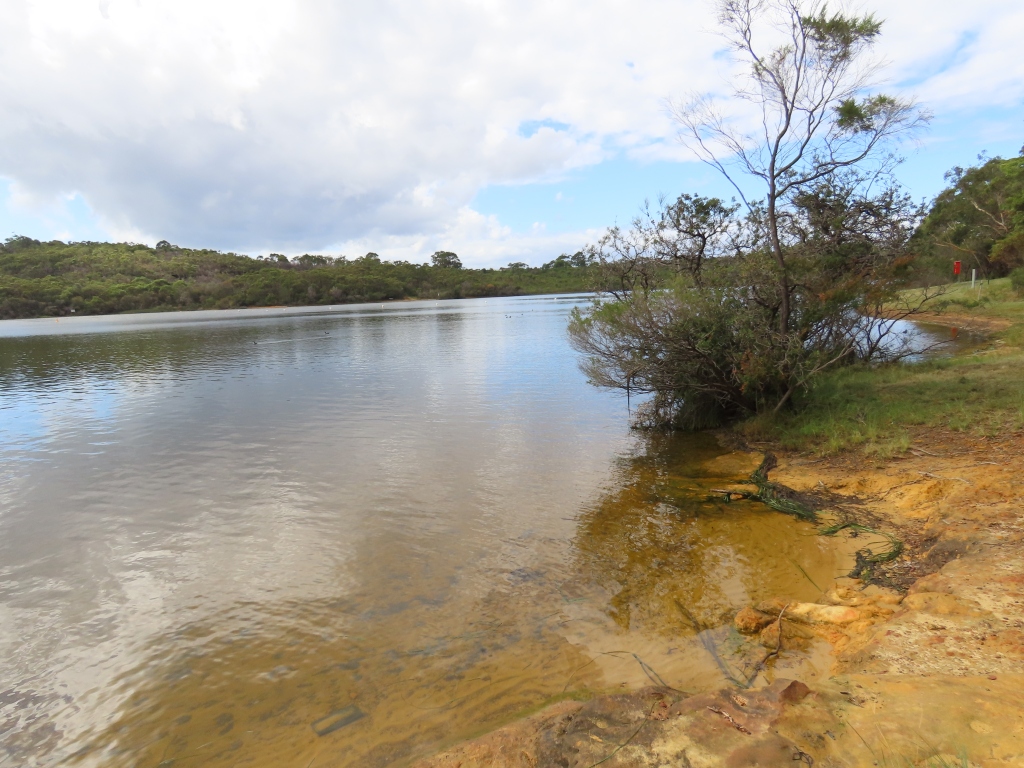
I spotted the Water Dragon at Manly Dam, north of Sydney, Australia. Here’s a zoomed-out view of the scene. You can see the lizard’s tail hanging down from the bush on the right-hand side of the dam:
Big lizard climbing tree near Sydney
The things birds in Australia have to put up with! This is a Water Dragon up a tree, probably looking for a nice breakfast of eggs:
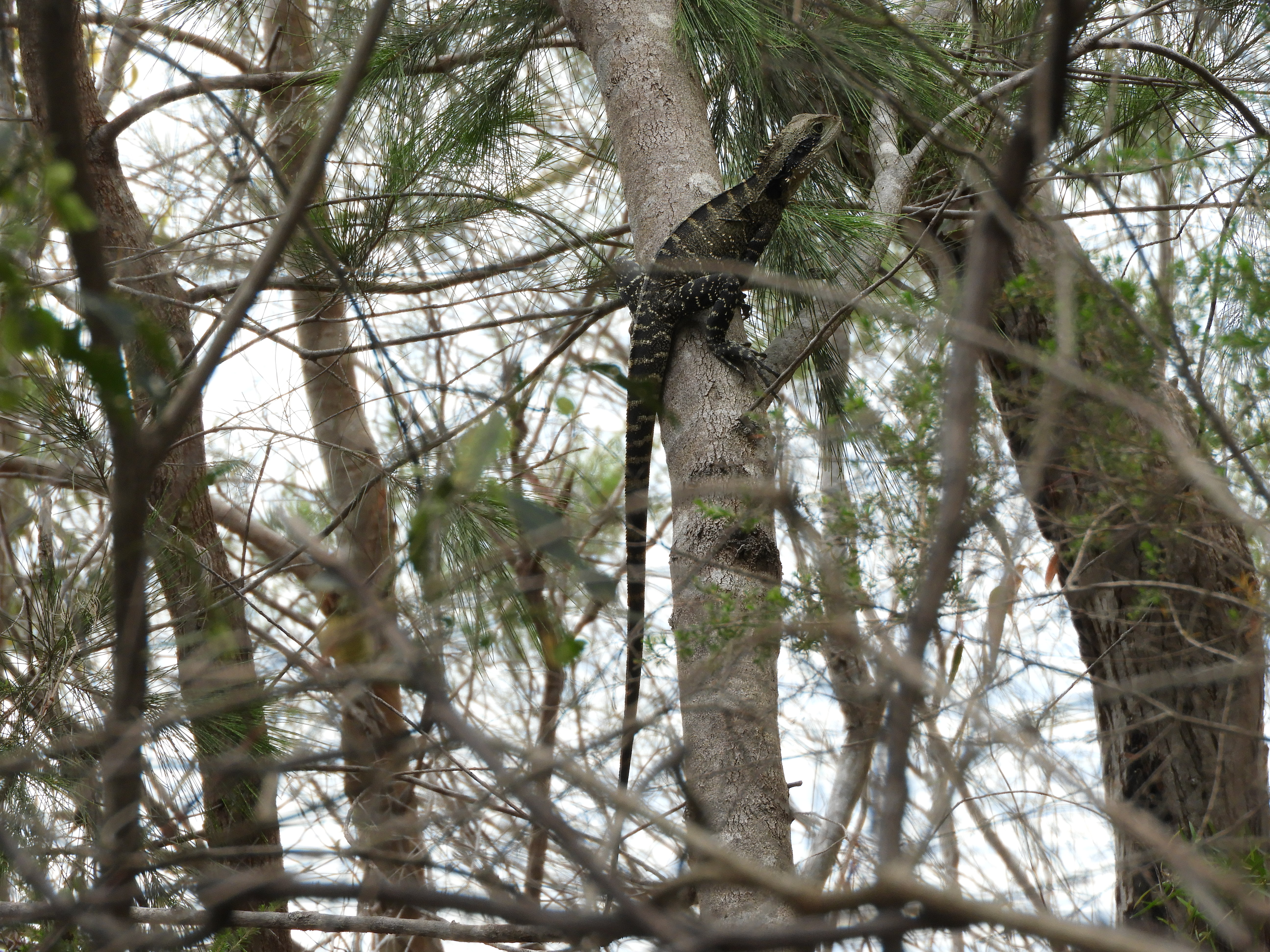
What a lovely long tail it has! Perfect for keeping a grip on a tree branch. Australian Water Dragons reach 90 cm in length. They have large heads which they can lift up quite high above the level of their bodies. Their scientific name isItellagama lesueurii lesueurii.
Australian water dragon in tree
While I wander with my head in the clouds, looking for birds, I sometimes spot other interesting creatures. This is an Australian Water Dragon.
They’re quite large lizards, at 80-90 cm when adult, and attractive with their fierce eyes and that spiky crest running down their spine. They can be quite colourful. This one is shades of grey with yellow tinges. I’ve seen others with a rosy red glow on their chests. They like to be near water, and have long-fingered strong hands for climbing trees.

Common name: Eastern water dragon, or Australian water dragon
Scientific name: Itellagama lesueurii lesueurii
Approximate length: 90 cm
Date spotted: 3 December 2016
Season: Summer
Location: Manly Dam Reserve, New South Wales, Australia
Latitude/longitude: 33°46’50.1″S 151°15’04.5″E
Water dragon in a tree
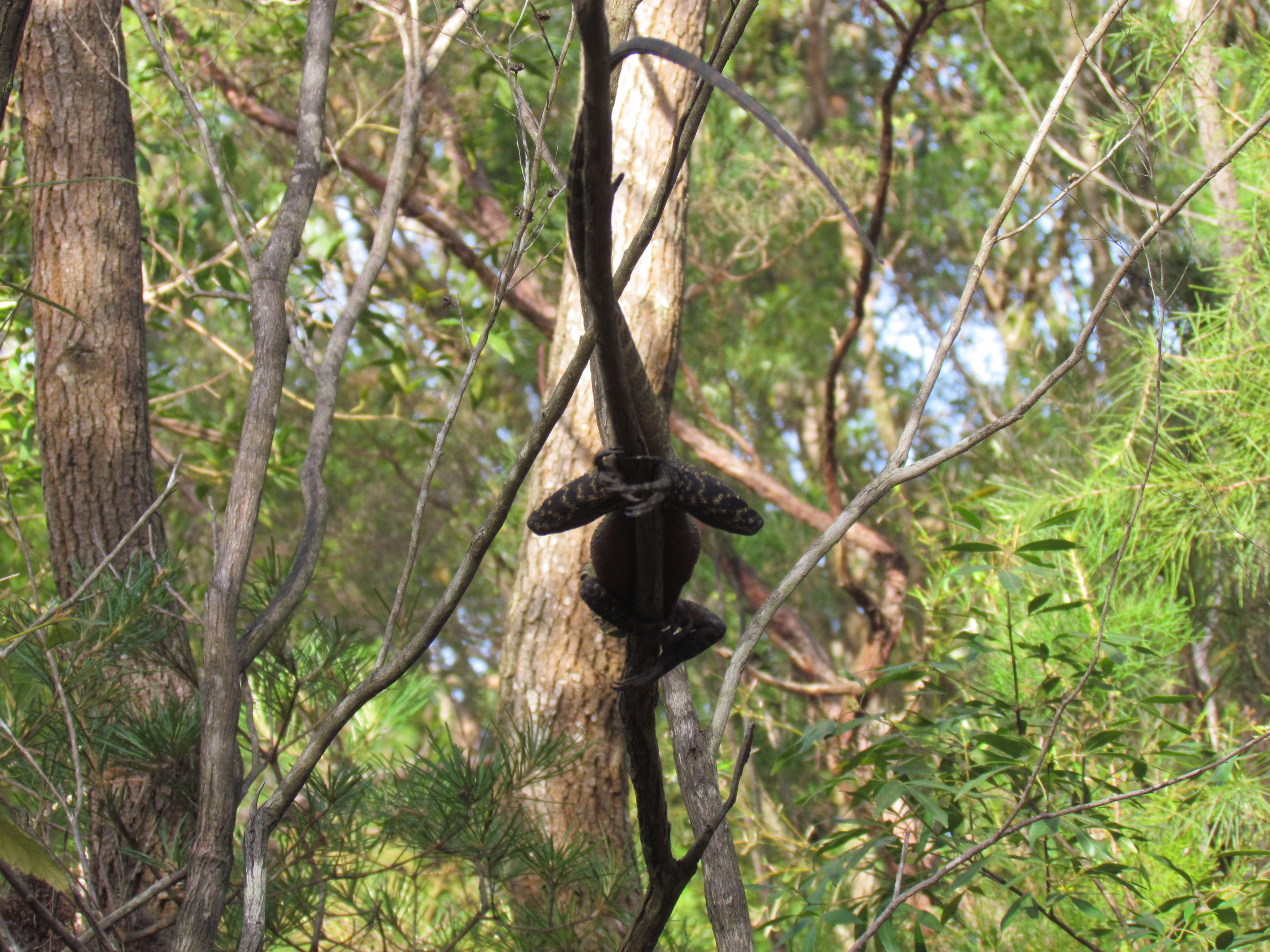
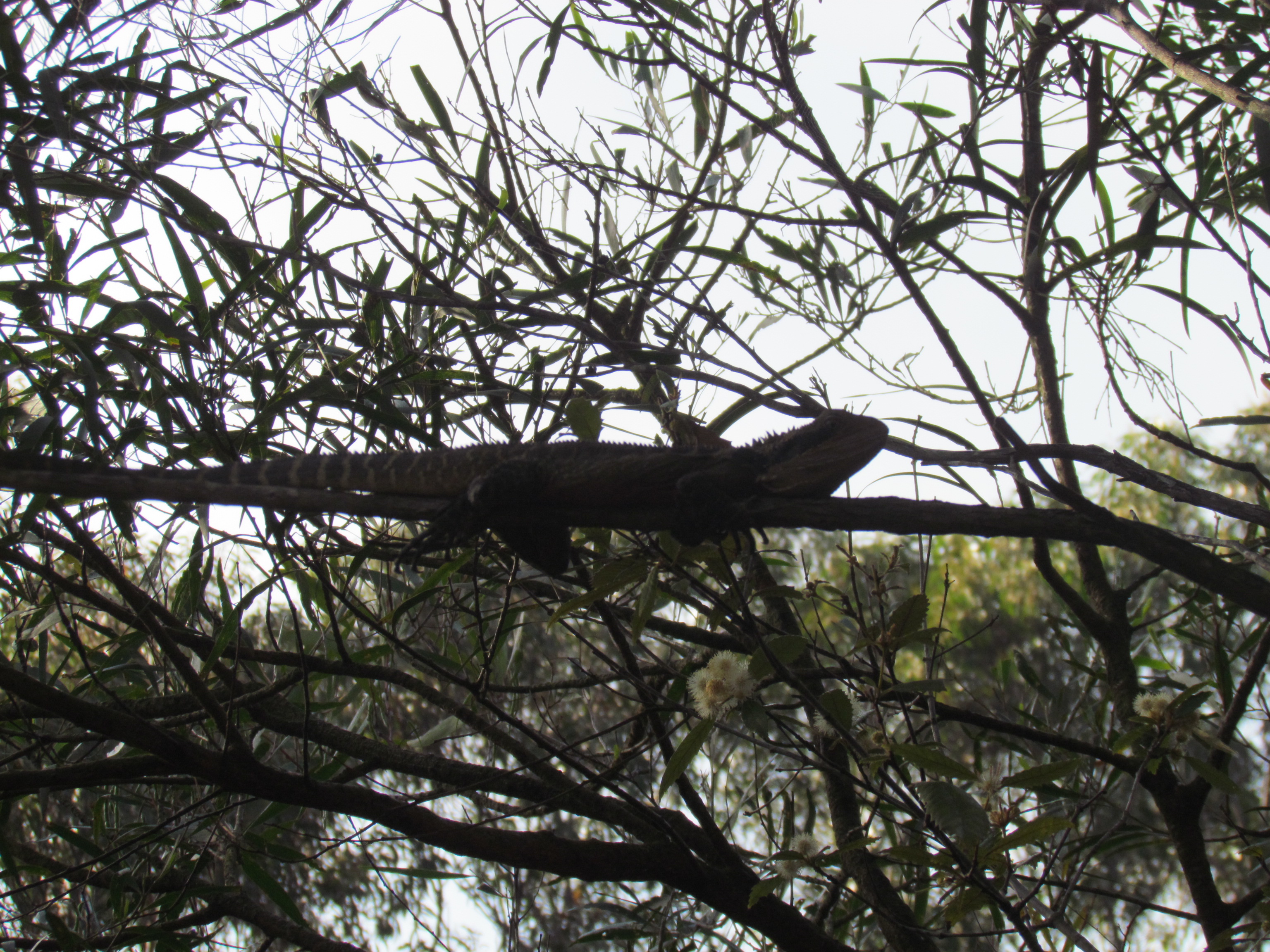
Not a bird this time. This is an Australian water dragon – a reasonably large lizard that climbs trees and loves water. This one is about 60 cm long, the length of my arm without my hand.
I first spotted it when walking underneath the branch it was on. See the impressively long tail:
Here’s a side-on view. Apologies for the silhouette. The lighting was difficult:
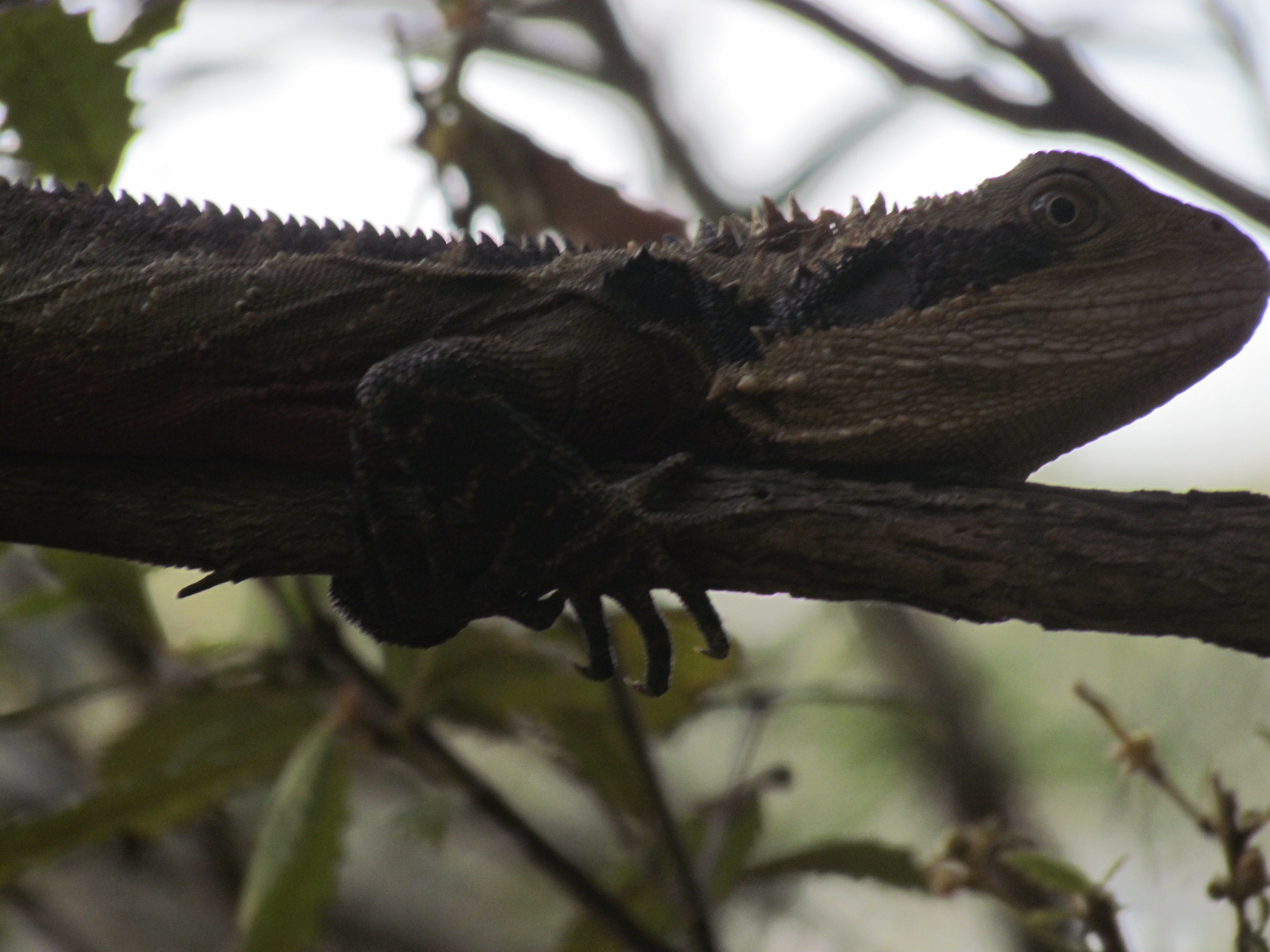
This is a close-up of its head and hands:
Common name: Eastern water dragon
Scientific name: Intellagama lesueurii lesueurii
Approximate length: 60 cm
Date spotted: 25 October 2014
Season: Spring
Location: Manly Dam National Park, New South Wales, Australia
Latitude/longitude: 33°46’24.1″S 151°15’05.5″E


 Sydney Birder