Blog Archives

Amazing wrap-around spider
When I approached my car the other day, I saw a patch of something on the door handle. “Bird dropping,” I thought, and was about to wipe it off. Then I noticed that the blotch was symmetrical. Uh oh. I looked more closely. A spider, and a real cutie. I’d have been devastated if I’d hurt it.
This is what it looks like when zoomed in on my camera:

The spider has wrapped itself around the door handle, to be as flat and inconspicuous as possible. The photo above shows the body of the spider. Its head is below, mostly hidden from view. The colours and patterns on the body are amazing. I think they’re enhanced because it had been raining and the spider was wet.
Here’s a picture with my hand and the keyhole, for scale:

I took the above photo the day after the first one. Yes, the spider was still there. It was dry this time, and therefore less colourful. And it had moved from the top to the bottom of the door handle.
Here’s the spider’s face, viewed from underneath the door handle:
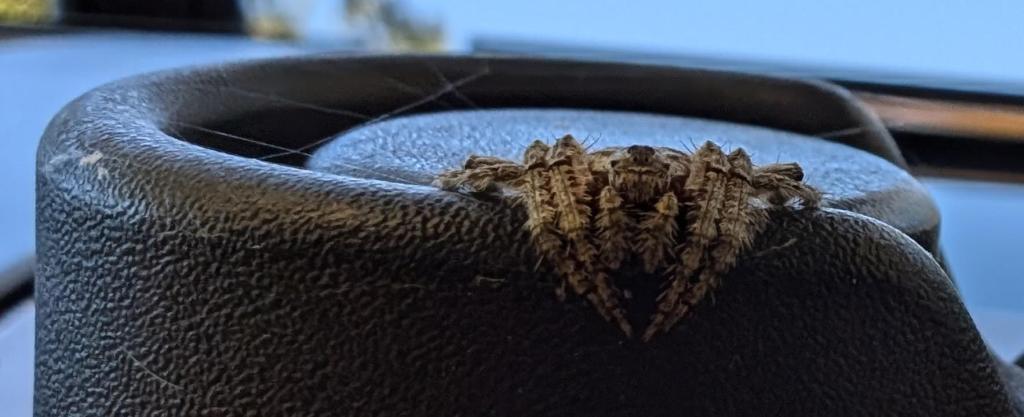
And here’s as much of the head and body as I could get into one shot:

Wrap-around spiders (genus Dolophones) have a flat, curved abdomen, so that they can wrap themselves around branches. This makes them good at disappearing into their surrounds. They build an orb web every evening, and destroy it each morning. I guess those strands of web on the door handle are the remains of last night’s web.
Since the spider had been on the door handle for two days, it looked like it had taken up residence. I don’t think spiders and door handles are a good match, so I persuaded the spider onto a leaf and moved it into the nearby shrubbery:


Green huntsman spider
Up to now, all the huntsman spiders that I’ve seen have been brown. Some were darker, others lighter, but basically brown. I was surprised to see this little one the other day:

It was quite small, for a huntsman, but still a good size spider. In real life, it appeared even more green than the photo shows. I had to Google it, to discover that indeed, green huntsman spiders are a thing. This one was in Allambie Heights, north of Sydney, NSW. I hope to see it again!

Beautiful red and brown Orb Weaving Spider
When walking along bush paths, especially early in the morning, I often walk through large spider webs spun across the path. Not infrequently, I end up with a spider in my hair or on my clothes.
Today I spotted the web and its occupant in time to avoid a collision! The spider was a Garden Orb Weaver (Eriophora sp). This individual was quite lovely, with red upper legs changing to black as they reached its body. Look at that cute furry head!

This was a large spider, its body about 2 cm long. We often see Garden Orb Weavers in our area, but I haven’t seen one with this colouring before. They come in a variety of sizes, shapes, and colours. (In fact, I wouldn’t be surprised if someone decides to do more research into these spiders and split up the classification a bit.) Here’s a side view of the one I saw yesterday:

I carefully walked around the web, using a tried-and-true method of waving a stick in front of me to detect stray strands of silk, and photographed the spider from the other side:

Garden Orb Weaving Spiders aren’t keen to bite you. If they do bite you, the symptoms are usually mild, usually limited to pain and swelling at the site of the bite. If you have worse symptoms or are concerned, seek medical advice. I haven’t yet been bitten. Long may that happy state of affairs last!
Location of the spider: Manly Dam Park, New South Wales, Australia: 33°46’51.5″S 151°14’51.0″E.
What about the birds, you may ask? Since this is primarily a blog about birds, where do they fit in? Birds do eat these spiders. Recently, an Australian Noisy Miner was extremely interested in a large Orb Weaver outside my window. The bird approached along the telephone line, then leapt into the air and hovered about a metre away from the spider. For some reason, the bird abandoned the attack. Maybe there wasn’t enough room for the bird to fly in, grab the spider, then swoop away before hitting the window.
Pale-yellow Robin eating a spider
This robin was cheeping loudly enough to attract my attention. I snapped a shot of it, to see what it was up to. When I zoomed in to the picture, I could see that the bird had caught a spider. Perhaps the loud noise was a boast or an expression of glee at the coming feast.
I think this is a Pale-yellow Robin, though it could be an Eastern Yellow Robin. Pale-yellows are smaller than Eastern Yellows (12 cm in length as opposed to 15) and have more white around the beak and throat.
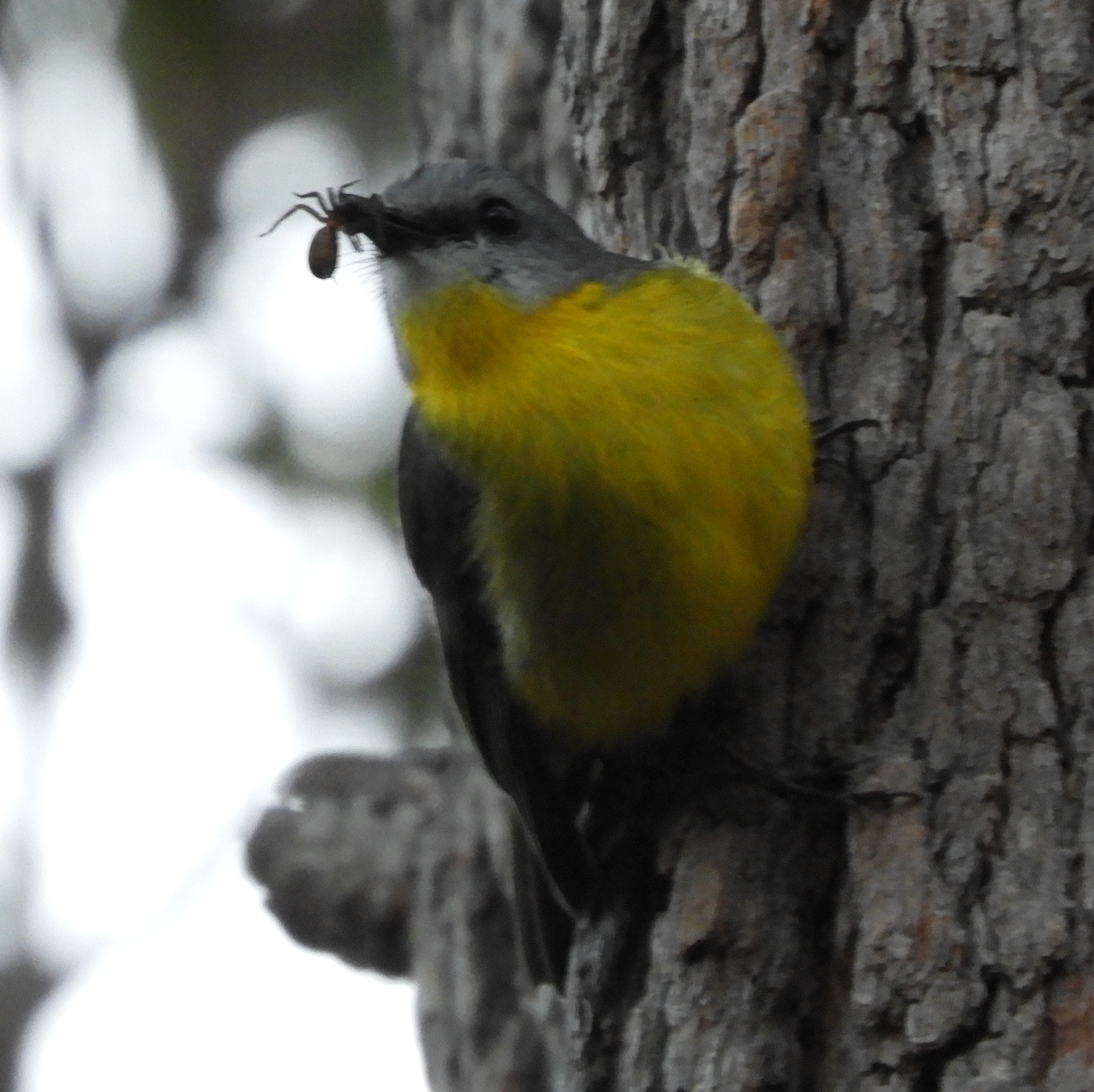
Common name: Pale-yellow Robin
Scientific name: Tregellasia capito
Approximate length: 12 cm
Date spotted: 12 September 2020 (spring)
Location: Manly Dam Reserve, New South Wales, Australia: 33°46’24.0″S 151°15’08.0″E


 Sydney Birder