Blog Archives

Pelicans at Cairns Esplanade
I’m in Cairns for a couple of days! Cairns is in Far North Queensland, about 2,000 kilometres from Sydney as the crow flies. Early this morning, before the tropical heat set in, I took a stroll along the Esplanade.
This lovely sculpture by Brian Robinson is called Citizens Gateway to the Great Barrier Reef:

I love the way the artwork frames the bay and the entrance to the Coral Sea.
A little further along the Esplanade, two Australian Pelicans were chilling out in the shelter of the boardwalk:

Common name: Australian Pelican
Scientific name: Pelecanus conspicillatus
Approximate length: 170 cm
Approximate wingspan: 2.5m
Date spotted: 14 May 2022 (autumn)
Location: Cairns Esplanade, Far North Queensland, Australia: 16°55’05.0″S 145°46’33.3″E

Yellow Figbird in Tropical North Queensland
Last weekend I was at Mission Beach in Tropical North Queensland. While there, I spotted a group of figbirds. The colouring of the males was quite different from the figbirds of the Sydney region. The northern variation (Sphecotheres viridis flaviventris) is called the Yellow Figbird for good reason:
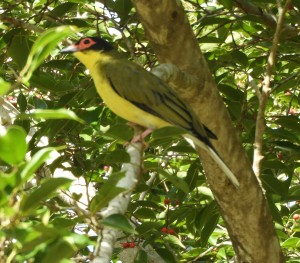
Common name: Yellow Figbird
Scientific name: Sphecotheres viridis flaviventris
Approximate length: 29 cm
Date spotted: 15 May 2021 (autumn)
Location: Mission Beach, Tropical North Queensland, Australia: 17°51’56.6″S 146°06’33.5″E
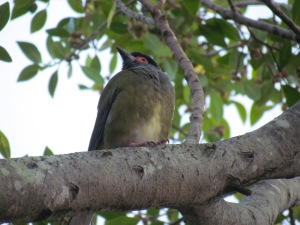
Compare the more subdued colouring of this male figbird in the Sydney region:

In search of a dinosaur uh Cassowary
(Not in Sydney.) This weekend I’m in Tropical North Queensland with my family. On Saturday, we drove up the east coast of Australia from Townsville, heading north for three hours until we reached the town of Mission Beach. This stretch of coast is the one place in the world where you’re most likely to meet a real live dinosaur.
Well, it’s not an actual dinosaur. What we were looking for was a Cassowary, the closest thing to a living dinosaur that I can imagine. A Cassowary is a large bird, ranging from one-and-a-half to two metres tall and weighing in at around 60 to 70kg. That means the bird is about the same height and weight as I am, or even larger!
Upon entering the area of Mission Beach, we came across enticing road signs like this one:

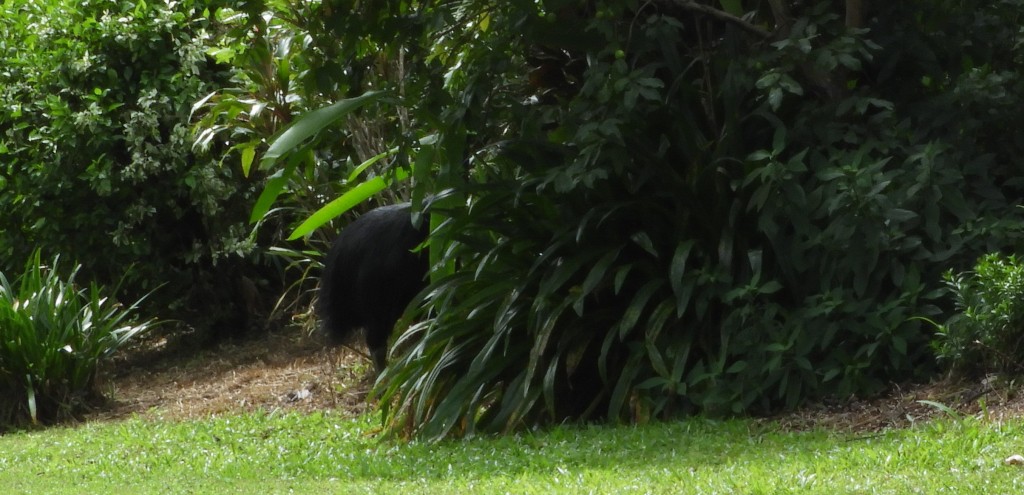
Cassowaries are usually timid and avoid contact with humans. Before setting out, I’d done some research about where we’d be most likely to see one, if we were lucky. And yes, we were lucky! Within an hour or so of starting our wandering around the southern areas of Mission Beach, we spotted a Cassowary. My first photo shows this intriguing rear end poking out from behind a bush:
Soon the bird appeared in full view:
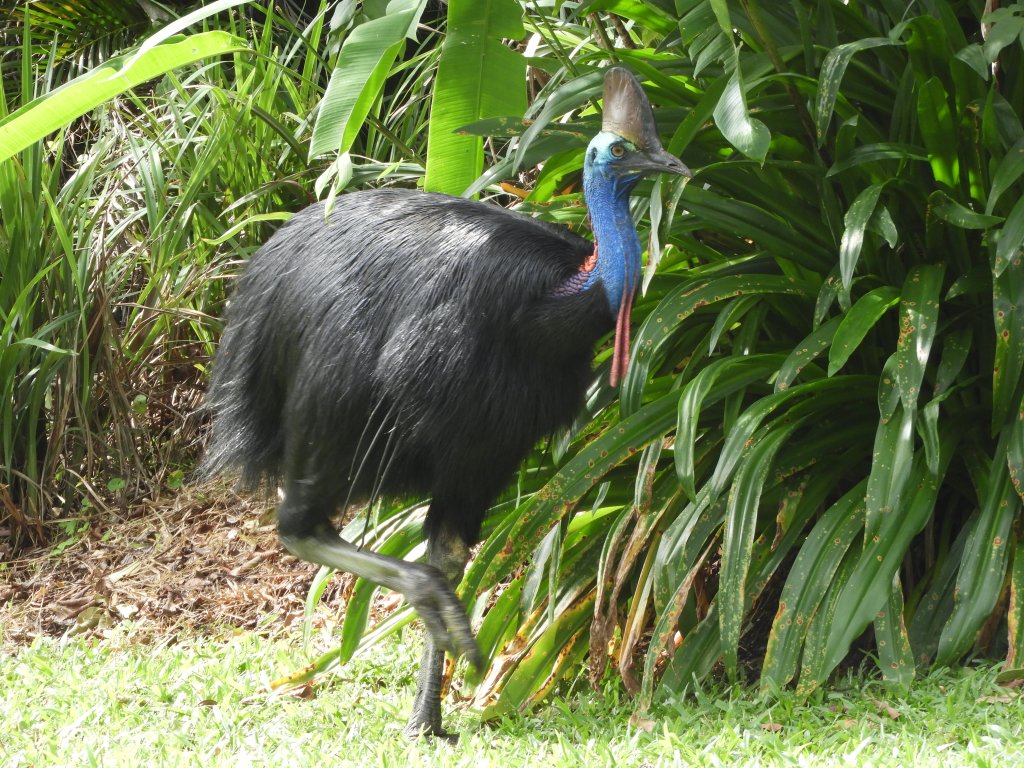
What a magnificent creature! We stayed well out of its way. Cassowaries are formidable. Quite apart from being large and fast, they have a big, strong beak and a twelve-centimeter-long, sharp claw on each foot, fit to disembowel any unwary adversary.
The curved bit that sticks up on the bird’s head is a hard, bony protrusion called a casque. Nobody is quite sure of its purpose. One theory is that the casque provides a sounding chamber that helps the bird make its deep, booming call. The colours on the bird’s head and in those red hanging wattles get brighter when the bird is agitated. Cassowaries can’t fly, but they can run up to 50 kilometres per hour, jump 2 metres straight up into the air, and swim well too.
This video shows the Cassowary quietly exploring the plants, looking for an edible treat:
Common name: Southern Cassowary
Scientific name: Casuarius casuarius johnsonii
Approximate height: Up to 2 metres
Date spotted: 15 May 2021 (autumn)
Location: South Mission Beach, Tropical North Queensland, Australia: Map


 Sydney Birder