Blog Archives

Rose-crowned Fruit Dove near Sydney
My first sighting of a Rose-crowned Fruit Dove in the wild!
A few days ago, I saw a social media post saying that people were seeing a Rose-crowned Fruit Dove in Manly, just north of Sydney. I was surprised, because these birds are more common further north. I verified the sightings on eBird, then went to see if I could find the bird.
My first few trips were fruitless, though there was a lot of fruit around, in the form of Blueberry Ash berries! When I later spotted a Rose-crowned Fruit Dove, it was in the midst of these blue berries.
Rose-crowned Fruit Doves are amazingly colourful — not what first comes to my mind when I think of doves. They get their name from the pink patch just above their beaks. The back and wings are a striking emerald green, and the front is a soft grey on the chest, moving to bright yellow and orange on the belly, then merging into a more lime-coloured green under the tail:

A frontal view shows the chest and belly, as well as the good strong legs and feet:

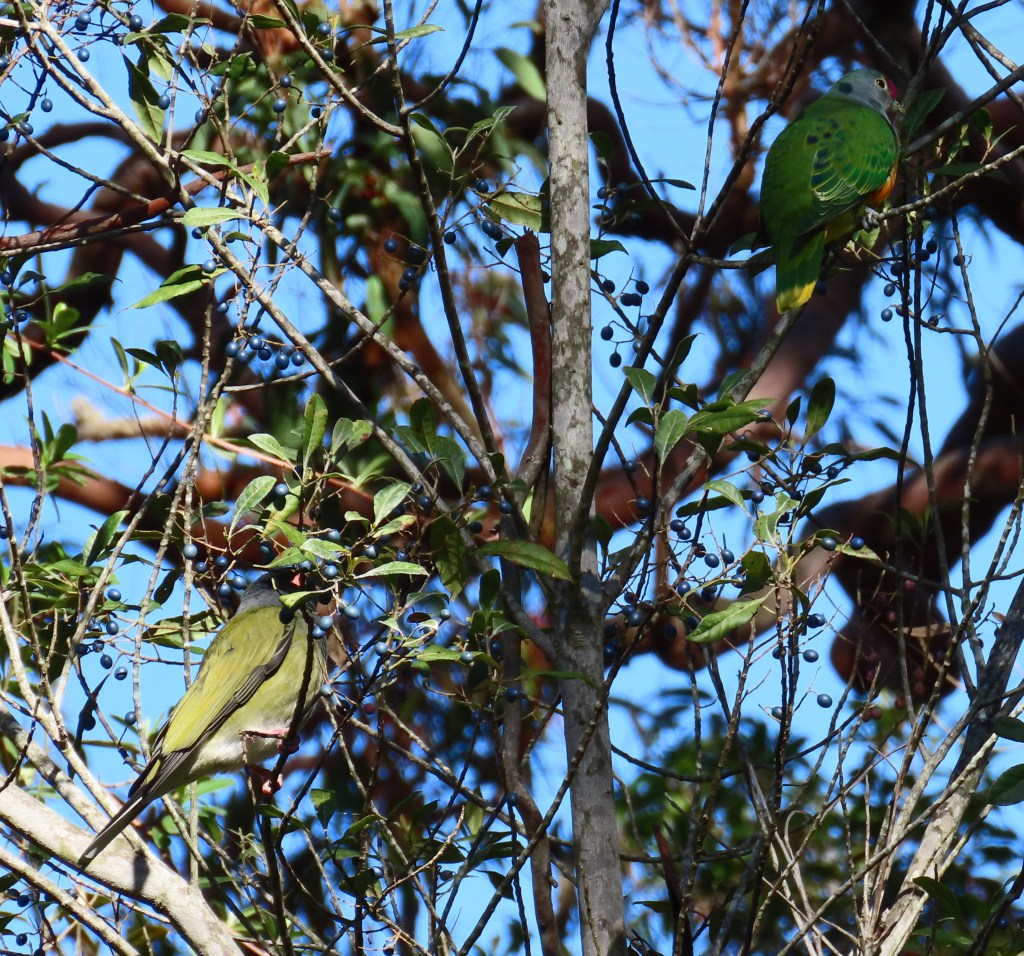
The dove had some competition for the berries from other birds. In particular, a group of figbirds moved in and started a bit of a squabble. The next photo shows the Rose-crowned Fruit Dove at top right and a figbird at bottom left. The photo gives a good view of the dove’s emerald green back:
Here’s a short video of the dove moving around:
Common name: Rose-crowned Fruit Dove
Scientific name: Ptilinopus regina
Approximate length: 22-24 cm
Date spotted: 7 September 2025 (spring)
Location: Manly North Head, Sydney Harbour National Park, New South Wales, Australia: 33°48’35.7″S 151°17’32.8″E
Evidently Rose-crowned Fruit Doves migrate to follow the fruit. They’ve been spotted breeding in this area too, and other people have seen a couple of juveniles in the same area recently.
One of the nicest experiences about this sighting was the bird watchers that I met. On the day when I actually saw Rose-crowned Fruit Dove, there was a group of people all pointing their cameras in the same direction. I was immediately fairly sure the bird was there, and indeed it was. People were generous in pointing out the bird and making sure I had a good spot to get my photos:


My first White-headed Pigeons, near Taree NSW
I was in Moto, near Taree, a few days ago, soon after the floods that have devastated much of the area. Driving along a country road next to a creek, I spotted a flock of about 7 large white-bodied, dark-winged pigeons on the side of the road. They flew up into the trees and onto the fences as I passed, but I managed to snap a shot of two of them with my phone:
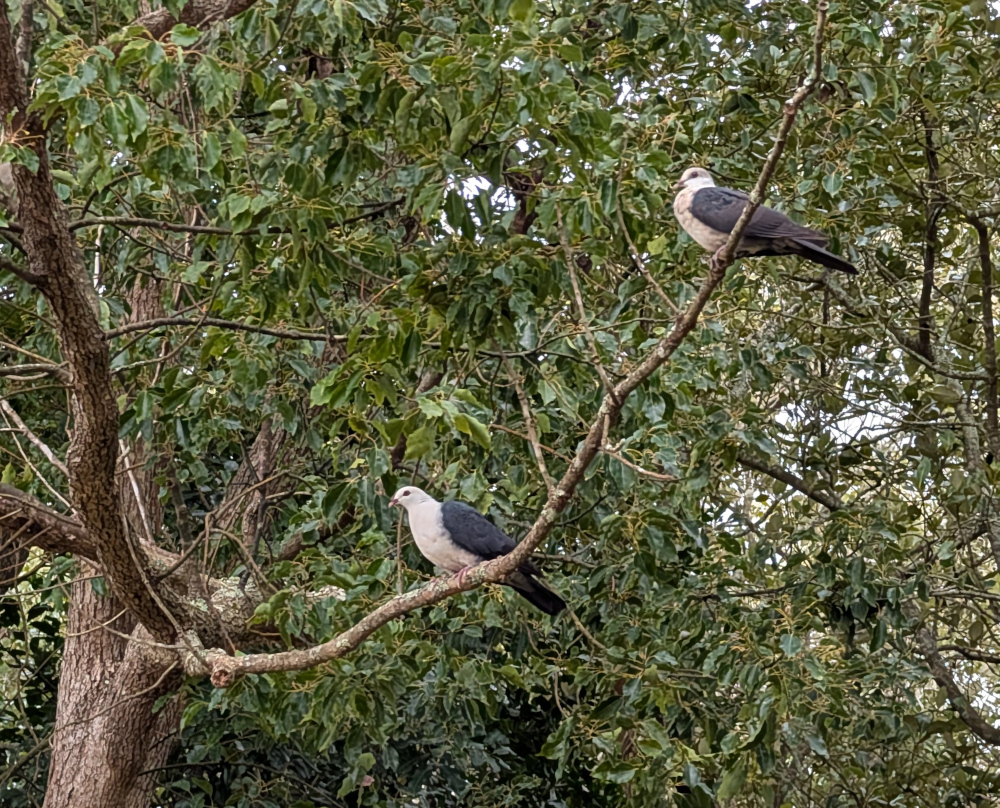
They’re White-headed Pigeons, my first sighting of these birds. The one on the left is a male. The one on the right is an immature male or female.
They’re larger than most pigeons, and exude an atmosphere of calm — until they fly away! My bird book lists them as scarce, and common in NE NSW. It comments that they’re “one of the shyest and wariest of pigeons”, so I count myself lucky to have seen them. eBird lists them as “Least Concern”.
Common name: White-headed Pigeon
Scientific name: Columba leucomela
Length: 38-40 cm
Date spotted: 4 June 2025 (winter)
Location: Moto, NSW, Australia: 31°51’16.8″S 152°35’00.9″E

Brown pigeon in Sydney but not a Brown Cuckoo-Dove?
This lovely brown pigeon perched on a post at Pyrmont in Sydney. Does anyone know what type of pigeon it is?

Here’s a closeup of the bird:
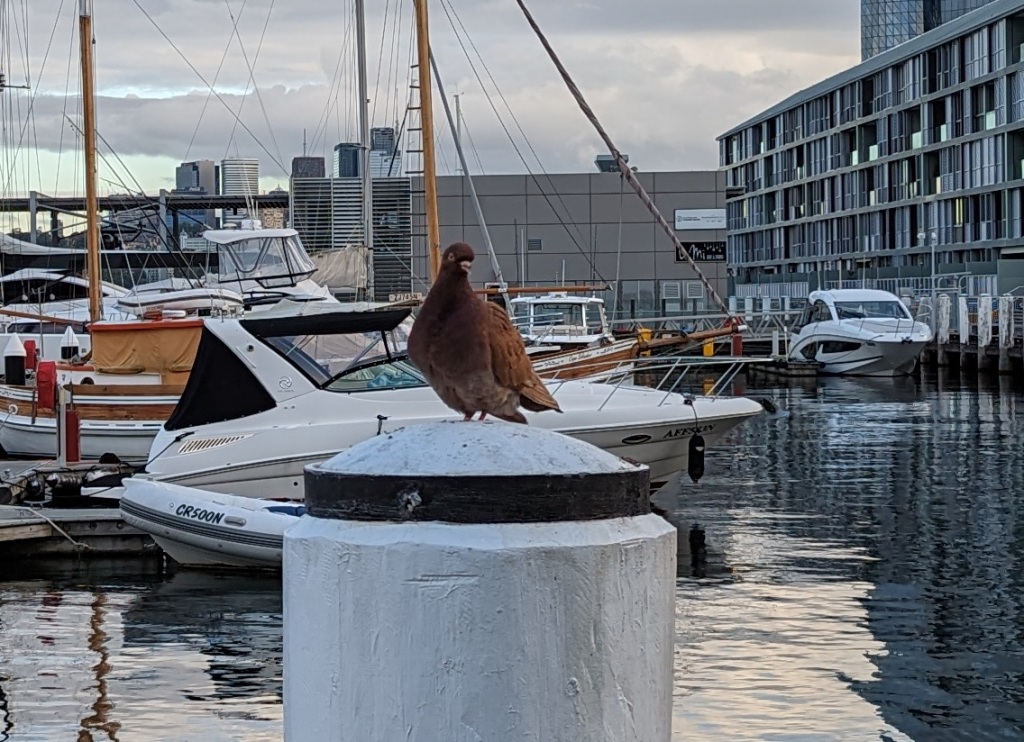
It doesn’t look like a Brown Cuckoo-Dove (Macropygia amboinensis) — the colouring isn’t quite right. This bird has a light-coloured beak and a light ring around its eye. Its chest plumage is as dark as the wings. Also, I don’t think its tail is long enough for a cuckoo-dove.
This picture shows the bird from a different angle, so that you can see its back, wings and tail:

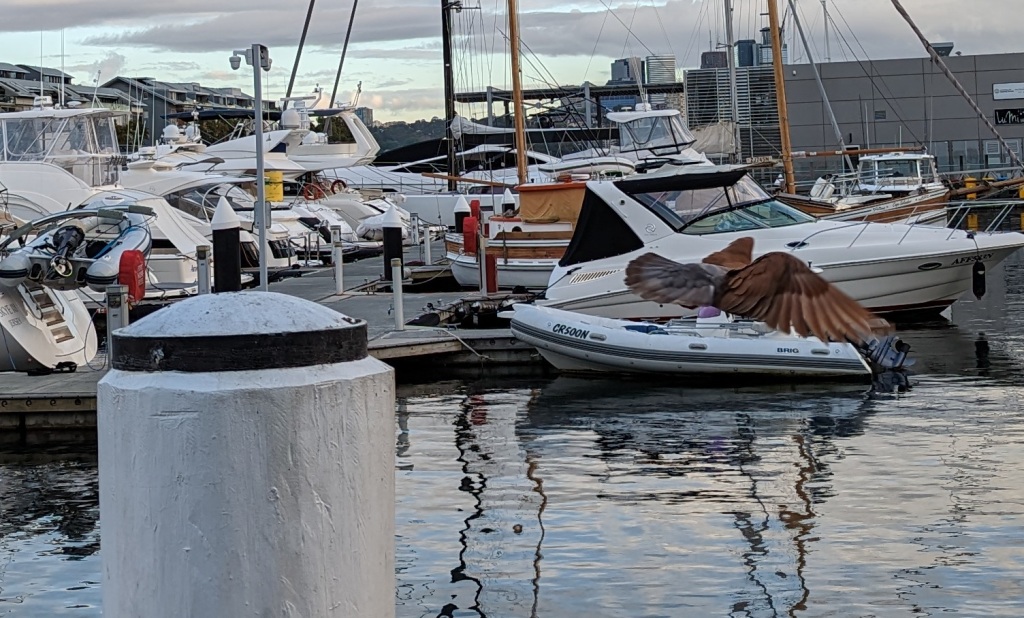
Here’s a picture of the bird flying off:
Common name: Pigeon
Scientific name: Unknown
Date spotted: 21 December 2022 (summer)
Location: Pyrmont, Sydney, New South Wales, Australia: 33°52’03.7″S 151°11’48.8″E

Common Bronzewing pigeon in Blue Mountains
This weekend I spent a day in the region of Kurrajong in the Blue Mountains area west of Sydney. On an early morning walk, I came across this large, colourful pigeon:

It’s a Common Bronzewing. I’d heard their calls from all round me in the bush: a deep, booming coo that sounds like something from Jurassic Park rather than from a pigeon!
Common name: Common Bronzewing
Scientific name: Phaps chalcoptera
Approximate length: 30-36cm
Date spotted: 31 October 2021 (spring)
Location: Grose Wold, New South Wales: 33°36’41.7″S 150°39’50.0″E
Hybrid Spotted Turtle-Dove with Crested Pigeon?
Today I spotted a couple of interlopers in an area that’s the regular hangout for a group of Crested Pigeons. One of the interlopers looks like a regular Spotted Turtle-Dove. Here’s a Crested Pigeon on the left and the interloper on the right:

But nearby, on the same wire, is this rather interesting individual:

The bird looks like a Spotted Turtle-Dove but has a bit of feathery decoration on its head. Could it be a cross-breeding of a Spotted Turtle-Dove with a Crested Pigeon? Or is it just a Spotted Turtle-Dove having a bad hair day?
Here’s another pic of the same Crested Pigeon as in the first photo:

Crested Pigeons are native to Australia. When they take off, you hear the distinctive whistling noise from their wings that is characteristic of many pigeon types. When I first saw these birds, I thought how typical it is that even the common pigeons in Australia are different from those I’ve seen in other part of the world.
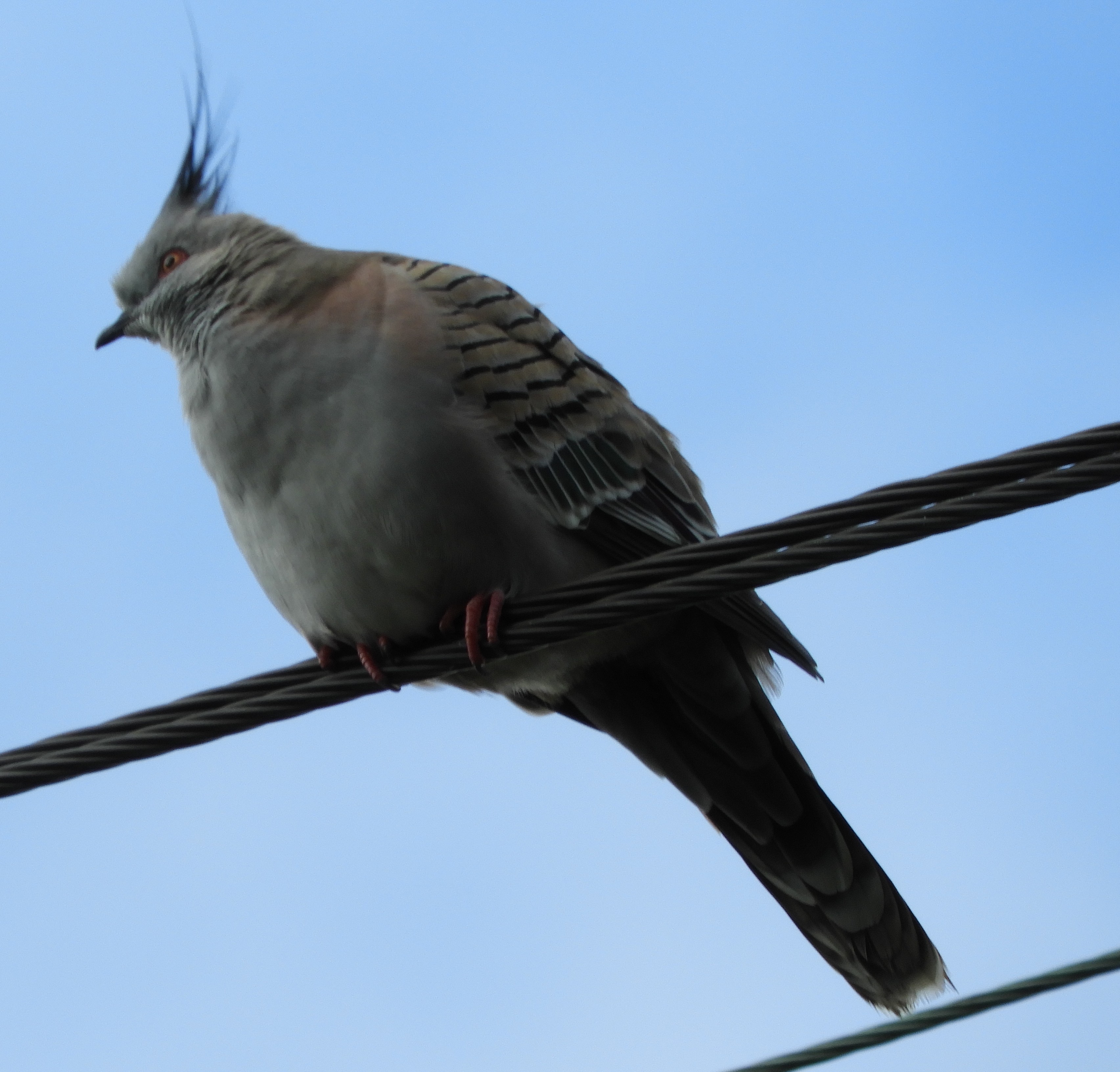
The group of birds later moved down to forage on the ground. Here’s one of the Crested Pigeons:

There was only one bird that looked like a Spotted Turtle-Dove with a vestigial crest. Here’s another pic of the same bird:
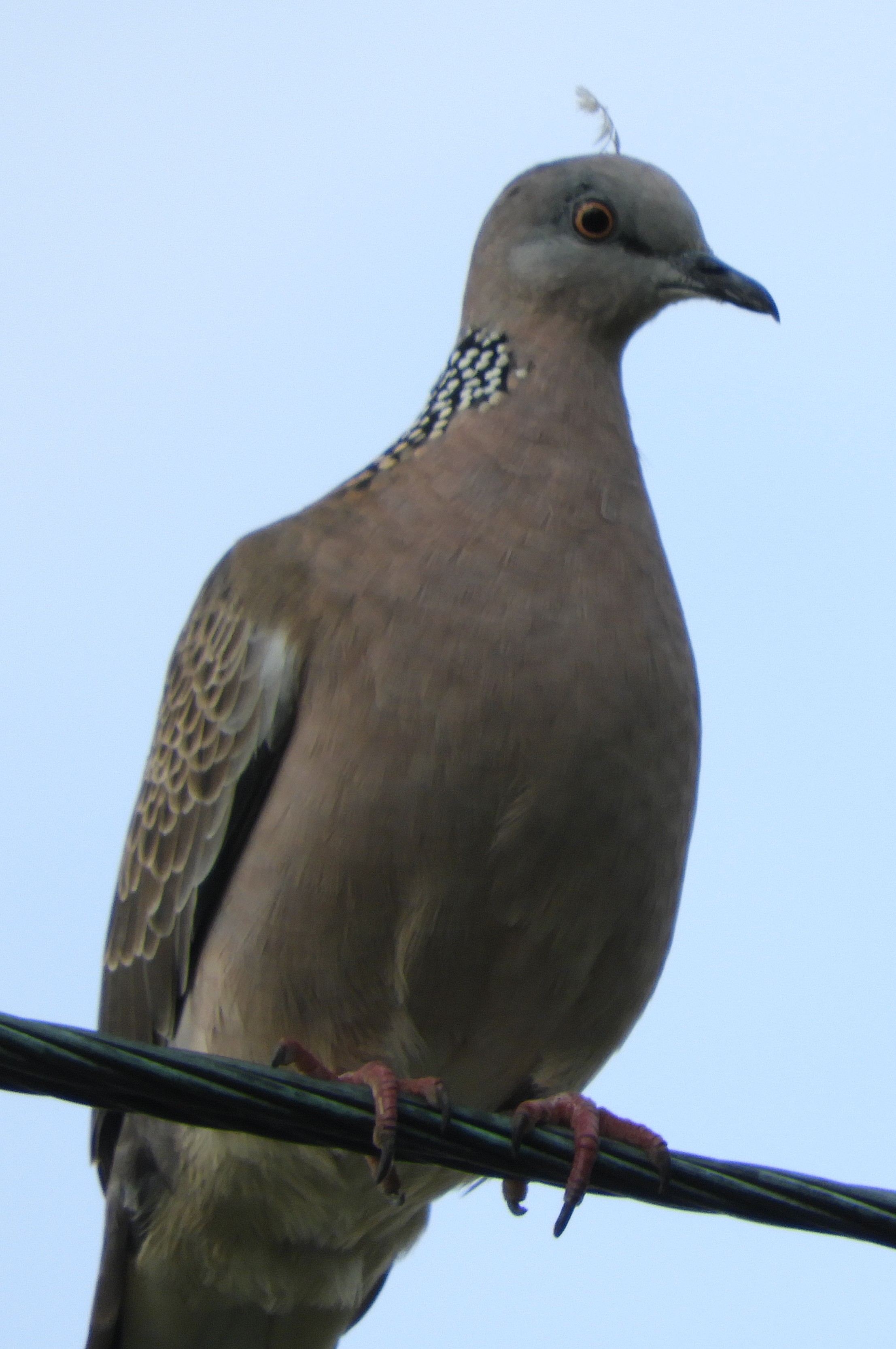
Spotted Turtle-Doves are not native to Australia. They were introduced in the late 1800s, and are seen as a pest in some regions of the country.
Pigeon or dove? The names “Crested Pigeon” and “Spotted Turtle-Dove” led me to wondering, not for the first time, what the difference is between a pigeon and a dove. I’ve asked various people over the years. Some say doves are white whereas pigeons are not. Other say that doves are smaller than pigeons. According to much of the internet, the two terms are interchangeable.
Here’s another view of the same bird with the miniscule crest (or perhaps it’s just a feather expressing its individual identity):

A wink, almost as if the bird knows that it’s presented me with a puzzle:

Spotted Turtle-Dove | Scientific name: Streptopelia chinensis | Approximate length: 30-32 cm
Crested Pigeon | Scientific name: Ocyphaps lophotes | Approximate length: 31-35 cm
Date spotted: 5 July 2019 (Winter)
Location: Allambie Heights, New South Wales, Australia


 Sydney Birder