Blog Archives

Mudlarks building nest of mud
A few weeks ago, I watched a pair of Mudlarks building their nest. Mudlarks get their name from their construction of nests made of mud and reeds. Despite their name, Mudlarks are not larks. Another name for them is Magpie-larks — but they’re not Magpies either! Yet another name for them is Peewees, which is an imitation of the noise they make: pee-wee, pee-wee.
Building a good nest takes a lot of patience and skill. The birds use their beaks to pile globules of mud on top of each other to form a bowl, increasing the circumference of the bowl with each layer. Every now and then, the birds sit in the growing nest and wiggle their bodies around to smooth out the inside and make sure the nest is the right size and shape. Watch this video to see the nest-building:
The birds collect mud and reeds from a nearby river or lake. Here’s a pair of them (male and female) collecting reeds at Manly Dam in NSW, Australia:
Here’s the female sitting in the nest, making sure it’s the right size and shape:

Here’s a still shot of the male gathering mud and reeds:
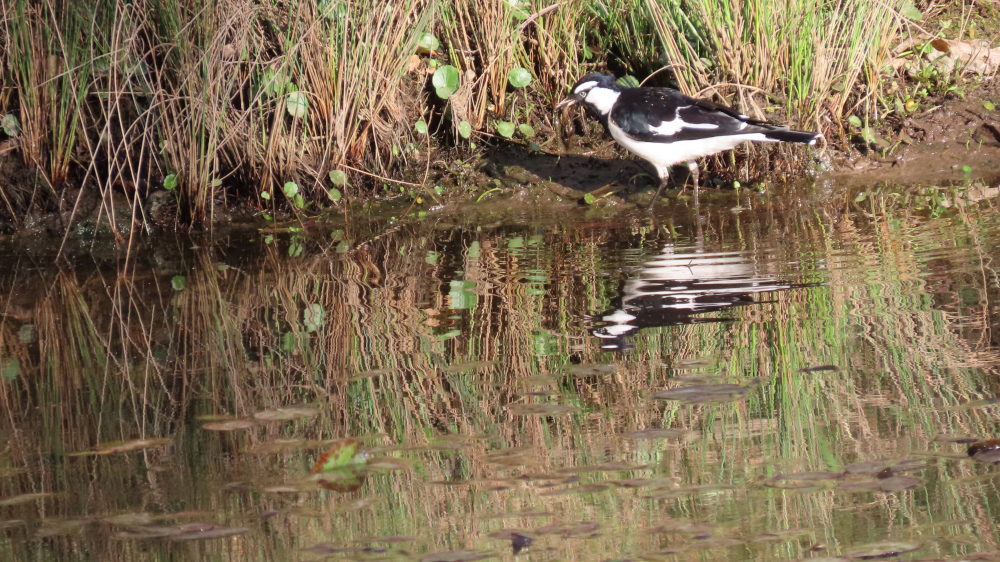
Common name: Magpie-lark, also called a Peewee or a Mudlark
Scientific name: Grallina cyanoleuca
Approximate length: 30 cm
Date spotted: 18 September 2025 (spring)
Location: Manly Dam National Park, New South Wales, Australia

Incoming!
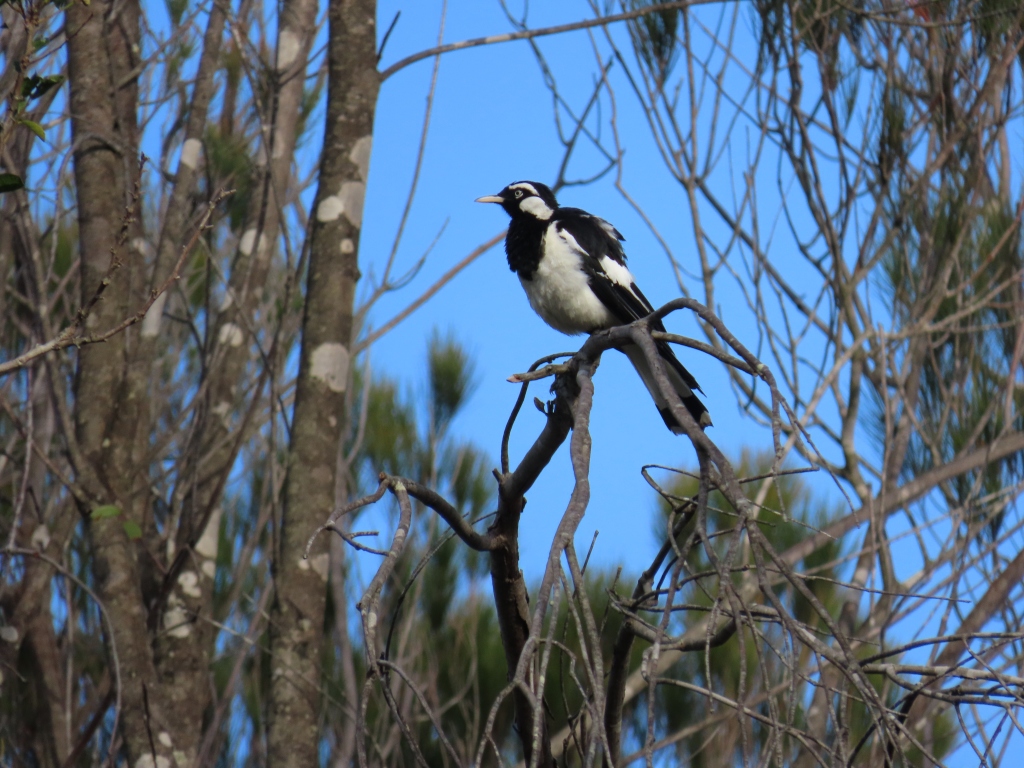
I took this photo so that I could identify the black and white birds on a far off skeleton tree. I only saw the incoming missile when I examined the photos at home:
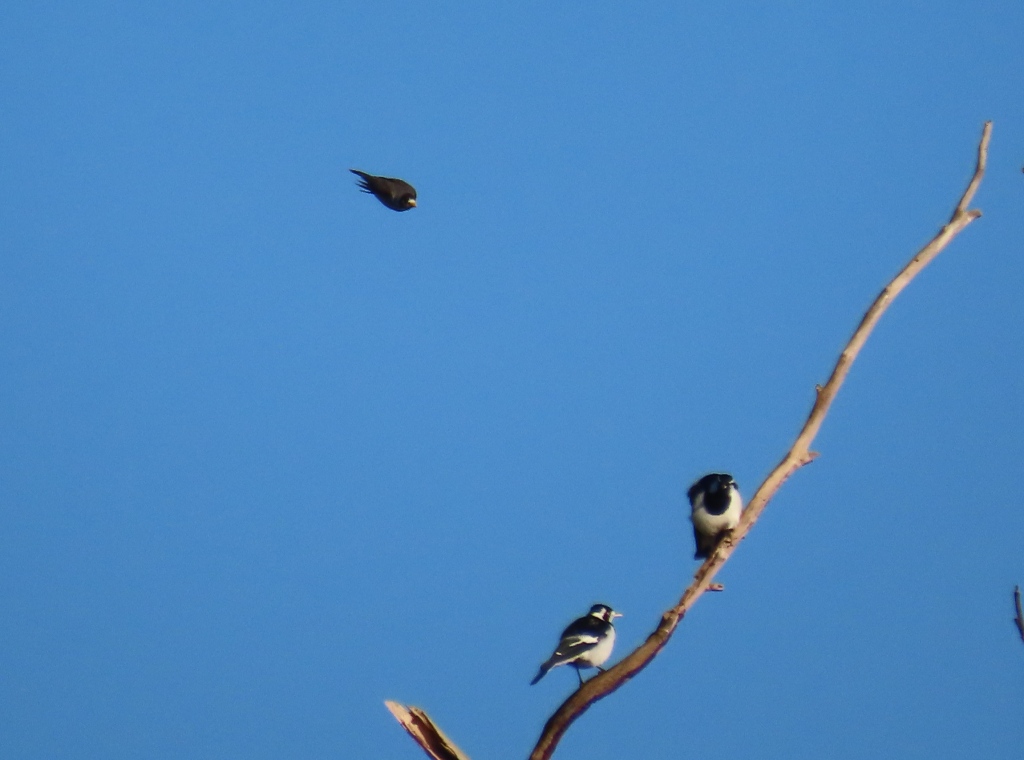
I think the missile is probably a Noisy Miner. The two birds on the tree are Magpie-larks. I’ve often seen Noisy Miners sitting on this strategically-placed dead tree branch, which has a good view over Manly Dam. I’ve seen several types of birds perched there, but the Magpie-larks are usually closer to the water rather than high in a tree.
Date spotted: 30 May 2024

Magpie-lark nest with chicks
A couple of days ago, I spotted a Magpie-lark having a quick cicada snack. Today, back in the same area of Manly Dam, there was more activity in the Magpie-lark community. It turns out that the birds have a nest nearby, and the adults are busily feeding the chicks.
In this video, the chicks’ heads pop up when the adult arrives to feed them. When the adult leaves, the babies stretch the necks, begging for more.
As you can tell, the nest was quite far away from my vantage point, and my camera’s zooming powers are stretched to the utmost. Still, you can see what’s happening.
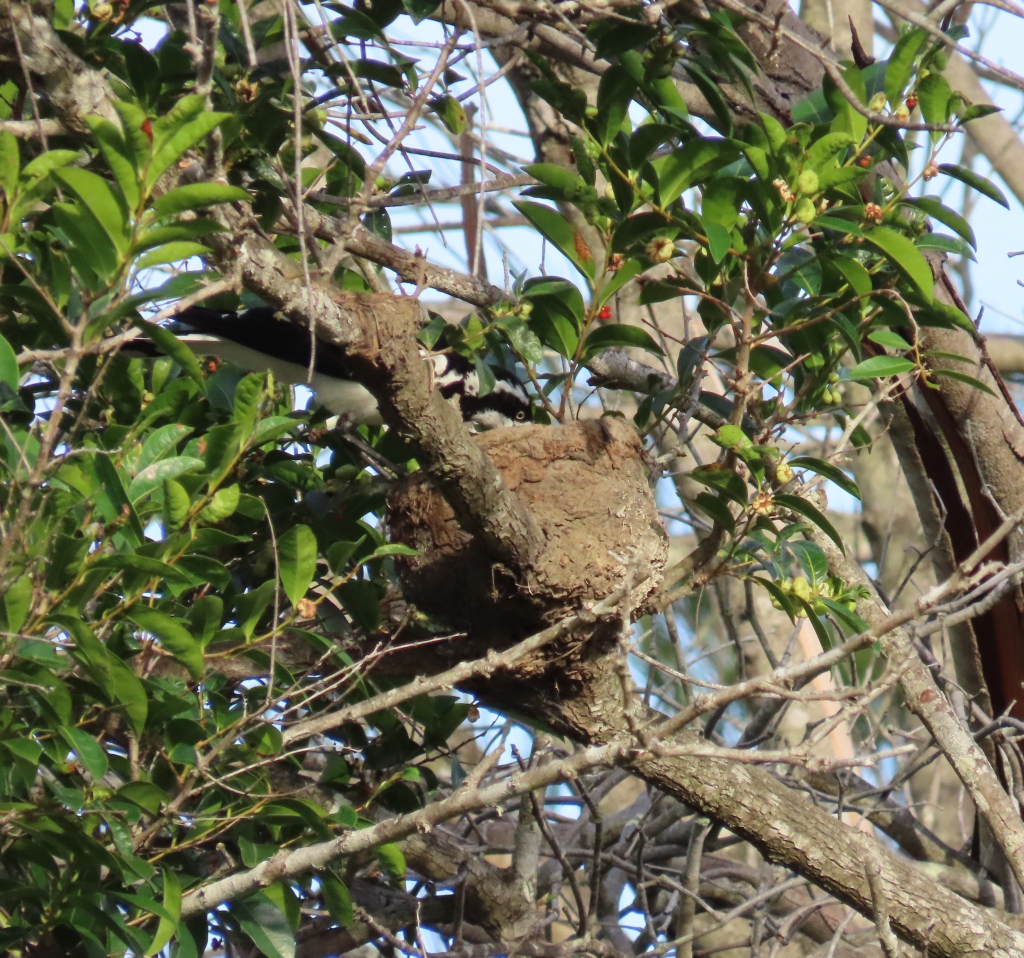
Here’s a still shot of the nest with an adult Magpie-lark peering down into it. The adult is a female, as it has a white throat. You can see the white underbelly of the bird towards the left, the black wings above, and then, on the right of the branch, the black-and-white head with the bird’s eye just above the rim of the nest:
Gathering food and feeding babies is hard work. The adults often take a breather within sight of the nest, but out of sight of the babies, so that the babies don’t squawk for food. Here’s a male adult (black throat) at top right of the photo, with the nest near the bottom left:
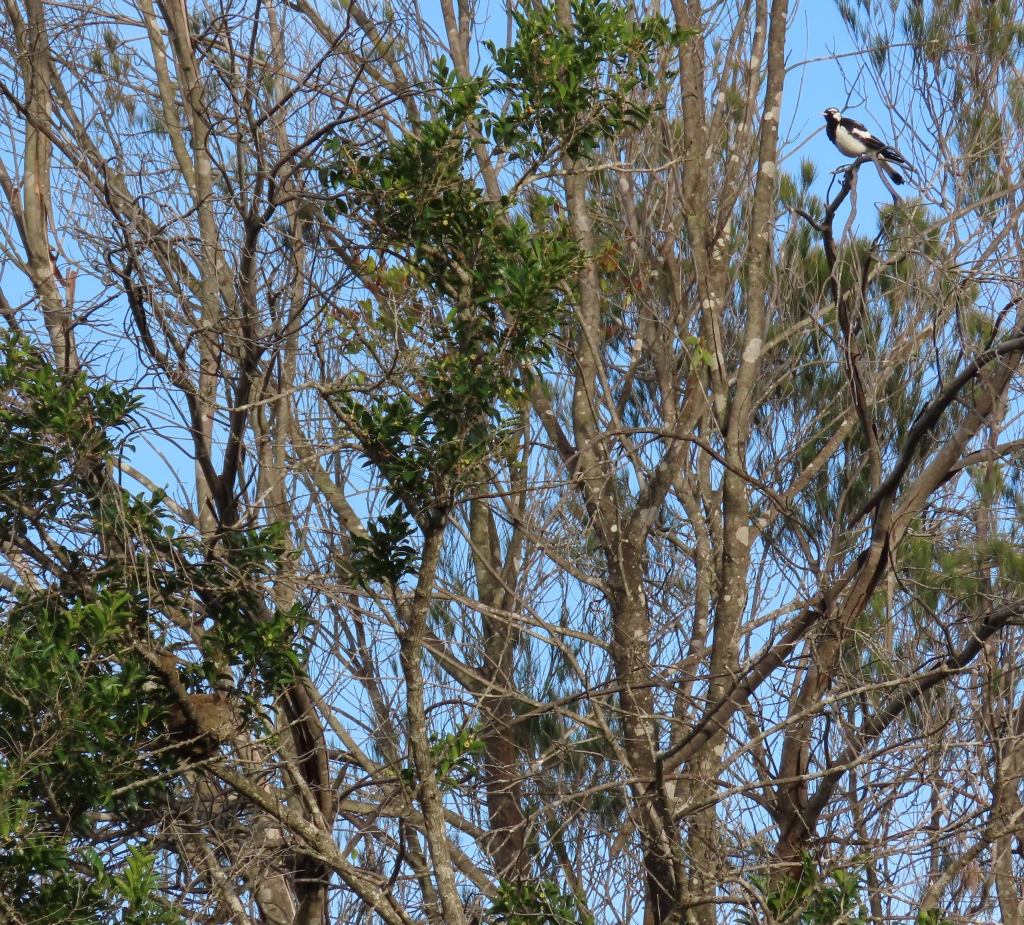
Here’s a closeup of the adult taking a breather:
Common name: Magpie-lark, also called a Peewee or a Mudlark
Scientific name: Grallina cyanoleuca
Approximate length: 30 cm
Date spotted: 7 January 2024 (summer)
Location: Manly Dam National Park, New South Wales, Australia: 33°46’35.5″S 151°14’50.3″E
Magpie-lark eating a cicada
Magpie-larks are quite striking to look at, with their clear black-and-white markings and their strangely light-coloured eyes. This one caught my attention because it had captured a large insect and was making a good meal of it. The insect is an interesting yellowish pink colour. I think it’s a cicada, most likely the yellow variation of a Green Grocer cicada:
The name Magpie-lark is rather confusing. This bird isn’t a magpie or a lark. I guess the “magpie” part of the name comes from the black and white colouring. I don’t know where the “lark” part comes from.
Evidently Magpie-larks, like their namesake magpies, do swoop at humans to protect their territory. Luckily that hasn’t happened to me yet.
This bird is a male. It has a black throat, whereas the female has a white throat.
Common name: Magpie-lark, also called a Peewee or a Mudlark
Scientific name: Grallina cyanoleuca
Approximate length: 30 cm
Date spotted: 5 January 2024 (summer)
Location: Manly Dam National Park, New South Wales, Australia: 33°46’35.5″S 151°14’50.3″E

Magpie-lark eating a cicada
This Magpie-lark, also known as a Mudlark or a Peewee, has caught a cicada for breakfast.
Cicadas are large beetles that appear around Sydney in summer and drive us all crazy with their singing. You can hear the harsh, ringing sound of the cicadas in the video.
There are a few different types of cicadas, many of them quite lovely. Take a look at these posts to see some that I’ve photographed on other occasions.
Back to the bird! This Magpie-lark is a male. You can tell by the colour of its throat, which is black. Female birds have a white throat.

Common name: Magpie-lark, also called a Peewee or a Mudlark
Scientific name: Grallina cyanoleuca
Approximate length: 30 cm
Date spotted: 28 November 2020 (spring)
Location: Manly Dam National Park, New South Wales, Australia: 33°46’35.5″S 151°14’50.3″E
Magpie-lark, Mudlark, or Peewee
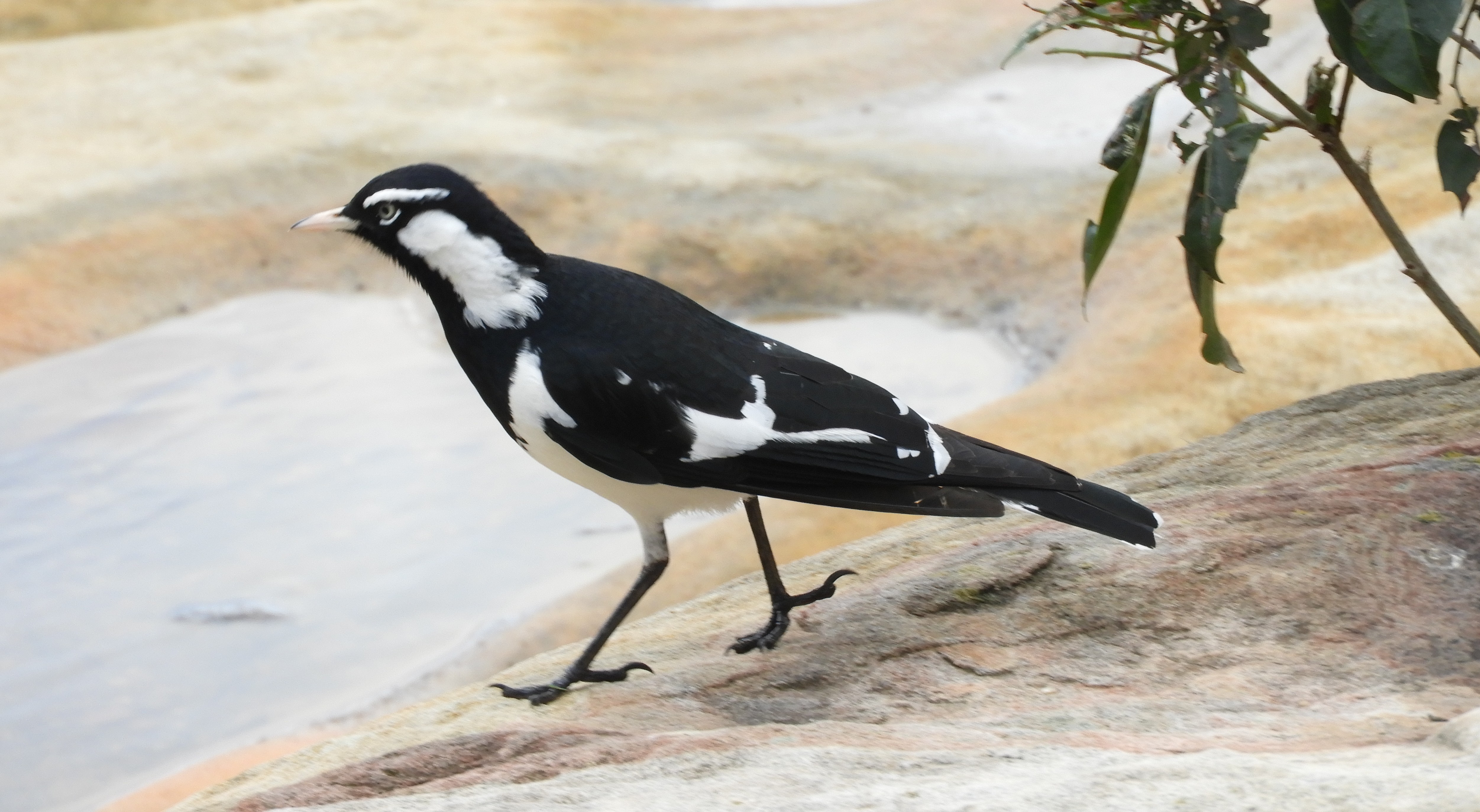
This Magpie-lark was one of three that came up close to investigate a friend and me while we were standing on the shore of Manly Dam. Magpie-larks are also known as Mudlarks, because they build their nests of mud, and as Peewees in imitation of the noise they make.
This one is a male. You can tell by the colour of the throat: in males it’s black, in females white.
Common name: Magpie-lark, also called a Peewee or a Mudlark
Scientific name: Grallina cyanoleuca
Approximate length: 30 cm
Date spotted: 28 April 2018 (Autumn)
Location: Manly Dam National Park, New South Wales, Australia: 33°46’35.5″S 151°14’50.3″E
Magpie-lark or Peewee
We don’t seem to quite know what to call these birds. Their most common name is Magpie-lark, but they’re neither magpies nor larks. They are sometimes called Peewees in imitation of their call, “pee wee, pee wee”. Other people call them Mudlarks, because they use mud to build their nests.
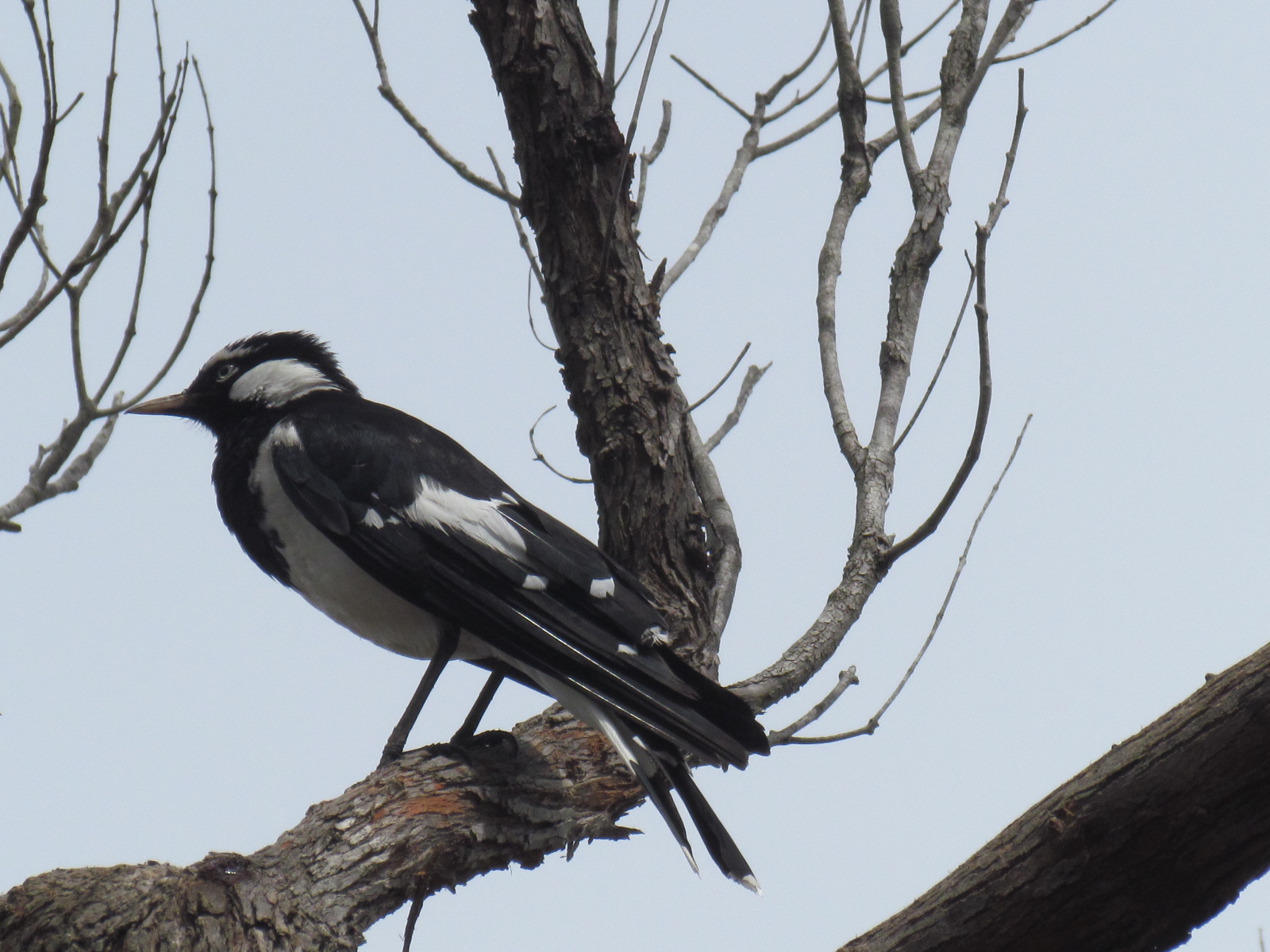
Magpie-lark usually look quite dapper, their feathers sleek and smooth. This one is a little ruffled, perhaps blown about by the strong wind.
Common name: Magpie-lark
Scientific name: Grallina cyanoleuca
Approximate length: 30 cm
Date spotted: Sunday 30 October 2016
Season: Spring
Location: Manly Dam Reserve, New South Wales, Australia
Latitude/longitude: 33°46’35.5″S 151°14’50.3″E


 Sydney Birder