Blog Archives

Osprey chased off by raven and noisy miners
At Long Reef Headland today, an Eastern Osprey sat peacefully on a branch. Then an Australian Raven dived at the osprey, cawing and moaning. The resident Noisy Miners heard the fracas and joined in. After a few seconds, the Osprey decided enough was enough and took off to find a quieter spot.
Eastern Ospreys are magnificent birds. They measure up to 65 centimetres from head to tail, and have a wingspan of up to 1.7 metres. They eat fish, which they catch by diving into the water from a height and dragging the fish out of the water in their claws.
We first spotted this osprey perched on the edge of a cliff. Later, we saw it a few metres further on, in a tree high on a ledge above the beach.
Here’s the osprey enjoying the sun and the view, before the other birds arrive:
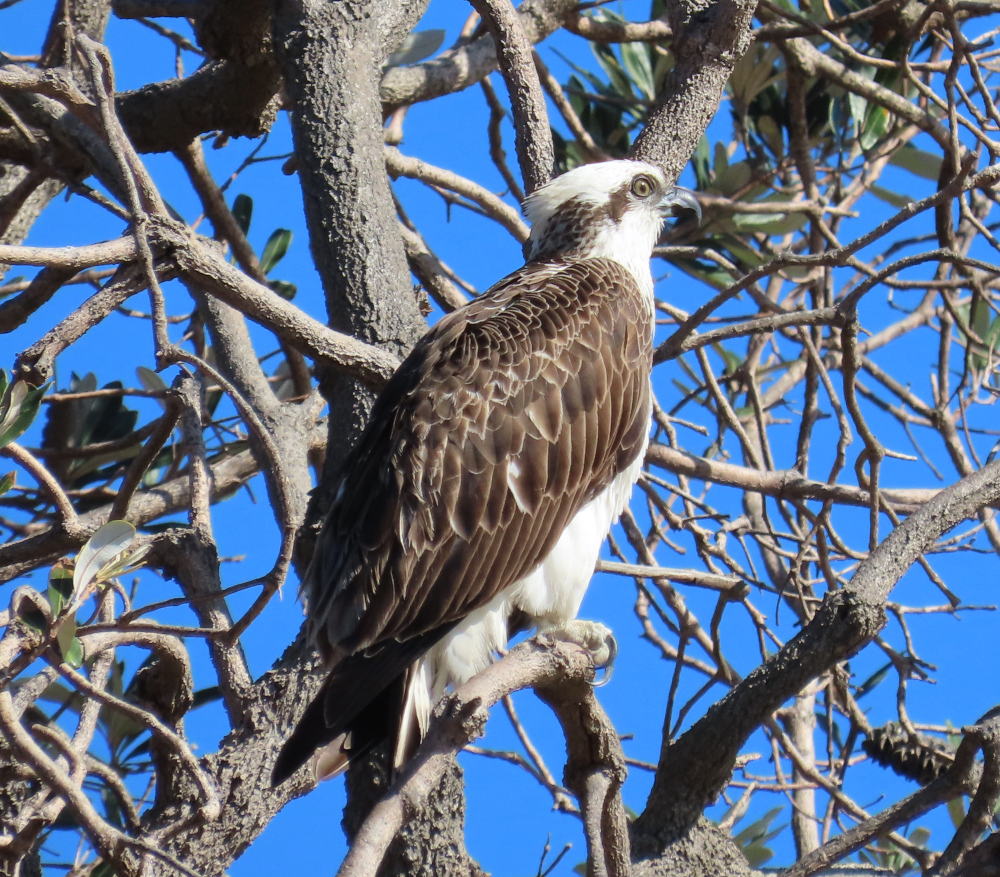
Then the Australian Raven arrived. Here the Osprey is warning the raven off:

That’s when I started the video recording, which you can watch at the top of this post.
Here’s the best picture I have of the osprey in flight:

Common name: Eastern Osprey
Scientific name: Pandion cristatus
Approximate length: 57 cm
Date spotted: 19 June 2024 (winter)
Location: Long Reef Aquatic Reserve, Collaroy, New South Wales, Australia: 33°44’19.7″S 151°18’42.0″E

Incoming!
I took this photo so that I could identify the black and white birds on a far off skeleton tree. I only saw the incoming missile when I examined the photos at home:
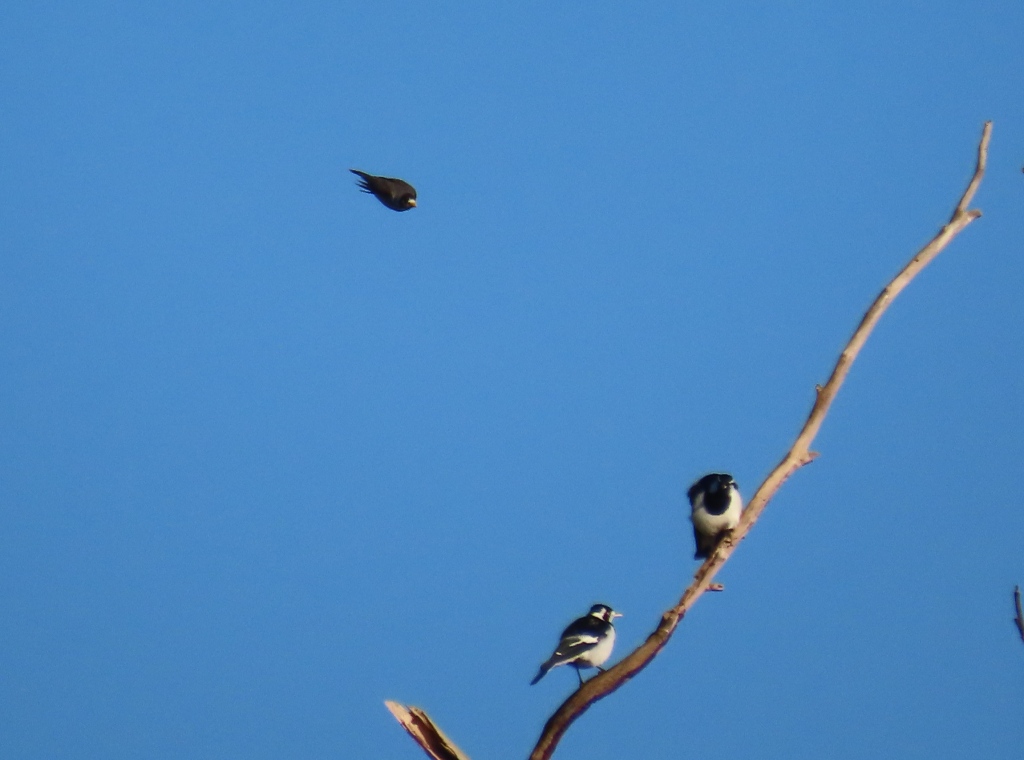
I think the missile is probably a Noisy Miner. The two birds on the tree are Magpie-larks. I’ve often seen Noisy Miners sitting on this strategically-placed dead tree branch, which has a good view over Manly Dam. I’ve seen several types of birds perched there, but the Magpie-larks are usually closer to the water rather than high in a tree.
Date spotted: 30 May 2024

Channel-billed Cuckoo laying egg in Currawong nest
This little episode happened in my garden today. It was interesting and exciting to watch!
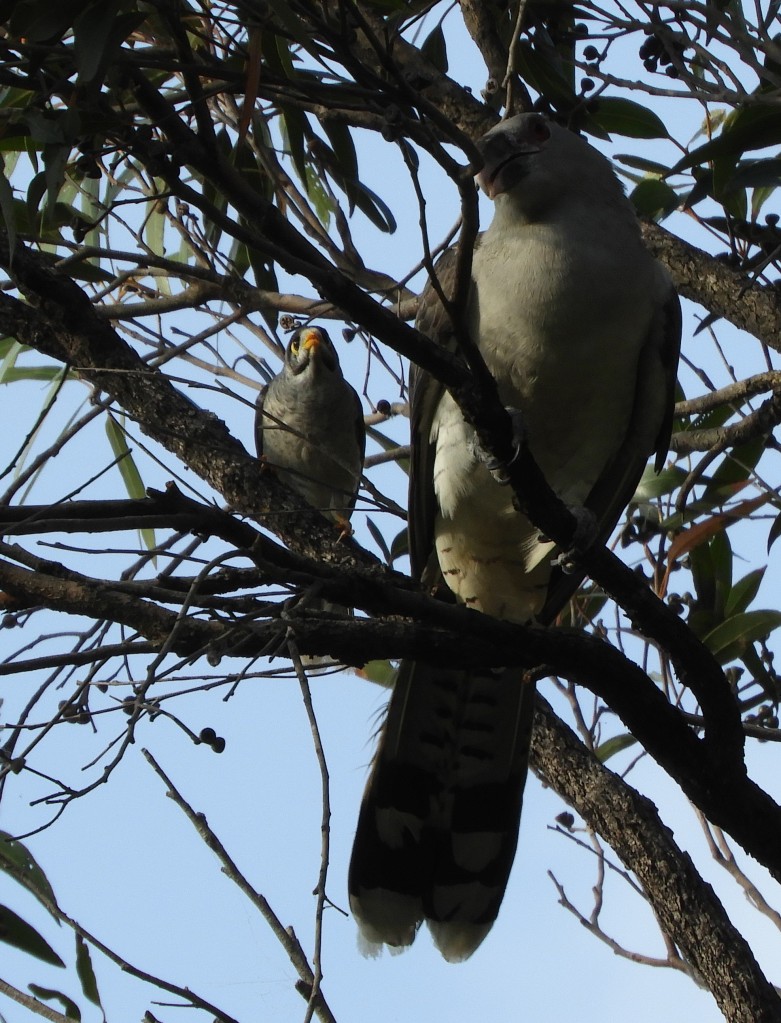
A cacophany of Noisy Miners and Currawongs drew me out into the garden to see what was up. High in a gum tree were two Channel-billed Cuckoos, being harassed as usual by the other birds. I only managed to get one of the cuckoos into my camera sights. Luckily, it turned out to be the female bird.
Here’s the Channel-billed Cuckoo on the right, with a little Noisy Miner by its side:
In this short video, you can hear the Noisy Miners peeping incessantly. The cuckoo emits a loud, harsh caw and cedes ground:
Next, the local Currawongs join the attack. The musical, bell-like tones are the Currawongs. The cuckoo flinches and utters its harsh croak. Then I noticed that there’s a Currawong nest just below where the cuckoo is sitting!
Like most cuckoos, Channel-billed Cuckoos are parasitic. They don’t build nests of their own. Instead, they look for a likely host (a Currawong does very nicely, thank you) and lay an egg in the chosen host’s nest. The Currawongs take over all parental duties, looking after the egg along with those of their own, then feeding the baby bird.
Channel-billed Cuckoo chicks don’t turf the other chicks out of the nest (many types of cuckoo chicks do) but they do eat a lot, and grow significantly bigger than the Currawong chicks.
Having decided that the neighbourhood is reasonably quiet and safe for a bit, the cuckoo eyes the nest and starts its approach:
Quick as a flash, it hops up into the nest and lays its egg:
Below is a still picture of the Currawong’s nest. I’ll keep an eye on it, in case I can spot the Currawong and cuckoo chicks when they arrive:

Channel-billed Cuckoo | Scythrops novaehollandiae | Approximate length: 58-65 cm
Noisy Miner, also called Australian Miner | Manorina melanocephala | Approximate length: 26 cm
Pied Currawong | Strepera graculina | Approximate length: 45 cm
Date spotted: 10 October 2021 (spring)
Location: Allambie Heights, New South Wales, Australia
Baby Noisy Miners doing well
Here’s an update on the nest of Australian Miners, also known as Noisy Miners, across the road from our house. The babies are getting bigger!
In this video, you see one of the chicks perched on the edge of the nest, making the incessant chirping that’s surely designed to drive a parent mad. One of the adults drops in with a quick morsel of food, and you can see both babies. I’m pretty sure there are only two chicks in the nest:
It’s quite a change since my previous post about the baby birds, just five days ago. This chick looks ready to take its first steps out of the nest:

Common name: Noisy Miner, also called Australian Miner
Scientific name: Manorina melanocephala
Approximate length: 26 cm
Date spotted: 30 March 2020 (late summer)
Location: Near Sydney, NSW, Australia
Noisy Miners nesting off season
Just across the road from my front window, a family of Australian Miners is nesting. They certainly are noisy, living up to their alternative name of Noisy Miners. I was surprised to see the birds nesting at this time of year. It’s late summer, coming up to autumn in this part of the world.
This short video shows a parent feeding the chicks. You can make out the orange beaks of the little ones, particularly when the parent flies away.
Here’s a still picture of the nest. You can see the parent bird, and the underside of a chick’s beak just to the left of the parent, between the parent’s chest and the branch:

It’s busy work, looking after a new family. Both parents are very attentive. Here’s one of them gathering nectar from a Banksia bush in our garden:

Common name: Noisy Miner, also called Australian Miner
Scientific name: Manorina melanocephala
Approximate length: 26 cm
Date spotted: 25 March 2020 (late summer)
Location: Near Sydney, NSW, Australia
Australian Miner auditions for The Birds and Psycho
This little Australian Miner landed on a branch near me and started that incessant eep-eep noise that they’re renowned for. It’s as if the bird is auditioning to do the soundtracks for two Hitchcock movies at once: The Birds and Psycho.
Well? Do I get the job?

How about if I spin my head around. You know, like in The Exorcist?

No? OK then, on to the next audition…

Common name: Noisy Miner, also called Australian Miner
Scientific name: Manorina melanocephala
Approximate length: 26 cm
Date spotted: 3 March 2018 (Summer)
Approximate location: Allambie Heights, NSW, Australia: 33°46’23.3″S 151°15’43.1″E
Noisy Miner chicks just out of their nest
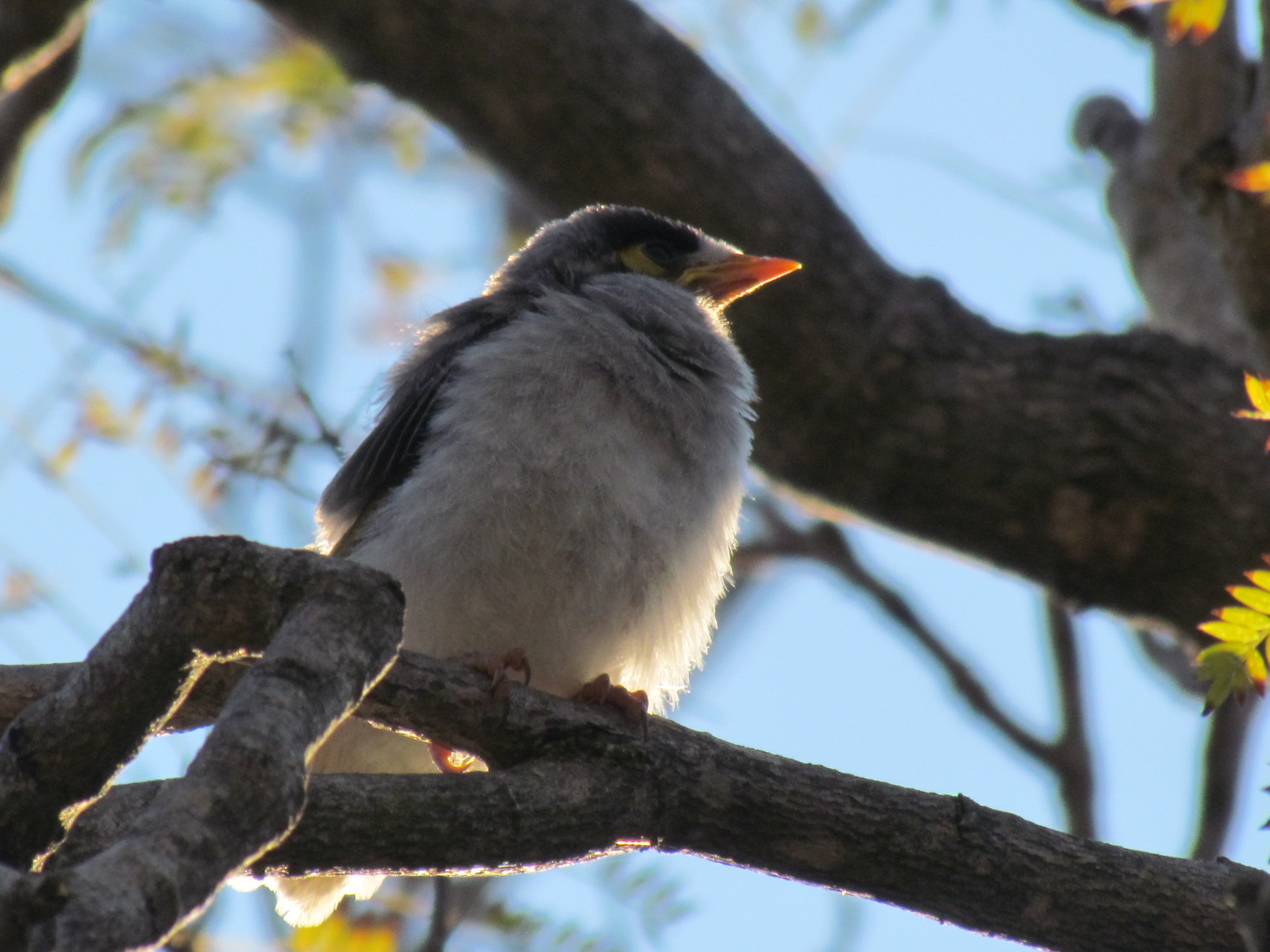
All fluffy and chirpy, three little Noisy Miners have taken their first steps out of their nest.
My previous post showed the chicks being fed in the nest. Now, just four days later, they’re on a branch, bunched together, preening and demanding food. The adults are still very much in attendance.
This still shot shows a chick outlined in the early morning sun:
Here are the three chicks, looking fluffy and cute but with the characteristic gimlet glare of the Noisy Miner:
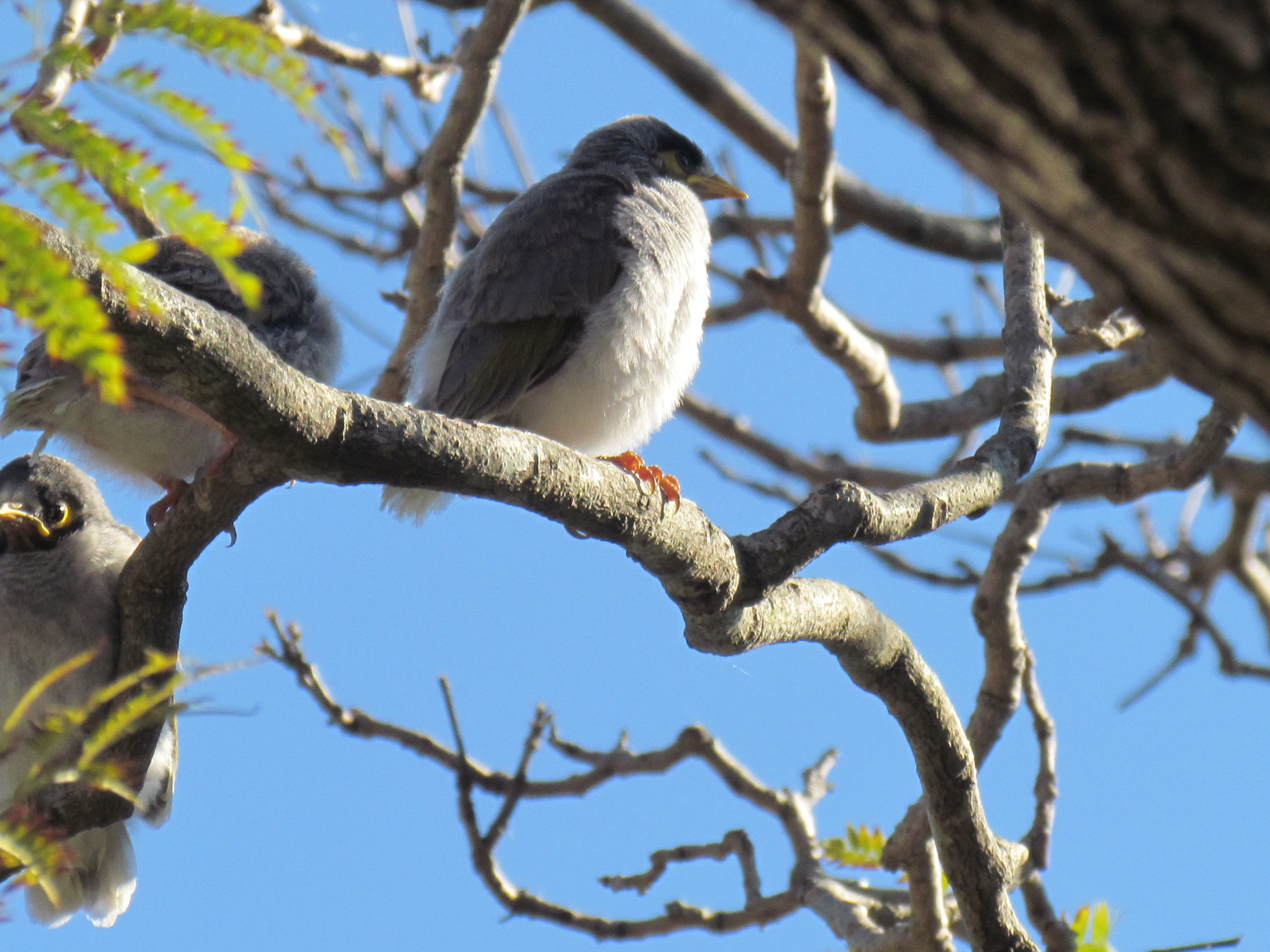
Common name: Noisy Miner, also called Australian Miner
Scientific name: Manorina melanocephala
Approximate length of adult bird: 26 cm
Date spotted: 17 September 2016
Season: Spring
Location: Allambie Heights, New South Wales, Australia
Latitude/longitude: 33°46’13.7″S 151°15’39.8″E
Noisy Miners feeding chicks in nest
Noisy Miners live up to their name. If they lived in California, Hitchcock would surely have used them as inspiration for The Birds. They cheep and squeak at everything in sight, and frequently attack everything in sight too. They’re also known as Australian Miners.
This nest has three chicks, cheeping continuously. The adult birds drop in to feed them every now and then. At one stage in the video, one of the chicks stretches up and flaps its wings. Getting ready for that first flight.
Interestingly, the adult birds feeding the chicks aren’t necessarily the parents. Other birds in a Miner colony often help to feed the babies. Noisy Miners are honeyeaters. They eat nectar, fruit and insects.
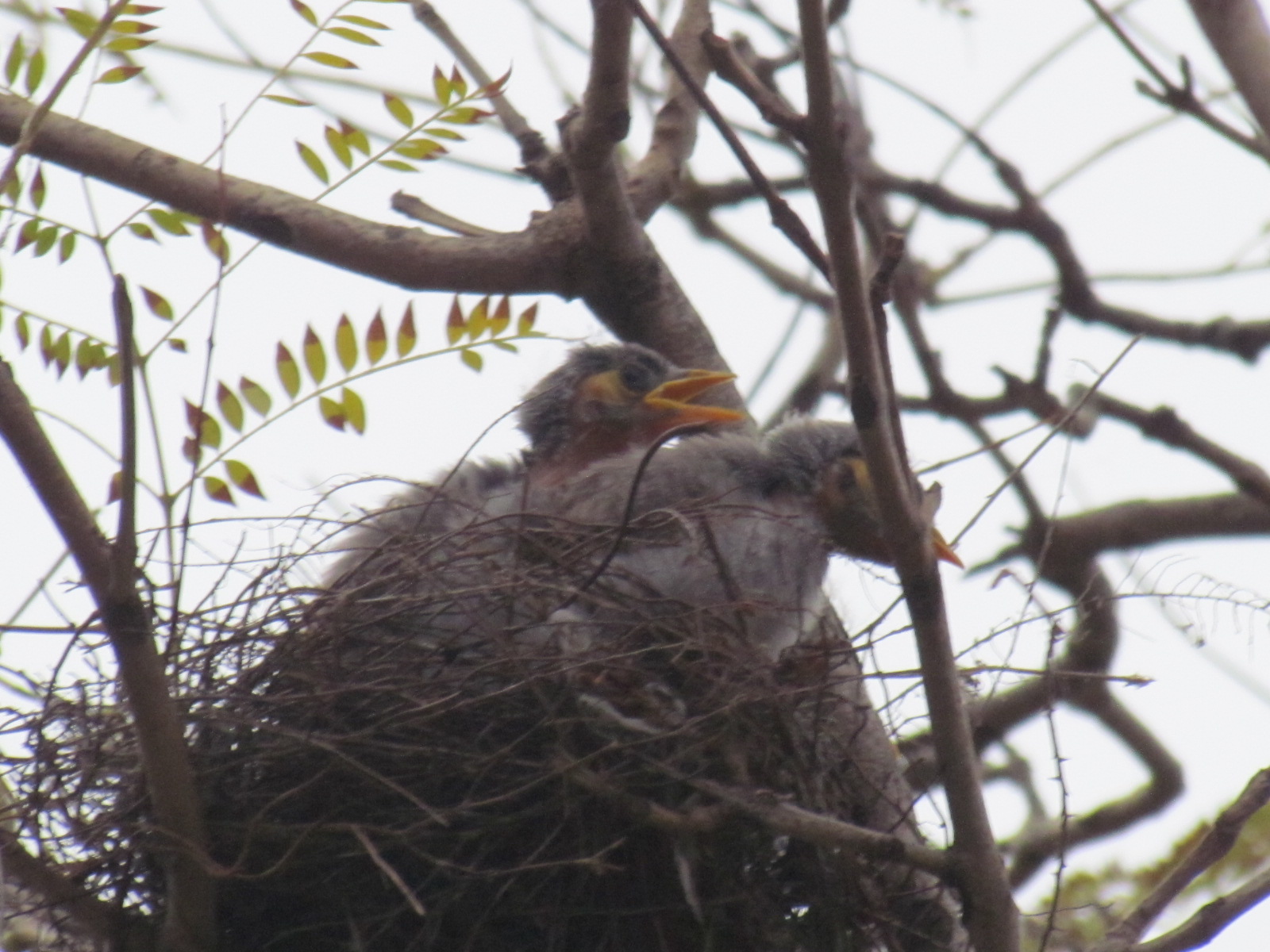
Common name: Noisy Miner, also called Australian Miner
Scientific name: Manorina melanocephala
Approximate length of adult bird: 26 cm
Date spotted: 13 September 2016
Season: Spring
Location: Allambie Heights, New South Wales, Australia
Latitude/longitude: 33°46’13.7″S 151°15’39.8″E
Noisy Miner attacking a Brush-turkey
It’s a common sight in Australia, especially in spring: a small bird dive-bombing a larger one. The small bird is usually a Noisy Miner, although other types do it too. The larger bird can be a kookaburra, a raven, a cuckoo – you name it. In fact, Australian birds are likely to attack anything, including people.
On Thursday morning this week, I saw a Brush-turkey under attack from a Noisy Miner. The first couple of videos are in a fairly low resolution, because I was using my phone camera.
Late that afternoon I passed by the same spot, and the miner and turkey were still at it! Two very stubborn birds. This video shows why Australians who are fond of their gardens tend not to be so fond of the Brush-turkeys. You’ll see a cunning dive from the miner at one point too:
Eventually, the Brush-turkey decided discretion is the better part of valour and headed out into suburbia. I had my Canon camera with me this time, so you can see the turkey in full splendour:
Peace at last, although you can still hear the Noisy Miners heckling:
The Noisy Miner:
Common name: Noisy Miner
Scientific name: Manorina melanocephala
Approximate length: 26 cm
The Brush-turkey:
Common name: Australian Brush-turkey
Scientific name: Alectura lathami
Approximate length: 60 cm
Date spotted: 27 November 2014
Season: Late spring
Location: Allambie, New South Wales, Australia
Latitude/longitude: 33°46’18.0″S 151°15’42.6″E


 Sydney Birder