Blog Archives

Noisy Friarbird reminds me of stretcher bearers in Bedknobs and Broomsticks
I have a childhood memory of a movie (I think it was Bedknobs and Broomsticks) where the vultures were the stretcher bearers on the sidelines of a sports match. Each time someone was injured, the birds would straighten up and look excited, then hunch down again dejectedly when the person didn’t need their attention.
This Noisy Friarbird reminds me of those cartoon stretcher bearers!

Common name: Noisy Friarbird
Scientific name: Philemon corniculatus
Approximate length: 30-35 cm
Date spotted: 12 September 2025 (spring)
Location: Denman, NSW, Australia: 32°23’33.7″S 150°41’00.4″E

More Noisy Friarbirds in Sydney’s Northern Beaches
Over the last couple of weeks, I’ve seen and heard several Noisy Friarbirds at Manly Dam in Sydney’s Northern Beaches. The birds seem to have moved in for the long haul. It’s exciting — I’ve only seen these birds further north and west before now.
Today I managed to actually get some images of the birds in a video, as well as their weird calls:
In the video, most of the noise is made by the friarbirds, but there are Rainbow Lorikeets chirping throughout, and the occasional Little Wattlebird too.
You can see more pictures of friarbirds in my other posts, taken in other areas of Australia.
Common name: Noisy Friarbird
Scientific name: Philemon corniculatus
Approximate length: 30-35 cm
Date spotted: 2 April 2025 (autumn)
Location: Manly Dam Reserve, New South Wales, Australia: 33°46’43.4″S 151°14’52.8″E

Noisy Friarbird feeding on Grevillea
I recently visited The Gap in Brisbane, Queensland. Every morning, as the sun came up, Noisy Friarbirds visited the flowering Grevilleas outside our window.
For the most part, the Noisy Friarbirds did live up to their name: they were noisy. Funnily enough, though, there’s not much Noisy Friarbird noise in the above video. I did take another video in the same location, of a Pale-headed Rosella this time. And, again funnily enough, in that video you don’t hear the Rosella but you do hear the Noisy Friarbirds (and other birds) in the background.
Noisy Friarbirds aren’t the prettiest of birds. Their body and wings are attractive in a quiet way, but the head looks as if it belongs on a dinosaur! The video and this photo give a nice view of the bump at the top of the bird’s beak, the bare skin and exposed ear, and that red eye:

Common name: Noisy Friarbird
Scientific name: Philemon corniculatus
Approximate length: 30-35 cm
Date spotted: 6 July 2024 (winter)
Location: The Gap, Brisbane, Queensland (approximate map reference)

Yellow-throated Miners see off a Noisy Friarbird
At first, I thought these birds were Noisy Miners, which are very common on the east coast of Australia where I live. However, we were out west at Mungo National Park, and the birds were Yellow-throated Miners.
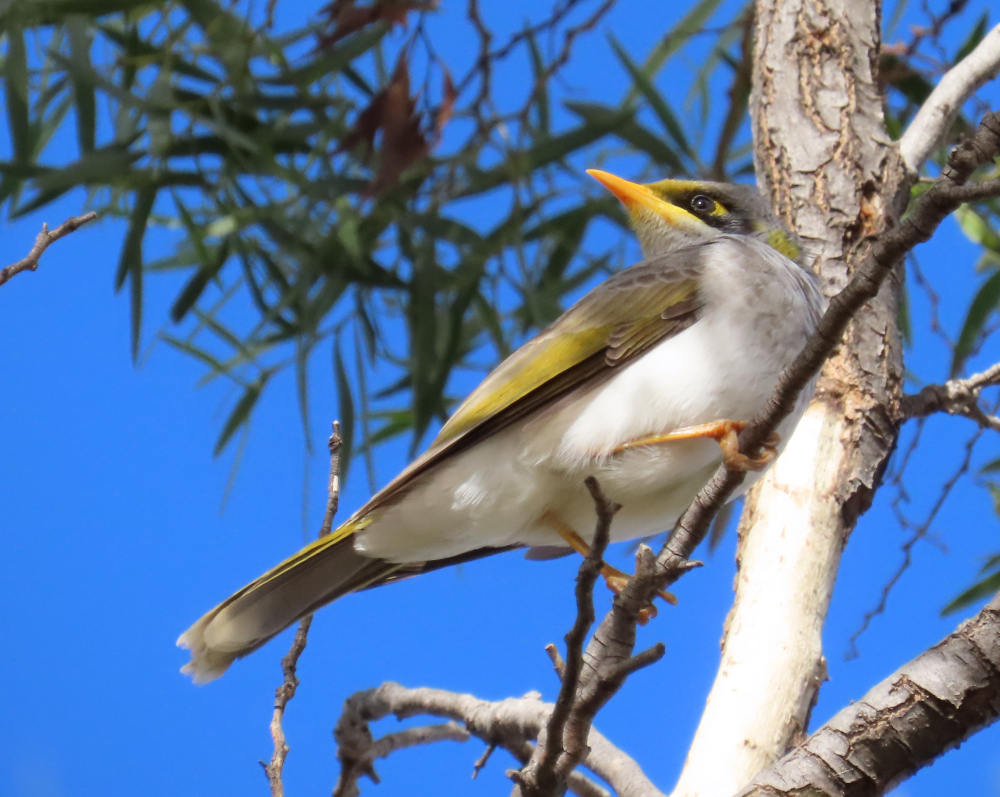
Common name: Yellow-throated Miner
Scientific name: Manorina favigula
Approximate length: 26-28 cm
Date spotted: 20-21 May 2024 (autumn)
Location: Mungo Lodge, Mungo National Park, New South Wales, Australia: 33°44’31.4″S 143°00’06.1″E
As you’d expect from the name, this bird has more yellow around its face and head than does the Noisy Miner. Here’s a Noisy Miner for comparison:

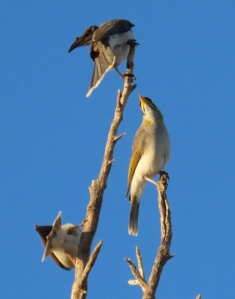
Just like their noisy cousins, it seems that the Yellow-throated Miners are territorial and fear nothing. These two were seeing off a Noisy Friarbird:
I have better pictures of Noisy Friarbirds in another post.

Second sighting of a Noisy Friarbird
This is only the second time I’ve seen a Noisy Friarbird. We’d stopped at a picnic area in the Blue Mountains for a quick snack and a swallow of coffee from our thermos. I noticed this rather unprepossessing bird peering at me from a Banksia tree:
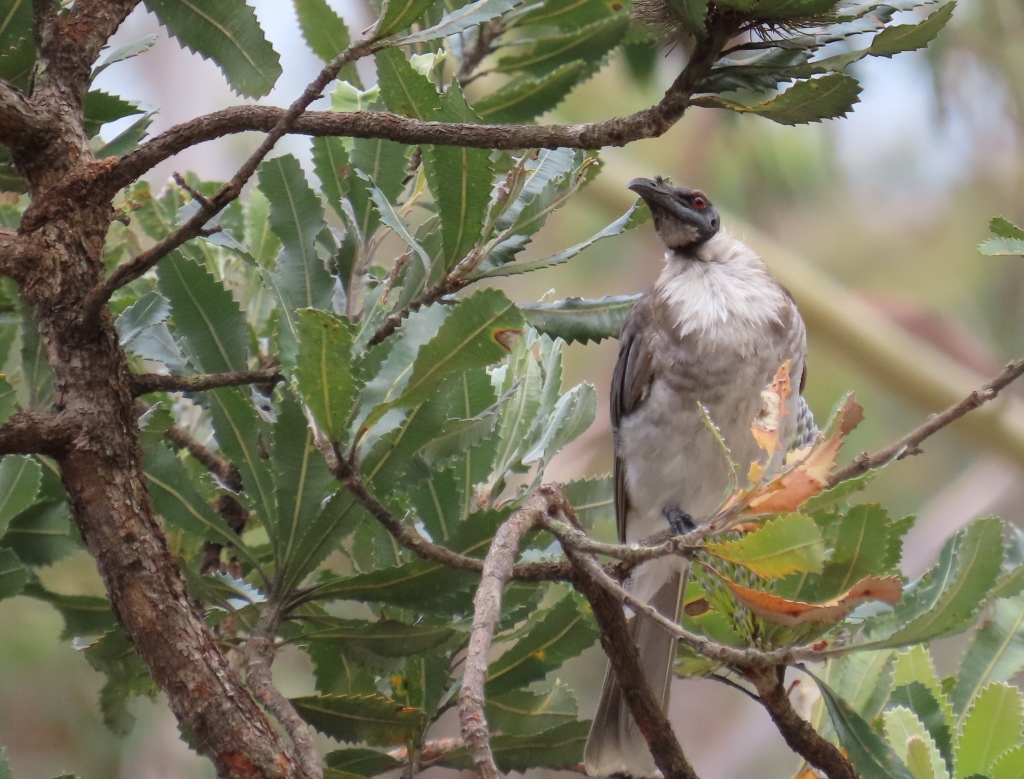
The bird was supping the nectar of the Banksia flowers, while checking for danger from above or below at regular intervals.
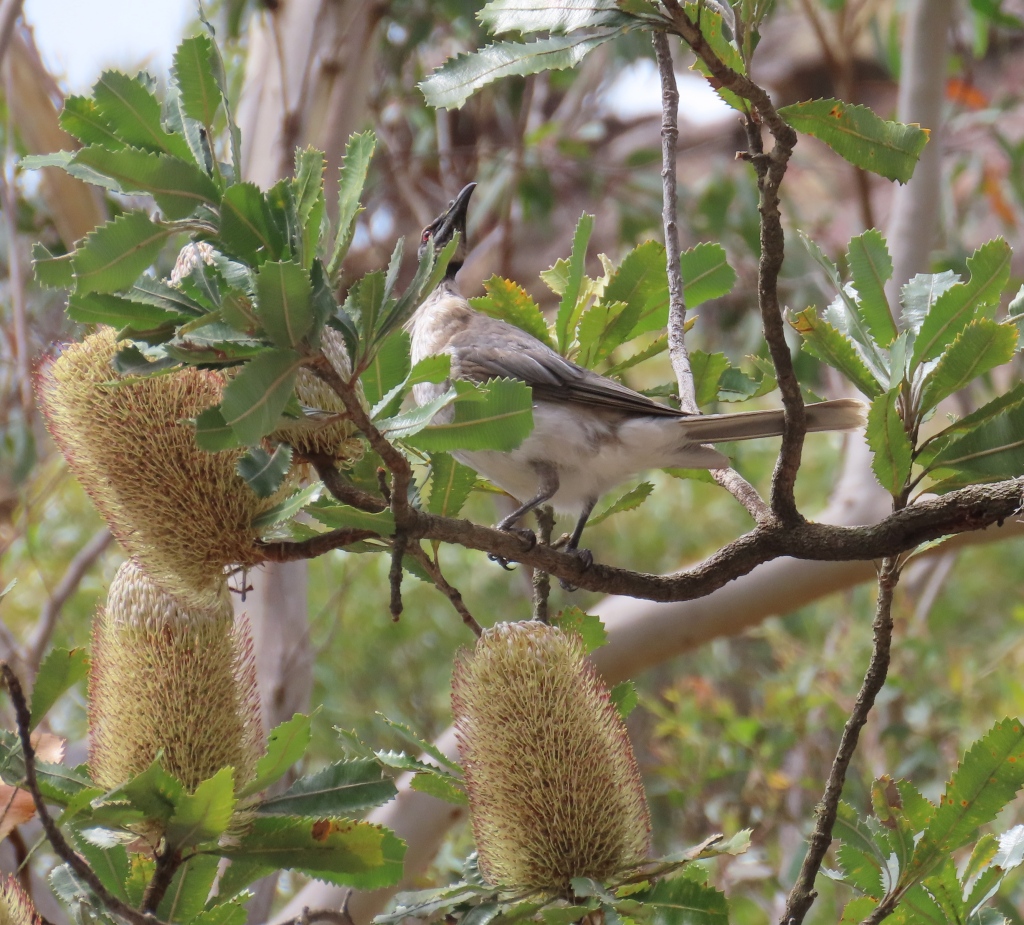
Noisy Friarbirds have a weird bump at the top of their beaks. It’s not visible in the photos, but you can see it in the video below, when the bird turns its head. The video shows the bird moving from branch to branch, pushing its beak into the flower heads. It’s probably taking insects from between the sticky tepals that make up the flower head. At one stage, I saw the bird grab a passing insect from the air too.
Common name: Noisy Friarbird
Scientific name: Philemon corniculatus
Approximate length: 30-35 cm
Date spotted: 20 January 2024 (summer)
Location: Pierces Pass Picnic Area, Blue Mountains, New South Wales, Australia: 33°34’13.2″S 150°20’17.0″E

Noisy Friarbird on nest at Coxs River
Off the beaten track for a day, I was delighted to see a Noisy Friarbird. Even more delightful was the fact that the bird was one of two taking turns to look after a nest:
The video shows one of the birds on the nest. It looks like there might be a youngster already hatched, because the bird seems to be passing something down into the nest (food?) and taking something else out (excrement?). At the end of the video, I panned out to show the lovely setting that the birds have chosen for their nest. It’s above Coxs River, with high trees and flowing water all round.
This is the first time I’ve seen a Noisy Friarbird. Indeed, it’s only the second friarbird that I’ve ever seen — the first was a Helmeted Friarbird up in North Queensland.
The nest is quite large and deep. It’s made of leaves, bark, and grass. Evidently the birds bind it together with spiderweb. Here’s a picture of one of the two birds sitting on the nest:
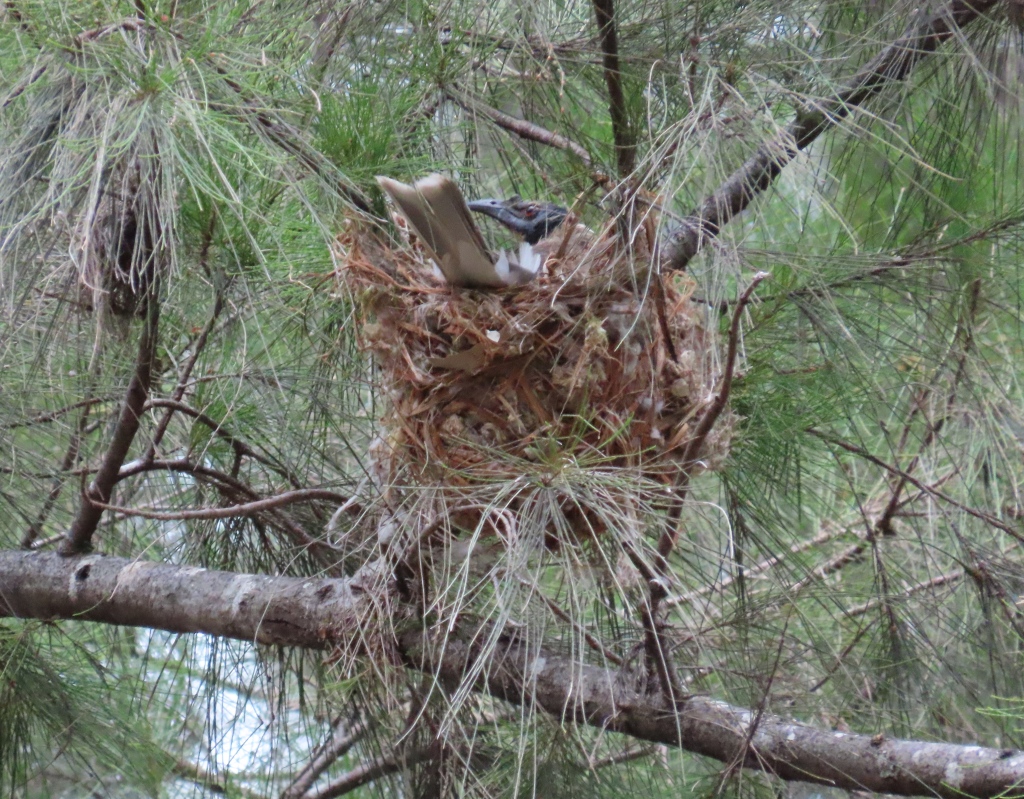
Noisy Friarbirds have a distinctive, slightly scary head: it’s bare of feathers, so that it looks a bit like a long black skull. Then there’s the large beak, with a knob on top. Not the prettiest of faces. The rest of the bird is quite pretty though, with creamy dappled white feathers below and soft browns and greys above, finished off with a white-tipped tail.
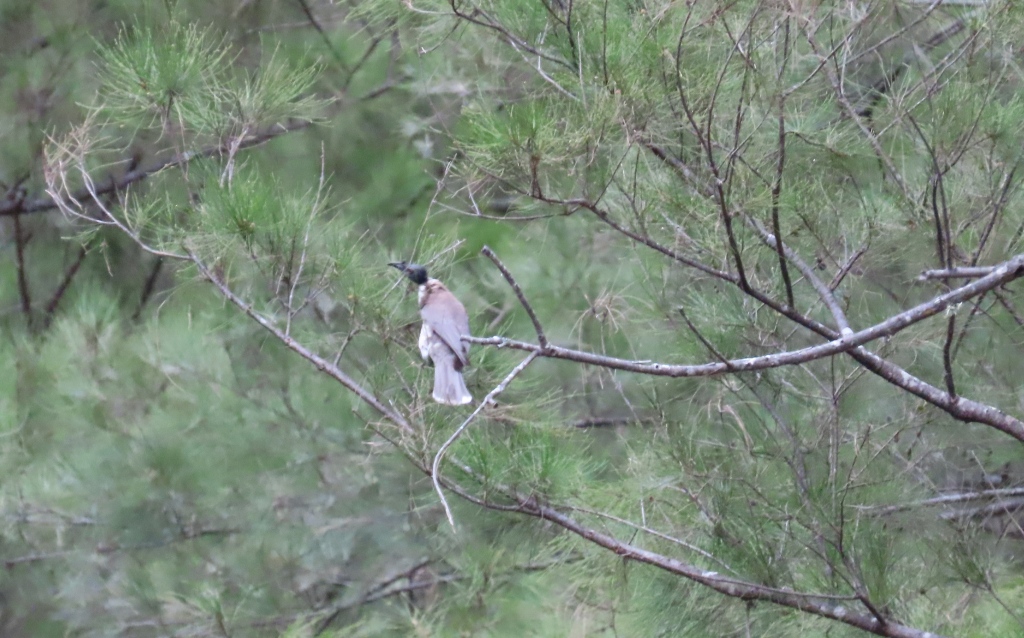
A few times, the birds would dive down steeply and fly horizontally just above the water. I think they were probably grabbing dragonflies and other insects as a tasty morsel:

This bird has something in its beak:

Common name: Noisy Friarbird
Scientific name: Philemon corniculatus
Approximate length: 30-35 cm
Date spotted: 23 December 2022 (summer)
Location: Coxs River Campground, Ganbenang, New South Wales, Australia: 33°44’35.1″S 150°10’45.1″E
Coxs River Campground is accessible only by four wheel drive. It’s a beautiful, restful spot, though it can get quite busy at times:


 Sydney Birder